
United Kingdom Cafes And Bars Market Size and Share
Market Overview
| Study Period | 2021 - 2031 |
|---|---|
| Forecast Data Period | 2026 - 2031 |
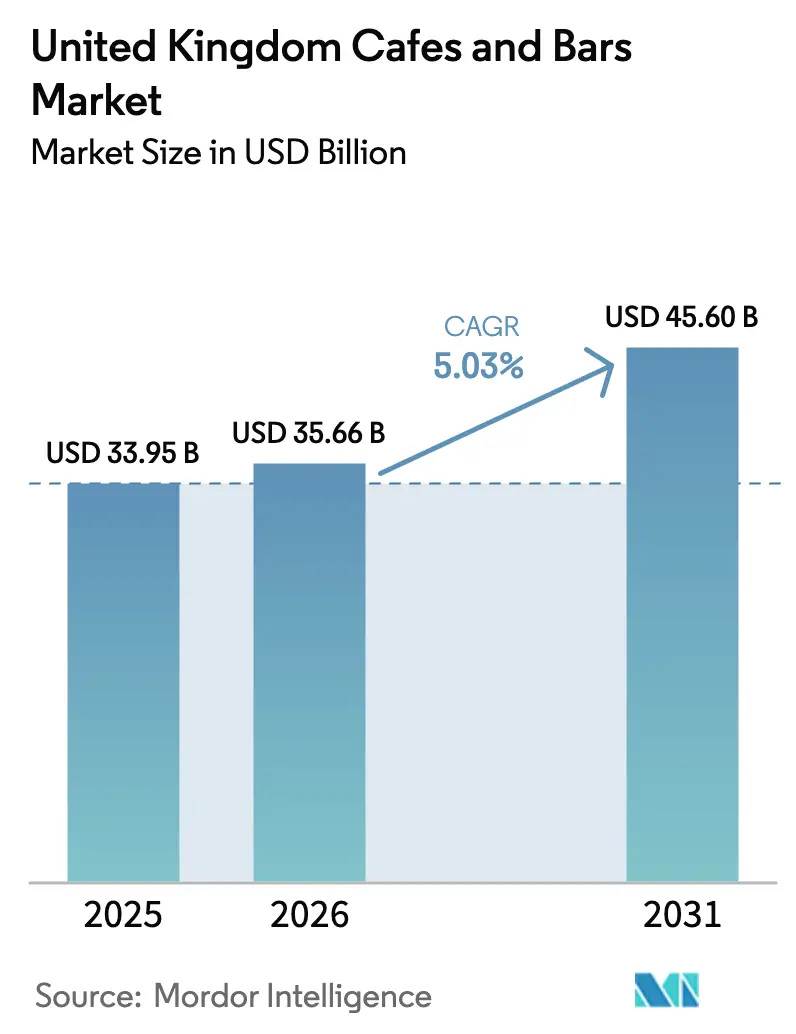
| Base Year Market Size (2025) | USD 33.95 Billion |
| Market Size (2026) | USD 35.66 Billion |
| Market Size (2031) | USD 45.6 Billion |
| Growth Rate (2026 - 2031) | 5.03 % |
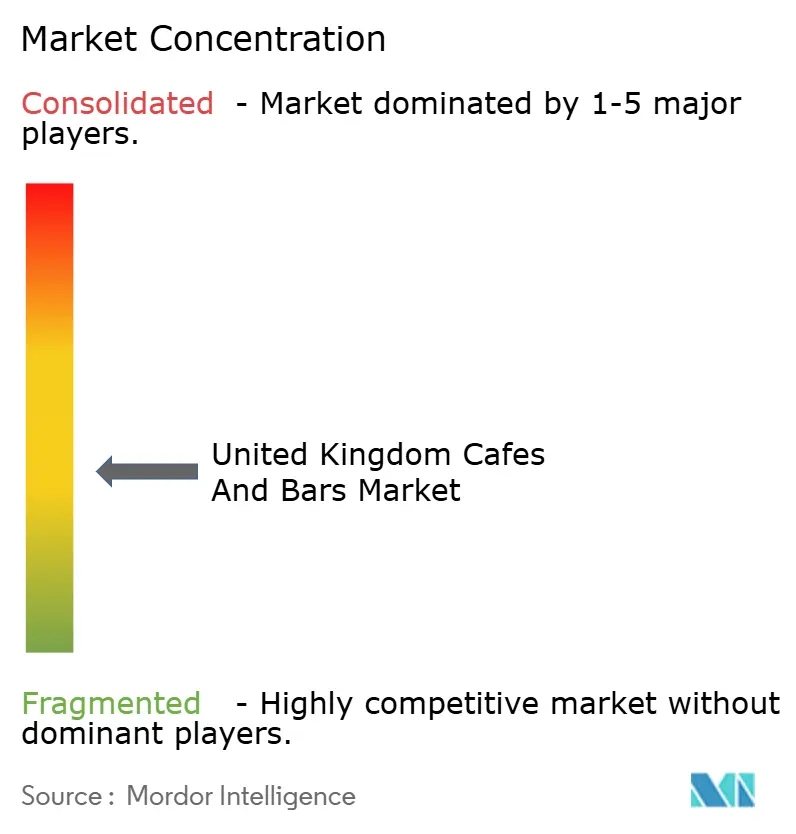
| Market Concentration | Medium |
Major Players
*Disclaimer: Major Players sorted in no particular order Image © Mordor Intelligence. Reuse requires attribution under CC BY 4.0. |
|
United Kingdom Cafes And Bars Market Analysis by Mordor Intelligence
United Kingdom cafes and bars market size in 2026 is estimated at USD 35.66 billion, growing from 2025 value of USD 33.95 billion with 2031 projections showing USD 45.6 billion, growing at 5.03% CAGR over 2026-2031. This growth is primarily driven by the recovery in domestic tourism, an increase in international visitors returning to 93% of pre-pandemic levels, and the growing role of social media in influencing consumer decisions about dining venues. Businesses are tackling challenges such as rising food prices and labor costs by expanding their supplier networks, enhancing cold-chain logistics, and adopting advanced inventory management tools to improve efficiency and maintain profitability. By Service Type, the increasing popularity of delivery services is reshaping how cafes and bars operate, with digital platforms playing a key role in reaching customers. By Cuisine, there is a growing demand for health-focused menu options, which is driving innovation and growth in this segment. By Outlet, independent cafes and bars are showing strong adaptability, while chain establishments leverage their operational efficiencies to remain competitive. By Location, the integration of cafes and bars with lodging services is creating unique and premium customer experiences. The market remains highly competitive and fragmented, allowing a diverse mix of players to thrive. These include niche independent operators, regional mini-chains, and global brands, all contributing to a dynamic and evolving market landscape.
Key Report Takeaways
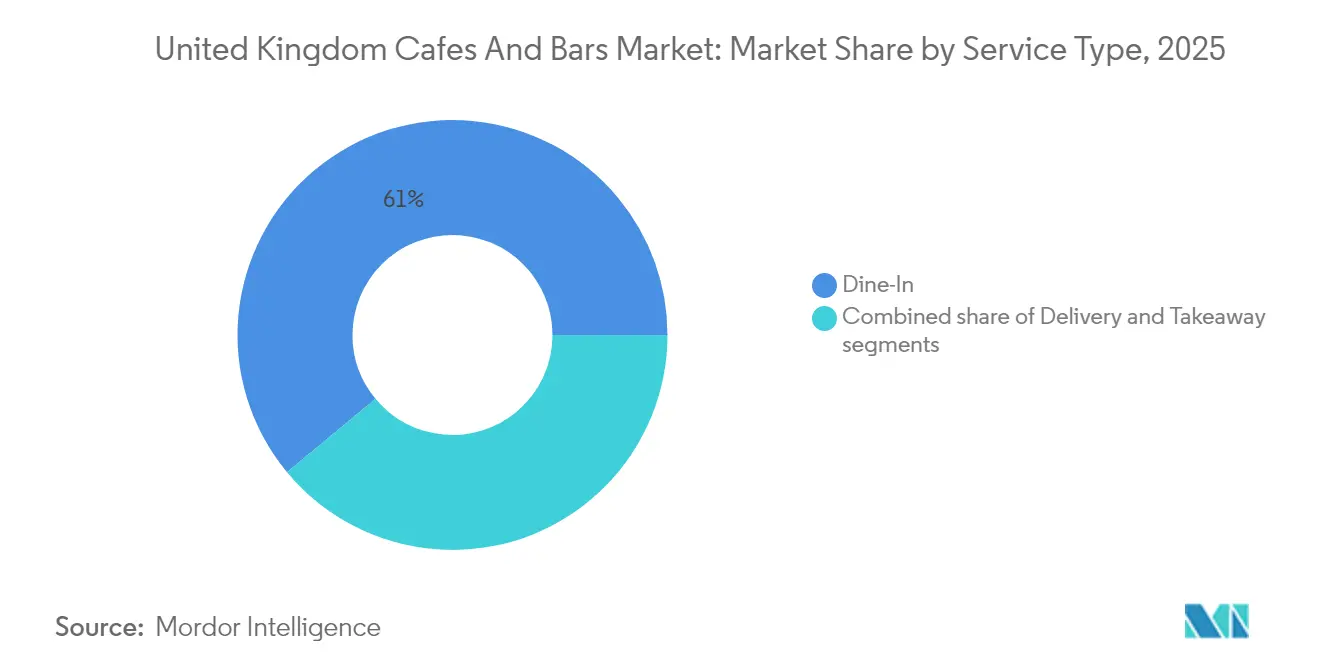
- By service type, dine-in led with 61.02% revenue share in 2025; delivery is forecast to advance at a 6.32% CAGR to 2031.
- By cuisine, cafes captured 42.10% of the United Kingdom cafes and bars market share in 2025, while juice / smoothies / desserts bars are expanding at a 6.00% CAGR through 2031.
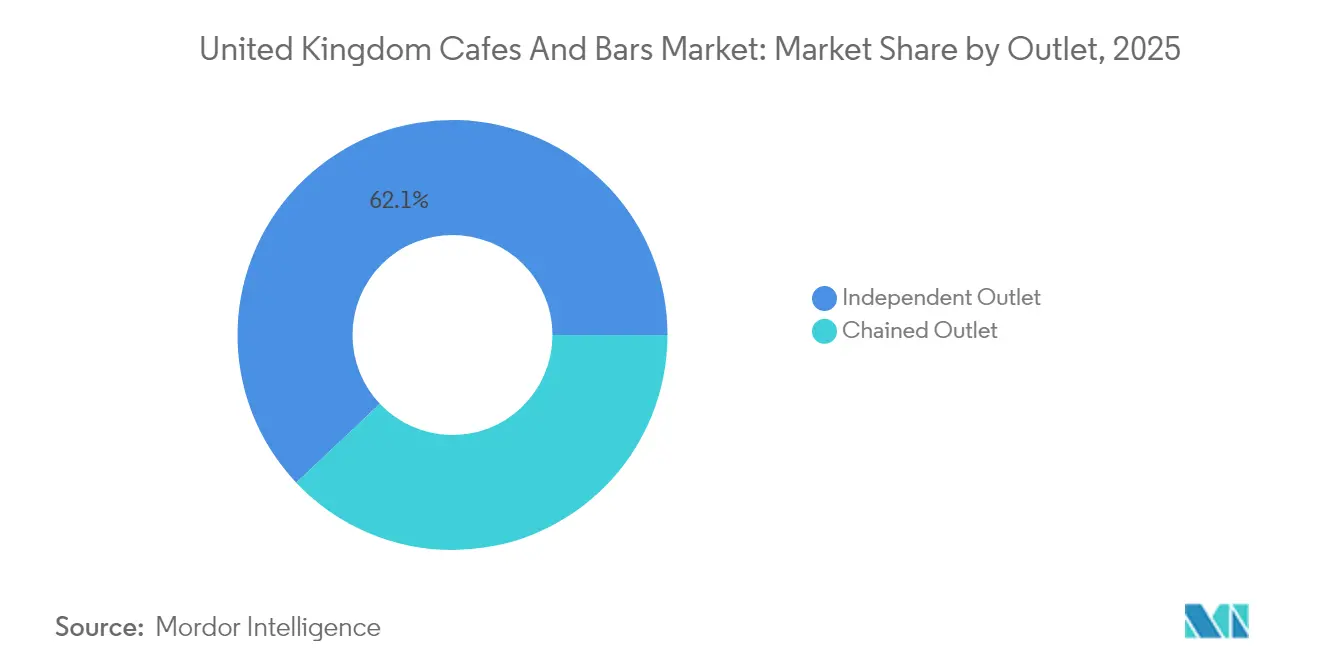
- By outlet, independent operators held 62.05% share of the United Kingdom cafes and bars market size in 2025; chained outlets are growing fastest at a 5.65% CAGR to 2031.
- By location, stand-alone venues controlled a 72.90% share in 2025, whereas lodging-based outlets are projected to surge at a 9.08% CAGR between 2026-2031.
Note: Market size and forecast figures in this report are generated using Mordor Intelligence’s proprietary estimation framework, updated with the latest available data and insights as of 2026.
United Kingdom Cafes And Bars Market Trends and Insights
Drivers Impact Analysis*
| DRIVER | (~) % IMPACT ON CAGR FORECAST | GEOGRAPHIC RELEVANCE | IMPACT TIMELINE |
|---|---|---|---|
| Growing preference for social and after-work occasions | +0.8% | National, with concentration in urban centers and commuter towns | Medium term (2-4 years) |
| Rising demand for premium and specialty beverages | +1.2% | National, strongest in London and major cities | Long term (≥ 4 years) |
| Greater integration of digital technology for contactless payments, app-based ordering, and customer loyalty programs | +0.9% | National, with faster adoption in metropolitan areas | Short term (≤ 2 years) |
| Influence of social media and experiential dining trends | +0.7% | National, particularly strong among urban millennials and Gen Z | Medium term (2-4 years) |
| Innovation in product offerings and service formats | +0.6% | National, with premium segments leading adoption | Long term (≥ 4 years) |
| Tourism and domestic travel supporting café and bar visits | +0.5% | Tourism-heavy regions, transport hubs, and leisure destinations | Medium term (2-4 years) |
| Source: Mordor Intelligence | |||


Rising demand for premium and specialty beverages
In the United Kingdom, the cafés and bars market is evolving due to growing consumer demand for premium and specialty beverages, driven by the country's strong coffee culture. According to the British Coffee Association, people in the United Kingdom consume approximately 98 million cups of coffee daily as of 2024[1]Source: British Coffee Association, "Coffee Consumption," britishcoffeeassociation.org. This trend reflects a shift toward higher-quality drinks and a preference for unique, experience-focused consumption. As a result, café operators are expanding their offerings and introducing innovative concepts to meet these demands. For example, Yorks Café announced the launch of its fourth outlet in Paradise Birmingham in October 2024. This new location is designed as an all-day venue, offering in-house roasted coffee, natural wines, and seasonal dishes. It aims to combine café culture with social dining, creating a space where customers can enjoy both quality beverages and a curated dining experience.
Growing preference for social and after-work occasions
In the United Kingdom, cafés and bars are becoming increasingly popular as places for socializing and unwinding after work. This trend is supported by stable employment levels and evolving workplace habits. According to the Office for National Statistics (ONS), the United Kingdom employment rate remained steady at 74.9% from August to October 2024, providing a consistent base of working professionals who frequent cafés and bars during weekdays[2]Source: Office for National Statistics, "Graduate Labour Market Statistics," statistics.service.gov.uk. A 2025 study by the University of Leeds revealed that employees who took short coffee breaks were 23% more productive compared to those who worked without breaks. This highlights the growing importance of cafés as spaces that not only offer relaxation but also enhance productivity. These factors are pushing café and bar operators to create versatile spaces that can serve as work-friendly environments during the day and transform into lively social hubs in the evening.
Influence of social media and experiential dining trends
In the United Kingdom, social media and the growing demand for unique dining experiences are playing a major role in shaping the cafés and bars market. Consumers are increasingly drawn to places that offer visually appealing settings and memorable experiences they can share online. According to the British Coffee Association in 2024, 80% of people visit coffee shops at least once a week, and 16% visit daily, highlighting how café culture has become an integral part of daily life for many[3]Source: British Coffee Association, "Coffee Consumption," britishcoffeeassociation.org. This trend has made social media a key tool for businesses to attract customers, as visually striking interiors, creative themes, and interactive drink presentations encourage people to share their experiences online. For example, brands like Loungers have successfully tapped into this trend by giving each café a unique name and designing the interiors to reflect the local community. This approach helps the brand expand nationally while maintaining a local connection.
Tourism and domestic travel supporting café and bar visits
In the United Kingdom, tourism and domestic travel play a crucial role in driving visits to cafés and bars, supported by steady growth in international arrivals and visitor spending. According to the Office for National Statistics (ONS), overseas visitors made an estimated 42.6 million trips to the United Kingdom in 2024, spending approximately GBP 32.5 billion[4]Source: Office for National Statistics, "Graduate Labour Market Statistics," statistics.service.gov.uk. This highlights the strong recovery of tourism after the pandemic. The increase in international tourists has boosted foot traffic in high streets, cultural areas, and travel hubs, where cafés and bars are popular for offering quick, high-quality food and drinks. the growing trend of domestic travel and staycations has further fueled spending in regional hospitality markets. This has reinforced the importance of cafés and bars as key social and experiential destinations within the United Kingdom’s tourism sector, catering to both local and international visitors seeking unique dining experiences.
Restraints Impact Analysis*
| RESTRAINT | (~) % IMPACT ON CAGR FORECAST | GEOGRAPHIC RELEVANCE | IMPACT TIMELINE |
|---|---|---|---|
| Changing consumer behaviour toward at-home consumption and takeaway options | -0.4% | National, with stronger impact in suburban and residential areas | Short term (≤ 2 years) |
| Fluctuating coffee bean prices affecting specialty coffee | -0.3% | National, with particular challenges in remote and island regions | Medium term (2-4 years) |
| High business rates and regulatory compliance costs | -0.6% | National, with disproportionate impact on urban high street locations | Long term (≥ 4 years) |
| Supply chain disruptions causing delays or inconsistency in sourcing key ingredients | -0.2% | National, with seasonal variations affecting different regions | Short term (≤ 2 years) |
| Source: Mordor Intelligence | |||
High business rates and regulatory compliance costs
In the United Kingdom, high business rates and increasing regulatory compliance costs are creating significant challenges for cafés and bars, especially smaller, independent businesses. The Office for Budget Responsibility (OBR) estimates that the planned increase in the National Living Wage to GBP 12.21 per hour in April 2025 will raise labor costs by approximately 10%, adding to the financial strain on these establishments. New regulations, such as “Martyn’s Law” for counter-terrorism measures, single-use cup charges in Scotland, and restrictions on zero-hour contracts, are forcing businesses to spend more on staff training, compliance systems, and eco-friendly packaging solutions. These changes require cafés and bars to adapt quickly, often with limited resources. The gradual reduction of business rates relief in 2025 means many establishments are now facing full payment obligations, all while grappling with rising food and energy costs.
Changing consumer behavior toward at-home consumption
In the United Kingdom, changing consumer habits are driving a shift toward at-home consumption and takeaway options, which is reshaping the cafés and bars market. According to the British Coffee Association (2024), 80% of United Kingdom households purchase instant coffee for home use, highlighting the growing demand for convenient and cost-effective café-style experiences at home. The increase in hybrid working has also reduced weekday customer traffic in city centers, with visits now concentrated during specific times, making it harder for businesses to manage staffing efficiently. The popularity of meal-kit subscriptions, premium ready-to-eat meals, and retail alcohol options has replaced many casual dining and evening bar outings. This trend has created tougher competition for consumers' disposable income, forcing cafés and bars to adapt their offerings to attract and retain customers.
*Our forecasts treat driver/restraint impacts as directional, not additive. The impact forecasts reflect baseline growth, mix effects, and variable interactions.
Segment Analysis
By Service Type: Delivery Drives Digital Transformation
Dine-in remains the most popular channel in the United Kingdom cafés and bars market, contributing 61.02% of the total market value. Consumers continue to favor the social and immersive experience of dining out, as it offers quality beverages, personalized service, and a lively atmosphere. To meet these expectations, operators are focusing on creating unique in-store experiences by introducing seasonal menus, designing inviting interiors, and incorporating local themes. These efforts not only attract customers but also encourage repeat visits, ensuring that dine-in services remain a key driver of the market's performance.
On the other hand, delivery is rapidly becoming one of the fastest-growing channels in the United Kingdom cafés and bars industry, with a projected CAGR of 6.32% through 2031, outpacing dine-in growth. This surge is fueled by changing consumer lifestyles, the convenience of online ordering, and the growing preference for enjoying café-style food and drinks at home. Businesses are adapting to this trend by offering delivery-friendly menus, using sustainable packaging, and implementing app-based loyalty programs to retain customers. Although delivery services face challenges like high third-party commission fees, they are expected to play a significant role in driving market growth during the forecast period.


By Cuisine: Health-Conscious Segments Accelerate Growth
In 2025, cafes accounted for 42.10% of the United Kingdom cafes and bars market revenue, showcasing their popularity as versatile spaces for various occasions. These establishments attract customers throughout the day by offering diverse menus and a welcoming atmosphere, making them ideal for breakfast, brunch, or casual evening gatherings. Their ability to serve as both social hubs and convenient stops has helped them maintain steady foot traffic in both urban and suburban areas. This consistent demand highlights the role of cafes in providing quality beverages and light meals while fostering a sense of community.
On the other hand, juice, smoothie, and dessert bars are expected to grow at the fastest rate in the sector, with a projected CAGR of 6.00% through 2031. This growth is driven by increasing consumer interest in health-conscious choices and functional beverages, as more people look for nutritious yet enjoyable options. The segment is also benefiting from innovative product offerings, customizable menu options, and the rising trend of wellness-focused lifestyles. These factors position juice and smoothie bars as a dynamic and rapidly expanding part of the cafes and bars market, appealing to a growing audience seeking healthier indulgences.
By Outlet: Independent Resilience Meets Chain Efficiency
In 2025, independent operators dominated the United Kingdom cafes and bars market, accounting for 62.05% of the total revenue. Their success is largely due to their ability to build strong connections within local communities and provide personalized services that cater to specific customer preferences. These operators often offer unique and tailored experiences, such as locally sourced menus and cozy atmospheres, which help them stand out from larger chains. By focusing on customer loyalty and creating a sense of belonging, independent cafes and bars have established themselves as essential parts of their neighborhoods, attracting regular patrons and maintaining steady growth.
On the other hand, chain cafes and bars are projected to grow at a compound annual growth rate (CAGR) of 5.65% through 2031, gradually narrowing the gap with independent operators. This growth is being fueled by significant private-equity investments, which enable chains to expand their presence across the country. The use of standardized technology platforms has improved operational efficiency and profit margins for these chains. By offering consistent quality and convenience, chain cafes and bars are becoming increasingly competitive, appealing to a broader audience and positioning themselves as strong contenders in the evolving market landscape.
By Location: Lodging Integration Drives Premium Experiences
In 2025, stand-alone venues contributed 72.90% of the total revenue in the United Kingdom cafes and bars market, maintaining the largest market share. These venues have gained popularity due to their ability to offer unique and personalized experiences, attracting both local customers and tourists. Located in high streets and popular destinations, they cater to a wide range of preferences, from quick coffee breaks to full-service dining. Their role as social and leisure hubs has been reinforced by the recovery in foot traffic, making them a preferred choice for consumers seeking convenience and variety.
On the other hand, lodging-based cafes and bars are expected to grow at a significant CAGR of 9.08% through 2031, outpacing other formats. This growth is fueled by the rise in domestic tourism and efforts by operators to increase guest spending beyond accommodation. By incorporating cafes and bars within hotels and resorts, businesses are creating additional revenue streams while enhancing the overall guest experience. These integrated setups not only attract tourists but also local customers, positioning lodging-based venues as a rapidly growing segment in the evolving cafes and bars market.
Geography Analysis
London remains the leading city in the United Kingdom's cafes and bars market, setting trends in premium and unique customer experiences. The city’s wealthy population and vibrant social scene make it a prime location for testing new ideas. Many operators use London’s busy areas to experiment with innovative menus, service styles, and branding strategies. These successful concepts often expand nationwide, influencing the overall market and setting high standards for quality and customer satisfaction across the country.
Performance in other regions varies significantly, depending on local economic conditions and consumer preferences. Some areas face challenges like lower customer footfall and higher operational costs, which force businesses to focus on cost control. On the other hand, regions with growing demand for specialty coffee and unique dining experiences are attracting more investments. Businesses in these areas must strike a balance between managing costs and offering appealing products and services to remain competitive and profitable.
Rural and suburban markets are undergoing significant changes, driven by the rise of hybrid work models. Community cafés in these areas are increasingly serving as co-working spaces and generating steady weekday revenue. Many café chains are expanding into these locations due to lower property costs and the opportunity to establish themselves early in less competitive markets. Additionally, new regional regulations and sustainability goals are pushing businesses to adjust their pricing, packaging, and service models to meet local expectations while staying aligned with broader market trends.
Competitive Landscape
The competitive landscape in the cafés and bars market is highly fragmented which allows a mix of niche independent operators, regional mini-chains, and global brands to thrive in the same space. A notable example of private equity interest in this market is Fortress Investment Group’s acquisition of Loungers for USD 416 million at 8.1× Earnings Before Interest, Taxes, Depreciation, and Amortisation (EBIDTA). This deal highlights the growing appeal of scalable mid-market operators with strong financial performance and growth potential, making them attractive targets for investors.
Key strategies in the market revolve around three main areas: premium positioning, operational efficiency, and local community engagement. Premium positioning focuses on offering high-quality ingredients and unique designs to attract customers. Operational efficiency is being enhanced through the use of integrated technology, such as self-service kiosks and mobile ordering systems. Local community engagement is achieved by empowering staff and offering hyperlocal menus tailored to regional preferences. For instance, Costa Coffee has expanded its kiosk and drive-thru formats to improve convenience, while WatchHouse has focused on creating an artisan coffee experience, appealing to premium customers in cities like London and New York.
Sustainability has become a critical factor in attracting younger consumers, particularly Gen Z, who prioritize ethical practices. Chains are increasingly adopting measures such as sourcing ethically produced coffee beans and offering incentives for using reusable cups. These efforts have helped larger chains gain an edge over independent operators in terms of environmental, social, and governance (ESG) practices. Compliance with labor laws and transparency in digital tipping have reduced staff turnover for well-capitalized operators. However, smaller independent cafés may struggle to meet these requirements, potentially leading to their exit from the market due to higher operational costs.
United Kingdom Cafes And Bars Industry Leaders
-
Costa Coffee
-
Stonegate Group
-
JD Wetherspoon plc
-
Caffè Nero Group Ltd
-
Starbucks Corporation
- *Disclaimer: Major Players sorted in no particular order

Recent Industry Developments
- December 2024: The Nero Group, the parent company of Caffè Nero, has entered into a partnership with Waitrose and John Lewis to introduce a new café concept. This collaboration aims to enhance customer experience by launching the concept initially in five Waitrose stores, combining premium coffee offerings with a curated retail environment.
- January 2024: Caffè Nero launched its first-ever drive-thru store in the United Kingdom. This move marked a significant step in the brand's expansion strategy, aiming to cater to the growing demand for convenient coffee options among United kingdom consumers.
- August 2023: Coffee shop chain Starbucks announced plans to invest USD 32.78 million toward opening 100 new outlets across the United Kingdom in 2023, as it expects its growth momentum to continue.
- January 2023: Costa Coffee added new servings to its menu like Cajun Spiced Chicken Pizza Wrap, uzeTea Mellow Mango Superfuzions Tea, FuzeTea Spiced Apple flavor Superfuzions Tea, FuzeTea Citrus Zing Superfuzions, or the new M&S Minestrone with Bacon Soup, M&S pineapple chunks, and a new range of Chocolate Cornflake Cake and caramel cakes at its outlets in the United Kingdom.


United Kingdom Cafes And Bars Market Report Scope
Bars & Pubs, Cafes, Juice/Smoothie/Desserts Bars, Specialist Coffee & Tea Shops are covered as segments by Cuisine. Chained Outlets, Independent Outlets are covered as segments by Outlet. Leisure, Lodging, Retail, Standalone, Travel are covered as segments by Location.| Dine-In |
| Takeaway |
| Delivery |
| Bars and Pubs |
| Cafes |
| Juice/Smoothies/Desserts Bars |
| Specialist Coffee and Tea Shops |
| Chained Outlet |
| Independent Outlet |
| Leisure |
| Lodging |
| Retail |
| Standalone |
| Travel |
| By Service Type | Dine-In |
| Takeaway | |
| Delivery | |
| By Cuisine | Bars and Pubs |
| Cafes | |
| Juice/Smoothies/Desserts Bars | |
| Specialist Coffee and Tea Shops | |
| By Outlet | Chained Outlet |
| Independent Outlet | |
| By Location | Leisure |
| Lodging | |
| Retail | |
| Standalone | |
| Travel |


Market Definition
- FULL-SERVICE RESTAURANTS - A foodservice establishment where customers are seated at a table, give their order to a server and are served food at a table.
- QUICK SERVICE RESTAURANTS - A foodservice establishment that provides customers convenience, speed, and food offerings at lower prices. Customers usually help themselves and carry their own food to their tables.
- CAFES & BARS - A type of foodservice business that include bars and pubs that are licensed to serve alcoholic drinks for consumption, cafes that serve refreshments and light food items, as well as specialty tea and coffee shops, dessert bars, smoothie bars, and juice bars.
- CLOUD KITCHEN - A foodservice business that utilizes a commercial kitchen for the purpose of preparing food for delivery or takeout only, with no dine-in customers.
| Keyword | Definition |
|---|---|
| Albacore Tuna | It is one of the smallest species of tuna found in the six distinct stocks known globally in the Atlantic, Pacific, and Indian oceans, as well as the Mediterranean Sea. |
| Angus beef | It is beef derived from a specific breed of cattle indigenous to Scotland. It requires certification from the American Angus Association to receive the "Certified Angus Beef" quality mark. |
| Asian cuisine | It includes full-service offerings in restaurants that serve cuisines from cultures such as Chinese, Indian, Korean, Japanese, Bengali, Southeast Asian, etc. |
| Average Order Value | It is the average value of all orders made by the customers at a foodservice establishment. |
| Bacon | It is salted or smoked meat that comes from the back or sides of a pig. |
| Bars & Pubs | It is a drinking establishment that is licensed to serve alcoholic drinks for consumption on the premises. |
| Black Angus | It is beef derived from a black-hided breed of cows that don't have horns. |
| BRC | British Retail Consortium |
| Burger | It is a sandwich consisting of one or more cooked beef patties, placed inside a sliced bread roll or bun roll. |
| Café | It is a foodservice establishment serving various refreshments (mainly coffee) and light meals. |
| Cafes & Bars | It is a type of foodservice business that include bars and pubs that are licensed to serve alcoholic drinks for consumption, cafes that serve refreshments and light food items, as well as specialty tea and coffee shops, dessert bars, smoothie bars, and juice bars. |
| Cappuccino | It is an Italian coffee drink that is traditionally prepared with equal parts double espresso, steamed milk, and steamed milk foam. |
| CFIA | Canadian Food Inspection Agency |
| Chained Outlet | It refers to a foodservice establishment that shares brands, operates in several locations, has central management, and standardized business practices. |
| Chicken Tender | It refers to chicken meat prepared from the pectoralis minor muscles of a chicken bird. |
| Cloud Kitchen | It is a foodservice business that utilizes a commercial kitchen for the purpose of preparing food for delivery or takeout only, with no dine-in customers. |
| Cocktail | It is an alcoholic mixed drink made with either a single spirit or a combination of spirits, mixed with other ingredients such as juices, flavored syrups, tonic water, shrubs, and bitters. |
| Edamame | It is a Japanese dish prepared with soybeans (harvested before they ripen or harden) and cooked in its pod. |
| EFSA | European Food Safety Authority |
| ERS | Economic Research Service of the USDA |
| Espresso | It is a concentrated form of coffee, served in shots. |
| European cuisine | It includes full-service offerings in restaurants that serve cuisines from cultures such as Italian, French, German, English, Dutch, Danish, etc. |
| FDA | Food and Drug Administration |
| Fillet Mignon | It is a cut of meat taken from the smaller end of the tenderloin. |
| Flank Steak | It is a cut of beef steak taken from the flank, which lies forward of the rear quarter of a cow. |
| Foodservice | It refers to the part of the food industry which includes businesses, institutions, and companies which prepare meals outside the home. It includes restaurants, school and hospital cafeterias, catering operations, and many other formats. |
| Franks | Also known as frankfurter or Würstchen, it is a type of highly seasoned smoked sausage popular in Austria and Germany. |
| FSANZ | Food Standards Australia New Zealand |
| FSIS | Food Safety and Inspection Service |
| FSSAI | Food Safety and Standards Authority of India |
| Full service restaurant | It refers to a foodservice establishment where customers are seated at a table, give their order to a server, and are served food at a table. |
| Ghost Kitchen | It refers to a cloud kitchen. |
| GLA | Gross Leasable Area |
| Gluten | It is a family of proteins found in grains, including wheat, rye, spelt, and barley. |
| Grain-fed beef | It is beef derived from cattle that have been fed a diet supplemented with soy and corn and other additives. Grain-fed cows can also be given antibiotics and growth hormones to fatten them up more quickly. |
| Grass-fed beef | It is beef derived from cattle that have only been fed grass as feed. |
| Ham | It refers to the pork meat taken from the leg of a pig. |
| HoReCa | Hotels, Restaurants and Cafes |
| Independent Outlet | It refers to a foodservice establishment that operates with a single outlet or is structured as a small chain with no more than three locations. |
| Juice | It is a drink made from the extraction or pressing of the natural liquid contained in fruit and vegetables. |
| Latin American | It includes full-service offerings in restaurants that serve cuisines from cultures such as Mexican, Brazilian, Argentinian, Colombian, etc. |
| Latte | It is a milk-based coffee that is made up of one or two shots of espresso, steamed milk, and a thin layer of frothed milk. |
| Leisure | It refers to foodservice offered as a part of a recreation business, such as sports arenas, zoos, movie theaters, and museums. |
| Lodging | It refers to foodservice offerings at hotels, motels, guesthouses, holiday homes, etc. |
| Macchiato | It is an espresso coffee drink with a small amount of milk, usually foamed. |
| Meat-based cuisines | This inlcudes food items like fried chicken, steak, ribs, etc. where meat is the primary ingredient for the dish. |
| Middle Eastern cuisine | It includes full-service offerings in restaurants that serve cuisines from cultures such as Arabic, Lebanese, Iranian, Israeli, etc. |
| Mocktail | It is an non-alcoholic mixed drink. |
| Mortadella | It is a large Italian sausage or luncheon meat made of finely hashed or ground heat-cured pork, which incorporates at least 15% small cubes of pork fat. |
| North American | It includes full-service offerings in restaurants that serve cuisines from cultures such as American, Canadian, Caribbean, etc. |
| Pastrami | It refers to a highly seasoned smoked beef, typically served in thin slices. |
| PDO | Protected Designation of Origin: It is the name of a geographical region or specific area that is recognized by official rules to produce certain foods with special characteristics related to location. |
| Pepperoni | It is an American variety of spicy salami made from cured meat. |
| Pizza | It is a dish made typically of flattened bread dough spread with a savory mixture usually including tomatoes and cheese and often other toppings and baked. |
| Primal cuts | It refers to the major sections of the carcass. |
| Quick service restaurant | It refers to a foodservice establishment that provides customers convenience, speed, and food offerings at lower prices. Customers usually help themselves and carry their own food to their tables. |
| Retail | It refers to a foodservice outlet inside a mall. shopping complex or a commercial real estate building, where there are other businesses operating as well. |
| Salami | It is a cured sausage consisting of fermented and air-dried meat. |
| Saturated fat | It is a type of fat in which the fatty acid chains have all single bonds. It is generally considered unhealthy. |
| Sausage | It is a meat product made of finely chopped and seasoned meat, which may be fresh, smoked, or pickled and which is then usually stuffed into a casing. |
| Scallop | It is an edible shellfish that is a mollusk with a ribbed shell in two parts. |
| Seitan | It is a plant-based meat substitute made out of wheat gluten. |
| Self-service kiosk | It refers to a self-order point-of-sale (POS) system through which customers place and pay for their own orders at kiosks, enabling totally contactless and frictionless service. |
| Smoothie | It is a beverage made by placing all the ingredients in a container and processing them together, without removing the pulp. |
| Specialty coffee & tea shops | It refers to a foodservice establishment that serves only various types of tea or coffee. |
| Standalone | It refers to a restaurants that have an independent infrastructure setup and not connected to any other business. |
| Sushi | It is a Japanese dish of prepared vinegared rice, usually with some sugar and salt, accompanied by a variety of ingredients, such as seafood—often raw—and vegetables. |
| Travel | It refers to foodservice offerings such as airplane food, dining on long-distance trains, and foodservice on cruise ships. |
| Virtual Kitchen | It refers to a cloud kitchen. |
| Wagyu Beef | It is beef derived from any of four strains of a breed of black or red Japanese cattle that are valued for their highly marbled meat. |


Research Methodology
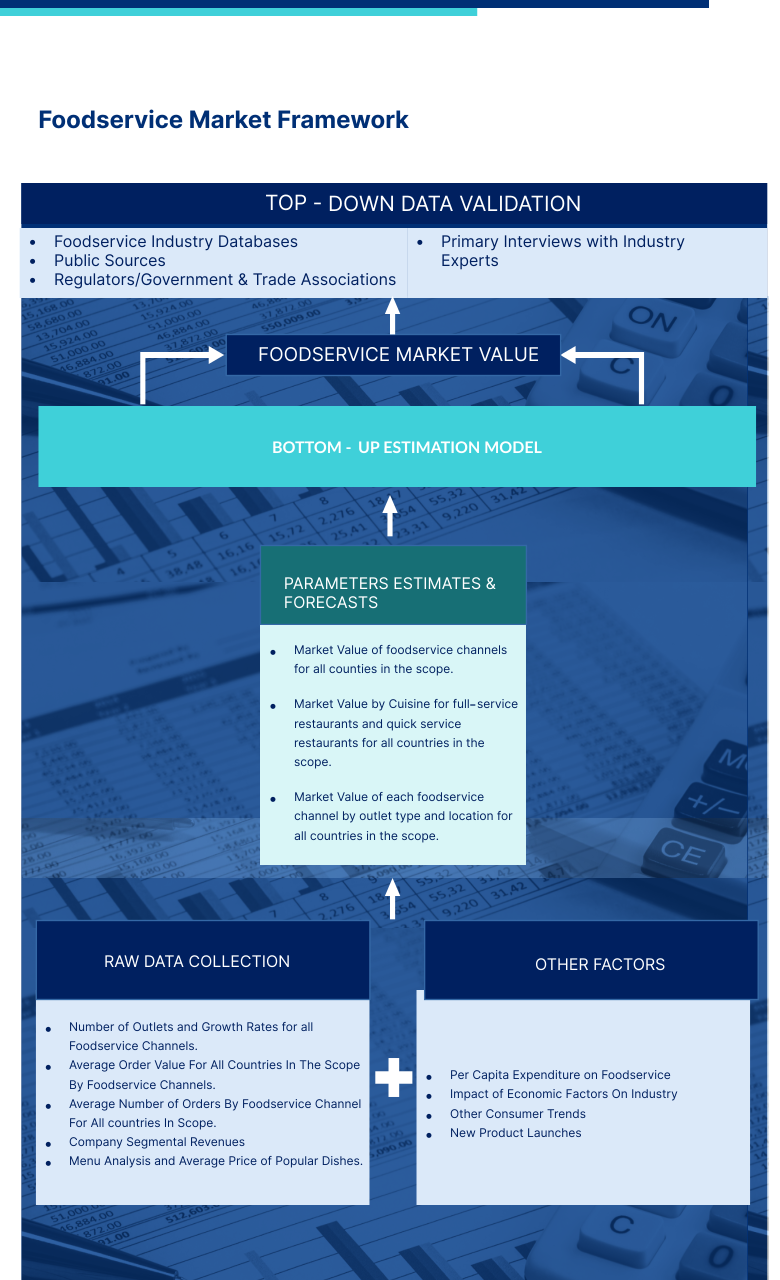
Mordor Intelligence follows a four-step methodology in all our reports.
- Step-1: Identify Key Variables: In order to build a robust forecasting methodology, the variables and factors identified in Step 1 are tested against available historical market numbers. Through an iterative process, the variables required for the market forecast are set, and the model is built on the basis of these variables.
- Step-2: Build a Market Model: Market size estimations for the forecast years are in nominal terms. Inflation is considered for average order value, and it is forecasted as per predicted inflation rates in the countries.
- Step-3: Validate and Finalize: In this important step, all market numbers, variables, and analyst calls are validated through an extensive network of primary research experts from the market studied. The respondents are selected across levels and functions to generate a holistic picture of the market studied.
- Step-4: Research Outputs: Syndicated Reports, Custom Consulting Assignments, Databases & Subscription Platforms





 Your data is secure and never sold or shared.


