
Underwater Robotic Imaging Systems Market Size and Share
Market Overview
| Study Period | 2020 - 2031 |
|---|---|
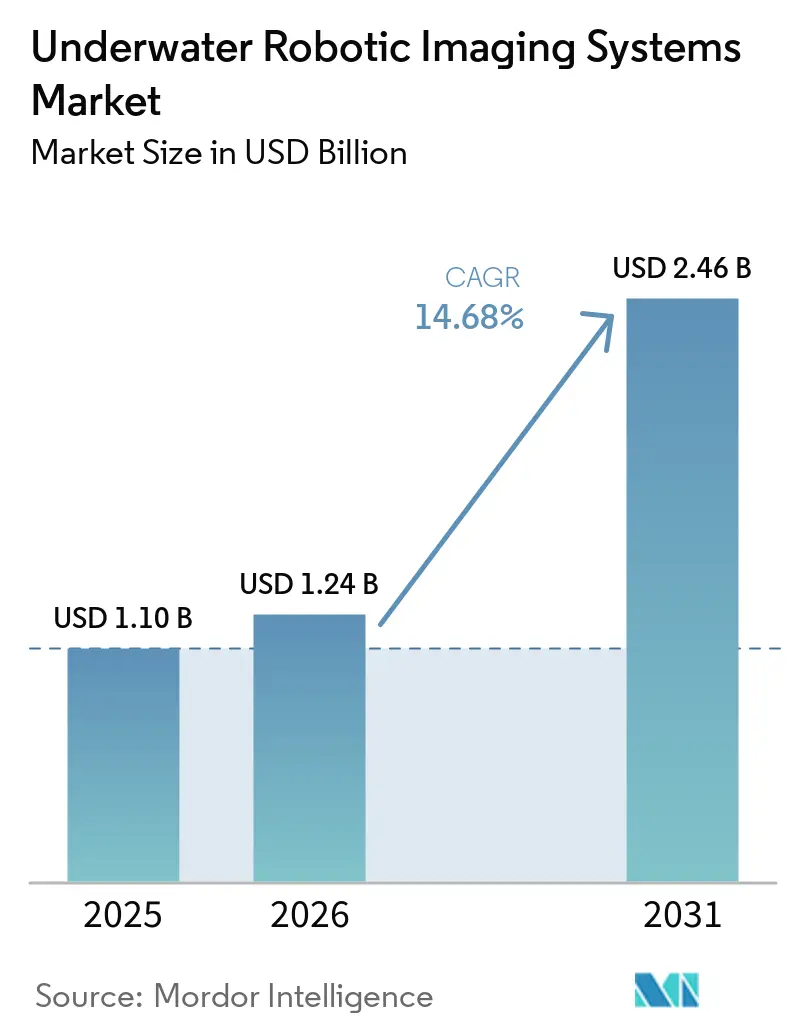
| Market Size (2026) | USD 1.24 Billion |
| Market Size (2031) | USD 2.46 Billion |
| Growth Rate (2026 - 2031) | 14.68 % |
| Fastest Growing Market | Asia-Pacific |
| Largest Market | Asia-Pacific |
| Market Concentration | Medium |
Major Players *Disclaimer: Major Players sorted in no particular order Image © Mordor Intelligence. Reuse requires attribution under CC BY 4.0. | |
Underwater Robotic Imaging Systems Market Analysis by Mordor Intelligence
The Underwater Robotic Imaging Systems Market size was valued at USD 1.10 billion in 2025 and is projected to reach USD 2.46 billion by 2031, registering a CAGR of 14.68% during 2026-2031. Inspection rules for offshore structures are making robotic image capture a recurring compliance purchase rather than an optional maintenance expense. ROV surveys can reduce diver exposure and limit operational downtime at fixed and floating offshore assets. Offshore wind construction and subsea cable projects also require more frequent seabed, cable-burial, and foundation checks. Defense programs are accelerating the qualification of sonar, optical imaging, and autonomous navigation systems that can later serve commercial users. Suppliers are responding by combining sensors, positioning tools, and data software in broader offerings, while battery limits, pressure-rated hardware costs, and skills shortages continue to constrain deployment.
Key Report Takeaways
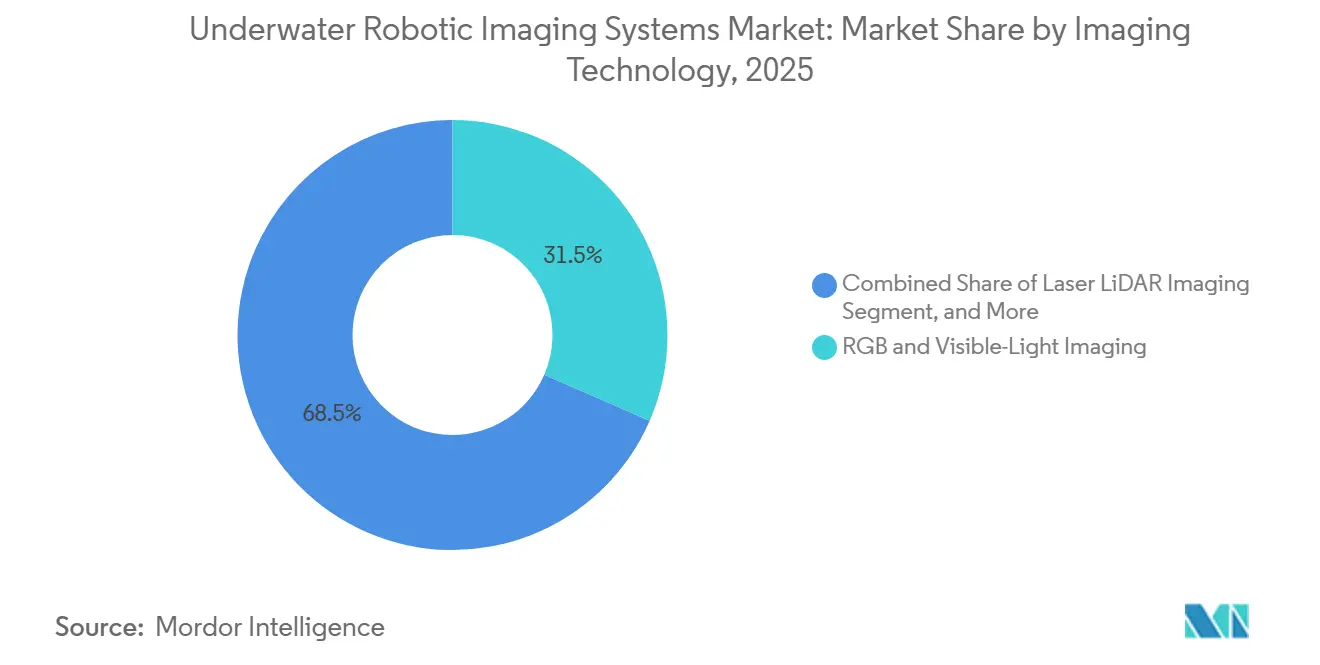
- By imaging technology, RGB and visible-light imaging held 31.52% of the Underwater Robotic Imaging Systems Market share in 2025, while laser and LiDAR imaging are projected to expand at a 17.21% CAGR through 2031.
- By application, inspection and maintenance accounted for 27.51% of the Underwater Robotic Imaging Systems Market size in 2025, while environmental monitoring is expected to expand at a 16.23% CAGR through 2031.
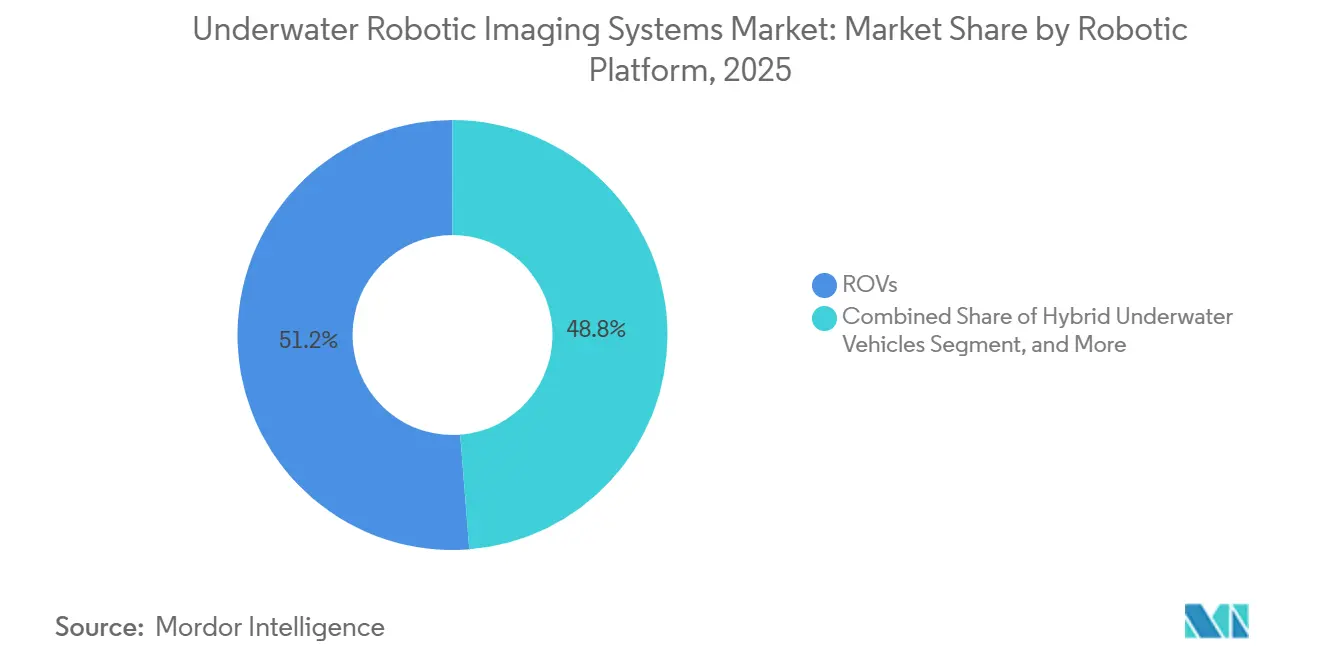
- By robotic platform, ROVs held 51.24% of revenue in 2025, while hybrid underwater vehicles are projected to expand at a 17.12% CAGR through 2031.
- By end-user industry, oil and gas held 26.61% of revenue in 2025, while offshore renewable energy is expected to expand at an 18.22% CAGR through 2031.
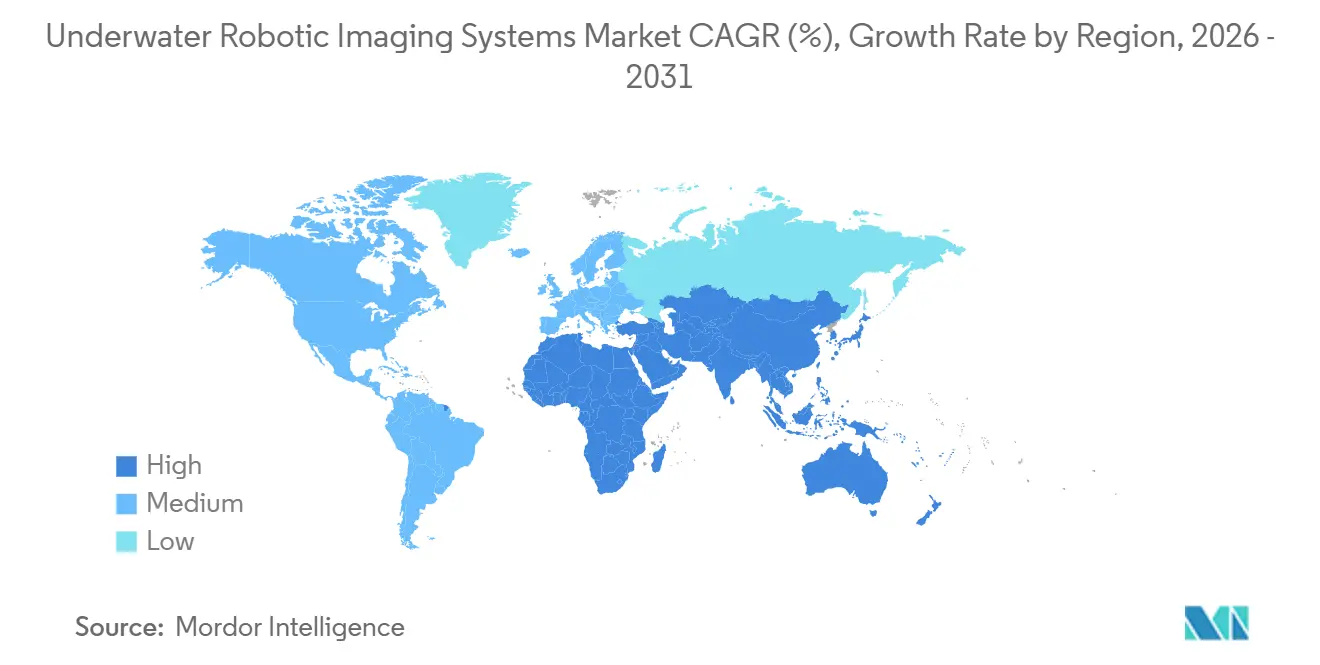
- By geography, Asia-Pacific accounted for 29.12% of revenue in 2025 and is projected to grow at a 15.34% CAGR through 2031.
Note: Market size and forecast figures in this report are generated using Mordor Intelligence’s proprietary estimation framework, updated with the latest available data and insights as of January 2026.
Market Trends and Insights
Drivers Impact Analysis of Underwater Robotic Imaging Systems Market*
| Driver | (~) % Impact on CAGR Forecast | Geographic Relevance | Impact Timeline |
|---|---|---|---|
| Offshore Infrastructure Inspection and Integrity Mandates | +4.2% | Global, concentrated in North America, Europe, and Middle East | Short term (≤ 2 years) |
| AI-Enabled Image Enhancement and Automated Defect Detection | +3.2% | Global | Medium term (2-4 years) |
| Offshore Wind and Subsea Cable Expansion | +2.8% | Europe, Asia-Pacific, North America | Medium term (2-4 years) |
| Defense Demand for Mine Countermeasures and Underwater Surveillance | +1.8% | North America, Europe, Asia-Pacific | Short term (≤ 2 years) |
| Aquaculture Shift to Offshore and High-Density Operations | +1.0% | Asia-Pacific, Norway, Chile, United Kingdom | Long term (≥ 4 years) |
| Resident and Remotely Supervised Subsea Operations | +0.7% | Global, with early gains in the North Sea and Gulf of Mexico | Long term (≥ 4 years) |
| Source: Mordor Intelligence | |||
Offshore Infrastructure Inspection and Integrity Mandates
Offshore integrity requirements are increasing the demand for repeatable image records of subsea structures. ABS updated Parts 7B and 7C of its offshore-unit rules in January 2026, including annual and 5-year risk-based inspection health checks for fixed and floating assets.[1]American Bureau of Shipping, “Rules for Building and Classing Offshore Units, Notices and General Information,” American Bureau of Shipping, abs.org The framework recognizes ROV-based visual capture as an alternative to in-person diver surveys in relevant inspection activities. NORSOK N-005:2026 addresses in-service integrity assessments for offshore structures, including assets operating beyond their original design conditions. These requirements favor systems that can document corrosion, structural condition, and changes across multiple inspection cycles, while providing operators with an evidence trail that can be reviewed during planning, classification, maintenance, and repair discussions. The Underwater Robotic Imaging Systems Market benefits because operators need reliable evidence to support compliance decisions and repair planning.
AI-Enabled Image Enhancement and Automated Defect Detection
Underwater imaging quality often declines when turbidity, low light, or suspended particles limit visual clarity. A 2026 study described a lightweight ROV vision framework for detecting pipeline cracks, pitting, and corrosion on resource-constrained hardware.[2]Ying Zhang et al., “A Lightweight and Robust Vision Framework for Underwater Pipeline Defect Detection,” Knowledge-Based Systems, sciencedirect.com Research published in MARLOG in 2026 also examined image enhancement methods to improve crack visibility prior to automated analysis. Improved image interpretation can reduce the time analysts spend reviewing large visual datasets after a mission. It also supports more consistent defect records across repeat inspections and separate operating teams, allowing operators to compare observations made at different times, under different water conditions, and during different maintenance campaigns without depending on individual reviewer judgment. The Underwater Robotic Imaging Systems Market, therefore, has room for providers that combine cameras and sonar with validated software tools.[3]Khaled Michel et al., “A Data-Driven ROV Framework for Underwater Crack Detection Using Mathematical Image Enhancement Techniques,” International Maritime Transport and Logistics, aast.edu
Offshore Wind and Subsea Cable Expansion
Offshore wind projects require imaging during construction, operation, repair, and environmental review. The Dogger Bank South East and West Offshore Wind Farms Order 2026 requires specified seabed surveys and cable-burial verification activities. These activities require operators to obtain repeatable information on seabed condition and installed cable routes. Jan De Nul began a 2026 Wadden Sea installation project involving 3 power cables and 1 fiber-optic cable, using specialized cable-laying and burial equipment.[4]Jan De Nul Group, “Industry-First, Installing Three Cables at Once with Low-Impact Equipment,” Jan De Nul Group, jandenul.com Such projects increase the value of systems that combine acoustic sediment information with optical cable tracking. The Underwater Robotic Imaging Systems Market can benefit as developers seek data to support installation assurance and subsequent asset maintenance.
Defense Demand for Mine Countermeasures and Underwater Surveillance
Defense customers require underwater systems that can identify objects, map the seabed, and operate in difficult conditions. Autonomous minehunting programs demonstrate the operational need for synthetic-aperture sonar and automatic target recognition. Defense specifications can accelerate the qualification of rugged sensors, onboard processing, and autonomous mission functions. Commercial operators can then adopt related equipment for pipeline, port, and offshore-energy inspections. This transfer supports demand for underwater robotic imaging systems, especially among customers who require certified equipment.
Restraints Impact Analysis of Underwater Robotic Imaging Systems Market*
| Restraint | (~) % Impact on CAGR Forecast | Geographic Relevance | Impact Timeline |
|---|---|---|---|
| High Deployment and Pressure-Rated Hardware Costs | -1.8% | Global, most acute in emerging markets | Short term (≤ 2 years) |
| Underwater Communication and Localization Constraints | -1.2% | Global, most pronounced in deepwater operations | Medium term (2-4 years) |
| Limited Battery Endurance and Charging Infrastructure | -0.8% | Global | Medium term (2-4 years) |
| Shortage of Skilled ROV Pilots and Inspection Analysts | -0.5% | Global, most acute in Asia-Pacific and Middle East and Africa | Long term (≥ 4 years) |
| Source: Mordor Intelligence | |||
High Deployment and Pressure-Rated Hardware Costs
Pressure-tolerant cameras, sonar units, batteries, and housings require specialized design and testing. Subsea battery packs for extended AUV missions often require tailored design, qualification work, and low-volume production. Smaller suppliers can find it difficult to fund tooling, certification, and repeated pressure testing before commercial deployment. Operators also face mobilization costs for vessels, crews, handling systems, and support equipment. Higher entry costs can delay the replacement of older camera-sonar combinations with advanced imaging systems. The Underwater Robotic Imaging Systems Market remains exposed to this constraint, where customers lack large capital budgets or predictable inspection contracts.
Underwater Communication and Localization Constraints
Seawater limits wireless data transmission and makes precise vehicle positioning difficult in deepwater operations. Acoustic communication can link underwater vehicles, but it has limited capacity for high-volume sensor data. High-resolution video, laser scans, and dense 3D point clouds often need to be stored onboard for post-mission review. An IEEE OCEANS 2025 paper demonstrated a wireless hybrid AUV/ROV system using acoustic communication during sea trials. The test confirmed the potential for dual-mode operation, while imaging workloads still require careful data-management planning. This limits the use of fully continuous monitoring models and can increase the time required to respond to critical defects.
*Our forecasts treat driver/restraint impacts as directional, not additive. The impact forecasts reflect baseline growth, mix effects, and variable interactions.
Underwater Robotic Imaging Systems Market Segment Analysis
By Imaging Technology:
Visible-Light Cameras Lead While LiDAR AcceleratesRGB and visible-light imaging held 31.52% of the Underwater Robotic Imaging Systems Market share in 2025. The technology benefits from lower sensor costs and broad compatibility with established ROV video workflows. Inspection teams can use real-time visual review to identify corrosion, marine growth, and mechanical damage where visibility is adequate. Acoustic and sonar imaging remains essential where turbidity, depth, or long-range coverage limits optical systems. Thermal, infrared, multispectral, and hyperspectral methods remain relatively small categories used in leak detection and environmental baseline assessments.
Laser and LiDAR imaging is projected to expand at a 17.21% CAGR from 2026 to 2031. It supports close-range dimensional measurements of structures where standard video cannot provide sufficient detail. Offshore wind work requires accurate records of foundation condition, scour protection, and cable interfaces, while stereo and 3D systems support photogrammetric measurement of welds and cracks. Kongsberg Discovery launched HISAS2020 in 2026 as a platform-agnostic sonar for AUVs, ROVs, towed assets, and surface vessels. The system produced 13 mm × 13 mm imagery via real-time GPU-enabled processing, revealing greater overlap between high-resolution acoustic and optical imaging.



By Application:
Inspection Anchors Demand as Environmental Monitoring SurgesInspection and maintenance accounted for 27.51% of the Underwater Robotic Imaging Systems Market size in 2025. Mandatory survey cycles for oil and gas assets, wind foundations, and subsea cables support this position. Customers use visual, acoustic, and dimensional imaging to assess corrosion, marine growth, damage, and changes in seabed conditions. Mapping and surveying require accurate seabed and route information before installation, while defense users use imaging for mine detection and undersea awareness. Exploration and scientific research are driven by public funding and multiyear program schedules, with buyers valuing reliable instruments that preserve data quality over time.
Environmental monitoring is expected to expand at a 16.23% CAGR from 2026 to 2031. Offshore wind approvals increasingly include conditions for seabed habitat review before and after construction. This connects environmental work with the positioning, imaging, and recording tools used in infrastructure inspection. A 2025 Scientific Reports study demonstrated an active-vision ROV system that identified aquaculture net-pen defects during operating conditions. Providers that enable comparable survey data across project stages can support regulatory review of cable routes, foundations, and marine farms.
By Robotic Platform:
ROVs Anchor the Market, Hybrids DisruptROVs held 51.24% of revenue in 2025 and led the platform mix. Fiber-optic tethers supply continuous power for sonar arrays, laser scanners, camera heads, and other demanding payloads. They also give pilots real-time control during close inspection and intervention. Work-class ROVs are therefore suited to pipelines, wellheads, manifolds, wind foundations, and cable systems. AUVs support wide-area surveys and defense missions, while crawlers fill narrower roles in hull, submerged-pipeline, and tank inspection.
Hybrid underwater vehicles are projected to expand at a 17.12% CAGR from 2026 to 2031. They combine tethered ROV operation for high-power imaging with untethered AUV operation for broader surveys. The Underwater Robotic Imaging Systems Market size for hybrid platforms is supported by customers seeking fewer mobilizations and more flexible asset use. An IEEE OCEANS 2025 study demonstrated wireless hybrid AUV/ROV operation without a physical tether during sea trials in Singapore. Adoption still depends on battery capacity, navigation accuracy, and reliable transition between operating modes.
By End-User Industry:
Oil and Gas Remains the Revenue Anchor, Renewables AccelerateOil and gas held 26.61% of revenue in 2025 and remained the largest end-user group. Offshore operators inspect pipelines, production trees, wellheads, manifolds, and related infrastructure over defined maintenance cycles. Imaging helps identify corrosion, damage, and marine growth before repair decisions, and the installed base of mature assets sustains demand. BSEE continued to set inspection and reporting expectations for offshore facilities in 2026. Defense and government form the second-largest group, while commercial marine, ports, research, aquaculture, and fisheries also require specialized systems.
Offshore renewable energy is projected to expand at an 18.22% CAGR from 2026 to 2031. Offshore wind fleets require recurring monitoring of foundations, scour protection, mooring lines, array cables, and electrical connectors. A 2025 review found that AUVs and ROVs are established tools in offshore wind inspection and maintenance activities. These vehicles can limit vessel callouts for routine checks when operators have reliable data and navigation systems. Renewable operators also need environmental evidence to meet consent conditions, thereby expanding the role of imaging systems beyond defect identification.
Geography Analysis
APAC Underwater Robotic Imaging Systems Market
Asia-Pacific held 29.12% of the Underwater Robotic Imaging Systems Market share in 2025 and is projected to expand at a 15.34% CAGR through 2031. China, South Korea, Japan, Taiwan, and India collectively drive demand for offshore wind, subsea cables, energy, and naval capabilities. China’s cable-detection capability is moving toward proprietary subsea technology, and a Guangdong offshore wind project reported cable burial of 11.6 m per minute in 2026. India also attracted suppliers seeking to support unmanned mine-countermeasure requirements. Localization efforts can make technology transfer and local partnerships more important for international suppliers.
North America and Europe Underwater Robotic Imaging Systems Market
North America and Europe have established offshore infrastructure and active naval procurement programs. Canada’s offshore petroleum regulations set out monitoring and integrity obligations for operators in the Canada-Newfoundland and Labrador and Canada-Nova Scotia offshore areas. The North Sea’s aging platforms and growing wind installations create sustained inspection needs. The 2026 Dogger Bank orders added seabed and cable verification requirements, while Exail delivered the first mine-countermeasure toolbox for the Belgian-Dutch rMCM program during 2025-2026. These regions reward systems that meet strict operational and documentation requirements.
MEA and South America Underwater Robotic Imaging Systems Market
The Middle East, Africa, and South America are at different stages of deployment. Mature Gulf fields require detailed imaging before operators prioritize subsea repairs, as shown by Oceaneering’s 5-year Qatar inspection and asset-integrity contract in July 2026. Brazil’s pre-salt operations require systems that can operate reliably below 2,000 m. African demand remains early outside South Africa and Nigeria, although offshore wind interest is developing in Kenya, Morocco, and South Africa.

Competitive Landscape
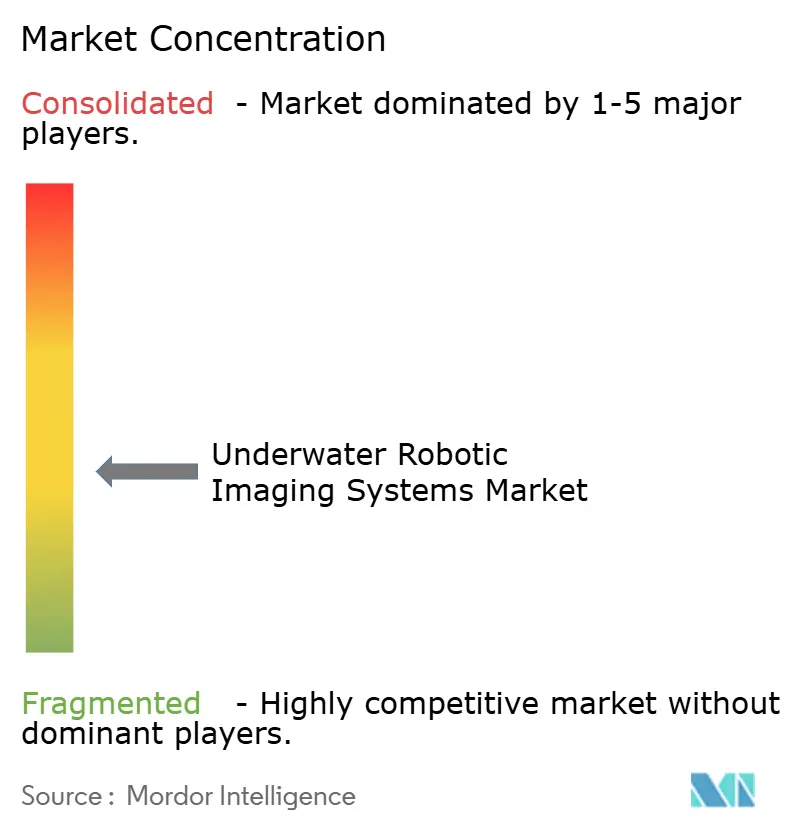
The Underwater Robotic Imaging Systems Market is moderately fragmented. Maritime defense companies and energy-service providers compete for integrated contracts, while specialist firms focus on sensor performance and imaging software. Kongsberg Discovery launched HISAS2020 in 2026 as a platform-agnostic sonar for AUVs, ROVs, towed bodies, and surface vessels. This approach enables the company to offer the sensor across different customer vehicle fleets and reduces its dependence on a single proprietary platform. Suppliers increasingly need to connect acoustic imaging, optical systems, navigation, and data processing within workable field deployments.
Kraken Robotics acquired the Covelya Group in March 2026, bringing Sonardyne International, Voyis Imaging, EIVA, Wavefront Systems, Forcys, and Chelsea Technologies into one organization. The move combined acoustic imaging, optical vision, underwater positioning, and related data capabilities. Oceaneering launched the Momentum Electric Work Class ROV in March 2026 for extended subsea deployment and compatible sensor integration. The vehicle was designed for 30-day continuous deployment and compatibility with the company’s Millennium ROV infrastructure. These moves show that established providers are targeting longer-duration work and broader integrated offerings.
The underwater robotic imaging systems industry has an opportunity in automated interpretation of imaging data. Validated defect-detection tools could increase the recurring value of software and data services. Compliance requirements set minimum specifications for equipment used on regulated offshore assets and can discourage the use of low-cost, unvalidated products. No combined market share for the leading companies was provided, so supplier concentration cannot be quantified from the available information.
Underwater Robotic Imaging Systems Industry Leaders
Oceaneering International, Inc.
Teledyne Technologies Incorporated
Saab AB
Kongsberg Gruppen ASA
Fugro N.V.
- *Disclaimer: Major Players sorted in no particular order
Underwater Robotic Imaging Systems Market Companies Covered in this Report
- Oceaneering International, Inc.
- Teledyne Technologies Incorporated
- Saab AB
- Kongsberg Gruppen ASA
- Fugro N.V.
- TechnipFMC plc
- Subsea 7 S.A.
- Forum Energy Technologies, Inc.
- ECA GROUP
- DeepOcean Group Holding B.V.
- IKM Subsea AS
- Soil Machine Dynamics Ltd.
- Blue Robotics, Inc.
- VideoRay LLC
- Deep Trekker Inc.
- Kraken Robotics Inc.
- SubC Imaging Inc.
- Coda Octopus Products Limited
- Water Linked AS
- Echologger Co., Ltd.
- Nauticus Robotics, Inc.
- Rovco Ltd.
- Voyis Inc.
- Blueprint Subsea Ltd.
- Hydromea SA

Recent Industry Developments in Underwater Robotic Imaging Systems Market
- August 2026: Taihan Cable and Panstar Robotics signed an MOU to co-develop high-performance burial ROVs and operating systems for HVDC subsea cable projects and offshore wind power networks, targeting localization of subsea robotics technology currently dependent on overseas suppliers for West Coast Energy Superhighway and related HVDC grid interconnection projects.
- August 2026: Kongsberg Gruppen unveiled the Aegir SSA family of subsea situational awareness sonars at ONS 2026 in Stavanger, designed to provide continuous underwater detection, classification, and tracking around ports, offshore assets, and coastal infrastructure, adding a dedicated subsea layer to its maritime security portfolio.
- July 2026: Oceaneering International was awarded a 5-year inspection and asset integrity services contract, with 2 1-year extension options, by a Qatar-based oil company, encompassing non-destructive testing, ROV inspection services, and deployment of the Inform digital inspection software and Vision data visualization platform.
- July 2026: SMD delivered the first of 2 heavy-duty subsea cable ploughs to Prysmian for offshore wind grid connections, with each system capable of supporting 2 GW offshore grid connections, and the second unit was scheduled for delivery in the second half of 2026.


Global Underwater Robotic Imaging Systems Market Report Scope
Underwater Robotic Imaging Systems refer to advanced optical and acoustic sensing technologies integrated into remotely operated vehicles (ROVs), autonomous underwater vehicles (AUVs), and other submersible platforms, enabling high-resolution visualization, 3D mapping, and data collection in challenging underwater environments for inspection, exploration, and scientific research.
The Underwater Robotic Imaging Systems Market Report is Segmented by Imaging Technology (RGB and Visible-Light Imaging, Acoustic and Sonar Imaging, 3D and Stereo Imaging, Laser and LiDAR Imaging, Thermal and Infrared Imaging, Multispectral and Hyperspectral Imaging, and Other Imaging Technologies), Application (Inspection and Maintenance, Mapping and Surveying, Exploration and Resource Assessment, Defense, Surveillance, and Security, Scientific Research and Marine Exploration, Environmental Monitoring, and Other Applications), Robotic Platform (ROVs, AUVs, Hybrid Underwater Vehicles, and Underwater Crawlers), End-User Industry (Oil and Gas, Offshore Renewable Energy, Defense and Government, Marine Research, Commercial Marine and Offshore, Aquaculture and Fisheries, Ports and Underwater Infrastructure, and Other End-User Industries), and Geography (North America, South America, Europe, Asia-Pacific, Middle East and Africa). The Market Forecasts are Provided in Terms of Value (USD).
| RGB and Visible-Light Imaging |
| Acoustic and Sonar Imaging |
| 3D and Stereo Imaging |
| Laser and LiDAR Imaging |
| Thermal and Infrared Imaging |
| Multispectral and Hyperspectral Imaging |
| Other Imaging Technologies |
| Inspection and Maintenance |
| Mapping and Surveying |
| Exploration and Resource Assessment |
| Defense, Surveillance, and Security |
| Scientific Research and Marine Exploration |
| Environmental Monitoring |
| Other Applications |
| ROVs |
| AUVs |
| Hybrid Underwater Vehicles |
| Underwater Crawlers |
| Oil and Gas |
| Offshore Renewable Energy |
| Defense and Government |
| Marine Research |
| Commercial Marine and Offshore |
| Aquaculture and Fisheries |
| Ports and Underwater Infrastructure |
| Other End-User Industries |
| North America | United States | |
| Canada | ||
| Mexico | ||
| South America | Brazil | |
| Argentina | ||
| Rest of South America | ||
| Europe | Germany | |
| United Kingdom | ||
| France | ||
| Italy | ||
| Spain | ||
| Rest of Europe | ||
| Asia-Pacific | China | |
| Japan | ||
| India | ||
| South Korea | ||
| Rest of Asia-Pacific | ||
| Middle East and Africa | Middle East | Saudi Arabia |
| United Arab Emirates | ||
| Turkey | ||
| Rest of the Middle East | ||
| Africa | South Africa | |
| Nigeria | ||
| Rest of Africa | ||
| By Imaging Technology | RGB and Visible-Light Imaging | ||
| Acoustic and Sonar Imaging | |||
| 3D and Stereo Imaging | |||
| Laser and LiDAR Imaging | |||
| Thermal and Infrared Imaging | |||
| Multispectral and Hyperspectral Imaging | |||
| Other Imaging Technologies | |||
| By Application | Inspection and Maintenance | ||
| Mapping and Surveying | |||
| Exploration and Resource Assessment | |||
| Defense, Surveillance, and Security | |||
| Scientific Research and Marine Exploration | |||
| Environmental Monitoring | |||
| Other Applications | |||
| By Robotic Platform | ROVs | ||
| AUVs | |||
| Hybrid Underwater Vehicles | |||
| Underwater Crawlers | |||
| By End-User Industry | Oil and Gas | ||
| Offshore Renewable Energy | |||
| Defense and Government | |||
| Marine Research | |||
| Commercial Marine and Offshore | |||
| Aquaculture and Fisheries | |||
| Ports and Underwater Infrastructure | |||
| Other End-User Industries | |||
| By Geography | North America | United States | |
| Canada | |||
| Mexico | |||
| South America | Brazil | ||
| Argentina | |||
| Rest of South America | |||
| Europe | Germany | ||
| United Kingdom | |||
| France | |||
| Italy | |||
| Spain | |||
| Rest of Europe | |||
| Asia-Pacific | China | ||
| Japan | |||
| India | |||
| South Korea | |||
| Rest of Asia-Pacific | |||
| Middle East and Africa | Middle East | Saudi Arabia | |
| United Arab Emirates | |||
| Turkey | |||
| Rest of the Middle East | |||
| Africa | South Africa | ||
| Nigeria | |||
| Rest of Africa | |||


Key Questions Answered in the Report
What is the size of the Underwater Robotic Imaging Systems Market?
The Underwater Robotic Imaging Systems Market size was USD 1.10 billion in 2025 and is projected to reach USD 2.46 billion by 2031, at a 14.68% CAGR during 2026-2031.
Which imaging technology leads underwater robotic imaging systems?
RGB and visible-light imaging led with 31.52% of revenue in 2025, supported by its cost accessibility and compatibility with established ROV video workflows.
What application is expected to expand fastest through 2031?
Environmental monitoring is expected to expand at a 16.23% CAGR through 2031, supported by seabed habitat surveys and offshore wind consent requirements.
Why are ROVs widely used for underwater imaging?
ROVs held 51.24% of revenue in 2025 because their tethers provide continuous power for high-demand cameras, sonar arrays, and laser scanners.
Which end-user group is expected to expand fastest?
Offshore renewable energy is projected to expand at an 18.22% CAGR through 2031 as wind operators need recurring inspection of foundations, cables, and scour protection.
Which region leads demand for underwater robotic imaging systems?
Asia-Pacific held 29.12% of revenue in 2025 and is projected to expand at a 15.34% CAGR through 2031, supported by offshore wind, subsea cable, energy, and defense activity.
Page last updated on:





