
Underbalanced Drilling Market Size and Share
Market Overview
| Study Period | 2022 - 2032 |
|---|---|
| Market Size (2027) | USD 5.07 Billion |
| Market Size (2032) | USD 7.21 Billion |
| Growth Rate (2027 - 2032) | 7.29 % |
| Fastest Growing Market | Asia-Pacific |
| Largest Market | North America |
| Market Concentration | Medium |
Major Players *Disclaimer: Major Players sorted in no particular order Image © Mordor Intelligence. Reuse requires attribution under CC BY 4.0. | |
Underbalanced Drilling Market Analysis by Mordor Intelligence
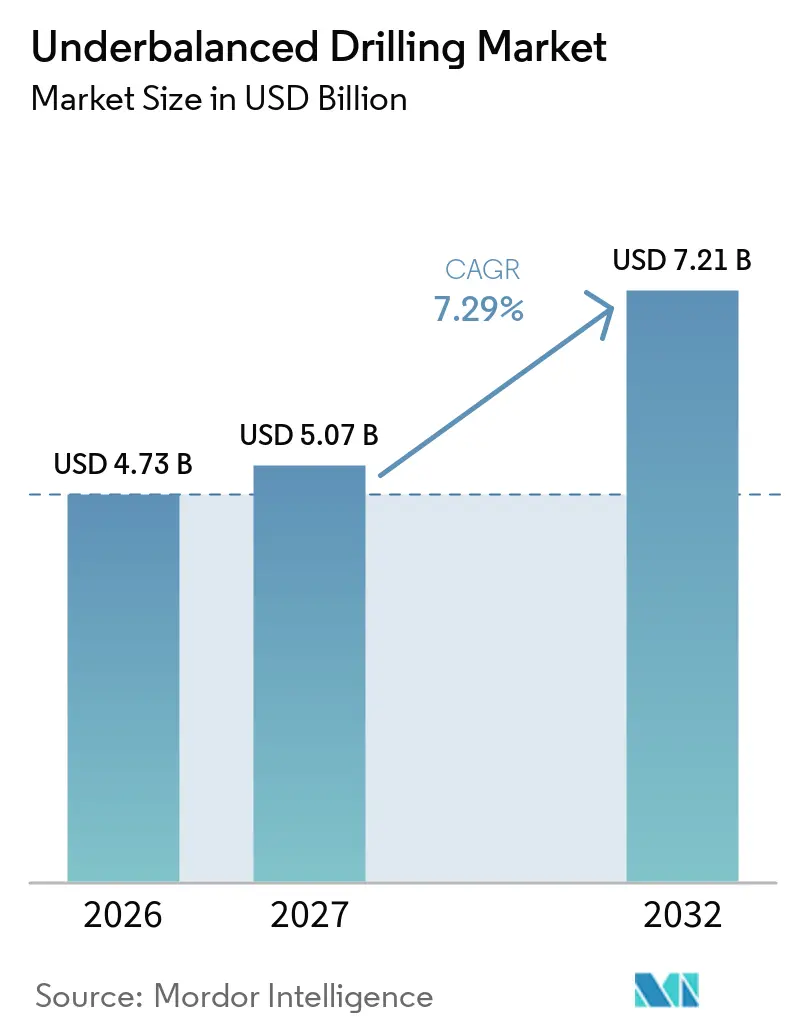
The Underbalanced Drilling Market size is expected to grow from USD 4.73 billion in 2026 to USD 5.07 billion in 2027 and is forecast to reach USD 7.21 billion by 2032 at 7.29% CAGR over 2027-2032. The underbalanced drilling market benefits as operators return to depleted fields where conventional drilling can cause losses, sticking, and formation damage. Underbalanced operations keep wellbore pressure below reservoir pressure, which can protect permeability while providing production and reservoir information during drilling. The underbalanced drilling market also gains relevance as operators use longer laterals, re-entry programs, and more complex well paths. Integrated contracts, specialized equipment, real-time modeling, and certified crews increasingly determine which suppliers can execute these campaigns. Cost exposure, well-control risk, foam performance in harsh conditions, and limited skilled personnel remain material limits on wider adoption.
Key Report Takeaways
- By technology, gas injections held 47.3% of the underbalanced drilling market share in 2026, while aerated fluid injection is projected to grow at a 7.8% CAGR through 2032.
- By application, onshore drilling accounted for 69.6% of the underbalanced drilling market size in 2026, while offshore drilling is forecast to expand at an 8.4% CAGR through 2032.
- By well type, horizontal wells held 46.7% revenue share in 2026, while multilateral wells are forecast to grow at an 8.3% CAGR through 2032.
- By geography, North America held 37.6% revenue share in 2026, while Asia-Pacific is projected to expand at a 7.4% CAGR through 2032.
Note: Market numbers in this report are based on Mordor Intelligence's proprietary estimation framework, which combines nine months of actuals with Q4 projections for base year 2026.
Market Trends and Insights
Drivers Impact Analysis of Underbalanced Drilling Market*
| Driver | (~) % Impact on CAGR Forecast | Geographic Relevance | Impact Timeline |
|---|---|---|---|
| Mature And Depleted Reservoir Development | +2.1% | Global, concentrated in the Middle East, North America, and Asia-Pacific aging fields | Medium term (2-4 years) |
| Formation-Damage Avoidance And Productivity Improvement | +1.5% | Global, with greatest value in carbonate and tight-gas provinces | Short term (≤ 2 years) |
| Growth Of Horizontal And Complex Well Designs | +1.2% | North America shale, Asia-Pacific deep shale gas, and Middle East gas re-entry | Medium term (2-4 years) |
| Adoption Of Real-Time Pressure Management | +0.8% | Global, with rapid adoption in the North Sea, deepwater Gulf of Mexico, and Asia-Pacific offshore | Short term (≤ 2 years) |
| Geothermal And Nontraditional Well Applications | +0.4% | Europe, western North America, Indonesia, and East Africa | Long term (≥ 4 years) |
| Demand For Lower Nonproductive Time In Narrow Pressure Windows | +0.6% | Global, especially in HPHT deepwater and complex onshore formations | Short term (≤ 2 years) |
| Source: Mordor Intelligence | |||
Mature And Depleted Reservoir Development Extends Asset Life
The underbalanced drilling market is supported by re-entry work in reservoirs where pressure depletion makes conventional drilling less practical. As reservoir pressure falls below hydrostatic equilibrium, an overbalanced approach can increase circulation losses and differential sticking. A 2025 American Rock Mechanics Association (ARMA) study assessed underbalanced coiled tubing drilling in Kuwait’s Lower Jurassic Marrat Formation at depths above 14,000 ft and found that safe operation depended on suitable parameter design in highly depleted intervals.[1] The same operating logic makes the method relevant for mature fields that need additional production without extensive formation impairment. Baker Hughes received a multi-year award in October 2025 to expand integrated coiled tubing drilling operations with Aramco in Saudi Arabia, taking the contracted fleet from 4 to 10 units.[2]
Formation protection supports the same demand pattern because drilling below pore pressure can limit filtrate invasion near the wellbore. This is important in tight carbonates and naturally fractured reservoirs where lost fracture conductivity can reduce productive capacity. A 2025 Society of Petroleum Engineers (SPE) paper on underbalanced coiled tubing intervention documented a Sharjah gas storage campaign that increased per-well productivity, reduced drilling cost, and lowered cushion-gas requirements.[3] The underbalanced drilling market therefore has a practical role where operators place greater value on productive reservoir contact than on a lower initial drilling service cost. The case for use is strongest when conventional techniques would require later remediation or create a higher risk of lost circulation. Operating standards and disciplined procedures remain necessary for repeatable pressure-managed work.
Horizontal And Complex Well Architectures Increase Operational Value
Longer horizontal sections make formation protection and efficient hole cleaning more important to well economics. In the Luzhou Block in southern Sichuan, research published in 2025 reported a rate of penetration improvement from 5.61 m/h to 7.03 m/h when underbalanced drilling addressed chip hold-down effects in deep shale gas wells.[4] The underbalanced drilling market is therefore linked to drilling programs that seek more reservoir contact through extended-reach well paths. The operating benefit is not limited to shale wells because mature carbonate fields also require longer laterals to reach bypassed zones. Nabors deployed its PACE-X Ultra X33 rig in South Texas in September 2025 for 4-mile laterals and vertical depths above 14,000 ft, showing the continuing demand for high-capacity land drilling systems.
Multilateral configurations add another reason to use underbalanced methods because several laterals can be drilled from one casing exit in live-well conditions. Complex well designs require compatible tools, detailed pressure-management plans, and trained crews. Demand for less nonproductive time also supports the underbalanced drilling market in formations with narrow pressure margins. The value is greatest where lost circulation, pack-off, or fluid invasion would extend rig time and reduce the chance of a productive completion. These operating conditions occur in deepwater wells, high-pressure formations, and technically complex land wells. The growing use of longer laterals increases the value of reliable pressure control across the full reservoir interval.
Real-Time Pressure Management Supports Precision Operations
The underbalanced drilling market increasingly depends on systems that combine downhole measurements, choke control, and hydraulic models. These tools help drilling teams maintain the intended pressure window while conditions change during well construction. SLB reported in 2025 that its PressPro RT software generated real-time downhole pressure models in Canada’s Jeanne d’Arc Basin, avoiding a bit trip and saving more than 2 days of rig time. Halliburton also reported that real-time automation on 3 offshore Indonesia wells generated 19 alerts that helped prevent pack-off and induced-loss events. These examples show why digital workflows are becoming part of service delivery rather than optional add-ons.
Equipment design is also changing to support more controllable operations and simpler surface packages. A 2025 Society of Petroleum Engineers (SPE) paper described Intelligent Pressure Control Technology that uses electric-powered actuators rather than hydraulic rotating-control-device systems. A separate 2025 SPE Journal paper described a campaign that reduced cleanout time by 24 hours, eliminated 1,500 bbl of fluid and 12,000 gal of liquid nitrogen, and reduced carbon dioxide emissions by 66.7% compared with conventional practices. The underbalanced drilling market benefits when these systems reduce operating uncertainty and resource use at the same time. Such capabilities matter most for operators that need repeatable execution across multiwell campaigns. They also favor providers that can combine pressure control, data interpretation, surface equipment, and trained crews in one operating model.
Geothermal And Nontraditional Well Applications Create Additional Demand
Geothermal wells provide a longer-term opportunity because high temperature and fractured formations can create difficult fluid and pressure-control conditions. Aerated fluids can offer a middle path between pure gas systems and conventional drilling fluids when stable bottomhole pressure control and cuttings transport are required. A 2025 University of Islam Riau study modeled aerated fluid and foam designs for a geothermal well and reported a 91% to 93% cutting transport ratio for the aerated approach. The underbalanced drilling market can benefit from this use case when drilling programs require a lower equivalent circulating density without sacrificing hole cleaning. International Association of Drilling Contractors’ (IADC’s) 2025 geothermal well classification also reflects the sector’s increasing attention to well-design requirements.
Nontraditional wells can add demand, but they also require systems that tolerate high temperature, salinity, and changing fluid behavior. Weatherford documented a 2025 geothermal underbalanced workover that removed scale from an environmentally sensitive well and enabled continued operation. The operating experience points to a role for specialized service packages rather than standard gas-injection designs. In Europe, western North America, Indonesia, and East Africa, geothermal development may broaden the addressable opportunity over time. The pace of adoption will depend on field economics, crew availability, and the ability to manage thermal effects on foam and pressure-control equipment. The underbalanced drilling market does not depend on geothermal growth, but these applications provide an additional route for equipment and service innovation.
Restraints Impact Analysis of Underbalanced Drilling Market*
| Restraint | (~) % Impact on CAGR Forecast | Geographic Relevance | Impact Timeline |
|---|---|---|---|
| High Equipment, Engineering, And Personnel Costs | -1.8% | Global, especially offshore and remote onshore locations with limited local supply chains | Medium term (2-4 years) |
| Well-Control, Blowout, And Fire Risk | -0.9% | Global, with higher exposure where well-control regulation is less mature | Short term (≤ 2 years) |
| Foam Destabilization In High-Salinity And High-Temperature Formations | -0.5% | Middle East HPHT carbonates, Southeast Asia geothermal projects, and North Africa | Long term (≥ 4 years) |
| Limited Availability Of Certified UBD Crews And Standardized Training | -0.7% | Global, with pronounced shortages in Asia-Pacific and Middle East and Africa expansion areas | Medium term (2-4 years) |
| Source: Mordor Intelligence | |||
High Equipment Costs and Limited Certified Crews Restrict Smaller Operators
A complete underbalanced spread requires pressure-control equipment, surface separation equipment, specialized downhole valves, and, in many offshore cases, a snubbing unit. These requirements can raise per-well cost by 20% to 30% compared with conventional drilling, which limits use by small operators and short campaigns. Engineering preparation adds further expense because of feasibility work, geomechanically modeling, multiphase hydraulic simulation, and safety-case revisions must occur before drilling begins. The underbalanced drilling market is consequently more accessible to operators that can spread pre-engineering and equipment costs across several wells. Remote locations can face additional logistics expense where nitrogen supply, qualified personnel, and replacement parts are not locally available. Smaller operators may remain dependent on integrated providers because they do not maintain the required engineering or operational resources internally.
Limited access to qualified personnel adds a separate constraint because well-control execution depends on both equipment and crew judgment. This challenge is more visible in expanding Asia-Pacific and Middle East and Africa programs where experienced underbalanced drilling supervisors are scarce. International Association of Drilling Contractors (IADC) and International Well Control Forum (IWCF) guidance supports consistent well-control practices, but operators still need training, certification, and field experience to apply them effectively. Integrated and lump-sum turnkey contracts can shift part of the upfront risk to service providers. Halliburton’s July 2026 Aramco award covers 285 onshore re-entry wells under a 3-year base term with 2-year extension options, illustrating the scale at which integrated delivery can support repeat activity. Such models can ease cost exposure, but they also reinforce the advantage of large suppliers with broad equipment fleets and personnel pools.
Well-Control Risk and Foam Performance Limit Wider Use
Underbalanced drilling intentionally operates with wellbore pressure below formation pressure, so any breakdown in pressure management can create an influx pathway. Well-control risk requires detailed planning, functioning alarms, suitable fluid programs, and crews able to respond quickly. A 2025 Geosystem Engineering study found that single-phase models can underestimate bottomhole pressure drops by up to 1.72 MPa in deep formations containing dissolved gas. This finding shows why simplified modeling can be inadequate in complex deep reservoirs. Norway’s Norwegian Ocean Industry Authority reported in 2025 that well-control incidents on the Norwegian Continental Shelf had not declined and that shallow-formation events remained significant.
Foam systems create another operating challenge because salinity and temperature can reduce stability. The issue is important in HPHT carbonates, geothermal wells, and formations where fluid properties vary across the wellbore. A 2025 scientific review examined stability challenges in foam systems used for underbalanced and geothermal drilling and identified thermal and chemical effects as continuing research priorities. The underbalanced drilling market must therefore advance fluid chemistry, real-time monitoring, and equipment design before these applications can scale widely. Stronger technical controls can reduce risk, but they also increase the engineering burden and reinforce the need for specialized providers. These constraints do not remove demand in difficult reservoirs, but they narrow the group of projects that can be executed safely and economically.
*Our forecasts treat driver/restraint impacts as directional, not additive. The impact forecasts reflect baseline growth, mix effects, and variable interactions.
Underbalanced Drilling Market Segment Analysis
By Technology:
Gas Injection Leads While Aerated Fluids ExpandGas injection held 47.3% of the underbalanced drilling market share in 2026, supported by its broad operating range and established supply chains for nitrogen and natural gas. Gas injection is commonly selected in North American shale operations, Middle East carbonate re-entries, and North Sea brownfield programs because it offers controllable pressure reduction without depending on foam stability. Foam injections remain useful in low-pressure fractured formations where cuttings transport is a leading concern. Mist and air drilling remain relevant for shallow and highly depleted targets that require liquid-light systems. The underbalanced drilling industry continues to rely on certified gas-injection equipment and rotating-control-device pressure ratings for safe deployment.
Aerated fluid injection is forecast to grow at a 7.8% CAGR through 2032. It sits between pure gas injection and conventional mud systems, which can make it suitable for geothermal wells and long horizontal sections. The approach can provide more stable bottomhole pressure control than straight gas injection in fractured geothermal formations. The 2025 WellPlan simulation study from Universitas Islam Riau reported strong cutting transport for aerated fluid designs. The underbalanced drilling market may see providers invest in aerated systems as geothermal activity and complex lateral drilling expand.
By Application:
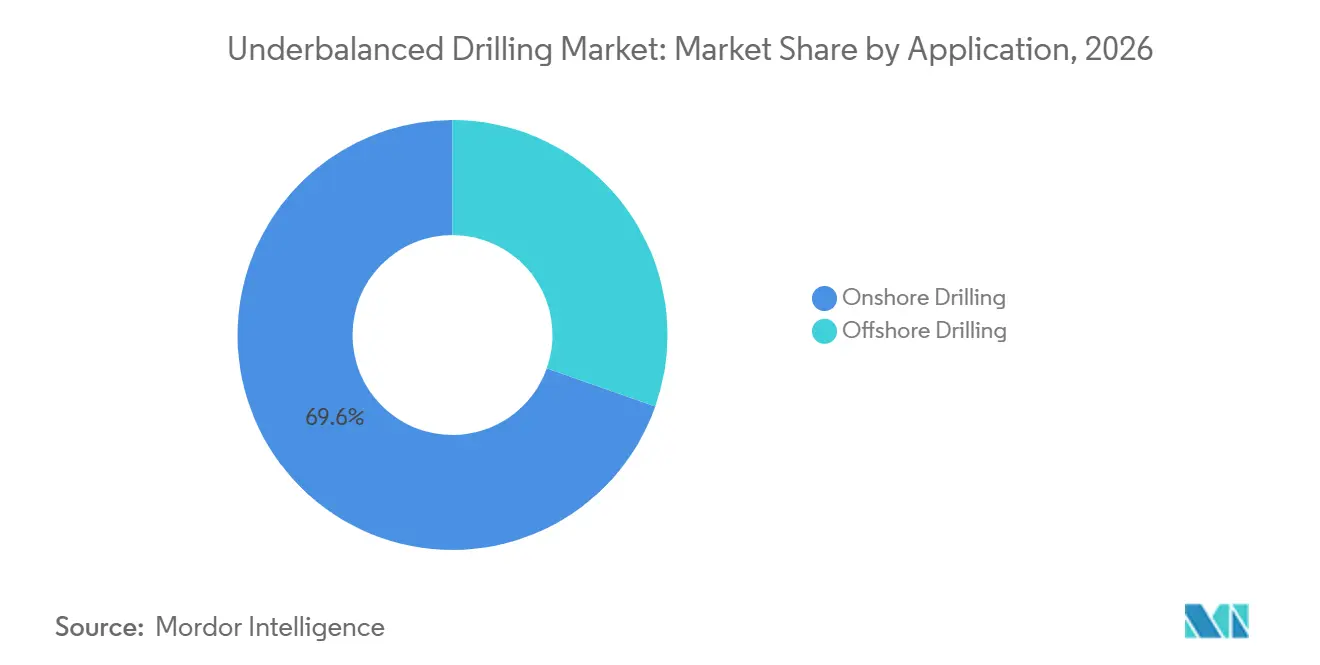
Onshore Volume Remains Largest While Offshore Re-Entries GrowOnshore drilling accounted for 69.6% of the underbalanced drilling market size in 2026. Mature land fields, tight reservoirs, and horizontal development programs in the Permian Basin, western Canada, and Saudi Arabia support this position. Onshore operations usually have simpler mobilization requirements and fewer redundancy requirements than offshore work. Nitrogen supply and surface separation can also be arranged with less complex logistics on land. These factors improve the cost case for using specialized underbalanced services in repeat re-entry campaigns.
Offshore drilling is forecast to grow at an 8.4% CAGR through 2032. Deepwater re-entries in Brazil, the Malay Basin, and the Norwegian North Sea often face narrow pressure windows that raise the value of reservoir protection. Weatherford’s 2026 award for the Búzios Field covers managed pressure drilling from the first quarter of 2027 through December 2030. Offshore regulations and high rig costs also make real-time monitoring and reliable equipment especially important. These conditions increase the premium placed on integrated providers that can manage drilling, pressure control, data, and intervention interfaces.
By Well Type:
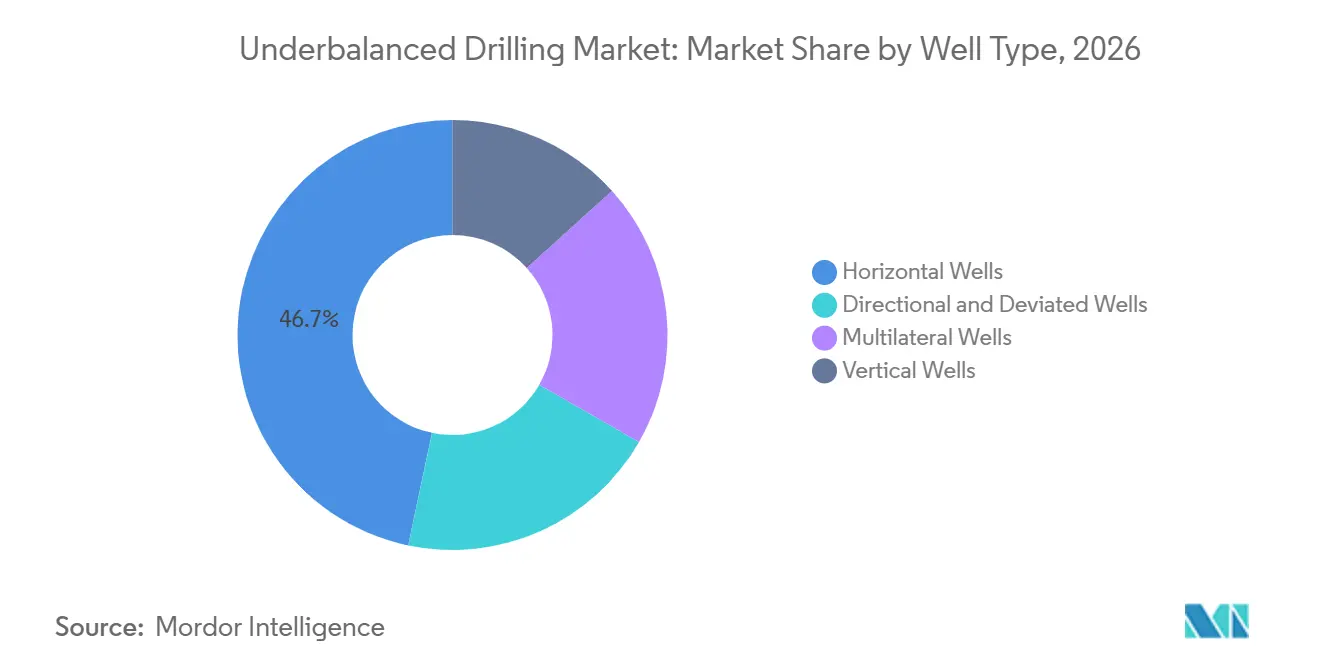
Horizontal Wells Lead While Multilateral Wells Form a Higher-Growth NicheHorizontal wells held 46.7% of revenue in 2026, reflecting their established role in unconventional development and mature carbonate fields. The underbalanced drilling market is closely linked to horizontal sections because overbalanced fluid conditions can intensify chip hold-down and formation damage along a longer wellbore. Underbalanced operations can protect productive rocks while supporting hole cleaning and rate of penetration. Vertical wells remain relevant for exploration targets and workover campaigns where a single-bore re-entry is the objective. Directional and deviated wells also remain important on space-constrained platforms in the Middle East and North Sea.
Multilateral wells are forecast to grow at an 8.3% CAGR through 2032. Their attraction comes from the ability to extend reservoir contact through several branches from one casing exit. The underbalanced drilling market can benefit when multilateral designs reduce the need for separate wellbores or extensive stimulation. Complex well construction is a specialized niche because it demands disciplined pressure management, compatible tools, and experienced crews. The operating case is stronger where several laterals can improve contact with a reservoir from a single entry point.
Geography Analysis
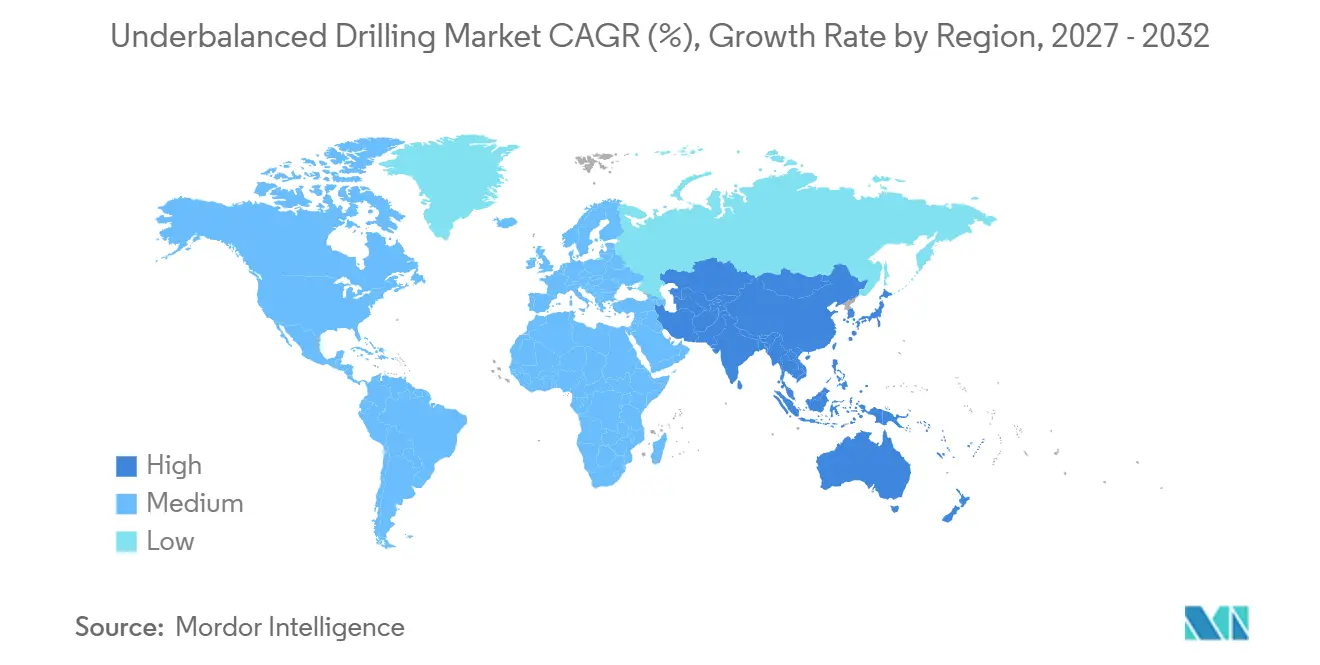
North America held 37.6% of revenue in 2026, giving the region the largest position in the underbalanced drilling market. Aging shale and tight-gas fields, an established service base, and widespread use of performance-based drilling contracts support regional demand. The United States leads activity across the Permian, Eagle Ford, Haynesville, and Delaware Basin, where operators manage depleted zones and pursue longer laterals. Canada adds demand through tight-gas re-entries in the Western Canada Sedimentary Basin. Mexico provides an offshore growth route through the Trion development, where SLB was awarded a drilling contract covering 18 ultra-deepwater wells.
Asia-Pacific is forecast to grow at a 7.4% CAGR through 2032. China’s southern Sichuan Basin uses underbalanced methods in deep shale gas horizontal sections where heavy drilling fluids can suppress drilling performance. Research on the Luzhou Block reported that high-density fluid can reduce rate of penetration, while underbalanced designs improved drilling performance across the studied wells. Indonesia and Malaysia add offshore redevelopment demand where subnormal-pressure fractured formations require careful pressure management. The underbalanced drilling market in the region will depend on local technical capacity as much as on the size of new drilling programs.
Europe has selective but important demand, particularly on the Norwegian Continental Shelf where depleted platform assets face tighter drilling windows. Equinor exercised options worth NOK 17 billion, equivalent to USD 1.83 billion, in May 2026 for continued drilling on 13 Norwegian Continental Shelf platforms. Baker Hughes, Halliburton, and SLB received contracts for integrated and specialized drilling services under this program. Brazil’s fractured carbonate settings and narrow pore-to-fracture-gradient windows support demand for advanced pressure-managed drilling as field development continues.
Competitive Landscape
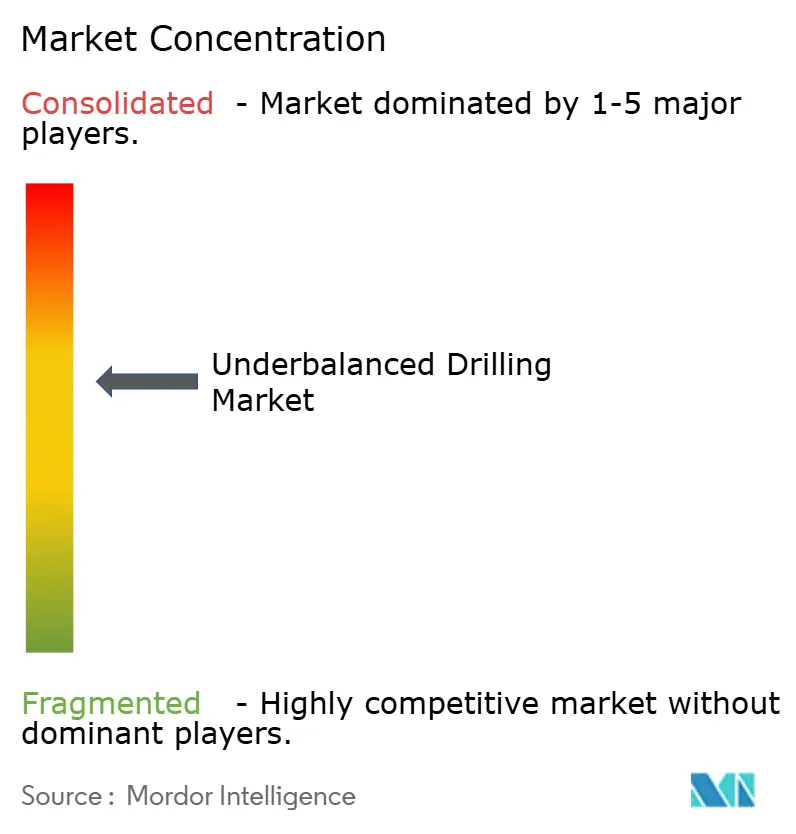
The underbalanced drilling market is moderately concentrated because a small group of global service companies can combine pressure-control equipment, well-design capability, real-time modeling, and certified crews. Baker Hughes, Halliburton, SLB, and Weatherford are central participants in technically complex projects. Nabors and National Oilwell Varco (NOV) also hold important positions in rig, automation, and drilling equipment supply. Operators often prefer a supplier that can take responsibility for rotating-control devices, bottomhole assemblies, surface processing, hydraulics, and crew management. The competitive field remains open to specialists in air and gas drilling, snubbing, and targeted field services where a full tier-1 spread is not economical.
Long-duration contracts favor suppliers with fleet capacity and integrated delivery models. Baker Hughes’ October 2025 agreement with Aramco expands the Saudi integrated coiled tubing drilling fleet from 4 to 10 units. Halliburton’s July 2026 Lump-Sum Turnkey (LSTK) award covers drilling, completions, workovers, and oil re-entry operations across Saudi fields. Weatherford’s Búzios contract adds a multi-year deepwater position in Brazil.
Technology remains a major source of differentiation. Baker Hughes combines its CoilTrak bottomhole assembly with GaffneyCline analytics in its Saudi campaign. SLB uses Performance Live delivery centers in the Trion project to support integrated and AI-enabled well construction. NOV reported that its Downhole Broadband Solutions drilled more than 750,000 ft in 2025, up 74% year over year, as digital drilling capability expanded. The underbalanced drilling market also offers room for specialists in digital twin workflows, high-temperature foam chemistry, and crew training.
Underbalanced Drilling Industry Leaders
-
Weatherford International plc
-
Halliburton Company
-
Schlumberger Limited (SLB)
-
Baker Hughes Company
-
Air Drilling Associates, Inc.
- *Disclaimer: Major Players sorted in no particular order
Underbalanced Drilling Market Companies Covered in this Report
- Air Drilling Associates, Inc.
- Archer Limited
- Baker Hughes Company
- Beyond Energy Services & Technology Corp.
- Blade Energy Partners, Ltd.
- China Oilfield Services Limited (COSL)
- Ensign Energy Services Inc.
- Expro Group Holdings N.V.
- Halliburton Company
- International Snubbing Services
- KCA Deutag International Limited
- Nabors Industries Ltd.
- National Oilwell Varco (NOV)
- Precision Drilling Corporation
- Reform Energy Services
- Schlumberger Limited (SLB)
- Strata Energy Services Inc.
- Superior Energy Services, Inc.
- Viking Services
- Weatherford International plc
Recent Industry Developments in Underbalanced Drilling Market
- July 2026: Halliburton awarded multi-year LSTK contracts by Aramco for 285 onshore re-entry wells across multiple Saudi fields. The lump-sum turnkey structure covers drilling, completions, workovers, and oil re-entry operations under a 3-year base term with 2-year extension options, positioning Halliburton as primary integrated well-delivery contractor for Aramco's onshore production-maintenance program. The scope supports Aramco's 12.0 mmbpd maximum sustainable capacity target and gas production growth objectives for Jafurah and other fields.
- June 2026: Weatherford announces definitive agreement to acquire NCS Multistage, expanding completions portfolio and unconventional resource exposure. The acquisition broadens Weatherford's managed-pressure and completions footprint into North American unconventional markets, where UBCTD and horizontal multi-stage completions are increasingly deployed together in tight-gas programs.
- May 2026: Equinor exercises contract options worth NOK 17 billion, USD 1.83 billion, for integrated drilling and well services on the Norwegian Continental Shelf. Baker Hughes, Halliburton, and SLB received integrated services contracts and specialist-services frameworks covering 13 platforms, sustaining high-specification drilling and MPD and UBD activity on the Norwegian Continental Shelf.
- May 2026: Weatherford wins MPD and subsea intervention contracts with Constellation Oil Services in offshore Brazil. MPD scope for the UDW drillship Brava Star covers the Búzios Field from Q1 2027 through December 2030. A separate award covers well intervention services for the Gold Star semisubmersible in the Campos and Espírito Santo Basins through December 2028.
Global Underbalanced Drilling Market Report Scope
Underbalanced drilling (UBD) is an oil and gas drilling technique in which the wellbore pressure is intentionally maintained below the natural fluid pressure (pore pressure) of the formation being drilled.
The underbalanced drilling market is segmented into technology, application, well type, and geography. By technology, the market is divided into gas injection, foam injection, aerated fluid injection, mist drilling, air drilling, and other technologies. By application, the market is segmented into onshore drilling and offshore drilling. By well type, the market is segmented into vertical wells, horizontal wells, directional and deviated wells, and multilateral wells. The report also covers the market size and forecasts for the global underbalanced drilling market across 26 countries in key regions. For each segment, the market sizing and forecasts have been provided on the basis of value (USD).
Segmentation Overview
| Gas Injection |
| Foam Injection |
| Aerated Fluid Injection |
| Mist Drilling |
| Air Drilling and Other Technologies |
| Onshore Drilling |
| Offshore Drilling |
| Vertical Wells |
| Horizontal Wells |
| Directional and Deviated Wells |
| Multilateral Wells |
| North America | United States |
| Canada | |
| Mexico | |
| Europe | Germany |
| France | |
| Italy | |
| Spain | |
| United Kingdom | |
| Netherlands | |
| Norway | |
| Russia | |
| Rest of Europe | |
| Asia-Pacific | China |
| India | |
| Japan | |
| Australia | |
| Indonesia | |
| Malaysia | |
| Thailand | |
| Rest of Asia-Pacific | |
| South America | Brazil |
| Argentina | |
| Colombia | |
| Rest of South America | |
| Middle East and Africa | Saudi Arabia |
| United Arab Emirates | |
| Egypt | |
| Oman | |
| Nigeria | |
| Rest of Middle East and Africa |
| By Technology | Gas Injection | |
| Foam Injection | ||
| Aerated Fluid Injection | ||
| Mist Drilling | ||
| Air Drilling and Other Technologies | ||
| By Application | Onshore Drilling | |
| Offshore Drilling | ||
| By Well Type | Vertical Wells | |
| Horizontal Wells | ||
| Directional and Deviated Wells | ||
| Multilateral Wells | ||
| By Geography | North America | United States |
| Canada | ||
| Mexico | ||
| Europe | Germany | |
| France | ||
| Italy | ||
| Spain | ||
| United Kingdom | ||
| Netherlands | ||
| Norway | ||
| Russia | ||
| Rest of Europe | ||
| Asia-Pacific | China | |
| India | ||
| Japan | ||
| Australia | ||
| Indonesia | ||
| Malaysia | ||
| Thailand | ||
| Rest of Asia-Pacific | ||
| South America | Brazil | |
| Argentina | ||
| Colombia | ||
| Rest of South America | ||
| Middle East and Africa | Saudi Arabia | |
| United Arab Emirates | ||
| Egypt | ||
| Oman | ||
| Nigeria | ||
| Rest of Middle East and Africa | ||
Key Questions Answered in the Report
What is driving demand for underbalanced drilling services?
Re-entry work in depleted reservoirs, formation protection, longer horizontal sections, and real-time pressure management are central demand factors.
How large is the underbalanced drilling sector in 2027?
The sector is estimated at USD 5.07 billion in 2027 and is forecast to reach USD 7.21 billion by 2032.
Which technology has the largest revenue position?
Gas injection leads with 47.3% revenue share in 2026, while aerated fluid injection has the highest projected growth rate at 7.8% through 2032.
Why are offshore applications growing faster?
Offshore re-entries often face narrow pressure windows and high rig costs, which increase the value of reliable pressure management and reservoir protection.
Which region is expanding fastest?
Asia-Pacific is forecast to grow at a 7.4% CAGR through 2032, supported by deep shale gas work in China and offshore redevelopment in Southeast Asia.
What limits wider adoption of underbalanced drilling?
Higher equipment and engineering cost, well-control exposure, unstable foam at high temperature, and shortages of certified crews can restrict deployment.