
UAE Social Commerce Market Size and Share
Market Overview
| Study Period | 2020 - 2031 |
|---|---|
| Forecast Data Period | 2026 - 2031 |
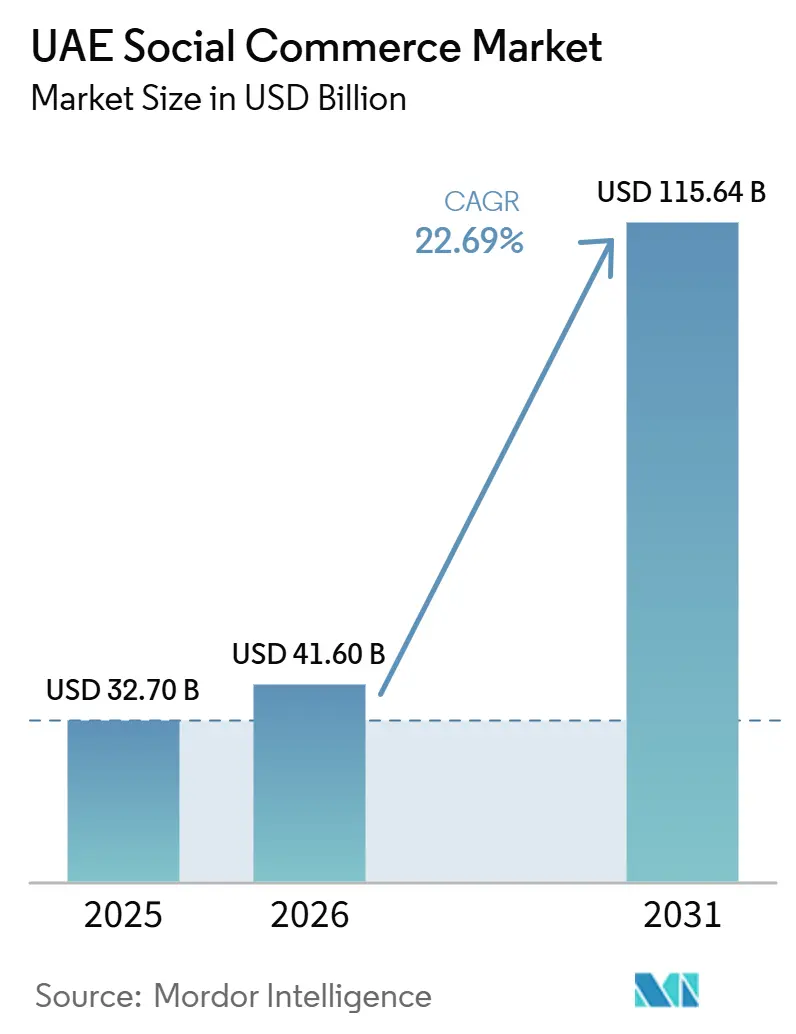
| Base Year Market Size (2025) | USD 32.70 Billion |
| Market Size (2026) | USD 41.60 Billion |
| Market Size (2031) | USD 115.64 Billion |
| Growth Rate (2026 - 2031) | 22.69 % |
| Market Concentration | Medium |
Major Players *Disclaimer: Major Players sorted in no particular order Image © Mordor Intelligence. Reuse requires attribution under CC BY 4.0. | |
UAE Social Commerce Market Analysis by Mordor Intelligence
The UAE social commerce market size was valued at USD 32.70 billion in 2025 and estimated to grow from USD 41.60 billion in 2026 to reach USD 115.64 billion by 2031, at a CAGR of 22.69% during the forecast period (2026-2031). Near-universal mobile access, creator-led product discovery, and closer links between social platforms and payment tools support this expansion. Social media has become a core retail discovery channel for many residents, while purchases increasingly move from content to checkout within the same customer journey. The February 2026 advertiser permit requirement is also raising standards for paid promotional content and directing brand activity toward verified creators. Payment choices, including buy-now, pay-later services, can support conversion in higher-value categories when used alongside stronger credit reporting arrangements. The UAE social commerce market, therefore, combines rapid demand growth with a need for dependable checkout, authentication, and responsible promotional practices.
Key Report Takeaways
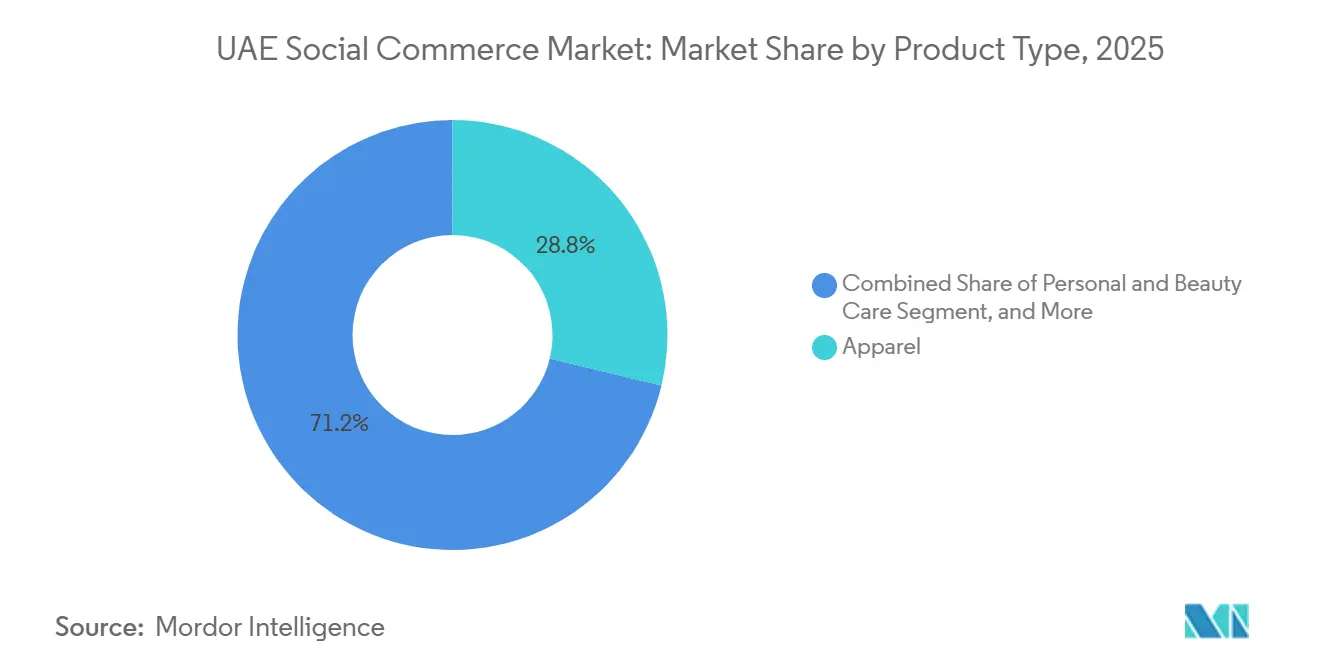
- By product type, apparel held 28.79% of the UAE social commerce market share in 2025, while personal and beauty care is projected to expand at a 23.34% CAGR through 2031.
- By device, smartphones accounted for 76.32% of the UAE social commerce market share in 2025 and are projected to grow at a 23.46% CAGR through 2031.
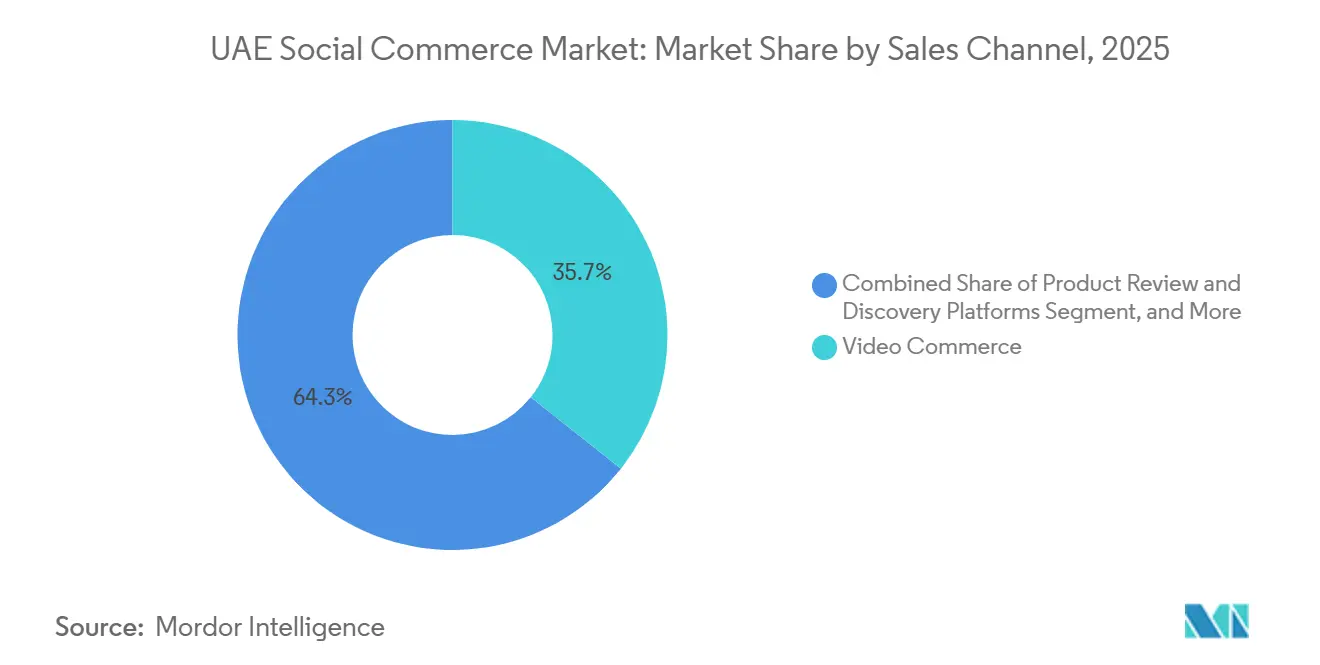
- By sales channel, video commerce held 35.68% of revenue in 2025, while social reselling is projected to expand at a 23.57% CAGR through 2031.
Note: Market size and forecast figures in this report are generated using Mordor Intelligence’s proprietary estimation framework, updated with the latest available data and insights as of January 2026.
UAE Social Commerce Market Trends and Insights
Drivers Impact Analysis*
| Driver | (~) % Impact on CAGR Forecast | Geographic Relevance | Impact Timeline |
|---|---|---|---|
| High Smartphone-Led Shopping Frequency | +4.2% | Global, with the UAE as a leading market | Short term (≤ 2 years) |
| Social Discovery Converting Into In-App and Chat Purchases | +3.8% | UAE and GCC core, with relevance across Middle East and North Africa | Short term (≤ 2 years) |
| Influencer and Affiliate Recommendations Increasing Purchase Confidence | +3.1% | UAE-wide, with Dubai and Abu Dhabi as primary hubs | Medium term (2-4 years) |
| Seamless Digital Payments and Buy Now, Pay Later Adoption | +2.6% | UAE-wide, with early adoption in Dubai and Abu Dhabi | Medium term (2-4 years) |
| Creator-Owned Shoppable Communities and Arabic-English Micro-Content | +2.0% | UAE-specific, with GCC relevance | Medium term (2-4 years) |
| Social Signals Improving Product-Market Matching for Local Sellers | +1.5% | UAE and GCC | Long term (≥ 4 years) |
| Source: Mordor Intelligence | |||
High Smartphone-Led Shopping Frequency
Smartphone penetration reached 95% as of 2026, making social commerce access a routine daily activity for most UAE residents. More than 95% 5G coverage reduces delays in video viewing, live demonstrations, and mobile payment steps. DHL reported that 96% of UAE consumers expected most online purchases to occur via social media platforms by 2030, underscoring the central role of mobile shopping in the UAE social commerce market. Instagram had 9.5 million monthly active users in the UAE in 2026, while TikTok had more than 7 million users and operated a UAE seller center. This scale favors referral-based selling and group purchasing because these formats depend on quick sharing and immediate response. It also gives merchants a reason to design product pages, payment links, and customer service with a mobile-first journey in mind.
Social Discovery Converting into In-App and Chat Purchases
The UAE social commerce market benefits when consumers can move from a product post to payment without leaving a familiar platform. TikTok Shop has made in-app product discovery, cart creation, payment collection, and post-purchase communication available to UAE sellers, including fulfillment options for Dubai and Abu Dhabi. Meta announced product review summaries and one-tap payment options through Stripe and PayPal for Facebook and Instagram in March 2026, addressing a similar point of friction. Zbooni processed 700,000 transactions worth USD 150 million across its regional merchant base in 2024, showing the role of chat-led purchasing for customers who prefer direct conversations. As checkout becomes more integrated, brands can connect promotional spending more directly to completed sales rather than relying only on clicks. This change can affect how merchants measure the contribution of creators, paid posts, and messaging channels.
Influencer and Affiliate Recommendations Increasing Purchase Confidence
Social media advertising spend was forecast to rise from USD 1.26 billion in 2025 to USD 1.42 billion in 2026, reflecting the importance of promotional content to retailer visibility. Smaller creators with 10,000 to 100,000 followers can give brands more focused audiences and clearer purchase outcomes than broad celebrity campaigns. The National Media Authority requires individuals who provide advertising or media content on social media and other digital platforms to hold a permit, supporting a more formal creator environment.[1]National Media Authority, “Permit for an Individual to Provide Advertising or Media Content on Social Media and Other Digital Platforms,” National Media Authority, nma.gov.ae The UAE social commerce market can benefit when advertisers work with compliant creators whose commercial relationships are visible to consumers. Amazon and Creators HQ launched Amazon Creators Foundry in Dubai in 2025 to help creators develop and sell products through Amazon.ae. This approach expands the creator role from promotion toward product development and longer-term sales participation.
Seamless Digital Payments and Buy Now, Pay Later Adoption
Buy now, pay later services have become an important option at checkout in social commerce, particularly for fashion, electronics, accessories, and premium beauty products. Tabby held a USD 4.5 billion private valuation after its October 2025 secondary share sale and received a Stored Value Facilities license from the Central Bank of the UAE. The license allows the company to hold consumer funds and develop additional financial services, which can support deeper payment integrations. From July 2026, the Al Etihad Credit Bureau will include Tabby and Tamara transaction data in UAE credit reports, strengthening the information available for consumer credit assessment. This measure can reduce concerns about repayment quality for merchants that offer installment payments. It may also support more sustainable use of payment flexibility in the UAE social commerce market.
Restraints Impact Analysis*
| Restraint | (~) % Impact on CAGR Forecast | Geographic Relevance | Impact Timeline |
|---|---|---|---|
| Platform Checkout and Policy Volatility | -2.1% | Global, with direct UAE exposure | Medium term (2-4 years) |
| Trust Gaps From Counterfeits, Misleading Claims, and Fake Reviews | -1.8% | UAE-wide, concentrated in social marketplace activity | Medium term (2-4 years) |
| Advertiser Permit and Content-Compliance Burden | -1.2% | UAE-specific | Short term (≤ 2 years) |
| Attribution Leakage Across Social, Chat, Marketplace, and Delivery Touchpoints | -0.9% | Global, with UAE implications | Medium term (2-4 years) |
| Source: Mordor Intelligence | |||
Platform Checkout and Policy Volatility
UAE merchants remain exposed to changes in platform policies and payment features. Instagram discontinued native checkout in most global markets in 2025, requiring many merchants to redirect customers to external payment pages. The additional handoff can increase abandonment and reduce the value of product tags or social advertising. TikTok Shop is active in the UAE, but its 5%-8% per-transaction commission can affect margin-sensitive fashion and fast-moving consumer goods sellers. Merchants are responding by implementing multi-channel systems that integrate Shopify storefronts with TikTok Shop, Instagram, and WhatsApp. This reduces dependence on any one platform, although it adds operational workload and complicates sales attribution.
Trust Gaps from Counterfeits, Misleading Claims, and Fake Reviews
Counterfeit products and misleading claims can weaken repeat purchasing through social channels. Dubai Police confiscated AED 8.7 billion (USD 2.37 billion) in counterfeit goods during 2019-2024, including apparel, electronics, and accessories that are important social commerce categories. The online promotion of counterfeit products is treated as electronic fraud under UAE law, with reported fines ranging from AED 50,000 (USD 13,613) to AED 200,000 (USD 54,452). Enforcement is still difficult when sellers use anonymous accounts or operate from outside the country. The Luxury Closet demonstrates the value of authenticated resale, with reported sales growth of nearly 100% year over year in 2026. However, provenance checks require investment and are harder to apply to high-volume, lower-margin categories. These conditions make trust, product verification, and clear return processes important safeguards for the UAE social commerce market.
*Our forecasts treat driver/restraint impacts as directional, not additive. The impact forecasts reflect baseline growth, mix effects, and variable interactions.
Segment Analysis
By Product Type: Beauty Commerce Grows Faster While Apparel Holds the Largest Share
Apparel accounted for 28.79% of the UAE social commerce market share in 2025, supported by fast-fashion retailers, modest-wear designers, and premium lifestyle brands that use creator affiliate programs. Dubai Design District, Fashion Forward Dubai, and the country’s large expatriate population support frequent fashion discovery and product turnover. Apparel and footwear remained the leading UAE e-commerce category by value in 2025. The resale channel also adds a route for fashion discovery and value-focused purchases. Accessories, home products, and health supplements remain relevant product groups within social selling. Home products benefit from interior design content and short videos that show use cases, furniture, and décor in context. These formats can help consumers assess products that require more visual explanation.
Personal and beauty care is projected to grow at a 23.34% CAGR through 2031, making it the fastest-growing product category in the UAE social commerce market. Tutorials, product demonstrations, and before-and-after content can shorten the path from consideration to checkout for skincare and cosmetics. Gulf female influencers have significant impact on beauty purchasing, while premium skincare and cosmetics can benefit from social proof. Food and beverages is a smaller but emerging category, supported by app-native grocery purchasing patterns. Talabat mart represented 32% of total platform GMV in Q4 2025.[2]Talabat, “Q4 and FY2025 Results Presentation,” talabat, talabat.com Health supplements also benefit from wellness content and demand among health-conscious expatriate consumers. Brands may position supplements alongside beauty and wellness content rather than treating them as entirely separate social selling categories.



By Device: Smartphones Remain the Primary Social Commerce Surface
Smartphones accounted for 76.32% of revenue in 2025 and held the leading share of the UAE social commerce market by device. Mobile use is embedded in product discovery because consumers spend more than 3 hours a day on social media applications. Product tags, short videos, live streams, and payment links are designed for the scroll-to-purchase experience. Biometric verification in banking and payment applications is reducing the number of steps needed to complete mobile payments in 2026. TikTok Shop’s UAE seller environment also follows a mobile-first model for seller and customer activity. These conditions keep mobile commerce central to daily retail interaction.
Smartphones are projected to expand at a 23.46% CAGR through 2031, showing that their existing lead is still strengthening. In-app checkout can move purchases that previously occurred through desktop browsers or across mixed-device journeys onto mobile. Laptops and desktops continue to play a role in higher-consideration purchases and among older consumer groups. Desktop use also remains practical for business purchasing, including bulk ordering and systems linked to enterprise resource planning tools. Augmented reality try-on features can further support mobile use in fashion and beauty by making the camera part of the pre-purchase process. Snap reported that AR try-on formats generated up to a 239% year-over-year lift in app click-through rates and 8 times higher attention than traditional advertisements. This feature is difficult for desktop shopping to replicate.
By Sales Channel: Video Commerce Leads While Social Reselling Gains Momentum
Video commerce held 35.68% of revenue in 2025, giving it the largest UAE social commerce market share among sales channels. Livestreams and shoppable recorded videos provide consumers with visual demonstrations, seller interaction, and time-limited offers. These features can create urgency that static listings often lack. Snap’s AR Ramadan Mall reached 16.8 million Snapchatters across the Middle East and North Africa and generated 250 million impressions in 2025. The event showed how seasonal shopping occasions can bring commerce content to large audiences. Social network-led commerce through Instagram Shopping, Facebook Shops, and WhatsApp catalogs remains an ongoing channel for everyday product discovery.
Social reselling is projected to grow at a 23.57% CAGR through 2031, the fastest rate among sales channels. Peer recommendations and micro-creator affiliate models shift attention toward community endorsement rather than brand advertising alone. The Luxury Closet uses authenticated, pre-owned luxury products from regional personalities to support a premium resale position. Group buying and team purchase models remain smaller channels, but they are relevant among South and Southeast Asian expatriate communities that use collective purchasing to reach lower prices. Product review and discovery platforms are also becoming more important as consumers begin some shopping journeys on social search. The UAE social commerce industry can gain from these upstream discovery channels when they are connected to transparent product information and trusted fulfillment. These selling models show that product discovery, recommendation, and purchase can occur through different but connected social interactions.
Geography Analysis
Dubai accounted for 60% of national e-commerce activity in 2025, giving it a central role in the UAE social commerce market.[3]EZDubai, “E-Commerce Report 2025,” EZDubai, ezdubai.ae Creators HQ, Dubai Design District, the Dubai International Financial Center, and dense luxury retail activity bring content production, brands, and higher-spending consumers together. Amazon and Creators HQ launched Amazon Creators Foundry in Dubai in 2025, providing support for creators looking to develop and sell products. The large expatriate population supports demand for both Arabic and English content. This mix benefits retailers that can communicate with Emirati nationals and diverse expatriate groups. Dubai’s concentration also means changes to logistics, payments, or platform checkout can have a large national effect.
Abu Dhabi is developing as a second hub, supported by digital economy initiatives and a growing base of younger mobile-first residents. Higher-income demand in the emirate supports premium beauty, health supplements, and curated fashion. These categories align with video commerce and social network-led shopping. Sharjah and the Northern Emirates, including Ajman, Ras Al Khaimah, Fujairah, and Umm Al Quwain, are more price-sensitive and show stronger potential for group buying and social reselling. Talabat has a Board-approved 2026 investment plan exceeding USD 100 million for dark store expansion, supply chain infrastructure, and its loyalty program across 8 Middle East and North Africa markets. Better last-mile delivery can make impulse purchases more practical outside Dubai when delivery times remain competitive.
The UAE leads the GCC in social commerce development through its digital infrastructure, creator commerce framework, and brand-consumer interaction. Saudi Arabia is the closest regional peer because it has a larger population and strong public digital investment. The UAE differs through its creator hubs, multilingual content, and high-value consumer base. Bahrain, Kuwait, and Qatar remain earlier in adoption, while UAE-based operators use the country to test formats before expansion. Zbooni operates across Saudi Arabia, Jordan, and Egypt, while talabat operates in 8 Middle East and North Africa markets. The UAE social commerce market is expected to retain these advantages through 2031 as infrastructure, creator density, and regulatory clarity continue to develop.
Competitive Landscape
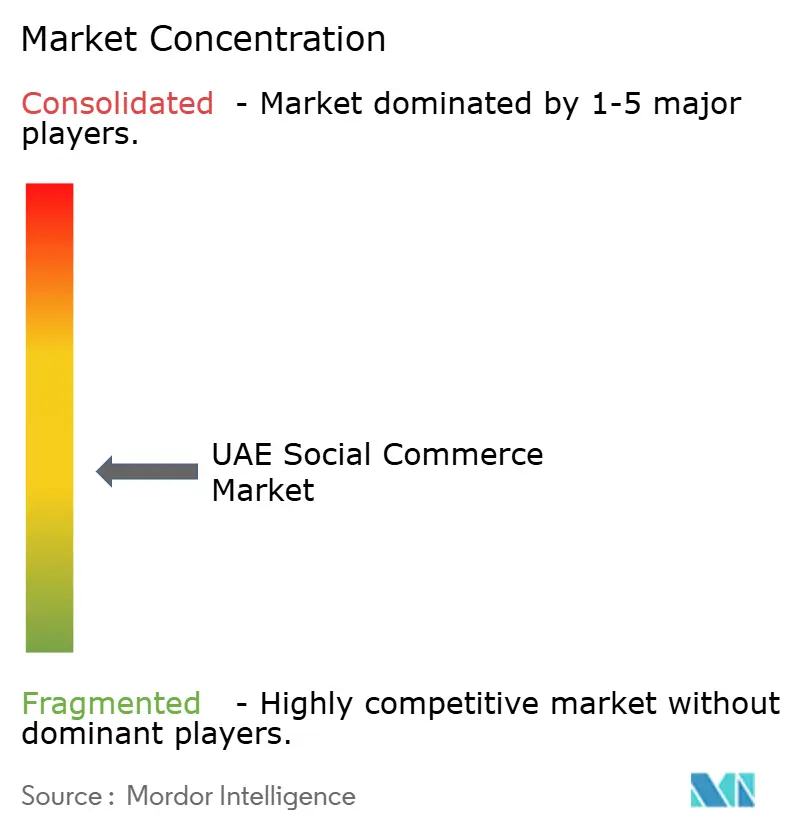
The UAE social commerce market is fragmented at the platform level, while a smaller group of companies provides key payment, delivery, and marketplace infrastructure. Meta Platforms, TikTok, and Alphabet compete for product discovery and creator engagement. Meta announced AI-powered product review summaries and one-tap checkout options for Facebook and Instagram in March 2026. The announcement addressed the conversion gap left by Instagram's discontinuation of native checkout in most global markets in 2025. TikTok Shop is active in the UAE and uses trade-license-based seller onboarding. Its 5% to 8% transaction commission affects the economics of sellers with tight margins.
Regional operators provide transaction and fulfillment capacity that independent merchants may not be able to build on their own. Talabat’s 2026 investment plan of more than USD 100 million covers dark stores, supply chain infrastructure, and the expansion of Talabat Pro across its active markets. Noon, Namshi, and Talabat can use brand recognition, delivery density, and local customer familiarity to compete for consumer spending. Zbooni serves chat-led purchasing, while The Luxury Closet has a distinct position in authenticated luxury resale. Amazon’s 2025 collaboration with Creators HQ provides another route for creators to develop products and use an established retail platform.[4]Zawya, “Creators HQ and Amazon Announce Amazon Creators Foundry,” Zawya, zawya.com These strategies show competition across discovery, transaction processing, delivery, and verified resale rather than in one single layer.
Potential openings remain in Arabic-first commerce tools, verified resale for mid-priced fashion, and business purchasing through messaging channels. Many social commerce tools and creator assets remain English-led, even though Arabic-language content can have particular relevance for Emirati consumers. The Luxury Closet has demonstrated authenticated resale in high-end goods, while verification for fashion priced at AED 300 (USD 82) to AED 2,000 (USD 545) remains less developed. Small and medium-sized enterprises that use WhatsApp for procurement also remain an underserved customer group. Meta is developing AI-led Instagram shopping capabilities that could shift product selection toward automated recommendations. The UAE social commerce market will continue to reward operators that can combine content relevance, secure payment, product verification, and reliable delivery.
UAE Social Commerce Industry Leaders
Meta Platforms, Inc.
Amazon.com, Inc.
Noon AD Holdings One Person Co. LLC
Alphabet Inc.
ByteDance Ltd.
- *Disclaimer: Major Players sorted in no particular order

Recent Industry Developments
- July 2026: Al Etihad Credit Bureau incorporated Tabby and Tamara buy now, pay later transaction data into UAE credit reports, marking the formalization of alternative consumer finance data within the country's federal credit reporting framework. The move covers both existing and new customers with relevant historical transactions and is expected to improve repayment discipline and reduce systemic default risk for buy now, pay later-enabled social commerce checkouts.
- March 2026: Meta announced AI-powered product insight summaries, AI-generated user review digests, and in-app one-tap checkout via Stripe and PayPal on Facebook and Instagram at the Shoptalk 2026 conference. The company also disclosed plans to test creator affiliate integrations with Amazon in the United States and Shopee in Asia, establishing infrastructure for a broader global affiliate commerce rollout.
- February 2026: Talabat announced a Board-approved investment plan of more than USD 100 million for 2026, allocating capital to talabat mart dark store expansion, supply chain infrastructure, and the multi-market rollout of its talabat Pro loyalty subscription program across 8 Middle East and North Africa markets.
- February 2026: Mumzworld launched a services category in Dubai, including childcare, online doctors, and family lifestyle services. The move extended its platform beyond product commerce into recurring service subscriptions.


UAE Social Commerce Market Report Scope
The UAE social commerce market is the ecosystem in which consumers discover, evaluate, and purchase products or services directly through social media platforms, messaging apps, creator-generated content, and community-driven digital channels. The market serves categories such as fashion, beauty, electronics, food, home products, and services, supported by high smartphone penetration, digital payments, logistics networks, and the UAE’s active social media user base.
The UAE Social Commerce Market Report is Segmented by Product Type (Apparel, Personal and Beauty Care, Accessories, Home Products, Health Supplements, Food and Beverages, and Other Product Types), Device (Laptops and Desktops, and Smartphones), and Sales Channel (Video Commerce, Social Network-Led Commerce, Social Reselling, Group Buying/Team Purchase, and Product Review and Discovery Platforms). The Market Forecasts are Provided in Terms of Value (USD).
| Apparel |
| Personal and Beauty Care |
| Accessories |
| Home Products |
| Health Supplements |
| Food and Beverages |
| Other Product Types |
| Laptops and Desktops |
| Smartphones |
| Video Commerce |
| Social Network-Led Commerce |
| Social Reselling |
| Group Buying/Team Purchase |
| Product Review and Discovery Platforms |
| By Product Type | Apparel |
| Personal and Beauty Care | |
| Accessories | |
| Home Products | |
| Health Supplements | |
| Food and Beverages | |
| Other Product Types | |
| By Device | Laptops and Desktops |
| Smartphones | |
| By Sales Channel | Video Commerce |
| Social Network-Led Commerce | |
| Social Reselling | |
| Group Buying/Team Purchase | |
| Product Review and Discovery Platforms |


Key Questions Answered in the Report
What is the UAE social commerce market size?
The UAE social commerce market size is estimated at USD 41.60 billion in 2026. It is forecast to reach USD 115.64 billion by 2031, representing a 22.69% CAGR during 2026-2031, as mobile access, creator-led discovery, and closer payment integration support purchasing through social platforms and encourage retailers to treat these channels as a regular part of the customer journey.
Which products lead and grow fastest in UAE social commerce?
Apparel led product types with a 28.79% revenue share in 2025, supported by fast-fashion, modest-wear, premium lifestyle brands, and creator affiliate programs. Personal and beauty care is projected to grow the fastest at a 23.34% CAGR through 2031 because tutorials, demonstrations, unboxing comparisons, and live content provide product information before checkout.
Why are smartphones important for social shopping in the UAE?
Smartphones generated 76.32% of revenue in 2025 and are projected to grow at a 23.46% CAGR through 2031.
Which sales channel is growing fastest in the UAE?
Social reselling is projected to expand at a 23.57% CAGR through 2031. Video commerce led sales channels with a 35.68% share in 2025, supported by live demonstrations, real-time seller questions, time-limited offers, and visual content that is more informative than a static product listing, particularly where consumers want to see products used in a practical setting.
What affects trust and checkout in UAE social commerce?
Counterfeit goods, misleading claims, fake reviews, and unstable platform checkout can weaken customer confidence. Authentication, clear seller disclosures, reliable returns, secure payment options, and multi-channel infrastructure can help address these issues, protect legitimate sellers, and reduce the impact of a platform policy change on merchant conversion. Better credit reporting for buy now, pay later activity can also support sustainable payment use and reduce concern over repayment quality.
How does the UAE creator permit affect social selling?
The National Media Authority’s permit requirement formalizes promotional activity on social platforms. It can encourage brands to work with verified creators, make paid commercial relationships more visible to consumers, and help distinguish compliant promotions from lower-quality or unregistered promotional activity, which is important when promotional content directs customers toward a purchase.
Page last updated on:





