
UAE Premium Goods Logistics Market Size and Share
Market Overview
| Study Period | 2020 - 2031 |
|---|---|
| Forecast Data Period | 2026 - 2031 |
| Base Year Market Size (2025) | USD 413.10 Million |
| Market Size (2026) | USD 436.43 Million |
| Market Size (2031) | USD 587.49 Million |
| Growth Rate (2026 - 2031) | 6.13 % |
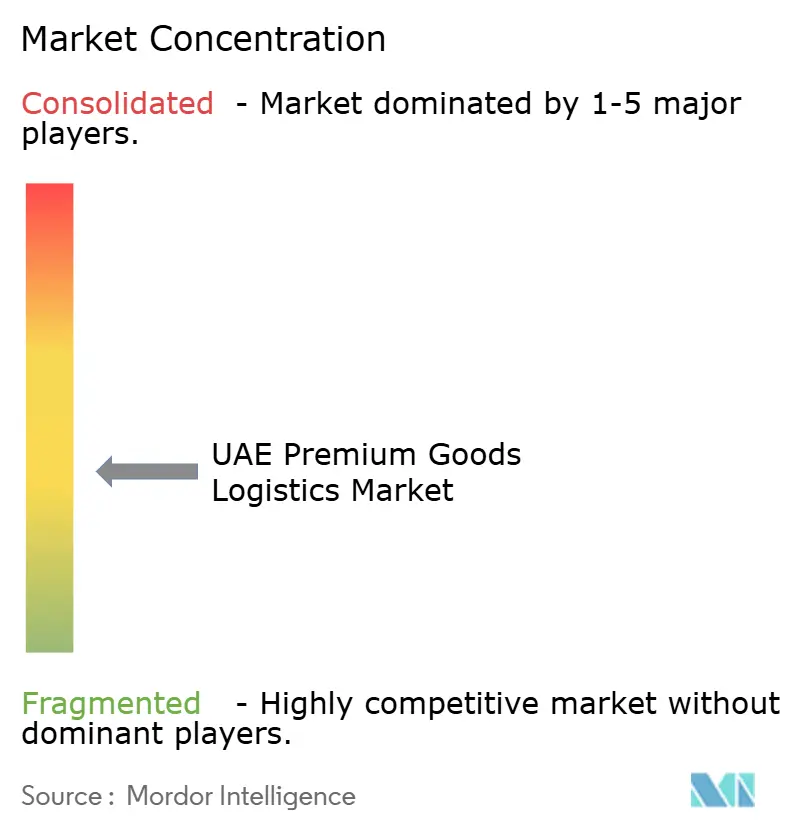
| Market Concentration | Medium |
Major Players *Disclaimer: Major Players sorted in no particular order Image © Mordor Intelligence. Reuse requires attribution under CC BY 4.0. | |
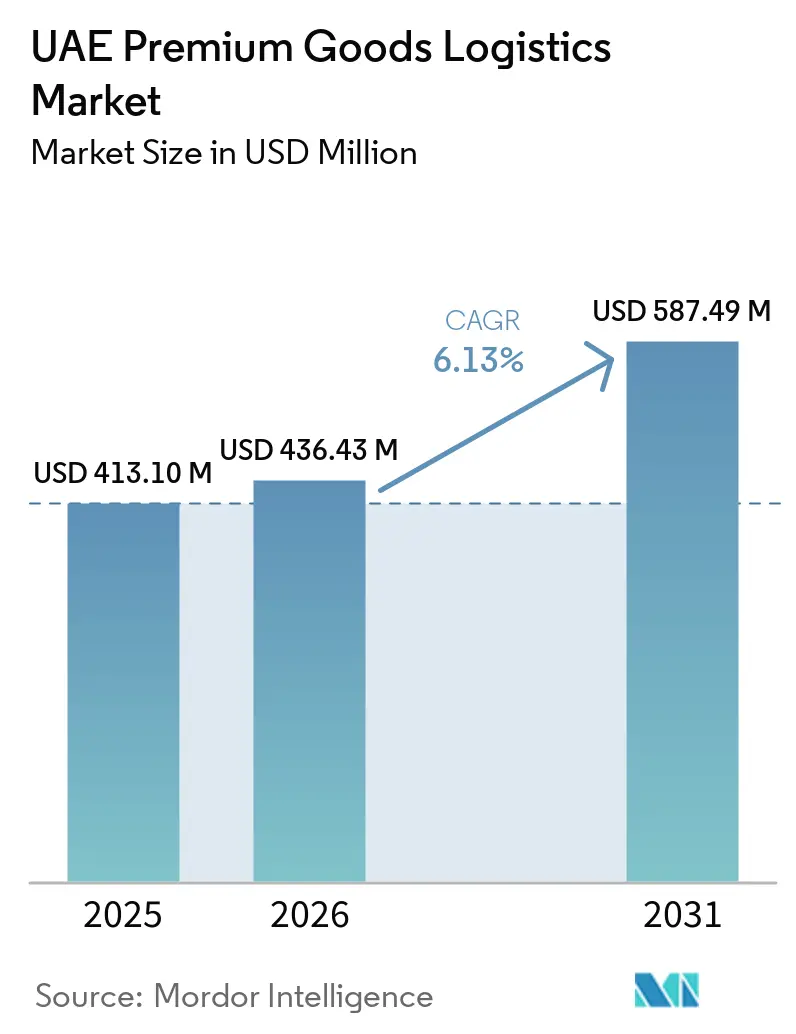
UAE Premium Goods Logistics Market Analysis by Mordor Intelligence
The UAE premium goods logistics market size was valued at USD 413.10 million in 2025 and is estimated to grow from USD 436.43 million in 2026 to reach USD 587.49 million by 2031, at a CAGR of 6.13% during the forecast period (2026-2031).
Dubai has increasingly served as a regional warehousing and distribution center for luxury brands that source from Europe and sell across Asia and the Gulf. This position has supported both inbound and outbound cargo flows, rather than relying on a single direction of trade. Company-controlled inventory and distribution operations in Dubai free zones have concentrated logistics spending in the emirate. Demand has also moved toward authenticated handling, premium delivery, and integrated retail and online fulfillment. Route disruption, security requirements, and high handling costs have limited margins for providers without specialized infrastructure.
Key Report Takeaways
- By service, transportation held 57.50% of the UAE premium goods logistics market share in 2025, while value-added services and others are projected to grow at a 7.05% CAGR through 2031.
- By goods type, luxury fashion and accessories held 35.50% of the UAE premium goods logistics market size in 2025, while watches and jewelry are projected to grow at a 7.25% CAGR through 2031.
- By end user, luxury brands and retailers held 42.55% of the UAE premium goods logistics market share in 2025, while e-commerce marketplaces are projected to grow at an 8.00% CAGR through 2031.
- By destination, domestic logistics held 57.00% of the UAE premium goods logistics market share in 2025, while international logistics are estimated to grow at a 6.40% CAGR through 2031.
Note: Market size and forecast figures in this report are generated using Mordor Intelligence’s proprietary estimation framework, updated with the latest available data and insights as of January 2026.
UAE Premium Goods Logistics Market Trends and Insights
Drivers Impact Analysis*
| Driver | (~) % Impact on CAGR Forecast | Geographic Relevance | Impact Timeline |
|---|---|---|---|
| Premium Luxury E-Commerce and Omnichannel Fulfillment Growth | +1.4% | Global, with concentrated inbound premium flows from Europe and Asia Pacific to UAE | Medium term (2-4 years) |
| Dubai's Role as a GCC Luxury Distribution Gateway | +1.1% | UAE core, with spill-over demand across GCC markets, including Saudi Arabia, Kuwait, and Qatar | Long term (≥ 4 years) |
| High-Value Air Cargo and Sea-Air Connectivity Expansion | +0.9% | Global, particularly UAE-Europe, UAE-Asia Pacific, and UAE-Americas corridors | Short term (≤ 2 years) |
| Duty-Suspended Inventory Through Bonded and Virtual Warehousing | +0.7% | UAE, concentrated in JAFZA, DAFZA, and Dubai South free zone corridors | Medium term (2-4 years) |
| Rising Demand for Secure, Traceable and White-Glove Delivery | +0.6% | UAE domestic, expanding into Saudi Arabia and the broader GCC | Medium term (2-4 years) |
| Luxury Tourism, Duty-Free Retail and Affluent Consumer Growth | +0.8% | UAE, particularly Dubai International and Al Maktoum International airport retail zones | Short term (≤ 2 years) |
| Source: Mordor Intelligence | |||
Premium Luxury E-Commerce and Omnichannel Fulfillment Growth
The UAE premium goods logistics market has benefited from the shift toward online luxury purchases and connected retail fulfillment. Ounass handled 80% of GCC luxury e-commerce orders and offered a 2-hour delivery promise in Dubai, which required inventory near urban customers and raised handling costs. Returns also need inspection, authentication, repackaging, and relisting before goods are returned to saleable stock. The UAE Personal Data Protection Law added data handling obligations for operators managing customer information across these fulfillment systems. These requirements added a further layer to online fulfillment operations.[1]“Federal Decree by Law No. (45) of 2021 Concerning the Protection of Personal Data,” UAE Legislation, uaelegislation.gov.ae Larger providers with established digital tools and compliance processes, therefore, held an operational advantage.
Dubai's Role as a GCC Luxury Distribution Gateway
The UAE premium goods logistics market has gained from luxury brands moving from third-party regional distribution toward company-controlled warehouses in Dubai free zones. This model concentrated customs clearance, bonded storage, and outbound freight within Dubai, while supporting deliveries across the GCC. Louis Vuitton used the One Freezone Passport initiative to retain JAFZA warehousing while opening its corporate office in the DWTC Free Zone under 1 license processed in 5 days. JAFZA generated USD 190 billion in trade in 2025, providing a large co-location base for logistics, customs, and forwarding activity. The same concentration increased exposure when port or airport operations faced disruption.[2]“DMCC Announces Record USD 41.7 Billion in Diamond Trade Through Dubai in 2025,” Government of Dubai / DMCC, dmcc.ae Providers serving several high-value categories have therefore placed more weight on network resilience and alternative routing.
High-Value Air Cargo and Sea-Air Connectivity Expansion
Air cargo capacity has remained central to the UAE premium goods logistics market because watches, jewelry, and fashion consignments require rapid and controlled transit. Emirates SkyCargo became the first airline cargo carrier to operate a Boeing 777-300ERSF converted freighter in June 2026, with its first commercial flight from Dubai to Hong Kong carrying over 100 tonnes of cargo. The carrier added 6 freighters since March 2026 and planned a fleet of 23 Boeing 777 freighters by year-end. More capacity can reduce exposure to spot-space shortages for time-sensitive premium consignments. Sea-air and air-road-sea services also became more relevant to the UAE premium goods logistics market, where direct sea-lane access was disrupted. These options supported cargo movement between Asia, the UAE, Europe, and the Americas.
Duty-Suspended Inventory Through Bonded and Virtual Warehousing
Duty-suspended storage has supported the UAE premium goods logistics market by easing working-capital demands for high-value inventory. Dubai's Virtual Warehouses Initiative took effect in April 2026 to provide a 3-year duty suspension for privately held artworks in its first phase. The pilot might extend to jewelry, watches, collectibles, and premium fashion, which are core cargo categories for specialist operators. Deferring the 5% UAE customs duty on a USD 10 million consignment held for 2 to 3 years deferred more than USD 500,000 in liability. Bonded facilities also allowed goods to remain duty-free when they were sold to GCC and international markets. DMCC launched its Luxury Innovation Centre in Dubai in 2025 to support provenance and authentication tools for luxury supply chains.
Restraints Impact Analysis*
| Restraint | (~) % Impact on CAGR Forecast | Geographic Relevance | Impact Timeline |
|---|---|---|---|
| Geopolitical Disruption Across Red Sea, Strait of Hormuz and Gulf Trade Routes | -0.7% | UAE, broader GCC, and international flows through Gulf corridors | Short term (≤ 2 years) |
| High Security, Insurance and Compliance Costs per Shipment | -0.4% | Global, amplified in UAE due to high-value cargo concentration per shipment | Medium term (2-4 years) |
| Extreme Heat Exposure and Limited Specialized Handling Capacity | -0.3% | UAE domestic, especially road transit and open-air transfer zones during June to September | Medium term (2-4 years) |
| High Last-Mile Costs and Short Luxury Delivery-Service Windows | -0.4% | Dubai and Abu Dhabi urban cores, with pressure expanding in Northern Emirates | Short term (≤ 2 years) |
| Source: Mordor Intelligence | |||
Geopolitical Disruption Across Red Sea, Strait of Hormuz, and Gulf Trade Routes
Disruption across the Strait of Hormuz and the Red Sea constrained international flows in the UAE premium goods logistics market. Vessel transits through Hormuz fell to single digits in September 2026 from more than 100 per day before hostilities began in February 2026. The effects extended beyond freight rates because sea-air options became harder to use, route choices narrowed, and war-risk insurance costs rose. DP World reported H1 2026 revenue of USD 12.7 billion, up 13.1% year-over-year, while noting temporarily reduced vessel traffic at Jebel Ali. Brands that moved packaging and secondary components by sea had to absorb higher air freight costs when schedules changed. Documentation and coverage requirements also placed a larger administrative burden on smaller providers.
High Security, Insurance, and Compliance Costs per Shipment
Security, insurance, and compliance costs have remained a structural constraint for the UAE premium goods logistics market. Ultra-high-value consignments required secure vehicles or escorts, insurance based on declared value, and product documentation for restricted materials. These expenses were largely fixed per shipment, which weakened the economics of smaller online orders. UAE anti-counterfeit enforcement requires operators to maintain verification and documentation processes during customs clearance.[3]“DMCC Launches Luxury Innovation Centre in Almas Tower to Push Global Industry Standards and Digital Tools,” Government of Dubai / DMCC, dmcc.ae Brand audits also required providers to demonstrate quality, security, packaging, and chain-of-custody controls. Those requirements narrowed the qualified provider base, sustained specialist pricing, and limited the pace at which capacity might expand.
*Our forecasts treat driver/restraint impacts as directional, not additive. The impact forecasts reflect baseline growth, mix effects, and variable interactions.
Segment Analysis
By Service: Value-Added Capabilities Redefine the Logistics Service Stack
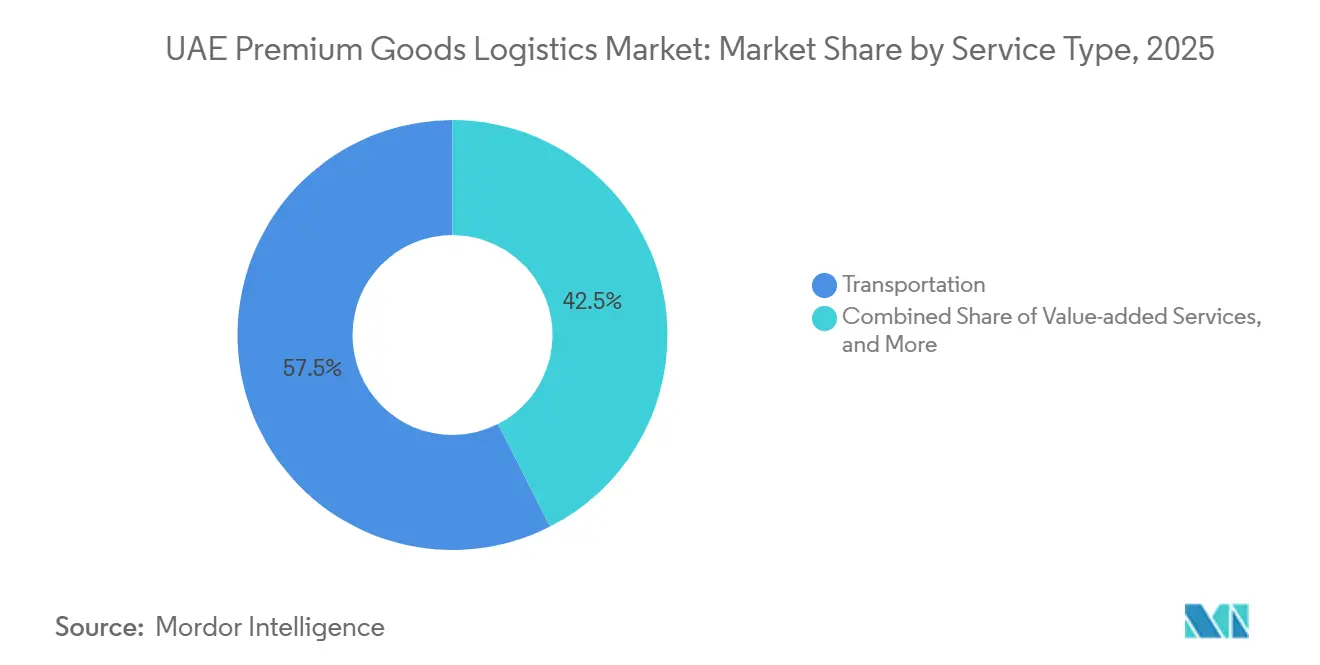
Transportation held 57.50% of the UAE premium goods logistics market share in 2025, reflecting the need to move high-value goods securely between origin, storage, and end customer. Air transport served the premium tier for watches, jewelry, and fashion, moving between European production sites and GCC distribution centers. Road services supported domestic delivery and bonded trucking across GCC markets. Sea and inland waterways supported fashion replenishment and larger consignments where volume and cost mattered more than speed.[4]“Legal Affairs - Unified Customs Law and Free Zones,” Government of Dubai, dubaicustoms.gov.ae Rail remained a small part of the service mix, despite sea-to-rail connectivity work and DHL's joint venture initiative with Etihad Rail.
The UAE premium goods logistics market size for value-added services and others recorded a 7.05% CAGR through 2031. This service group included white-glove delivery, bespoke packaging, provenance tagging, product authentication, and returns processing. Chalhoub Group fully operationalized the SCALLOG goods-to-person robotics system at its DIP warehouse in February 2026 to handle beauty and luxury e-commerce orders. Transportation gave providers broad volumes, while specialized handling delivered a higher-value service profile. Providers that developed service expertise rather than only freight capacity were better placed to capture this demand. Warehousing and Storage remained important because JAFZA's bonded model allowed duty-deferred inventory holding for luxury brands.



By Goods Type: Jewelry and Watches Outpace Fashion Despite Fashion's Scale Lead
Luxury fashion and accessories held 35.50% of the UAE premium goods logistics market share in 2025, supported by Dubai's large luxury retail base. Seasonal collections required coordinated delivery from air freight to boutiques. Returns also required authenticated assessment and regrading before resale. Consumer Electronics was the 3rd-largest goods type, driven by personal devices sold through premium retail and online channels. Cosmetics and Fragrances required temperature-controlled handling, which separated specialist providers from general cargo operators.
Watches and jewelry recorded a 7.25% CAGR through 2031, the fastest rate among goods types. DMCC reported a record diamond trade through Dubai of USD 41.7 billion in 2025, up 16.2% year-over-year. This trade base increased demand for secure, traceable, and high-security logistics. Dubai Watch Week 2025 hosted more than 90 brands across 200,000 square feet, reinforcing the city as a watch commerce center. Fine art and collectibles also became more professionalized after Chenue Middle East was pre-launched in November 2025 for museum-grade art logistics. Premium spirits and wine required licensed movement and sale channels, which created an entry barrier for logistics providers.
By End User: E-Commerce Platforms Grow Fastest as Brands Invest in Owned Channels
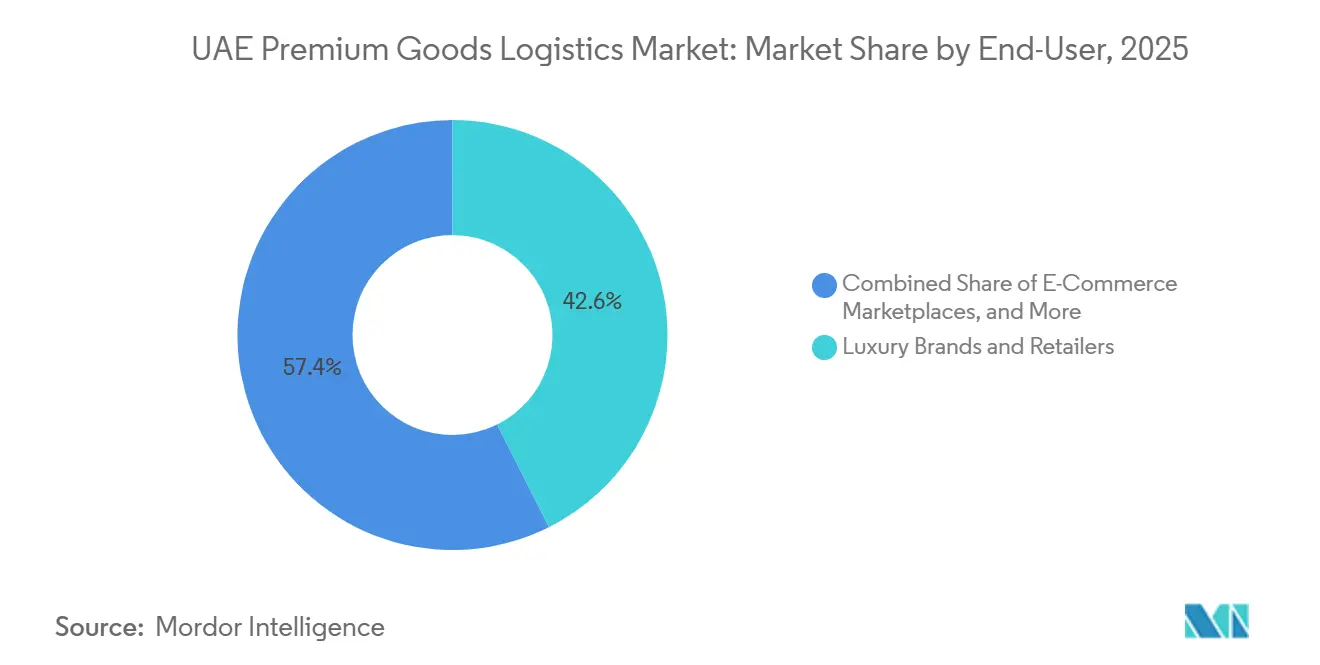
Luxury brands and retailers accounted for 42.55% of the UAE premium goods logistics market size in 2025, making them the main client group in the UAE premium goods logistics market. Direct-operated boutiques, regional flagships, and brand-owned distribution centers prioritized service quality and brand presentation. Multi-year logistics agreements gave providers a more predictable basis for infrastructure investment. Art galleries and auction houses relied on niche providers with ATA Carnet, climate-control, and condition-report capabilities. Airports and duty-free operators also generated frequent high-value logistics activity around Dubai International and Al Maktoum International.
E-commerce marketplaces recorded an 8.00% CAGR through 2031, the fastest end-user growth rate. Their orders were smaller and faster-moving than boutique replenishment, with more demanding packaging and returns needs. Operators also needed to integrate with order management systems for timely inventory visibility. This favored providers with connected fulfillment systems over companies focused solely on physical transport. Corporate gifting and concierge services remained a high-margin niche for rare watches, custom fashion, and luxury collectibles. Their requirements overlapped with private-client services, where discretion and security supported premium pricing.
By Destination: International Growth Picks Up as Domestic Hub Function Matures
Domestic logistics held 57.00% of the UAE premium goods logistics market share in 2025. Internal distribution linked bonded facilities and free zones with boutiques, duty-free retailers, concierge services, and residential deliveries. Activity remained concentrated in Dubai retail corridors and Abu Dhabi shopping districts. Premium deliveries often require signature confirmation, intact packaging, and scheduled handover. Higher delivery density among affluent urban residents supported route economics for specialist last-mile firms.
The UAE premium goods logistics market size for international logistics recorded a 6.40% CAGR through 2031. Dubai's re-export role grew as brands consolidated inventory in UAE free zones before shipping to Saudi Arabia, Kuwait, Qatar, Bahrain, Egypt, and other markets. The UAE-New Zealand CEPA took effect in November 2025 and increased premium New Zealand export volumes through Emirates SkyCargo's Dubai hub. Conflict-related disruption shifted some transport toward air and routes through Fujairah and Khor Fakkan. DP World's 50-year concession for 2 Fujairah terminals may add east-coast gateway capacity when the facilities become operational.
Geography Analysis
Dubai held the leading position in the UAE premium goods logistics market because the city has concentrated bonded warehouses, free zones, air cargo capacity, and luxury retail. JAFZA generated USD 190 billion in trade in 2025 and housed more than 650 logistics companies from more than 60 countries. Dubai International remained a key hub for high-value air cargo, while Dubai World Central developed as a second air cargo gateway. DHL planned a USD 120 million contract logistics investment in Dubai South, including a 55,000 sqm multi-user warehouse, which broke ground in Q1 2026 and expected to be completed in summer 2027.
Abu Dhabi gained relevance through luxury travel retail and deep-sea multimodal connections. Zayed International Airport welcomed more than 32 million passengers in 2025, increasing the base for affluent transit retail demand. Falic Group's agreement to acquire DFS luxury travel retail concessions at the airport covered 30 stores. Khalifa Port supported sea-air flows from Southeast Asia, while industrial and healthcare logistics investment created related capacity for premium cosmetics, pharmaceutical-grade skincare, and specialty products. Regulatory oversight for these categories favored experienced providers with established relationships.
The Northern Emirates served as secondary nodes with distinct supply-chain roles. Sharjah Airport handled feeder cargo and absorbed some Dubai overflow during peak periods. Fujairah gained strategic importance in 2026 because its east-coast location sat outside the Strait of Hormuz. DP World's planned Al Rugaylat and Dibba terminals may increase UAE container capacity from 19.4 million TEU to nearly 22 million TEU when operational. Ras Al Khaimah's hospitality investment and airport expansion added downstream demand for concierge, hospitality supply, and high-end residential delivery.
Competitive Landscape
The UAE premium goods logistics market remained moderately fragmented, with no operator leading across service, goods type, end user, and destination at the same time. DHL Group, DSV A/S, Kuehne+Nagel, FedEx, and UPS competed through network reach, technical capability, and global contracts with luxury brands. Emirates SkyCargo, DP World, Aramex, and dnata competed through proximity to UAE infrastructure and local customs knowledge. RSA Global, Al-Futtaim Logistics, GAC Group, and other specialists competed where client relationships and operational flexibility carried greater weight. DB Schenker was no longer a separate competitor after DSV completed its EUR 14.3 billion (USD 16.28 billion) acquisition on April 30, 2025.
Investment in Dubai South, JAFZA, and DWC showed how competitors expanded specialized capacity in the UAE premium goods logistics market, including DSV’s integration of the former DB Schenker network into its Dubai operations during 2025. Hellmann Worldwide Logistics broke ground on a 28,000 sqm automotive logistics hub at JAFZA in June 2026. RSA Global launched a 10,000 sqm hub at EZDubai in May 2026 to support cross-border, regional, and domestic flows. CEVA Logistics opened a dedicated e-commerce warehouse at Dubai South in January 2026. These investments added capacity for premium fulfillment, even when some facilities also served other cargo categories.
Technology and secure handling created important points of differentiation in the UAE premium goods logistics industry. DHL introduced a customs tool in the UAE in 2025 to support customs-compliant item descriptions, while Hellmann installed robotics-assisted storage at its Dubai CommerCity fulfillment center to expand storage capacity and shorten e-commerce order cycles. Fine art logistics remained a small specialist field, with Chenue Middle East among the providers positioned for museum-grade crating, provenance, and customs management. ISO 28000 and TAPA FSR requirements created barriers that limited margin pressure from general cargo operators.
UAE Premium Goods Logistics Industry Leaders
DHL Group
DSV A/S
Aramex
DP World
Emirates SkyCargo
- *Disclaimer: Major Players sorted in no particular order

Recent Industry Developments
- July 2026: DP World reached an agreement in principle with the Fujairah Ports Authority under a 50-year concession to develop 2 new deep-water terminals, Al Rugaylat container and Dibba General Cargo, on the UAE's east coast, outside the Strait of Hormuz. Once operational, the development raises UAE container handling capacity from 19.4 million TEUs to approximately 22 million TEUs.
- July 2026: Dubai Chambers signed an MoU with FedEx to help Dubai-based businesses strengthen export readiness through FedEx's global logistics network, customs advisory support, and preferential logistics programs.
- June 2026: Hellmann Worldwide Logistics and INDU Group broke ground on a new 28,000 sqm automotive spare parts logistics hub in JAFZA, reinforcing Hellmann's 5th specialized location in the UAE and expanding its spare parts distribution network across the GCC, Africa, and international markets.
- May 2026: RSA Global launched a new 10,000 sqm logistics hub at EZDubai within Dubai South, strategically positioned near Al Maktoum International Airport and Jebel Ali Port. The facility supports cross-border, regional, and domestic logistics flows.


UAE Premium Goods Logistics Market Report Scope
| Transportation | Road |
| Rail | |
| Air | |
| Sea and Inland Waterways | |
| Warehousing and Storage | |
| Value-added Services |
| Luxury Fashion and Accessories |
| Watches and Jewelry |
| Consumer Electronics |
| Cosmetics and Fragrances |
| Fine Art and Collectibles |
| Premium Spirits and Wine |
| Other Premium Goods |
| Luxury Brands and Retailers |
| E-commerce Marketplaces |
| Art Galleries and Auction Houses |
| Airports and Duty-Free Operators |
| Corporate Gifting and Concierge Services |
| Others |
| Domestic |
| International |
| By Service | Transportation | Road |
| Rail | ||
| Air | ||
| Sea and Inland Waterways | ||
| Warehousing and Storage | ||
| Value-added Services | ||
| By Goods Type | Luxury Fashion and Accessories | |
| Watches and Jewelry | ||
| Consumer Electronics | ||
| Cosmetics and Fragrances | ||
| Fine Art and Collectibles | ||
| Premium Spirits and Wine | ||
| Other Premium Goods | ||
| By End User | Luxury Brands and Retailers | |
| E-commerce Marketplaces | ||
| Art Galleries and Auction Houses | ||
| Airports and Duty-Free Operators | ||
| Corporate Gifting and Concierge Services | ||
| Others | ||
| By Destination | Domestic | |
| International |


Key Questions Answered in the Report
What was the UAE premium goods logistics value in 2026?
The 2026 value was USD 436.43 million and the market value will reach USD 587.49 million by 2031 at a CAGR of 6.13%.
Which service led premium goods logistics in the UAE?
Transportation led with 57.50% share in 2025, while value-added services and others will grow at a 7.05% CAGR through 2031.
Which goods category will grow fastest through 2031?
Watches and jewelry will grow at a 7.25% CAGR through 2031, supported by Dubai's diamond and watch trade ecosystem.
Which end users create the strongest logistics demand?
Luxury brands and retailers accounted for 42.55% of spending in 2025, while e-commerce marketplaces will grow at an 8.00% CAGR through 2031.
Why does Dubai matter for premium goods distribution?
Dubai combines free-zone warehousing, air cargo, customs support, and retail demand, which supports regional distribution across the GCC.
What constrains providers serving premium goods shipments?
Route disruption, high security and insurance costs, compliance requirements, heat exposure, and demanding last-mile delivery standards constrain operations.
Page last updated on:





