
UAE Prefabricated Buildings Market Size and Share
Market Overview
| Study Period | 2021 - 2032 |
|---|---|
| Forecast Data Period | 2027 - 2032 |
| Base Year Market Size (2026) | USD 9.53 Billion |
| Market Size (2027) | USD 10.15 Billion |
| Market Size (2032) | USD 13.93 Billion |
| Growth Rate (2027 - 2032) | 6.54 % |
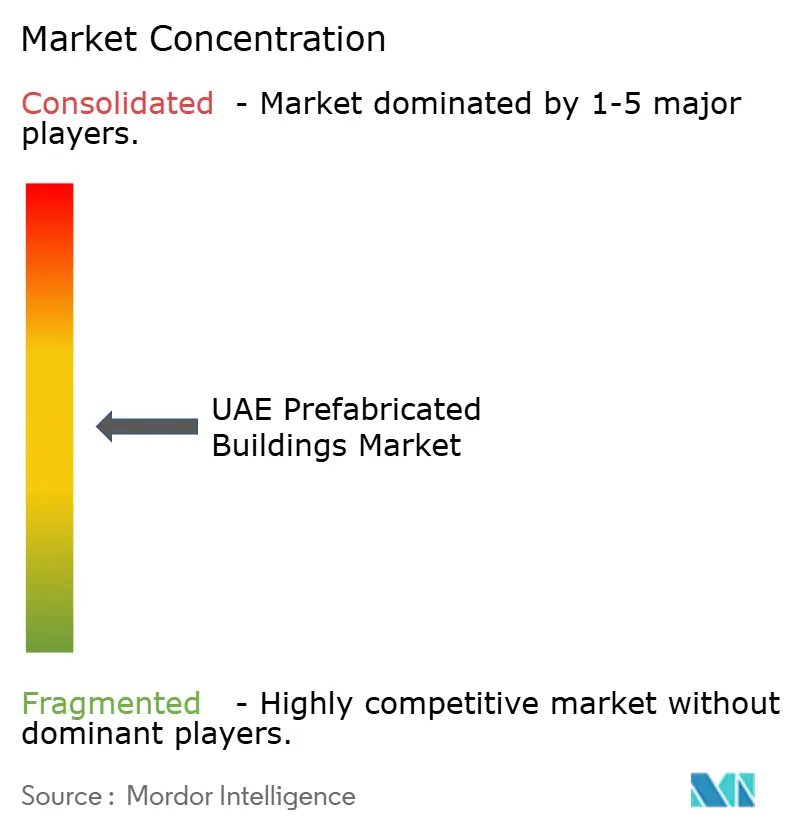
| Market Concentration | Medium |
Major Players *Disclaimer: Major Players sorted in no particular order Image © Mordor Intelligence. Reuse requires attribution under CC BY 4.0. | |
UAE Prefabricated Buildings Market Analysis by Mordor Intelligence
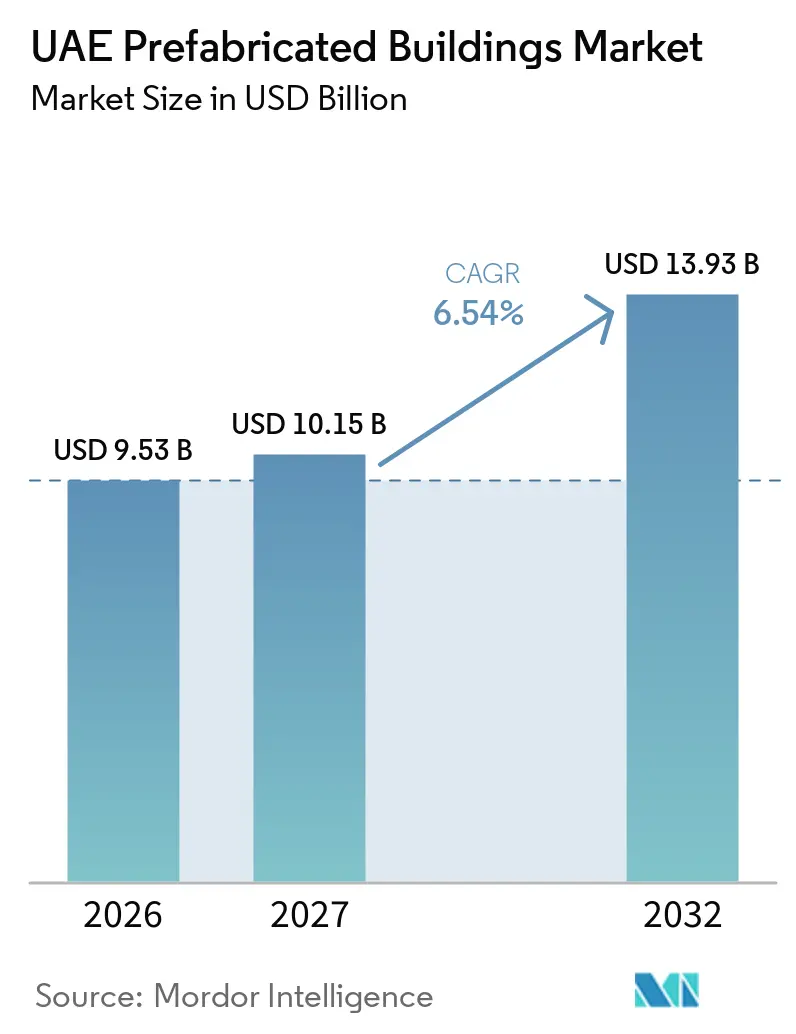
The UAE Prefabricated Buildings Market size is expected to grow from USD 9.53 billion in 2026 to USD 10.15 billion in 2027 and is forecast to reach USD 13.93 billion by 2032 at 6.54% CAGR over 2027-2032.
Demand is moving toward repeatable factory-built systems as developers seek shorter project schedules and greater control over quality. Public procurement requirements, local manufacturing policy, and sustainability rules are making off-site delivery more relevant to large housing programs. Data center, industrial, hospitality, and residential construction create different demand patterns, yet each favors systems that can be assembled quickly. Competitive advantage increasingly depends on manufacturing capacity, approval credentials, and direct developer relationships. These factors give established integrated suppliers a stronger position than small fabricators that focus on temporary structures.
Key Report Takeaways
- By material, metal accounted for a 40.4% share of the UAE prefabricated buildings market share in 2026, while timber is projected to grow at a 7.51% CAGR through 2032.
- By application, residential construction accounted for a 35.5% share of the UAE prefabricated buildings market in 2026, while other applications are projected to grow at a 7.41% CAGR through 2032.
- By product type, modular buildings accounted for a 43.1% share of the UAE prefabricated buildings market size in 2026 and are projected to grow at a 7.69% CAGR through 2032.
- By geography, Dubai accounted for a 39.8% share of the UAE prefabricated buildings market size in 2026, while Sharjah is projected to grow at a 7.81% CAGR through 2032.
Note: Market numbers in this report are based on Mordor Intelligence's proprietary estimation framework, which combines nine months of actuals with Q4 projections for base year 2026.
Market Trends and Insights
Drivers Impact Analysis of UAE Prefabricated Buildings Market*
| Drivers | (~) % Impact on CAGR Forecast | Geographic Relevance | Impact Timeline |
|---|---|---|---|
| Government support for industrialized construction | +1.8% | National, concentrated in Dubai and Abu Dhabi | Medium term (2-4 years) |
| Large residential development pipelines | +1.5% | National, concentrated in Dubai, Abu Dhabi, and Sharjah | Medium term (2-4 years) |
| Pressure to shorten construction timelines | +1.2% | National | Short term (≤ 2 years) |
| Sustainability and waste-reduction targets | +1.0% | National, concentrated in Abu Dhabi and Dubai | Medium term (2-4 years) |
| Data center and industrial facility expansion | +0.8% | Abu Dhabi, Dubai, and Ajman | Short term (≤ 2 years) |
| Growing domestic manufacturing capability | +0.6% | National, with early gains in Abu Dhabi, Dubai, and Sharjah | Long term (≥ 4 years) |
| Source: Mordor Intelligence | |||
Government Policy Creates Structurally Binding Demand for Prefabricated Construction
Dubai Municipality has expanded modular approvals from earlier frameworks, widening the range of buildings that can use volumetric systems. Abu Dhabi Projects and Infrastructure Centre requires prefabricated components in up to 80% of Abu Dhabi housing projects under its May 2026 mandate. The change makes off-site construction part of mainstream housing procurement rather than an optional project choice. The Make it in the Emirates program identified more than USD 45.7 billion in 10-year localization opportunities in 2025, supporting investment in domestic production capacity[1]. Local-content expectations also encourage suppliers to build long-term UAE operating capacity. For the UAE prefabricated buildings market, these policies give manufacturers greater confidence that demand can continue beyond isolated demonstration projects.
Residential Pipeline Depth Shifts Prefab from Project Tactic to Delivery Standard
Large residential programs are changing component sourcing from short project orders to longer factory and developer relationships. Sobha Modular Industries had more than 32,000 residential units under construction in the UAE in 2025, supported by a 2.7 million square foot factory that produces bathroom pods, mechanical, electrical, and plumbing systems, and partitions[2]. Dubai Holding Asset Management selected AMANA Group for Lantana Hills, a USD 185.2 million contract using 2,730 DuBox units and 2,020 DuPod bathroom units. The project targets 85% off-site completion and illustrates how modular delivery is being built into the project plan from the outset[3]. This model gives developers clearer control over production sequencing before site work begins. This approach raises the qualification threshold for suppliers and strengthens the opportunity for companies with reliable factory capacity.
Construction Timeline Pressure is Accelerating Adoption of Factory-Finished Volumetric Systems
Developers face pressure to deliver large schemes without relying solely on the capacity of conventional site labor. SIBS AB stated in February 2026 that its modular systems can reduce project timelines by 40%, production costs by up to 30%, and energy consumption by up to 50% compared with conventional construction. Manufacturers are therefore developing more standardized volumetric designs for repeatable building needs. Eagle Hills has signaled plans for 15- to 30-story residential towers using factory-built systems. Such projects show how a completed pilot can become a repeatable delivery model for the UAE prefabricated buildings market. The effect is most visible where schedules are critical, and designs can be standardized before construction starts.
Sustainability Compliance is Closing the Gap Between Environmental Goals and Off-Site Procurement
Federal Decree Law No. 11 of 2024 took effect on May 30, 2025, and requires annual emissions reduction plans across sectors including construction. The UAE Net Zero 2050 Strategy identifies buildings as 1 of 6 key decarbonization sectors. Dubai Holding reports that the Lantana Hills approach can reduce material waste by up to 30%. Estidama and Al Sa'fat reward lower-waste and energy-efficient building practices, supporting the use of factory-controlled components. These systems can also make materials tracking more consistent across repeated units. This regulatory setting gives the UAE prefabricated buildings market a practical route to align cost, schedule, and compliance priorities.
Restraints Impact Analysis of UAE Prefabricated Buildings Market*
| Restraints | (~) % Impact on CAGR Forecast | Geographic Relevance | Impact Timeline |
|---|---|---|---|
| High manufacturing investment requirements | -0.8% | National | Short term (≤ 2 years) |
| Transport and lifting constraints for oversized modules | -0.6% | National, concentrated in dense urban and remote sites | Short term (≤ 2 years) |
| Limited design standardization | -0.5% | National | Medium term (2-4 years) |
| Complex technical certification and approvals | -0.4% | National | Medium term (2-4 years) |
| Source: Mordor Intelligence | |||
Capital Intensity Concentrates Market Power Among Integrated Manufacturers
A viable modular facility needs land, automated production lines, testing capability, and quality certification before it can compete for major projects. SafeTech opened in February 2025 as a 2.2 million square foot precast factory with annual output above 700,000 cubic meters. The project demonstrates the level of capital needed to serve large residential and infrastructure demand. Saif Bin Darwish also acquired Gulf Precast in October 2025, bringing 6 Dubai and Abu Dhabi factories into its platform. Investment requirements make it difficult for smaller firms to duplicate established capacity quickly. Small suppliers therefore remain more exposed to cabins and temporary structures, while large integrated providers compete for certified, repeatable projects in the UAE prefabricated buildings market.
Module Size and Logistics Constraints Qualify the Modular Value Proposition Geographically
Volumetric modules need specialized transport permits, planned delivery windows, and suitable lifting equipment. Steel-frame bathroom pods and service cores used in taller buildings can exceed standard handling requirements. Central Dubai and inner Abu Dhabi restrict access windows, which can lengthen installation programs and increase crane costs. LINQ Modular has noted that transport costs can weaken the off-site advantage at remote sites several hours from Abu Dhabi. Design teams must consider these constraints before fixing module dimensions and delivery plans. The value proposition is therefore strongest on sites with road access, space for lifting, and designs that permit repeated module sizes.
*Our forecasts treat driver/restraint impacts as directional, not additive. The impact forecasts reflect baseline growth, mix effects, and variable interactions.
UAE Prefabricated Buildings Market Segment Analysis
By Material:
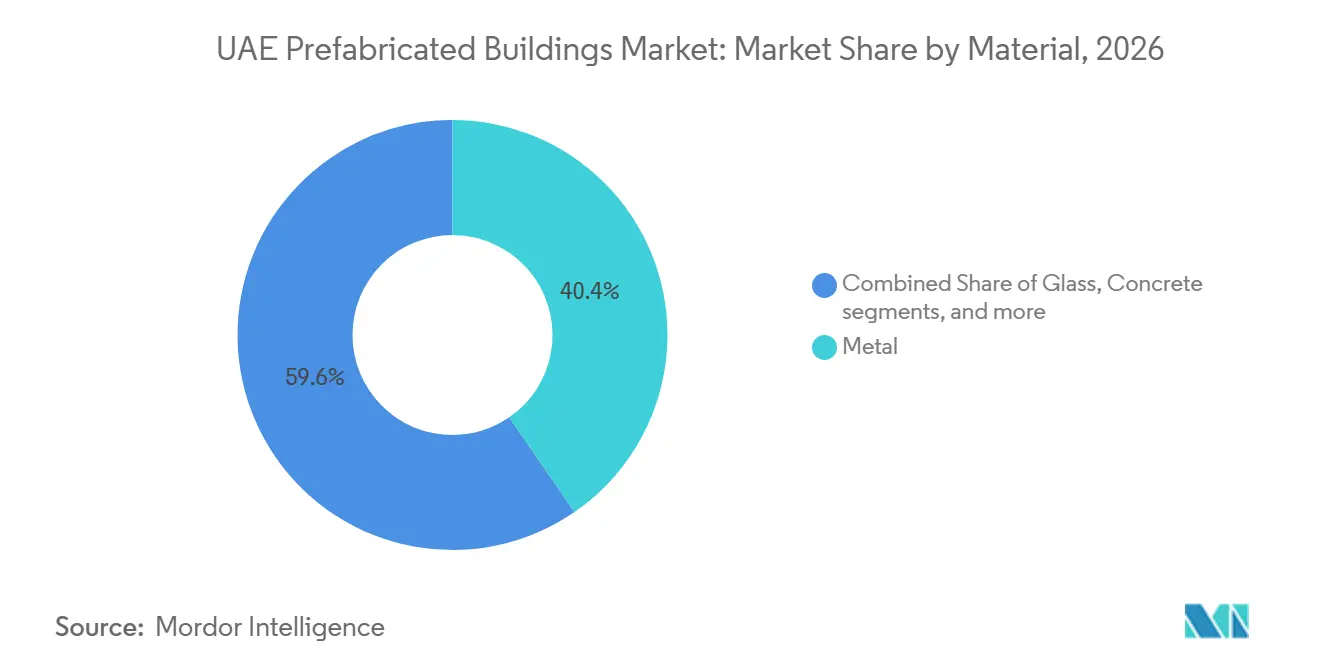
Metal Anchors Volume While Timber Attracts Innovation CapitalMetal held 40.4% of the UAE prefabricated buildings market in 2026, reflecting its established role in volumetric modules, pre-engineered buildings, and data center structures. Steel supports long spans and stacking requirements in residential and hospitality projects, while also tolerating precise factory finishing for service-heavy buildings. Concrete remains important for foundations, infrastructure, and large precast components. SafeTech contributes annual output exceeding 700,000 cubic meters from its new facility. Glass and other materials continue to serve façades and specialized building elements.
Timber is the fastest-growing material category, with a projected 7.51% CAGR from 2027 to 2032. DesertBoard used 3,000 cubic meters of Palm Strand Board in Select Group residential projects during February 2026. Its local panels offer an alternative for applications that need bio-based materials. Dubai Research, Development and Innovation Program supports the Hy-PALM project, which is developing hybrid cross-laminated timber panels for modular mid-rise and high-rise buildings. The work targets EN 16351 and Eurocode 5 compliance, giving timber a wider role in the UAE prefabricated buildings market.

By Application:
Residential Leads While Others Register the Fastest GrowthResidential accounted for 35.5% of the UAE prefabricated buildings market size in 2026. Government-backed housing programs and private developer projects provide a broad base of demand. Modular bathroom units, partitions, and service components can be repeated across large villa and townhouse communities. Commercial uses include hospitality, retail, and office buildings that seek faster openings. Lantana Hills shows how off-site methods can be applied at substantial residential scale.
Others, including industrial, institutional, infrastructure, and energy projects, are projected to grow at a 7.41% CAGR through 2032. Free zone expansion, artificial intelligence data center campuses, and specialized facilities support this faster pace. PodTech completed a prefabricated cleanroom in Sharjah for a UAE space-sector client in October 2026. Its PODULE system combined air handling, building management, fire protection, and utilities in a factory-tested facility. This example shows where standardized, certified environments can offer greater value than site-built alternatives, broadening the UAE prefabricated buildings market beyond housing.
By Product Type:
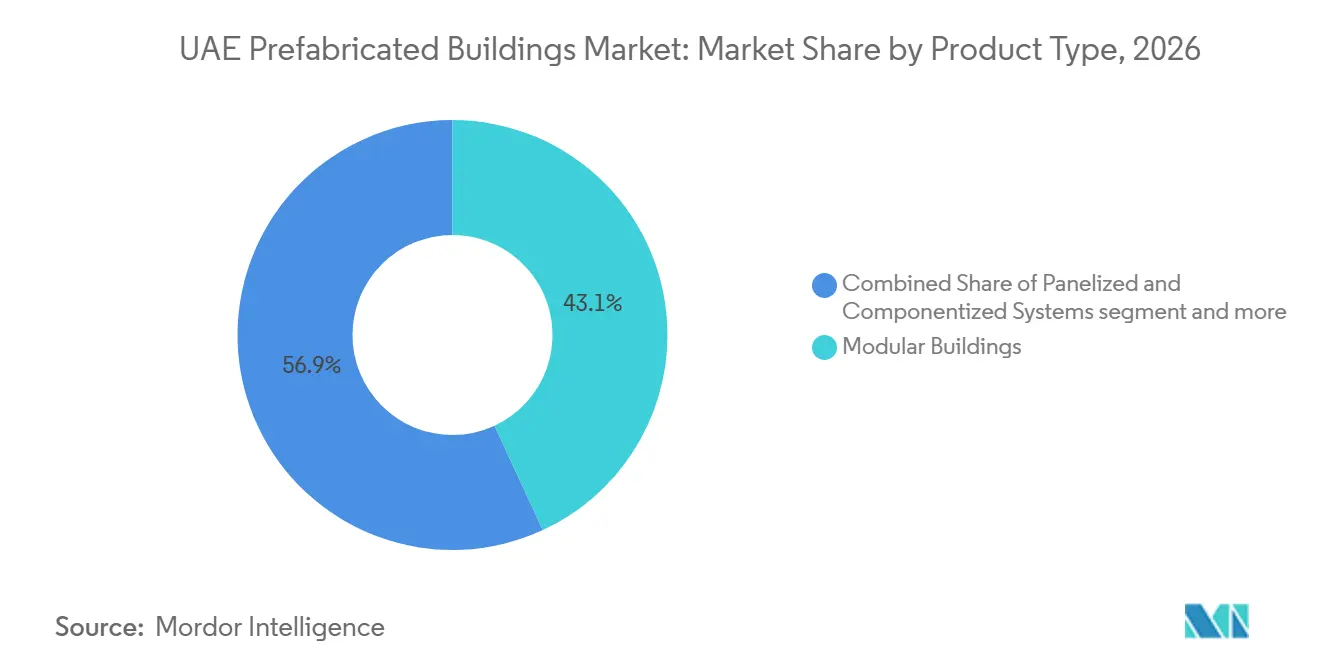
Modular Buildings Lead and Accelerate as Panelized Systems Fill a Complementary RoleModular buildings held 43.1% of the UAE prefabricated buildings market share in 2026. They use factory-finished volumes that can combine structural, interior, and service elements before delivery. LINQ Modular operates a Dubai production facility with 6 lines running around the clock. AMANA Group has deployed its DuBox platform at Lantana Hills. Developers can apply this approach to repeatable residential and hospitality layouts.
Modular buildings are also the fastest-growing product type, with a forecast CAGR of 7.69% through 2032. SIBS AB and LINQ Modular agreed in February 2026 to target at least 1,500 modular units annually across residential, commercial, and hospitality projects. Panelized and componentized systems remain important where site conditions limit the use of full volumetric units. Light-gauge steel panels can provide factory precision while allowing greater flexibility during installation. Other prefab types, including portable cabins, site offices, and cleanrooms, serve shorter-cycle and specialized needs within the UAE prefabricated buildings market.
Geography Analysis
Dubai accounted for 39.8% of the UAE prefabricated buildings market share in 2026. Residential, hospitality, and digital infrastructure construction support the emirate’s demand for factory-built systems. The emirate's modular approval environment supports the practical use of volumetric construction. The USD 185.2 million Lantana Hills contract uses DuBox and DuPod systems and targets 85% off-site completion. LINQ Modular is developing standardized townhouse units for Dubai South and Al Furjan, showing continued interest in repeatable residential systems.
Abu Dhabi is the second-largest emirate for prefabricated building demand. The prefabricated component requirement for up to 80% of housing projects is a direct procurement signal. Estidama Pearl Rating System requirements also favor approaches that reduce waste and improve resource efficiency. Data center construction creates a separate source of demand for structural shells and mechanical, electrical, and plumbing modules. This combination supports both housing and specialized infrastructure in the UAE prefabricated buildings market.
Sharjah is projected to grow at a 7.81% CAGR through 2032, the fastest rate among the emirates. The forecast reflects residential needs, industrial expansion, and a developing manufacturer cluster. Arada has completed more than 8,200 units at Aljada, while the USD 408.4 million Sakoon project involves 859 villas and townhouses with a second-quarter 2029 target. Hamriyah Free Zone helps suppliers serve industrial and temporary building needs.
Competitive Landscape
The UAE prefabricated buildings market features a mix of established integrated manufacturers and smaller specialized suppliers. DuBox/AMANA, LINQ Modular, and Sobha Modular Industries leverage proprietary building systems, manufacturing capacity, and strong developer relationships to strengthen their market positions. Smaller cabin and porta-cabin providers serve a more fragmented segment of the market. LINQ holds a Dubai Municipality modular license for structures up to G+6 and has three International Organization for Standardization (ISO) certificates covering quality, environmental, and occupational health management. These credentials can improve suppliers’ eligibility for major development projects.
Strategic partnerships are helping companies combine international manufacturing expertise with local project execution and regulatory approvals. In February 2026, LINQ Modular and SIBS AB formed a collaboration targeting annual deliveries of at least 1,500 units across the Middle East. AMANA’s Lantana Hills contract highlights its strategy of combining a proprietary modular platform with large-scale development projects. In October 2025, Saif Bin Darwish acquired Gulf Precast, integrating six factories across Dubai and Abu Dhabi and expanding its manufacturing capabilities. These developments underscore the importance of production scale and local execution in the UAE prefabricated buildings market.
Material innovation and specialized building systems provide additional opportunities for differentiation. Hy-PALM is developing palm-timber panels for modular mid-rise and high-rise buildings. Suppliers of cleanroom systems and data center components can also target projects where certification and integrated services are key purchasing considerations. Meanwhile, prefabricated construction in mid-market schools, clinics, and light industrial buildings remains a relatively underdeveloped opportunity, as procurement requirements promote off-site construction less extensively in these segments than in housing.
UAE Prefabricated Buildings Industry Leaders
-
DuBox/AMANA
-
LINQ Modular
-
ALEC Holdings
-
Sobha Modular Industries
-
Speed House
- *Disclaimer: Major Players sorted in no particular order
UAE Prefabricated Buildings Market Companies Covered in this Report
- DuBox/AMANA
- LINQ Modular
- ALEC Holdings
- Sobha Modular Industries
- Speed House
- SafeTech
- China State Construction Engineering Corporation
- Emirates Building Systems
- Emirates Precast Construction LLC
- Emirates International Modular Construction LLC
- BKG Modular Systems LLC
- Accent
- AXON Tec Prefab Solutions
- Bait Al Jazeera Prefab House
- GREEN PREFAB
- Global Prefab General Contracting LLC
- Modest Company
- Al Masaood Bergum
- Trojan Holding LLC
- Mammut Building Systems FZC
Recent Industry Developments in UAE Prefabricated Buildings Market
- October 2026: PodTech completed a prefabricated cleanroom facility in Sharjah for a UAE space sector client, using the PODULE system with self-contained air handling, BMS, fire protection, and utility distribution. Factory pre-acceptance testing compressed the project schedule by up to 50% compared with traditional construction.
- May 2026: Dubai Holding Asset Management awarded AMANA Group a USD 185.2 million contract for Lantana Hills, 390 townhouses in Al Barsha South, Dubai. The project deploys 2,730 DuBox modular units and 2,020 DuPod bathroom units with 85% off-site construction, LEED Silver pre-certification, and a second-half 2027 delivery target.
- May 2026: Hi-Tech Concrete Products, part of Trojan Holding, signed an operational management agreement with Abu Dhabi International Pre-Cast Plant covering precast facilities in Al Ain spanning 179,878 square meters.
UAE Prefabricated Buildings Market Report Scope
Segmentation Overview
| Concrete |
| Glass |
| Metal |
| Timber |
| Other Materials |
| Residential |
| Commercial |
| Others, Including Industrial, Institutional, Infrastructure, and Energy |
| Modular Buildings |
| Panelized and Componentized Systems |
| Other Prefab Types |
| Dubai |
| Abu Dhabi |
| Sharjah |
| Ras Al Khaimah |
| Rest of the United Arab Emirates |
| By Material | Concrete |
| Glass | |
| Metal | |
| Timber | |
| Other Materials | |
| By Application | Residential |
| Commercial | |
| Others, Including Industrial, Institutional, Infrastructure, and Energy | |
| By Product Type | Modular Buildings |
| Panelized and Componentized Systems | |
| Other Prefab Types | |
| By Emirate | Dubai |
| Abu Dhabi | |
| Sharjah | |
| Ras Al Khaimah | |
| Rest of the United Arab Emirates |
Key Questions Answered in the Report
What is the forecast growth rate for UAE prefabricated buildings?
The UAE prefabricated buildings market is projected to grow at a 6.54% CAGR from 2027 to 2032. This outlook reflects wider use of factory-built systems across major projects.
Which material leads prefabricated building demand in the UAE?
Metal leads with a 40.4% share in 2026, supported by its use in modular units, pre-engineered buildings, and specialized structures. Timber is the fastest-growing material category at a 7.51% CAGR.
Which prefabricated product type is growing fastest in the UAE?
Modular buildings lead with a 43.1% share in 2026 and have the highest projected CAGR of 7.69% through 2032. Panelized systems remain relevant where full modules are impractical.
Which application has the largest share in UAE prefabricated buildings?
Residential applications hold a 35.5% share in 2026, supported by large housing programs and developer-led communities. Others are the fastest-growing application grouping at a 7.41% CAGR.
Which emirate has the strongest demand for prefabricated buildings?
Dubai leads with a 39.8% share in 2026, while Sharjah is projected to record the fastest CAGR of 7.81% through 2032. Abu Dhabi also has a procurement requirement for prefabricated housing components.
What is driving use of modular construction in the UAE?
Government procurement requirements, housing delivery needs, faster construction schedules, and lower-waste construction practices are key drivers. Local factory capacity and approvals also shape adoption.