
UAE Farm Implements Market Size and Share
Market Overview
| Study Period | 2022 - 2032 |
|---|---|
| Forecast Data Period | 2027 - 2032 |
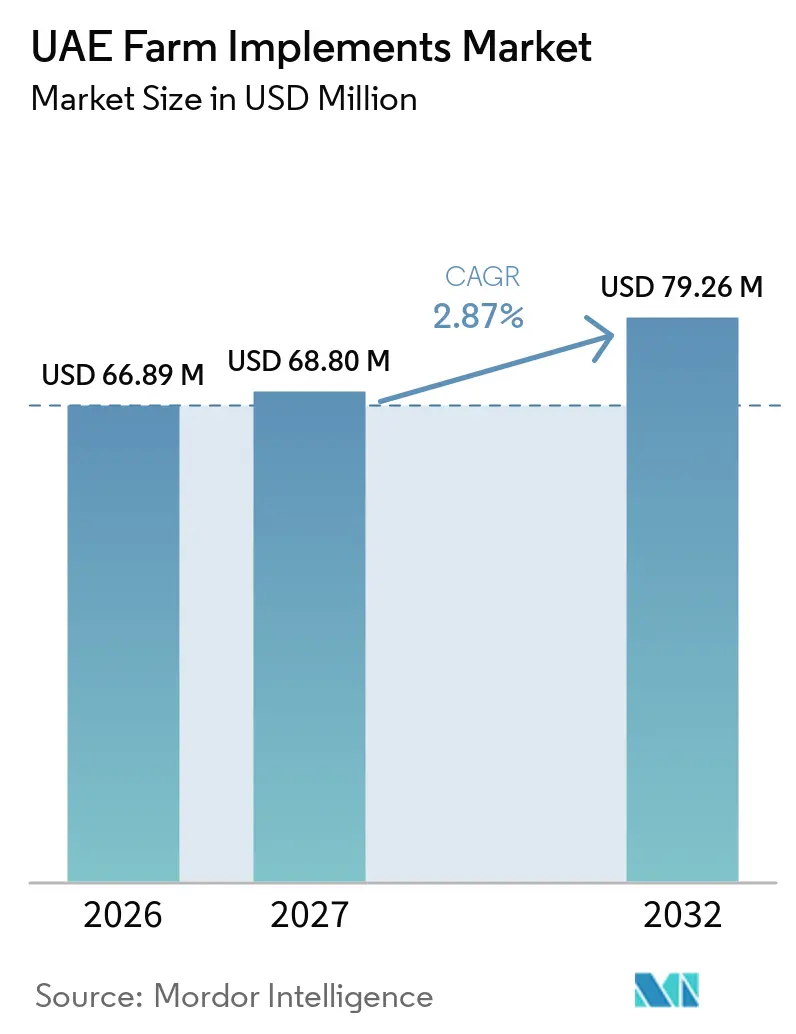
| Base Year Market Size (2026) | USD 66.89 Million |
| Market Size (2027) | USD 68.80 Million |
| Market Size (2032) | USD 79.26 Million |
| Growth Rate (2027 - 2032) | 2.87 % |
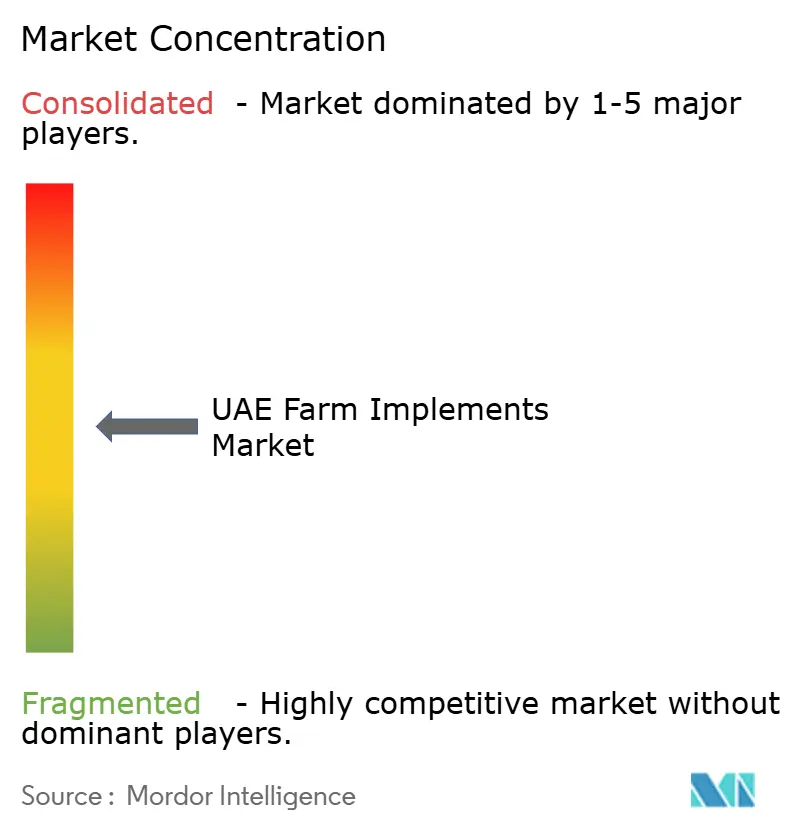
| Market Concentration | Medium |
Major Players *Disclaimer: Major Players sorted in no particular order Image © Mordor Intelligence. Reuse requires attribution under CC BY 4.0. | |
UAE Farm Implements Market Analysis by Mordor Intelligence
The UAE farm implements market size was USD 66.89 million in 2026 and is forecast to grow from USD 68.80 million in 2027 to USD 79.26 million by 2032, at a CAGR of 2.87% from 2027 to 2032. Food security policy supports demand, as domestic production goals require farms to use equipment that improves output and resource efficiency. Limited arable land and water scarcity make compact, efficient equipment more relevant than high-volume equipment designed for large farms. Controlled-environment farming, precision irrigation, and mechanized crop management are driving procurement toward connected, specialized implements. The UAE farm implements market is also heavily dependent on imported equipment, making procurement costs and spare parts availability key considerations for buyers. Dealers can strengthen their position through service coverage, spare-parts availability, training, and tractor-implement packages rather than through price competition alone.
Key Report Takeaways
- By product type, tractors accounted for 31% of the UAE farm implements market share in 2026, while precision and autonomous implements are forecast to grow at a CAGR of 10% from 2027 to 2032.
- By mode of operation, powered implements accounted for 68% of the UAE farm implements market size in 2026 and are forecast to grow at a CAGR of 6.2% from 2027 to 2032.
- By power output, below 30 HP equipment accounted for 34% of the market share in 2026, while above 130 HP equipment is forecast to grow at a CAGR of 7% from 2027 to 2032.
Note: Market numbers in this report are based on Mordor Intelligence's proprietary estimation framework, which combines nine months of actuals with Q4 projections for base year 2026.
Market Trends and Insights
Drivers Impact Analysis of UAE Farm Implements Market*
| Driver | (~) % Impact on CAGR Forecast | Geographic Relevance | Impact Timeline |
|---|---|---|---|
| Food Security and Domestic Production Mandates | +0.65% | UAE-wide, concentrated in Abu Dhabi, Al Ain, Al Dhafra, and Ras Al Khaimah agricultural zones | Medium term (2-4 years) |
| Arid Climate Demand for Water-Efficient Implements | +0.55% | Abu Dhabi, Ras Al Khaimah, Sharjah, and Fujairah agricultural belts | Long term (≥ 4 years) |
| Controlled Environment and Protected Agriculture Expansion | +0.45% | Abu Dhabi, Dubai Food Tech Valley, and the Northern Emirates | Medium term (2-4 years) |
| Precision Agriculture and Variable Rate Application | +0.40% | Abu Dhabi and Dubai, with early adoption in Ras Al Khaimah | Medium term (2-4 years) |
| Mechanization to Replace Manual Labor | +0.35% | UAE-wide | Short term (≤ 2 years) |
| Dealer Bundling of Tractors and Implements | +0.25% | UAE-wide, with the greatest dealer presence in Abu Dhabi and Dubai | Short term (≤ 2 years) |
| Source: Mordor Intelligence | |||
Food Security and Domestic Production Mandates
Federal food security measures support demand for farm equipment across the UAE. The National Food Security Strategy 2051 aims to enhance local food production through modern technologies, promote sustainable agricultural practices, and strengthen the resilience of domestic food supply chains. These objectives encourage improvements in farm productivity and resource efficiency[1]. The Ministry of Climate Change and Environment (MOCCAE), in collaboration with the International Center for Biosaline Agriculture (ICBA), launched the National Agricultural Initiative for the Adoption of Climate-Smart Crops in April 2026. The initiative includes field trials across 45 farms, farmer training, and plans for commercial expansion of climate-adaptive crops[2]. These activities can support demand for agricultural equipment used in soil preparation, planting, irrigation, and crop management. Institutional agritech projects can also create equipment procurement opportunities through organized farm development and commercial agricultural expansion, complementing demand from individual farms.
Arid Climate Demand for Water-Efficient Implements
Water management remains central to equipment selection in the UAE farm implements market. Agriculture accounted for nearly half of the country’s annual freshwater withdrawals, while groundwater made up more than 90% of the conventional water supply.[3] This environment favors drip-compatible tools, precision spray systems, and sensor-linked field controllers. Farms in Al Dhafra, Ras Al Khaimah, and Al Dhaid face pressure to move away from less efficient irrigation methods. In 2025, United Arab Emirates University (UAEU) researchers developed an AI-enabled falaj irrigation controller with soil-moisture sensors, remote access, and real-time alerts. Equipment suppliers that match products to desert water conditions are better positioned to address local farm requirements.
Controlled Environment and Protected Agriculture Expansion
Controlled-environment agriculture is expanding the need for specialized farm equipment. These projects can increase demand for specialized equipment, including compact harvesting systems, precision nutrient-delivery equipment, and climate-integrated seeding platforms. Silal and Shouguang Vegetable Industry Group agreed in May 2025 to develop a 100,000-square-meter smart agritech hub in Al Ain. The project included AED 120 million (USD 32.7 million) of investment and planned robotic harvesting, precision drip irrigation, and automated climate control across more than 10 crop varieties. Silal’s Innovation Oasis also entered a December 2025 collaboration with Square Roots for an AI-enabled controlled-climate research facility in Al Ain. The growth of these facilities broadens demand beyond conventional field implements.
Precision Agriculture and Variable Rate Application
Precision equipment is growing faster than the broader UAE farm-implements market. Adoption is supported by policy programs, labor constraints, and a developing local technology base. Agro Solution Global signed a USD 2.6 million agreement with UAE-based Alfafa Agriculture for the second-phase expansion of a strawberry production smart farm. The agreement follows a USD 800,000 pilot project conducted in 2024 and covers the supply of vertical-farming equipment for strawberry cultivation and the transfer of cultivation expertise. This development reflects investment in specialized agricultural production systems, although it does not directly establish demand for variable-rate application equipment. Large greenhouse operators and government-backed agricultural projects can provide an initial customer base for connected and precision equipment, while broader adoption among smallholders will depend on affordability and demonstrated productivity benefits.
Restraints Impact Analysis of UAE Farm Implements Market*
| Restraint | (~) % Impact on CAGR Forecast | Geographic Relevance | Impact Timeline |
|---|---|---|---|
| Limited Arable Land and Small Farm Operating Footprints | -0.45% | UAE-wide, most acute in Dubai, Ajman, and Umm Al Quwain | Long term (≥ 4 years) |
| High Equipment and Financing Costs | -0.40% | UAE-wide, especially smallholder farms in the Northern Emirates | Medium term (2-4 years) |
| Import Dependence and Spare Parts Lead Times | -0.30% | UAE-wide, with greater logistical exposure in Fujairah and Ras Al Khaimah | Short term (≤ 2 years) |
| Compatibility and Operator Skills Gaps | -0.25% | UAE-wide, especially dispersed smallholder farms in Abu Dhabi | Short term (≤ 2 years) |
| Source: Mordor Intelligence | |||
Limited Arable Land and Small Farm Operating Footprints
Arable land accounted for approximately 0.8% of the UAE's total land area in 2023, reflecting the limited availability of land suitable for conventional crop cultivation. Smaller farm parcels can reduce the economic justification for large, high-throughput equipment, particularly where operations involve orchards, greenhouses, and date-palm cultivation. Buyers operating smaller plots may therefore favor rental, shared-use, or custom-hire models over outright purchases. Compact tractor and implement combinations are better suited to operations with limited working areas. These factors can constrain demand for large-capacity equipment in the UAE farm implements market.
High Equipment and Financing Costs
Equipment prices reflect shipping costs, import conformity requirements, distributor and dealer margins. Precision systems also generate recurring expenses for GPS calibration, sensor replacement, and software updates. These costs are difficult for smaller vegetable and forage farms to include in operating budgets. Financing further weakens the case for multi-implement purchases where farm margins are limited. Lease-to-own and equipment-as-a-service offerings can reduce the upfront purchase barrier, but adoption of these models may remain limited among smallholder farms.
*Our forecasts treat driver/restraint impacts as directional, not additive. The impact forecasts reflect baseline growth, mix effects, and variable interactions.
UAE Farm Implements Market Segment Analysis
By Product Type:
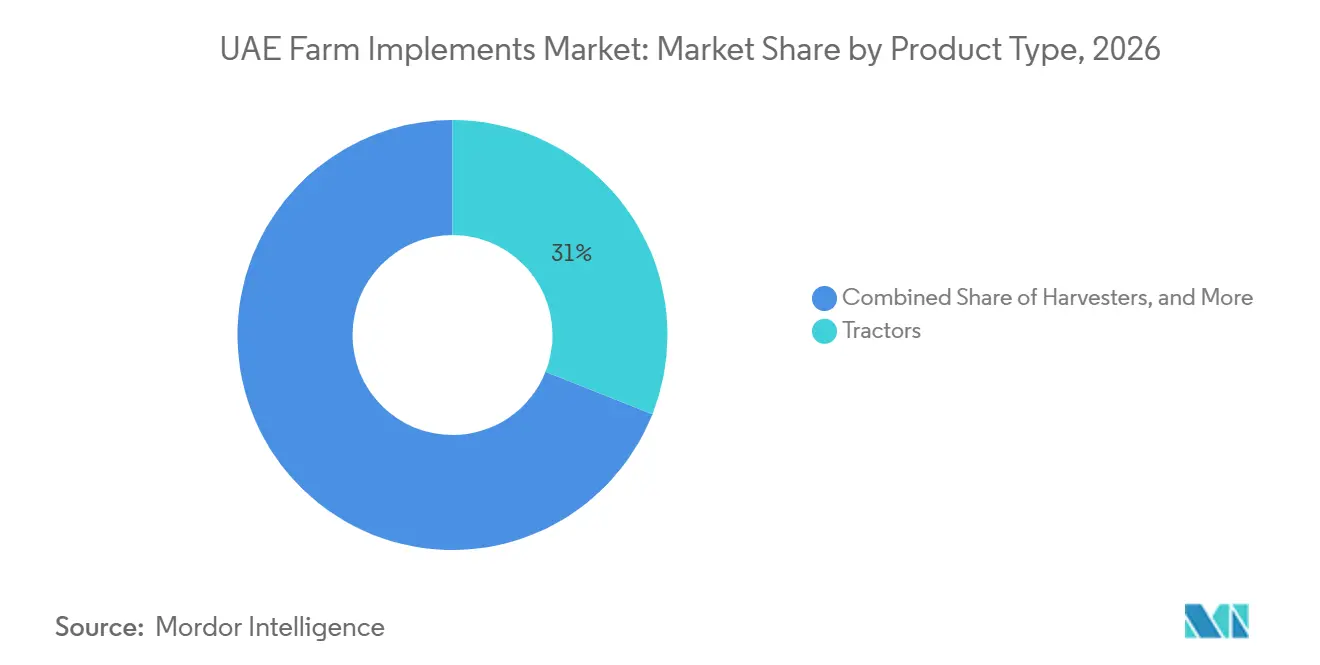
Tractors Support Core Demand While Precision Equipment Expands FastTractors accounted for 31% of the UAE farm implements market share in 2026. They provide the power base for rotavators, disc plows, sprayers, and seed drills. Dealers often bundle tractors with attachments and after-sales support to improve equipment utilization and service retention. Harvesters, soil preparation equipment, and planting, seeding, and fertilizing equipment serve open-field farms in Al Ain and Ras Al Khaimah. Irrigation and crop-protection equipment has gained attention as farms shift toward water-efficient systems. Haying and forage equipment supports livestock-linked operations and specialty horticulture.
Precision and autonomous implements are forecast to grow at a 10% CAGR from 2027 to 2032. GPS-guided sprayers, variable-rate seeding platforms, and drone-compatible monitoring attachments align with food security programs and resource-efficient production. Demand for this equipment category is supported by procurement from larger farms and controlled-environment operators. These buyers can use the equipment more frequently and can support the related service requirements. Conventional equipment remains necessary for field preparation and crop handling. The product mix is therefore changing without displacing the central role of tractors.

By Mode of Operation:
Powered Equipment Gains with Mechanized Farm OperationsPowered implements accounted for 68% of the UAE farm implements market share in 2026 and are forecast to grow at a 6.2% CAGR from 2027 to 2032. The segment includes PTO-driven, hydraulic, and electromechanically controlled equipment. Higher labor costs make mechanized operations more important for repetitive farm tasks. Powered implements can reduce manual effort, improve consistency in work, and support the timely completion of field operations. Connected and electronically controlled equipment can also facilitate digital monitoring and precision farm management.
Unpowered implements continue to serve smallholders and community farm operators due to their relatively low purchase costs and simpler operating requirements. Basic tillage tools, manually actuated trailers, and simple seeders remain suitable for smaller-scale operations. However, their operational limitations become more apparent where farms require higher productivity, greater operational consistency, or data-enabled management. In February 2025, AGCO Corporation and SDF Group agreed that SDF Group would manufacture low-to-mid-horsepower tractors for the Massey Ferguson brand. The arrangement expands AGCO's manufacturing collaboration for this tractor range, although its implications for UAE equipment availability and pricing remain to be established. The UAE farm implements market is likely to retain demand for both modes of operation, with powered implements serving mechanized and productivity-focused farms while unpowered tools remain relevant to smaller operations.
By Power Output:
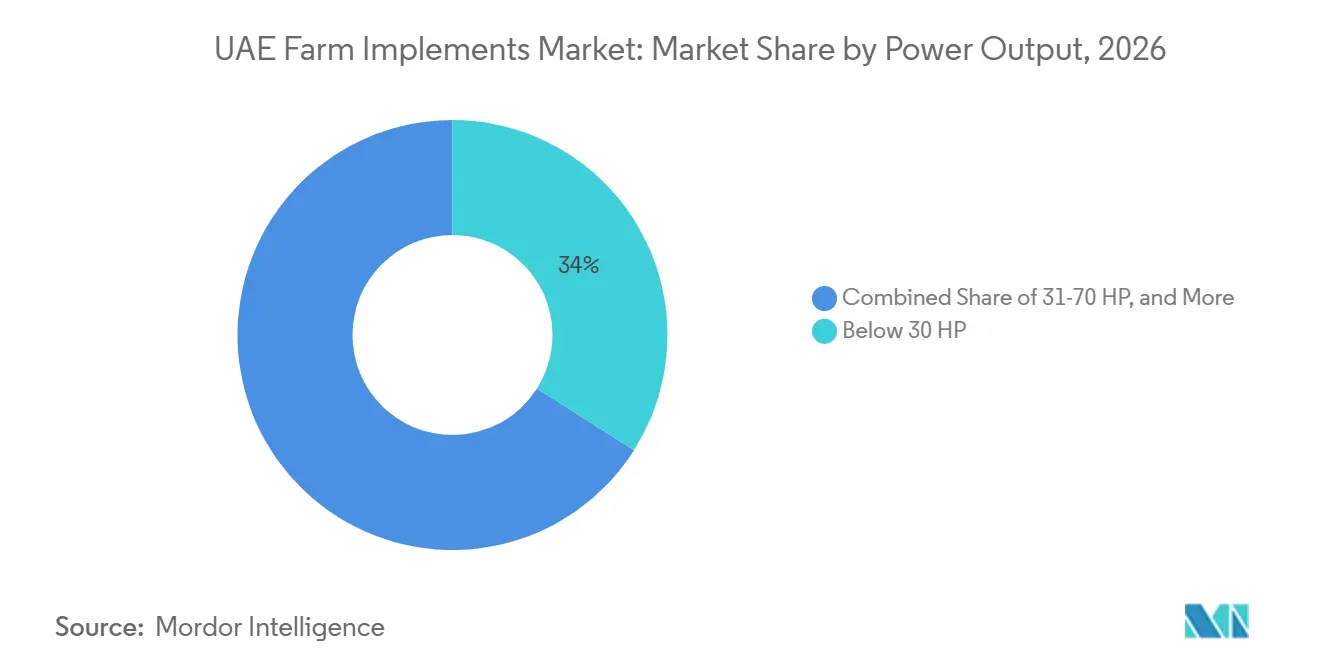
Compact Equipment Leads While High Power Equipment Gains DemandBelow 30 HP equipment accounted for 34% of the market share in 2026. Small rotavators, compact disc plows, orchard sprayers, and bed formers are well-suited to the country’s small plots, greenhouses, and date-palm gardens. Compact machines offer maneuverability where high horsepower provides limited value. The 31-70 HP and 71-130 HP categories serve larger vegetable farms in Al Ain and Ras Al Khaimah. These farms purchase soil preparation and seeding equipment around seasonal cultivation cycles. Dealer bundles have helped build the installed base of compact tractors and compatible attachments.
Above 130 HP equipment is forecast to grow at a 7% CAGR from 2027 to 2032. Larger greenhouse facilities, government-contracted fodder farms, and agritech hubs require higher throughput for primary tillage and harvesting. The UAE farm implements market size for higher power systems is supported by a limited number of larger projects rather than broad farm adoption. ISO 11783 compatibility is also becoming more relevant where buyers need tractors and implements to exchange operational data. Compact equipment will remain the larger base because most farms have smaller operating footprints.
Geography Analysis
Abu Dhabi’s agricultural sector is supported by an institutional ecosystem centered on the Abu Dhabi Agriculture and Food Safety Authority (ADAFSA). Its project pipeline includes the Al Ain smart agritech hub and agricultural photovoltaic activity at Al Foah Farm. These developments support the emirate’s agricultural modernization efforts and can create opportunities for the adoption of mechanized equipment and digital farm management systems.
Dubai’s role is based more on logistics and commercial innovation than on farm area. Jebel Ali Port and its free zone act as a major import gateway for agricultural equipment. The GigaFarm project at Food Tech Valley, developed by ReFarm Global and Intelligent Growth Solutions (IGS), is planned as a 200-tower vertical farming facility on a 900,000-square-foot site, with a designed annual production capacity of more than 3 million kilograms. In June 2026, IGS reported that construction was underway, with the first phase comprising 20 towers. Sharjah’s Al Dhaid agricultural belt supports demand for compact soil preparation and irrigation equipment, while its annual agricultural exhibition connects equipment suppliers with local buyers.
Ras Al Khaimah is emerging as a location for mechanized open-field production. Silal and the National Agricultural Center launched a farmer-support initiative in Al Hamraniyah in March 2026. Fujairah's terraced farms can create demand for slope-adapted tillage and spraying equipment. Ajman and Umm Al Quwain contribute mainly through smallholder demand. Indian-origin compact tractor packages are relevant in these northern markets due to their lower purchase costs.
Competitive Landscape
The UAE farm implements market is moderately concentrated in 2026, with Deere & Company, CNH Industrial N.V., AGCO Corporation, Kubota Corporation, and Al Shirawi Enterprises among the prominent market participants. The remaining market is served by Indian-origin brands, European specialists, Chinese entrants, and local distributors. Competition depends heavily on dealer reach and spare parts availability. After-sales service is also important, as equipment downtime can disrupt time-sensitive farm operations.
Al Shirawi Enterprises has represented CASE IH since 1998, highlighting the importance of established distribution and service networks in the UAE. Global manufacturers are also adjusting supply arrangements to address demand for lower-priced equipment. AGCO Corporation’s February 2025 agreement with SDF Group covers low-to-mid HP tractors for the Massey Ferguson brand. CNH Industrial N.V. has also announced an investment in India for tractors and crop solutions. These developments reflect manufacturers' efforts to strengthen tractor supply and address demand for lower-cost equipment.
Opportunities remain in compact precision equipment for greenhouse and orchard applications. Leasing, rental, and equipment-as-a-service models can serve buyers who cannot justify a full purchase. Tractors and Farm Equipment Limited (TAFE) and AgroAsia Tractors offer equipment packages at lower prices than many European alternatives, including disc plows, rotavators, harrows, and trailers for farms in the Northern Emirates. Connected retrofit attachments can add data capability to conventional implements. Company strategies must balance technical features with local service coverage and operator support.
UAE Farm Implements Industry Leaders
-
Deere & Company
-
CNH Industrial N.V.
-
AGCO Corporation
-
Kubota Corporation
-
Al Shirawi Enterprises
- *Disclaimer: Major Players sorted in no particular order
UAE Farm Implements Market Companies Covered in this Report
- Deere & Company
- CNH Industrial N.V.
- AGCO Corporation
- Kubota Corporation
- Mahindra & Mahindra Limited
- CLAAS KGaA mbH
- Yanmar Holdings Co., Ltd.
- J.C. Bamford Excavators Ltd. (JCB Group)
- SDF Group
- KUHN Group (Bucher Industries AG)
- HORSCH Maschinen GmbH
- Al Shirawi Enterprises
- AgroAsia Tractors
- AECO Tractors
- Tractors and Farm Equipment Limited (TAFE)
Recent Industry Developments in UAE Farm Implements Market
- July 2026: Agro Solution Global signed a USD 2.6 million agreement with UAE-based Alfafa Agriculture for the second-phase expansion of a strawberry-production smart farm. The agreement covers the supply of vertical-farming equipment and the transfer of cultivation expertise, following an USD 800,000 pilot project in 2024. The deal was facilitated through KOTRA's Dubai office.
- June 2026: Silal Group and Dutch agricultural consultancy Delphy signed a strategic collaboration to design and deliver agricultural training and capacity-building programs across the UAE over an initial five-year period. The collaboration covers open-field and protected-crop cultivation, including advanced greenhouse and hydroponic systems, along with knowledge transfer and farm business development.
- February 2025: AGCO Corporation and SDF Group signed a global supply agreement under which SDF will manufacture tractors with outputs of up to 85 HP for the Massey Ferguson brand. The agreement covers most global markets, with the phased introduction of the new tractor range beginning in mid-2025.
UAE Farm Implements Market Report Scope
The farm implements market refers to agricultural machinery and equipment used to support and mechanize various farming operations.
The UAE Farm Implements Market is Segmented by Product Type (Tractors, Harvesters, Soil Preparation and Cultivation Equipment, Planting, Seeding, and Fertilizing Equipment, Irrigation and Crop-Protection Implements, Precision and Autonomous Implements, Haying and Forage Equipment, and Other Implements), by Mode of Operation (Powered Implements and Unpowered Implements), and by Power Output (Below 30 HP, 31-70 HP, 71-130 HP, and Above 130 HP). The Market Forecasts are Provided in Terms of Value (USD).
Segmentation Overview
| Tractors |
| Harvesters |
| Soil Preparation and Cultivation Equipment |
| Planting, Seeding, and Fertilizing Equipment |
| Irrigation and Crop-Protection Implements |
| Precision and Autonomous Implements |
| Haying and Forage Equipment |
| Other Implements |
| Powered Implements |
| Unpowered Implements |
| Below 30 HP |
| 31-70 HP |
| 71-130 HP |
| Above 130 HP |
| By Product Type | Tractors |
| Harvesters | |
| Soil Preparation and Cultivation Equipment | |
| Planting, Seeding, and Fertilizing Equipment | |
| Irrigation and Crop-Protection Implements | |
| Precision and Autonomous Implements | |
| Haying and Forage Equipment | |
| Other Implements | |
| By Mode of Operation | Powered Implements |
| Unpowered Implements | |
| By Power Output | Below 30 HP |
| 31-70 HP | |
| 71-130 HP | |
| Above 130 HP |
Key Questions Answered in the Report
What is the size of the UAE farm implements market?
The UAE farm implements market size was USD 66.89 million in 2026 and is forecast to grow from USD 68.80 million in 2027 to USD 79.26 million by 2032, at a CAGR of 2.87% from 2027 to 2032.
What supports equipment demand in the UAE?
Food security measures, water-efficient farming, controlled-environment projects, and mechanized operations support equipment purchases.
Which product category leads UAE farm equipment sales?
Tractors accounted for 31% of market share in 2026. Precision and autonomous equipment is the fastest-growing product category at a CAGR of 10% from 2027 to 2032.
Why are compact farm implements important in the UAE?
Below 30 HP equipment accounted for 34% of market share in 2026 because compact machines suit orchards, greenhouses, date-palm gardens, and smaller farm plots.
What can limit the adoption of farm equipment in the UAE?
Small farm footprints, high ownership costs, import reliance, and a shortage of trained operators can limit adoption.