
Triathlon Clothing Market Size and Share
Market Overview
| Study Period | 2022 - 2032 |
|---|---|
| Market Size (2027) | USD 2.91 Billion |
| Market Size (2032) | USD 4.37 Billion |
| Growth Rate (2027 - 2032) | 8.45 % |
| Fastest Growing Market | Asia-Pacific |
| Largest Market | North America |
| Market Concentration | Medium |
Major Players *Disclaimer: Major Players sorted in no particular order Image © Mordor Intelligence. Reuse requires attribution under CC BY 4.0. | |
Triathlon Clothing Market Analysis by Mordor Intelligence
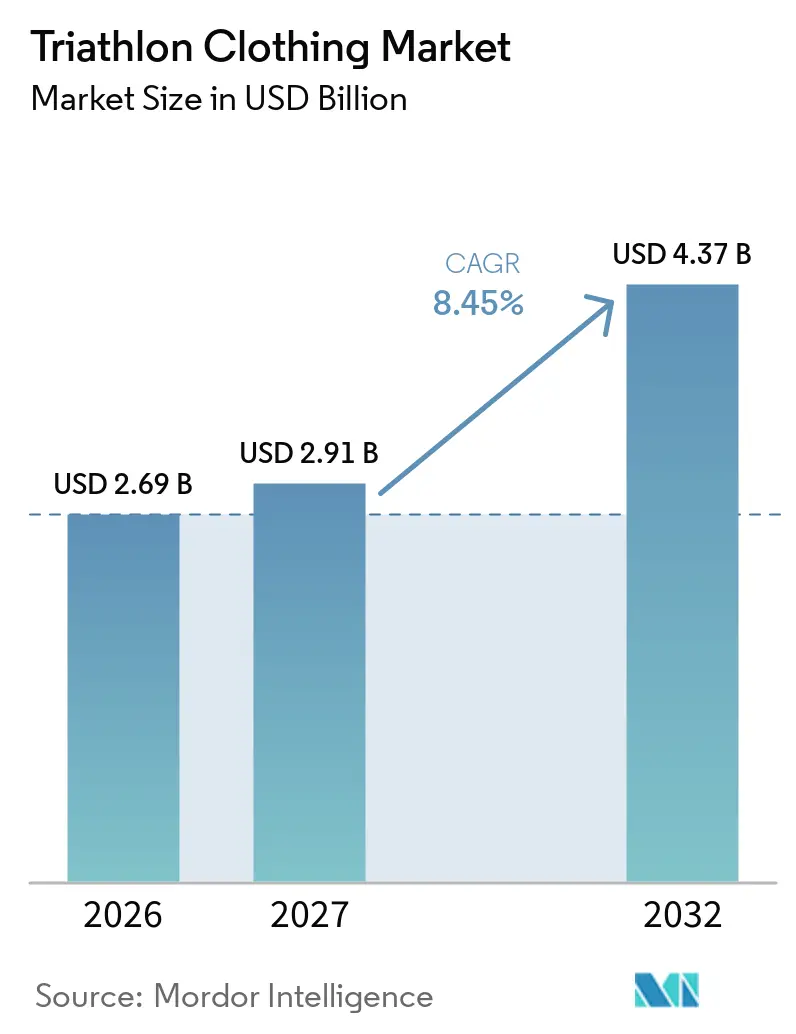
The Triathlon clothing market size was valued at USD 2.69 billion in 2026 and is estimated to grow to reach USD 4.37 billion by 2032, at a CAGR of 8.45% during the forecast period (2027-2032). The Triathlon clothing market is supported by higher race participation, especially among new and younger entrants, and IRONMAN reported more than 250,000 registrations across 148 events globally in 2025 while first-time entries rose 10% from the prior year. Each new participant needs clothing suitable for swimming, cycling, running, and transitions, which supports first purchases and later upgrades, while technical design, digital purchasing, and more race activity in Asia-Pacific are shaping brand and channel decisions in the Triathlon clothing market. Price sensitivity remains a constraint for new athletes, who may choose general cycling or swimming apparel rather than dedicated products, but the strongest commercial opportunity lies in helping a participant progress from a first event into regular training and later competition rather than treating the initial sale as the full customer relationship. Race participation can create a clear need for clothing, but it does not automatically create understanding of why specialized construction matters, particularly as participation becomes younger and more digitally informed while physical fitting and race-expo contact remain important for products with complex fit requirements.
Key Report Takeaways
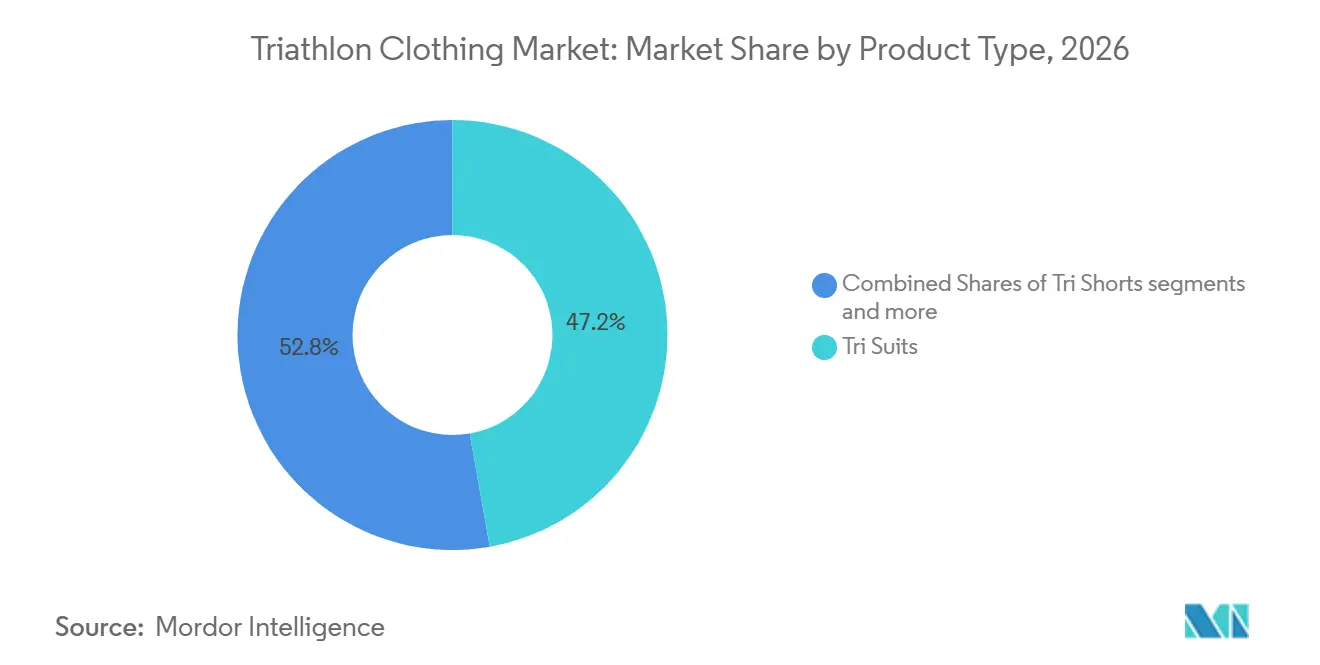
- By product type, Tri Suits held 47.23% of the Triathlon clothing market share in 2026, while Tri Shorts are forecast to grow at a 10.92% CAGR through 2032.
- By sports type, Cycling accounted for 36.12% of revenue in 2026, while Swimming is forecast to grow at a 10.72% CAGR through 2032.
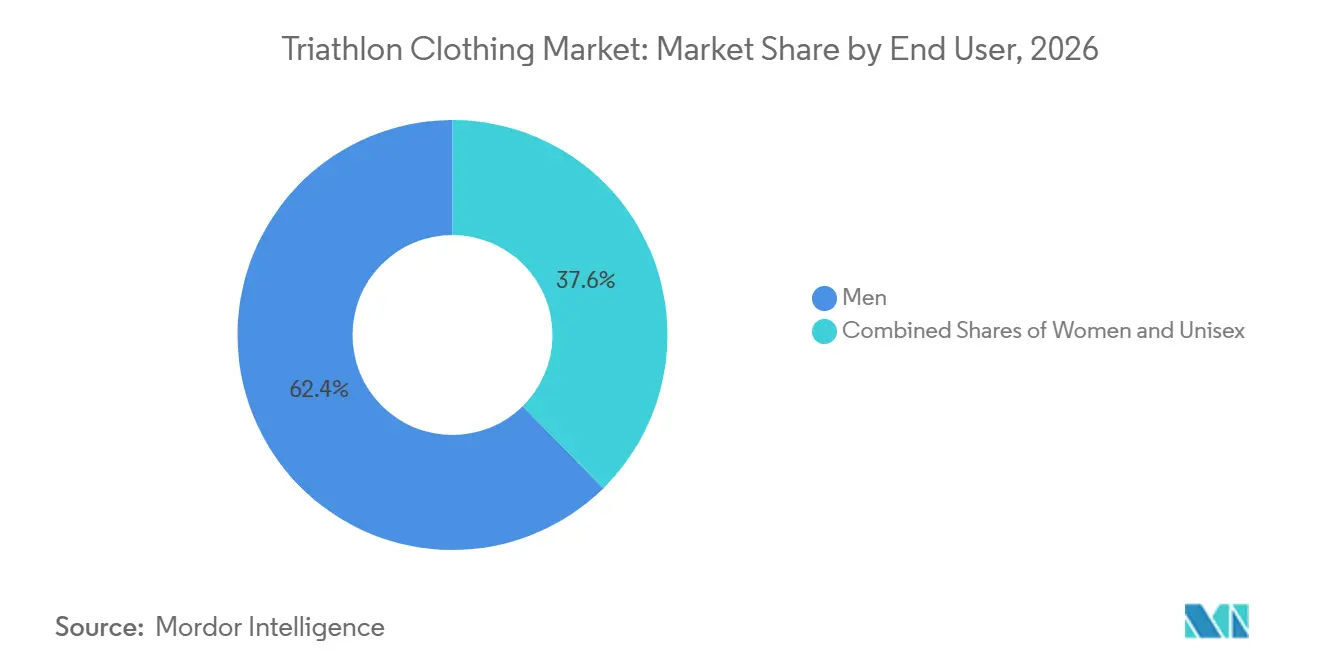
- By end user, Men held 62.38% of revenue in 2026, while Unisex is forecast to grow at an 11.27% CAGR through 2032.
- By distribution channel, Offline Stores accounted for 78.46% of revenue in 2026, while Online Stores are forecast to grow at a 10.78% CAGR through 2032.
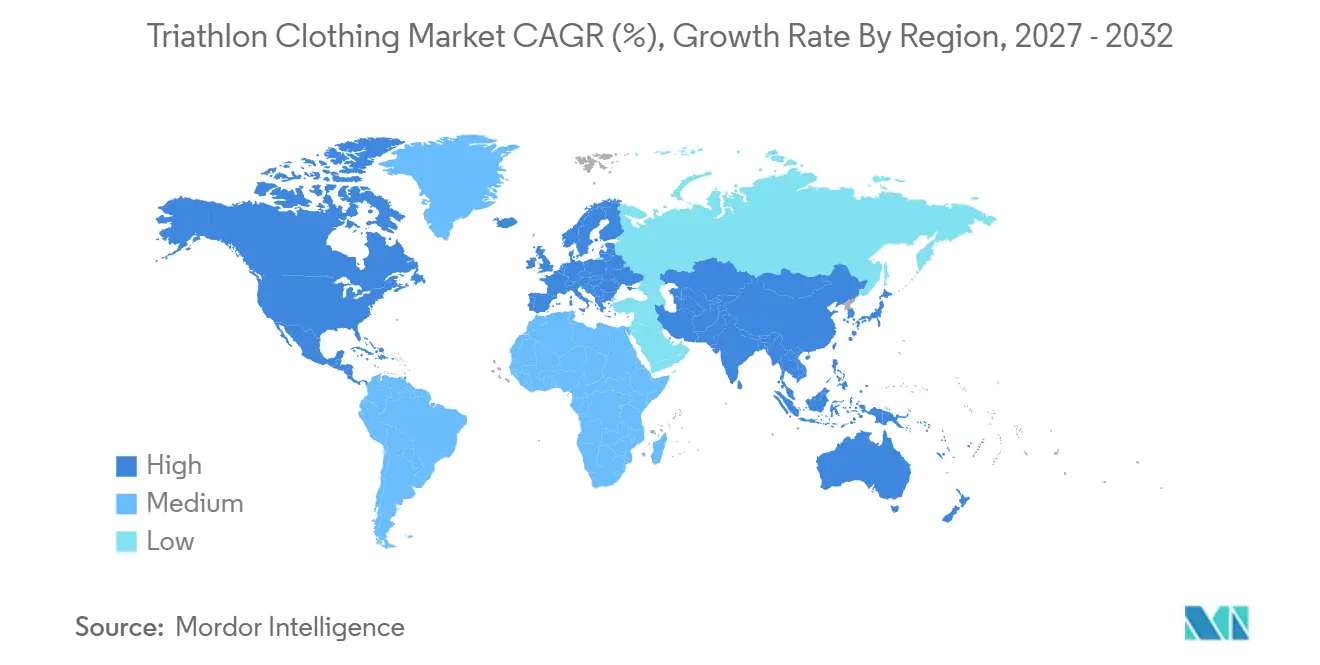
- By geography, North America held 36.26% of revenue in 2026, while Asia-Pacific is forecast to grow at a 10.15% CAGR through 2032.
Note: Market numbers in this report are based on Mordor Intelligence's proprietary estimation framework, which combines nine months of actuals with Q4 projections for base year 2026.
Global Triathlon Clothing Market Trends and Insights
Drivers Impact Analysis*
| Driver | (~) % Impact on CAGR Forecasts | Geographic Relevance | Impact Timeline |
|---|---|---|---|
| Increasing participation in triathlon and endurance sports | +2.2% | Global | Short term (≤ 2 years) |
| Greater awareness of health, fitness, and active lifestyles | +1.6% | Global | Medium term (2–4 years) |
| Strong demand for high-performance and technical sportswear | +1.3% | North America & EU | Medium term (2–4 years) |
| Technological advancements in lightweight and aerodynamic fabrics | +1.0% | Global | Long term (≥ 4 years) |
| Rising popularity of amateur and recreational triathlon events | +0.9% | North America & Asia-Pacific | Medium term (2–4 years) |
| Growing premiumization of specialized athletic clothing | +0.7% | North America & EU | Long term (≥ 4 years) |
| Source: Mordor Intelligence | |||
Increasing Participation in Triathlon and Endurance Sports
Event registrations are creating repeat apparel purchasing cycles across price levels in the Triathlon clothing market. USA Triathlon reported 303,000 unique active members in 2025, and the 20-29 age group grew by nearly 20%, with 2 out of 3 of those members new to the sport[1]. The same report found that 73% of participants raced shorter formats, which can increase first purchases of specialized clothing. New athletes enter the category with entry-level needs, while returning athletes can move toward higher-performance suits. This creates demand across product price points rather than only at the premium end. The Triathlon clothing market therefore benefits from both a broader participation base and repeat replacement demand, because a participant’s needs can change as race distances, training frequency, and familiarity with specialist equipment develop. Entry-level buyers may begin with individual garments, while more experienced competitors may replace worn apparel or choose products with more targeted fabric and fit features. This sequence gives brands several points at which to earn a customer’s next purchase.
Technological Advancements in Lightweight and Aerodynamic Fabrics
Textile development is bringing aerodynamic features from elite racing into the wider Triathlon clothing market. 2XU released its Light Speed React tri suit in February 2025 after 18 months of wind-tunnel development and incorporated HeiQ Smart Temp technology to increase sweat evaporation as body temperature rises. Zone3 introduced its 2025 Aspire wetsuit with limestone-derived B-prene neoprene, which it states biodegrades by 30% within 522 days under compostable conditions. These product developments combine thermal management, hydrodynamics, and material selection. World Triathlon equipment rules also make compliance important when brands pursue construction and buoyancy improvements. This favors brands that can translate performance features into products suited to sanctioned competition. It also keeps research and product development central to competitive positioning, since technical features must work across water, cycling, and running conditions rather than in a single activity. Brands need to balance performance claims with comfort, durability, and the practical expectations of amateur competitors. Material choices can also affect how an athlete assesses the value of a higher-priced specialist garment.
Rising Popularity of Amateur and Recreational Triathlon Events
Amateur racing is expanding the addressable base for the Triathlon clothing market. IRONMAN added 4 North American events in 2025, and the average participant age at its events fell from 42.50 years to 40 years. IRONMAN 70.3 Valencia for 2027 sold out in 10 days, 80 days sooner than the 2026 event, and 55.60% of entrants were first-time IRONMAN 70.3 participants. First-time participation can lead to purchases of suits, shorts, and accessories at the same time. Race expos and targeted digital activity can reach athletes when their need for equipment is most immediate. Brands that serve this purchase moment can build relationships before athletes establish product preferences. The growth of amateur events also supports opportunities outside traditional elite racing, including opportunities to introduce technical products through event-related retail, educational content, and direct online engagement. Participants preparing for an initial race can have questions about the purpose of each garment and when a product should be used. Clear guidance can make specialist apparel more accessible to athletes who would otherwise select general sportswear.
Growing Premiumization of Specialized Athletic Clothing
Specialized apparel is gaining visibility through elite partnerships and performance-led product positioning. ROKA renewed its USA Triathlon partnership in January 2025 as official tri suit and podium performance partner for high-performance athletes through LA28. The partnership links product exposure to athletes competing in the Olympic cycle. Premium products can appeal to amateurs who follow elite race-day equipment and seek technical benefits. This gives brands a route to support higher-value purchases when performance claims are credible. The Triathlon clothing market can also gain from apparel associated with major competition and athlete visibility. Product quality, fit, and clear technical differentiation remain necessary for brands to retain this demand, especially when an athlete can choose from general sportswear, cycling products, and dedicated triathlon garments. Elite visibility can encourage product consideration, but it does not remove the need to deliver a clear benefit in real training and racing conditions. A consistent connection between sponsorship, product development, and athlete experience remains important.
Restraints Impact Analysis*
| Restraint | (~) % Impact on CAGR Forecasts | Geographic Relevance | Impact Timeline |
|---|---|---|---|
| High prices of specialized triathlon apparel | -0.8% | Global | Short term (≤ 2 years) |
| Availability of substitutes from general sportswear and cycling apparel | -0.5% | North America & EU | Medium term (2–4 years) |
| Seasonal demand and weather-dependent participation in outdoor events | -0.4% | APAC & Europe | Medium term (2–4 years) |
| Limited consumer awareness of specialized triathlon clothing | -0.3% | APAC & MEA | Long term (≥ 4 years) |
| Source: Mordor Intelligence | |||
High Prices of Specialized Triathlon Apparel
Premium tri suits retail between USD 200 and USD 500, which can deter first-time and price-sensitive participants. IRONMAN identifies kit cost as an entry barrier, particularly for athletes under 30 years old. The issue is especially relevant where disposable income limits purchases of imported performance apparel. Entry-level ranges can help brands reach athletes before they move to race-day products. However, maintaining multiple price tiers can increase stock-keeping and range-management demands. This restraint can limit conversion at the initial purchase stage in the Triathlon clothing market, because the first purchase often occurs before an athlete has established a long-term commitment to the sport. A tiered range can provide an entry point, but brands still need to communicate what changes as customers move to a higher-priced product. The challenge is to make technical clothing attainable without weakening the value of premium equipment.
Availability of Substitutes from General Sportswear and Cycling Apparel
General sportswear, cycling shorts, wetsuits, and running tops can meet the needs of athletes who compete only once or twice each year. These consumers may buy items separately instead of purchasing a dedicated tri suit. Decathlon and mainstream cycling brands offer multi-sport and triathlon products at lower prices than specialist apparel. The competitive risk is strongest where buyers do not see a clear benefit from a dedicated product. Specialists need to explain the value of fit, transition convenience, fabric performance, and aerodynamic design. Wider retail coverage and stronger public awareness can make general sportswear a practical substitute in the Triathlon clothing market, particularly when a buyer has limited experience with the sport. Dedicated brands can respond by showing how garment construction supports transitions, prolonged cycling, and movement across 3 activities. Product education needs to be specific enough to make the distinction meaningful without making a first purchase seem unnecessarily complicated.
*Our forecasts treat driver/restraint impacts as directional, not additive. The impact forecasts reflect baseline growth, mix effects, and variable interactions.
Segment Analysis
By Product Type: Tri Suits Anchor Revenues, Tri Shorts Lead Growth
Tri Suits held 47.23% of revenue in 2026. Their lead reflects the value athletes place on an integrated garment that can be worn through swimming, cycling, running, and transitions. A one-piece design can reduce the need to layer separate garments during competition. It also supports fabric zoning across a larger continuous surface. Wetsuits remain relevant where open-water swimming conditions require them. Tri Tops and Accessories support training-day demand and add purchase occasions for athletes who race less often. Athletes who enter through shorter events can assemble clothing over several purchases instead of buying a complete race kit immediately. This creates a role for products that balance race suitability with frequent training use. Brands can use coordinated ranges to connect these purchases without assuming that every participant follows the same buying path. The Triathlon clothing market benefits when product choices support both initial participation and ongoing involvement.
Tri Shorts are forecast to grow at a 10.92% CAGR between 2027 and 2032. Shorter-format racing supports this category because 73% of USA Triathlon members chose Sprint or Olympic-distance events in 2025. Training demand also favors products where comfort and chamois flexibility can take priority over full-race aerodynamics. Champion System Japan redesigned its 2025 tri suit range with speed-focused sleeve configurations and ventilation-focused mesh panels[2]. That release reflects demand for apparel usable in training and competition. The Triathlon clothing industry can use this overlap to serve athletes across more than one use case. A product that is comfortable in training and dependable on race day can reduce the need for separate wardrobes. That practical value is relevant for athletes who are still learning which product configuration suits their preferred distance. It also gives manufacturers a reason to explain the intended use of padding, ventilation, and fit in clear terms. This combination of training and competition needs supports continued attention to Tri Shorts within the Triathlon clothing market.

By Sports Type: Cycling Dominance Masks Swimming's Structural Ascent
Cycling accounted for 36.12% of revenue in 2026. The cycling leg is the longest discipline by elapsed time in many triathlon formats and places strong weight on aerodynamic performance. This makes cycling apparel features central to product design and athlete purchasing decisions. Running maintains stable demand because athletes need clothing for regular brick-training sessions. A 2025 review in Frontiers in Sports and Active Living noted that women represented 25% to 40% of triathlon event fields globally and often concentrated in shorter-distance events. Those formats can increase the importance of lightweight and flexible running-oriented textiles. Cycling remains the reference point for design because it is the longest discipline in many events, but it cannot be considered in isolation. Athletes assess how a garment performs after the swim and during the run as well. Product development therefore needs to consider the interaction of all 3 disciplines. This requirement keeps the Cycling segment important to the Triathlon clothing market while leaving room for other sports types to gain relevance.
Swimming is forecast to grow at a 10.72% CAGR between 2027 and 2032. Open-water participation and demand for triathlon swim equipment support this expansion. Zone3 launched its 2025 open-water range with the Vanquish-X Limited Edition wetsuit, Bio-Rubber panels, and Alpha Titanium lining. TYR also secured an exclusive global supplier partnership with World Aquatics through 2029, covering events including Championships in Singapore, Budapest, and Beijing. The partnership provides continued visibility for competitive swim products. These developments give swimming-focused products a stronger role within the Triathlon clothing market. Wetsuits and related products need to address open-water conditions as well as movement and comfort before the cycling leg. Material choices can also influence how a brand is viewed by athletes who value product responsibility. The segment therefore brings technical apparel design and swim-specific participation into the same purchase decision. Continued event visibility can help manufacturers explain those distinctions to newer customers.
By End User: Men's Segment Leads, Unisex Emerges as the Fastest Mover
Men held 62.38% of revenue in 2026. This position reflects the historically male-skewed participation base in triathlon. IRONMAN reported a 9% year-over-year increase in women athletes globally in 2025, while women aged 25-29 grew by nearly 44% in IRONMAN 70.3 events. The women’s segment remains important as participation grows. The Triathlon Industry Alliance reported 32% female participation in Great Britain in 2025 and parity in shorter-format events. Product fit, comfort, and technical design remain relevant to reaching this customer base. The reported growth in younger women at IRONMAN 70.3 events indicates that demand is not limited to the sport’s traditional participant profile. Brands need to avoid treating sizing as a minor product detail when athletes have different requirements across cycling, swimming, and running. A wider fit range can improve the practical relevance of specialist products. These considerations help the Triathlon clothing market serve participation growth more effectively.
Unisex is forecast to grow at an 11.27% CAGR between 2027 and 2032. Younger participants are placing more emphasis on gender-neutral sizing and design. Asia Triathlon reported that 12 countries qualified athletes for the 2026 Youth Olympic Games through youth-development programs[2]. These programs can shape the expectations of athletes entering the sport. Brands with credible unisex lines can respond to demand for inclusive fit options. The Triathlon clothing market will need product choices that reflect this changing participant profile. Unisex ranges can offer an additional option rather than replacing products designed for men or women. Clear sizing information becomes especially important when the customer is buying online for the first time. Brands also need to ensure that technical features remain suitable across different body shapes and intended uses. This makes inclusive design a product-development issue as well as a brand-positioning decision.
By Distribution Channel: Offline Retail Leads, Online Growth Reshapes Buying Behavior
Offline Stores accounted for 78.46% of revenue in 2026. Fit, compression, chamois density, and fabric weight are features many athletes prefer to assess before buying technical clothing. Specialty stores and race expos give brands opportunities for direct fitting and product education. IRONMAN’s 148-event circuit in 2025 created recurring in-person access to triathlon participants. Tri suits can also create higher return risk online because fit is more complex than for general activewear. These conditions keep physical retail important to the Triathlon clothing market. In-person advice can help an athlete understand the difference between a training garment and a race-day garment. Retail staff and event-expo teams can also address questions about fit before a buyer makes a higher-value purchase. This function is especially useful for participants who have not previously worn a tri suit. Physical channels therefore remain relevant even as digital purchasing becomes more common.
Online Stores are forecast to grow at a 10.78% CAGR between 2027 and 2032. Zoot’s parent company acquired Tailwind Brands GmbH in October 2025 to take direct control of its European operations. Direct sales channels can provide brands with information on sizing, returns, and repeat purchases. That information can support product development and customer retention. Online channels also offer a practical way to reach younger athletes who discover products through digital channels. The channel shift increases the need for clear fit guidance and effective service after purchase. Online sellers can reduce uncertainty by explaining product measurements, intended conditions, and return processes clearly. Repeat purchases can become more likely when athletes trust a brand’s sizing consistency. Digital channels also allow brands to remain in contact between events and training cycles. These features support the rising role of Online Stores in the Triathlon clothing market.
Geography Analysis
North America held 36.26% of revenue in 2026. The region benefits from a dense event calendar and consumer willingness to spend on performance equipment. IRONMAN added 4 North American events in 2025 in Rockford, Boise, Ottawa, and Oklahoma City. The company also planned 4 additional North American event debuts for 2026. Its participant base became younger in 2025, as the average age fell to 40 years. Growth among athletes aged 18-29 can support more digital-first purchasing behavior. A younger participant base may be more willing to research products online before attending a store or race expo. At the same time, technical fit needs mean that digital discovery does not remove the role of physical support. The regional event calendar gives apparel brands repeated points of contact with athletes at different stages of experience. North America therefore retains a favorable setting for both specialist retail and direct brand activity in the Triathlon clothing market.
Europe is a mature region with active demand for technical and sustainable products. France became IRONMAN’s second-largest European market in 2025, with French registrations rising 25% and international participants at French events rising 31%. Zone3’s biodegradable B-prene wetsuit range supported its international expansion across Spain, Benelux, and Australia. Spain had sportswear sales of EUR 6.3 billion in 2025, and 48% of people aged 15 and older practiced sports regularly, as stated in the supplied material. The original source for this figure was a commercial market research provider, so it is not used as supporting evidence here. European demand nonetheless remains relevant to premium technical products and domestic brand partnerships. The region has established event participation, which gives technical apparel brands a base for product launches and athlete engagement. Sustainable material choices can be relevant where buyers consider both performance and product responsibility. The presence of domestic and international brands also gives consumers a wider choice of specialist products. This competitive setting can encourage differentiation through fabric development, fit, and race-community visibility.
Asia-Pacific is forecast to grow at a 10.15% CAGR between 2027 and 2032, the fastest regional rate in the Triathlon clothing market. World Triathlon added Beijing and Hong Kong Cup events to its 2026 schedule, as stated in the supplied material. South America and the Middle East and Africa remain smaller regions, although new events and wider participation are increasing their relevance. The expansion of elite events in large Asian consumer centers can improve awareness of the sport and its equipment needs. Local athletes who move from general activewear to dedicated clothing can support retail and direct-to-consumer development. Brands entering the region need to consider local fitting services, product availability, and price sensitivity. Asia-Pacific provides the fastest regional growth outlook for the Triathlon clothing market, but progress will depend on converting participation into repeat specialist-apparel purchases.
Competitive Landscape
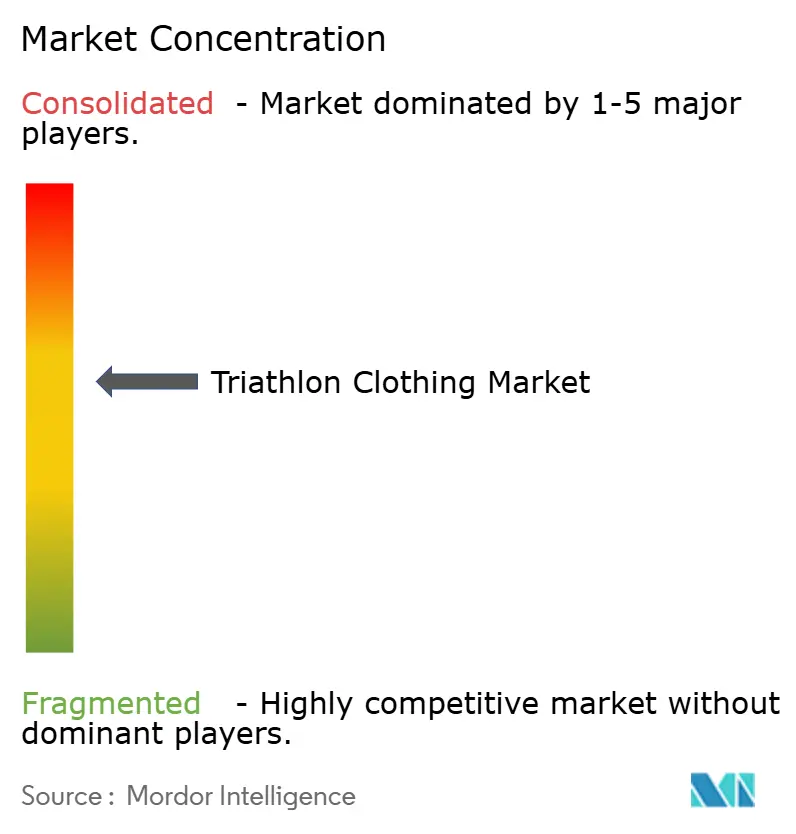
The Triathlon clothing market has a medium concentration and remains fragmented. Competition centers on technical performance, athlete-community credibility, elite partnerships, and event sponsorships. Zoot is the exclusive cycling and triathlon apparel partner of the IRONMAN Group through 2028[3]. This partnership gives Zoot consistent access to IRONMAN and IRONMAN 70.3 events for product visibility. Its parent company’s acquisition of Tailwind Brands GmbH in October 2025 was intended to bring European operations under direct control. That move illustrates how established brands are strengthening regional distribution and direct relationships with athletes. Exclusive event partnerships can offer a recognizable platform for apparel launches and athlete interaction. They also allow a brand to connect race participation with its products across several countries. Distribution control can improve how a brand presents its range and responds to local channel needs. These choices matter in a fragmented category where partnerships can increase visibility without changing the underlying competitive structure.
Technical product development is another competitive factor in the Triathlon clothing market. Zone3’s work on biodegradable B-prene neoprene provides a sustainability-focused position within performance wetsuits. Such launches show how brands use fabric, aerodynamic design, and comfort to differentiate their offers. Emerging challengers are also using direct-to-consumer distribution and performance-oriented design to compete below elite price points. The ability to present clear product benefits is important when buyers compare specialist products with general sportswear. Technical claims need to be matched by information that athletes can understand before making a purchase. Comfort through all 3 disciplines can be as important to a recreational buyer as an elite-level feature. Direct-to-consumer brands may use product education to compete where their physical retail presence is limited. The Triathlon clothing market remains open to brands that combine credible performance design with accessible customer communication.
Women’s-specific technical development and inclusive sizing remain areas of opportunity. Brands can address fit and product needs as female and younger participation increases. The Triathlon clothing industry is likely to remain competitive because no single participant has dominant control over demand. Strategic partnerships, material innovation, and direct engagement with athletes will remain central to brand positioning. No company share figures were supplied that would support a claim of leadership by any individual business. The supplied concentration assessment instead indicates a field where established brands and smaller challengers can both compete. This keeps product relevance and athlete trust central to commercial outcomes. Brands that respond to fit, price, sustainability, and channel expectations can pursue opportunities without relying on a dominant market position.
Triathlon Clothing Industry Leaders
-
Zoot Sports
-
TYR Sport, Inc.
-
ROKA Sports, Inc.
-
HUUB Ltd.
-
IRONMAN Group
- *Disclaimer: Major Players sorted in no particular order
Recent Industry Developments
- August 2026: Casper Stornes launched a limited-edition collection featuring the Dottore Speed TRI Skinsuit and Gregarius Clima Jersey, developed in collaboration with professional triathlete Casper Stornes.
- June 2026: Zone 3 introduced updated trisuits made from recycled performance materials, designed to enhance athlete comfort and race-day performance. The new designs feature improved ventilation to support breathability, aerodynamic sleeve fabrics to help reduce drag, and practical pockets that provide convenient storage for race-day nutrition.
- March 2026: Zoot Sports launched a performance-oriented triathlon apparel collection developed with professional triathlete Sam Long, featuring men's and women's gear designed for training and racing.
Global Triathlon Clothing Market Report Scope
The triathlon clothing market is segmented by product type into tri tops, tri shorts, tri suits, wetsuits, and accessories. By sports type, the market is categorized into swimming, cycling, running, and other sports types. By end user, the market is divided into men, women, and unisex. Based on distribution channel, the market is segmented into online stores and offline stores. Geographically, the market covers North America, Europe, Asia-Pacific, South America, and the Middle East and Africa. The market sizing has been done in value terms in USD for all the abovementioned segments.
| Tri Tops |
| Tri Shorts |
| Tri Suits |
| Wetsuits |
| Accessories |
| Swimming |
| Cycling |
| Running |
| Other Sports Type |
| Men |
| Women |
| Unisex |
| Online Stores |
| Offline Stores |
| North America | United States |
| Canada | |
| Mexico | |
| Rest of North America | |
| Europe | Germany |
| United Kingdom | |
| France | |
| Italy | |
| Spain | |
| Netherlands | |
| Sweden | |
| Poland | |
| Belgium | |
| Rest of Europe | |
| Asia-Pacific | China |
| India | |
| Japan | |
| Australia | |
| South Korea | |
| Vietnam | |
| Indonesia | |
| Rest of Asia-Pacific | |
| South America | Brazil |
| Argentina | |
| Chile | |
| Peru | |
| Colombia | |
| Rest of South America | |
| Middle East and Africa | United Arab Emirates |
| Saudi Arabia | |
| South Africa | |
| Nigeria | |
| Rest of Middle East and Africa |
| Product Type | Tri Tops | |
| Tri Shorts | ||
| Tri Suits | ||
| Wetsuits | ||
| Accessories | ||
| Sports Type | Swimming | |
| Cycling | ||
| Running | ||
| Other Sports Type | ||
| End User | Men | |
| Women | ||
| Unisex | ||
| Distribution Channel | Online Stores | |
| Offline Stores | ||
| By Geography | North America | United States |
| Canada | ||
| Mexico | ||
| Rest of North America | ||
| Europe | Germany | |
| United Kingdom | ||
| France | ||
| Italy | ||
| Spain | ||
| Netherlands | ||
| Sweden | ||
| Poland | ||
| Belgium | ||
| Rest of Europe | ||
| Asia-Pacific | China | |
| India | ||
| Japan | ||
| Australia | ||
| South Korea | ||
| Vietnam | ||
| Indonesia | ||
| Rest of Asia-Pacific | ||
| South America | Brazil | |
| Argentina | ||
| Chile | ||
| Peru | ||
| Colombia | ||
| Rest of South America | ||
| Middle East and Africa | United Arab Emirates | |
| Saudi Arabia | ||
| South Africa | ||
| Nigeria | ||
| Rest of Middle East and Africa | ||
Key Questions Answered in the Report
What is the projected value of triathlon clothing by 2032?
The category is projected to reach USD 4.37 billion by 2032, expanding at an 8.45% CAGR from 2027 to 2032.
Which triathlon clothing product has the largest revenue share?
Tri Suits lead product revenue with a 47.23% share in 2026.
Which product category is growing the fastest?
Tri Shorts are forecast to grow at a 10.92% CAGR through 2032.
Which sales channel is growing the fastest for triathlon clothing?
Online Stores are forecast to expand at a 10.78% CAGR from 2027 to 2032.