
Timestamping Services Market Size and Share
Market Overview
| Study Period | 2020 - 2031 |
|---|---|
| Market Size (2026) | USD 0.62 Billion |
| Market Size (2031) | USD 1.46 Billion |
| Growth Rate (2026 - 2031) | 18.68 % |
| Fastest Growing Market | Asia-Pacific |
| Largest Market | North America |
| Market Concentration | Medium |
Major Players *Disclaimer: Major Players sorted in no particular order Image © Mordor Intelligence. Reuse requires attribution under CC BY 4.0. | |
Timestamping Services Market Analysis by Mordor Intelligence
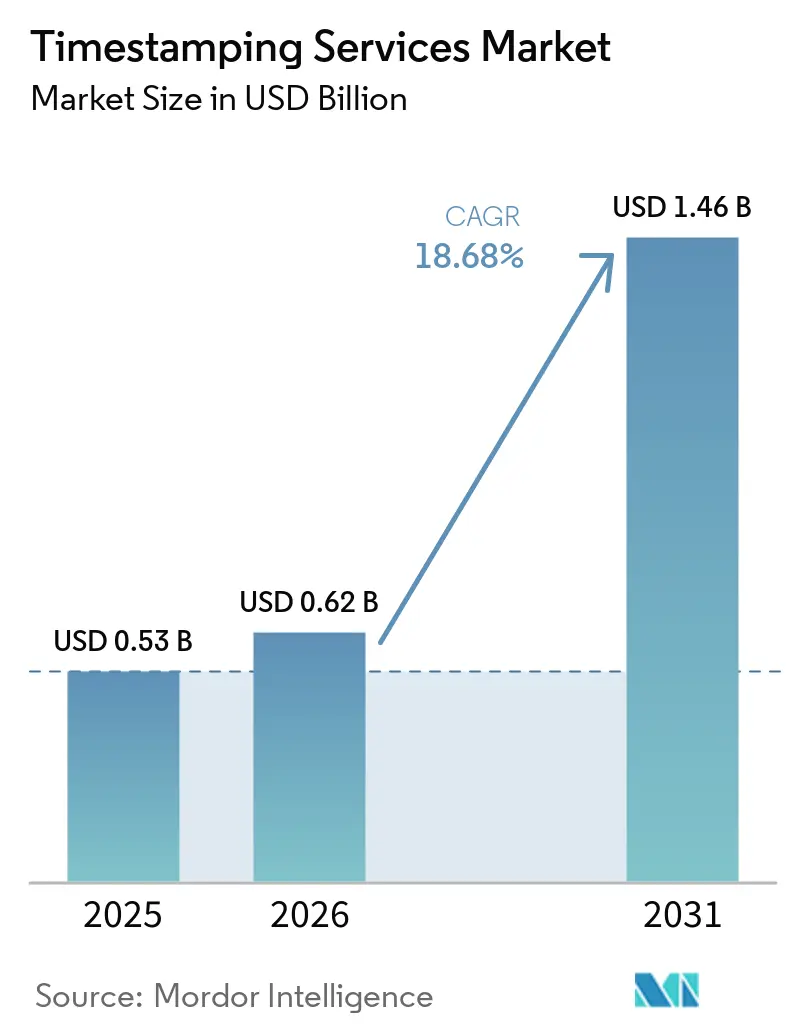
The timestamping services market size was valued at USD 0.53 billion in 2025 and is estimated to grow from USD 0.62 billion in 2026 to reach USD 1.46 billion by 2031, at a CAGR of 18.68% during the forecast period (2026-2031). The timestamping services market is expanding as organizations replace paper-based evidence processes with cryptographic records that establish when a document or transaction existed. Regulatory recognition, shorter code-signing certificate lifetimes, and higher fraud exposure are making time records more important in financial, software, and regulated document workflows. Managed delivery models are also broadening adoption because buyers can use application programming interfaces rather than procure and operate specialized hardware across organizations with limited internal security resources. The timestamping services market is likely to reward providers that can meet qualified trust-service requirements, manage certificate changes with little customer disruption, and prepare customers for post-quantum cryptography.
Key Report Takeaways
- By component, timestamping platforms and software held 42.89% of the timestamping services market share in 2025, while managed timestamping and trust services is projected to expand at a 22.71% CAGR through 2031.
- By deployment model, cloud held 63.27% of the timestamping services market share in 2025 and is projected to grow at a 23.64% CAGR through 2031.
- By organization size, large enterprises held 68.76% of the market in 2025, while SMEs are expected to expand at a 21.81% CAGR through 2031.
- By end-user industry, banking, financial services and insurance (BFSI) accounted for 31.84% of the market in 2025, while the healthcare and life sciences industry is projected to grow at a 24.76% CAGR through 2031.
- By geography, North America held 36.72% of the market in the timestamping services market in 2025, while Asia-Pacific is expected to advance at a 23.91% CAGR through 2031.
Note: Market size and forecast figures in this report are generated using Mordor Intelligence’s proprietary estimation framework, updated with the latest available data and insights as of January 2026.
Global Timestamping Services Market Trends and Insights
Drivers Impact Analysis*
| DRIVER | (~) % IMPACT ON CAGR FORECAST | GEOGRAPHIC RELEVANCE | IMPACT TIMELINE |
|---|---|---|---|
| Digital Compliance and Legally Binding Electronic Records | +4.2% | Global | Medium term (2-4 years) |
| Code-Signing and Software Supply-Chain Security | +3.8% | North America and Europe, with spillover to Asia-Pacific | Short term (≤ 2 years) |
| API-Based Cloud Timestamping Adoption | +3.3% | Asia-Pacific and North America, expanding to Europe and Middle East and Africa | Medium term (2-4 years) |
| Digital Fraud and Evidentiary Requirements | +2.9% | Global, with highest intensity in North America and Europe | Short term (≤ 2 years) |
| Blockchain and Distributed-Ledger Provenance Use Cases | +2.1% | Asia-Pacific, with spillover to North America and Europe | Long term (≥ 4 years) |
| Recognition of Qualified Electronic Timestamps | +1.7% | Europe, expanding to Middle East and Africa and Asia-Pacific | Medium term (2-4 years) |
| Source: Mordor Intelligence | |||
Growth in Digital Compliance and Legally Binding Electronic Records
Digital records are becoming central to regulated transactions, which increases the need to show when a file was created, approved, or changed. The European Commission established standards for qualified electronic time-stamping services through Commission Implementing Regulation 2025/1929, which identifies ETSI EN 319 421 and ETSI EN 319 422 as applicable standards.[1] These requirements support the use of qualified timestamps in workflows where document integrity and timing may later be called into question. The timestamping services market, therefore, benefits when organizations standardize records used for cross-border contracts, e-invoicing, and regulated retention. GDPR-related accountability requirements also increase the value of records that show access and modification history. The timestamping services market gains further support as companies outside Europe align internal controls with eIDAS-based practices to avoid maintaining separate evidence processes.
Expansion of Code-Signing and Software Supply-Chain Security
Software publishers increasingly need evidence that signed code was released through a controlled and traceable process. Microsoft made Signing Transparency generally available in 2026, using the IETF SCITT architecture to create tamper-evident software supply-chain records.[2] The CA/B Forum change that limited code-signing certificate lifetimes to 460 days, effective March 2026, makes valid timestamp tokens more important after a signing certificate expires. This change affects existing signed artifacts as well as future releases, potentially increasing transaction volumes without a corresponding increase in software output. NIST also described code signing as part of software supply-chain management in its 2025 guidance. The timestamping services market is consequently becoming more connected to DevSecOps practices than to traditional public key infrastructure purchases alone.
API-Based Cloud Timestamping Adoption
Cloud delivery reduces the operational burden of operating a timestamp authority and can make high-assurance services available through standard integrations. GMO GlobalSign reported more than 5.5 million timestamp operations in June 2026, compared with 4.6 million in January 2025. Its reported usage shows that cloud infrastructure can handle production-scale signing and timestamp workloads. Utimaco completed an eIDAS conformity assessment for its Timestamp as a Service in July 2026 after adopting FIPS 140-3 Level 3 hardware security modules and a geo-redundant design. These investments show that managed delivery still requires substantial assurance infrastructure. The timestamping services market is expanding because subscription access converts a large hardware decision into a service expense. Providers can differentiate their managed offerings through qualified status, service-level commitments, and support for certificate lifecycle changes.
Rising Digital Fraud and Evidentiary Requirements
Higher fraud exposure is increasing the demand for transaction records that can be tested during an investigation. The International Monetary Fund cited USD 16.6 billion in internet crime losses reported to the FBI Internet Crime Complaint Center for 2024. The European Payments Council reported growing social-engineering threats to payment systems in its 2025 fraud trends report. Financial institutions can use timestamps at the points of approval, access, and modification to create a more complete audit trail. Such records help establish the sequence of events when a transaction is disputed. The timestamping services market is supported when legal, compliance, and security teams all view the same evidence control as necessary. This demand is particularly relevant to settlement, lending, anti-money-laundering, and consumer payment workflows.
Restraints Impact Analysis*
| RESTRAINT | (~) % IMPACT ON CAGR FORECAST | GEOGRAPHIC RELEVANCE | IMPACT TIMELINE |
|---|---|---|---|
| Interoperability Gaps Across Timestamp Protocols and Legacy Systems | -1.8% | Global | Medium term (2-4 years) |
| Data-Residency and Cross-Border Trust-Service Constraints | -1.4% | Asia-Pacific, Middle East and Africa, and parts of Europe | Long term (≥ 4 years) |
| Cryptographic Migration and Long-Term Validation Costs | -1.1% | Global | Long term (≥ 4 years) |
| Dependence on High-Assurance Time Sources and HSM Infrastructure | -0.8% | Global | Medium term (2-4 years) |
| Source: Mordor Intelligence | |||
Interoperability Gaps Across Timestamp Protocols and Legacy Systems
Organizations often manage RFC 3161 tokens, blockchain-anchored proofs, and archive formats from multiple signing systems. These formats may require different validation processes and increase the cost of managing long-lived document archives. Sectigo completed the migration of more than 500,000 public certificates from Entrust in September 2025, demonstrating the downstream effects that changes in certificate hierarchies can have on validation chains.[3] DigiCert also notified customers in 2026 that QuoVadis timestamping certificates would be replaced, requiring some customers to review pinned references. Smaller organizations may face particular difficulty when they need to rebuild certificate paths, update hashes, or re-timestamp older signatures. The timestamping services market can grow more slowly where customers cannot validate records across providers without specialized tools. Providers that simplify migration and validation have a clearer retention advantage.
Data-Residency and Cross-Border Trust-Service Constraints
Data residency rules can limit where a timestamp provider processes data and hosts supporting infrastructure. Regulation 2025/1929 recognizes the relevance of European data protection rules to personal data processed in the course of timestamp issuance. China, India, and Vietnam have separate legal frameworks that can require country-specific approaches for regulated clients. Global accreditation alone may not be sufficient to serve government or financial-sector buyers in these markets. This can preserve demand for regional operators but raise the cost of geographic expansion. The timestamping services market may therefore remain fragmented across high-growth jurisdictions. Data-center investment and localized operating models can also pressure the margins of providers seeking to scale internationally.
*Our forecasts treat driver/restraint impacts as directional, not additive. The impact forecasts reflect baseline growth, mix effects, and variable interactions.
Segment Analysis
By Component: Managed Services Expand as Platform Licensing Matures
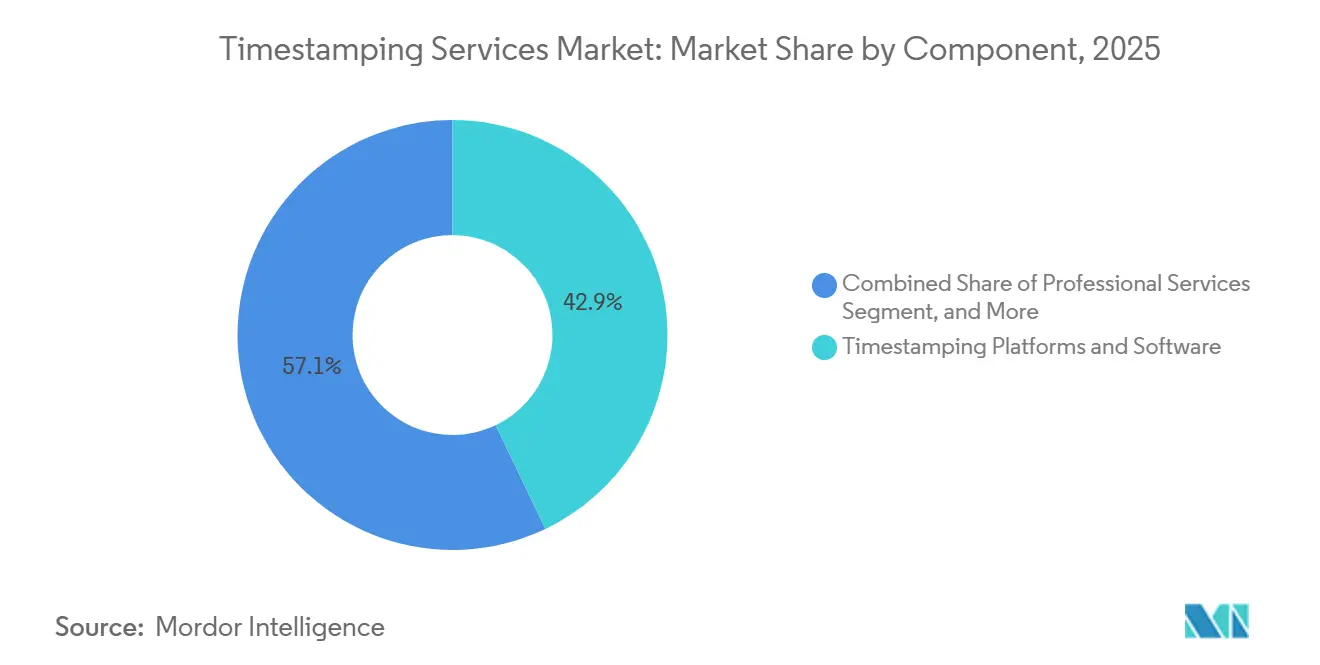
Timestamping platforms and software held 42.89% of the timestamping services market in 2025. Enterprise deployments use software such as Ascertia ADSS TSA Server, Utimaco TimestampServer HSM, and Keyfactor SignServer to support qualified trust-service operations and document integrations. These installations remain important where companies require direct control over infrastructure, controlled archives, audit evidence, and complex internal approval workflows. Managed Timestamping and Trust Services is projected to record a 22.71% CAGR through 2031. This growth reflects a buyer preference for subscription services that combine timestamp issuance, service-level commitments, accreditation, and certificate lifecycle support.
Utimaco completed its eIDAS conformity assessment in July 2026 after implementing FIPS 140-3 Level 3 hardware security modules and geo-redundant service architecture.[4] That example shows the operational standards that managed providers must sustain. Professional Services remains the smallest component, yet it supports implementation, eIDAS 2.0 readiness work, and cryptographic migration projects. Signicat moved to Ascertia ADSS TSA Server after its prior solution became technically obsolete, showing how platform replacement can create demand for deployment and transition support. The timestamping services industry is likely to favor vendors that can support recurring conformity obligations while simplifying customer transitions from older systems.

By Deployment Model: Cloud Leads While Hybrid Supports Controlled Environments
Cloud held 63.27% of the timestamping services market size in 2025 and is projected to grow at a 23.64% CAGR through 2031. Cloud services allow companies to connect signing applications through application programming interfaces without acquiring hardware security modules. GMO GlobalSign recorded more than 5.5 million timestamp operations during June 2026, which indicates active use of API-based delivery at scale. This model suits buyers that need fast implementation, flexible usage, centralized service management, and predictable capacity during fluctuating document volumes. It also supports smaller companies that previously could not justify a dedicated timestamp authority.
On-premises systems retain importance where defense, financial services, healthcare, or public-sector users require physical control of keys and locally managed records. Hybrid configurations combine cloud capacity for high-volume activity with controlled infrastructure for high-assurance signing. Regulation 2025/1929 includes technical expectations for hardware security modules that apply to qualified services. DigiCert's 2026 certificate replacement notice also showed that cloud users must manage dependency changes where their applications pin a specific timestamp certificate. The timestamping services market size for cloud delivery is therefore supported by convenience, while hybrid and on-premises models remain relevant for strict control requirements.
By Organization Size: SMEs Gain Access Through Subscription Services
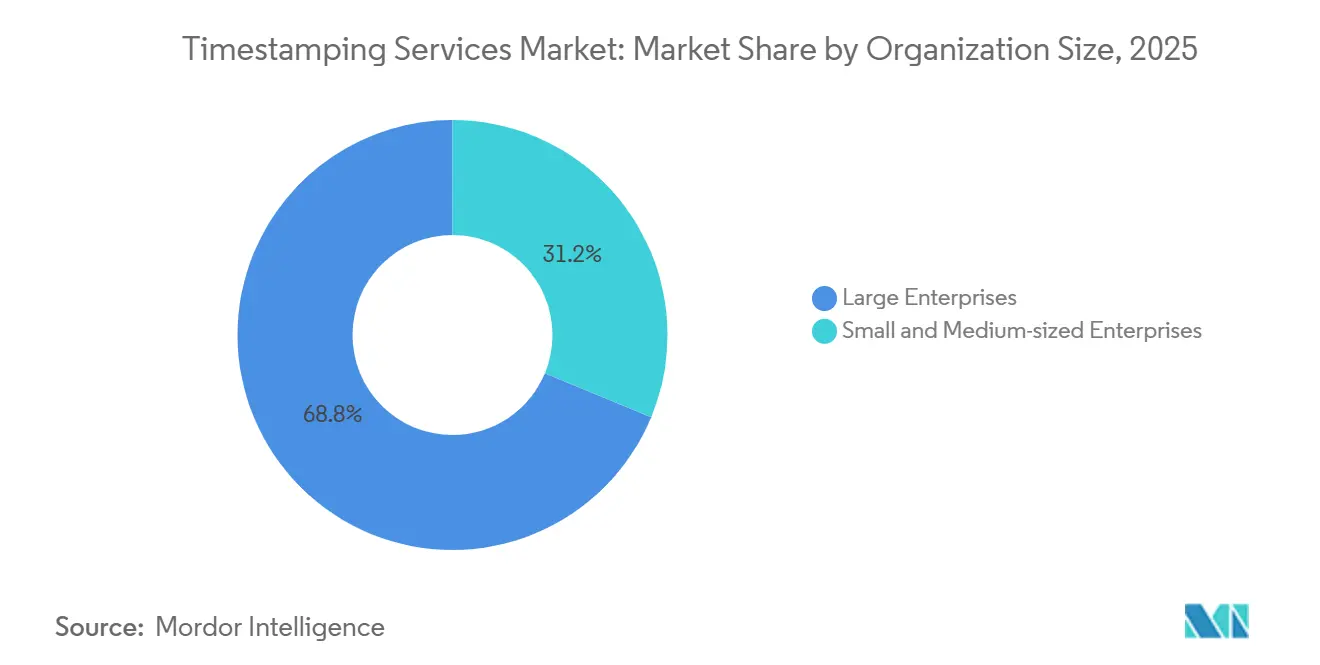
Large enterprises held 68.76% of the market in 2025 because financial institutions, pharmaceutical companies, and government contractors have embedded timestamps in audit trails and formal filings. SMEs are projected to grow at a 21.81% CAGR through 2031. Managed APIs lower the initial cost by allowing these buyers to purchase timestamp capacity through a subscription or usage model. Structured e-invoicing requirements in Europe can extend document-retention controls to small businesses. This makes time-stamped evidence relevant to firms that do not operate their own security infrastructure, including those managing invoices, contracts, and customer approvals.
DocuSign expanded its integration with eMudhra in June 2026 to provide a unified signing experience for Indian compliance needs. The integration can reduce the complexity that SMEs face when they need signing and trust services from different suppliers. eMudhra reported 30% growth in its trust services business during fiscal year 2026, driven by partner expansion, combination certificates, and direct retail eSign activity.[5] Large enterprises are also consolidating services across subsidiaries, which can increase contract value even as the cost per timestamp falls. The timestamping services market continues to broaden as both customer groups move away from isolated, self-managed systems.
By End-User Industry: Healthcare and Life Sciences Records Fastest Growth
Banking, financial services, and Insurance (BFSI) held 31.84% of the market in 2025 because lending, payments, regulatory reporting, and anti-money-laundering processes require reliable event records. Healthcare and Life Sciences are projected to grow at a 24.76% CAGR through 2031. The U.S. Food and Drug Administration requires secure, computer-generated, time-stamped audit trails for regulated electronic records. This requirement supports timestamping in systems that create, modify, or delete records. Digital health and regulated clinical systems extend this need beyond conventional document signing to include automated clinical decision tools and connected diagnostic systems.
The government and public-sector programs also need qualified trust services for digital identity and online public transactions. Demand for Information Technology and Telecommunications is linked to higher code-signing volume and to security expectations for software releases. Legal and Professional Services use automated timestamping in contract lifecycle management and electronic evidence workflows. Manufacturing users apply it to quality records, while education users apply it to research data integrity. The timestamping services market benefits from this broad range of use cases because each sector has a different compliance or evidence requirement. No single customer workflow defines the full demand base, which supports continued adoption across the timestamping services industry.
Geography Analysis
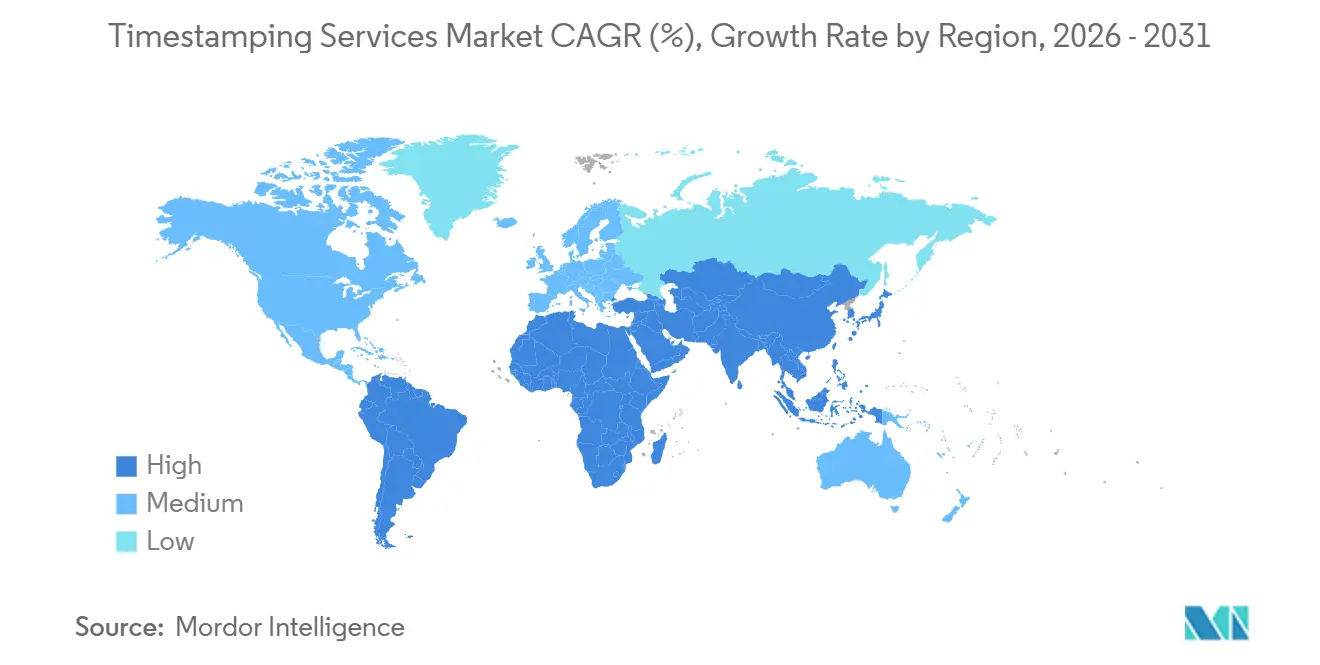
North America held 36.72% of the timestamping services market share in 2025. The region benefits from global certificate authorities and widespread use of cryptographic controls in software and financial services, where mature digital workflows are common. Executive Order 14412 requires U.S. federal high-value systems to migrate digital signatures to post-quantum cryptography by December 31, 2031, while a related OMB memorandum requires agencies to submit migration plans during 2026.[6] This direction supports procurement for providers capable of managing cryptographic transitions and long-term validation. Shorter code-signing certificate lifetimes also increase activity in the region's software supply chains, while Canada follows similar trust-service practices in government and finance.
Europe is the second-largest regional area because eIDAS provides an established legal basis for qualified electronic timestamps. France's ANSSI supervises trust services under eIDAS, supporting a quality-led environment for public and private users. Namirial completed eIDAS 2 compliance across Italy, France, and Spain in 2026. The timestamping services market has a structured European compliance base, although technical and audit obligations can limit smaller providers. South America is developing through Brazil's electronic invoice framework and Mexico's CFDI requirements, which have familiarized users with controlled digital records and support wider private-sector adoption.
Asia-Pacific is projected to advance at a 23.91% CAGR through 2031, the highest regional rate. India is expanding trust-service capacity through certificate authority partnerships and financial-market infrastructure, while Japan maintains a national certification framework, and Seiko Trust renewed its certification in February 2025. China's localization requirements support domestic providers and create a distinct operating environment. Digital government programs in the United Arab Emirates and Saudi Arabia, along with digital finance demand in South Africa, are driving adoption across the Middle East and Africa.
Competitive Landscape
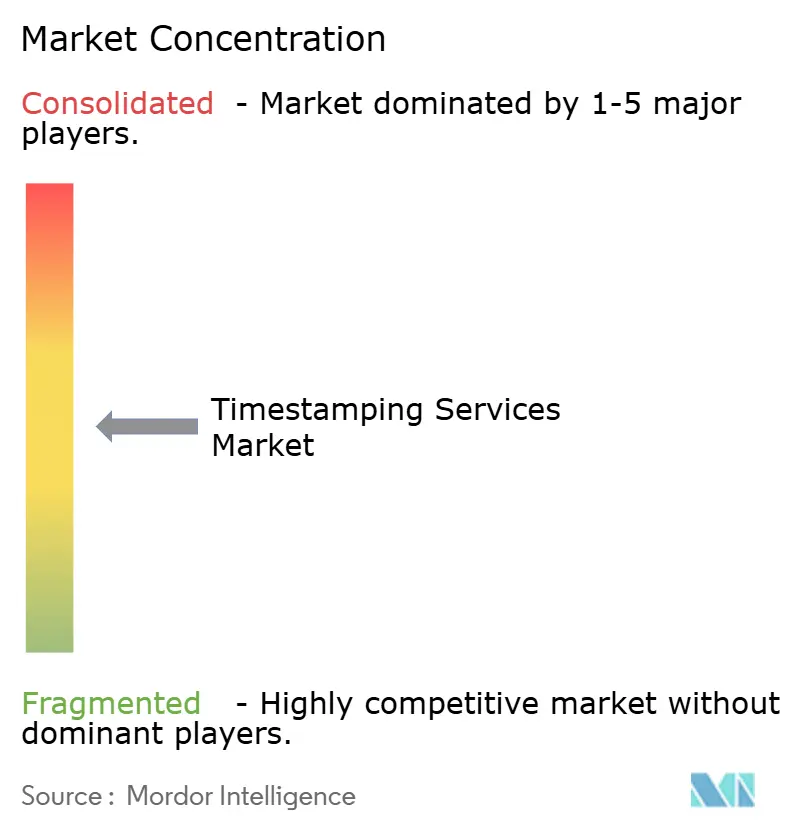
The timestamping services market is moderately concentrated among large global certificate authorities but remains fragmented across regional qualified trust service providers. Sectigo acquired Entrust's public certificate business in January 2025 and completed the migration of more than 500,000 public certificates in September 2025. The transaction expanded Sectigo's enterprise footprint and showed the value of scale during certificate lifecycle changes. Larger suppliers in the timestamping services market compete through trust-list coverage, managed-service capacity, and multinational support. Regional providers remain important where local accreditation and data residency determine eligibility.
DigiCert launched Content Trust Manager in April 2026 for C2PA-compliant signing and timestamping of digital assets. DocuSign deepened its eMudhra integration in June 2026, providing Indian customers with a native signing and timestamping workflow within a single contract. Utimaco's July 2026 conformity assessment strengthened its position in managed qualified timestamping. These moves show competition expanding from token issuance into digital provenance, local compliance, and managed assurance. Guardtime also presents a blockchain-oriented option through its keyless signature infrastructure for long-term verification.
Post-quantum cryptography is a strategic concern because existing trust services often use RSA or elliptic-curve signatures. The federal migration timetable increases pressure on providers to identify dependencies and offer transition support. Artificial intelligence audit records and connected-device documentation are potential future use cases, but they depend on interoperability and accepted evidence formats. ETSI conformity obligations can raise operating thresholds and may encourage additional consolidation in the high-assurance portion of the timestamping services market, particularly where providers must sustain recurring audits and hardware assurance requirements.
Timestamping Services Industry Leaders
-
GlobalSign
-
Entrust Corporation
-
DocuSign, Inc.
-
DigiCert, Inc.
-
Sectigo Limited
- *Disclaimer: Major Players sorted in no particular order
Recent Industry Developments
- September 2026: Sectigo launched Sectigo Quantum Ready, a cryptographic discovery and quantum readiness solution enabling enterprises to map cryptographic assets, assess PQC exposure, and prioritize migration planning. The launch marked Sectigo's entry into the Quantum Security Posture Management space, directly relevant for TSA operators facing the December 2031 federal PQC deadline under Executive Order 14412.
- September 2026: Entrust expanded its Cryptographic Security Platform with CBOM import/export capabilities, Ansible-based certificate lifecycle automation, and SPIRE-based support for machine and AI agent identities, available as SaaS or on-premises deployment targeting post-quantum migration and data sovereignty requirements.
- July 2026: Utimaco completed the eIDAS conformity assessment for its Timestamp as a Service, following migration to FIPS 140-3 Level 3 certified HSMs and deployment of a geo-redundant architecture, covering ETSI EN 319 401, EN 319 421, and EN 319 422 compliance.
- June 2026: DocuSign deepened its integration with eMudhra, India's largest licensed Certificate Authority, effective June 22, 2026, delivering a fully native sending and signing experience within DocuSign for Indian regulatory compliance under a single DocuSign contract.
- April 2026: DigiCert launched Content Trust Manager within the DigiCert ONE platform, enabling enterprises to cryptographically sign and timestamp digital assets using C2PA-compliant workflows and DigiCert-issued certificates, including device-level timestamping via DigiCert Device Trust Manager for imaging hardware.
Global Timestamping Services Market Report Scope
The timestamping services market includes trusted timestamp authorities (TSAs) and related solutions that cryptographically bind a precise date and time to electronic data, signatures, or transactions using standards such as RFC 3161 and, in some jurisdictions, qualified timestamps under eIDAS. These services provide independently verifiable proof of when data existed or was signed, supporting long‑term validation, non‑repudiation, auditability, and compliance for sectors such as finance, legal, healthcare, and software code signing.
The Timestamping Services Market Report is Segmented by Component (Timestamping Platforms and Software, Managed Timestamping and Trust Services, and Professional Services), Deployment Model (Cloud, On-Premises, and Hybrid), Organization Size (Large Enterprises, and Small and Medium-sized Enterprises), End User Industry (Banking, Financial Services and Insurance, Government and Public Sector, Information Technology and Telecommunications, Legal and Professional Services, Healthcare and Life Sciences, and Other End User Industries), and Geography (North America, South America, Europe, Asia-Pacific, and Middle East and Africa). The Market Forecasts are Provided in Terms of Value (USD).
| Timestamping Platforms and Software |
| Managed Timestamping and Trust Services |
| Professional Services |
| Cloud |
| On-Premises |
| Hybrid |
| Large Enterprises |
| Small and Medium-sized Enterprises |
| Banking, Financial Services and Insurance |
| Government and Public Sector |
| Information Technology and Telecommunications |
| Legal and Professional Services |
| Healthcare and Life Sciences |
| Other End User Industries |
| North America | United States | |
| Canada | ||
| South America | Brazil | |
| Mexico | ||
| Rest of South America | ||
| Europe | Germany | |
| United Kingdom | ||
| France | ||
| Rest of Europe | ||
| Asia-Pacific | China | |
| Japan | ||
| India | ||
| Rest of Asia-Pacific | ||
| Middle East and Africa | Middle East | Saudi Arabia |
| United Arab Emirates | ||
| Rest of Middle East | ||
| Africa | South Africa | |
| Rest of Africa | ||
| By Component | Timestamping Platforms and Software | ||
| Managed Timestamping and Trust Services | |||
| Professional Services | |||
| By Deployment Model | Cloud | ||
| On-Premises | |||
| Hybrid | |||
| By Organization Size | Large Enterprises | ||
| Small and Medium-sized Enterprises | |||
| By End User Industry | Banking, Financial Services and Insurance | ||
| Government and Public Sector | |||
| Information Technology and Telecommunications | |||
| Legal and Professional Services | |||
| Healthcare and Life Sciences | |||
| Other End User Industries | |||
| By Geography | North America | United States | |
| Canada | |||
| South America | Brazil | ||
| Mexico | |||
| Rest of South America | |||
| Europe | Germany | ||
| United Kingdom | |||
| France | |||
| Rest of Europe | |||
| Asia-Pacific | China | ||
| Japan | |||
| India | |||
| Rest of Asia-Pacific | |||
| Middle East and Africa | Middle East | Saudi Arabia | |
| United Arab Emirates | |||
| Rest of Middle East | |||
| Africa | South Africa | ||
| Rest of Africa | |||
Key Questions Answered in the Report
What is the 2026 size of the timestamping services market?
The timestamping services market size was valued at USD 0.53 billion in 2025 and is estimated to grow from USD 0.62 billion in 2026 to reach USD 1.46 billion by 2031, at a CAGR of 18.68% during the forecast period (2026-2031).
What is driving demand for timestamping services?
Digital compliance, code-signing security, cloud APIs, and the need for stronger fraud evidence are expanding demand.
Which component is growing fastest through 2031?
Managed Timestamping and Trust Services is projected to grow at a 22.71% CAGR as buyers move toward managed qualified services.
Why is cloud deployment important for timestamping?
Cloud held 63.27% in 2025 and enables API-based access without dedicated hardware procurement.
Which end-user sector is projected to grow fastest?
Healthcare and Life Sciences is projected to grow at a 24.76% CAGR through 2031 because of electronic record controls.
Which region will grow fastest through 2031?
Asia-Pacific is expected to grow at a 23.91% CAGR, supported by national trust-service frameworks and digitalization programs.