
Time-Based TOTP Hardware Token Market Size and Share
Market Overview
| Study Period | 2021 - 2032 |
|---|---|
| Market Size (2027) | USD 10.97 Billion |
| Market Size (2032) | USD 17.33 Billion |
| Growth Rate (2027 - 2032) | 9.58 % |
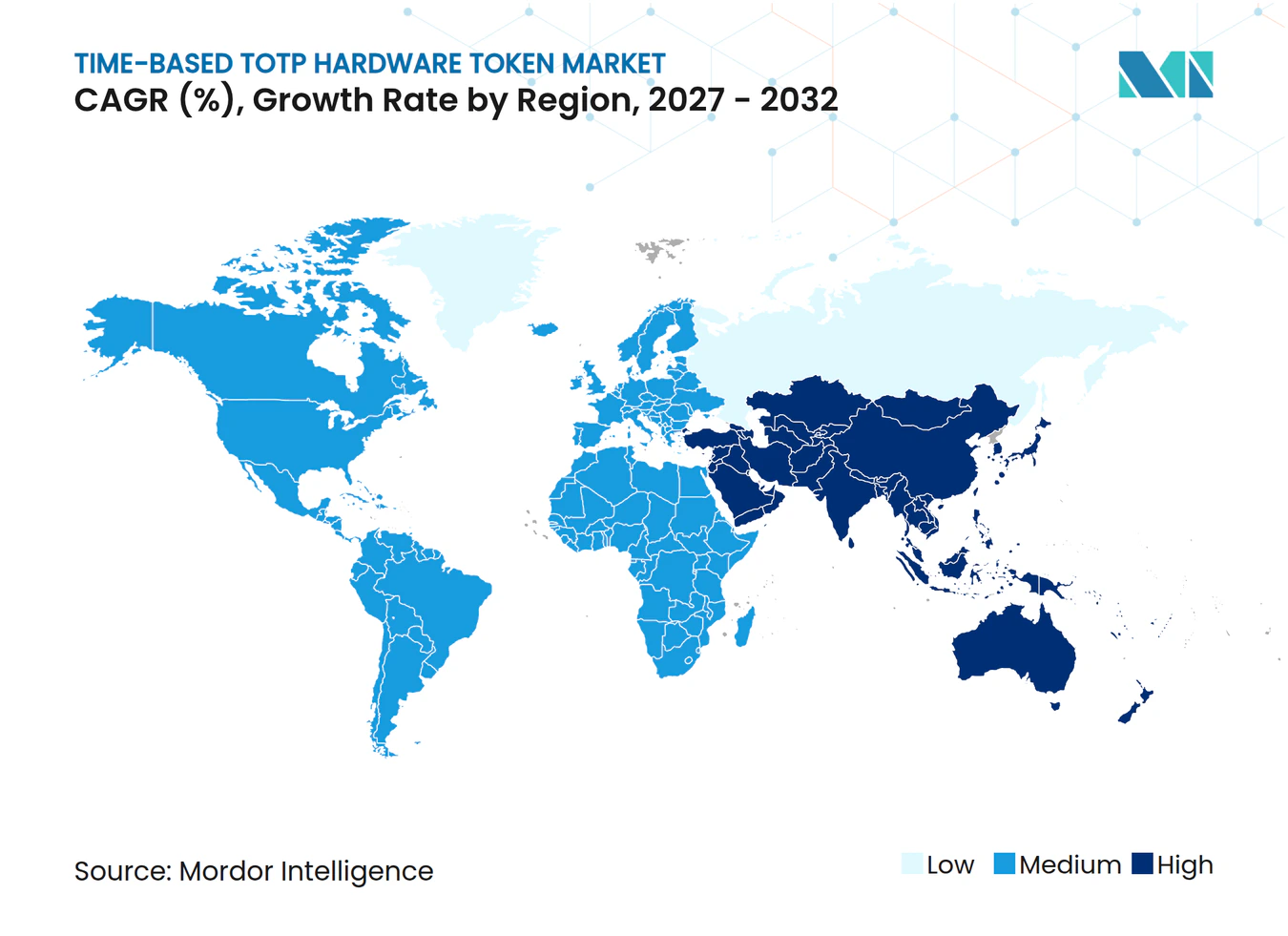
| Fastest Growing Market | Asia-Pacific |
| Largest Market | North America |
| Market Concentration | Medium |
Major Players *Disclaimer: Major Players sorted in no particular order Image © Mordor Intelligence. Reuse requires attribution under CC BY 4.0. | |
Time-Based TOTP Hardware Token Market Analysis by Mordor Intelligence
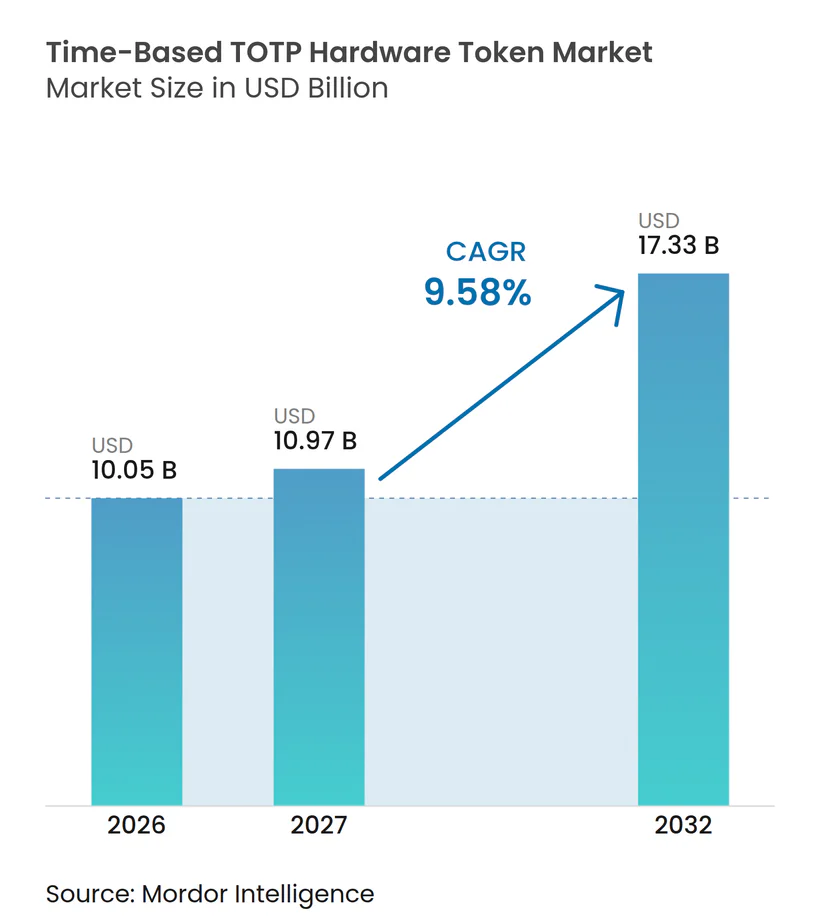
The TOTP hardware token market size was valued at USD 10.05 billion in 2026 and estimated to expand from USD 10.97 billion in 2027 to reach USD 17.33 billion by 2032, at a CAGR of 9.58% during the forecast period 2027-2032. Regulatory requirements in the United States, Europe, Japan, and other Asian economies are directing institutions toward stronger authentication for sensitive systems and transactions. The TOTP hardware token market also benefits when a single credential supports both legacy OATH systems and newer FIDO2 or WebAuthn environments during identity-platform changes. Buyers are focusing on tokens that work across desktop, mobile, shared-workstation, and restricted-connectivity settings, rather than replacing every existing authentication process at once. Subscription services and cloud lifecycle tools are changing procurement from a one-time device purchase toward an ongoing operational relationship. Mobile authenticators and platform passkeys remain a constraint, especially for lower-risk users, although hardware credentials retain a stronger role where secure key storage, auditability, or transaction controls are required.
Key Report Takeaways
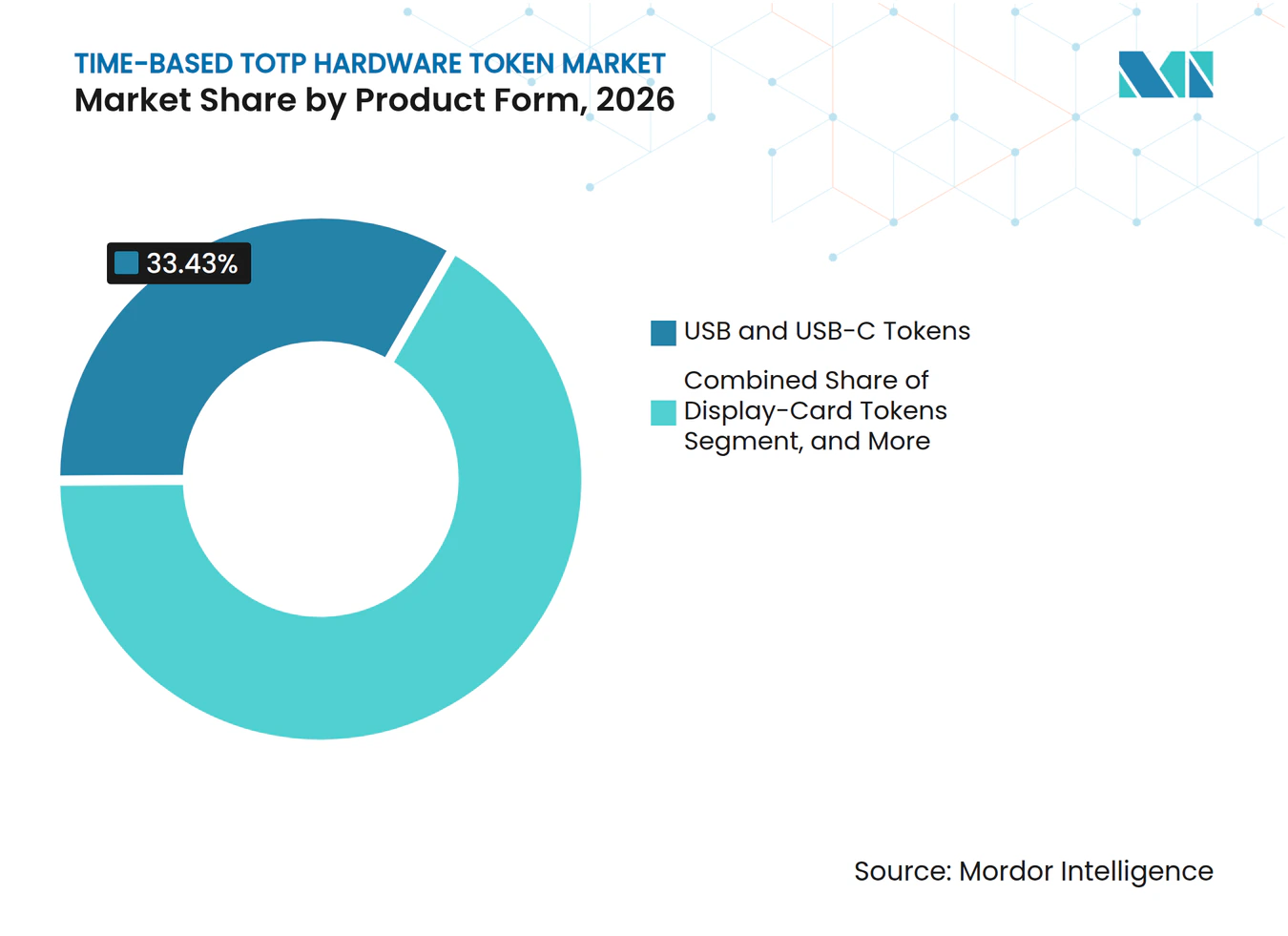
- By product form factor, USB and USB-C tokens led with 33.43% revenue share in 2026, while NFC-enabled tokens are projected to expand at a 10.58% CAGR through 2032.
- By connectivity mode, USB-connected tokens held 32.94% of the TOTP hardware token market share in 2026, while contactless NFC tokens are projected to expand at a 10.56% CAGR through 2032.
- By authentication function, time-based TOTP tokens held 59.71% revenue share in 2026, while TOTP and FIDO2 hybrid authentication is projected to expand at a 10.43% CAGR through 2032.
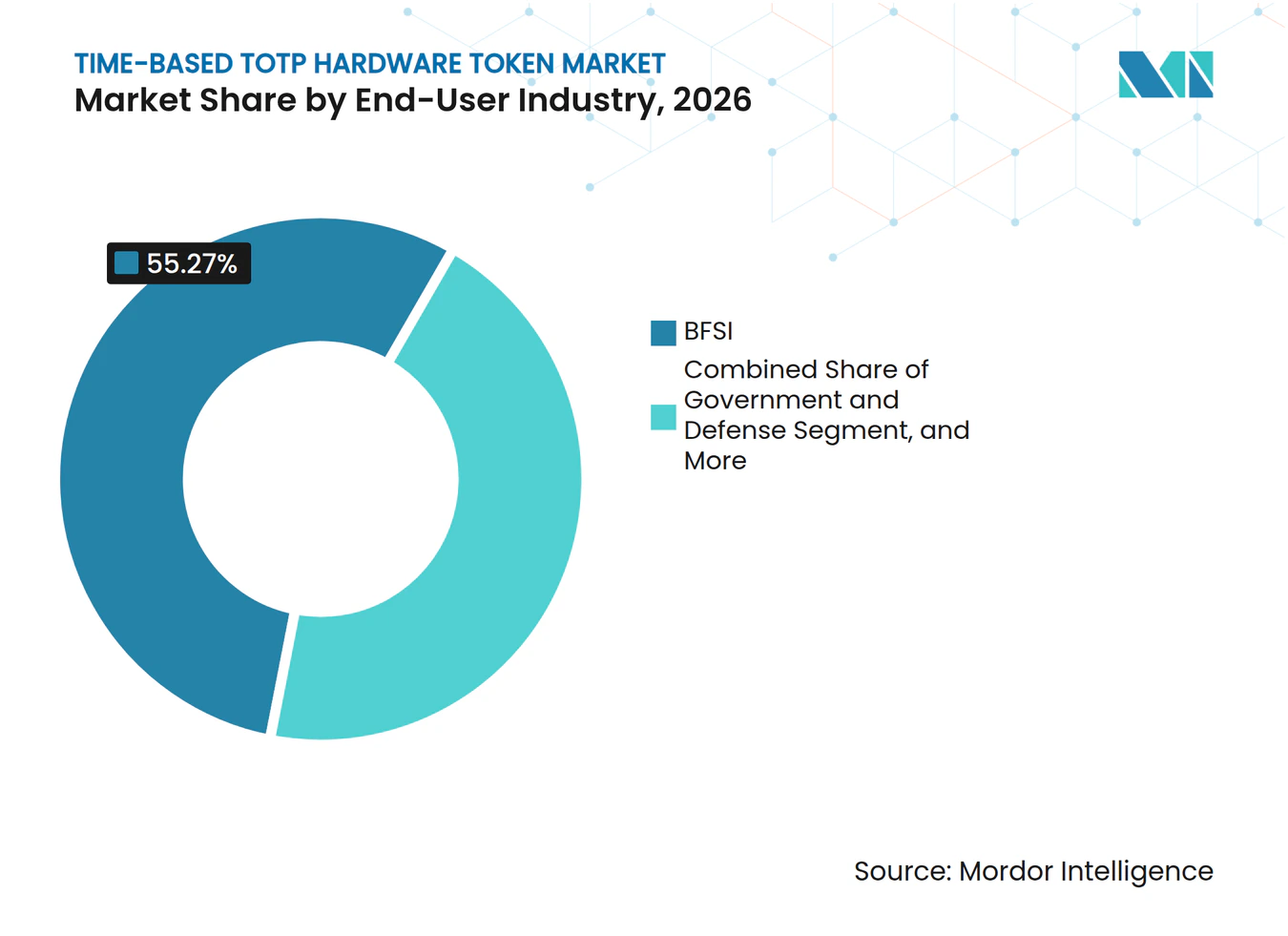
- By end-user industry, BFSI accounted for 55.27% of the TOTP hardware token market share in 2026, while healthcare and life sciences are projected to expand at a 10.62% CAGR through 2032.
- By deployment environment, on-premise deployment held 63.32% revenue share in 2026, while cloud deployment is projected to expand at a 10.14% CAGR through 2032.
- By geography, North America held 38.92% revenue share in 2026, while Asia-Pacific is projected to expand at a 10.72% CAGR through 2032.
Note: Market numbers in this report are based on Mordor Intelligence's proprietary estimation framework, which combines nine months of actuals with Q4 projections for base year 2026.
Market Trends and Insights
Drivers Impact Analysis of Time-Based TOTP Hardware Token Market*
| Driver | (~) % Impact on CAGR Forecast | Geographic Relevance | Impact Timeline |
|---|---|---|---|
| Rising Regulatory Requirements for Strong Customer Authentication | +3.5% | Global, concentrated near-term impact in Europe, the United States, and Japan | Short term (≤ 2 years) |
| Increasing Exposure to Credential Theft and Account Takeover | +2.2% | Global, most acute in North America, Europe, and Asia-Pacific financial centers | Short term (≤ 2 years) |
| Expansion of Digital Banking, Instant Payments and E-Commerce | +1.5% | Asia-Pacific core, with spillover to the Middle East, South America, and Africa | Medium term (2-4 years) |
| Growing Zero-Trust and Remote-Access Security Programs | +1.0% | North America and Europe, with early adoption in the Asia-Pacific enterprise segment | Medium term (2-4 years) |
| Hardware TOTP Adoption in Air-Gapped and Connectivity-Restricted Environments | +0.6% | North American defense and utilities, and European critical infrastructure | Long term (≥ 4 years) |
| Increasing Demand for NFC-Programmable and Multi-Platform Tokens | +0.5% | Global, with strongest demand in European and Asia-Pacific healthcare and retail | Medium term (2-4 years) |
| Source: Mordor Intelligence | |||
Rising Regulatory Requirements for Strong Customer Authentication
Regulation is central to demand for TOTP hardware tokens because it converts stronger authentication from a discretionary security upgrade into a compliance requirement. The European Banking Authority requires authentication codes to be linked to a specific transaction amount and payee under its strong customer authentication standards, which raises the value of controlled credentials for high-risk payment activity.[1] The planned European payment rules also recognize the need for an alternative authentication route for people who cannot use smartphones, preserving a role for dedicated hardware. The Japan Securities Dealers Association's guidance identifies passkeys and PKI-based methods as reference approaches for preventing unauthorized access to online trading. In the United States, the proposed HIPAA Security Rule would require multifactor authentication for access to electronic protected health information, placing health systems under pressure to evaluate deployment options before a final rule takes effect. These requirements drive demand in the TOTP hardware token market, as a single device can support regulated workflows while identity teams modernize their broader authentication architecture.
Increasing Exposure to Credential Theft and Account Takeover
Credential theft remains a direct concern for organizations protecting privileged accounts, payment systems, and cloud administration tools. KELA reported 2.86 billion compromised credentials in 2025, with business cloud and authentication services representing more than 30% of exposed data in its review. eSentire reported a 389% year-over-year increase in identity-based account-compromise threats in 2025, indicating ongoing pressure on employee credentials. Proofpoint found that 59% of compromised accounts had software-based MFA enabled at the time of the breach, showing that deployment alone does not eliminate phishing and session-theft risks. Hardware tokens can store cryptographic key material in a secure device, thereby providing stronger control for targeted users than reusable codes or software-only processes. The TOTP hardware token market is consequently most relevant where the cost of a compromised account is materially higher than the cost of device issuance and administration.
Expansion of Digital Banking, Instant Payments and E-Commerce
Digital banking and real-time payment services are increasing the number of authentication events that require stronger risk controls. India’s Unified Payments Interface processed more than 13 billion transactions each month in early 2026, creating a large and attractive target environment for payment fraud. Mastercard stated that it aims for password-free and number-free online checkout across Asia-Pacific by 2030, reflecting the movement toward phishing-resistant payment authentication. In regulated workflows, hardware devices retain relevance when buyers require validated security modules, physical possession controls, or a method that operates independently of a personal smartphone. The TOTP hardware token market also serves high-value banking accounts and administrative payment access, where the user population is narrower than the full retail customer base. Payment expansion, therefore, enlarges the pool of risk-sensitive roles even as lower-risk consumer authentication continues to shift toward mobile applications.
Growing Zero-Trust and Remote-Access Security Programs
Zero-trust programs are driving demand for credentials that provide stronger assurance at the point of access. FIDO2 hardware tokens support device attestation through the FIDO Alliance Metadata Service, which helps a relying party assess the credential and authenticator used in a login flow. Research presented at the 2025 ACM Workshop on Secure and Trustworthy Cyber-Physical Systems described an architecture that combined FIDO2 hardware-bound tokens with edge-based validation in operational technology and industrial control settings. This model is relevant where plant-level identity services cannot always be reached, and security teams need an authentication approach that functions under connectivity constraints. Yubico and Delinea announced a 2026 integration using Role Delegation Tokens to connect human approval with AI-agent authorization in enterprise environments. The TOTP hardware token market can benefit when zero-trust programs extend from workforce login toward high-assurance authorization for administrative and machine-assisted actions.
Restraints Impact Analysis of Time-Based TOTP Hardware Token Market*
| Restraint | (~) % Impact on CAGR Forecast | Geographic Relevance | Impact Timelein |
|---|---|---|---|
| Competition from Mobile Authenticator Applications and Biometrics | -3.0% | Global, most pronounced in consumer-facing Asia-Pacific and European markets with high smartphone penetration | Short term (≤ 2 years) |
| High Lifecycle Cost of Provisioning, Replacement and Revocation | -1.5% | Global, most acute for mid-market organizations and large field-operations deployments | Medium term (2-4 years) |
| TOTP Clock Drift and Enrollment-Synchronization Failures | -0.7% | Global, particularly in large enterprise and geographically distributed deployments | Medium term (2-4 years) |
| Component Traceability and Counterfeit-Token Risks in Distributed Supply Chains | -0.4% | Asia-Pacific, South America, and Africa distribution networks, affecting mid-tier procurement | Long term (≥ 4 years) |
| Source: Mordor Intelligence | |||
Competition From Mobile Authenticator Applications and Biometrics
Mobile authenticators and platform-native passkeys are the strongest alternative to broad hardware token issuance. A 2026 FIDO Alliance workforce survey found that 32% of surveyed organizations used mobile authenticator applications, compared with 25% using hardware security keys. Platform-native FIDO2 passkeys on iOS and Android have also improved phishing resistance for software-based authentication. Many organizations now reserve hardware devices for privileged accounts, remote administrators, regulated transactions, and users without reliable smartphone access. This approach narrows the volume opportunity for full-workforce hardware programs while raising the value of the remaining deployment tier. The TOTP hardware token market must therefore compete on secure key storage, compliance coverage, multi-protocol support, and dependable operation in shared or restricted environments.
High Lifecycle Cost of Provisioning, Replacement and Revocation
Hardware credentials create operating costs beyond the price paid for the token. Each device requires enrollment, testing, assignment to an identity, secure distribution, replacement procedures, and revocation when it is lost, damaged, or no longer needed. RSA reported that 69% of organizations experienced an identity-related breach in the preceding 3 years and linked lifecycle weaknesses to growing identity risk.[2] Yubico expanded YubiKey as a Service to 175 countries and 24 territories in May 2025, while HID introduced Enterprise Passkey Management in August 2025 to reduce provisioning and management effort. Subscription services can spread initial costs, although recurring charges remain a concern for mid-sized buyers comparing long-term operating budgets. The TOTP hardware token market is more likely to gain from these services when they reduce manual work without adding a new layer of vendor dependency.
*Our forecasts treat driver/restraint impacts as directional, not additive. The impact forecasts reflect baseline growth, mix effects, and variable interactions.
Time-Based TOTP Hardware Token Market Segment Analysis
By Product Form Factor:
USB Tokens Anchor Revenue as NFC Reshapes GrowthUSB and USB-C tokens commanded 33.43% of 2026 revenue, giving this form factor the largest share among the listed product categories. Their installed base reflects direct integration with desktop operating systems, VPN workflows, and endpoint management tools. Organizations with legacy applications value a physical interface that does not require redesigning the authentication process. Display-card tokens remain useful for financial-service transaction confirmation, while key-fob products continue to serve replacement cycles at organizations that still use established token programs. Hybrid devices appeal to buyers who need to support RADIUS-based infrastructure while preparing for FIDO-based access.
NFC-enabled tokens are projected to expand at a 10.58% CAGR through 2032, the fastest rate among product form factors. The product-level TOTP hardware token market size benefits from clinical, retail, and field settings where users do not work at a fixed desk. Okta introduced NFC authentication for frontline workers into self-service early access in 2026, supporting badge-tap-plus-PIN sign-in on Windows devices. This approach can work for shared workstations where using a personal phone for each sign-in is impractical, and it gives employers the option to align user movement, shift changes, and access needs with a controlled credential. The form factor’s progress depends on reader availability, endpoint compatibility, and clear enrollment processes for frontline staff.



By Connectivity Mode:
Contactless Adoption Advances Against Tethered DefaultsUSB-connected tokens accounted for 32.94% of 2026 revenue, reflecting the established presence of desktop- and laptop-based enterprise authentication. This connectivity mode suits workers who use managed computers and are familiar with VPN or identity provider interfaces. Disconnected tokens remain important in air-gapped networks and in financial services systems that accept manually entered codes. Bluetooth-enabled devices and dual-interface products serve smaller requirements in mobile-heavy field environments, shaped by policy, device availability, and the sensitivity of the account being protected. The TOTP hardware token market continues to see USB demand, as many enterprise systems were designed around tethered user access.
Contactless NFC tokens are projected to expand at a 10.56% CAGR through 2032. The connectivity-level TOTP hardware token market size is supported by the expanding use of NFC readers in endpoint and access-control infrastructure. Hardware-based key storage and resistance to physical and software attacks are important requirements in higher-assurance contactless deployments. The certification-based approach can distinguish a contactless token from a software passkey in procurements that require hardware-backed private keys. Contactless authentication can reduce friction at shared devices, but it requires coordinated deployment of readers, compatible endpoints, and secure credential issuance and recovery.
By Authentication Function:
Time-Based Codes Lead but Hybrid Models AccelerateTime-based TOTP tokens held 59.71% of 2026 authentication-function revenue, making them the largest segment in the TOTP hardware token market. OATH RFC 6238 support across identity providers, VPN gateways, and RADIUS servers gives time-based codes a very broad installed base. Event-based HOTP devices remain relevant in isolated industrial and air-gapped settings where time synchronization may not be reliable. PIV and smart-card products address government and defense use cases where certificate-based identity is required, and buyers must also consider legacy systems, policies, and available support skills. The large TOTP installed base gives vendors a reason to preserve compatibility even as users seek phishing-resistant alternatives.
TOTP and FIDO2 hybrid authentication is projected to expand at a 10.43% CAGR through 2032. This TOTP hardware token market segment can support organizations that need a single credential for older OATH services and modern WebAuthn relying parties. The ACM research on hardware-bound FIDO2 and edge validation shows why this combination has relevance in operational technology settings with limited identity connectivity. A hybrid device can reduce parallel refresh cycles as an enterprise moves from code-based login to phishing-resistant authentication, while reducing the number of physical devices an employee carries. The segment’s adoption depends on whether buyers see migration value that justifies a more capable token and the related lifecycle work.
By End-User Industry:
BFSI Dominates as Healthcare Mandates Drive the Next Expansion WaveBFSI accounted for 55.27% of 2026 revenue, the leading share across end-user industries. Financial institutions face a dense set of requirements around payment authentication, privileged access, fraud prevention, and customer protection. European banking rules require strong customer authentication safeguards for payment transactions. Government and defense buyers use tokens for privileged access and classified identity vetting, while enterprise IT and cloud-security teams are adopting multi-protocol devices for administrative access. Telecommunications and retail users focus their deployments on network operations and payment systems, preserving the importance of regulated accounts even when mobile authenticators serve lower-risk users.
Healthcare and life sciences are projected to expand at a 10.62% CAGR through 2032, the highest rate among end-user industries. The proposed HIPAA Security Rule has brought renewed attention to multifactor authentication for the protection of electronic protected health information. Health systems are assessing device-based authentication before a final rule could create a compressed compliance window. OneSpan highlighted the Digipass FX1 in 2025 for supporting HIPAA, NIS2, DORA, and GDPR-related requirements in a single authentication product. The TOTP hardware token industry will need simple, multi-framework provisioning and recovery processes if healthcare buyers are to extend high-assurance access beyond a limited group of administrators.

By Deployment Environment:
On-Premise Base Holds as Cloud Lifecycle Services Gain ShareOn-premises deployment accounted for 63.32% of 2026 revenue, the largest share among deployment environments. Existing Active Directory domains, RADIUS servers, and LDAP directories were often designed for intranet-based identity management. Data residency rules, air-gapped operational technology networks, and validated-device mandates can also require local deployment. Hybrid models introduce cloud-managed MFA while keeping selected systems on established infrastructure, and many buyers will retain local components because application migration schedules move slowly. The TOTP hardware token market benefits from products that can work with both established directories and newer cloud identity services.
Cloud deployment is projected to expand at a 10.14% CAGR through 2032. Cloud lifecycle platforms can reduce the administrative burden of issuing, monitoring, replacing, and revoking devices across distributed workforces. Providers are introducing centralized tools that support credential issuance and management without local credential-management software. These systems are intended to provide organizations with cloud provisioning while maintaining control over cryptographic key material, making hardware authentication more accessible to teams without local credential management software. Adoption will still depend on buyer confidence in data control, integration with existing directories, and the cost of recurring service subscriptions.
Geography Analysis
North America Time-Based TOTP Hardware Token Market
North America accounted for 38.92% of 2026 revenue, the largest regional share. The United States supports demand for these areas through financial services, federal contracting, critical infrastructure, and healthcare, where NIST guidance and the proposed HIPAA rule have increased attention to phishing-resistant and multifactor authentication. Payment Card Industry Data Security Standard requirements also reinforce the use of multifactor authentication for remote network access in payment environments. Canada contributes to demand through banking and federal digital identity programs. Mexico’s fintech sector is seeing a growing need for high-value account protection.
EMEA and South America Time-Based TOTP Hardware Token Market
Europe is the second-largest regional contributor to the TOTP hardware token market. Germany, the United Kingdom, and France remain key institutional markets because their banks, critical entities, and public organizations face layered security obligations. The EBA’s strong customer authentication rules, combined with NIS2 and digital operational resilience requirements, encourage the adoption of standardized, multi-framework credentials. Swissbit and Infinigate formed a distribution partnership for Germany and Austria in June 2025, citing demand for the iShield Key family in the region.[3]South America uses hardware OTP in select banking settings to address SIM-swap exposure, while the Middle East has government and financial-sector demand shaped by national cybersecurity standards, and Africa remains earlier-stage, aside from South Africa, Nigeria, and Egypt.
APAC Time-Based TOTP Hardware Token Market
Asia-Pacific is projected to expand at a 10.72% CAGR through 2032, the highest regional rate in the TOTP hardware token market. Japan issued phishing-resistant authentication guidance in 2026, and India’s high volume of instant payments encourages banks to use stronger authentication on high-privilege payment corridors. Singapore has supported hardware tokens for high-security banking, while Yubico reported enterprise activity in Singapore, India, and Japan as it expanded service availability. China’s localization requirements and South Korea’s early adoption of biometric passkeys create conditions that make the Asia-Pacific region one where regulation, payment scale, and institutional cybersecurity spending converge.
Competitive Landscape
Market Concentration
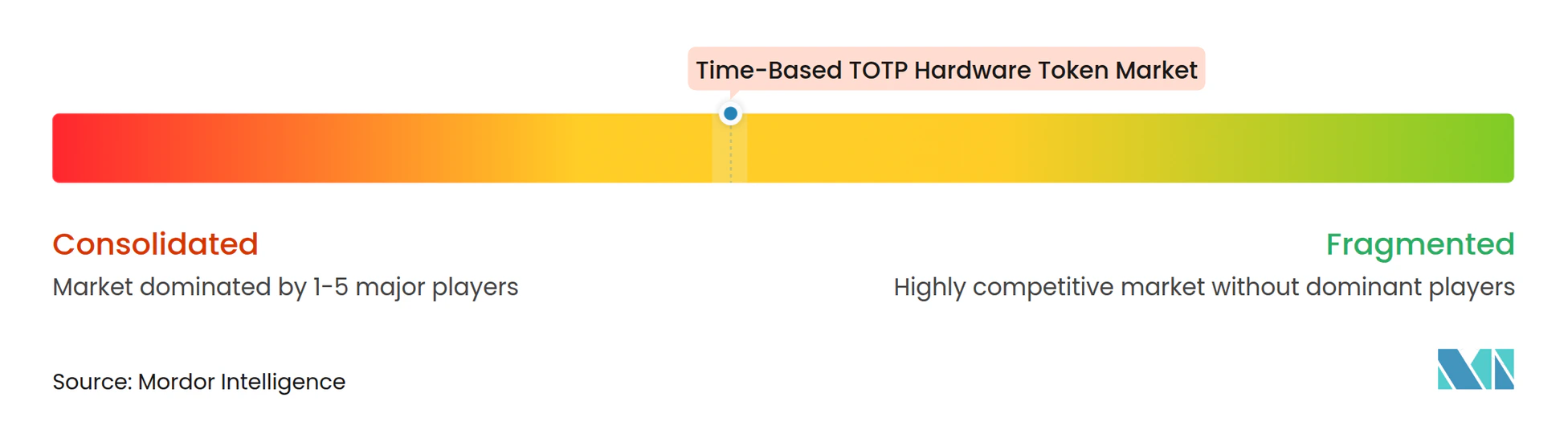
The TOTP hardware token market is moderately concentrated in the enterprise tier, where Thales, RSA Security, OneSpan, Yubico, and HID Global maintain long-standing relationships with regulated buyers. Their portfolios include validated devices and established identity platform integrations, while the competition centers on support for TOTP, HOTP, FIDO2, PIV, and physical access credentials without additional device complexity. Yubico, HID Global, and Versasec have emphasized lifecycle management services to simplify deployment and build recurring customer relationships. Yubico expanded YubiKey as a Service to 175 countries and 24 territories in May 2025
Product convergence is a prominent competitive approach in the TOTP hardware token market. Swissbit launched iShield Key 2 in May 2025 with FIPS 140-3 Level 3 certification and support for NFC, USB-C, USB-A, FIDO2, TOTP, HOTP, PIV, and selected physical-access interfaces, combining an access badge and an authentication credential in a single device. Thales expanded its FIDO-certified portfolio to 36 items in 2025 and introduced a software-as-a-service enrollment platform for its authentication portfolio. Cryptsoft demonstrated hybrid post-quantum authentication in April 2026 using an ML-DSA-65 implementation and a FEITIAN OpenSK dongle, pointing to future work on quantum-safe hardware credentials. These moves show that vendors are competing by offering management services, broader protocol support, and readiness for evolving cryptographic requirements.
The mid-market remains a contested segment in the TOTP hardware token market because organizations with 500 to 5,000 users often require more than manual provisioning can provide, yet may not meet enterprise contract thresholds. FEITIAN, Token2, Protectimus, ID Control, and Hypersecu compete on unit pricing, seed provisioning flexibility, and RADIUS compatibility. FIDO2 certification and metadata statement verification increasingly function as entry requirements, and vendors without a compliant attestation chain can lose access to higher-assurance tenders regardless of device price. Competition is active, but established vendors retain advantages in compliance evidence, support coverage, and identity-platform partnerships.
Time-Based TOTP Hardware Token Industry Leaders
-
Thales S.A.
-
RSA Security LLC
-
OneSpan Inc.
-
Yubico AB
-
FEITIAN Technologies Co., Ltd.
- *Disclaimer: Major Players sorted in no particular order
Time-Based TOTP Hardware Token Market Companies Covered in this Report
- Thales S.A.
- RSA Security LLC
- OneSpan Inc.
- Yubico AB
- FEITIAN Technologies Co., Ltd.
- Entrust Corporation
- HID Global Corporation
- Token2 AG
- Protectimus Ltd
- Deepnet Security Limited
- SecureMetric Technology Sdn Bhd
- SurePassID Corp.
- Authenex, Inc.
- Hypersecu Information Systems Inc.
- Perico AS
- SecuTech Solutions
- Nexus Group AB
- ID Control B.V.
- Swissbit AG
- AuthenTrend Technology Co., Ltd.
Recent Industry Developments in Time-Based TOTP Hardware Token Market
- October 2026: Swissbit showcased the iShield Key 2 alongside functional post-quantum cryptography demonstrators at it-sa 2026 in Nuremberg, confirming expanded support for LEGIC advant and LEGIC neon physical access standards. The company presented the iShield Key PQC Evaluation Platform to selected partners, signaling a production roadmap for quantum-safe hardware authentication products within its multi-application security key family.
- July 2026: Yubico launched YubiKey 5.8, extending hardware-backed passkeys from authentication to verified authorization through Role Delegation Tokens, a cryptographic primitive that cryptographically binds human approval to AI agent operations. This release broadened the addressable market for hardware security keys to include agentic AI governance use cases in enterprise software factories and cloud automation pipelines.
- April 2026: OpenAI and Yubico partnered to bring custom phishing-resistant YubiKeys to OpenAI users, with mandatory hardware key requirements for researchers beginning September 1, 2026. The partnership represents a high-visibility endorsement of hardware authentication in the AI research sector and raises baseline credential standards for organizations managing frontier AI systems.
- April 2026: Cryptsoft publicly demonstrated a hybrid post-quantum cryptography authentication-token proof of concept combining an ML-DSA-65 Rust implementation with a FEITIAN OpenSK dongle, delivering hybrid PQC passkey authentication for the Cryptsoft KMIP C Server. The result is the first publicly documented firmware-level integration of NIST-standardized ML-DSA on a FIDO-capable hardware platform, establishing a collaborative path toward PQC-ready hardware token products.
Global Time-Based TOTP Hardware Token Market Report Scope
The Time-Based TOTP Hardware Token Market comprises physical authentication devices that generate time-based one-time passwords (TOTPs) using the Time-Based One-Time Password algorithm to verify user identities and secure access to digital systems, applications, networks, and sensitive information. These tokens generate temporary authentication codes that remain valid for a predefined period, providing an additional layer of security beyond conventional passwords and helping organizations mitigate unauthorized access, credential theft, and identity-related security risks.
The Time-Based TOTP Hardware Token Market Report is Segmented by Product Form Factor (Key-Fob Tokens, Display-Card Tokens, USB and USB-C Tokens, NFC-Enabled Tokens, and Hybrid Hardware Authentication Tokens), Connectivity Mode (Disconnected Tokens, Contactless NFC Tokens, USB-Connected Tokens, Bluetooth-Enabled Tokens, and Dual-Interface Tokens), Authentication Function (Time-Based TOTP, Event-Based HOTP, TOTP and FIDO2 Hybrid Authentication, and TOTP and PIV or Smart-Card Authentication), End-User Industry (BFSI, Government and Defense, Enterprise IT and Cloud Security, Healthcare and Life Sciences, Telecommunications, Critical Infrastructure and Industrial Security, and Retail and E-Commerce), Deployment Environment (On-Premise, Cloud, and Hybrid), and Geography (North America, South America, Europe, Asia-Pacific, Middle East, and Africa). The Market Forecasts are Provided in Terms of Value (USD).
Segmentation Overview
| Key-Fob Tokens |
| Display-Card Tokens |
| USB and USB-C Tokens |
| NFC-Enabled Tokens |
| Hybrid Hardware Authentication Tokens |
| Disconnected Tokens |
| Contactless NFC Tokens |
| USB-Connected Tokens |
| Bluetooth-Enabled Tokens |
| Dual-Interface Tokens |
| Time-Based TOTP |
| Event-Based HOTP |
| TOTP and FIDO2 Hybrid Authentication |
| TOTP and PIV or Smart-Card Authentication |
| BFSI |
| Government and Defense |
| Enterprise IT and Cloud Security |
| Healthcare and Life Sciences |
| Telecommunications |
| Critical Infrastructure and Industrial Security |
| Retail and E-Commerce |
| On-Premise |
| Cloud |
| Hybrid |
| North America | United States |
| Canada | |
| Mexico | |
| South America | Brazil |
| Argentina | |
| Rest of South America | |
| Europe | Germany |
| United Kingdom | |
| France | |
| Italy | |
| Spain | |
| Rest of Europe | |
| Asia-Pacific | China |
| Japan | |
| India | |
| South Korea | |
| Singapore | |
| Australia | |
| Rest of Asia-Pacific | |
| Middle East | Saudi Arabia |
| United Arab Emirates | |
| Turkey | |
| Rest of Middle East | |
| Africa | South Africa |
| Nigeria | |
| Egypt | |
| Kenya | |
| Rest of Africa |
| By Product Form Factor | Key-Fob Tokens | |
| Display-Card Tokens | ||
| USB and USB-C Tokens | ||
| NFC-Enabled Tokens | ||
| Hybrid Hardware Authentication Tokens | ||
| By Connectivity Mode | Disconnected Tokens | |
| Contactless NFC Tokens | ||
| USB-Connected Tokens | ||
| Bluetooth-Enabled Tokens | ||
| Dual-Interface Tokens | ||
| By Authentication Function | Time-Based TOTP | |
| Event-Based HOTP | ||
| TOTP and FIDO2 Hybrid Authentication | ||
| TOTP and PIV or Smart-Card Authentication | ||
| By End-User Industry | BFSI | |
| Government and Defense | ||
| Enterprise IT and Cloud Security | ||
| Healthcare and Life Sciences | ||
| Telecommunications | ||
| Critical Infrastructure and Industrial Security | ||
| Retail and E-Commerce | ||
| By Deployment Environment | On-Premise | |
| Cloud | ||
| Hybrid | ||
| By Geography | North America | United States |
| Canada | ||
| Mexico | ||
| South America | Brazil | |
| Argentina | ||
| Rest of South America | ||
| Europe | Germany | |
| United Kingdom | ||
| France | ||
| Italy | ||
| Spain | ||
| Rest of Europe | ||
| Asia-Pacific | China | |
| Japan | ||
| India | ||
| South Korea | ||
| Singapore | ||
| Australia | ||
| Rest of Asia-Pacific | ||
| Middle East | Saudi Arabia | |
| United Arab Emirates | ||
| Turkey | ||
| Rest of Middle East | ||
| Africa | South Africa | |
| Nigeria | ||
| Egypt | ||
| Kenya | ||
| Rest of Africa | ||
Key Questions Answered in the Report
What is the size of the TOTP hardware token market?
The TOTP hardware token market is valued at USD 10.05 billion in 2026 and is projected to reach USD 17.33 billion by 2032 at a 9.58% CAGR.
Which product form factor leads TOTP hardware token demand?
USB and USB-C tokens lead with 33.43% of 2026 revenue because they integrate directly with managed enterprise endpoints and VPN workflows.
Why are NFC-enabled hardware tokens gaining adoption?
NFC-enabled tokens are projected to expand at a 10.58% CAGR through 2032 because they suit clinical, retail, and field environments with shared or non-desk workstations.
Which end-user sector uses the most TOTP hardware tokens?
BFSI accounted for 55.27% of 2026 revenue, supported by payment security, privileged-access, and fraud-control requirements.
Which region is expected to expand fastest for hardware authentication devices?
Asia-Pacific is projected to expand at a 10.72% CAGR through 2032, supported by banking regulation, payment activity, and cybersecurity investment.
How do hardware tokens compare with mobile authenticators?
Hardware devices remain most relevant for regulated, privileged, and restricted-connectivity use cases, while mobile authenticators are widely used for lower-risk workforce access.