
Thailand Pet Treats Market Size and Share
Market Overview
| Study Period | 2021 - 2031 |
|---|---|
| Forecast Data Period | 2026 - 2031 |
| Base Year Market Size (2025) | USD 334.46 Million |
| Market Size (2026) | USD 356.69 Million |
| Market Size (2031) | USD 503.75 Million |
| Growth Rate (2026 - 2031) | 7.15 % |
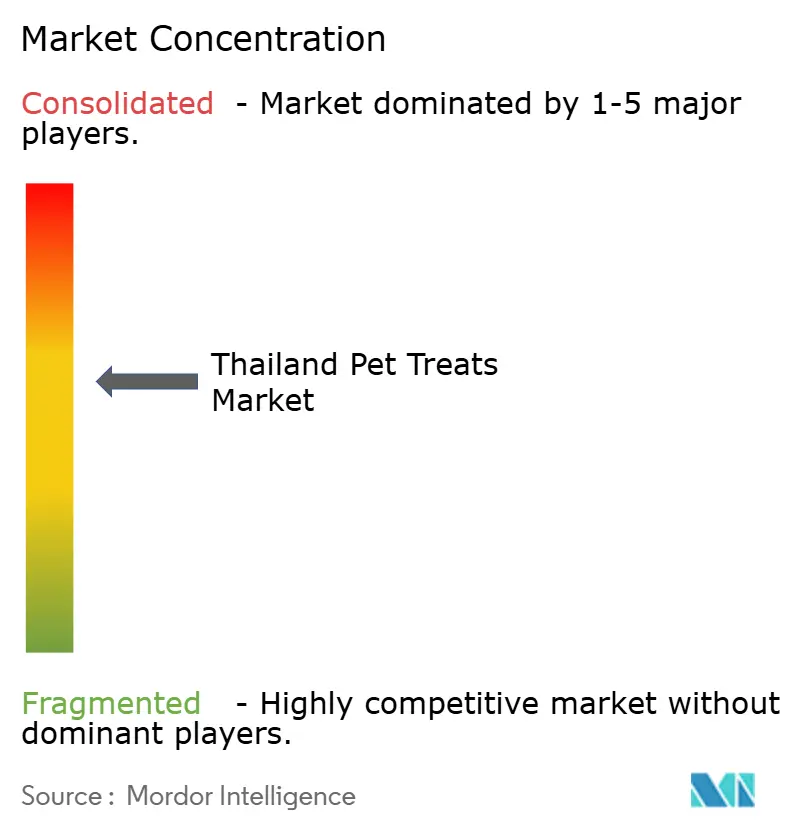
| Market Concentration | Medium |
Major Players
*Disclaimer: Major Players sorted in no particular order Image © Mordor Intelligence. Reuse requires attribution under CC BY 4.0. |
|
Thailand Pet Treats Market Analysis by Mordor Intelligence
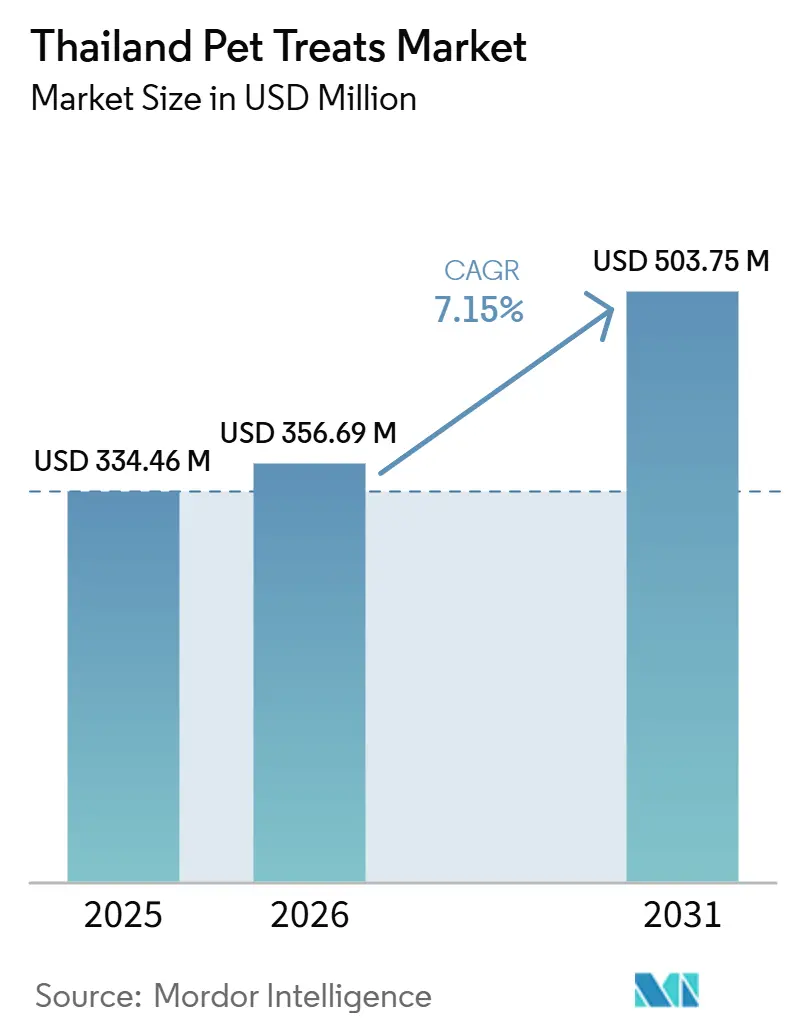
The Thailand pet treats market was valued at USD 334.46 million in 2025 and is forecast to grow from USD 356.69 million in 2026 to USD 503.75 million by 2031, at a CAGR of 7.15% during the forecast period 2026–2031. Thailand's broader pet economy continued to expand in 2025 and 2026, supporting higher spending on treats as owners increasingly used them for routine care, training, and wellness rather than as occasional rewards. The market also benefits from the country's strong manufacturing base, as export-scale production allows suppliers to launch new products locally with better cost control and faster turnaround. Urban demand remains the primary growth driver, with Bangkok and other large cities driving premium formats, specialty retail, and online ordering faster than provincial areas. Companies are responding with dental, functional, and premium product lines, while using influencer partnerships, retail expansion, and export-backed investment to broaden their reach. Cost pressures on imported additives and limited regulatory clarity for functional claims continue to restrict the wider rollout of premium products, particularly among smaller brands that lack the scale, compliance resources, or sourcing leverage of larger players[1]Source: USDA FAS Report, "Thailand's Pet Food Market 2025," apps.fas.usda.gov.
Key Report Takeaways
- By sub product, dental treats was the largest segment and held 24.5% of the Thailand pet treats market share in 2025, while freeze-dried and jerky treats is the fastest growing segment and is anticipated to expand at a 8.2% CAGR between 2026 and 2031
- By pets, dogs was the largest segment and held 68.7% of the Thailand pet treats market size in 2025, while cats is the fastest growing segment and is forecasted to expand at a 8.6% CAGR between 2026 and 2031
- By distribution channel, specialty stores was the largest segment and held 39.4% of the market share in 2025, while online channel is the fastest growing segment and is anticipated to grow at a 7.9% CAGR between 2026 and 2031
Note: Market size and forecast figures in this report are generated using Mordor Intelligence’s proprietary estimation framework, updated with the latest available data and insights as of January 2026.
Thailand Pet Treats Market Trends and Insights
Drivers Impact Analysis*
| Driver | (~) % Impact on CAGR Forecast | Geographic Relevance | Impact Timeline |
|---|---|---|---|
| Pet humanization and premium treat adoption | +1.8% | National, strongest in Bangkok, Chiang Mai, and major urban centers | Long term (≥ 4 years) |
| Rising cat ownership and treat-focused spending | +1.2% | National, strongest in Bangkok metropolitan area and secondary urban cities | Medium term (2-4 years) |
| Expansion of e-commerce, social commerce, and quick-commerce channels | +1.1% | National, with stronger gains in digital-first urban consumers | Medium term (2-4 years) |
| Growth of modern trade and pet specialty retail | +0.9% | Urban Thailand, with gradual expansion into second-tier cities | Long term (≥ 4 years) |
| Demand for dental, functional, and health-oriented treats | +1.0% | National, with faster adoption in premium urban centers | Medium term (2-4 years) |
| Availability of domestic protein supply and pet food manufacturing base | +0.7% | National, anchored in Central Thailand and Eastern Seaboard production clusters | Short term (≤ 2 years) |
| Source: Mordor Intelligence | |||
Pet Humanization and Premium Treat Adoption
Pet ownership in Thailand is increasingly associated with higher routine spending on care products, supporting steady demand for premium snacks and wellness-focused treats. Thailand's domestic pet food market reached USD 2,250.0 million in 2025, indicating that treat purchases are being supported by a broader rise in pet-related household spending. Premium positioning is proving viable, as Royal Canin Thailand reported USD 49.8 million in revenue in 2025, attributing part of that performance to demand for senior pet food and cat-related products. This trend supports the Thailand pet treats market, as owners are showing greater willingness to spend on products that fit daily health, bonding, and reward routines rather than serving only as occasional indulgences.
Rising Cat Ownership and Treat-Focused Spending
Cat ownership grew faster than dog ownership in Thailand between 2021 and 2025, expanding the addressable base for cat-focused treats, particularly soft, moist, and lickable formats. According to the United States Department of Agriculture Foreign Agricultural Service (USDA FAS) report in 2025, Thailand had 1.94 million pet cats, a base large enough to support specialized product planning rather than treating cat treats as a minor extension of dog portfolios[2]Source: USDA FAS Report, "Thailand's Pet Food Market 2025," apps.fas.usda.gov. Multi-pet households add another layer of demand, increasing the likelihood of cross-category purchases that include multiple treat types in a single transaction. Inaba Petfood Co., Ltd. illustrates how brands are responding with its Churu range, produced at its Saraburi facility in Thailand and built around a format suited to daily cat feeding habits. Longer feline lifespans are also driving greater attention toward age-specific and function-led products, providing the Thailand pet treats market a clear path to expand beyond simple flavor-led offerings.
Expansion of E-Commerce, Social Commerce, and Quick-Commerce Channels
Digital retail is expanding access to the Thailand pet treats market by making premium products easier to discover, compare, and reorder across urban and provincial areas. Social commerce plays a notable role by integrating product discovery with live selling events, which suits impulse-driven purchases such as treats and small pack formats. Quick-commerce services support repeat demand by reducing delivery times and enabling small top-up purchases with same-day fulfillment. JerHigh's deployment of automated dog treat vending machines in Bangkok shopping malls illustrates how brands are expanding convenience-oriented retail touchpoints to improve accessibility and encourage impulse purchases. These evolving retail formats are strengthening distribution reach and creating additional buying occasions rather than simply shifting demand from traditional retail to online channels.
Growth of Modern Trade and Pet Specialty Retail
Specialty retail continues to shape how premium products are sold in the Thailand pet treats market, as staff guidance remains important in categories such as dental, functional, and life-stage treats. Pet Lovers Centre has identified Thailand as a priority market in its regional store expansion plan, reflecting the remaining potential for specialty-led penetration outside established urban locations. The channel is significant because shoppers often require assistance in choosing among different textures, functions, and claim types, support that is difficult to replicate on a standard grocery shelf. Physical stores are also taking on a secondary role as small fulfillment points for click-and-collect and same-day delivery, helping them remain relevant as online sales grow. This combination of advice, visibility, and fulfillment gives specialty retail a continued role in the market.
Restraints Impact Analysis*
| Restraint | (~) % Impact on CAGR Forecast | Geographic Relevance | Impact Timeline |
|---|---|---|---|
| Imported ingredient price volatility | -1.2% | National, strongest for mid-tier producers using imported additives and binders | Short term (≤ 2 years) |
| Strong price sensitivity outside major urban centers | -0.9% | Provincial Thailand and smaller cities beyond Bangkok and Chiang Mai | Medium term (2-4 years) |
| Uneven regulatory clarity for functional claims and supplements | -0.6% | National, highest for dental and nutraceutical-style products | Medium term (2-4 years) |
| Limited cold-chain and premium logistics penetration | -0.5% | Provincial Thailand, with better coverage in Bangkok and the Eastern corridor | Long term (≥ 4 years) |
| Source: Mordor Intelligence | |||
Imported Ingredient Price Volatility
Thailand has a strong domestic protein base, but several treat inputs still depend on imports, including specialty fats, grain binders, probiotics, glucosamine, and chondroitin. According to the United States Department of Agriculture Foreign Agricultural Service in 2025, Thailand's pet food imports increased from USD 66 million in 2021 to USD 122 million in 2024. Over the same period, China's share of Thailand's pet food imports rose from 3% to 39%. This trend indicates the extent to which price competition from imported inputs can affect local producers, particularly those without scale purchasing or long-term contracts. The risk increases as brands move into more advanced formats, since functional treats typically require a higher proportion of specialized ingredients than standard snacks. This keeps margin pressure high for mid-sized producers seeking to premiumize but lacking the export volumes needed to spread sourcing risk.
Strong Price Sensitivity Outside Major Urban Centers
Demand for premium products in the Thailand pet treats market remains concentrated in Bangkok and a limited number of other urban centers, while buyers in provincial areas remain more price-conscious. Bangkok's higher pet ownership rates, higher incomes, and better access to specialty retail support faster adoption of dental and functional formats compared to most secondary cities. Outside these areas, lower willingness to pay makes pack size, price ladders, and product entry points more important than shelf presence alone. As a result, distribution expansion does not automatically translate into premium sell-through where local affordability does not match the price point. The Thailand pet treats market therefore remains heavily dependent on a narrow set of urban areas for premium revenue, which increases exposure to shifts in city-level consumer confidence.
*Our forecasts treat driver/restraint impacts as directional, not additive. The impact forecasts reflect baseline growth, mix effects, and variable interactions.
Segment Analysis
By Sub Product: Dental Formats Anchor Volume as Freeze-Dried Premiums Gain
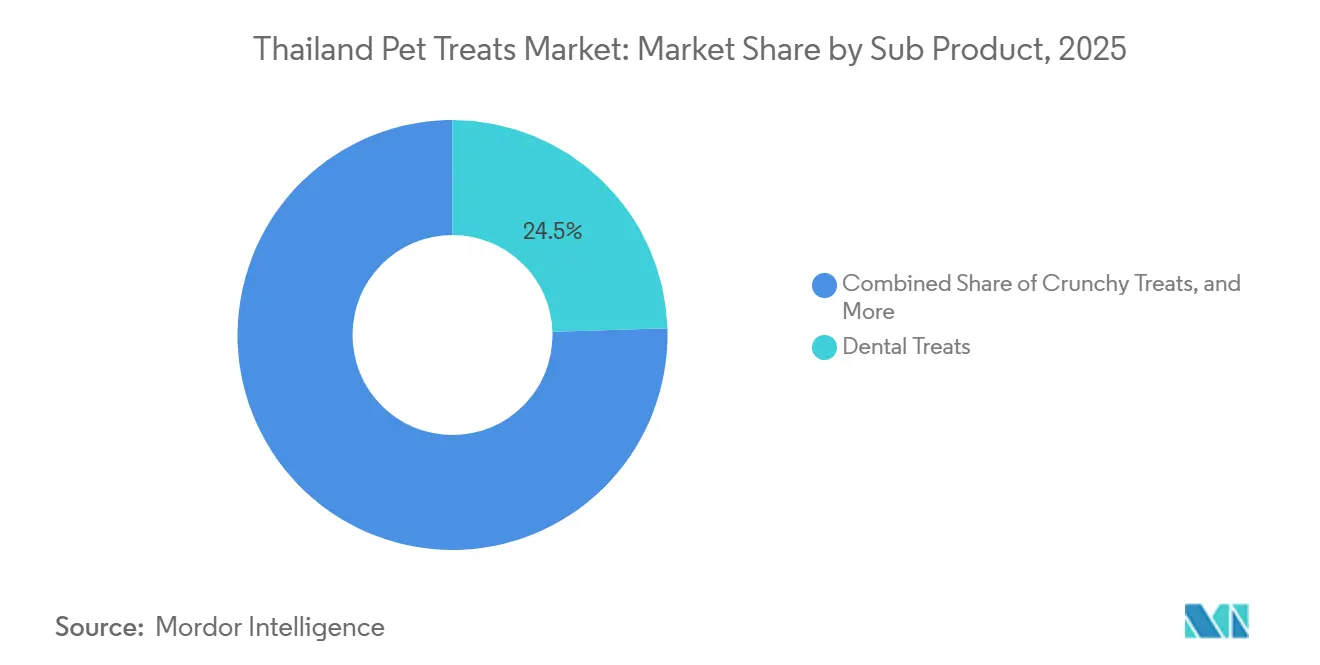
Dental treats held 24.5% of the Thailand pet treats market share in 2025, making them the largest sub product category. This position reflects a category where owners see a clear daily use case and retailers can communicate product benefits more easily than they can for less familiar functional claims. JerHigh's September 2025 launch of Den-T Chews illustrates how domestic players are expanding dental care into a broader platform with added positioning around memory, joint health, and coat support. Crunchy treats remain a large everyday format due to their ease of stocking, pricing, and distribution across mass and specialty channels.
Freeze-dried and jerky treats are anticipated to expand at an 8.2% CAGR between 2026 and 2031, making them the fastest-growing sub product category in the Thailand pet treats market. Growth is supported by premium urban buyers who respond to meat-led textures, limited-ingredient positioning, and minimally processed formats. Soft and chewy products also have room to grow, as they suit cat preferences and older pets better than hard formats. Other treats, including meat sticks and toppers, remain active in specialty channels where small-batch brands and targeted claims can find shelf space. Overall, the product mix indicates that the Thailand pet treats market is shifting from shelf-stable reward snacks toward more purpose-led and texture-led purchasing.



By Pets: Dog Ownership Anchors Scale, Cat Growth Reshapes the Treat Mix
Dogs accounted for 68.7% of the Thailand pet treats market in 2025, giving the dog segment the broadest reach across product lines, price points, and retail channels. Thailand had 3.45 million dogs in 2025, and this base continues to drive repeat purchases across mainstream snacks, training treats, and dental chews. Companies continue to support this scale with new product releases. JerHigh alone launched multiple dog treat SKUs in 2025 across different textures and product variants. The dog segment also benefits from more established retail placement and a wider range of functional chew products, which helps keep sales stable even when buyers shift between premium and mid-tier price bands.
The cat segment is anticipated to expand at a CAGR of 8.6% between 2026 and 2031, making it the fastest-growing pet type in the Thailand pet treats market. Cat ownership is rising faster than dog ownership, gradually shifting texture demand, pack formats, and merchandising approaches across the category[3]Source: Kasikorn Research Center, "Thailand's pet food market in 2025 continues to grow both domestically and exportedly due to the popularity of pets," kasikornresearch.com. Multi-pet households reinforce this trend, as cat and dog treats are often purchased in the same transaction rather than as separate shopping trips. Other pets remain a small but served niche, supported mostly by specialty stores whose broader assortments make these lower-volume lines viable. Overall, the Thailand pet treats market still depends on dogs for scale, while cats are playing a larger role in shaping the next stage of format innovation.
By Distribution Channel: Specialty Stores Set the Value Tone, Online Channel Expands Reach
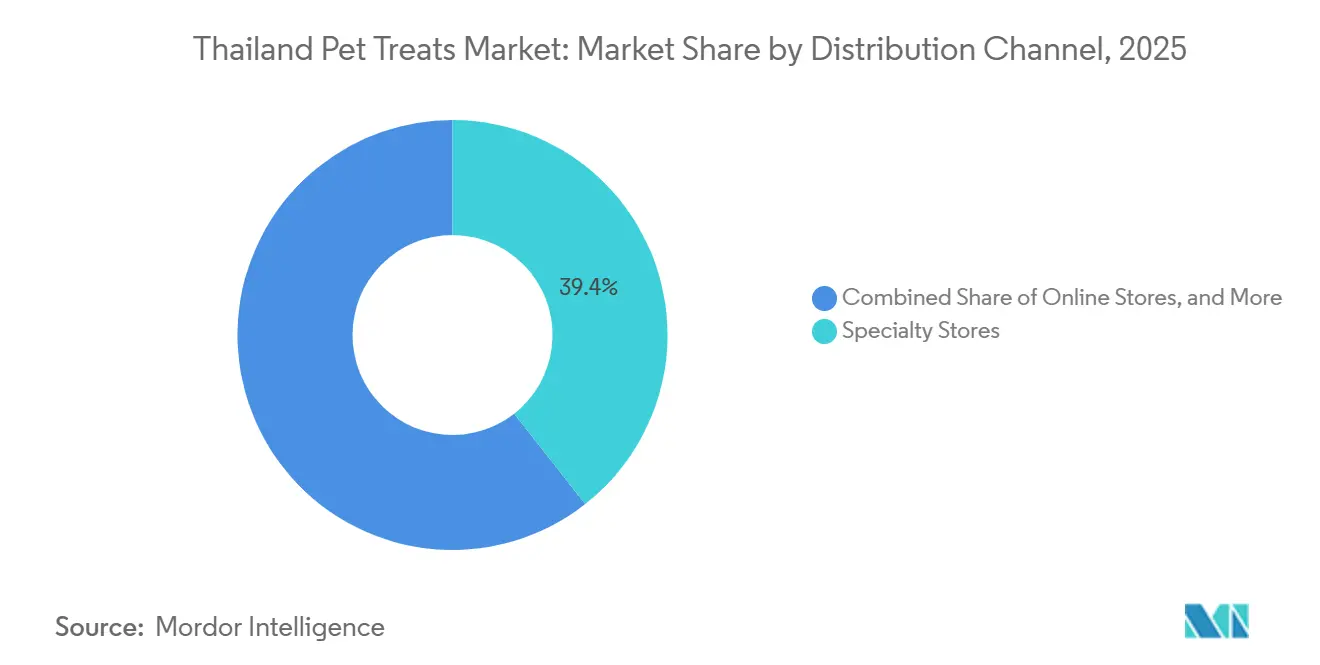
Specialty stores held 39.4% of the Thailand pet treats market size in 2025, maintaining their position as the leading distribution channel. This position is supported by a retail model where store staff can guide buyers toward dental, cat-specific, and functional options that are more difficult to explain on a standard grocery shelf. Supermarkets and hypermarkets remain important for accessible formats, particularly crunchy and soft treats sold at value-driven price points. Other channels, including veterinary clinics and grooming outlets, are most relevant when professional recommendations improve consumer confidence in product claims.
The online channel is anticipated to expand at a 7.9% CAGR between 2026 and 2031, making it the fastest-growing distribution channel in the Thailand pet treats market. Online growth is supported by social commerce, quick reordering, and broader product visibility, all of which favor small packs and premium treats that do not require a large basket size to justify purchase. The distinction between specialty retail and e-commerce is also narrowing, as stores increasingly serve as local fulfillment points for digital orders. This improves convenience without removing the role of specialist advice from the shopping journey. As a result, physical stores continue to shape consumer trust and product choice, while online channels expand reach and purchase frequency across the Thailand pet treats market.
Geography Analysis
Bangkok remains the primary demand center for premium treats, driven by higher pet ownership rates, income levels, retail access, and digital purchasing compared to most other areas. Chiang Mai also supports premium demand, while Phuket and Pattaya represent smaller but attractive urban pockets associated with higher-spending households and expatriate communities. The Eastern Seaboard plays a different role, functioning primarily as a production and supply base rather than a major consumer demand center. Facilities linked with Nestlé, Betagro, and contract producers strengthen manufacturing efficiency and improve the market's ability to respond to shifting product demand.
Thailand holds a strong position in pet food exports, supporting local treat innovation through export-grade production facilities, established ingredient networks, and packaging capacity. Dog and cat food exports reached USD 2.9 billion in 2025, confirming the industrial depth behind domestic product launches. This positions the Thailand pet treats market with a cost and supply advantage over smaller Southeast Asian consumer bases that rely more heavily on imported finished goods.
Provincial markets offer the largest remaining growth opportunity but are also the most difficult to scale quickly. Traditional trade channels retain a stronger presence outside major cities, limiting the visibility of premium dental and functional treat formats. E-commerce is beginning to close the access gap by making urban product assortments available in more locations, though price sensitivity continues to slow conversion in many provincial households. Improved trade terms that expand access to novel ingredients could help local producers broaden the appeal of health-oriented products over time. Until such conditions develop more broadly, the strongest near-term growth is likely to remain concentrated in Thailand's larger urban consumer clusters rather than distributed evenly across the country.
Competitive Landscape
The Thailand pet treats market is moderately concentrated. Mars, Incorporated, International Pet Food Company Limited (Charoen Pokphand Group Co., Ltd.), Nestlé Purina PetCare (Nestlé S.A.), Hill’s Pet Nutrition, Inc. (Colgate-Palmolive Company), and Betagro Public Company Limited form the first tier of suppliers and collectively held a major share in 2025. These companies benefit from established distribution networks, strong brand recognition, and the ability to invest in product development and marketing at scale. This scale allows large operators to manage regulatory requirements, sourcing pressures, and channel investment more effectively than smaller producers.
Mars, Incorporated maintained its strong presence in the Thailand pet food market through its established manufacturing operations, which support the production of a broad portfolio of pet food products for domestic consumption and export markets. In 2026, Mars, Incorporated and Big Idea Ventures launched the Global Pet Food Innovation Program, focusing on Asia-Pacific startups, including Thai companies. This reflects an innovation strategy that extends beyond internal product development. Charoen Pokphand Group Co., Ltd.'s JerHigh brand pursued a different approach by pairing new product launches with influencer-led activation and rapid format extension in 2025. Betagro is pursuing growth through capacity expansion, premium portfolio upgrades, and higher revenue targets for its pet business, indicating more active competition in specialized nutrition and higher-value formats.
Thai Union Group Public Company Limited's i-Tail Corporation adds another competitive layer, as the company is increasing its focus on innovation-derived revenue and views treats as a growing part of its product mix. No single domestic player has established a dominant position across the full functional treat space, leaving room for further competition in dental, senior-support, and condition-specific products. Veterinary-linked players such as Virbac S.A. and Dechra Pharmaceuticals PLC also retain influence in segments where professional recommendation carries more weight than consumer advertising. This keeps the Thailand pet treats market open to niche expansion, even as the leading companies continue to control most of the branded scale and channel leverage.
Thailand Pet Treats Industry Leaders
-
Mars, Incorporated
-
Nestlé Purina PetCare (Nestlé S.A.)
-
Betagro Public Company Limited
-
Hill’s Pet Nutrition, Inc. (Colgate-Palmolive Company)
-
International Pet Food Company Limited (Charoen Pokphand Group Co., Ltd.)
- *Disclaimer: Major Players sorted in no particular order

Recent Industry Developments
- July 2026: Betagro Public Company Limited unveiled a 3-year plan targeting THB 5.6 billion (USD 165 million) in pet business revenue by 2028, dedicating 15% to 20% of annual sales to brand building, production capacity expansion, and research and development (R&D). The company aims to raise the premium segment's share of its pet portfolio to 54% by 2028, up from 45% in 2026.
- November 2025: International Pet Food Company Limited unveiled JerHigh Thai Taste, a premium Thai-flavor treat collection, at Pet Fair Southeast Asia 2025, targeting export markets in Asia and the Middle East, with a commercial launch planned for Q1 2026.
- February 2025: Betagro Public Company Limited committed THB 4.8 billion (USD 139 million) for 2025, covering production capacity expansion at its Lopburi facility, premium portfolio upgrades, and export diversification, targeting 3% to 7% overall revenue growth.


Thailand Pet Treats Market Report Scope
Pet treats are snack and reward products formulated for companion animals and are used for indulgence, training, oral care, and functional health support.
The Thailand Pet Treats Market is Segmented by Sub Product (Crunchy Treats, Dental Treats, Freeze-Dried and Jerky Treats, Soft and Chewy Treats, and Other Treats), by Pets (Dogs, Cats, and Other Pets), and by Distribution Channel (Convenience Stores, Online Channel, Specialty Stores, Supermarkets and Hypermarkets, and Other Channels). The Market Forecasts are Provided in Terms of Value (USD) and Volume (Metric Tons).
| Crunchy Treats |
| Dental Treats |
| Freeze-Dried and Jerky Treats |
| Soft and Chewy Treats |
| Other Treats |
| Dogs |
| Cats |
| Other Pets |
| Specialty Stores |
| Online Channel |
| Supermarkets and Hypermarkets |
| Convenience Stores |
| Other Distribution Channels |
| By Sub Product | Crunchy Treats |
| Dental Treats | |
| Freeze-Dried and Jerky Treats | |
| Soft and Chewy Treats | |
| Other Treats | |
| By Pets | Dogs |
| Cats | |
| Other Pets | |
| By Distribution Channel | Specialty Stores |
| Online Channel | |
| Supermarkets and Hypermarkets | |
| Convenience Stores | |
| Other Distribution Channels |


Key Questions Answered in the Report
What is the forecasted value of Thailand pet treats by 2031?
The Thailand pet treats market is forecasted to reach USD 503.75 million by 2031, up from USD 356.69 million in 2026.
What is driving pet treat demand in Thailand?
Higher pet spending, stronger premiumization, rising cat ownership, and wider online and specialty retail access are the main demand supports.
Which sub product leads sales in Thailand?
Dental treats led in 2025 with 24.5% share, helped by growing owner focus on oral care and wellness-linked daily use.
What is the main challenge for new or smaller brands?
Imported ingredient volatility, price sensitivity outside urban centers, and slower registration for functional claims remain the key barriers.
Page last updated on:





