
Thailand Industrial Press Machines Market Size and Share
Market Overview
| Study Period | 2020 - 2031 |
|---|---|
| Forecast Data Period | 2026 - 2031 |
| Base Year Market Size (2025) | USD 0.28 Billion |
| Market Size (2026) | USD 0.3 Billion |
| Market Size (2031) | USD 0.4 Billion |
| Growth Rate (2026 - 2031) | 5.92 % |
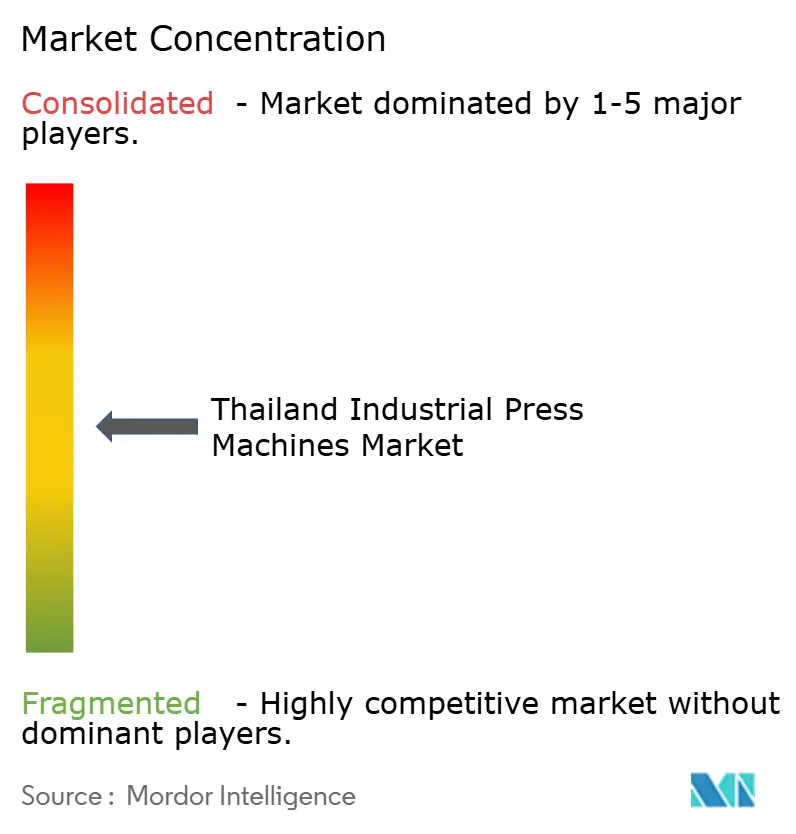
| Market Concentration | Medium |
Major Players *Disclaimer: Major Players sorted in no particular order Image © Mordor Intelligence. Reuse requires attribution under CC BY 4.0. | |
Thailand Industrial Press Machines Market Analysis by Mordor Intelligence
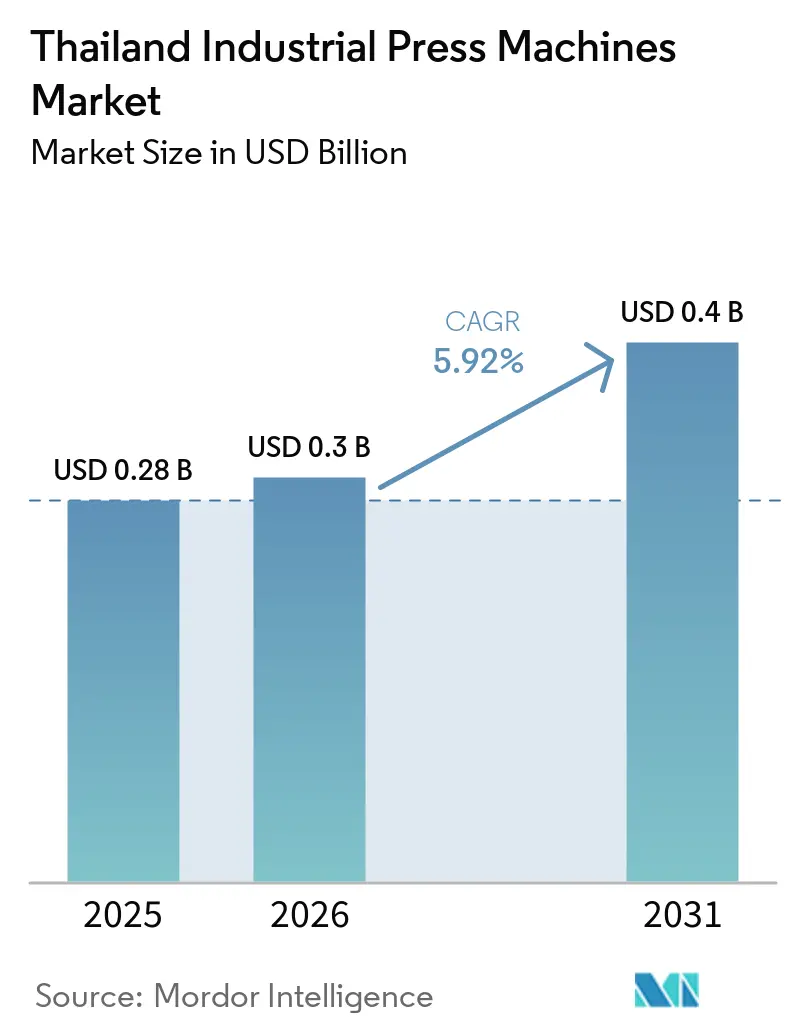
The Thailand Industrial Press Machines Market size was valued at USD 0.28 billion in 2025 and is estimated to grow from USD 0.3 billion in 2026 to reach USD 0.4 billion by 2031, at a CAGR of 5.92% during the forecast period (2026-2031).
Production diversification into electric vehicles, battery cells, precision electronics, and medical devices is shaping Thailand's industrial press machine market. These activities require equipment that can manage tighter dimensional tolerances, controlled forming forces, and repeatable production conditions. The Eastern Economic Corridor remains the main investment location, while Ayutthaya and Greater Bangkok support electronics, printed circuit board, and component manufacturing. Suppliers are responding with faster service, retrofit support, automated equipment, and applications tailored to individual factories. Capital constraints, imported component exposure, and uneven EV investment can delay equipment orders, although electronics, medical production, and refurbishment work provide a steadier base of demand.
Key Report Takeaways
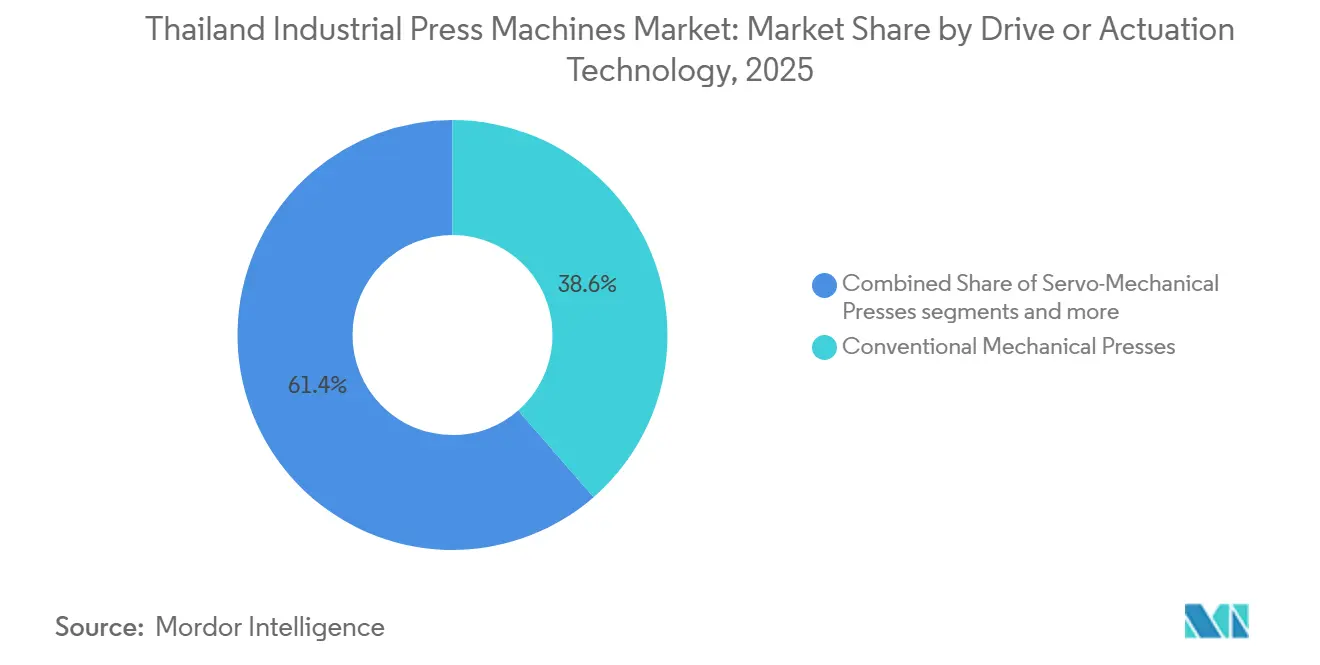
- By drive or actuation technology, conventional mechanical presses held 38.6% of the Thailand industrial press machines market share in 2025, while servo-mechanical presses are forecast to grow at an 8.1% CAGR through 2031.
- By press force or capacity, the 101–500 tons range accounted for 40.2% of the Thailand industrial press machines market size in 2025, while the above 2,000 tons range is projected to expand at a 6.8% CAGR through 2031.
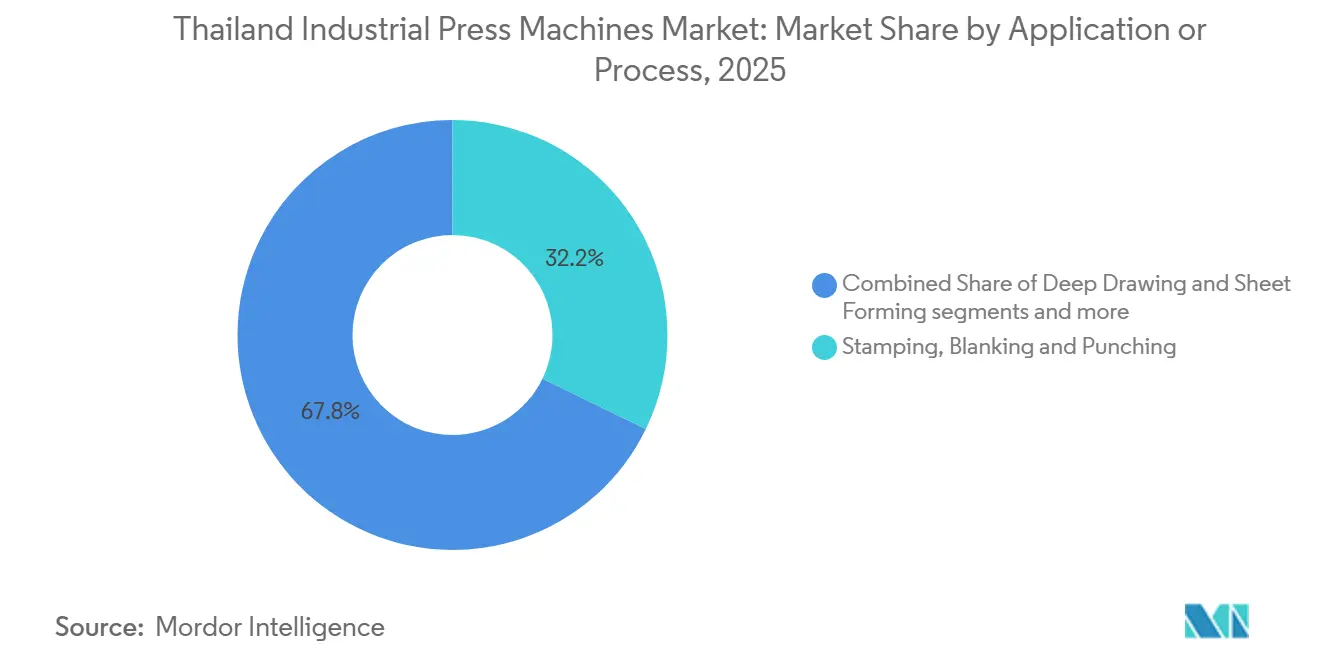
- By application or process, stamping, blanking, and punching captured 32.2% of the Thailand industrial press machines market share in 2025, while assembly, press-fitting, and joining are forecast to advance at a 6.2% CAGR through 2031.
- By end-use industry, automotive and transportation held 43.8% of demand in 2025, while medical and precision manufacturing is projected to grow at a 7.1% CAGR through 2031.
Note: Market size and forecast figures in this report are generated using Mordor Intelligence’s proprietary estimation framework, updated with the latest available data and insights as of January 2026.
Thailand Industrial Press Machines Market Trends and Insights
Drivers Impact Analysis*
| Driver | (~) % Impact on CAGR Forecast | Geographic Relevance | Impact Timeline |
|---|---|---|---|
| EV and Battery Component Manufacturing Expansion | +1.6% | EEC core in Chonburi and Rayong, with spillover to Samut Prakan | Short term (≤ 2 years) |
| Electronics and PCB Manufacturing Investment | +1.2% | Ayutthaya, Pathumthani, and Chonburi | Short term (≤ 2 years) |
| Automation, Robotics, and Industry 4.0 Adoption | +1.0% | Nationwide, with the highest concentration in the EEC and the Bangkok metropolitan area | Medium term (2-4 years) |
| Aging Mechanical Press Base and Retrofit Demand | +0.8% | Nationwide, concentrated in the eastern seaboard industrial estates | Short term (≤ 2 years) |
| Precision Forming Needs for Lightweight Materials | +0.5% | EEC automotive cluster, Rayong, and Chonburi | Medium term (2-4 years) |
| Localized Press-Line Service and Refurbishment | +0.3% | Nationwide, centered on the Bangkok metropolitan area and EEC service hubs. | Long term (≥ 4 years) |
| Source: Mordor Intelligence | |||
EV and Battery Component Manufacturing Expansion
Thailand’s EV policy is encouraging manufacturers to increase local vehicle and component output. The Thailand Board of Investment had approved 198 EV-related projects worth more than USD 4.1 billion by May 2026, spanning vehicles, hybrid systems, batteries, and components.[1]Thailand Board of Investment, “EV 3.5 Package,” Board of Investment of Thailand, boi.go.th The March 2025 approval for Sunwoda Electronics’ battery cell investment in Chonburi added a large-scale cell manufacturing project to the EEC production base. The EV 3.5 program requires participating producers to manufacture 2 vehicles in Thailand for every imported vehicle in 2026, with the requirement increasing to 3 vehicles in 2027. This requirement supports orders for body-panel, battery-case, and structural-component production equipment in the Thailand industrial press machines market. Battery cell production also creates a separate need for electrode calendering and deep-drawing equipment, which broadens demand beyond conventional vehicle stamping.
Electronics and PCB Manufacturing Investment
Advanced electronics investment is increasing demand for precision pressing systems used in multilayer board materials and connector production. New facilities increase the need for localized materials processing, connector production, and controlled lamination. PCB laminate production requires hydraulic presses with close temperature and pressure control, rather than the high-cycle mechanical equipment used for automotive stampings. Panasonic Industry announced a JPY 17 billion (USD 108.8 million) investment in September 2025 for a new multilayer circuit board materials plant at Ayutthaya, with operations planned for November 2027. The growth of PCB production in Ayutthaya, Pathum Thani, and Chonburi is therefore widening the Thailand industrial press machines market beyond the EEC automotive base.
Automation, Robotics, And Industry 4.0 Adoption
Manufacturers are modernizing press lines because automated monitoring can improve repeatability, uptime, and energy use. Thailand ranked 14th globally in industrial robot installations and second in ASEAN after Singapore, while only 2% of Thai manufacturers had achieved full Industry 4.0 integration by May 2025. The remaining gap leaves many factories with an incentive to upgrade controls, sensing, and data collection before moving to fully automated production. Servo presses are relevant because their motion can be programmed and monitored during each stroke. Thailand’s robotics roadmap for 2024 through 2026 also supports the adoption of AI and industrial internet tools in manufacturing. The 2025 to 2029 equipment efficiency support program can provide up to 30% financial support for qualified equipment upgrades, making energy-efficient systems more accessible.[2] International Energy Agency, “Energy Efficiency 2025,” International Energy Agency, iea.org
Aging Mechanical Press Base and Retrofit Demand
A large number of mechanical presses installed during Thailand’s industrial expansion now require updated drives, controls, guarding, and maintenance. Many of these machines have operated for 15 to 25 years and face tighter dimensional requirements from modern vehicle, electronics, and appliance programs. Full equipment replacement can be difficult when manufacturers face high foreign-exchange costs and limited long-term credit. Retrofit packages allow factories to preserve sound press frames while improving safety, control, and reliability. This work supports local service providers and keeps them engaged with customers until a full replacement becomes feasible. The Thailand industrial press machines market also benefits because maintenance relationships can lead to later orders for new equipment when production volumes or specifications change.
Restraints Impact Analysis*
| Restraint | (~) % Impact on CAGR Forecast | Geographic Relevance | Impact Timeline |
|---|---|---|---|
| High Capital Cost and Limited SME Financing | -1.2% | Nationwide, most acute outside EEC provinces | Short term (≤ 2 years) |
| Dependence on Imported Equipment and Critical Components | -0.9% | Nationwide, including EEC factories with import exposure | Long term (≥ 4 years) |
| Shortage of Press Programming and Maintenance Specialists | -0.6% | Nationwide, particularly the eastern seaboard industrial zones | Medium term (2-4 years) |
| Long Qualification Cycles for Automotive and Electronics Customers | -0.4% | EEC automotive and electronics clusters | Medium term (2-4 years) |
| Source: Mordor Intelligence | |||
High Capital Cost and Limited SME Financing
Financing conditions remain a direct constraint for smaller suppliers considering a press replacement or automation project. Outstanding Thai SME bank loans declined 3.1% year over year to THB 3.08 trillion (USD 97.8 billion) at the end of 2024.[3]Organisation for Economic Co-operation and Development, “Thailand, Financing SMEs and Entrepreneurs 2026,” OECD, oecd.org The SME gross nonperforming loan ratio stood at 7.2% in 2024, reflecting a cautious lending environment. SME nonperforming loans reached 7.6% in the second quarter of 2025, while stage-2 loans exceeded 13%. AMRO reported that SME lending returns of 8% to 10% can fall below total costs of 11% to 13%, limiting the incentive for banks to expand riskier credit. These conditions can postpone purchases of 200–500 tons servo presses, where collateral requirements and assessment costs are difficult for smaller manufacturers to absorb.
Dependence On Imported Equipment and Critical Components
Thailand relies on imported equipment and components for many advanced press systems. The BOI machinery duty-exemption program supports industrial investment, while also reflecting the limited local supply of core machinery and high-value parts. Servo drives, precision linear guides, proportional hydraulic valves, and computerized press controls are generally sourced from foreign suppliers. Chinese and Taiwanese electronics investment has increased Thailand’s imports of intermediate machinery and IC-based components. The BOI recorded THB 231,710 million (USD 7,357.4 million) across 407 electronics and electrical appliance projects in 2024, showing that demand is expanding faster than local component capacity. This reliance can expose the Thailand industrial press machines market to exchange-rate changes, delivery delays, and limited access to specialized replacement parts.
*Our forecasts treat driver/restraint impacts as directional, not additive. The impact forecasts reflect baseline growth, mix effects, and variable interactions.
Segment Analysis
By Drive/Actuation Technology: Conventional Base Sustains as Servo Scales
Conventional mechanical presses held 38.6% of demand in 2025 because Thailand retains a large automotive stamping installed base. These machines support established applications where high throughput and proven operating practices remain important. Hydraulic presses are used where controlled force delivery is more important than cycle speed. Pneumatic presses support light assembly and connector-fitting work in electronics operations. Other and hybrid systems, including servo-hydraulic equipment, serve high-value and lower-volume work in aerospace and medical forming.
Servo-mechanical presses are forecast to grow at an 8.1% CAGR through 2031, the highest rate among drive types. The Thailand industrial press machines market is adopting them for energy management, programmable motion, and production data collection. Tier-1 vehicle suppliers use in-stroke force monitoring and corrective controls when forming EV structural parts. These functions support tighter specifications for battery trays and motor housings than conventional flywheel-driven machines can provide. The 2025 to 2029 efficiency support program strengthens the financial case for shifting from older mechanical equipment to certified servo systems.



By Press Force/Capacity: Mid-Range Demand Leads While Heavy Equipment Expands
The 101–500 tons range commanded 40.2% of demand in 2025, covering general sheet-metal work, automotive stampings, and PCB laminate pressing. Up to 100 tons of equipment is used for electronic connectors, precision hardware, and medical components. The 501–1,000 tons and 1,001–2,000 tons ranges support larger body panels and heavy structural assemblies. Their presence reflects the depth of Thailand’s established vehicle supply chain. The Thailand industrial press machines market is therefore anchored by a mid-range equipment base that serves several manufacturing activities.
The above 2,000 tons range is forecast to grow at a 6.8% CAGR through 2031, the fastest-growing capacity category. Battery enclosure deep drawing and larger EV structures can require high clamping forces and single-hit operations. Equipment in this range is relevant when factories form high-strength aluminum or ultra-high-strength steel parts. The Thailand industrial press machines market is also seeing demand shift toward larger investments in the EEC as battery projects prepare for later production ramp-ups. This change does not replace mid-range demand, but it adds a high-value equipment requirement for selected vehicle and battery plants.
By Application/Process: Stamping Leads While Assembly and Joining Grow
Stamping, blanking, and punching retained 32.2% of demand in 2025, supported by automotive body, chassis, battery separator, electrode, and motor lamination production. Deep drawing and sheet forming serve battery shells, appliance housings, and structural vehicle components. Forging, compression molding, and powder compaction address smaller but specialized aerospace, defense, and sintered drivechain applications. Straightening and general forming support contract manufacturers and job shops. Other applications cover varied needs across Thailand’s diversified manufacturing base.
Assembly, press-fitting, and joining are projected to grow at a 6.2% CAGR through 2031. EV module production requires work such as busbar clinching, cell-to-module joining, and connector insertion. Electronics sub-assembly also requires controlled pressing for connectors and other small parts. Thailand’s established precision metalwork skills in automotive and electronics can be applied to medical sub-assembly. This supports a broader set of end uses for the Thailand industrial press machines market while reducing reliance on large vehicle stamping projects.
By End-Use Industry: Automotive Leads While Medical Production Gains Pace
Automotive and transportation accounted for 43.8% of demand in 2025, supported by Thailand’s role as ASEAN’s largest vehicle manufacturing hub. Vehicle suppliers are adapting ICE-era stamping lines to EV structural component requirements. High-strength aluminum and ultra-high-strength steel need closer control of press force and tool motion than mild steel parts. Electrical and electronics is the second-largest end-use group as PCB and semiconductor projects move from approval into factory operations. Appliances, consumer durables, industrial machinery, aerospace and defense, construction, energy, and metal products provide additional demand across the Thailand industrial press machines market.
Medical and precision manufacturing is forecast to grow at a 7.1% CAGR through 2031. Medical device production requires close process control and quality documentation for formed and assembled components. The BOI Grade A2 incentive can provide up to 8 years of corporate income tax exemption for eligible high-technology medical device production. Medical component production uses precision forming and sub-100 tons servo presses for smaller, tightly specified parts. This segment offers a growth path for suppliers that can combine equipment delivery with validation and technical service support.
Geography Analysis
The Eastern Economic Corridor is the largest demand center in Thailand's industrial press machines market because it combines automotive, EV, battery, electronics, and appliance production. The corridor covers Chonburi, Rayong, and Chachoengsao, which host manufacturing sites requiring equipment from small connector presses to large body-shop systems. Its concentration of investment reflects the presence of linked production activities and supporting industrial estates. EEC Phase 2 was approved in March 2026 with THB 540 billion, equivalent to USD 15 billion, committed over 5 years for EV and battery manufacturing, semiconductor packaging, and biotechnology. The EEC’s vehicle and battery projects support continuing equipment demand because they require local production capacity, qualified tooling, and responsive maintenance services.
Greater Bangkok and the Central Plains form the second main cluster for the Thailand industrial press machines market. Samut Prakan, Pathumthani, Nonthaburi, and Ayutthaya combine electronics, vehicle assembly, precision components, and general manufacturing. Ayutthaya has become important for PCB manufacturing, which favors hydraulic laminate presses and precision multi-daylight hot-press systems. Panasonic Industry’s Ayutthaya expansion shows continued upstream investment in circuit board materials. This application base has a different equipment mix from conventional automotive stamping because thermal control and process consistency are central requirements.
Northern and northeastern Thailand support domestic manufacturers in food processing, agricultural machinery, and general fabrication. These areas maintain demand for conventional mechanical presses below 200 tons, although demand density is lower than in the EEC and Central Plains. Suppliers need EEC service coverage, fast Bangkok logistics, and technical staff who can work across Japanese, Chinese, Korean, and European OEM quality systems. The Thailand industrial press machines market, therefore, rewards companies that balance high-capacity project support with practical maintenance coverage across provincial manufacturing centers.
Competitive Landscape
The Thailand industrial press machines market exhibits a medium level of market concentration. Japanese manufacturers, including AIDA Engineering and Komatsu Industries Thailand, have long-standing automotive customer relationships from earlier Japanese investment in Thailand. Taiwanese suppliers, including Chin Fong Machine Industrial and SEYI Machinery, compete in mid-range mechanical presses through competitive pricing and automotive-grade equipment. European suppliers such as ANDRITZ Schuler are relevant in high-tonnage hydraulic and transfer presses where complex engineering and local service support matter. Chinese OEMs, including Yangli Group and JIER Machine-Tool Group, compete in mechanical and large hydraulic presses through shorter delivery times and financing options.
Competition increasingly depends on service capability, control software, and automation rather than equipment price alone. Service activity is increasingly important as customers maintain older installed equipment while delaying larger capital commitments. ANDRITZ Schuler continues to develop monitoring systems that help factories track operating conditions and protect dies during production. The company also developed updated HFA hydraulic fineblanking presses with Feintool in January 2026, covering 3,200–15,500 kN capacities and up to 85 strokes per minute. Such product development shows how suppliers are pairing equipment engineering with application-specific automation and process support.
Suppliers have room to develop servo and hybrid solutions for Thai SME parts manufacturers, predictive maintenance services, and certification programs for used equipment. Technical competence in retrofit engineering is also important because many customers will improve existing assets before investing in full replacements. Compliance with IEC 60204-1 remains important for customers seeking internationally certified machinery and electrical safety controls.
Thailand Industrial Press Machines Industry Leaders
AIDA Engineering, Ltd.
Komatsu Industries (Thailand) Co., Ltd.
AMADA CO., LTD.
Schuler Group
Yangli Group
- *Disclaimer: Major Players sorted in no particular order

Recent Industry Developments
- July 2026: Schuler Group announced approximately 500 additional job cuts at its Schuler unit in Germany, citing weak automotive demand and the discontinuation of non-core toolmaking; the company confirmed its 2026 revenue guidance of EUR 8.0–8.3 billion, underpinned by Hydropower, Pulp & Paper, and Metals divisions.
- January 2026: Schuler Inc. and Feintool jointly developed a new generation of HFA hydraulic fineblanking presses in the 3,200–15,500 kN range with output of up to 85 strokes per minute; two HFA plus systems (8,800 kN each) were completed at Göppingen, Germany, for Feintool's United States
- September 2025: Panasonic Industry announced an approximately JPY 17 billion (USD 108.83 million) investment to construct a new MEGTRON multilayer circuit board materials plant at its Ayutthaya facility in Thailand, targeting AI server-driven demand; the scheduled start of operations is November 2027.


Thailand Industrial Press Machines Market Report Scope
The Thailand Industrial Press Machines Market is Segmented by Drive Technology (Conventional Mechanical Presses, Hydraulic Presses, Pneumatic Presses, and More), by Press Force (Up To 100 Tons, 101–500 Tons, 501–1, 000 Tons, and More), by Application (Forging, Powder Compaction, and More), by End-Use Industry (Aerospace and Defense, Electrical and Electronics, and More). The Market Forecasts are Provided in Terms of Value (USD).
| Conventional Mechanical Presses |
| Servo-Mechanical Presses |
| Hydraulic Presses |
| Pneumatic Presses |
| Other and Hybrid Presses |
| Up to 100 Tons |
| 101–500 Tons |
| 501–1,000 Tons |
| 1,001–2,000 Tons |
| Above 2,000 Tons |
| Stamping, Blanking and Punching |
| Deep Drawing and Sheet Forming |
| Forging |
| Straightening and General Forming |
| Compression Molding |
| Powder Compaction |
| Assembly, Press-Fitting and Joining |
| Other Press Applications |
| Automotive and Transportation |
| Aerospace and Defense |
| Industrial Machinery and Equipment |
| Electrical and Electronics |
| Appliances and Consumer Durables |
| Construction and Heavy Equipment |
| Energy and Power Equipment |
| Metal Products and General Manufacturing |
| Medical and Precision Manufacturing |
| Other End-Use Industries |
| By Drive / Actuation Technology | Conventional Mechanical Presses |
| Servo-Mechanical Presses | |
| Hydraulic Presses | |
| Pneumatic Presses | |
| Other and Hybrid Presses | |
| By Press Force / Capacity | Up to 100 Tons |
| 101–500 Tons | |
| 501–1,000 Tons | |
| 1,001–2,000 Tons | |
| Above 2,000 Tons | |
| By Application / Process | Stamping, Blanking and Punching |
| Deep Drawing and Sheet Forming | |
| Forging | |
| Straightening and General Forming | |
| Compression Molding | |
| Powder Compaction | |
| Assembly, Press-Fitting and Joining | |
| Other Press Applications | |
| By End-Use Industry | Automotive and Transportation |
| Aerospace and Defense | |
| Industrial Machinery and Equipment | |
| Electrical and Electronics | |
| Appliances and Consumer Durables | |
| Construction and Heavy Equipment | |
| Energy and Power Equipment | |
| Metal Products and General Manufacturing | |
| Medical and Precision Manufacturing | |
| Other End-Use Industries |


Key Questions Answered in the Report
What is the projected value of Thailand industrial press machines market by 2031?
It is projected to reach USD 0.40 billion by 2031, growing from USD 0.30 billion in 2026 at a 5.9% CAGR. The outlook reflects demand from vehicle components, batteries, electronics, medical devices, and the modernization of installed equipment. Growth remains exposed to investment cycles, particularly within EV production and related supply chains.
Which press technology is growing fastest in Thailand?
Servo-mechanical presses are projected to grow at an 8.1% CAGR through 2031 because factories seek programmable motion, monitoring, and energy efficiency. They are especially relevant for EV structural components and other production tasks that require repeatable force and motion control. Their compatibility with data collection also supports factory automation upgrades.
Which capacity range currently leads demand for press equipment?
The 101–500 tons range led with 40.2% of demand in 2025, supported by automotive stamping, PCB laminate pressing, and general sheet-metal work. It is broad enough to serve established vehicle suppliers and the growing electronics production base. The range also covers many general industrial forming requirements outside the largest vehicle plants.
Why is the Eastern Economic Corridor important for press machine suppliers?
The EEC concentrates on automotive, EV, battery, electronics, and appliance production, creating demand for installation, service, retrofit, and automation support. Its production mix also requires suppliers to support equipment across a wide range of capacities and applications. EEC customers also require technical service that can respond rapidly to production-line needs.
Which end-use area is expanding fastest for industrial presses?
Medical and precision manufacturing are projected to grow at a 7.1% CAGR through 2031, supported by medical device investment and precision component requirements. Suppliers serving this area need to provide accurate forming equipment and responsive technical support for smaller components. This creates opportunities for lower-capacity servo equipment and controlled assembly applications.
What factors can limit equipment purchases by Thai manufacturers?
Limited SME financing, imported component exposure, skills shortages, and long customer qualification cycles can delay new press and automation investments. These factors can favor retrofit projects and staged upgrades before customers commit to full equipment replacement. Localized service capacity can reduce downtime risks, but it cannot remove financing or import constraints.
Page last updated on:


 Your data is secure and never sold or shared.


