
Tertiary Water and Wastewater Treatment Equipment Market Size and Share
Market Overview
| Study Period | 2021 - 2031 |
|---|---|
| Market Size (2026) | USD 33.23 Billion |
| Market Size (2031) | USD 43.76 Billion |
| Growth Rate (2026 - 2031) | 5.66 % |
| Fastest Growing Market | Asia-Pacific |
| Largest Market | Asia-Pacific |
| Market Concentration | Medium |
Major Players *Disclaimer: Major Players sorted in no particular order Image © Mordor Intelligence. Reuse requires attribution under CC BY 4.0. | |
Tertiary Water and Wastewater Treatment Equipment Market Analysis by Mordor Intelligence
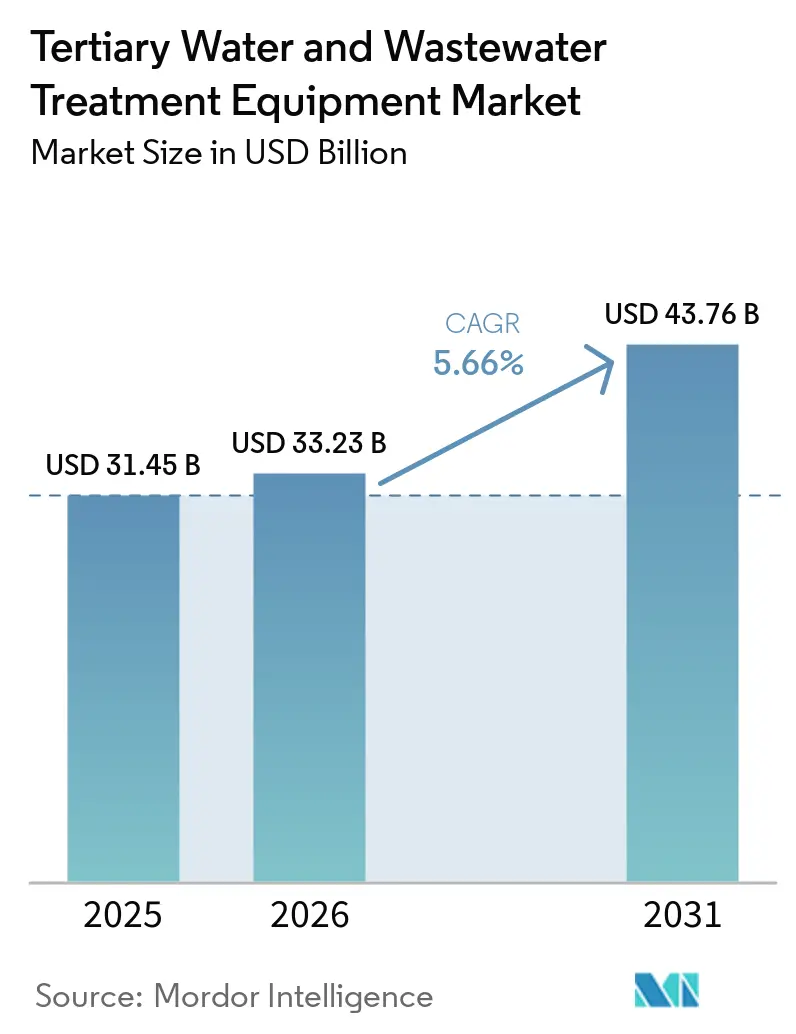
The Tertiary Water and Wastewater Treatment Equipment Market size was valued at USD 31.45 billion in 2025 and is estimated to grow from USD 33.23 billion in 2026 to reach USD 43.76 billion by 2031, at a CAGR of 5.66% during the forecast period (2026-2031). The tertiary water and wastewater treatment equipment market is being shaped by tighter water-quality rules, water scarcity, and investment in reuse systems. These conditions are moving tertiary treatment from a final polishing process to a larger part of utility and industrial water planning. Water reuse requires treatment systems that can manage a wider range of contaminants and produce water suitable for more uses. Suppliers are responding with membranes, filtration media, oxidation processes, and monitoring tools that fit both new facilities and retrofit projects. The opportunity is strongest where utilities and industrial operators need to improve treatment performance without interrupting essential water services.
Key Report Takeaways
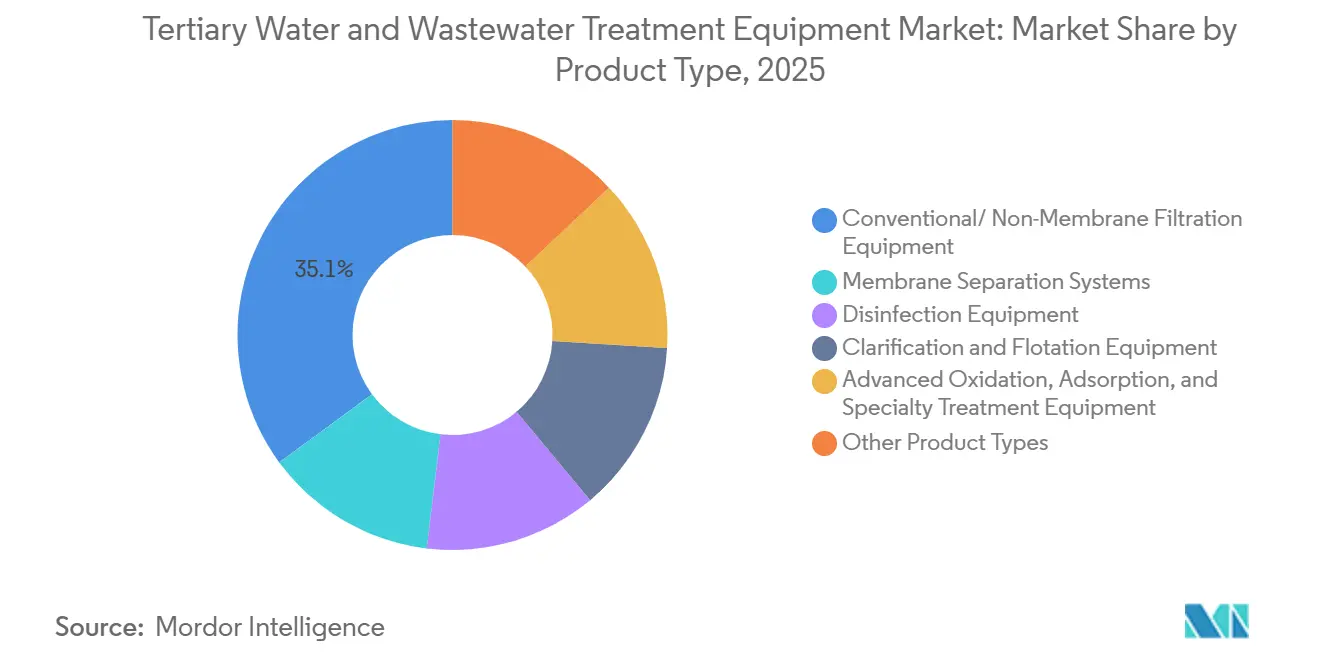
- By product type, conventional/non-membrane filtration equipment held 35.10% of the tertiary water and wastewater treatment equipment market share in 2025, while membrane separation systems are projected to advance at the highest CAGR of 6.34% through 2031.
- By application, wastewater treatment held 45.67% of the tertiary water and wastewater treatment equipment market share in 2025, while water reuse and recycling are projected to advance at a 6.56% CAGR through 2031.
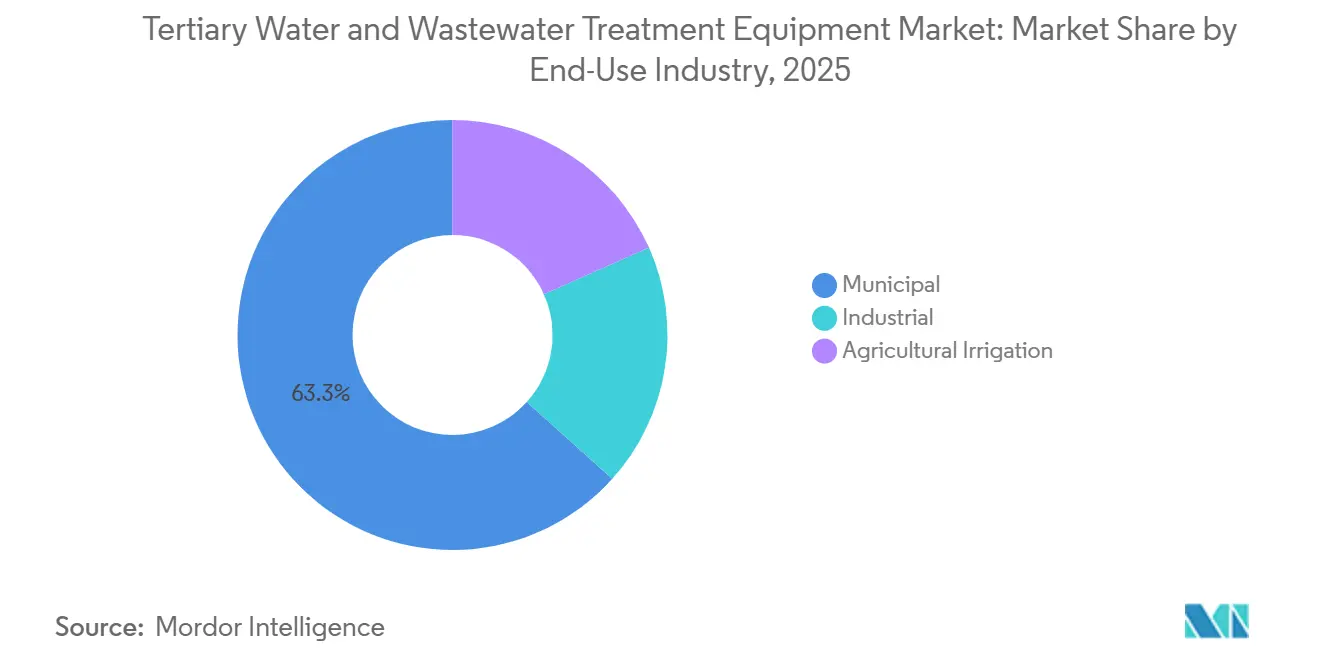
- By end-use industry, municipal held 63.34% of the tertiary water and wastewater treatment equipment market share in 2025, while the industrial segment is projected to advance at a 6.68% CAGR through 2031.
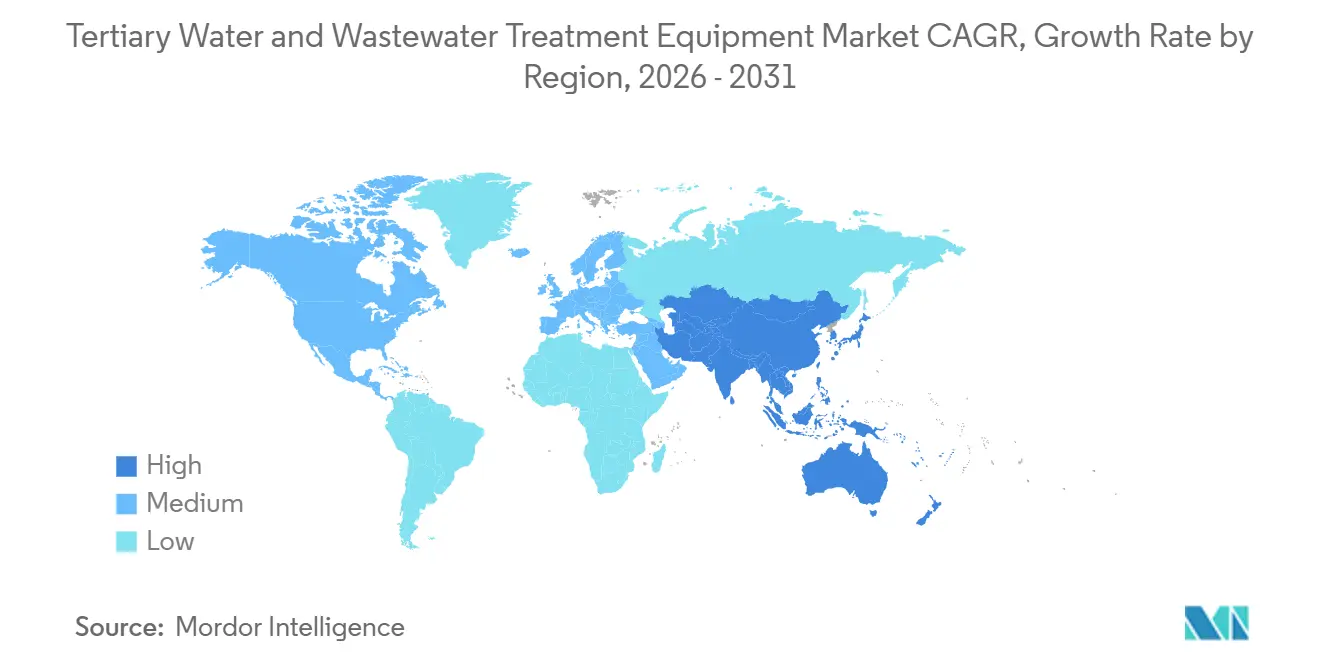
- By geography, Asia-Pacific held 35.72% of the tertiary water and wastewater treatment equipment market share in 2025 and is projected to advance at a 6.23% CAGR through 2031.
Note: Market size and forecast figures in this report are generated using Mordor Intelligence’s proprietary estimation framework, updated with the latest available data and insights as of January 2026.
Global Tertiary Water and Wastewater Treatment Equipment Market Trends and Insights
Drivers Impact Analysis*
| Driver | (~) % Impact on CAGR Forecast | Geographic Relevance | Impact Timeline |
|---|---|---|---|
| Stricter Effluent, Nutrient, and Reuse Standards | +1.5% | Global, with intensity in North America, EU, China, and India | Medium term (2–4 years) |
| Freshwater Scarcity and Drought-Resilience Investment | +1.2% | Global, concentrated in APAC, MEA, and Western US | Medium term (2–4 years) |
| Contaminant-Specific Treatment Trains for PFAS and Micropollutants | +0.9% | North America and EU core, extending to APAC | Short term (≤ 2 years) |
| Industrial Water Circularity and Freshwater Cost Avoidance | +0.7% | Global, high density in China, EU, and Southeast Asia | Medium term (2–4 years) |
| Aging Treatment Assets and Retrofit Demand | +0.6% | North America, Europe, and mature APAC markets | Long term (≥ 4 years) |
| Semiconductor Fab Expansion Driving High-Recovery Polishing | +0.5% | APAC core (South Korea, Taiwan, Japan), spillover to US and Singapore | Short term (≤ 2 years) |
| Source: Mordor Intelligence | |||
Stricter Effluent, Nutrient, and Reuse Standards
Stricter requirements for effluent quality, nutrients, and reuse are supporting demand across the tertiary water and wastewater treatment equipment market. Tighter wastewater requirements are increasing attention on micropollutants and advanced treatment at larger facilities. Perfluoroalkyl and polyfluoroalkyl substances (PFAS) and other persistent contaminants need treatment trains that combine adsorption, ion exchange, membranes, oxidation, or final disinfection. Calgon Carbon Corporation is expanding carbon reactivation capacity at its Columbus, Ohio, plant to support demand related to PFAS compliance. These requirements favor suppliers that can combine equipment with operating support and testing capability. They also make retrofits more complex because new tertiary equipment must work with existing hydraulic and biological processes. Utilities must assess monitoring, residual handling, and operator training when they select a treatment configuration.
Freshwater Scarcity and Drought-Resilience Investment
Freshwater scarcity is making reuse a practical water-security option for utilities and industrial sites in the tertiary water and wastewater treatment equipment market. The World Bank identifies water reuse as a route to expand water supplies for municipal and industrial users[1]World Bank, “Scaling Water Reuse: A Tipping Point for Municipal and Industrial Use,” World Bank, worldbank.org. Reuse projects require dependable removal of pathogens, salts, nutrients, and trace contaminants before treated water can enter its intended use. This need raises demand for filtration, membrane separation, advanced oxidation, and disinfection equipment. Drought-driven capital programs can continue after immediate shortages ease because plants require ongoing operation, replacement parts, and service support. The resulting demand is relevant in water-stressed parts of Asia-Pacific, the Middle East and Africa, and the western United States. It also makes dependable treatment performance more important when reused water supports essential municipal or manufacturing activity.
Industrial Water Circularity and Freshwater Cost Avoidance
Industrial water circularity is expanding the role of the tertiary water and wastewater treatment equipment market in production planning. Companies in semiconductor, pharmaceutical, chemical, and petrochemical operations need stable water quality and lower freshwater withdrawals. High-recovery systems can return more treated water to industrial processes, although they also create more demanding brine management needs. DuPont launched FilmTec Fortilife XC-Max UHP and XC220 reverse osmosis elements for Zero Liquid Discharge (ZLD) and Minimum Liquid Discharge (MLD) configurations, including use at brine concentrations of up to 220 g/L sodium chloride. Semiconductor fabrication further increases demand for high-recovery polishing because facilities require reliable ultrapure water and wastewater recycling systems. Suppliers that reduce site footprint and simplify system operation can be more attractive to industrial buyers with limited construction windows. This is particularly relevant when a plant must add treatment capacity without disrupting an existing production line.
Aging Treatment Assets and Retrofit Demand
Aging assets are creating a steady retrofit opportunity for the tertiary water and wastewater treatment equipment market. The American Water Works Association identifies significant long-term investment needs across the United States drinking water infrastructure[2]American Water Works Association, “Beyond the Replacement Era,” American Water Works Association, awwa.org. Many existing plants were designed around secondary treatment and may need upstream improvements before advanced tertiary modules can be installed. This favors phased projects that combine filtration, chemical treatment, controls, and hydraulic upgrades. Replacement cycles also create recurring demand for activated carbon, membranes, ultraviolet components, and related services. Suppliers with municipal relationships can use these projects to provide integrated packages rather than isolated equipment. Their ability to coordinate engineering and maintenance can reduce implementation risk for operators managing older assets.
Restraints Impact Analysis*
| Restraint | (~) % Impact on CAGR Forecast | Geographic Relevance | Impact Timeline |
|---|---|---|---|
| High Capital and Lifecycle Operating Costs | -1.3% | Global, most constraining in emerging-market municipalities in South Asia and Sub-Saharan Africa | Long term (≥ 4 years) |
| Energy Intensity of Membrane and Advanced Oxidation Systems | -0.9% | Global, most acute in energy-cost-sensitive regions of APAC and South America | Medium term (2–4 years) |
| Concentrate Handling Constraints in High-Recovery Systems | -0.5% | Inland and water-scarce regions globally | Long term (≥ 4 years) |
| Process Variability in Semiconductor and Industrial Wastewater Streams | -0.4% | APAC semiconductor hubs and global heavy industrial parks | Short term (≤ 2 years) |
| Source: Mordor Intelligence | |||
High Capital and Lifecycle Operating Costs
High capital and lifecycle operating costs can delay purchases in the tertiary water and wastewater treatment equipment market. Municipal budgets in lower-income economies are often designed for basic treatment and may not cover advanced equipment, civil works, or extended commissioning. Advanced oxidation and evaporation systems can increase project costs when compared with conventional physical and chemical treatment. Membrane replacement, chemical use, labor, and maintenance also affect the full cost of ownership after commissioning. Financing tools can improve affordability, but access remains uneven among municipal operators. These conditions make modular and phase installations more relevant, where buyers cannot fund complete upgrades at once. They can also lead purchasers to select proven equipment with predictable maintenance requirements over more complex configurations.
Energy Intensity of Membrane and Advanced Oxidation Systems
Energy use remains a constraint for membrane and advanced oxidation systems in the tertiary water and wastewater treatment equipment market. Reverse osmosis commonly consumes 3-6 kWh per cubic meter of product water in municipal applications. High-recovery systems can require further energy for pumping, ultraviolet treatment, electrochemical processes, and concentrate handling. Energy recovery devices can reduce consumption in some reverse osmosis settings, but their benefits can be harder to realize in municipal and inland applications with changing feedwater conditions. Energy prices, therefore, influence whether utilities select full advanced treatment trains or stage upgrades over time. This constraint is most significant in regions where electricity costs and supply reliability limit operating budgets. It also increases the value of designs that match energy demand to the quality of the incoming water.
*Our forecasts treat driver/restraint impacts as directional, not additive. The impact forecasts reflect baseline growth, mix effects, and variable interactions.
Segment Analysis
By Product Type: Conventional/Non-Membrane Filtration Equipment Leads, While Membrane Separation Systems Expand
Conventional/non-membrane filtration equipment held 35.10% of revenue in 2025. Sand, multimedia, and granular activated carbon systems remain widely used in municipal and industrial facilities. Their installed base supports demand for media replacement, backwash improvements, reactivation services, and performance upgrades. Calgon Carbon Corporation announced a nearly USD 100 million expansion at its Columbus, Ohio, facility in February 2026. The project is expected to add 27 million pounds of annual drinking-water carbon reactivation capacity by 2028. Disinfection equipment continues to support pathogen control in drinking water and reuse applications. Clarification and flotation equipment also remain important in plant designs that manage suspended solids before final polishing. These equipment classes can reduce the load placed on downstream membranes and oxidation units. Their continued use reflects the need to sequence treatment steps around the characteristics of each wastewater stream.
Membrane separation systems are projected to advance at a 6.34% CAGR through 2031. They are supported by discharge rules, industrial reuse requirements, and the need for compact systems. DuPont introduced ultrafiltration modules with an integrated pre-filter in April 2026. The approach combines 2 treatment steps in one unit and can reduce space requirements at constrained sites. Advanced oxidation, adsorption, and specialty treatment equipment have a related role where plants must remove PFAS and other difficult contaminants. Product competition is increasingly based on system reliability, operating simplicity, and how well equipment fits the complete treatment train. Membrane suppliers must, therefore, demonstrate both contaminant removal and stable operation over the intended service interval. This requirement supports interest in materials and module designs that limit fouling and simplify cleaning.



By Application: Wastewater Treatment Anchors, While Water Reuse and Recycling Reshape the Market
Wastewater treatment held 45.67% of application revenue in 2025. Municipal sewage upgrades provide a large part of equipment demand because many facilities need improved effluent quality. Water treatment for potable supply also requires advanced filtration and disinfection when aging systems are upgraded. Desalination remains a specialized application in water-scarce coastal areas and industrial locations. Aquatech was selected in June 2025 as a technology partner for the Corpus Christi Inner Harbor Water Treatment Campus in Texas. The project shows how reverse osmosis can support new water supplies alongside conventional treatment infrastructure. Equipment suppliers, therefore, serve applications that range from discharge compliance to potable water production and industrial process water. Each application has different requirements for water quality, plant configuration, and operating support. This breadth allows suppliers to serve projects that address water availability as well as wastewater management.
Water reuse and recycling are projected to advance at a 6.56% CAGR through 2031. The World Bank has identified substantial potential to scale municipal and industrial water reuse. Direct potable reuse needs a treatment train that can include ultrafiltration or microfiltration, reverse osmosis, advanced oxidation, and final disinfection. These configurations use several equipment classes and require close control of performance. Research on advanced wastewater treatment has found that hybrid membrane bioreactor and advanced oxidation approaches can extend contaminant removal beyond conventional tertiary systems. Factory-assembled modules can also support reuse projects where centralized expansion faces longer approvals. This gives suppliers with modular designs an additional route to industrial parks and growing urban areas. It can also shorten the interval between project approval and system installation. Reuse applications require suppliers to address both treatment performance and the operational controls needed to protect end users.
By End-Use Industry: Municipal Scale Persists as Industrial Accelerates
Municipal held 63.34% of the market revenue in 2025. Public sewage networks and drinking water systems remain the main source of global procurement. Calgon Carbon Corporation and the American Water Works Association finalized a 9-year exclusive granular activated carbon supply agreement in January 2025. The agreement covered more than 50 sites in 10 United States states for drinking water PFAS treatment through 2033. Long-term supply arrangements help municipal buyers maintain access to treatment media and related services. Agricultural irrigation is a smaller end-use area, but treated effluent can provide a practical water source in water-stressed regions. Municipal demand continues to favor suppliers that can support planning, equipment delivery, and operations over long contract periods. Procurement decisions often include service continuity because treatment failures can affect large populations. This creates an advantage for suppliers with established local service and media replacement capability.
Industrial is projected to advance at a 6.68% CAGR through 2031. Semiconductor facilities need reliable water treatment because their manufacturing processes require tightly controlled water quality. Veolia Korea signed an agreement with MagnaChip Semiconductor in July 2026 to deploy Continuous Electrodeionization (C-EDI) technology for boron removal from ultrapure water. The agreement targets operation through 2038 and illustrates the long operating horizon for semiconductor water projects. Industrial facilities also use tertiary treatment to meet ZLD requirements, recycle process water, and recover resources from wastewater streams. Chemical, pharmaceutical, and petrochemical operators face similar pressures where freshwater availability or discharge requirements affect production. The tertiary water and wastewater treatment equipment industry is therefore becoming more connected to industrial capital programs rather than only compliance spending. Buyers can evaluate water treatment alongside facility capacity, process reliability, and wastewater management needs. This broadens the role of equipment providers in industrial project planning.
Geography Analysis
Asia-Pacific held 35.72% of revenue in 2025 and is projected to advance at a 6.23% CAGR through 2031. China, India, South Korea, Japan, and Southeast Asian countries combine large urban treatment needs with growing industrial water requirements. Veolia secured 15-year operations and maintenance contracts in February 2026 for Mumbai’s Bhandup and Panjrapur water treatment plants. The facilities have capacities of 2,000 million liters per day and 910 million liters per day, respectively. They are expected to supply more than 60% of Mumbai’s water needs when operational by 2030. South Korea’s semiconductor investment also supports demand for high-specification ultrapure water and wastewater treatment systems. The regional tertiary water and wastewater treatment equipment market benefits from new construction as well as upgrades to existing plants. This mix supports sales of both complete treatment trains and additions to existing systems. Regional suppliers must meet different municipal and industrial requirements across many countries.
North America is supported by water-quality compliance and the replacement of aging assets. The American Water Works Association has documented substantial investment needs in the United States drinking water infrastructure. This need supports phased projects involving filtration, disinfection, monitoring, and related treatment equipment. Xylem and Amazon Web Services (AWS) partnered in September 2025 on smart water upgrades in Mexico City and Monterrey. The partnership targeted annual savings of more than 1.3 billion liters through leak detection and predictive analytics. The tertiary water and wastewater treatment equipment market in the region covers municipal modernization, industrial reuse, and new water supply projects. Its demand profile is broad because utility and industrial buyers face different but connected water management needs. Municipal operators need dependable compliance and asset renewal, while industrial sites may prioritize process-water reliability and reuse. These requirements support a varied set of treatment technologies and service models.
Europe is planning upgrades as advanced treatment requirements and contaminant concerns become more important. LANXESS reported that its Lewatit MDS TP 108 selective resin removed more than 99% of PFAS compounds at a Chemours facility in the Netherlands. Suppliers can use these applications to demonstrate performance against contaminants that conventional systems may not fully address. South America and the Middle East and Africa are earlier-stage areas for advanced systems, but industrial recycling projects are adding demand. Veolia announced a USD 500 million industrial water recycling project for Saudi Aramco Total Refining and Petrochemical Company (SATORP) in Jubail, Saudi Arabia, in September 2025. The project includes a moving bed biofilm reactor, membrane, and clarification technologies. These regions can provide future growth where regulation, water scarcity, and industrial expansion raise the case for tertiary treatment. Projects may begin with industrial recycling before broader municipal upgrades become viable. Suppliers that can adapt systems to local water conditions can address this varied demand.

Competitive Landscape
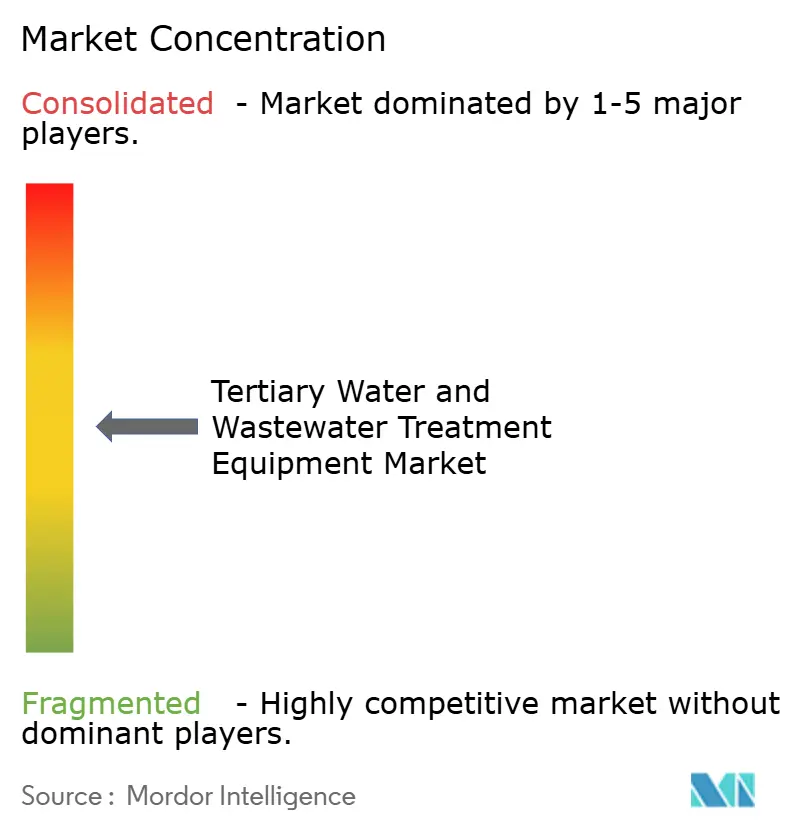
The tertiary water and wastewater treatment equipment market is moderately concentrated, with the top five players including Veolia, Xylem, Thermax Limited, DuPont, and Ecolab Inc. Scale matters because large projects often need equipment, engineering, operating support, and long-term service in one package. Veolia completed its acquisition of the remaining 30% interest in Water Technologies and Solutions in May 2025. The transaction gave Veolia full ownership of the platform. This type of ownership change can strengthen a supplier’s ability to coordinate technology, manufacturing, and project delivery. It can also give a provider greater control over product development and customer support. Larger platforms can offer a wider equipment range to customers managing complex water programs.
Product development is another competitive route in the tertiary water and wastewater treatment equipment market. DuPont expanded its FilmTec manufacturing presence in China through a reverse osmosis acquisition agreement announced in September 2025 The move positions the company closer to demand in Asia-Pacific. DuPont also launched a multi-technology water treatment design tool in June 2026 that brings ultrafiltration, ion exchange, reverse osmosis, and nanofiltration design together. The tertiary water and wastewater treatment equipment market is placing greater value on designs that coordinate several treatment processes. Suppliers that can show dependable performance across the full system have an advantage in complex reuse and industrial projects. Digital monitoring and water-quality sensing can also help operators respond more quickly to changing conditions. These tools can support decisions about treatment performance, chemical use, and equipment maintenance. Their role is growing where operators need evidence that a system is meeting defined water-quality targets.
Specialists can compete where customers need strong technical depth in a narrow treatment area. Aquatech acquired FTS H2O in May 2026 to expand its membrane-driven brine concentration and resource recovery capabilities. Calgon Carbon Corporation’s reactivation capacity investment addresses the need for activated carbon in drinking water PFAS treatment. Veolia’s Mumbai contracts show the importance of long-term operations and maintenance capability for large municipal projects. Competition therefore depends on technology performance, local execution, lifecycle support, and the ability to meet project-specific water standards. The tertiary water and wastewater treatment equipment industry includes both full-service integrators and specialists that can provide a defined part of a complex treatment train. Customers can select an integrated supplier or combine specialized equipment based on their operational needs. This balance supports competition across both broad portfolios and focused technical applications.
Tertiary Water and Wastewater Treatment Equipment Industry Leaders
Veolia
Xylem
Thermax Limited
DuPont
Ecolab Inc.
- *Disclaimer: Major Players sorted in no particular order

Recent Industry Developments
- March 2026: WABAG secured a public-private partnership (PPP) order from Chennai Metropolitan Water Supply and Sewerage Board to refurbish, finance, operate, and maintain a 45 million liters per day (MLD) Tertiary Treatment Reverse Osmosis plant at Kodungaiyur, Chennai. The project will restore advanced Ultrafiltration/Reverse Osmosis (UF/RO)-based treatment capacity for supplying reclaimed wastewater to industrial corridors, supporting demand for tertiary treatment and water-reuse equipment.
- February 2026: Diageo India and TERI inaugurated a 10 m³/d advanced water treatment plant in Alwar using TERI’s UV-based TADOX advanced oxidation technology to treat graywater for non-potable reuse. The project demonstrates growing deployment of advanced oxidation and polishing technologies for tertiary wastewater treatment, particularly in water-stressed industrial regions.


Global Tertiary Water and Wastewater Treatment Equipment Market Report Scope
Tertiary water and wastewater treatment equipment comprises advanced systems used to further remove residual contaminants from treated water and wastewater. These systems improve water quality and enable treated water to meet stringent discharge, reuse, and process-water requirements.
The Tertiary Water and Wastewater Treatment Equipment Market is segmented by product type, application, end-use industry, and geography. By product type, the market is segmented into conventional/non-membrane filtration equipment, membrane separation systems, disinfection equipment, clarification and flotation equipment, advanced oxidation, adsorption, and specialty treatment equipment, and other product types. By application, the market is segmented into wastewater treatment, water treatment, integrated circuit (IC) manufacturing, water reuse and recycling, and desalination. By end-use industry, the market is segmented into municipal, industrial, and agricultural irrigation. The report also covers the market size and forecasts for tertiary water and wastewater treatment equipment in 15 countries across major regions. For each segment, the market sizing and forecasts have been done on the basis of value (USD).
| Conventional/Non-Membrane Filtration Equipment |
| Membrane Separation Systems |
| Disinfection Equipment |
| Clarification and Flotation Equipment |
| Advanced Oxidation, Adsorption, and Specialty Treatment Equipment |
| Other Product Types |
| Wastewater Treatment |
| Water Treatment |
| Integrated Circuit (IC) Manufacturing |
| Water Reuse and Recycling |
| Desalination |
| Municipal |
| Industrial |
| Agricultural Irrigation |
| Asia-Pacific | China |
| India | |
| Japan | |
| South Korea | |
| ASEAN Countries | |
| Rest of Asia-Pacific | |
| North America | United States |
| Canada | |
| Mexico | |
| Europe | Germany |
| United Kingdom | |
| France | |
| Italy | |
| NORDIC Countries | |
| Rest of Europe | |
| South America | Brazil |
| Argentina | |
| Rest of South America | |
| Middle East and Africa | Saudi Arabia |
| South Africa | |
| Rest of Middle East and Africa |
| By Product Type | Conventional/Non-Membrane Filtration Equipment | |
| Membrane Separation Systems | ||
| Disinfection Equipment | ||
| Clarification and Flotation Equipment | ||
| Advanced Oxidation, Adsorption, and Specialty Treatment Equipment | ||
| Other Product Types | ||
| By Application | Wastewater Treatment | |
| Water Treatment | ||
| Integrated Circuit (IC) Manufacturing | ||
| Water Reuse and Recycling | ||
| Desalination | ||
| By End-Use Industry | Municipal | |
| Industrial | ||
| Agricultural Irrigation | ||
| By Geography | Asia-Pacific | China |
| India | ||
| Japan | ||
| South Korea | ||
| ASEAN Countries | ||
| Rest of Asia-Pacific | ||
| North America | United States | |
| Canada | ||
| Mexico | ||
| Europe | Germany | |
| United Kingdom | ||
| France | ||
| Italy | ||
| NORDIC Countries | ||
| Rest of Europe | ||
| South America | Brazil | |
| Argentina | ||
| Rest of South America | ||
| Middle East and Africa | Saudi Arabia | |
| South Africa | ||
| Rest of Middle East and Africa | ||


Key Questions Answered in the Report
What is the size of the tertiary water and wastewater treatment equipment market?
The tertiary water and wastewater treatment equipment market stands at USD 33.23 billion in 2026 and is projected to reach USD 43.76 billion by 2031.
What is driving demand for tertiary water and wastewater treatment equipment?
Stricter effluent rules, PFAS treatment needs, freshwater scarcity, reuse projects, and upgrades to aging treatment assets are supporting demand.
Which product type led revenue in 2025?
Conventional/non-membrane filtration equipment held 35.10% of revenue in 2025, supported by its installed base in municipal and industrial treatment facilities.
Which application is projected to grow the fastest through 2031?
Water reuse and recycling are projected to advance at a 6.56% CAGR through 2031 as utilities and industrial sites seek reliable alternative water supplies.
Page last updated on:





