
Tele Intensive Care Unit Market Size and Share
Market Overview
| Study Period | 2022 - 2031 |
|---|---|
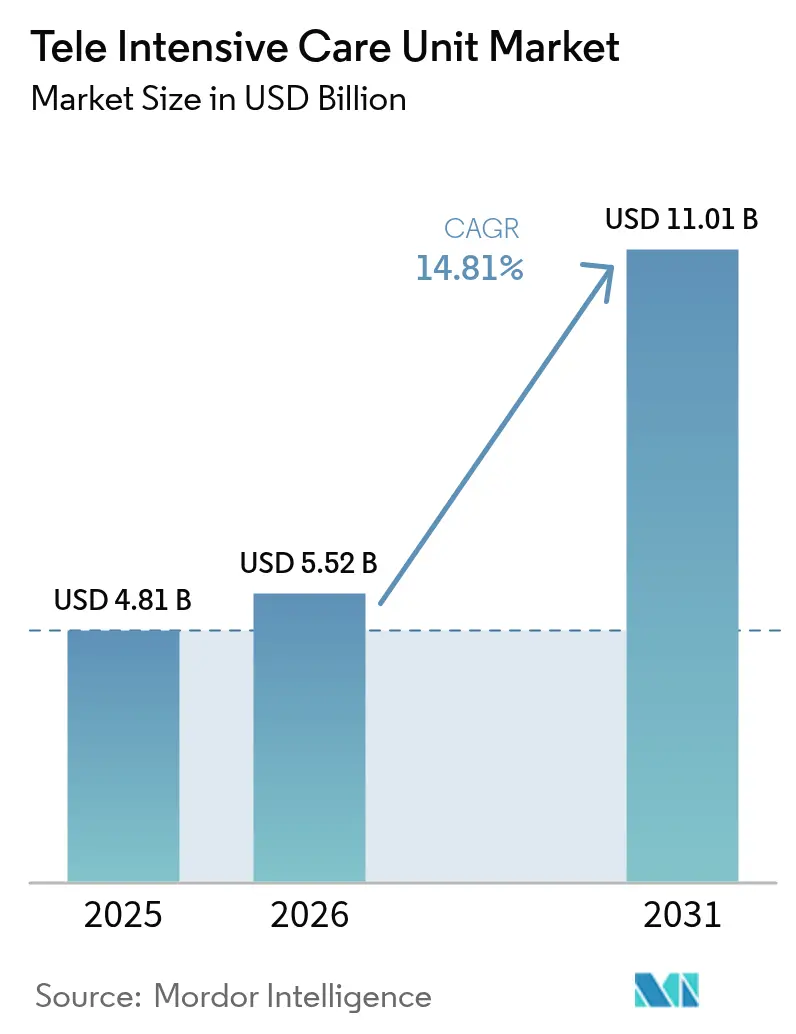
| Market Size (2026) | USD 5.52 Billion |
| Market Size (2031) | USD 11.01 Billion |
| Growth Rate (2026 - 2031) | 14.81 % |
| Fastest Growing Market | Asia Pacific |
| Largest Market | North America |
| Market Concentration | Medium |
Major Players *Disclaimer: Major Players sorted in no particular order Image © Mordor Intelligence. Reuse requires attribution under CC BY 4.0. | |
Tele Intensive Care Unit Market Analysis by Mordor Intelligence
The Tele Intensive Care Unit Market size was valued at USD 4.81 billion in 2025 and estimated to grow from USD 5.52 billion in 2026 to reach USD 11.01 billion by 2031, at a CAGR of 14.81% during the forecast period (2026-2031).
Growth is fueled by persistent intensivist shortages, the need to extend critical-care expertise into underserved regions, and rapid progress in real-time connectivity technologies. North America retains its leadership position by combining mature hospital networks with payer policies that reimburse virtual critical-care encounters, while Asia-Pacific records the quickest uptake as health-system investors back5G-ready facilities and remote-monitoring pilots. Hybrid command-center models gain support because they couple centralized specialists with on-site clinical teams, moderating cost while lifting clinical performance. New5G deployments inside hospitals have lowered round-trip latency to under10ms, which is enabling high-definition imaging review, robot-assisted ultrasound, and continuous video analytics during admissions. Although reimbursement cliffs and high start-up costs temper near-term adoption, public grants and the permanence of post-pandemic telehealth waivers continue to widen the business case for virtual critical care across hospital sizes.
Key Report Takeaways
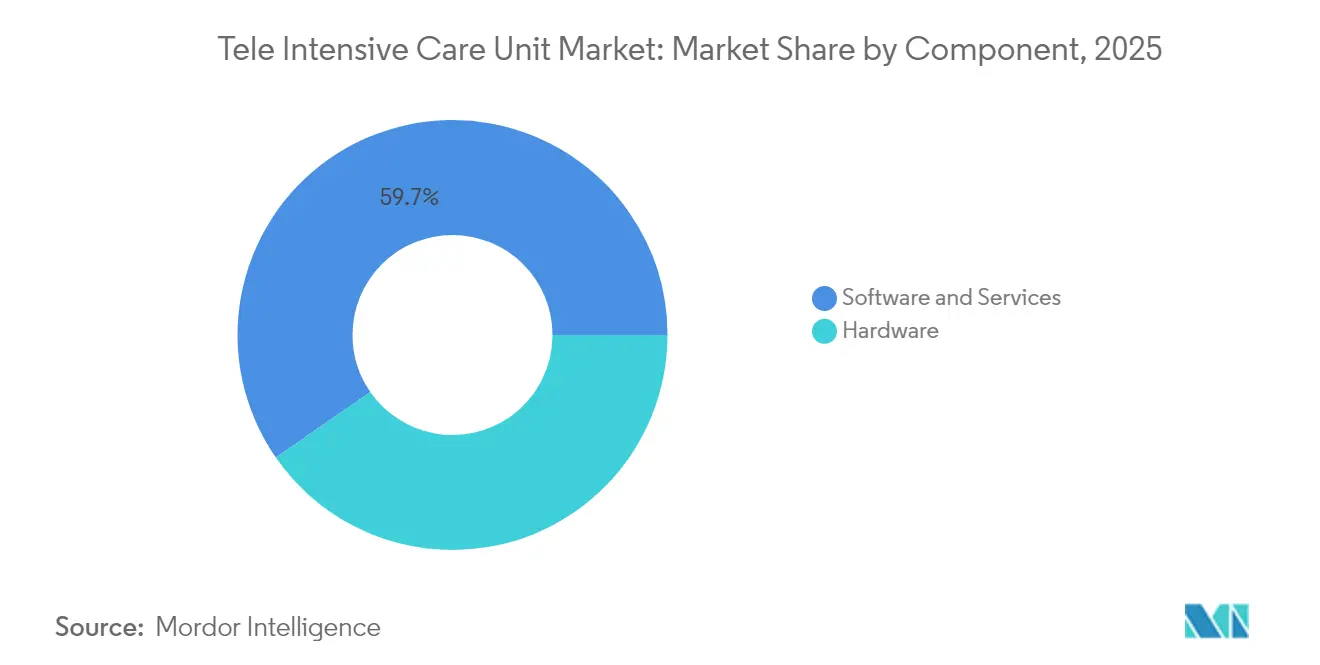
- By component, software & services held 59.65% of the tele-intensive care unit market share in 2025, while smart cameras are projected to expand at a 13.92% CAGR through 2031.
- By model type, centralized model commanded 50.30% revenue share in 2025; hybrid configurations are expected to post the fastest 15.24% CAGR to 2031.
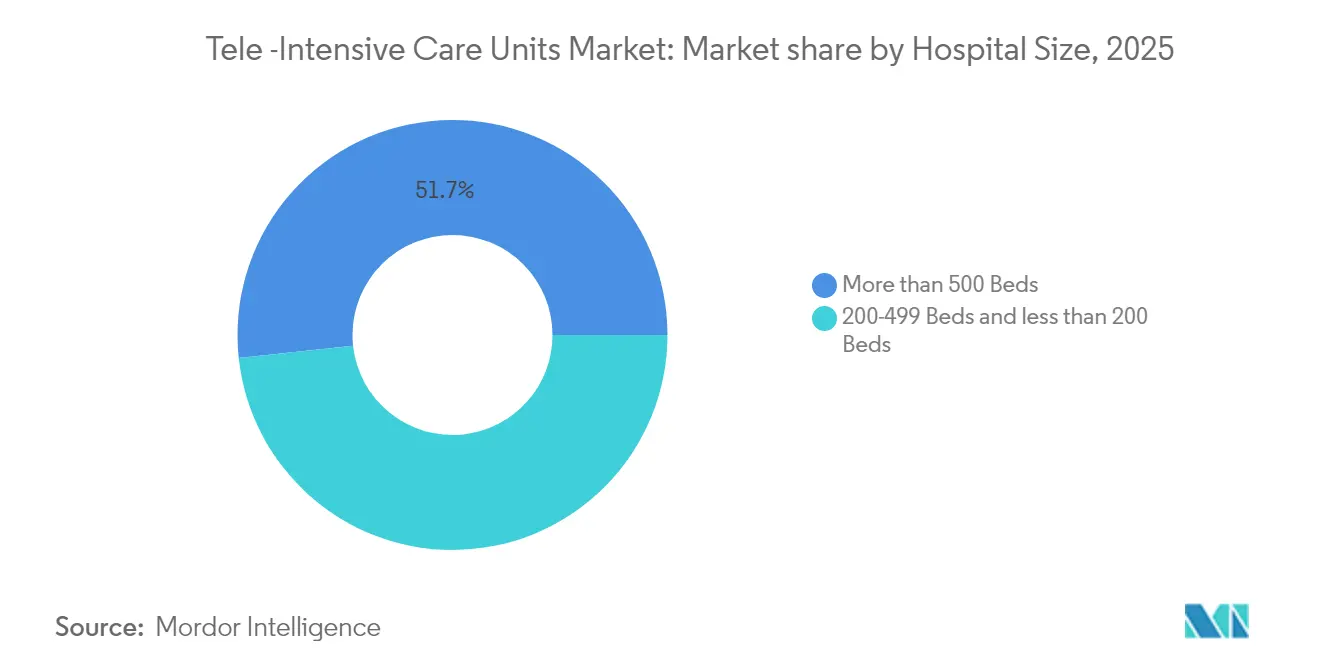
- By hospital size, facilities with more than 500 beds controlled 51.70% share of the tele-intensive care unit market size in 2025, yet 200-499 bed hospitals are forecast to grow at 14.12% CAGR to 2031.
- By geography, North America led with 43.10% revenue share in 2025, and Asia-Pacific is projected to register a 15.42% CAGR through 2031.
Note: Market size and forecast figures in this report are generated using Mordor Intelligence’s proprietary estimation framework, updated with the latest available data and insights as of 2026.
Global Tele Intensive Care Unit Market Trends and Insights
Drivers Impact Analysis*
| Driver | (~) % Impact on CAGR Forecast | Geographic Relevance | Impact Analysis |
|---|---|---|---|
| Aging Population Driven Critical Care Demand Surge | +3.2 | Global, with highest impact in North America and Europe | Long term (≥5 yrs) |
| Accelerated Adoption of 5G-Ready Hospital Networks | +2.1 | North America, Europe, and developed APAC | Medium term (≈3-4 yrs) |
| Increasing Demand for Remote Patient Monitoring | +3.5 | Global | Short term (≤2 yrs) |
| Large-Scale Public Tele-ICU Grants | +1.8 | North America and Europe | Medium term (≈3-4 yrs) |
| Post-COVID Remote Monitoring Policies Becoming Permanent | +2.7 | Global, with highest impact in North America | Short term (≤2 yrs) |
| Chronic Intensivist Shortage Triggering Outsourced e-ICU Staffing in Europe | +2.4 | Europe, with spillover to North America and APAC | Medium term (≈3-4 yrs) |
| Source: Mordor Intelligence | |||


Aging Population Intensifies ICU Demand
Demand for critical-care beds climbs as older adults represent a growing share of admissions. The American Hospital Association notes that people aged 65 and older will surpass 20% of the United States population by 2030, a shift that elevates chronic disease complexity and raises ICU utilization [1]Source: American Hospital Association, “Fact Sheet: Telehealth,” aha.org . Hospitals report rising ventilation hours and longer monitoring requirements, prompting administrators to add tele-ICU coverage across multisite systems. Tele-ICU programs show mortality reductions of up to 40% in recent multisite cohorts because remote intensivists can intervene earlier during deterioration events criticalcaremedicine. These outcomes strengthen the business case for virtual oversight in geriatric hotspots and encourage payers to maintain reimbursement codes tied to population.
Accelerated Adoption of 5G-Ready Hospital Networks
Hospital-owned 5G stand-alone networks now carry bedside video, imaging, and device telemetry with sub-10 ms latency, a threshold that supports telesurgery guidance and continuous computer-vision analytics. Finland’s Hola 5G Oulu project recorded instantaneous transmission of MRI sequences and live ultrasound streams, reducing clinical decision lag and driving new quality benchmarks. Singapore’s National University Health System achieved 1 Gbps downlink speeds on a hybrid 5G enterprise network, paving the way for bandwidth-heavy tele-ICU dashboards. Early adopters report 44.5% fewer patient falls after integrating smart cameras and 5G backbones, highlighting the operational impact of seamless, high-definition video monitoring valleyhealth. Capital budgets increasingly earmark 5G upgrades as network resilience becomes a prerequisite for advanced virtual-care services.
Remote Patient Monitoring Adoption
Continuous, cloud-connected biosensors and ceiling-mounted smart cameras extend surveillance beyond traditional ICUs to step-down and home settings. AI-enabled analytics now detect hemodynamic instability up to six hours before conventional vital-sign thresholds, allowing pre-emptive therapy that can avert transfers into high-acuity units. Wearable devices linked to electronic records improve chronic-disease tracking while reducing unscheduled visits, a trend that eases staff shortages. A 2025 study on hypertension monitoring demonstrated a 22.2% positive return on investment once patient adherence exceeded 55%, underscoring the financial viability of RPM-driven tele-ICU pathways. Hospital groups are therefore bundling remote patient monitoring platforms with central command centers to optimize workforce allocation.
Post-COVID Telehealth Waivers Become Permanent
Temporary flexibilities extended during the pandemic now influence permanent payment policy. The Centers for Medicare & Medicaid Services kept core waivers through March 2025, including permission for patients to receive tele-ICU services from non-rural homes[2]Source: Centers for Medicare & Medicaid Services, “Medicare Learning Network Newsletter,” cms.gov . Legislative coalitions aim to make these geographic waivers indefinite, citing reductions in readmission rates for patients supported by home monitoring programs. New billing codes in the 2025 Medicare Physician Fee Schedule cover advanced primary-care integration with tele-ICU dashboards, broadening the eligible clinician pool. Hospitals scale virtual critical-care lines faster because reimbursement visibility now spans the full forecast horizon.
Restraints Impact Analysis*
| Restraint | (~) % Impact on CAGR Forecast | Geographic Relevance | Impact Analysis |
|---|---|---|---|
| Limited Reimbursement | -2.3 | Global, with highest impact in emerging markets | Medium term (≈3-4 yrs) |
| High Cost of Treatment and Expensive Setup | -2.5 | Global, with highest impact in emerging markets | Short term (≤2 yrs) |
| Data-Integration Silos Between EMR Vendors & Tele-ICU Platforms | -1.9 | Global, with highest impact in fragmented healthcare systems | Medium term (≈3-4 yrs) |
| Nurse & Intensivist Resistance to Remote Oversight in Tier-2 Hospitals | -1.6 | APAC and emerging markets, with moderate impact in Europe | Short term (≤2 yrs) |
| Source: Mordor Intelligence | |||
High Implementation Cost
Launch budgets still approach USD 50,000 to 100,000 per monitored bed when factoring servers, audiovisual endpoints, integration software, and 24 × 7 clinical staffing. University pilot sites report initial capital outlays above USD 1.1 million and annual operating expenses near USD 2.5 million, figures that deter smaller hospitals from full-scale adoption. Despite an incremental cost-effectiveness ratio of USD 45,320 per quality-adjusted life year, financial sustainability hinges on patient volume. Break-even models show large centers recoup investment within three years, whereas sub-200-bed facilities often require grant support to offset start-up costs. Vendors respond with subscription-based packages and shared-service contracts aimed at lowering the entry barrier.
Limited Reimbursement Variability
The 2025 Medicare conversion factor falls by 2.8%, trimming professional-fee margins for tele-ICU physicians and intensifying pressure on hospital-based groups. Private payers differ on eligible originating sites and coding rules, with modifiers such as GQ, GT, or 95 applied inconsistently. Medicaid programs likewise vary by state, creating administrative complexity and revenue uncertainty for multistate health systems. Policy analysts warn that abrupt reversals of audio-only allowances could exclude vulnerable patient cohorts and diminish return on investment. This uncertainty slows multi-hospital rollouts and encourages phased deployments aligned with favorable payer mixes.
*Our forecasts treat driver/restraint impacts as directional, not additive. The impact forecasts reflect baseline growth, mix effects, and variable interactions.
Segment Analysis
By Component: Software & Services Dominate as Smart Cameras Accelerate
Software & Services contributed 59.65% of the tele-intensive care unit market size in 2025 because remote intensivist coverage, nursing triage, and analytics support remain indispensable for continuous patient oversight. Outsourcing clinical expertise lets hospital administrators compensate for regional workforce gaps while standardizing practice across networks. Vendors bundle 24 × 7 coverage, quality-metric reporting, and change-management programs, raising switching costs and reinforcing service revenues. At the same time, AI-enabled workflow engines now filter waveform and laboratory streams, reducing alert fatigue and allowing a single clinician to supervise a larger census.
Hardware revenue stems from physiological monitors, ceiling-mounted cameras, and command-center displays. Smart cameras stand out, expanding at a 13.92% CAGR as computer-vision algorithms classify posture, detect apnea events, and trigger fall alerts with macro F1-scores above 0.92. Software portfolios increasingly integrate decision-support modules such as Multiscale Vision Transformers capable of estimating nursing-activity scores, which helps staffing managers fine-tune resource deployment. This convergence of hardware, software, and services heightens differentiation among vendors and sustains long-term subscription growth inside the tele-intensive care unit market.


By Model Type: Hybrid Configurations Gain Momentum
Centralized command centers captured 50.30% of 2025 revenue because pooled intensivists can supervise multiple spoke hospitals from one location, securing economies of scale and standard protocols criticalcaremedicine. Evidence from multi-site rollouts links centralized decision authority with a 23% reduction in hospital mortality within three years, supporting payer negotiations for outcome-based contracts.
The hybrid model is forecast to record a 15.24% CAGR, making it the fastest-growing configuration in the tele-intensive care unit market. Under this structure, bedside teams retain autonomy for routine decisions while escalating complex cases to remote specialists, balancing clinician acceptance with resource efficiency. AI-driven predictive analytics embedded in hybrid networks facilitate early sepsis alerts and ventilator-weaning optimization. Decentralized arrangements persist in academic ecosystems that already house dispersed subspecialists; however, capacity constraints and cost pressures steer most expansion plans toward hybrid hubs.
By Hospital Size: Mid-Sized Facilities Adopt Rapidly
Hospitals with more than 500 beds dominated 2025 revenue at 51.70%, leveraging existing IT staff, enterprise networks, and high patient flow to justify command-center investments. Many large systems serve as spokes for smaller affiliated hospitals, deepening referral ties and capturing downstream specialist revenue.
Mid-sized hospitals in the 200–499 bed range are projected to expand tele-intensive care unit market size at a 14.12% CAGR as leaders seek to maintain local admissions while meeting quality benchmarks. Economic models show break-even points within four years when these hospitals reach 150 monitored beds, making tele-ICU financially attractive without major building projects. Facilities below 200 beds rely on grant funding and subscription models to launch limited virtual coverage during nights and weekends. As vendors roll out cloud-native platforms that remove on-premise server requirements, entry costs fall, supporting broader adoption across community settings.
Geography Analysis
North America held 43.10% of global revenue in 2025 and remains the center of commercial innovation in the tele-intensive care unit market. U.S. hospital networks deploy virtual critical-care dashboards that integrate electronic medical records with live camera feeds, providing clinicians unified patient views at local and remote sites. The American Hospital Association supports legislation to eliminate geographic restrictions permanently and to extend provider eligibility, moves that would further stabilize reimbursement. The Department of Veterans Affairs funds access points in rural communities, bringing specialist oversight to dispersed veteran populations.
Asia-Pacific is forecast to grow at 15.42% CAGR, the fastest among all regions. Health ministries in Singapore, Australia, and South Korea subsidize 5G private networks inside tertiary hospitals, clearing capacity for high-bandwidth tele-ICU video streams. Thailand pilots telemedicine kiosks to route non-critical cases away from crowded urban centers. Local start-ups partner with academic centers to deliver multilingual user interfaces that address cultural and regulatory heterogeneity.
Europe occupies a solid third position, supported by national e-health strategies in 40 countries and sustained investment from public payers. Projects like Hola 5G Oulu demonstrate clinical utility for sub-second data exchange, inspiring similar initiatives in Germany and Spain. The European Society of Intensive Care Medicine highlights persistent intensivist shortages, prompting outsourced e-ICU staffing contracts that allow hub hospitals to supervise smaller spokes across borders . EU programs such as Thera4Care channel research funds into AI-enabled theranostics, which dovetail with tele-ICU analytics to create integrated care pathways.
The Middle East and Africa and South America represent smaller but accelerating opportunities. Gulf states showcase digital-first hospitals, and regional exhibitions like Arab Health feature command-center demonstrations that link operating rooms with remote anesthesiologists. Latin American ministries negotiate public-private partnerships that equip provincial hospitals with cloud-based monitoring platforms, aligning with workforce-development goals.
Regulatory Landscape
Tele-ICU deployments sit at the intersection of telehealth reimbursement and practice rules, privacy and cybersecurity obligations, and rising expectations for interoperability and clinical risk management. In the United States, Centers for Medicare and Medicaid Services (CMS) telehealth policies under 42 CFR 410.78 and related CMS guidance continue to shape which virtual services are payable and the conditions for coverage, with telehealth flexibility extended through December 31, 2027 in federal updates. FCC programs that fund connected-care and telehealth connectivity also influence how hospitals plan the bandwidth they need for continuous ICU audio-visual monitoring.
Outside the United States, requirements vary by jurisdiction, which pushes vendors and providers to align to recognized standards while tailoring clinical workflows to local rules. Dubai Health Authority telehealth standards define Tele-ICU and require compliance with UAE Federal Law No. (2) of 2019 for ICT use in health, which provides a defined compliance path for facilities operating in Dubai. On the technical side, ITU-T F.780.5 (January 2024) offers an architecture reference for telemonitoring systems and explicitly supports FHIR-based interoperability, while ISO 13131:2021 sets out risk management processes for quality and safety in tele-intensive/critical care services, strengthening expectations for auditable clinical governance alongside platform certification and security controls.
Competitive Landscape
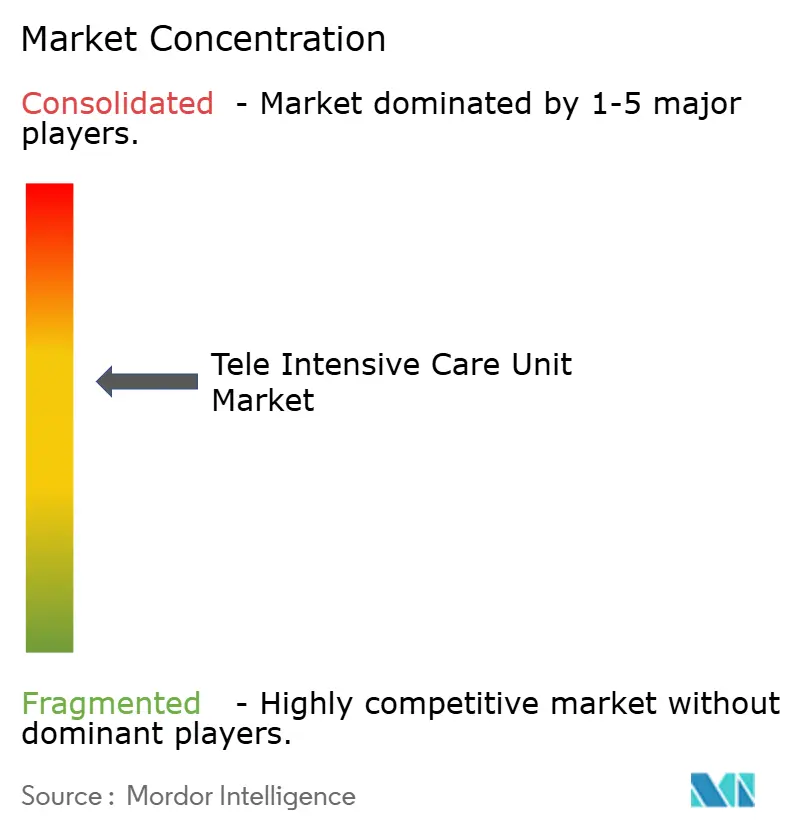
Competition is moderately concentrated, with diversified imaging vendors, telehealth platforms, and cloud service providers vying for enterprise contracts. Philips couples patient-monitoring hardware with AI-enabled clinical-decision software and recently unveiled helium-free MRI scanners designed to integrate with tele-ICU dashboards, cutting service interruptions during remote consultations. GE HealthCare collaborates with AWS to embed generative AI inside its Command Center software, which reduces bed-assignment times by 66% at early adopter sites. Teladoc Health enhances its Prism platform by adding AI-enabled clinical transcription and automated referrals, strengthening links between virtual critical care and community providers.
Strategic partnerships dominate growth agendas. Philips joined ST Engineering to co-develop cybersecurity-hardened digital-health suites for Asia-Pacific hospitals stengg. GE HealthCare forged a seven-year pact with Sutter Health that will upgrade imaging fleets across California, cementing an installed base receptive to tele-ICU overlays. Avel eCare’s acquisition of Amwell Psychiatric Care extends behavioral-health capabilities into 46 states, positioning the firm to provide ancillary psychiatry consults to ICU patients presenting with delirium or withdrawal.
White-space opportunities focus on underserved rural hospitals where capital budgets lag. Vendors test subscription models bundled with analytics licenses and hardware leasing to lower adoption barriers. Early pilots that integrate AI-powered hybrid chatbots report 25% fewer readmissions and 30% higher patient engagement, hinting at next-generation service layers that could differentiate offerings.
Tele Intensive Care Unit Industry Leaders
Inova
INTeLeICU
InTouch Technologies Inc.
Koninklijke Philips NV
Advanced ICU Care
- *Disclaimer: Major Players sorted in no particular order

Market Opportunities and Future Outlook
Near-term whitespace is most visible in scaling tele-ICU beyond large academic systems into mid-sized and community hospitals that want continuous coverage without fully staffing on-site intensivists. Facility expansion and modernization projects are increasingly incorporating command-center readiness and high-acuity monitoring into new ICU builds, which creates practical entry points for vendors bundling smart cameras, bedside device integration, and managed services. In 2026, Mount Sinai Health System broke ground for a new ICU at Mount Sinai Queens adding 13 ICU beds, and HCA Florida Healthcare announced a USD 200 million expansion at Ocala Hospital that includes a new 16-bed ICU. Both announcements indicate active capital cycles where tele-ICU infrastructure can be specified at design time rather than retrofitted.
A second opportunity sits in moving beyond video oversight toward integrated, workflow-driven telemetry and quality measurement across hub-and-spoke networks, where interoperability and governance set the limits on scale. In Brazil, Tele-UTI Conectada (INTEGRARE) has highlighted structured data workflows for real-time remote telemetry integration across heterogeneous ICUs, pointing to demand for platform layers that normalize data across multiple bedside devices and EMRs. On the clinical side, the 2026 Teleneurocritical Care (TeleNCC) consensus emphasis on defined hub and spoke roles, standardized communication protocols, and routine quality and outcome measurement matches procurement preferences for auditable operations, not just connectivity, which supports differentiated software and services offerings for hybrid models.
Recent Industry Developments
- April 2026: HCA Florida Healthcare announced a USD 200 million expansion project at Ocala Hospital, including construction of a new 16-bed intensive care unit. The announcement points to continued capital allocation to higher-acuity capacity where tele-ICU monitoring, smart cameras, and centralized coverage models can be incorporated into the build-out rather than added later.
- April 2026: Mount Sinai Health System broke ground on a new clinically advanced intensive care unit at Mount Sinai Queens that adds 13 ICU beds. The additional ICU capacity supports system-level demand for integrated monitoring and command-center connectivity that can extend intensivist coverage across a broader footprint.
- January 2025: Philips agreed to sell its Emergency Care business to Bridgefield Capital as it sharpened its focus on higher-growth patient monitoring and related hospital segments. The portfolio move reinforces its strategic emphasis on monitoring platforms that can integrate with tele-ICU workflows and enterprise virtual-care deployments.


Research Methodology Framework and Report Scope
Market Definition and Coverage
For this study, the tele-intensive care unit (tele-ICU) market is defined as revenue generated from technology and services that let ICU teams monitor and support critically ill patients remotely, using real-time clinical data and two-way audio-visual connectivity.
Scope exclusions: We exclude remote patient monitoring that is not designed for ICU-grade workflows, along with post-acute home telemetry kits and general telehealth visits that are not tied to ICU oversight.
Segmentation Overview
- By Component
- Hardware
- Software & Services
- By Model Type
- Centralized Model
- Decentralized Model
- Hybrid / Distributed Hub-and-Spoke Model
- By Hospital Size
- More than 500 Beds
- 200–499 Beds
- Less than 200 Beds
- By Geography
- North America
- United States
- Canada
- Mexico
- Europe
- Germany
- United Kingdom
- France
- Italy
- Spain
- Rest of Europe
- Asia-Pacific
- China
- Japan
- India
- South Korea
- Australia
- Rest of Asia- Pacific
- Middle East and Africa
- GCC
- South Africa
- Rest of Middle East and Africa
- South America
- Brazil
- Argentina
- Rest of South America
- North America
Data Sources, Market Sizing, and Validation
Desk Research
Desk work is used to frame the demand pool and set realistic assumptions before we start any model build. We rely on public sources such as the US CDC and CMS releases, the World Health Organization, OECD health statistics, and national health ministry publications to understand ICU capacity indicators, utilization pressure, and digital health adoption signals.
We also review hospital annual reports, investor presentations, and audited filings to map solution pricing logic and the mix of software, hardware, and ongoing support revenue that typically sits inside tele-ICU programs. Where needed, paid subscriptions are used for company financials and news tracking, and we use patent databases plus public tender monitoring to confirm rollout timing. These examples are not exhaustive, and other public sources were referred to for data collection, validation, and clarification.
Primary Interviews and Surveys
Primary inputs help us tighten the market scope and test what is actually being purchased, renewed, and used in ICU settings. We speak with ICU leaders, hospital digital health owners, tele-ICU program managers, and solution-side product and implementation roles across major regions so our assumptions on pricing, deployment patterns, and renewal behavior are aligned with how these programs operate in practice.
Distribution of primary research fieldwork respondents
| Company type | Respondent position | Region |
|---|---|---|
| Top tier: 36% | CXOs: 14% | APAC: 50% |
| Mid tier: 48% | Functional/Unit leaders: 32% | EMEA: 29% |
| Smaller Players: 16% | Managers: 54% | Americas: 21% |
Market-Sizing & Forecasting
The core estimate is built using a top-down approach where ICU capacity and monitored bed potential are reconstructed by region, and then converted into an addressable tele-ICU spend using adoption and program intensity assumptions. To keep the totals realistic, we corroborate the result with selective bottom-up approximations, such as sampled average contract values multiplied by active program counts, alongside supplier and channel checks where data is available.
Key inputs used in the model include ICU bed availability and occupancy signals, the estimated share of beds under remote coverage, typical hub-and-spoke staffing ratios, average price progression for software licenses and managed monitoring, and renewal or expansion cycles tied to hospital budgeting. For forecasting, we use scenario analysis supported by expert consensus, since adoption can move faster or slower depending on reimbursement support, clinician staffing gaps, and hospital capital constraints. When bottom-up signals are missing for smaller facilities, we handle gaps through conservative coverage-rate ranges that are cross-checked with interview feedback before finalizing the curve.
Data Validation & Update Cycle
After the model is built, outputs are compared against independent signals such as known ICU capacity trends, digital health spending direction, and observed program rollout patterns shared during interviews. Outliers are investigated, and assumptions are adjusted only when the change can be explained by a clear variable shift, then documented for review.
Each report passes through multi-step internal checks so arithmetic, unit consistency, and currency timing remain consistent across regions. We refresh the report annually, and interim updates are triggered if major reimbursement changes, large-scale hospital program expansions, or material pricing shifts are observed. Before delivery, a final analyst pass is completed so clients receive the latest updated view.
Mordor Intelligence's Tele Intensive Care Unit Icu Market Estimate Compared With Other Published Estimates
Published market sizes for tele-ICU often vary because the scope can be defined differently and the inputs are not always built from the same demand pool. Differences also show up when one estimate leans more on announced projects, while another leans on deployed programs and renewal revenue.
The main gap comes from whether the total includes broader virtual acute care revenue or sticks to ICU-specific monitoring and command-center workflows, and Mordor Intelligence counts the market only when the spend is tied to ICU-grade remote oversight (including ongoing support revenue) rather than general telehealth or non-ICU monitoring tools. Forecast spreads are also influenced by how fast adoption is assumed to rise, how average contract values are stepped up over time, and how currency conversion timing is handled across regions.
Benchmark comparison
| Source | Market Size | Gaps in Research Methodology |
|---|---|---|
| Mordor Intelligence | USD 5.52 B (2026) | |
| Global Consultancy A | USD 4.24 B (2024) | Uses an earlier base year and may include a wider set of virtual ICU revenue booked outside ICU command-center programs, which can pull the current-year total down or shift it across years. |
| Industry Publisher B | USD 4.62 B (2023) | Starts from a 2023 base and applies a longer forecast window, and the estimate appears less explicit on separating ICU-specific workflows from adjacent remote monitoring categories. |
Looking across the table, the spread is mostly explained by the year used for the starting point and by how strictly ICU-only scope is enforced. By tying the model to ICU coverage rates, program economics, and renewal behavior, the final number stays traceable to a few practical variables that can be rechecked over time.


Key Questions Answered in the Report
How big is the Tele Intensive Care Unit Market?
The Tele Intensive Care Unit Market size is expected to reach USD 5.52 billion in 2026 and grow at a CAGR of 14.81% to reach USD 11.01 billion by 2031.
What is the current Tele Intensive Care Unit Market size?
In 2026, the Tele Intensive Care Unit Market size is expected to reach USD 5.52 billion.
Which is the fastest growing region in Tele Intensive Care Unit Market?
Asia-Pacific is estimated to grow at the highest CAGR over the forecast period (2026-2031).
What years does this Tele Intensive Care Unit Market cover, and what was the market size in 2025?
In 2025, the Tele Intensive Care Unit Market size was estimated at USD 5.52 billion. The report covers the Tele Intensive Care Unit Market historical market size for years: 2021, 2022, 2023 and 2024. The report also forecasts the Tele Intensive Care Unit Market size for years: 2026, 2027, 2028, 2029, 2030 and 2031.
Page last updated on:


 Your data is secure and never sold or shared.


