
Switzerland Secure Logistics Market Size and Share
Market Overview
| Study Period | 2020 - 2031 |
|---|---|
| Forecast Data Period | 2026 - 2031 |
| Base Year Market Size (2025) | USD 0.72 Billion |
| Market Size (2026) | USD 0.74 Billion |
| Market Size (2031) | USD 1.03 Billion |
| Growth Rate (2026 - 2031) | 6.76 % |
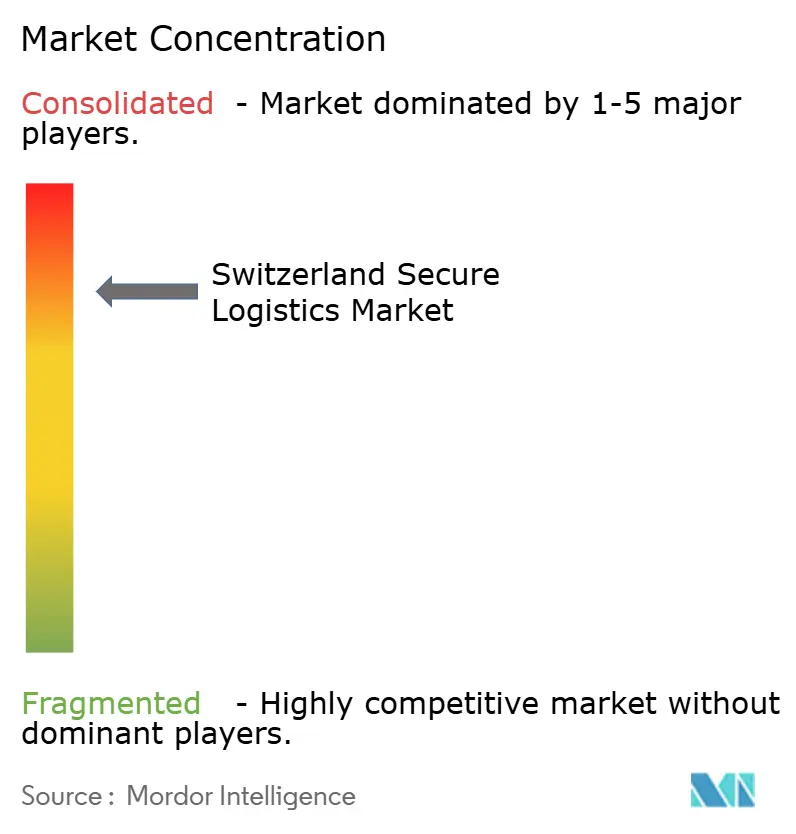
| Market Concentration | High |
Major Players *Disclaimer: Major Players sorted in no particular order Image © Mordor Intelligence. Reuse requires attribution under CC BY 4.0. | |
Switzerland Secure Logistics Market Analysis by Mordor Intelligence
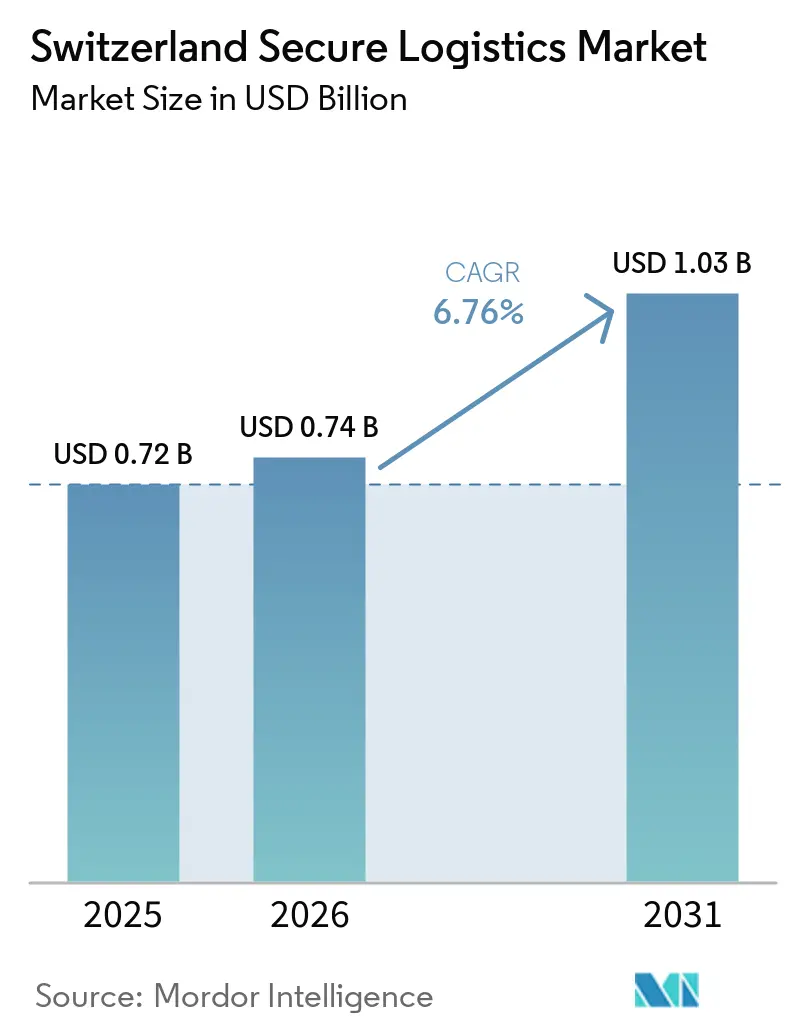
The Switzerland secure logistics market size was valued at USD 0.72 billion in 2025 and is estimated to grow from USD 0.74 billion in 2026 to reach USD 1.03 billion by 2031, at a CAGR of 6.76% during the forecast period (2026-2031).
The Switzerland secure logistics market serves private banking, gold refining, watchmaking, and pharmaceutical exports, where cargo requires tightly controlled handling. Its landlocked location directs sensitive cross-border movements through a limited group of air and rail corridors. Those corridors support premium pricing for operators with established security systems and border capabilities. Digital custody records are widening the client base for the Switzerland secure logistics market because they meet audit-trail expectations in financial services. Providers that combine secure transport, tracking, and compliant documentation are better placed to secure longer service contracts.
Key Report Takeaways
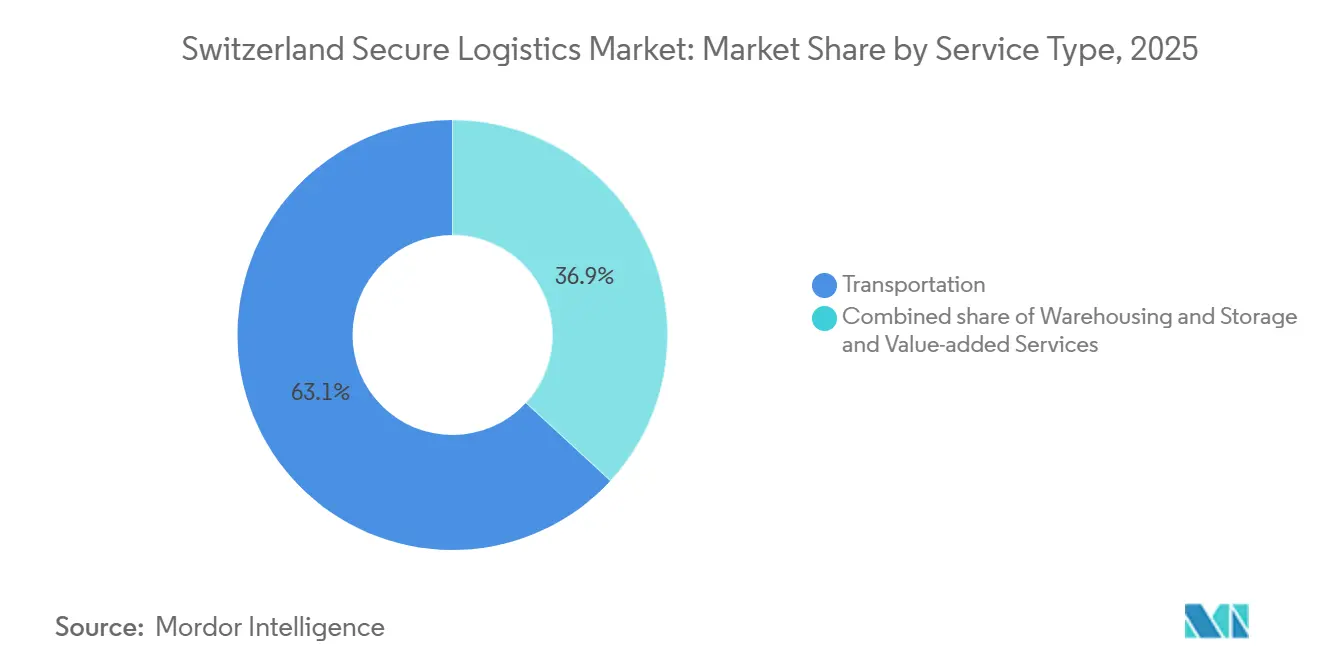
- By service type, transportation held 63.15% of the Switzerland secure logistics market share in 2025, while value-added services are projected to grow at a 9.10% CAGR through 2031.
- By application, cash management held 54.55% of the Switzerland secure logistics market size in 2025, while the jewelry and precious metals segment is projected to grow at a 9.20% CAGR through 2031.
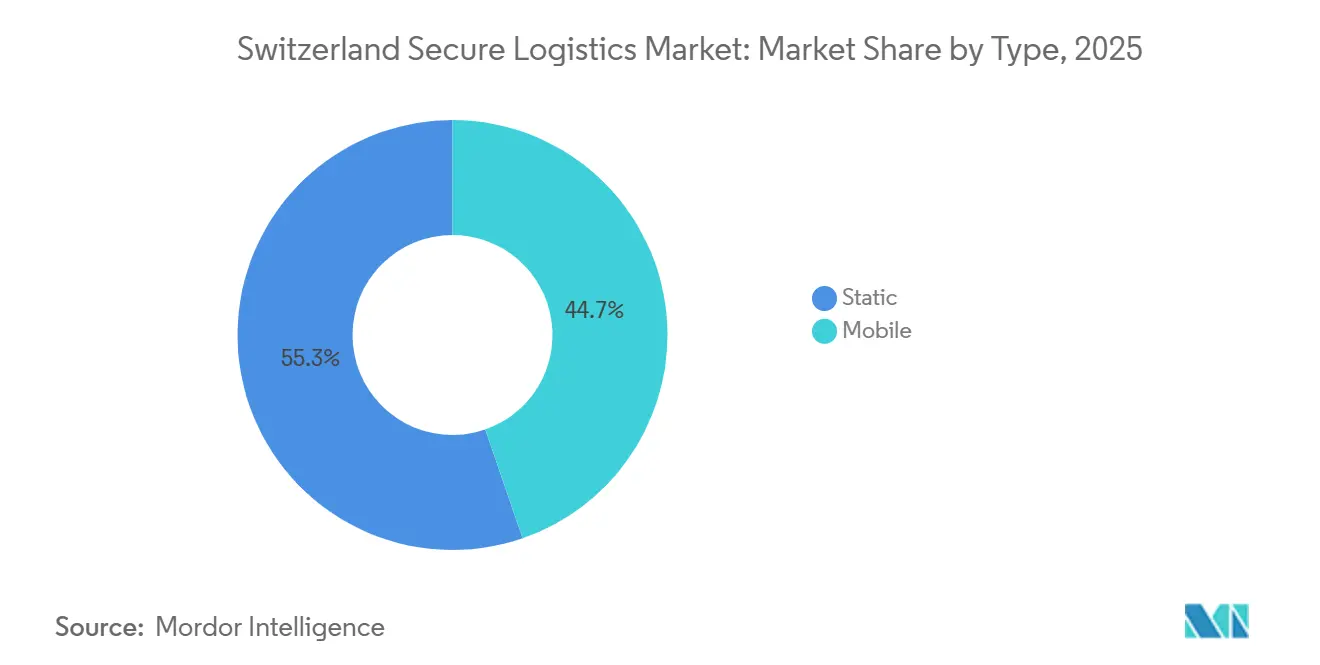
- By type, static services held 55.35% of the Switzerland secure logistics market share in 2025, while mobile services are projected to grow at a 7.44% CAGR through 2031.
- By end user, financial institutions accounted for 53.10% of the Switzerland secure logistics market size in 2025, while the retailers segment is projected to grow at an 8.60% CAGR through 2031.
Note: Market size and forecast figures in this report are generated using Mordor Intelligence’s proprietary estimation framework, updated with the latest available data and insights as of January 2026.
Switzerland Secure Logistics Market Trends and Insights
Drivers Impact Analysis*
| Driver | (~) % Impact on CAGR Forecast | Geographic Relevance | Impact Timeline |
|---|---|---|---|
| Persistent Cash Handling Demand in Retail and Banking | +1.4% | Switzerland, with concentration in Zurich, Geneva, and Basel retail corridors | Long term (≥ 4 years) |
| High-Value Goods Flows From Luxury, Watches, Pharmaceuticals, and Precious Metals | +1.7% | Switzerland, with links to Germany, France, and Italy | Medium term (2-4 years) |
| Chain-of-Custody Digitization and Real-Time Tracking Adoption | +1.1% | Global, led by Swiss financial and pharmaceutical hubs | Medium term (2-4 years) |
| Security-Grade Outsourcing by Banks, Retailers, and Industrial Shippers | +1% | Zurich, Geneva, Lausanne, and Bern | Short term (≤ 2 years) |
| Cross-Border Secure Transit Demand Tied to Switzerland’s Central European Logistics Position | +0.8% | Switzerland and border corridors with Germany, France, Italy, and Austria | Long term (≥ 4 years) |
| Premium Demand for Controlled Storage | +0.6% | Zurich, Geneva, and Basel freeport and vault corridors | Long term (≥ 4 years) |
| Source: Mordor Intelligence | |||
Persistent Cash Handling Demand in Retail and Banking
Cash remained important to Switzerland’s payment system through 2025 despite widespread digital payment use. The Swiss National Bank brought together 50 representatives from banks, cash-in-transit providers, retailers, Swiss Post, and SBB at its November 2025 cash roundtable[1]Swiss National Bank, “Second Roundtable on Cash,” Swiss National Bank, snb.ch. Participants noted that cash was used in nearly half of payment disruptions across Swiss retail channels, which showed its continuing role when electronic payment systems fail. This keeps cash-in-transit services relevant to financial resilience, rather than treating them only as a legacy retail service. The Swiss National Bank’s work on adequate access to cash and the SIX and Swiss Post concept study on shared cash-access infrastructure support this operating role across the national network. Fewer ATMs and bank counters can concentrate handling volumes on the routes that remain, improving route density and collection frequency for established operators in the Switzerland secure logistics market.
High-Value Goods Flows from Luxury, Watches, Pharmaceuticals, and Precious Metals
Switzerland produces a dense mix of cargo with high insured value across several export-oriented activities. Swiss watch exports reached CHF 25.6 billion (USD 32.4 billion) in 2025[2]STAR Logistique, “Secure Transport of High-Value Goods,” STAR Logistique, starlogistique.ch. These movements require armored transport and event logistics that general freight services do not typically provide because the goods need controlled handoffs. Basel’s life sciences activity also requires temperature-controlled logistics with secure custody, favoring specialist operators in the Switzerland secure logistics market. Gold refining adds another flow that needs vault-grade custody from raw-material intake through final international delivery. The convergence of watches, pharmaceuticals, and precious metals at Swiss air hubs supports providers that can handle more than 1 high-value cargo category under consistent operating procedures.
Chain-of-Custody Digitization and Real-Time Tracking Adoption
Real-time tracking is replacing paper custody records in a growing share of secure logistics contracts. Banking and pharmaceutical clients require auditable, time-stamped records within their data governance procedures and contractual controls. GPS-based custody platforms can provide verified transit data that supports differentiated insurance terms for documented shipments. This creates a practical reason for clients to require tracking in new contracts rather than accept only traditional proof-of-delivery records. Operators in the Switzerland secure logistics market that have adopted these systems can meet compliance requirements that are harder to demonstrate with manual records. Digital custody is therefore becoming a baseline procurement requirement rather than a service feature for providers serving regulated customers.
Security-Grade Outsourcing by Banks, Retailers, and Industrial Shippers
Banks and retailers are outsourcing more cash handling and valuables transport as internal operations face higher liability and operating costs. The Swiss National Bank estimated annual national cash-access infrastructure costs of CHF 640 million (USD 810.2 million) to CHF 880 million (USD 1.11 billion)[3]Swiss Broadcasting Corporation, “Fewer Retailers Accept Cash in Switzerland,” SWI swissinfo.ch, swissinfo.ch. This spending shows the scale of compliant cash operations that organizations would need to maintain themselves over a national network. Watch, and pharmaceutical shippers also need continuous custody across multimodal and cross-border movements that involve several operational handoffs. GPS tracking, dual control, and certified documentation are costly to replicate internally and require ongoing operating discipline. These conditions support longer managed-service agreements in the Switzerland secure logistics market, especially where customers need a single accountable provider.
Restraints Impact Analysis*
| Restraint | (~) % Impact on CAGR Forecast | Geographic Relevance | Impact Timeline |
|---|---|---|---|
| High Operating Cost of Armored Fleet, Personnel Vetting, and Insurance | -0.7% | Switzerland | Long term (≥ 4 years) |
| Tight Compliance Burden for Licensing, Training, and Weapons Authorization | -0.5% | Switzerland, with cantonal variation | Long term (≥ 4 years) |
| Urban Congestion, Route Variability, and Security Exposure During Transit | -0.4% | Zurich, Geneva, Basel, and Bern | Short term (≤ 2 years) to Medium term (2-4 years) |
| Workforce Scarcity in Highly Trained Security-Logistics Roles | -0.6% | Switzerland, particularly French-speaking cantons | Medium term (2-4 years) to Long term (≥ 4 years) |
| Source: Mordor Intelligence | |||
High Operating Cost of Armored Fleet, Personnel Vetting, and Insurance
Compliant armored fleets have a high fixed cost base in Switzerland. Operators must procure specialized vehicles, maintain them frequently, and replace them more often than standard commercial trucks because security performance cannot be deferred. Smaller route networks can find it difficult to spread these costs over enough activity and maintain competitive service pricing. Recruitment also requires criminal-record checks, financial reviews, and psychological assessments before employees can take on sensitive duties. Insurance for high-value cargo adds to the cost of each controlled movement and reflects the low tolerance for loss events. These demands favor well-capitalized operators in the Switzerland secure logistics market and make entry more difficult for regional providers.
Tight Compliance Burden for Licensing, Training, and Weapons Authorization
Security logistics personnel operate within a framework that combines federal rules with cantonal requirements. Guards and cash-in-transit employees who carry firearms need cantonal weapons permits and evidence of technical competence before they can work in armed roles. Switzerland’s 26 cantons administer their own licensing processes, which can differ in procedure, documentation, and timing. Periodic renewals and audits add continuing administrative work for providers that operate across more than 1 canton. Changes to screening or psychological testing can leave an operator with staffing gaps if workers are not requalified in time. This favors firms with dedicated compliance resources in the Switzerland secure logistics market.
*Our forecasts treat driver/restraint impacts as directional, not additive. The impact forecasts reflect baseline growth, mix effects, and variable interactions.
Segment Analysis
By Service Type: Transportation Anchors the Market, While Value-Added Services Gain Weight
Transportation held 63.15% of the Switzerland secure logistics market share in 2025. Armored road transport supports daily cash cycles that connect banking centers, ATMs, and retail chains across cantonal networks. Air freight through Zurich and Geneva supports international movements of watches, precious metals, and pharmaceutical cargo. Rail serves narrower high-value flows that require coordination with existing security procedures. Warehousing and storage are becoming a distinct revenue source as banking clients seek custody arrangements and luxury brands need secure facilities. The Switzerland secure logistics market size for transportation reflects the central role of physical movement in these customer requirements.
Value-added services are projected to grow at a 9.10% CAGR through 2031, the fastest rate among service types. Clients increasingly request custody documentation, compliance reporting, and real-time inventory reconciliation with physical transport. These requirements shift contracts from individual deliveries to managed services. Sea and inland waterway services remain limited because Switzerland is landlocked. Rhine movements from Basel can still serve specific precious-metals flows where discretion and less frequent transit are more important than speed. The Switzerland secure logistics market is moving toward service packages that combine transport, records, and ongoing client support.



By Application: Cash Management Leads, While Jewelry and Precious Metals Grow Fastest
Cash management accounted for 54.55% of the Switzerland secure logistics market size in 2025. It includes formal cash-in-transit contracts, ATM management, and custody services for banks in Zurich and Geneva. The Swiss National Bank’s cash-access work, and the SIX and Swiss Post study support a move toward fewer and larger managed-service arrangements. This structure can favor providers already embedded in cash infrastructure. Smaller operators that depend on transaction volumes can face pressure as contracts become more concentrated. Cash management remains the primary application base for the Switzerland secure logistics market.
The jewelry and precious metals segment is projected to grow at a 9.20% CAGR through 2031. Watch and gem shipments need armored transport for trade events and related international movements. Bonded freeport storage can create recurring vault revenue for certified facilities in Geneva and Zurich. Diamond logistics requires vault handling and Kimberley Process-compliant documentation. Manufacturing clients need secure movement of high-value components and specialized tools between production and assembly locations. Fine arts, collectibles, archival documents, and high-security IT assets add demand for tailored custody services in the Switzerland secure logistics market.
By Type: Static Services Lead, While Mobile Solutions Expand with Outsourcing
Static services held 55.35% of the Switzerland secure logistics market share in 2025. These services include permanent vaults, secure storage locations, and fixed cash-processing centers serving financial institutions. Multi-year custody contracts can provide stable revenue and lower client turnover. Controlled storage near freeport areas and art-trade locations also requires facilities that mobile services cannot provide. Brunig Mega Safe AG began a new phase of underground cavity construction in Canton Obwalden in early 2026 to expand its secure vault and storage platform. This project reflects demand for high-security physical asset custody in the Switzerland secure logistics market.
Mobile services are projected to grow at a 7.44% CAGR through 2031. Their work includes ATM cassette replenishment, retail cash pickup, and on-demand transport of precious metals. Mobile activity can generate higher revenue per interaction while requiring less fixed infrastructure than vault operations. It can help operators improve capital efficiency without adding storage capacity. Enterprise clients are expected to favor contracts that combine permanent vault custody with on-demand mobile access. This can narrow the gap between static and mobile revenue streams across the Switzerland secure logistics market.
By End User: Financial Institutions Dominate, While Retailers Drive Growth
Financial institutions accounted for 53.10% of the Switzerland secure logistics market size in 2025. Banks use cash-in-transit services, ATM fleet management, and vault custody, particularly in Zurich and Geneva. Formal contracts with these customers anchor revenue for many secure logistics providers. Government users include federal agencies, cantonal tax authorities, and Swiss Post’s financial services operations. Their demand is stable but grows more slowly as public payment channels become more digital. Financial institutions remain the largest customer base in the Switzerland secure logistics market.
The retailers segment is projected to grow at an 8.60% CAGR through 2031, the fastest rate among end users. Integrated cash-management platforms can move point-of-sale collection, counting, and processing from internal teams to secure logistics providers. This creates continuous managed services with real-time cash-flow visibility rather than periodic collections. The Swiss National Bank reported that cash acceptance among retailers declined between 2023 and 2025. The cash that retailers continue to accept can require more deliberate and compliant handling as transaction frequency falls. Luxury retailers, art institutions, private collectors, and pharmaceutical distributors also need tailored service combinations in the Switzerland secure logistics market.
Geography Analysis
Zurich, Geneva, and Basel concentrate the largest share of Switzerland secure logistics market demand because of private banking, luxury goods, and life sciences activity. Zurich is the main operating hub for cash-in-transit routes serving banks, retailers, and Zurich Airport cargo terminals. Geneva combines watch trade activity with demand for bonded storage and exhibition logistics. These needs support higher-value services than standard freight movements. Bern adds demand for secure documents and institutional asset custody from federal organizations.
Basel supports certified pharmaceutical logistics where temperature control and secure custody must operate together. Switzerland also connects high-value movements among Germany, France, Italy, and Austria. Continuous custody across borders is important for pharmaceutical products and precious metals shipments.
Valais, Ticino, and the Graubunden corridor are smaller but developing demand areas. Luxury tourism, alpine private banking, and high-net-worth residential activity create needs for private wealth transport and localized vault services. Swiss Securitas Group acquired ASP, Agence Securite et Protection SA, in Valais in 2025. The acquisition extended its coverage beyond the 4 main urban centers. Rural and alpine routes need mobile service models that can manage difficult terrain and dispersed infrastructure. The geography of the Switzerland secure logistics market is gradually extending from major cities to selected cantonal corridors.
Competitive Landscape
The Switzerland secure logistics market is highly concentrated. International full-service providers hold leading positions in cash-in-transit and valuables transport, while domestic specialists compete through local relationships and sector knowledge. International operators can coordinate across borders and maintain global insurance relationships. They also have a greater capacity to renew fleets and invest in digital custody systems. Domestic providers can remain relevant where proximity, local compliance knowledge, or a specialized cargo focus matter most.
Digital investment is changing how providers structure and price secure logistics services. Cloud-based warehouse systems, GPS-integrated custody platforms, and route optimization support more integrated service models. Tamper-evident packaging, RFID tracking, and digital custody systems are relevant to providers serving regulated customers. These tools can help operators document physical custody and meet customer reporting requirements. Firms that continue with route-only or vault-only offerings can face greater price pressure when clients seek integrated managed services. The Switzerland secure logistics market, therefore, favors providers that connect security, documentation, and transport.
Regional cantonal coverage, combined pharmaceutical and precious-metals handling, and technology-enabled vault services remain areas where providers can expand. Compliance with cantonal Swiss rules and relevant European requirements is a material entry barrier. Existing certification and long-standing institutional relationships can help retain customers. Swiss Securitas Group’s 2025 acquisition of ASP extended its presence into the Valais corridor. Malca-Amit’s 2026 partnership with GemGeneve strengthened its position in event logistics for high-value gems and jewelry[4]Malca-Amit, “Malca-Amit x GemGenève 2026, Official Partnership,” Malca-Amit EMEA, linkedin.com. The combination of compliance costs, technology needs, and scale supports gradual consolidation in the Switzerland secure logistics market.
Switzerland Secure Logistics Industry Leaders
Malca-Amit
Loomis AB
The Brink’s Company
Planzer Holding AG
SOS Cash & Value SA
- *Disclaimer: Major Players sorted in no particular order

Recent Industry Developments
- September 2026: Loomis AB completed the issuance of EUR 300 million (USD 352.9 million) in senior unsecured bonds, carrying a coupon of 4.125% and a tenor of five years. The bonds were issued under its EMTN Program. The proceeds will be used for general corporate purposes, including financing company acquisitions.
- May 2026: Malca-Amit formalized its partnership with GemGeneve as the official secure logistics partner for the 2026 edition at Palexpo, Geneva. This reinforces its presence in Switzerland's high-value gem and jewelry trade event circuit and expands coverage for international exhibitors requiring armored transport and vault-grade storage.
- April 2026: Kuehne+Nagel initiated a global rollout of its cloud-native KN SwiftLOG contract logistics platform across more than 1,000 operational sites, incorporating agentic AI capabilities. This technology upgrade is directly relevant to its Swiss secure storage and high-value goods logistics operations.
- June 2025: Swiss Securitas Group acquired ASP, Agence Securite et Protection SA, a Valais-based security services company. This acquisition expands its geographic reach into Switzerland's alpine resort and high-net-worth residential corridor beyond the four main urban centers.


Switzerland Secure Logistics Market Report Scope
| Transportation | Road |
| Rail | |
| Air | |
| Sea and Inland Waterways | |
| Warehousing and Storage (including Secure Storage and Vault Services) | |
| Value-added Services |
| Cash Management |
| Diamonds |
| Jewelry and Precious Metals |
| Manufacturing |
| Others |
| Static |
| Mobile |
| Financial Institutions |
| Retailers |
| Government |
| Others |
| By Service Type | Transportation | Road |
| Rail | ||
| Air | ||
| Sea and Inland Waterways | ||
| Warehousing and Storage (including Secure Storage and Vault Services) | ||
| Value-added Services | ||
| By Application | Cash Management | |
| Diamonds | ||
| Jewelry and Precious Metals | ||
| Manufacturing | ||
| Others | ||
| By Type | Static | |
| Mobile | ||
| By End User | Financial Institutions | |
| Retailers | ||
| Government | ||
| Others |


Key Questions Answered in the Report
What is the projected value of secure logistics in Switzerland by 2031?
The Switzerland secure logistics market is forecast to reach USD 1.03 billion by 2031, from USD 0.74 billion in 2026, at a 6.76% CAGR.
Which service category has the largest share in Switzerland?
Transportation led service types with a 63.15% share in 2025.
Which secure logistics application is growing the fastest in Switzerland?
Jewelry and precious metal logistics is projected to expand at a 9.20% CAGR through 2031.
Why do Swiss banks use secure logistics providers?
Banks use logistics providers for cash-in-transit, ATM fleet management, and vault custody.
Which customer group is expected to grow the fastest?
Retailers are projected to grow at an 8.60% CAGR through 2031 as they outsource cash collection, counting, and processing.
Which Swiss locations generate the most demand for these services?
Zurich, Geneva, and Basel are key demand centers because of banking, luxury goods, watch trade, and life sciences activity.
Page last updated on:





