
Switches and Sockets Market Size and Share
Market Overview
| Study Period | 2021 - 2032 |
|---|---|
| Market Size (2027) | USD 28.98 Billion |
| Market Size (2032) | USD 39.01 Billion |
| Growth Rate (2027 - 2032) | 6.13 % |
| Fastest Growing Market | Asia-Pacific |
| Largest Market | Asia-Pacific |
| Market Concentration | Medium |
Major Players *Disclaimer: Major Players sorted in no particular order Image © Mordor Intelligence. Reuse requires attribution under CC BY 4.0. | |
Switches and Sockets Market Analysis by Mordor Intelligence
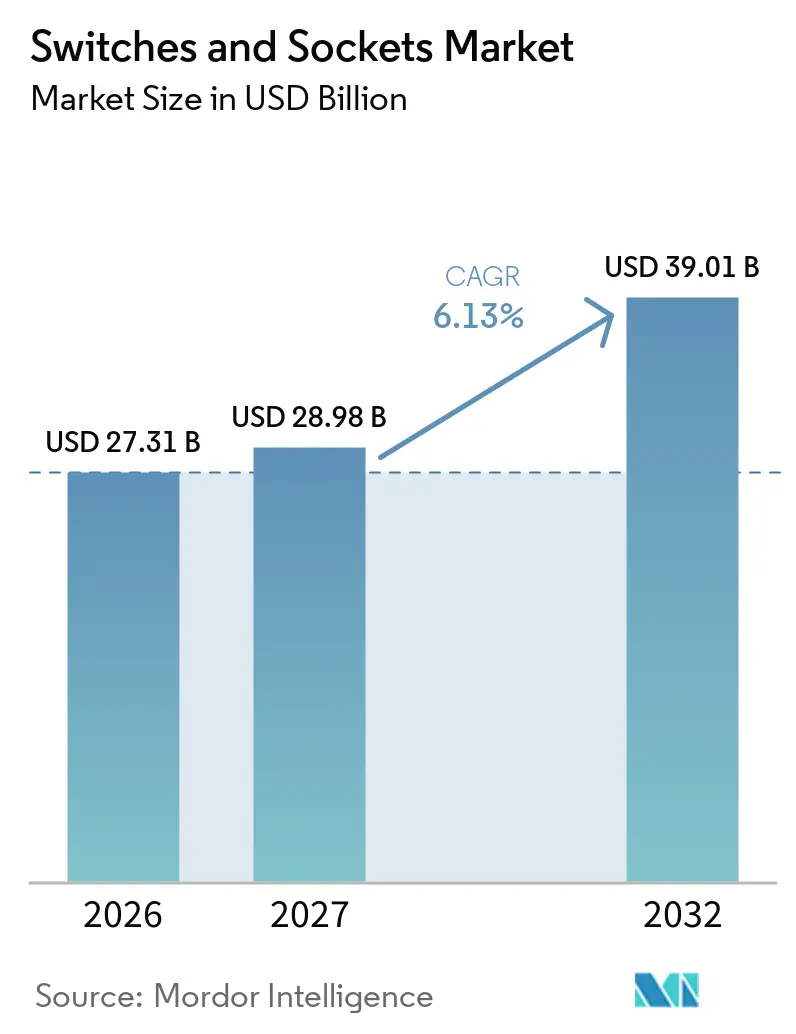
The Switches And Sockets Market size was valued at USD 27.31 billion in 2026 and is estimated to grow from USD 28.98 billion in 2027 to reach USD 39.01 billion by 2032, at a CAGR of 6.13% during the forecast period (2027-2031). The switches and sockets market serves replacement demand in existing buildings as well as requirements from new housing, commercial projects, and public infrastructure. Connected controls, USB-C charging, and energy monitoring are increasing the value of selected products, especially where renovation programs favor upgrades over replacement with basic devices. Demand is also widening in data centers, EV charging locations, and power infrastructure, where the number of connection points and switching devices exceeds that of conventional buildings. Manufacturers are responding with modular platforms that can be adapted across residential, hospitality, commercial, and infrastructure projects. Material costs, local standards, and cybersecurity obligations for connected devices remain important limits on margins and speed of product rollout.
Key Report Takeaways
- By product type, switches held 36.2% revenue share in 2026, while dimmers and lighting-control devices are forecast to grow at a 6.9% CAGR through 2032.
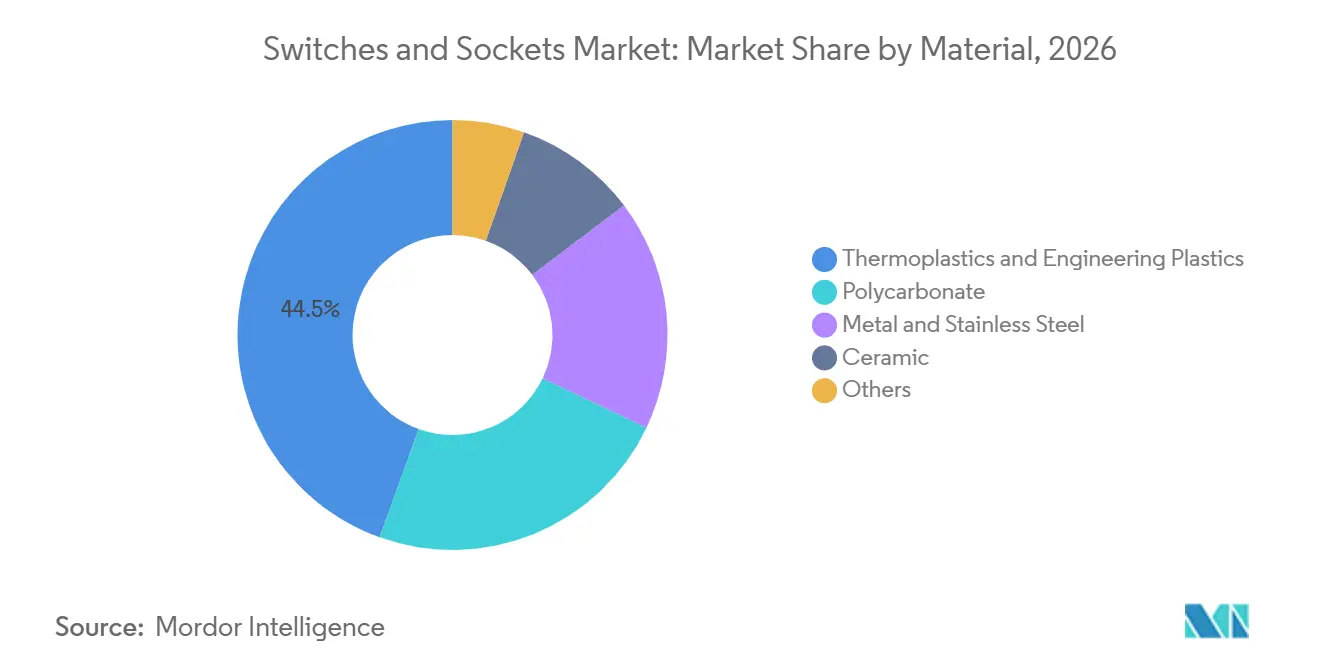
- By material, thermoplastics and engineering plastics held 44.5% revenue share in 2026, while polycarbonate is forecast to grow at a 6.4% CAGR through 2032.
- By technology, traditional and mechanical devices held 57.3% revenue share in 2026, while smart and connected devices are forecast to grow at an 8.5% CAGR through 2032.
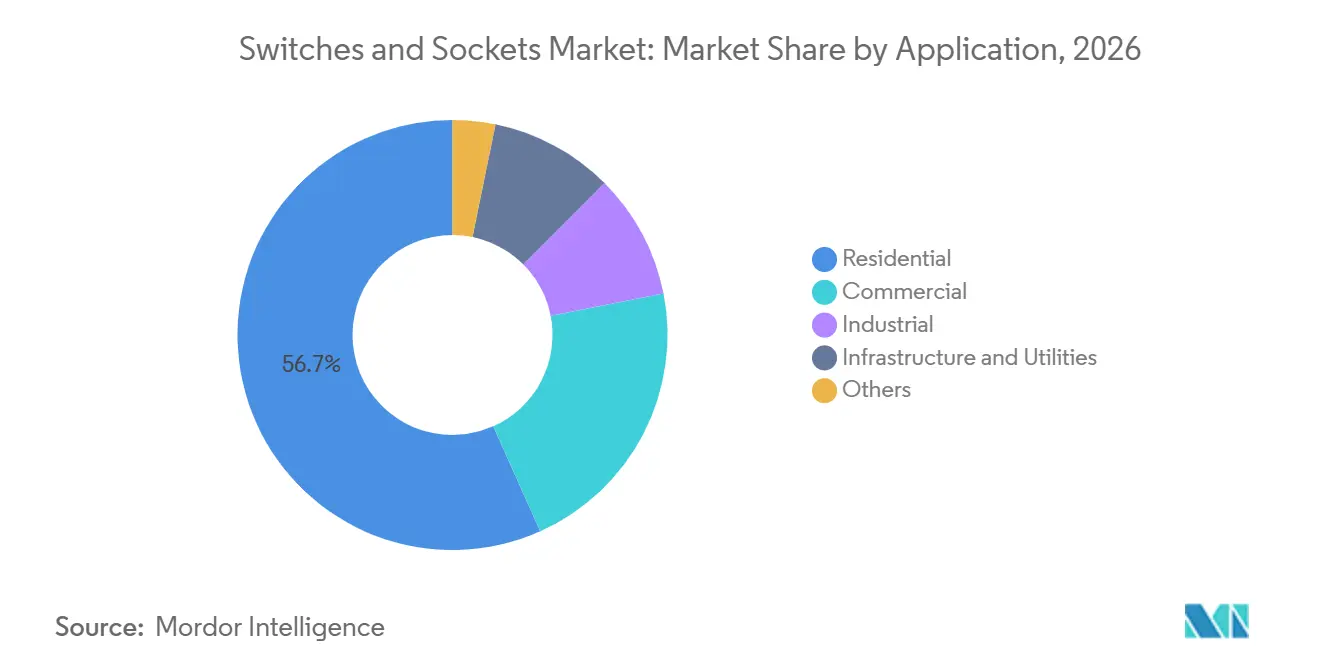
- By application, residential applications held 56.7% revenue share in 2026, while infrastructure and utilities are forecast to grow at a 6.5% CAGR through 2032.
- By geography, Asia-Pacific held 43.6% revenue share in 2026 and is forecast to grow at a 7.1% CAGR through 2032.
Note: Market numbers in this report are based on Mordor Intelligence's proprietary estimation framework, which combines nine months of actuals with Q4 projections for base year 2026.
Market Trends and Insights
Drivers Impact Analysis of Switches and Sockets Market*
| Driver | (~) % Impact on CAGR Forecast | Geographic Relevance | Impact Timeline |
|---|---|---|---|
| Smart-Home and Building-Automation Adoption | +1.80% | Global, concentrated in North America, Europe, and East Asia | Short term (≤ 2 years) |
| Urban Residential Construction and Renovation Cycles | +1.40% | APAC core, spill-over to MEA and South America | Medium term (2–4 years) |
| Electrification of Industrial and Commercial Infrastructure | +1.10% | North America, Europe, APAC | Medium term (2–4 years) |
| Matter-Compatible Modular Retrofits and Interoperable Ecosystems | +0.90% | North America & EU, early-stage APAC | Short term (≤ 2 years) |
| USB-C Power Delivery and Energy-Monitoring Outlet Upgrades | +0.70% | Global, EU mandate-led acceleration | Short term (≤ 2 years) |
| Stricter Electrical-Safety and Energy-Efficiency Standards | +0.50% | EU, North America, APAC regulatory hubs | Long term (≥ 4 years) |
| Source: Mordor Intelligence | |||
Smart-Home and Building-Automation Adoption
Smart-home adoption is shortening the replacement cycle for conventional switches in the switches and sockets market. Smart lighting and switching can act as the first connection point in a wider home automation system. This creates demand for products that can work with other certified devices instead of operating through closed systems. Manufacturers that offer pre-certified connected modules can compete on compatibility, design, and service support rather than on price alone. The Connectivity Standards Alliance released Matter 1.4.2 in December 2025, which expanded the standard’s scope across smart-home energy and device management functions[1]. The same standard supports a larger installed device base and can make connected switching more practical in larger residential and commercial projects.
Urban Residential Construction and Renovation Cycles
Construction and renovation activity support a steady demand for basic and advanced wiring devices in the switches and sockets market. New homes need switches and sockets throughout each room, while renovation projects often replace visible faceplates, outlets, and controls together. Energy-focused renovations can also favor dimmers, timers, energy-monitoring outlets, and connected devices. Buildings and construction accounted for 37% of global carbon dioxide emissions and almost 50% of global material extraction in 2025, which keeps energy and material performance central to building upgrade programs. Southeast Asian markets also support premium demand as households spend more on interior finishes and connected home equipment. This demand can be less dependent on housing completions because existing homes require periodic electrical upgrades.
Matter-Compatible Modular Retrofits and Interoperable Ecosystems
Matter-compatible products support modular retrofits because installers can replace controls without redesigning the entire electrical system. The switches and sockets market benefits when homeowners or building managers can add connected products in stages. Matter 1.4.2 added support for broader energy-management use cases, including equipment relevant to heat pumps, EV charging, and home batteries. The specification also includes requirements intended to strengthen interoperability and device security across certified products. This lowers the risk that buyers will be locked into a single proprietary platform. It also improves the commercial case for modular switches and sockets that can be upgraded during a renovation rather than only during a full construction project.
USB-C Power Delivery and Energy-Monitoring Outlet Upgrades
USB-C charging and energy monitoring are increasing the functional value of wall outlets. IEC 62680-1-2:2026 specifies USB Power Delivery requirements, including extended power range operation up to 240 W[2]. IEC 62680-1-3:2026 also sets technical requirements for USB Type-C cables and connectors. These specifications encourage manufacturers to develop outlets with integrated USB-C modules for homes, hotels, offices, and public spaces. Products that use current charging standards can support replacement demand when older outlets no longer meet user expectations. Manufacturers that still rely on USB-A products face a narrower path in categories moving toward USB-C designs.
Restraints Impact Analysis of Switches and Sockets Market*
| Restraint | (~) % Impact on CAGR Forecast | Geographic Relevance | Impact Timeline |
|---|---|---|---|
| Volatility in Copper, Engineering Plastics, and Electronic Components | -0.90% | Global | Short term (≤ 2 years) |
| Fragmented National Plug, Socket, and Installation Standards | -0.60% | Global, most acute in MEA and South America | Long term (≥ 4 years) |
| Cybersecurity and Firmware-Support Liability in Connected Devices | -0.40% | North America & EU | Medium term (2–4 years) |
| High Upfront Cost of Smart and Advanced Devices | -0.50% | Developing economies in APAC and MEA | Medium term (2–4 years) |
| Source: Mordor Intelligence | |||
Volatility in Copper, Engineering Plastics, and Electronic Components
Copper, engineering plastics, and electronic components affect the cost base of the switches and sockets market. Copper is particularly important because switches, sockets, and related distribution products require conductive parts at significant scale. The United States Geological Survey reported that building construction accounted for 42% of United States copper and copper-alloy product use, showing the connection between building demand and copper consumption[3]. Price changes can reduce margins for manufacturers that buy inputs on short contracts. Engineering plastic prices can also move with petrochemical feedstock costs, creating a separate source of pressure. Companies with long-term procurement arrangements, material expertise, or integrated supply chains are better placed to manage these changes.
Fragmented National Plug, Socket, and Installation Standards
National standards remain a long-term constraint on efficient international product launches. IEC TR 60083 documents the many plug and socket systems used for household and similar applications across countries[4]. Each system can require distinct molds, ratings, certification files, packaging, and local inventory. Connected products add further requirements because firmware, wireless settings, voltage limits, and safety rules can differ by market. These obligations raise the cost of entering several countries at once. They also favor manufacturers with established certification teams and broad regional distribution networks.
*Our forecasts treat driver/restraint impacts as directional, not additive. The impact forecasts reflect baseline growth, mix effects, and variable interactions.
Switches and Sockets Market Segment Analysis
By Product Type:
Dimmers and Lighting-Control Devices Lead Smart UpgradesDimmers and lighting-control devices are forecast to grow at a 6.9% CAGR through 2032, making them the fastest-growing product category in the switches and sockets market. Their growth follows demand for energy management, lighting control, and connected-home functions. Each dimmer can serve as a control point within a wider automation system, which supports higher average selling prices than basic mechanical products. Switches held 36.2% of the switches and sockets market size in 2026 because they remain essential in every building type. Their replacement frequency also supports recurring demand across affordable, premium, residential, and commercial properties.
Sockets and switch-socket combinations serve high-volume replacement demand. Combination units are relevant in dense urban buildings where efficient use of wall space is important. Specialized and industrial sockets address data centers, hospitals, and heavy manufacturing, where safety ratings and locking functions can command a premium. Schneider Electric introduced the Unica X range in August 2026 across 7 Asia-Pacific and Gulf markets. The modular platform combines switches, sockets, USB-C charging, dimmers, and communication modules. This type of platform reduces product complexity for installers while allowing a manufacturer to offer multiple functions through a common design language.
By Material:
Thermoplastics Remain the Volume Base While Polycarbonate Supports Advanced HousingsThermoplastics and engineering plastics held 44.5% revenue share in 2026. Within the switches and sockets market, their position reflects cost efficiency, established injection-molding processes, and suitability for high-volume residential and light-commercial products. Polycarbonate is forecast to grow at a 6.4% CAGR through 2032. It supports demand for flame-retardant and dimensionally stable housings that can contain electronic components. The material also fits slimmer switch plates and premium finishes used in higher-value residential and hospitality projects.
Metal and stainless-steel products serve premium projects, including hotels and commercial spaces where surface finish is an important purchase factor. Ceramic remains relevant for heritage home renovations and design-led applications, particularly where traditional interiors are maintained. ABB launched its SAGA switch range with Covestro’s Makrolon RE bio-circular polycarbonate in 2024. ABB stated that the material change could deliver annual carbon dioxide savings of 400 tonnes by 2030. The launch shows how material selection can support both technical performance and procurement requirements related to sustainability.
By Technology:
Smart and Connected Devices Show the Strongest GrowthSmart and connected devices are forecast to expand at an 8.5% CAGR through 2032. This is the highest technology growth rate in the switches and sockets market. Connected products support remote control, scheduling, energy monitoring, and integration with home and building automation systems. Traditional and mechanical devices held 57.3% of revenue in 2026. Their large base reflects the installed stock in developing markets and the price requirements of affordable housing projects.
Electronic programmable products occupy the middle position between mechanical and fully connected products. They offer timing and control functions that appeal to commercial and light-industrial users without requiring a broader smart ecosystem. Wireless devices are relevant in retrofit projects where new cable routes are not practical. Matter 1.4.2 strengthened security and interoperability requirements for certified smart devices. These requirements can reduce uncertainty for facility managers considering connected controls. They also raise the development and compliance threshold for suppliers seeking to enter this part of the switches and sockets market.
By Application:
Residential Scale and Infrastructure Demand Support Different RequirementsResidential applications held 56.7% of the switches and sockets market size in 2026. The segment benefits from the large global housing base and regular replacement of worn, outdated, or visually dated devices. This gives the switches and sockets market a stable base of demand for standard products. Basic mechanical products remain important in this segment, while connected lighting controls and USB-C outlets add a premium path. Infrastructure and utilities are forecast to grow at a 6.5% CAGR through 2032. The segment requires specialized outlets, metered connections, and robust switching systems for power delivery environments.
Data centers, grid projects, and EV charging locations increase the need for dependable electrical connections at several levels of the power chain. This demand is different from household replacement because performance, uptime, and safety certifications carry greater weight. Commercial demand is supported by office, retail, and hotel renovation cycles. Hospitality projects are particularly receptive to integrated controls because room-level lighting and charging features can affect the guest experience. The switches and sockets industry, therefore, serves a broad base of standard products while also addressing more specialized requirements in infrastructure projects.
Geography Analysis
APAC Switches and Sockets Market
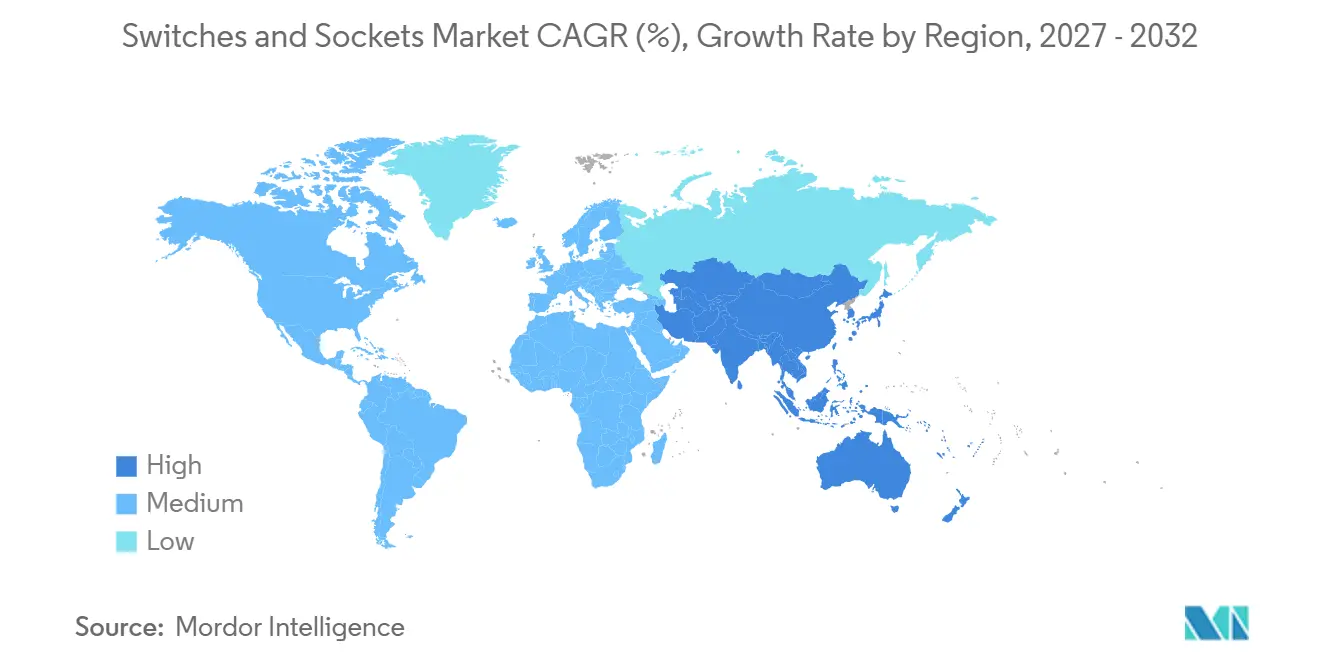
Asia-Pacific held 43.6% revenue share in 2025 and is forecast to grow at a 7.1% CAGR through 2032. The region combines a large production base with strong demand from housing, urban development, and smart-home adoption. China remains important because of its large domestic electrical-device base and ongoing renovation activity. India’s construction pipeline and smart-city programs support demand for residential, commercial, and public electrical products. Japan’s aging population creates demand for accessible controls and home automation features. These varied demand patterns allow the switches and sockets market to serve both high-volume basic devices and higher-value connected products across the region.
North America and Europe Switches and Sockets Market
North America and Europe remain important for technology-led upgrades. In these regions, smart controls, USB-C charging, and energy-monitoring outlets can support revenue growth even when new construction is weaker. IEC USB-C specifications give manufacturers a common technical reference point for compatible charging products. Renovation activity is therefore important for the switches and sockets market size in the mature building stock. Buyers in these regions also place greater emphasis on certification, design quality, and smart-platform compatibility. These conditions favor established suppliers that can support installation channels and product updates over time.
MEA and South America Switches and Sockets Market
South America and the Middle East and Africa have long-term importance for volume growth in the switches and sockets market. Brazil’s use of the IEC 60906-1 Type N national plug standard provides a clearer compliance path than more fragmented standard environments. Saudi Arabia and the United Arab Emirates are investing in smart-city, tourism, hospitality, and commercial projects that require premium electrical products. Legrand identified the Asia-Gulf corridor as a strategic focus at its September 2026 Capital Markets Day. African electrification and urban growth also expand the potential installed base for formal electrical devices. Local standards, affordability, and distributor coverage will continue to shape the pace at which this potential becomes sales.
Competitive Landscape
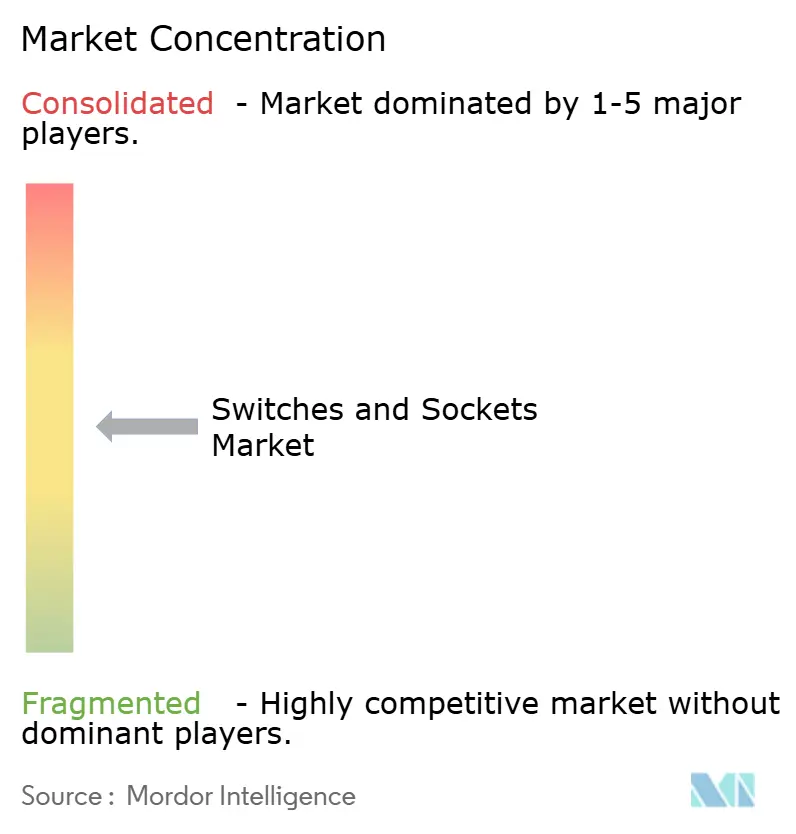
The switches and sockets market has a moderately consolidated premium tier and a fragmented mid-market tier. Schneider Electric, Legrand, ABB, Siemens, and Hubbell compete through product design, certification coverage, connected-device compatibility, and distribution access. Regional specialists and Chinese volume producers compete more strongly on price and domestic market access. Product development is increasingly focused on smart platforms, data-center power needs, and modular systems. This approach allows suppliers to extend from basic wiring devices into broader electrical and building-control categories. The switches and sockets industry remains competitive because buyers can choose between established global brands and lower-cost local alternatives.
Legrand completed 7 acquisitions in 2025, including Cogelec and Avtron Power Solutions. The company acquired Kratos Industries in February 2026 and invested in Accelsius, expanding its position in data-center power and cooling applications. Hubbell signed an agreement in May 2026 to acquire NSI Industries for USD 3 billion in cash. NSI supplies more than 15,000 branded electrical products to over 2,000 North American distributors. These transactions show a push toward broader product portfolios and stronger access to infrastructure-related channels.
Lutron acquired Orluna LED Technologies in June 2025 and Tanury Industries in February 2026, extending its reach in luminaires and premium finishes. Schneider Electric’s August 2026 Unica X launch across 7 markets shows how coordinated regional product introductions can support premium positioning. ABB has identified AI data-center electrification as a priority area for its Electrification business. Matter certification requirements also favor suppliers that can maintain security and compliance resources across product lifecycles. These conditions make it harder for smaller suppliers to establish a credible connected-device offering in several markets at the same time.
Switches and Sockets Industry Leaders
-
Schneider Electric SE
-
Legrand SA
-
Siemens AG
-
ABB Ltd.
-
Eaton Corporation plc
- *Disclaimer: Major Players sorted in no particular order
Switches and Sockets Market Companies Covered in this Report
- ABB Ltd.
- Albrecht Jung GmbH & Co. KG
- Eaton Corporation plc
- Feidiao Electrical Co., Ltd.
- GEWISS S.p.A.
- Gira Giersiepen GmbH & Co. KG
- Hager SE
- Havells India Limited
- Hubbell Incorporated
- Legrand SA
- Leviton Manufacturing Co., Inc.
- Lutron Electronics Co., Inc.
- MENNEKES Elektrotechnik GmbH & Co. KG
- Panasonic Holdings Corporation
- Schneider Electric SE
- Siemens AG
- Simon, S.A.
- T&J Electric Co., Ltd.
- Vimar S.p.A.
- Zhejiang CHINT Electrics Co., Ltd.
Recent Industry Developments in Switches and Sockets Market
- September 2026: Legrand hosted its Capital Markets Day in Singapore alongside Data Centre World Asia, presenting upgraded 2030 ambitions with a specific focus on data-center infrastructure technology and underscoring the Asia-Gulf corridor as the company's next priority growth axis.
- May 2026: Hubbell Incorporated signed a definitive agreement to acquire NSI Industries for USD 3 billion in cash. NSI supplies more than 15,000 branded electrical products to over 2,000 North American distributors.
- April 2026: Schneider Electric introduced the Unica X premium stainless-steel switch and socket range across India, the Gulf region, Hong Kong, Malaysia, Singapore, Vietnam, and Thailand. The IEC- and BS-certified platform, tested to over 20,000 switch operations and 18,000 socket insertions, integrates switches, sockets, USB-C charging, dimmers, and communication modules in a modular face-plate system designed for premium residential, hospitality, and commercial applications.
- February 2026: Legrand acquired Kratos Industries, a manufacturer of low-voltage switchboards and medium-voltage switchgear for data-center gray-space and industrial applications, and participated in Accelsius’ Series B round to advance two-phase, direct-to-chip liquid cooling for AI factory applications.
Global Switches and Sockets Market Report Scope
The switches and sockets market comprises the manufacturing and sales of electrical switches, sockets, and related combinations and specialized variants used primarily for electrical power control and connection across residential, commercial, and industrial applications.
The Switches and Sockets Market is segmented by product type, material, technology, application, and geography. By product type, the market is segmented into switches, sockets, switch-socket combinations, dimmers, and industrial sockets. By material, the market is segmented into thermoplastics, polycarbonate, metal, and ceramic. By technology, the market is segmented into traditional, electronic, smart and connected, and wireless. By application, the market is segmented into residential, commercial, industrial, and infrastructure. The report also covers the market size and forecasts for the global switches and sockets market across 26 countries in key regions. For each segment, the market sizing and forecasts have been provided on the basis of value (USD)
Segmentation Overview
| Switches |
| Sockets |
| Switch-Socket Combinations |
| Dimmers and Lighting-Control Devices |
| Specialized and Industrial Sockets |
| Thermoplastics and Engineering Plastics |
| Polycarbonate |
| Metal and Stainless Steel |
| Ceramic |
| Others |
| Traditional and Mechanical |
| Electronic |
| Smart and Connected |
| Wireless |
| Others |
| Residential |
| Commercial |
| Industrial |
| Infrastructure and Utilities |
| Others |
| North America | United States |
| Canada | |
| Mexico | |
| Europe | Germany |
| France | |
| Italy | |
| Spain | |
| United Kingdom | |
| Poland | |
| Russia | |
| Rest of Europe | |
| Asia-Pacific | China |
| India | |
| Japan | |
| South Korea | |
| Australia | |
| Indonesia | |
| Vietnam | |
| Thailand | |
| Rest of Asia-Pacific | |
| South America | Brazil |
| Argentina | |
| Chile | |
| Rest of South America | |
| Middle East and Africa | Saudi Arabia |
| United Arab Emirates | |
| Egypt | |
| South Africa | |
| Morocco | |
| Rest of Middle East and Africa |
| By Product Type | Switches | |
| Sockets | ||
| Switch-Socket Combinations | ||
| Dimmers and Lighting-Control Devices | ||
| Specialized and Industrial Sockets | ||
| By Material | Thermoplastics and Engineering Plastics | |
| Polycarbonate | ||
| Metal and Stainless Steel | ||
| Ceramic | ||
| Others | ||
| By Technology | Traditional and Mechanical | |
| Electronic | ||
| Smart and Connected | ||
| Wireless | ||
| Others | ||
| By Application | Residential | |
| Commercial | ||
| Industrial | ||
| Infrastructure and Utilities | ||
| Others | ||
| By Geography | North America | United States |
| Canada | ||
| Mexico | ||
| Europe | Germany | |
| France | ||
| Italy | ||
| Spain | ||
| United Kingdom | ||
| Poland | ||
| Russia | ||
| Rest of Europe | ||
| Asia-Pacific | China | |
| India | ||
| Japan | ||
| South Korea | ||
| Australia | ||
| Indonesia | ||
| Vietnam | ||
| Thailand | ||
| Rest of Asia-Pacific | ||
| South America | Brazil | |
| Argentina | ||
| Chile | ||
| Rest of South America | ||
| Middle East and Africa | Saudi Arabia | |
| United Arab Emirates | ||
| Egypt | ||
| South Africa | ||
| Morocco | ||
| Rest of Middle East and Africa | ||
Key Questions Answered in the Report
What is the projected value of the global switches and sockets sector by 2032?
The sector is projected to reach USD 39.01 billion by 2032, growing at a 6.13% CAGR from 2027 to 2032.
Which product category is growing fastest through 2032?
Dimmers and lighting-control devices are forecast to record the fastest product growth at a 6.9% CAGR. Their role in energy management and connected lighting supports product upgrades in the switches and sockets market. These products also offer a practical path from basic mechanical controls to a wider automation system without changing every device in a building.
Why are smart switches and sockets gaining adoption?
Smart devices support remote control, scheduling, energy monitoring, and connection with wider home and building automation systems. Interoperability standards also make the switches and sockets market more accessible to buyers that want devices to work across several brands. This supports phased renovation decisions in homes, hospitality sites, offices, and other locations where complete rewiring is not preferred.
Which region leads demand for switches and sockets?
Asia-Pacific held 43.6% of 2026 revenue and is forecast to grow at a 7.1% CAGR through 2032. Housing construction, urban development, and rising smart-home adoption support the region’s position in the switches and sockets market. The region also contains both large-volume entry-level demand and premium demand for connected and modular products.
What is the largest application for wiring devices?
Residential applications held 56.7% of revenue in 2026 because homes require regular replacement and renovation of electrical devices. This large installed base gives the switches and sockets market a broad demand foundation. Infrastructure and utilities, however, are forecast to grow at the faster 6.5% CAGR as electrification projects require more specialized connections.
What limits growth for connected electrical devices?
Material-cost volatility, fragmented national standards, cybersecurity obligations, and the higher price of advanced products can slow adoption. These constraints increase development and certification work for manufacturers serving several countries in the switches and sockets market. Procurement plans and lifecycle support are therefore important factors for suppliers of connected products.