
Sweet Potato Products Market Size and Share
Market Overview
| Study Period | 2022 - 2032 |
|---|---|
| Market Size (2027) | USD 8.55 Billion |
| Market Size (2032) | USD 11.31 Billion |
| Growth Rate (2027 - 2032) | 5.58 % |
| Fastest Growing Market | Asia-Pacific |
| Largest Market | North America |
| Market Concentration | Medium |
Major Players *Disclaimer: Major Players sorted in no particular order Image © Mordor Intelligence. Reuse requires attribution under CC BY 4.0. | |
Sweet Potato Products Market Analysis by Mordor Intelligence
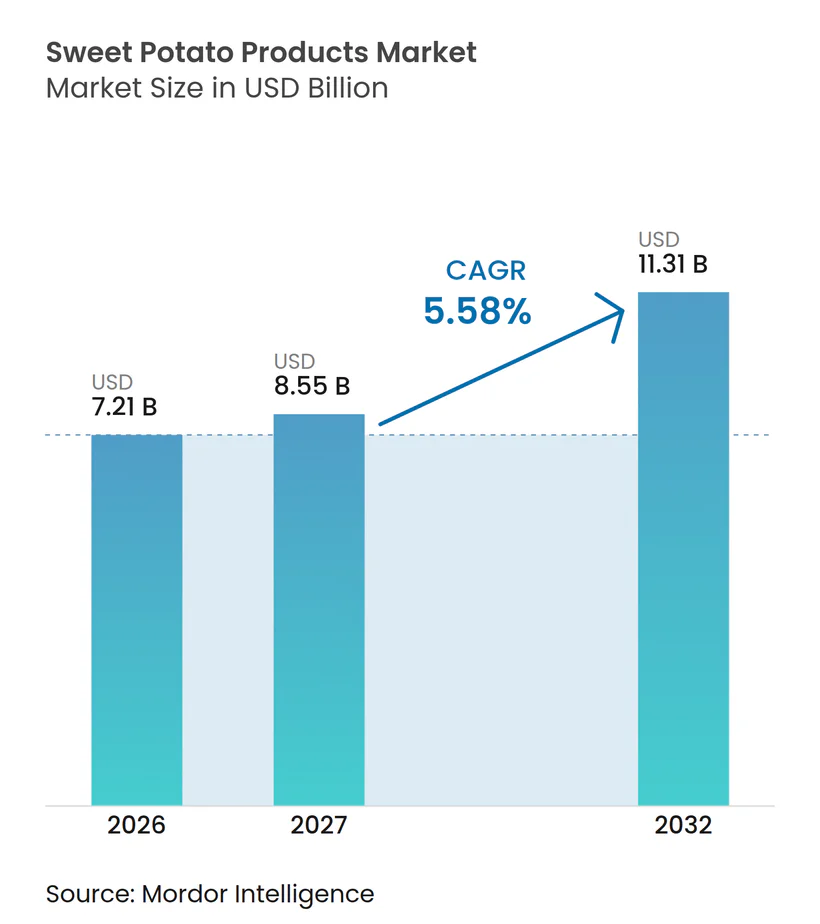
The sweet potato products market size is expected to grow from USD 7.21 billion in 2026 to USD 8.55 billion in 2027, and is forecast to reach USD 11.31 billion by 2032, at a 5.58% CAGR over 2027-2032. Growing demand for frozen sweet potato cuts, chips, snacks, flour, and purée across retail, foodservice, and packaged food applications supports market growth. Increasing consumer preference for nutritious foods further enhances the appeal of sweet potato-based products, while expanding production and processing capabilities creates opportunities for product innovation and value addition. Advances in storage and processing practices also improve product quality, supply reliability, and the range of ingredient applications.
Key Report Takeaways
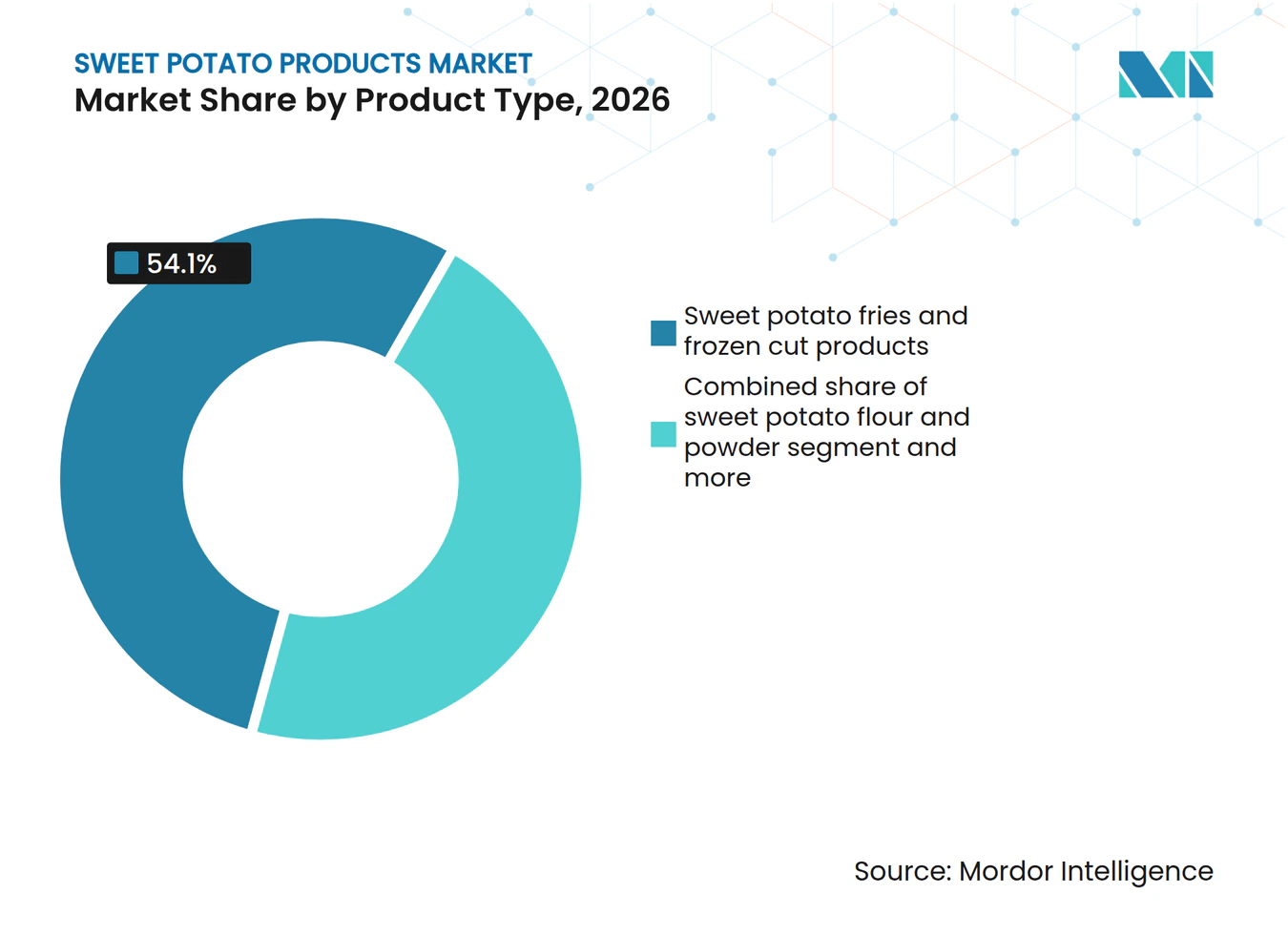
- By product type, sweet potato fries and frozen cut products held 54.01% of the sweet potato products market share in 2026, while sweet potato flour and powder are forecast to grow at a 6.21% CAGR from 2027 to 2032.
- By nature, conventional held 72.21% of the sweet potato products market in 2026, while organic is forecast to grow at a 7.21% CAGR from 2027 to 2032.
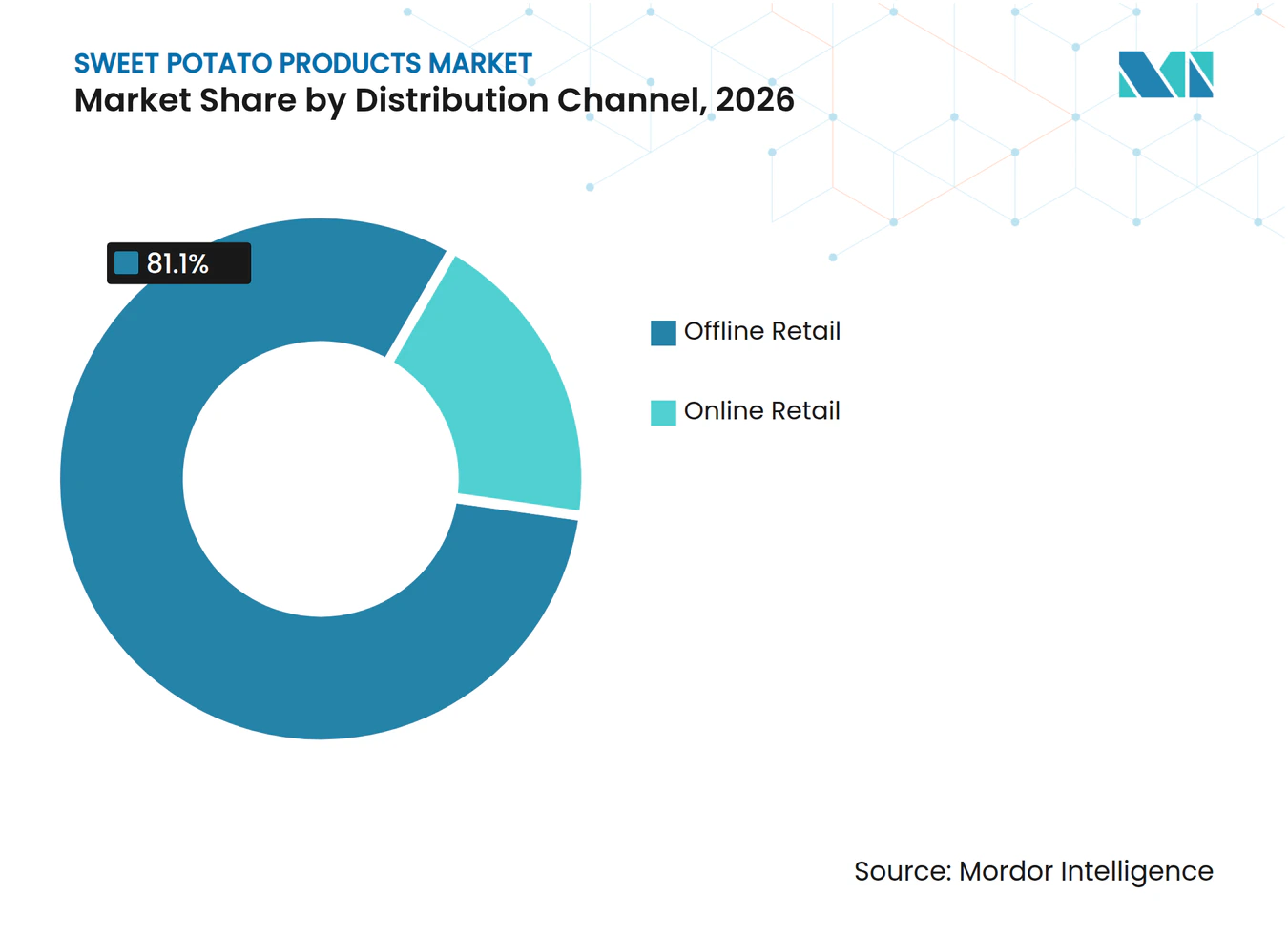
- By distribution channel, offline retail held 81.11% of the sweet potato products market in 2026, while online retail is forecast to grow at a 9.12% CAGR from 2027 to 2032.
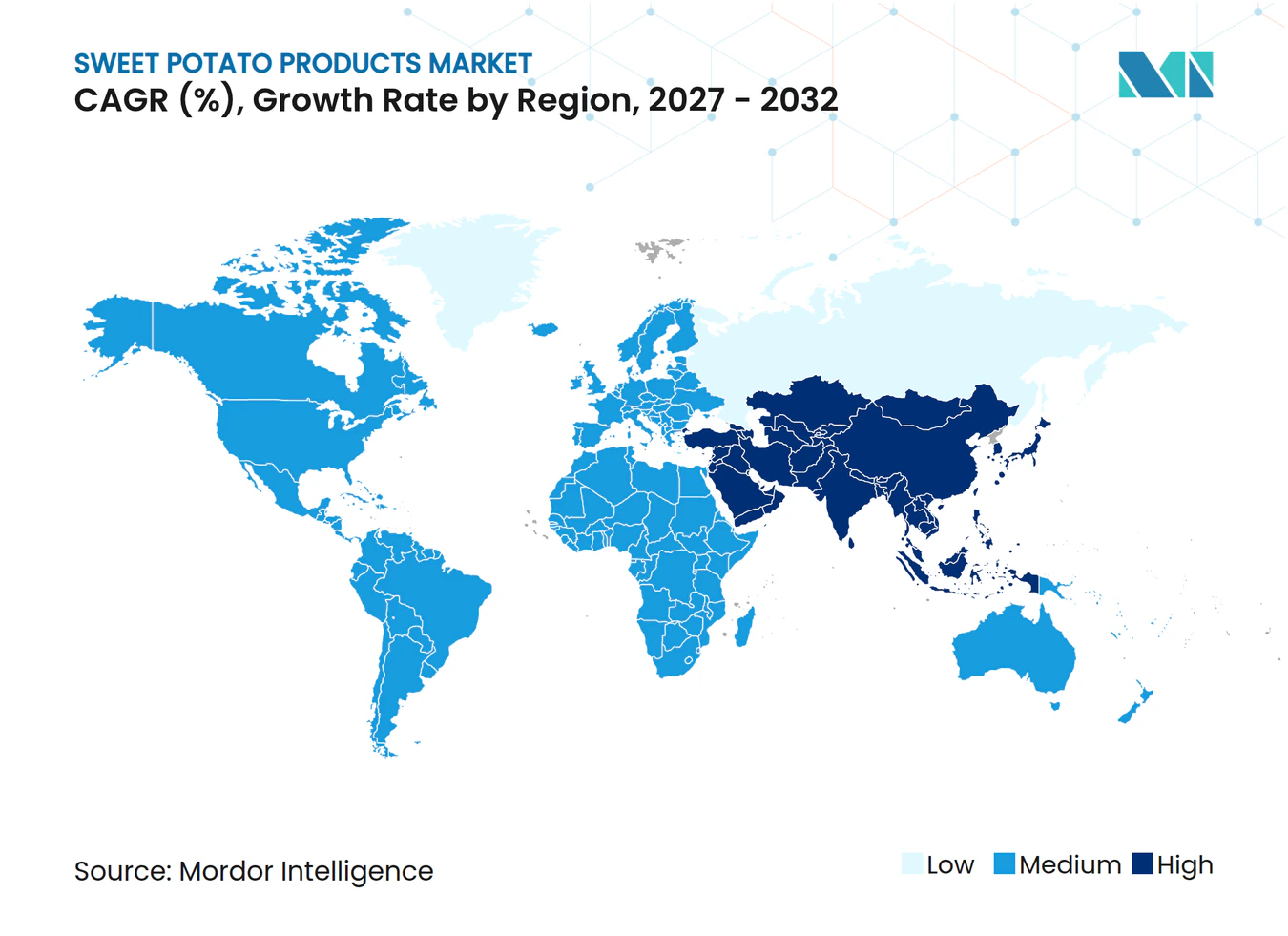
- By geography, North America held 34.22% of the sweet potato products market in 2026, while Asia-Pacific is forecast to grow at a 7.81% CAGR from 2027 to 2032.
Note: Market numbers in this report are based on Mordor Intelligence's proprietary estimation framework, which combines nine months of actuals with Q4 projections for base year 2026.
Market Trends and Insights
Drivers Impact Analysis of Sweet Potato Products Market*
| Driver | (~) % Impact on CAGR Forecast | Geographic Relevance | Impact Timeline |
|---|---|---|---|
| Growing consumer preference for nutrient-rich sweet potato products | +1.2% | Global | Short term (≤ 2 years) |
| Rising consumer interest in nutritious sweet potato product | +0.9% | North America, Europe | Short term (≤ 2 years) |
| Increasing use of shelf-stable sweet potato purée | +0.7% | North America, Europe | Medium term (2-4 years) |
| Product innovation in sweet potato cuts, coatings, and flavors | +0.5% | South Asia, Sub-Saharan Africa | Medium term (2-4 years) |
| Increasing foodservice demand for sweet potato fries and sides | +0.8% | North America, Asia-Pacific | Medium term (2-4 years) |
| Growing demand for value-added sweet potato products | +0.6% | North America, Europe, Asia-Pacific | Long term (≥ 4 years) |
| Source: Mordor Intelligence | |||
Growing Consumer Preference for Nutrient-Rich Sweet Potato Products
Growing consumer interest in convenient, value-added food products is driving demand for processed sweet potato products, including flour and frozen chips. For instance, in November 2025, according to a National Library of Medicine study in Ghana’s Volta Region, 37% of surveyed respondents preferred sweet potato flour, while 32.3% preferred frozen sweet potato chips among processed sweet potato products [1]. These findings indicate demand for diverse processed sweet potato formats within the surveyed population and highlight opportunities for product diversification in the market.
Rising Consumer Interest in Nutritious Sweet Potato Products
Consumer preferences for taste, freshness, shelf life, and nutritional attributes are driving interest in processed sweet potato products. For instance, in October 2025, a study of 50 households in Tanzania’s Shinyanga and Mwanza regions found that 95% of respondents cited taste, 85.8% cited shelf life, and 80.8% cited freshness as factors influencing the consumption of processed sweet potato products. Additionally, 51% of respondents identified attractive packaging as an influencing factor [2]. Meanwhile, the Indian Council of Agricultural Research (ICAR) emphasized the potential of biofortified sweet potato flour in developing food products with distinct nutritional profiles.
Increasing Use of Shelf-Stable Sweet Potato Purée
Shelf-stable orange-fleshed sweet potato (OFSP) purée creates opportunities to expand the use of sweet potato products in commercial food processing. For instance, the International Potato Center (CIP) reports that its microwave-processing and aseptic-packaging technology can preserve orange-fleshed sweet potato puree for more than one year at ambient temperatures. It also reports that, in testing, the shelf-stable product achieved freshness perception, likability, and purchase intent comparable to those of refrigerated, pasteurized purée. Additionally, in March 2025, CIP documented agro-processors in Northern Ghana using OFSP purée to replace 30–60% of imported wheat flour in products such as bread, cakes, biscuits, and granola [3].
Product Innovation in Sweet Potato Cuts, Coatings, and Flavors
Product innovation is expanding the use of sweet potatoes beyond conventional side dishes to include seasoned fries, coated products, snacks, and breakfast foods. Manufacturers are developing products with distinctive seasonings, coatings, and preparation formats to cater to evolving consumer preferences for convenience, flavor variety, and healthier alternatives. Foodservice demand for bold flavor combinations, diverse textures, and complementary dips creates opportunities to differentiate sweet potato fries and side dishes across quick-service restaurants, casual dining outlets, and other foodservice formats. In packaged foods, manufacturers can incorporate sweet potato ingredients into granola, snacks, and other value-added products, expanding their applications across foodservice and retail markets.
Restraints Impact Analysis of Sweet Potato Products Market*
| Restraint | (~) % Impact on CAGR Forecast | Geographic Relevance | Impact Timeline |
|---|---|---|---|
| Perishability and cultivar-specific storage requirements | -0.8% | Global, intensified in Asia-Pacific and Middle East and Africa | Short term (≤ 2 years) |
| Inconsistencies in texture and cooking quality across sweet potato varieties | -0.3% | Global | Medium term (2-4 years) |
| High processing, certification and temperature-controlled distribution costs | -0.6% | Emerging markets | Medium term (2-4 years) |
| Competition from alternative starches, flours and conventional snack products | -0.5% | Global | Medium term (2-4 years) |
| Source: Mordor Intelligence | |||
Perishability and Cultivar-Specific Storage Requirements
Sweet potato products require careful postharvest handling and storage to maintain root quality and ensure a reliable supply for processing. Curing requires controlled temperature and humidity conditions, while handling delays can reduce root quality. Inappropriate storage temperatures can lead to chilling injury, internal browning, hard texture, bitter flavor, sprouting, and weight loss. Variations in storage requirements among sweet potato varieties further complicate the implementation of standardized storage protocols. These factors increase the need for appropriate curing facilities, temperature-controlled storage, and efficient postharvest infrastructure, creating supply chain challenges for sweet potato processors, particularly in regions with limited storage capacity.
High Processing, Certification, and Temperature-Controlled Distribution Costs
Sweet potato processing incurs costs related to raw material procurement, processing operations, storage, and regulatory compliance. Converting fresh roots into processed ingredients requires specialized equipment and efficient use of resources. Products such as frozen sweet potatoes also require adequate storage and refrigeration infrastructure. Manufacturers serving organic and premium product categories may face additional expenses to meet certification and compliance requirements. These combined costs can pressure profit margins and increase the financial burden of maintaining consistent production. Smaller processors may be particularly affected, as lower production volumes limit their ability to distribute fixed costs efficiently.
*Our forecasts treat driver/restraint impacts as directional, not additive. The impact forecasts reflect baseline growth, mix effects, and variable interactions.
Sweet Potato Products Market Segment Analysis
By Product Type:
Frozen Cuts Lead, Flour and Powder Grow FastestSweet potato fries and frozen cuts held 54.01% of the sweet potato products market share in 2026. Sweet potato fries benefit from established foodservice preparation methods and standardized product formats, enabling restaurants to incorporate them easily into menus as side dishes, appetizers, and quick-service offerings. Their compatibility with common frying, baking, and seasoning processes supports broader adoption across restaurants, cafés, and fast-food outlets. Chips, crisps, and other sweet potato snacks also meet retail demand for convenient, portable products with distinctive flavor and perceived nutritional benefits.
Sweet potato flour and powder are projected to grow at a CAGR of 6.21% through 2032. Sweet potato flour serves as a functional ingredient in bakery products, coatings, pasta, and gluten-free formulations. Its suitability across applications depends on properties such as water absorption capacity and gelatinization behavior, which affect product texture and processing performance. Sweet potato purées and concentrates also support food manufacturing, particularly in South Asia and Sub-Saharan Africa, where manufacturers incorporate them into locally processed foods and use them to partially replace conventional flour.



By Nature:
Conventional Leads, Organic Builds Premium DemandConventional accounted for 72.21% of the sweet potato products market size in 2026. Conventional sweet potato products benefit from well-established supply chains that connect growers, processors, and high-volume buyers. Their widespread availability supports retail, foodservice, and industrial applications that require consistent supply and cost efficiency. Established production and processing networks enable manufacturers to meet volume requirements, while lower costs than organic products support the use of conventional sweet potato products.
Organic is projected to grow at a 7.21% CAGR through 2032. Organic certification provides a recognized framework for sweet potato products produced using organic practices, enabling differentiation in specialty retail and premium market segments. Organic cultivation methods, such as cover cropping and biological pest management, can also improve crop quality and marketable yields. While these practices may support more consistent production, certification requirements and farming costs remain key considerations for growers and processors.
By Distribution Channel:
Offline Retail Leads Volume While Online Retail Expands AccessOffline accounted for 81.11% of the sweet potato products market size in 2026. Supermarkets, hypermarkets, convenience stores, and specialty food retailers remain the primary places of purchase for fresh and frozen sweet potato products. Physical retail channels also support regular household purchases and established procurement by foodservice and industrial customers. Foodservice accounts for a significant share of the remaining distribution base, as restaurants increasingly feature sweet potato fries and side dishes on their menus. Industrial buyers are also expanding their use of sweet potato flour, powder, and purée in bakery, snack, and convenience meal production.
Online retail is projected to grow at a 9.12% CAGR through 2032. E-grocery platforms and direct-to-consumer channels improve consumer access to organic sweet potatoes, specialty varieties, flour, and powder. These channels enable consumers to purchase products with limited availability in physical stores while allowing smaller brands, including regional producers and niche brands, to reach customers without extensive retail distribution. Online platforms also facilitate product discovery through product descriptions, customer reviews, and targeted promotions, expanding access to value-added sweet potato products across diverse consumer segments. The convenience of home delivery and subscription-based purchasing options further supports repeat purchases and broadens the reach of specialty sweet potato products.

Geography Analysis
North America Sweet Potato Products Market
North America accounted for 34.22% of the sweet potato products market share in 2026. The United States has an established sweet potato production base, led by major growing regions such as North Carolina. Strong domestic production and export networks ensure the availability of sweet potatoes for fresh consumption and processing. Access to international markets enables producers and processors to serve overseas customers, supporting the regional supply of fresh and value-added sweet potato products.
APAC and South America Sweet Potato Products Market
Asia-Pacific is projected to register a CAGR of 7.81% through 2032. Demand for sweet potato products varies by region, influenced by local consumption patterns, foodservice activity, and processing capabilities. In Japan, manufacturers use sweet potatoes in processed food applications, driving the development of snacks and confectionery products. Across the Asia-Pacific region, the expansion of foodservice and retail channels creates opportunities for frozen and packaged sweet potato products. In South America, established production facilities supply sweet potato products to neighboring markets.
EMEA Sweet Potato Products Market
In the Middle East and Africa, demand for root crops and packaged food products creates opportunities for sweet potato processors to address traditional consumption requirements and emerging convenience-oriented segments. Europe’s sweet potato market benefits from established import networks and diversified sourcing options. France, Spain, and Poland contribute significantly to regional demand, while the Netherlands acts as a key hub for import distribution and re-exports. Competition among suppliers from various origins shapes market dynamics, prompting businesses to strengthen sourcing strategies, enhance supply chain efficiency, and explore value-added processing opportunities to address regional demand.
Competitive Landscape
Market Concentration
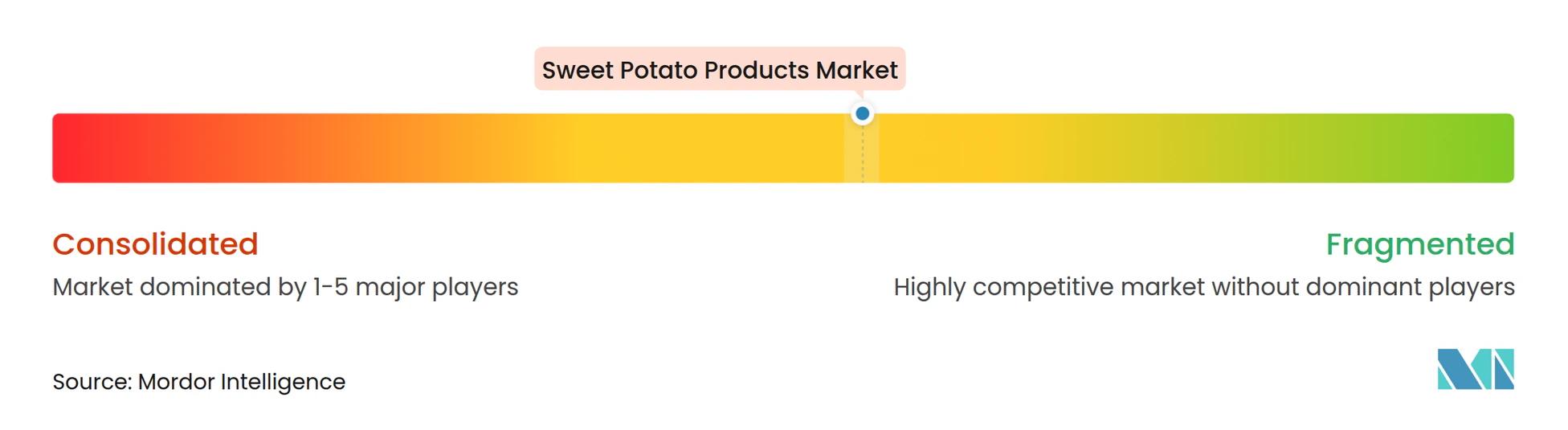
The sweet potato products market is moderately fragmented, with companies competing across both frozen products and processed-ingredient applications. Lamb Weston, J.R. Simplot, Aviko, Farm Frites, and Agristo operate in the frozen-processing segment, while Ingredion and Van Drunen Farms serve the ingredient market. Manufacturers are expanding production capacity and strengthening regional supply networks to meet demand from foodservice and retail channels. Regional facilities also improve the availability of frozen sweet potato products and other processed formats across international markets.
Capacity expansions and acquisitions enable sweet potato product manufacturers to strengthen regional supply networks and improve access to key markets. Companies are investing in new production facilities, upgrading existing processing plants, and expanding their geographic presence to serve customers more efficiently. These strategies increase production capacity, enhance distribution capabilities, and support a more reliable supply of frozen and processed sweet potato products across regional markets. They also help manufacturers reduce transportation lead times, improve inventory availability, and respond more effectively to changing demand from retail, foodservice, and industrial customers.
Opportunities in the sweet potato products market include organic products, gluten-free ingredients, premium varieties, and direct-to-consumer channels. Specialized ingredient processors can address applications beyond frozen products, while enhanced temperature monitoring, traceability, and postharvest handling can improve product quality and supply consistency. However, competition from alternative starches, high processing and handling costs, and variations in the functional properties of sweet potato varieties may constrain market expansion. Companies that combine efficient production, specialized ingredient capabilities, and effective supply chain management can better meet diverse market requirements.
Sweet Potato Products Industry Leaders
-
Lamb Weston Holdings, Inc.
-
Saptarishi Agro Industries Ltd. (Fraytoz)
-
J.R. Simplot Company
-
Royal Cosun (Aviko B.V.)
-
Farm Frites International B.V.
- *Disclaimer: Major Players sorted in no particular order
Sweet Potato Products Market Companies Covered in this Report
- Lamb Weston Holdings, Inc.
- Saptarishi Agro Industries Ltd. (Fraytoz)
- J.R. Simplot Company
- Royal Cosun (Aviko B.V.)
- Farm Frites International B.V.
- Ardo Group
- J.D. Irving Limited (Cavendish Farms Corporation)
- Conagra Brands, Inc. (Alexia)
- The Kraft Heinz Company (Ore-Ida)
- Agristo NV
- Russet House Inc.
- International Food and Consumable Goods
- Trinity Frozen Foods
- Ingredion Incorporated
- Goya Foods, Inc.
- Van Drunen Farms
- Carolina Innovative Food Ingredients
- Saipro Foods
- Sinofi Group
- Burton and Bamber Co. Ltd.
Recent Industry Developments in Sweet Potato Products Market
- June 2026: Kudumbashree, under the Punarjeevana Madhuram project, launched six value-added sweet potato products, including sweet potato flour, health mix, soup, gummies, chips, and kulfi. The products use technologies transferred by the ICAR-Central Tuber Crops Research Institute (ICAR-CTCRI).
- April 2026: Tropical Sun (Wanis) launched a 300 g tub of purple sweet potato chips made from naturally purple-fleshed sweet potatoes, expanding its snack portfolio with visually distinctive premium products.
- September 2025: International Food and Consumable Goods (IFCG), Egypt introduced new-season frozen sweet potato wedges in skin-on and skin-off formats for foodservice and retail applications.
Global Sweet Potato Products Market Report Scope
Sweet potato products include food items made from sweet potatoes, such as frozen cuts, fries, chips, crisps, snacks, flour, and powder. The sweet potato products market is segmented by product type, nature, distribution channel, and geography. By product type, the market includes sweet potato fries and frozen cut products, sweet potato chips, crisps, and snacks, sweet potato flour and powder, and other product types. By nature, the market is categorized into conventional and organic products. By distribution channel, the categories include industrial food ingredients, foodservice, and retail. The retail segment is further divided into online and offline retail channels. Geographically, the market covers North America, Europe, Asia-Pacific, South America, and the Middle East and Africa, including key countries within each region. The report provides market size estimates and forecasts in terms of value (USD).
Segmentation Overview
| Sweet potato fries and frozen cut products |
| Sweet potato chips, crisps and snacks |
| Sweet potato flour and powder |
| Other Product Type |
| Conventional |
| Organic |
| Industrial Food Ingredients | ||
| Foodservice | Retail | Online Retail |
| Offline Retail | ||
| North America | United States |
| Canada | |
| Europe | Germany |
| United Kingdom | |
| Italy | |
| France | |
| Spain | |
| Netherlands | |
| Poland | |
| Belgium | |
| Rest of Europe | |
| Asia-Pacific | India |
| Japan | |
| Australia | |
| China | |
| Indonesia | |
| South Korea | |
| Thailand | |
| Singapore | |
| Rest of Asia-Pacific | |
| South America | Brazil |
| Middle East and Africa | South Africa |
| Saudi Arabia | |
| United Arab Emirates | |
| Rest of Middle East and Africa |
| By Product Type | Sweet potato fries and frozen cut products | ||
| Sweet potato chips, crisps and snacks | |||
| Sweet potato flour and powder | |||
| Other Product Type | |||
| By Nature | Conventional | ||
| Organic | |||
| By Distribution Channel | Industrial Food Ingredients | ||
| Foodservice | Retail | Online Retail | |
| Offline Retail | |||
| By Geography | North America | United States | |
| Canada | |||
| Europe | Germany | ||
| United Kingdom | |||
| Italy | |||
| France | |||
| Spain | |||
| Netherlands | |||
| Poland | |||
| Belgium | |||
| Rest of Europe | |||
| Asia-Pacific | India | ||
| Japan | |||
| Australia | |||
| China | |||
| Indonesia | |||
| South Korea | |||
| Thailand | |||
| Singapore | |||
| Rest of Asia-Pacific | |||
| South America | Brazil | ||
| Middle East and Africa | South Africa | ||
| Saudi Arabia | |||
| United Arab Emirates | |||
| Rest of Middle East and Africa | |||
Key Questions Answered in the Report
What is the sweet potato products market size and growth outlook?
The market is expected to reach USD 7.21 billion in 2027 and USD 11.31 billion by 2032, growing at a CAGR of 5.58% over 2027-2032.
Why are gluten-free applications important for sweet potato products?
Sweet potato flour is naturally gluten-free and can be used in baked goods, pasta, and coatings that need verifiable gluten-free ingredients.
Which sales channel is expanding fastest?
Online retail is forecast to grow at a 9.12% CAGR through 2032, supported by e-grocery platforms and direct-to-consumer brands.
Which region is growing fastest for sweet potato products?
Asia-Pacific is forecast to grow at a 7.81% CAGR through 2032, driven by processed food use and growing foodservice demand.