
Surface Modification Chemicals Market Size and Share
Market Overview
| Study Period | 2021 - 2031 |
|---|---|
| Market Size (2026) | USD 4.06 Billion |
| Market Size (2031) | USD 5.35 Billion |
| Growth Rate (2026 - 2031) | 5.67 % |
| Fastest Growing Market | Asia-Pacific |
| Largest Market | Asia-Pacific |
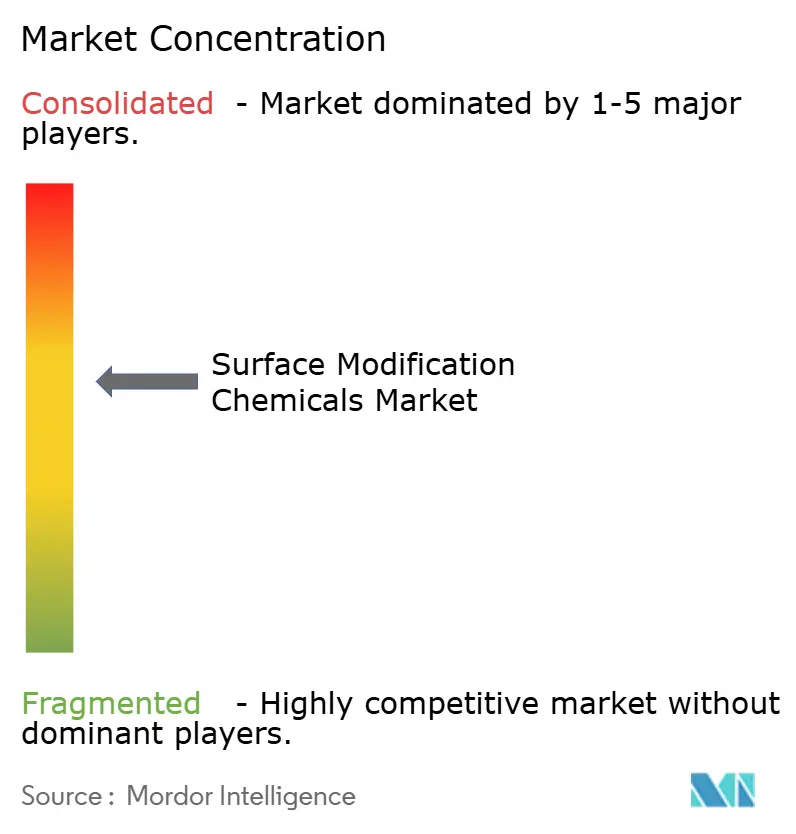
| Market Concentration | Medium |
Major Players *Disclaimer: Major Players sorted in no particular order Image © Mordor Intelligence. Reuse requires attribution under CC BY 4.0. | |
Surface Modification Chemicals Market Analysis by Mordor Intelligence
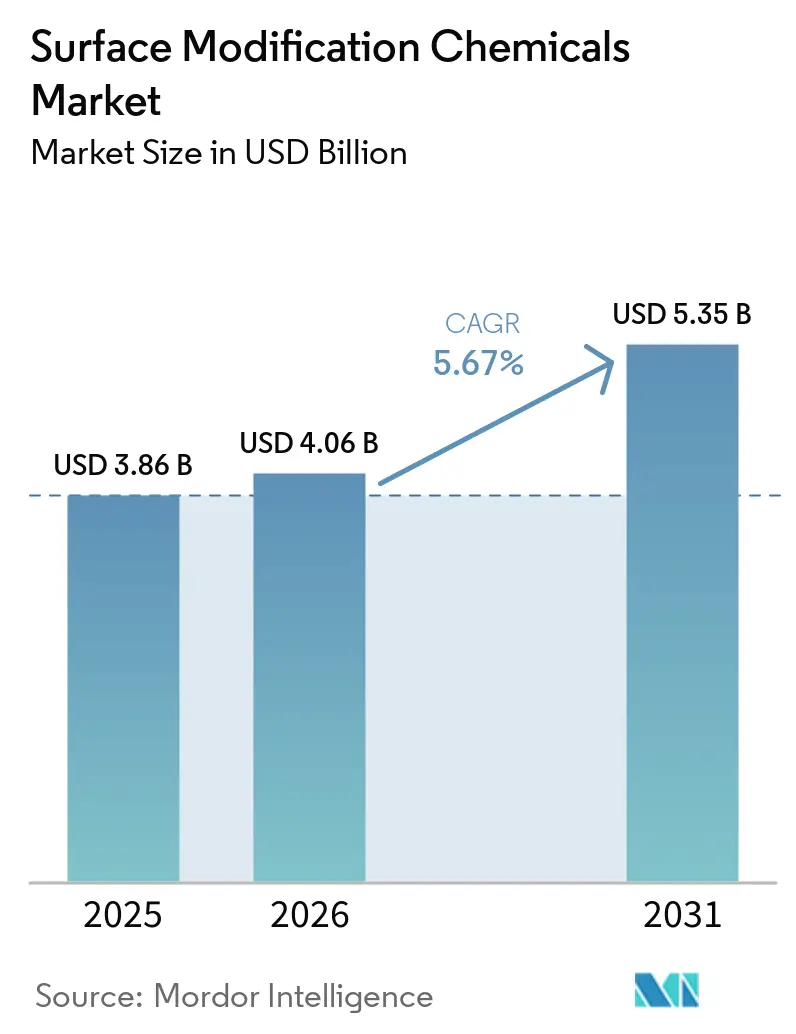
The surface modification chemicals market size was estimated at USD 3.86 billion in 2025 and is estimated to grow from USD 4.06 billion in 2026 to USD 5.35 billion by 2031, at a CAGR of 5.67% during the forecast period (2026-2031). The surface modification chemicals market is shifting away from zinc-phosphate and hexavalent chromium systems toward silane-based and zirconium-conversion chemistries for automotive, electronics, and infrastructure applications. This transition is shortening product qualification cycles and changing purchasing patterns among large industrial customers. Sustainability regulations in the European Union, the United States, and China are driving demand for chromium-free and low-volatile organic compound (VOC) products at a faster rate than demand alone. Large specialty chemical and surface science groups maintain an advantage through proprietary formulations, regulatory approvals, and joint development agreements with Tier 1 customers, while Chinese silane producers continue to exert price pressure on commodity applications.
Key Report Takeaways
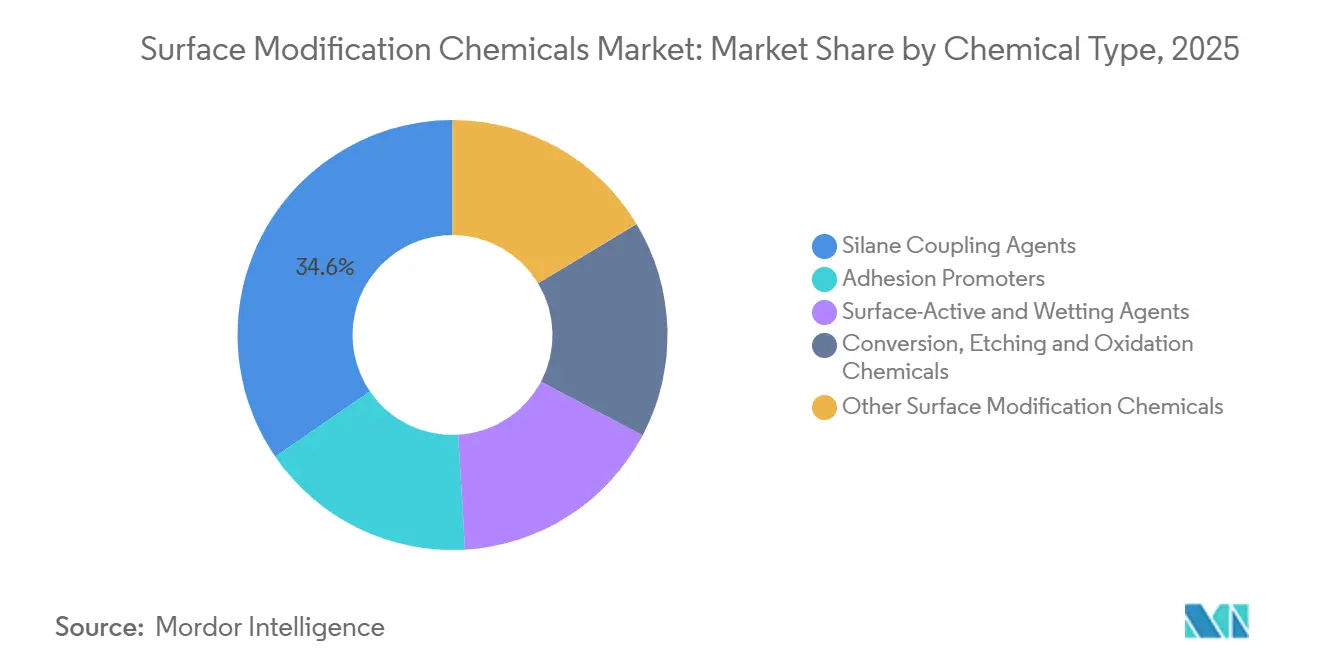
- By chemical type, silane coupling agents held 34.56% of revenue in 2025, while adhesion promoters are forecast to grow at a 6.45% CAGR through 2031.
- By substrate material, metals held 60.45% of revenue in 2025, while plastics and polymers are forecast to grow at a 6.63% CAGR through 2031.
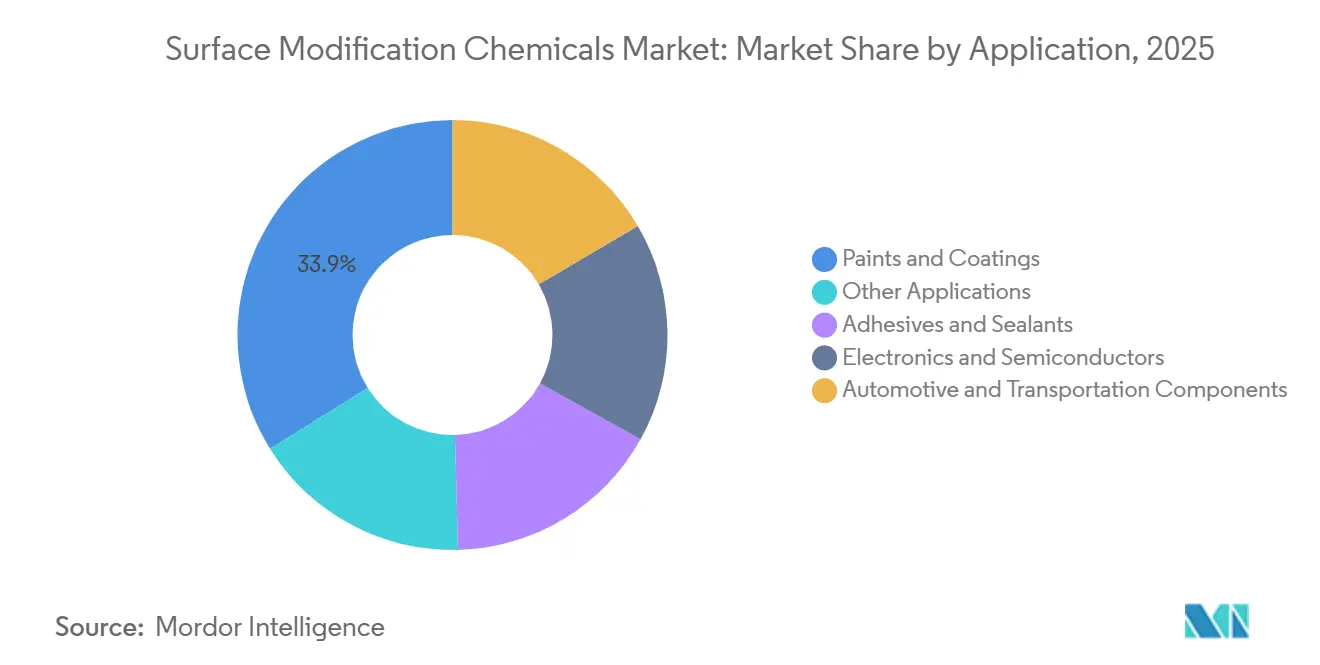
- By application, paints and coatings held 33.87% of revenue in 2025, while electronics and semiconductors are forecast to grow at a 6.94% CAGR through 2031.
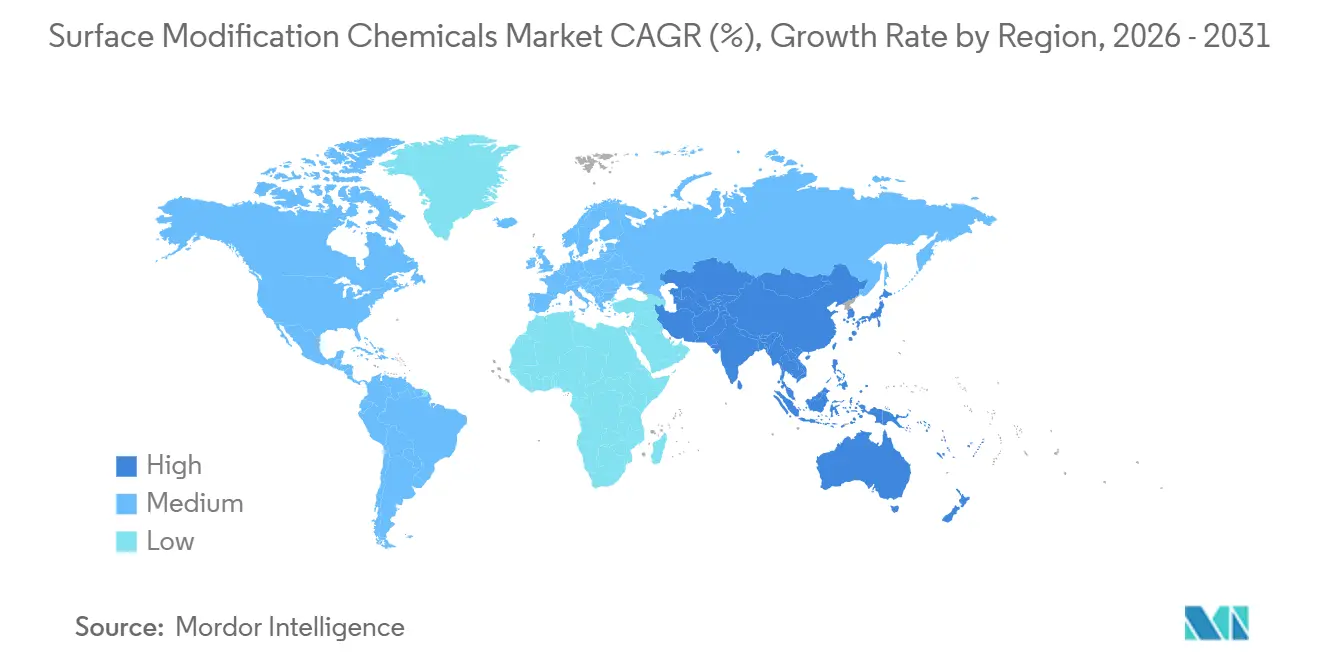
- By geography, Asia-Pacific held 42.13% of global revenue in 2025 and is forecast to grow at a 6.85% CAGR through 2031.
Note: Market size and forecast figures in this report are generated using Mordor Intelligence’s proprietary estimation framework, updated with the latest available data and insights as of January 2026.
Market Trends and Insights
Drivers Impact Analysis of Surface Modification Chemicals Market*
| Drivers | (~) % Impact on CAGR Forecast | Geographic Relevance | Impact Timeline |
|---|---|---|---|
| Electric Vehicle (EV) Lightweighting and Multi-Metal Pretreatment | +1.2% | APAC core, including China, South Korea, and India, with spillover to North America and Europe | Medium term (2-4 years) |
| Electronics Miniaturization and Precision Plating | +1.0% | Global, concentrated in Taiwan, South Korea, China, and select North American sites | Short term (≤ 2 years) |
| Infrastructure Corrosion Protection and Offshore Wind Expansion | +0.9% | Europe, APAC, and spillover to the Middle East and Africa | Medium term (2-4 years) |
| Additive Manufacturing Surface Finishing | +0.5% | North America and Europe, with early adoption in APAC | Long term (≥ 4 years) |
| Closed-Loop, AI-Controlled Bath Management | +0.5% | Global, with early use in automotive manufacturing and semiconductor wet-clean applications | Short term (≤ 2 years) |
| Chromium-Free and Low-Volatile Organic Compound (VOC) Formulation Innovation | +0.9% | Global, with the strongest regulatory urgency in the European Union and the United States | Short term (≤ 2 years) |
| Source: Mordor Intelligence | |||
EV Lightweighting and Multi-Metal Pretreatment: The Body-in-White Chemistry Shift
Electric vehicle body-in-white construction combines high-strength steel, aluminum alloys, magnesium die-castings, and glass-fiber-reinforced polymers on a single assembly line. This mix supports demand in the surface modification chemicals market for pretreatment systems that can handle different substrates in a single bath without chemistry changeovers. Zirconium-silane hybrid conversion coatings manage this requirement more effectively than zinc phosphating. They operate at lower temperatures and produce less phosphate sludge, which reduces waste-treatment work for automotive Tier 1 facilities. Chemetall, part of BASF Coatings, launched Gardolene D in October 2025 as a chromium-free and fluoride-free passivation technology for EV battery copper foils. The product delivered up to 6% longer battery life after 1,000 charge cycles at 25°C under the reported testing conditions[1].
The EU Battery Regulation requires digital battery passports and hazardous-substance declarations from 2027. These requirements increase the need for chromium-free surface chemistry across EV battery supply chains. OEMs are therefore moving more quickly to retrofit multi-metal lines and retire zinc-phosphate systems. This directs near-term capital spending toward silane and zirconium conversion chemical suppliers rather than commodity cleaning formulators. The surface modification chemicals market benefits where suppliers can meet both mixed-metal performance requirements and formal chemical disclosure needs. Suppliers that already support automotive line conversion can strengthen their position as battery material processing becomes more closely tied to vehicle assembly requirements.
Electronics Miniaturization and Precision Plating: Sub-5 nm Drives Chemistry Specificity
Semiconductor process nodes below 5 nm require higher purity and greater chemical input at every surface-treatment stage in advanced packaging. This supports the surface modification chemicals market for copper through-silicon-via metallization and micro-bump formation. Wafer-level packaging requires suppressors, levelers, and brighteners with sub-parts-per-billion consistency. A defect in a single through-silicon via within a chiplet stack can disable the entire module, making chemical specification a performance requirement rather than a routine cost decision. Aminosilane- and HMDS-based adhesion promoters remain important in the underlayer chemistry of extreme ultraviolet (EUV) lithography for advanced logic and memory production.
U.S. CHIPS and Science Act-supported fab expansions in Arizona, Ohio, and Texas are adding wafer-start capacity through 2028, creating demand for high-purity processing chemistries at new facilities. Research published in 2025 demonstrated autonomous optimization of an electroplating bath using a large language model (LLM) agent that selected current density, temperature, and additive concentration for nickel thin-film deposition, illustrating how precision plating control can be developed in advanced facilities. The 5G rollout also supports demand for alkoxysilane-modified epoxy resins in printed circuit boards that must retain dielectric stability at millimeter-wave frequencies under power-dense operation. These requirements give the surface modification chemicals market a role in both chip packaging and communications hardware.
Infrastructure Corrosion Protection and Offshore Wind Expansion: Scale Drives Demand
Infrastructure renewal and offshore wind construction support steady demand for corrosion-protection products in the surface modification chemicals market. Offshore wind steel monopiles require multi-layer systems that include zinc-rich primers, surface-active pretreatment chemicals, and epoxy or polyurethane topcoats, designed for 25-year service in splash-zone conditions. The chemical requirement per foundation is greater than in many smaller end uses, making offshore structures a significant outlet for durable corrosion-control formulations and linking coating selection to long operating periods and difficult maintenance conditions.
A 2025 study reported a hydrogen-bonded, graphene-functionalized polyurea coating with 92.2% self-healing efficiency after 60 seconds of near-infrared light exposure, supporting research interest in reactive surface-modification chemistry for offshore asset management. A Basque research consortium led by Iberdrola Renovables and Tecnalia is developing PFAS-free, zero-VOC zinc-flake coatings for offshore metal structures, signaling a need to reformulate corrosion-protection systems from the substrate upward. The surface modification chemicals market favors suppliers qualified in eco-compliant silane and organic conversion chemistry. Suppliers that continue to depend on PFAS-containing wetting agents or solventborne formulations face a more difficult qualification path.
Chromium-Free and Low-VOC Formulation Innovation: Compliance as a Product Catalyst
Regulatory action on chromium and VOC-bearing chemicals is expanding the range of products that meet both sustainability and technical requirements. This supports the surface modification chemicals market rather than restricting it to legacy products. Evonik launched Protectosil ECO-TRETE ANTIGRAFFITI in March 2026. The PFAS-free, silane-based product chemically bonds to building substrates and maintains protective performance through repeated cleaning cycles, demonstrating how a silane system can replace fluorocarbon-based surface treatments in building protection applications and illustrating the value of products that combine regulatory compliance with in-use performance.
Henkel launched Loctite AF 8810 and AF 8812 in April 2026. These are PFAS-free, silicone-based anti-fingerprint coatings for automotive in-vehicle displays that meet the 9H glass hardness standard and contain no fluorine-based ingredients. California VOC rules have already prompted many U.S. adhesive producers to adopt silane-modified systems, demonstrating how regional rules can drive reformulation across global supply chains. Residual chromate and high-VOC solventborne chemistries may become less viable in mainstream industrial uses before 2030. This technology shift creates an opening in the surface modification chemicals market for suppliers of chromium-free and bio-based chemistry.
Restraints Impact Analysis of Surface Modification Chemicals Market*
| Restraints | (~) % Impact on CAGR Forecast | Geographic Relevance | Impact Timeline |
|---|---|---|---|
| Hexavalent Chromium Requalification and Compliance Costs | -0.5% | European Union and United Kingdom core, with spillover to North American and APAC aerospace supply chains | Short term (≤ 2 years) |
| Specialty Raw-Material Price Volatility | -0.3% | Global, most acute in Europe and North America, because of the silicon-metal import dependence on China | Medium term (2-4 years) |
| Captive-Line Total Cost and Waste-Management Burden | -0.2% | Global, most acute in small and medium manufacturing clusters in APAC and Europe | Medium term (2-4 years) |
| Qualification Gaps for Bio-Based and Nanostructured Alternatives | -0.1% | Global, concentrated in the European Union and North American innovation ecosystems | Long term (≥ 4 years) |
| Source: Mordor Intelligence | |||
Hexavalent Chromium Requalification and Compliance Costs: REACH Transition Uncertainty
In April 2025, the European Chemicals Agency published a restriction proposal for 13 hexavalent chromium compounds under the EU REACH Regulation EC No. 1907/2006. The proposal estimated compliance costs of EUR 314 million (~USD 363.80 million) to EUR 3.23 billion (~USD 3.74 billion) for affected European industries, covering substitution programs, worker exposure controls, and potential facility closures[2]. Existing REACH Annex XIV authorization decisions have become less reliable planning tools for chemical users, with authorization processing averaging 14.5 months, compared with a statutory three-month period. This has reduced certainty for procurement teams managing chemistry changeovers and associated capital spending, which, in turn, can slow purchasing decisions in the surface-modification chemicals market.
Aerospace and defense users within the Aerospace and Defense Chromates Re-Authorization Consortium secured authorizations extending continued-use titles until December 2034, providing more time to manage the transition. Smaller automotive and general-industrial users outside such consortium arrangements face more immediate compliance needs, with surface-treatment research teams required to devote time to regulatory records and requalification work rather than new product development. This situation favors larger multinational formulators with established regulatory resources and may drive consolidation in the surface modification chemicals market.
Specialty Raw-Material Price Volatility: Silicon Metal and Feedstock Concentration Risk
Organofunctional silanes depend on silicon metal, an energy-intensive commodity for which China supplies 60% to 70% of global feedstock. This import dependency is difficult for European and North American formulators to hedge in the short term. Production disruptions related to carbon-emission limits, power rationing, or trade policy can quickly affect silane coupling agent spot prices, compressing margins for formulators without upstream integration. Trialkoxysilane intermediates also have a limited number of qualified alternative suppliers, and requalification of technically suitable substitutes can take 12 to 18 months.
Mid-size formulators face the greatest exposure in this environment. Large integrated groups such as Wacker Chemie and Dow rely on internal supply arrangements and long-term agreements to improve feedstock assurance, while smaller custom formulators remain more exposed to spot price movements. These differences affect pricing and procurement across the surface modification chemicals market. Nearshoring silane intermediate production in Europe is a growing supply-chain priority through 2030; however, the capital required for new silane synthesis capacity may limit short-term output growth at the formulator level.
*Our forecasts treat driver/restraint impacts as directional, not additive. The impact forecasts reflect baseline growth, mix effects, and variable interactions.
Surface Modification Chemicals Market Segment Analysis
By Chemical Type:
Silane Chemistry Anchors Market, Adhesion Promoters AccelerateAdhesion promoters are forecast to expand at a 6.45% CAGR from 2026 to 2031, making them the fastest-growing chemical type. They are used on difficult-to-bond polymer substrates in automotive body panels, consumer electronics housings, and structural assemblies. Conventional mechanical preparation cannot always provide durable interfacial bonds at the required tolerances. Chlorinated polyolefin and silane-modified primer systems are gaining use as automakers increase the use of low-surface-energy polypropylene and thermoplastic polyolefin (TPO). A 2024 study found that a covalent-bonding adhesion primer for polyolefins increased lap shear strength by 10% to 50% against plasma-treated substrates and remained effective after two months of storage. This durability has clear implications for assembly-line use.
Silane coupling agents accounted for 34.56% of the surface modification chemicals market share in 2025. Their position reflects functional versatility across tire-filler bonding, advanced printed circuit board laminates, and corrosion-inhibiting pretreatment for automotive and industrial applications. Surface-active and wetting agents are also expanding as coating systems shift from solventborne to waterborne formats. Evonik launched TEGO Wet 288 in April 2025 for waterborne and radiation-curing formulations where conventional wetting agents can lose effectiveness during storage. Conversion, etching, and oxidation chemicals are moving from zinc phosphate to zirconium-based nano-conversion layers. A 2025 study documented a complete phosphate-to-zirconium conversion at an automotive paint facility in 12 days.

By Substrate Material:
Metals Dominant, Plastics and Polymers Gaining ShareMetals held 60.45% of revenue in 2025, reflecting their continued use in automotive bodies, industrial equipment, infrastructure components, and electronic hardware enclosures. These applications consume the greatest quantities of pretreatment chemicals. The surface modification chemicals market is also being shaped by the replacement of metal parts with engineering polymers and fiber-reinforced composites in weight-sensitive products. This shift moves spending away from conventional phosphating and toward adhesion promoters for low-surface-energy polymer surfaces. Plastics and polymers are forecast to grow at a 6.63% CAGR from 2026 to 2031. Automotive lightweighting requirements in the European Union and Chinese fuel-economy standards support higher polymer content in vehicle bodies and interiors.
Consumer electronics housings are also moving from aluminum to molded polymers with specialized finishing requirements. Glass and ceramic substrates use silane coupling agent treatments to improve coating adhesion in architectural glazing, photovoltaic modules, and electronic display cover lenses. Automotive displays and residential solar deployment support this use case. Composites in aerospace, offshore wind turbine blades, and high-performance sporting equipment require chemistry that manages carbon and glass fiber surfaces without weakening the fiber-matrix interface. A 2024 study reported that vinyl-trimethoxysilane-modified SiO2 nanoparticles incorporated into polyurethane automotive clearcoats improved scratch resistance, gloss retention, and water uptake performance. The surface-modification chemicals market therefore benefits as customers adopt higher-fiber-fraction structures to reduce weight and extend service intervals.
By Application:
Paints and Coatings Lead, Electronics and Semiconductors AcceleratePaints and coatings accounted for 33.87% of the surface modification chemicals market in 2025 and remained the largest application. The segment reflects the installed base of surface-treatment lines in automotive, consumer goods, and construction. These lines require continuous supplies of wetting agents, conversion chemicals, and adhesion promoters. BASF launched biomass-balanced architectural coating additives in July 2026, including Dispex AA 4145 MB for pigment wetting and Rheovis PU 1333 MB and Rheovis HS 1169 MB for rheology control. The products support formulators seeking bio-attributed raw materials in certified finishes without changing existing formulations. This reflects continued demand for sustainability-linked inputs in a large, established application base.
Electronics and semiconductors are forecast to grow at a 6.94% CAGR from 2026 to 2031. Successive logic and memory nodes add wet-chemical processing stages, increasing chemical consumption per wafer even as wafer quantities moderate. Chiplet and 3D integration increase surface-treatment area for usable silicon as through-silicon-via depths rise and micro-bump pitches fall below 20 micrometers. India's semiconductor manufacturing program is establishing a demand center for precision plating and surface-modification chemicals that currently rely heavily on imports. The program is supported by the Production Linked Incentive scheme and investment commitments from Tata and Foxconn. Adhesives and sealants and automotive transportation components are smaller but steady applications, as electric vehicle (EV) battery modules and multi-material body assemblies increasingly use structural bonds that require engineered pretreatment chemistry.
Geography Analysis
APAC Surface Modification Chemicals Market
Asia-Pacific held 42.13% of the surface modification chemicals market share in 2025 and is forecast to grow at a 6.85% CAGR through 2031. The region has large bases for semiconductor fabrication, automotive assembly, and consumer electronics manufacturing. China is transitioning automotive coating lines from phosphate-based to zirconium-conversion pretreatment and expanding domestic silane and specialty chemical supply, as industrial policy emphasizes self-sufficiency in strategic electronics inputs. Japan and South Korea contribute premium demand for high-purity materials in semiconductor processing and display panel production. Vietnam, Thailand, and Malaysia are attracting investment in electronics assembly as companies diversify their supply chains.
India and North America Surface Modification Chemicals Market
India is developing as another demand center through investments in electronics assembly and packaging under the Production Linked Incentive scheme. Its surface-treatment chemical requirements are currently met largely through imports, although localized blending capacity is beginning to develop. High-purity formulations from Japan, the United States, and Germany will remain important for several years. North America is the second-largest regional market, with high-value demand in aerospace coatings, advanced semiconductor specialty chemicals, and automotive OEM pretreatment. New fabs in Arizona, Ohio, and Texas are supporting demand for high-purity adhesion promoters, plating additives, and conversion chemicals, broadening the regional base for the surface modification chemicals market.
EMEA and South America Surface Modification Chemicals Market
Europe has regulation-driven demand for chromium- and PFAS-free products in the automotive, aerospace, and offshore wind sectors. REACH-related Cr(VI) compliance and substitution programs also create costs for line conversions and can restrain spending growth. South America remains a smaller market, with Brazil and Argentina supporting demand for automotive body-in-white pretreatment and industrial maintenance coatings. The Middle East and Africa are seeing increased demand driven by Saudi Arabia's industrial diversification programs and regional pipeline and upstream oil infrastructure development. In many regional submarkets, distribution-network capability, rather than product availability, remains the primary limitation, making local service coverage important for participants in the surface modification chemicals market.
Competitive Landscape
The surface modification chemicals market is moderately consolidated. Large integrated specialty chemical groups hold positions in high-value silane coupling agents for advanced electronics, precision plating chemistry for semiconductor packaging, and chromium-free conversion coatings for automotive OEMs. These positions are supported by proprietary formulations, regulatory approvals across regions, and co-development agreements with Tier 1 customers. Such agreements create switching costs for customers with qualified production lines, making competitive positions strongest where both chemical performance and formal approval are required. Commodity-grade applications are more exposed to price pressure from Chinese silane producers, with single-site organofunctional silane capacity reaching 80,000 metric tons annually.
Companies are expanding production capacity and broadening technical coverage. Wacker Chemie commissioned new specialty silane and silicone capacity in China and the Czech Republic in 2025. Shin-Etsu Chemical invested in a silicone products plant in Zhejiang. In April 2025, Quaker Houghton acquired Natech Ltd. in the United Kingdom for USD 6.5 million, expanding its surface-treatment coverage in automotive electronics and European industrial applications. Formulation development focused on chromium-free and PFAS-free products also presents barriers to entry, as regulatory approval requires significant time and resources.
AI-based process-control services are developing alongside the chemical supply industry. In June 2026, Digiclean raised EUR 2.5 million (USD 2.89 million) to scale an AI-powered monitoring and automated dosing system that maintains treatment baths within target ranges without manual sampling. The service can reduce chemical waste and shift customer engagement beyond a standard chemical purchase. Research on autonomous electroplating suggests that process-intelligence capabilities may become increasingly relevant in the surface modification chemicals market. In December 2025, ALTANA secured a European Investment Bank credit line for sustainable research and development through 2028, supporting the ongoing reformulation work needed across several product families.
Surface Modification Chemicals Industry Leaders
-
Henkel AG and Co. KGaA
-
BASF
-
PPG Industries, Inc.
-
Dow
-
Nihon Parkerizing Co., Ltd.
- *Disclaimer: Major Players sorted in no particular order
Surface Modification Chemicals Market Companies Covered in this Report
- ALTANA
- BASF
- Dow
- Element Solutions Inc
- Evonik Industries AG
- Henkel AG and Co. KGaA
- JCU CORPORATION
- Lamberti S.p.A.
- Momentive
- Nihon Parkerizing Co., Ltd.
- NOF CORPORATION
- PPG Industries, Inc.
- Quaker Chemical Corporation
- Shin-Etsu Chemical Co., Ltd.
- Wacker Chemie AG
Recent Industry Developments in Surface Modification Chemicals Market
- July 2026: BASF launched a range of biomass-balanced architectural coating additives globally, including Dispex AA 4145 MB for pigment wetting, Rheovis PU 1333 MB, and Rheovis HS 1169 MB for rheology control, under a certified mass-balance approach. The launch allows architectural coatings formulators to adopt bio-attributed raw material alternatives to fossil-feedstock-derived additives without reformulation, supporting Leadership in Energy and Environmental Design (LEED) and equivalent certification pathways.
- April 2026: Henkel AG & Co. KGaA launched Loctite AF 8810 and Loctite AF 8812, PFAS-free and fluorine-free silicone-based anti-fingerprint coatings for automotive in-vehicle displays and touchscreens. Loctite AF 8812 achieves 9H glass hardness without fluorine ingredients, retaining hydrophobicity after 5,000 eraser-abrasion cycles, positioning the portfolio as a compliance-ready alternative to fluorocarbon-based display surface chemistries in European, U.S., and Asian markets.
Global Surface Modification Chemicals Market Report Scope
Surface modification chemicals are reactive compounds used to alter the surface properties of materials, such as wettability, adhesion, or corrosion resistance, without changing their core structure. Key types include silanes, organic acids, polymers, and thiols, which form strong bonds on substrates such as glass, metals, and plastics.
The surface modification chemicals market is segmented by chemical type, substrate material, application, and geography. By chemical type, the market is segmented into silane coupling agents, adhesion promoters, surface-active and wetting agents, conversion, etching and oxidation chemicals, and other surface modification chemicals. By substrate material, the market is segmented into metals, plastics and polymers, glass and ceramics, composites, and other substrate materials. By application, the market is segmented into paints and coatings, adhesives and sealants, electronics and semiconductors, automotive and transportation components, and other applications. The report also covers market size and forecasts for surface modification chemicals across 15 countries in major regions. The market sizes and forecasts are provided in terms of value (USD).
Segmentation Overview
| Silane Coupling Agents |
| Adhesion Promoters |
| Surface-Active and Wetting Agents |
| Conversion, Etching and Oxidation Chemicals |
| Other Surface Modification Chemicals |
| Metals |
| Plastics and Polymers |
| Glass and Ceramics |
| Composites |
| Other Substrate Materials |
| Paints and Coatings |
| Adhesives and Sealants |
| Electronics and Semiconductors |
| Automotive and Transportation Components |
| Other Applications |
| Asia-Pacific | China |
| India | |
| Japan | |
| South Korea | |
| ASEAN Countries | |
| Rest of Asia-Pacific | |
| North America | United States |
| Canada | |
| Mexico | |
| Europe | Germany |
| United Kingdom | |
| France | |
| Italy | |
| NORDIC Countries | |
| Rest of Europe | |
| South America | Brazil |
| Argentina | |
| Rest of South America | |
| Middle East and Africa | Saudi Arabia |
| South Africa | |
| Rest of Middle East and Africa |
| By Chemical Type | Silane Coupling Agents | |
| Adhesion Promoters | ||
| Surface-Active and Wetting Agents | ||
| Conversion, Etching and Oxidation Chemicals | ||
| Other Surface Modification Chemicals | ||
| By Substrate Material | Metals | |
| Plastics and Polymers | ||
| Glass and Ceramics | ||
| Composites | ||
| Other Substrate Materials | ||
| By Application | Paints and Coatings | |
| Adhesives and Sealants | ||
| Electronics and Semiconductors | ||
| Automotive and Transportation Components | ||
| Other Applications | ||
| By Geography | Asia-Pacific | China |
| India | ||
| Japan | ||
| South Korea | ||
| ASEAN Countries | ||
| Rest of Asia-Pacific | ||
| North America | United States | |
| Canada | ||
| Mexico | ||
| Europe | Germany | |
| United Kingdom | ||
| France | ||
| Italy | ||
| NORDIC Countries | ||
| Rest of Europe | ||
| South America | Brazil | |
| Argentina | ||
| Rest of South America | ||
| Middle East and Africa | Saudi Arabia | |
| South Africa | ||
| Rest of Middle East and Africa | ||
Key Questions Answered in the Report
What is current market size of Surface Modification Chemicals Market?
The surface modification chemicals market size was estimated at USD 3.86 billion in 2025 and is estimated to grow from USD 4.06 billion in 2026 to USD 5.35 billion by 2031, at a CAGR of 5.67% during the forecast period (2026-2031).
Which chemical type leads demand?
Silane coupling agents led with 34.56% of revenue in 2025, owing to their use inlow-VOC products tire bonding, circuit board laminates, and corrosion-control pretreatment.
Which application is growing fastest?
Electronics and semiconductors are forecast to grow at a 6.94% CAGR through 2031 as advanced packaging needs more precise wet-chemical processing.
Why are chromium-free formulations gaining use?
Regulatory requirements and customer qualification needs are moving users toward chromium-free and low-volatile organic compound (VOC) products in automotive, battery, aerospace, and industrial applications.