
Surface Energy Modifier Market Size and Share
Market Overview
| Study Period | 2021 - 2031 |
|---|---|
| Market Size (2026) | USD 1.9 Billion |
| Market Size (2031) | USD 2.59 Billion |
| Growth Rate (2026 - 2031) | 6.43 % |
| Fastest Growing Market | Asia-Pacific |
| Largest Market | Asia-Pacific |
| Market Concentration | Low |
Major Players *Disclaimer: Major Players sorted in no particular order Image © Mordor Intelligence. Reuse requires attribution under CC BY 4.0. | |
Surface Energy Modifier Market Analysis by Mordor Intelligence
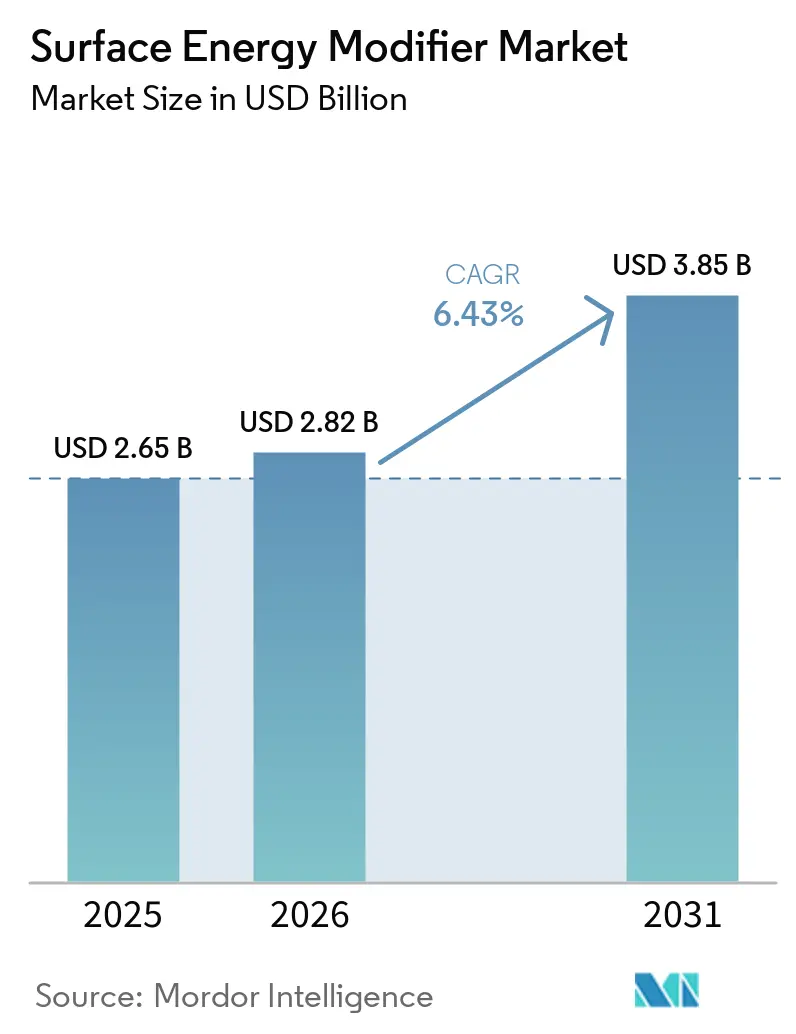
The Surface Energy Modifier Market size is expected to grow from USD 1.79 billion in 2025 to USD 1.9 billion in 2026 and is forecast to reach USD 2.59 billion by 2031 at 6.43% CAGR over 2026-2031. The surface energy modifier market is supported by tighter controls on volatile organic compounds (VOCs) and per- and polyfluoroalkyl substances (PFAS), which are moving coating and ink formulations toward waterborne, radiation-curable, and fluorine-free systems. These systems need reliable wetting, leveling, and adhesion control because water has higher surface tension than common organic solvents. Industrial expansion in packaging, electronics, automotive production, and construction also increases demand for additives that support consistent film formation on varied substrates. Suppliers with silicone and acrylic portfolios are positioned to benefit from fluorinated additive substitution, while suppliers with legacy fluorochemistry face longer qualification cycles. Recycled polypropylene and polyethylene add another need because contamination and variable polarity can impair coating adhesion, increasing the value of surface control additives in circular material streams.
Key Report Takeaways
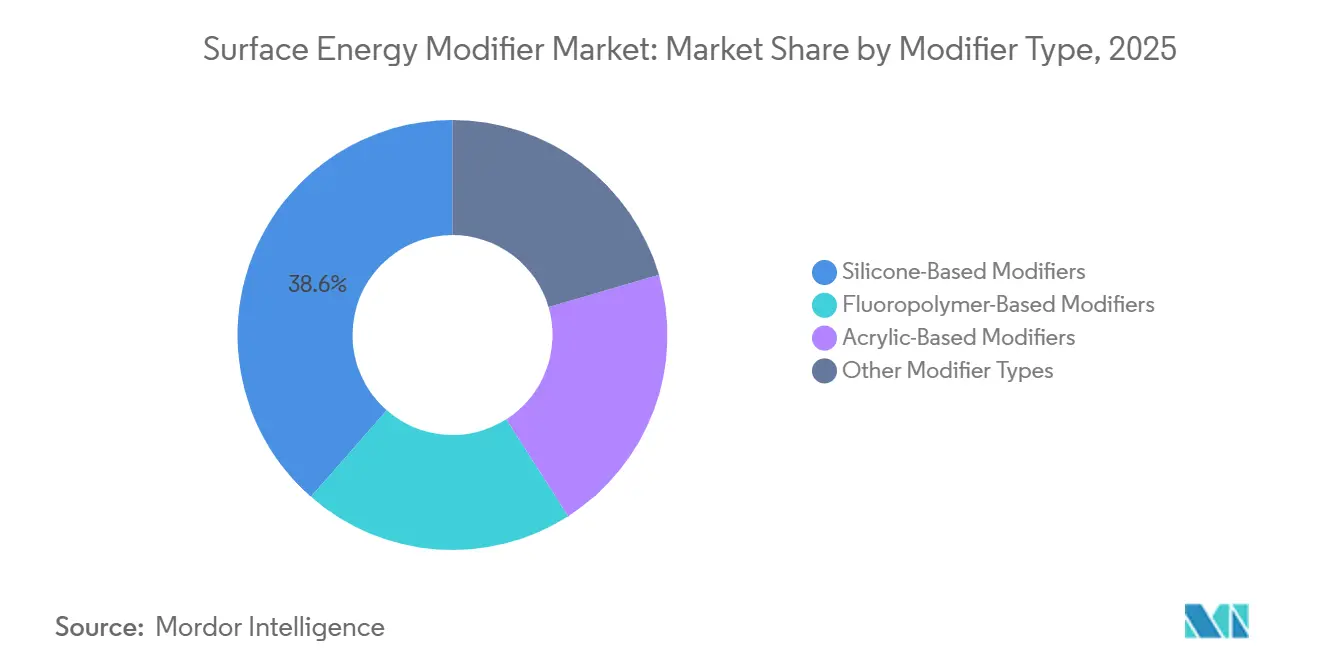
- By modifier type, silicone-based modifiers held 38.56% of the surface energy modifier market share in 2025, while fluoropolymer-based modifiers are projected to advance at a 7.21% CAGR through 2031.
- By substrate, plastics and polymers held 31.77% of the surface energy modifier market share in 2025, while composites are projected to advance at a 7.34% CAGR through 2031.
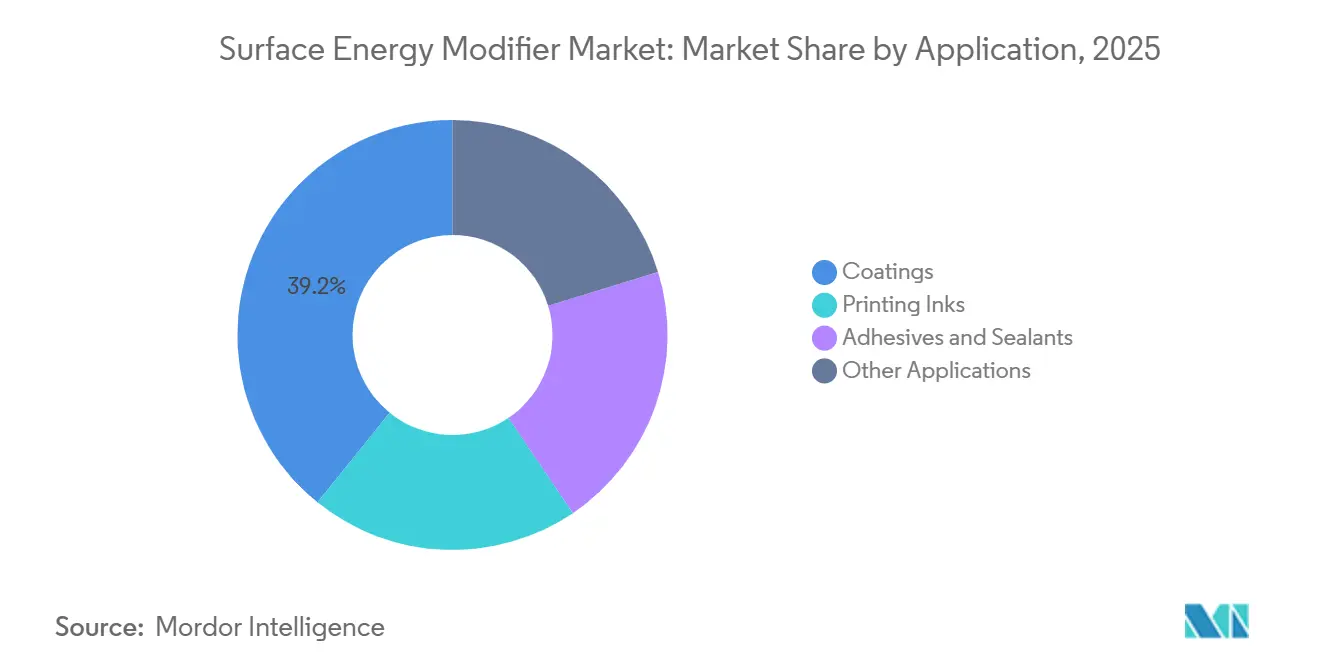
- By application, coatings held 39.19% of the surface energy modifier market share in 2025, while printing inks are projected to advance at a 7.77% CAGR through 2031.
- By geography, Asia-Pacific held 40.21% of the surface energy modifier market share in 2025 and is projected to advance at a 7.63% CAGR through 2031.
Note: Market size and forecast figures in this report are generated using Mordor Intelligence’s proprietary estimation framework, updated with the latest available data and insights as of January 2026.
Market Trends and Insights
Drivers Impact Analysis of Surface Energy Modifier Market*
| Driver | (~) % Impact on CAGR Forecast | Geographic Relevance | Impact Timeline |
|---|---|---|---|
| Rising Adoption of Waterborne and Low-VOC Formulations | +1.8% | Global, concentrated in EU, North America, and coastal China | Short term (≤ 2 years) |
| Demand for High-Performance Coating, Ink, and Adhesive Additives | +1.5% | Global | Medium term (2–4 years) |
| Growth of Packaging, Automotive, Electronics, and Construction Applications | +1.2% | APAC core, spillover to MEA | Medium term (2–4 years) |
| PFAS-Free Reformulation and Fluorine-Free Surface-Control Technologies | +0.9% | EU and North America, with spillover to APAC | Short term (≤ 2 years) |
| High-Speed Coating and Printing Requiring Dynamic Wetting Control | +0.5% | Global, concentrated in APAC and North America | Medium term (2–4 years) |
| Additive Demand for Recycled and Low-Surface-Energy Substrates | +0.3% | EU and North America | Long term (≥ 4 years) |
| Source: Mordor Intelligence | |||
Rising Adoption of Waterborne and Low-VOC Formulations
Regulations under the European Union Registration, Evaluation, Authorisation and Restriction of Chemicals (REACH) framework, the U.S. Environmental Protection Agency (EPA) Toxic Substances Control Act (TSCA), and China’s Ministry of Ecology and Environment standards have shifted coatings and inks away from solvent-borne chemistry. The surface energy modifier market benefits because waterborne and radiation-curable formulations need additives that improve substrate wetting and film formation. Water has a surface tension of 72 millinewtons per meter, compared with 20-30 millinewtons per meter for typical organic solvents, which makes spontaneous substrate wetting more difficult. Evonik introduced TEGO Wet 288 in April 2025 to address the reduced effectiveness of conventional siloxane additives in high-pH waterborne inkjet inks and during extended storage. Waterborne systems accounted for 90% of architectural coating formulations in mature North American and European markets, while lower penetration across the Asia-Pacific left room for additional adoption. Formulators in the surface energy modifier market also need more stable surface-control additives when moving to low-VOC systems because water-based formulations have higher surface energy.
Demand for High-Performance Coating, Ink, and Adhesive Additives
Automotive original equipment manufacturers, electronics producers, and food packaging converters have tightened performance specifications for coatings and adhesives. The surface energy modifier market serves these requirements through products that support scratch resistance, ultraviolet durability, wetting uniformity, and adhesion. Automotive body panels often combine steel, aluminum, and thermoplastic polyolefin parts, which have different surface energy profiles and cannot always use a single conventional additive. Evonik launched TEGO Addbond LTK and TEGO Addbond LTK-B in 2025 as polyester-based adhesion promoters for steel substrates, which accounted for 65% of pre-coated metal products. Printed circuit board conformal coatings and advanced semiconductor packages also require uniform nanoscale films on low-energy laminates without delamination. Lightweight electric vehicle construction adds demand for adhesive systems that bond carbon-fiber-reinforced polymer, aluminum, and steel under thermal cycling.
Growth of Packaging, Automotive, Electronics, and Construction Applications
Packaging, automotive, electronics, and construction remain the main end-use sectors for the surface energy modifier market. Flexible packaging creates large-value demand because waterborne and ultraviolet flexographic inks need rapid control of dynamic surface tension on films. Industrial flexographic printing can run at 400-700 meters per minute, so additives must reduce surface tension quickly enough to prevent misting and crater formation. A 2025 study reported defect-free waterborne flexographic printing at speeds of up to 700 meters per minute after optimized additive combinations were used in varnishes. Automotive lightweighting also uses thermoplastic composites that need surface modification to improve coating adhesion, especially in electric vehicle body structures. Evonik’s March 2026 launch of Protectosil ECO-TRETE ANTIGRAFFITI showed the direction of construction additives, with a fluorine-free silane product designed for building protection.
PFAS-Free Reformulation and Fluorine-Free Surface-Control Technologies
The European Union proposal to restrict per- and polyfluoroalkyl substances under the Registration, Evaluation, Authorisation and Restriction of Chemicals framework is reshaping product development in the surface energy modifier market. Five national authorities submitted the proposal in January 2023, and the European Chemicals Agency continues to assess it through its scientific committees[1]. The proposal covers many fluorinated surfactants, wetting agents, leveling agents, and wax additives used in coating, ink, and packaging systems. Germany’s Federal Environment Agency provided guidance through its PFAS portal and reinforced the need for practical substitution planning. BASF launched six alternatives in July 2025, including Efka SI defoamers and Efka FL leveling agents based on silicone-modified polyacrylate structures. Low-molecular-weight fluorosurfactants face greater restriction risk, while some high-molecular-weight fluoropolymers are retained for consideration under derogation processes for semiconductor and industrial uses.
Restraints Impact Analysis of Surface Energy Modifier Market*
| Restraint | (~) % Impact on CAGR Forecast | Geographic Relevance | Impact Timeline |
|---|---|---|---|
| Formulation Compatibility and Intercoat Adhesion Challenges | -1.2% | Global | Medium term (2–4 years) |
| Raw Material Price Volatility | -0.8% | Global, acute in regions dependent on Chinese HF and silicone production | Short term (≤ 2 years) |
| Performance and Qualification Burden for PFAS Alternatives | -0.6% | EU and North America primarily | Medium term (2–4 years) |
| Source: Mordor Intelligence | |||
Formulation Compatibility and Intercoat Adhesion Challenges
Surface energy modifiers migrate to interfaces, which helps them manage wetting and surface tension but can disrupt multilayer coating systems when the additive is mismatched or overdosed. Silicone-based modifiers can lower film-surface energy enough to prevent a subsequent coat from wetting properly. This can cause intercoat adhesion failures and create rework or scrap in automotive and industrial finishing lines. The challenge becomes stronger during waterborne conversions in the surface energy modifier market because pH, ionic strength, and co-solvent levels differ from those in solvent-borne reference formulations. Qualification testing for electrocoat primer, waterborne basecoat, and clearcoat systems can exceed 6 months, which slows reformulation. Reactive silicone grades can bond into the polymer network during curing and limit later migration, but their price premium and requalification needs restrict use among cost-sensitive customers.
Raw Material Price Volatility
Silicone and fluoropolymer chemistries depend on supply chains with concentrated production, limited feedstock substitution, and long investment cycles. These conditions expose the surface energy modifier market to disruptions in energy, raw materials, and logistics. Wacker Chemie AG raised prices for its entire silicone-based product range effective April 1, 2026, citing Middle-East geopolitical disruptions that increased these costs[2]. The company stated that its silicones division generated 50% of group sales, showing the importance of silicone availability to specialty additives. Higher input costs can lead formulators in commodity-adjacent coatings applications to lower additive loading below optimal levels. Such reductions can impair application performance and final-product quality.
*Our forecasts treat driver/restraint impacts as directional, not additive. The impact forecasts reflect baseline growth, mix effects, and variable interactions.
Surface Energy Modifier Market Segment Analysis
By Modifier Type:
Silicone-Based Modifiers Anchor Share Amid Fluoropolymer-Based Modifiers TransitionBy modifier type, silicone-based modifiers held 38.56% of the surface energy modifier market share in 2025. Polydimethylsiloxane and polyether-modified siloxane chemistries work in waterborne, solvent-borne, ultraviolet-curable, and radiation-curable systems. They reduce surface tension, control foam, and improve substrate wetting and leveling across different formulations. Conventional silicone migration can cause problems in multilayer coatings, but reactive grades with acrylate, hydroxyl, or epoxide groups can crosslink into the cured film, as shown by BYK’s UV 3590 and UV 3595 products for ultraviolet printing inks and overprint varnishes. This technical range helps silicone grades remain relevant as fluorine-free alternatives gain attention.
Fluoropolymer-based modifiers are projected to advance at a 7.21% CAGR through 2031. Their growth reflects residual demand in semiconductor manufacturing, high-barrier food packaging, and specialty industrial coatings, where alternatives do not yet meet every performance requirement. This demand exists alongside restrictions on low-molecular-weight fluorosurfactants, which have a different regulatory position from certain high-molecular-weight fluoropolymers. Acrylic-based modifiers provide a growing alternative as fluorine substitution progresses, while polyolefin-based and wax-based products serve plastic compounding, mold release, and recycled-substrate applications. BASF introduced three Efka FL leveling agents in July 2025 using silicone-modified polyacrylate chemistry to improve flow and wetting without introducing slip.

By Substrate:
Composites Drive the Fastest Revenue GrowthPlastics and polymers held 31.77% of the substrate segment in 2025, reflecting their use in flexible packaging, automotive trim, and consumer electronics housings. Polyethylene and polypropylene have low surface energy, which often creates adhesion barriers for coatings, inks, and adhesives. Post-consumer recyclate increases this challenge because surface contamination and polarity can vary between material streams. The surface energy modifier market supports these substrates by improving wetting and consistent protective or decorative film formation as packaging and automotive applications increase recycled-content use. Metals, glass, paper, paperboard, and textiles add demand where print quality, coating adhesion, and barrier performance depend on controlled surface energy.
Composites are projected to advance at a 7.34% CAGR through 2031, supported by aerospace and automotive use of carbon-fiber-reinforced polymer and glass-fiber-reinforced polymer. Untreated carbon-fiber-reinforced polymer surfaces can prevent direct adhesive bonding or coating without activation. Thermoplastic composite variants increase the need for additive-based correction because they cannot always use high-temperature chemical etching or extended plasma cycles. This makes the surface energy modifier market relevant to production lines that need controlled surface preparation. A 2025 scientific review found that plasma treatment and silane functionalization achieved wettability thresholds that supported durable adhesion on thermoplastic composite surfaces for transportation applications.
By Application:
Printing Inks Outpace Coatings on Digital and Flexible Packaging GrowthCoatings held 39.19% of application revenue in 2025, the largest share of the surface energy modifier market size by application. This segment includes architectural, automotive original equipment manufacturer, industrial protective, can, and coil finishing systems. Surface modifiers are standard formulation components in these systems because they support consistent wetting, leveling, and film quality. Growth is more moderate because coatings are mature and have already completed substantial waterborne reformulation investment, although high-solids, ultraviolet-cure, and waterborne systems still require specialized additive performance. Adhesives and sealants also need surface energy matching to maintain joint durability in multi-material automotive and electronics assemblies.
Printing inks are projected to advance at a 7.77% CAGR through 2031, driven by movement from solvent-based gravure toward waterborne and ultraviolet flexographic printing. Flexible packaging, labels, and folding cartons need consistent performance at high press speeds. Static surface tension does not fully describe this need because the rate of dynamic surface tension reduction determines ink behavior on newly created surfaces. Evonik’s TEGO Wet 288 uses a hydrophobic siloxane architecture to support dynamic tension reduction, reprintability, and glueability in downstream lamination. Other Applications, including plastic compounding, films, packaging, and mold-release agents, add demand as converters adopt functional films and increase recyclate use.
Geography Analysis
APAC Surface Energy Modifier Market
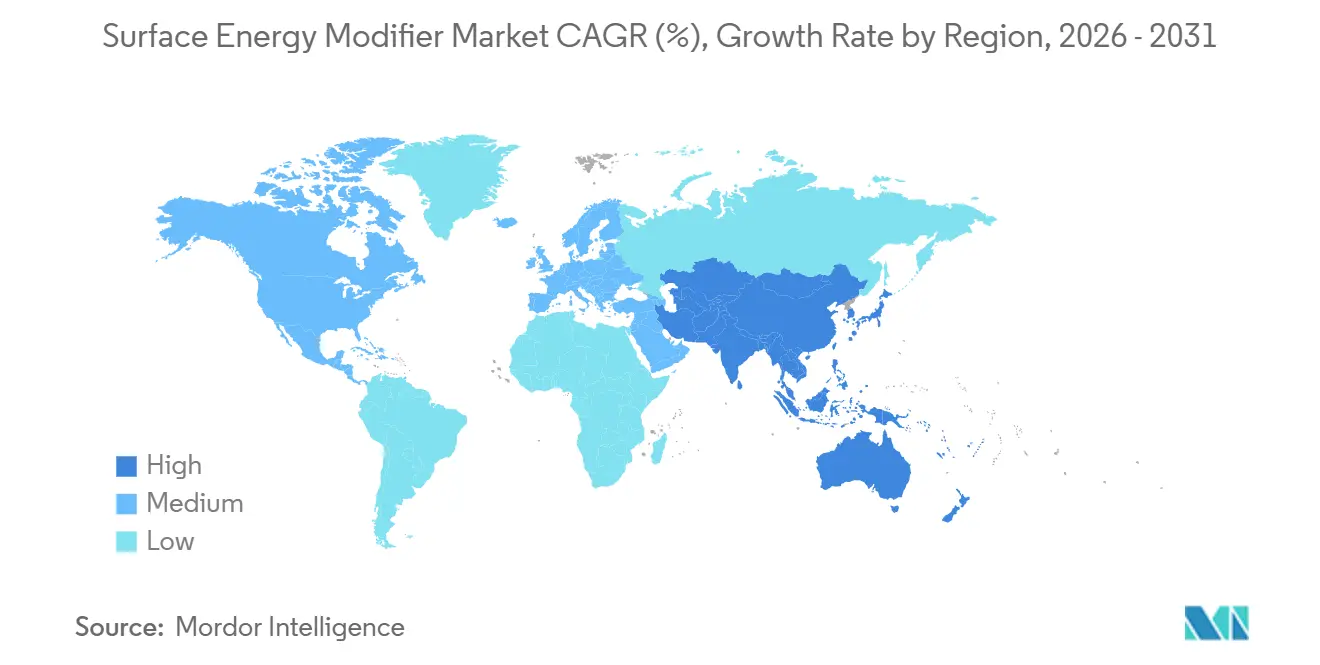
Asia-Pacific held 40.21% of the surface energy modifier market in 2025 and is projected to advance at a 7.63% CAGR through 2031. China drives regional demand through electronics assembly, flexible packaging conversion, and automotive paint activity in the Yangtze River Delta and Pearl River Delta. The Ministry of Ecology and Environment's volatile organic compound standards have supported a shift from solvent-based products toward water-compatible silicone polyethers. Japan and South Korea remain high-specification demand centers for printed circuit board protection and ultraviolet-curing systems, while Japanese automotive original equipment manufacturers require scratch-resistant and hydrophobic clearcoat films. India is the fastest-growing national market in the region, supported by packaging production and automotive manufacturing. Nouryon expanded Levasil colloidal silica capacity in Guangzhou in 2026 after opening its Shanghai innovation center in November 2025, showing how suppliers are increasing manufacturing and technical service coverage in Asia-Pacific.
North America and Europe Surface Energy Modifier Market
In North America, environmental requirements influence the quality and composition of demand. U.S. actions on fluorinated substances and state restrictions have increased co-development work, while automotive original equipment manufacturers have standardized high-performance wetting agents in electrodeposition primer lines. Europe follows a stricter regulatory path, with the European Chemicals Agency reviewing the European Union's per- and polyfluoroalkyl substance restriction proposal. Germany, the United Kingdom, France, and Italy account for much of European coatings additive demand, with Germany’s automotive and industrial machinery base setting important specifications.
South America and MEA Surface Energy Modifier Market
South America is led by Brazil’s automotive assembly, flexible packaging, and architectural coatings demand. Brenntag’s 2025 distribution agreement with Nouryon expanded access to waterborne paint and ink additives in Brazil, while Argentina and the Rest of South America remain more price-sensitive and face supply-chain limitations. The Middle-East and Africa markets are linked to construction and industrial diversification, with Saudi Arabia’s Vision 2030 investments supporting industrial and protective coatings. South Africa adds demand from automotive assembly and flexible packaging, but the region has less technology-led formulation demand than the Asia-Pacific.
Competitive Landscape
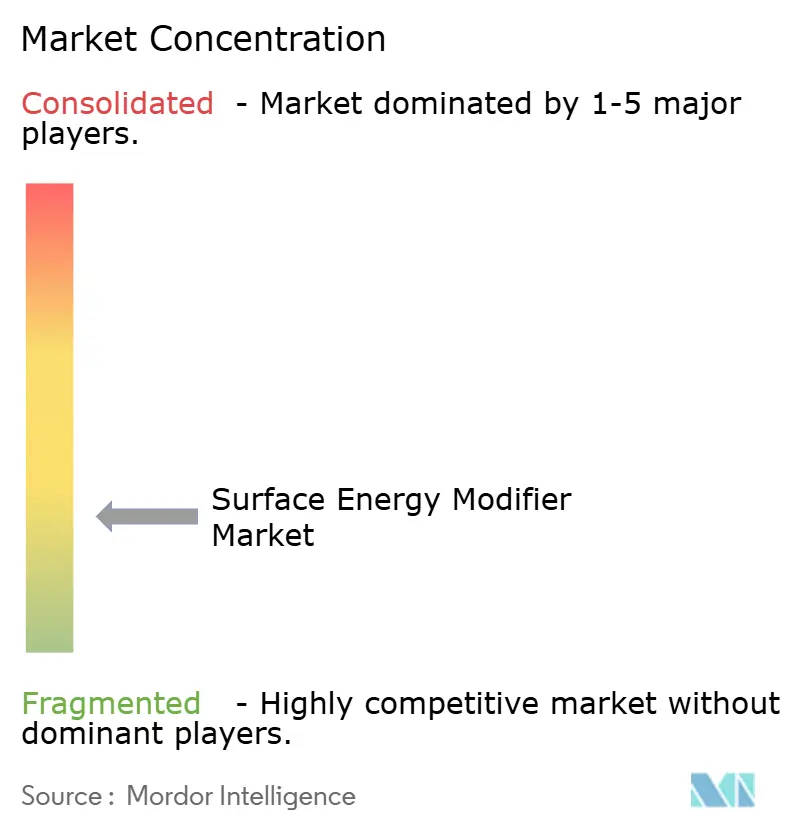
The surface energy modifier market is highly fragmented, with the top five players including ALTANA, Evonik Industries AG, BASF, Dow, and Momentive. Evonik, BASF, Dow, Arkema, Croda, and Clariant lead the high-performance segment through research and development capacity, application laboratories, and long-standing relationships with paint, ink, and adhesive original equipment manufacturers. These relationships make supplier changes harder because customers must validate performance and obtain formal approvals. Michelman, Münzing, and Nouryon operate in a second tier that competes through customized formulations, application expertise, and local service. The competitive focus has shifted from broad portfolios toward regulatory compliance and dependable technical support, favoring suppliers that launched alternatives before customer qualification planning began.
BASF released six per- and polyfluoroalkyl substance alternatives in the Efka SI and Efka FL series in July 2025, strengthening its compliance-focused offering. Evonik used molecular design to differentiate TEGO Wet 288 for stability in high-pH aqueous systems and radiation-curable inks. Arkema announced a proposed divestment of its impact modifier and acrylic copolymer processing-aids businesses to Praana in December 2025, a move that focused the company on higher-margin specialty materials and adhesives. Within the surface energy modifier market, suppliers increasingly need to combine chemistry development with formulation advice as customers change to waterborne and ultraviolet-cure systems.
Elementis completed the acquisition of Alchemy Ingredients for USD 22 million in November 2025, adding natural oil-gelling and water-gelling rheology technologies to its specialty additives platform. The surface energy modifier market has open opportunities in formulation service, particularly where customers in India, Southeast Asia, and Brazil have less application infrastructure. Suppliers with regional laboratories and technical teams can reduce customer qualification time and improve formulation reliability. Lubrizol launched Solsperse 82510 and Solsperse 84510 in July 2026 for complex solvent-borne and titanium dioxide-intensive pigment systems, broadening its position across adjacent additive categories.
Surface Energy Modifier Industry Leaders
-
ALTANA
-
Evonik Industries AG
-
BASF
-
Dow
-
Momentive
- *Disclaimer: Major Players sorted in no particular order
Surface Energy Modifier Market Companies Covered in this Report
- ALTANA
- Arkema
- BASF
- CLARIANT
- Croda International Plc
- Dow
- Eastman Chemical Company
- Elementis PLC
- Evonik Industries AG
- Huntsman Corporation
- Lubrizol
- Michelman, Inc.
- Momentive
- Münzing Corporation
- Nouryon
Recent Industry Developments in Surface Energy Modifier Market
- April 2025: Evonik Industries AG launched TEGO Wet 288, a substrate-wetting additive that reduces surface tension and improves wetting in waterborne and radiation-curing coatings and inks. The product supports applications requiring surface energy and interfacial property control.
- March 2025: Evonik Industries AG launched TEGO Wet 270 eCO, a mass-balanced substrate-wetting agent with more than 40% bio-attributed carbon. The product is designed to provide wetting and crater-prevention performance across waterborne, solventborne, and radiation-curing coatings.
Global Surface Energy Modifier Market Report Scope
Surface energy modifiers are additives used to alter the surface properties of materials, such as wettability, adhesion, spreading, and surface tension. They help improve coating coverage, ink adhesion, bonding performance, and processing characteristics across plastics, metals, glass, composites, and other substrates.
The Surface Energy Modifier Market is segmented by modifier type, substrate, application, and geography. By modifier type, the market is segmented into silicone-based modifiers, fluoropolymer-based modifiers, acrylic-based modifiers, and other modifier types (including polyolefin-based, wax-based, and other surface energy modifiers). By substrate, the market is segmented into plastics and polymers, metals, glass, composites, and other substrates (including paper and paperboard, textiles, and other substrates). By application, the market is segmented into coatings, printing inks, adhesives and sealants, and other applications (including plastic compounding, films and packaging, mold release, and other applications). The report also covers the market size and forecasts for surface energy modifiers in 15 countries across major regions. For each segment, the market sizing and forecasts have been done on the basis of value (USD).
Segmentation Overview
| Silicone-Based Modifiers |
| Fluoropolymer-Based Modifiers |
| Acrylic-Based Modifiers |
| Other Modifier Types (Polyolefin-Based, Wax-Based, Other Surface Energy Modifiers) |
| Plastics and Polymers |
| Metals |
| Glass |
| Composites |
| Other Substrates (Paper and Paperboard, Textiles, Other Substrates) |
| Coatings |
| Printing Inks |
| Adhesives and Sealants |
| Other Applications (Plastic Compounding, Films and Packaging, Mold Release, Other Applications) |
| Asia-Pacific | China |
| India | |
| Japan | |
| South Korea | |
| Rest of Asia-Pacific | |
| North America | United States |
| Canada | |
| Mexico | |
| Europe | Germany |
| United Kingdom | |
| France | |
| Italy | |
| Rest of Europe | |
| South America | Brazil |
| Argentina | |
| Rest of South America | |
| Middle-East and Africa | Saudi Arabia |
| South Africa | |
| Rest of Middle-East and Africa |
| By Modifier Type | Silicone-Based Modifiers | |
| Fluoropolymer-Based Modifiers | ||
| Acrylic-Based Modifiers | ||
| Other Modifier Types (Polyolefin-Based, Wax-Based, Other Surface Energy Modifiers) | ||
| By Substrate | Plastics and Polymers | |
| Metals | ||
| Glass | ||
| Composites | ||
| Other Substrates (Paper and Paperboard, Textiles, Other Substrates) | ||
| By Application | Coatings | |
| Printing Inks | ||
| Adhesives and Sealants | ||
| Other Applications (Plastic Compounding, Films and Packaging, Mold Release, Other Applications) | ||
| By Geography | Asia-Pacific | China |
| India | ||
| Japan | ||
| South Korea | ||
| Rest of Asia-Pacific | ||
| North America | United States | |
| Canada | ||
| Mexico | ||
| Europe | Germany | |
| United Kingdom | ||
| France | ||
| Italy | ||
| Rest of Europe | ||
| South America | Brazil | |
| Argentina | ||
| Rest of South America | ||
| Middle-East and Africa | Saudi Arabia | |
| South Africa | ||
| Rest of Middle-East and Africa | ||
Key Questions Answered in the Report
What is the size of the surface energy modifier market?
The Surface Energy Modifier Market size is expected to grow from USD 1.79 billion in 2025 to USD 1.9 billion in 2026 and is forecast to reach USD 2.59 billion by 2031 at 6.43% CAGR over 2026-2031.
What is driving demand for surface energy modifiers?
Waterborne and low-VOC formulations, fluorine-free reformulation, and growth in packaging, automotive, electronics, and construction support demand.
Which modifier type led revenue in 2025?
Silicone-based modifiers held 38.56% of modifier type revenue in 2025 because they work across waterborne, solvent-borne, and radiation-curable systems.
Which application is expected to grow the fastest through 2031?
Printing inks are projected to advance at a 7.77% CAGR through 2031 as flexible packaging shifts toward waterborne and ultraviolet flexographic printing.