
Superhard Material Market Size and Share
Market Overview
| Study Period | 2021 - 2031 |
|---|---|
| Market Size (2026) | USD 6.78 Billion |
| Market Size (2031) | USD 8.85 Billion |
| Growth Rate (2026 - 2031) | 5.46 % |
| Fastest Growing Market | Asia-Pacific |
| Largest Market | Asia-Pacific |
| Market Concentration | Medium |
Major Players *Disclaimer: Major Players sorted in no particular order Image © Mordor Intelligence. Reuse requires attribution under CC BY 4.0. | |
Superhard Material Market Analysis by Mordor Intelligence
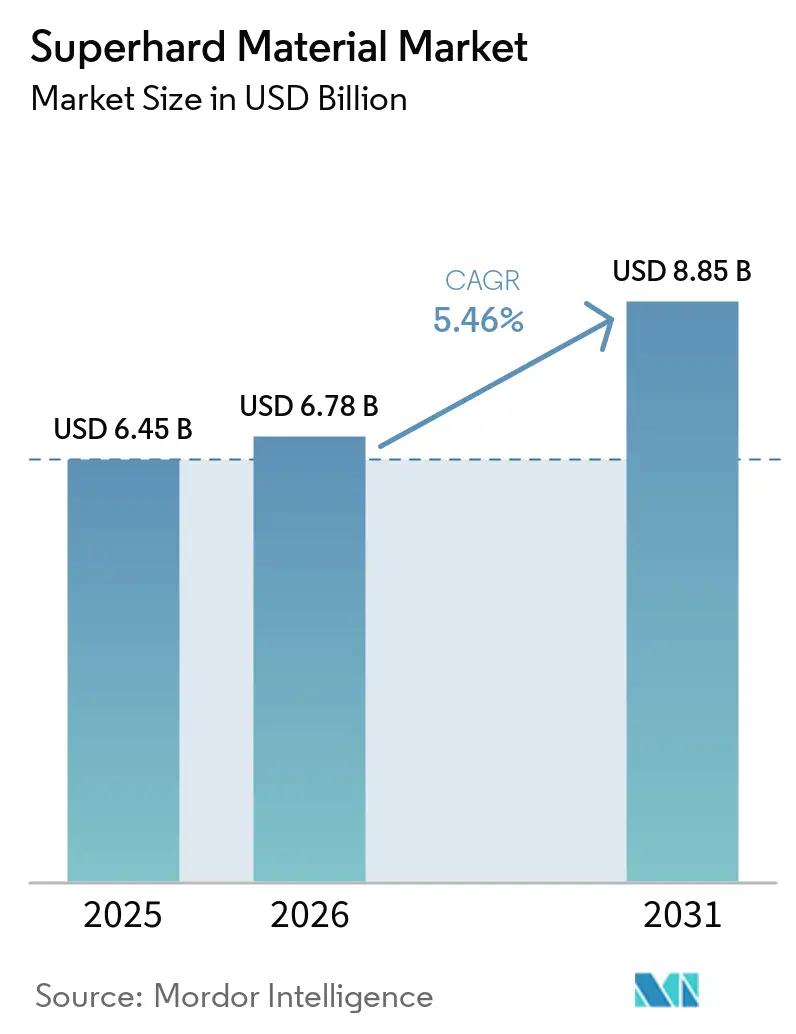
The Superhard material market size was valued at USD 6.45 billion in 2025 and is estimated to grow from USD 6.78 billion in 2026 to reach USD 8.85 billion by 2031, at a CAGR of 5.46% during the forecast period (2026-2031). The superhard material market serves production activities where resistance to wear, heat, and deformation is essential. Precision manufacturing, construction, semiconductor processing, and resource extraction require tools that maintain performance under demanding operating conditions. Once a superhard tool is qualified for production, replacement is difficult, as changes may affect cycle times, component quality, and tool life. This gives suppliers reason to compete on process performance and reliable supply, not only on material price. The superhard material market is also exposed to input and energy costs, particularly in synthetic diamond production.
Key Report Takeaways
- By type, extrinsic superhard materials held 60.12% of the Superhard material market share in 2025, while intrinsic materials are forecast to grow at a 6.24% CAGR through 2031.
- By cover, polycrystalline diamond held 32.46% share in 2025, while polycrystalline cubic boron nitride is forecast to grow at a 6.67% CAGR through 2031.
- By form, polycrystalline materials held 46.04% share in 2025, while composite materials are forecast to grow at a 6.83% CAGR through 2031.
- By application, cutting tools held 42.81% share in 2025, while diamond drill bits are forecast to grow at a 7.07% CAGR through 2031.
- By end-user industry, stone and construction held 29.07% share in 2025, while mining and drilling are forecast to grow at a 7.23% CAGR through 2031.
- By geography, Asia-Pacific held 41.32% of the Superhard material market share in 2025 and is forecast to grow at a 6.46% CAGR through 2031.
Note: Market size and forecast figures in this report are generated using Mordor Intelligence’s proprietary estimation framework, updated with the latest available data and insights as of January 2026.
Market Trends and Insights
Drivers Impact Analysis of Superhard Material Market*
| Drivers | (~) % Impact on CAGR Forecast | Geographic Relevance | Impact Timeline |
|---|---|---|---|
| Precision Machining for Electric Vehicle (EV) Lightweight Components | +1.2% | Global, concentrated in China, Germany, the United States, and South Korea | Medium term (2-4 years) |
| Semiconductor Wafer and Thermal Management Processing | +0.9% | Asia-Pacific core, with spillover to the United States | Long term (≥ 4 years) |
| Reshoring and Automation in High-Value Manufacturing | +0.8% | North America and Europe | Medium term (2-4 years) |
| Infrastructure-Led Diamond Tool Demand in Asia-Pacific | +1.3% | Asia-Pacific core, with spillover to the Middle East and Africa | Short term (≤ 2 years) |
| Longer Tool Life in Difficult-to-Machine Alloys and Composites | +0.7% | Global, with early gains in aerospace and defense clusters in the United States, the United Kingdom, and France | Long term (≥ 4 years) |
| Source: Mordor Intelligence | |||
Precision Machining for EV Lightweight Components
Polycrystalline diamond (PCD) tooling demand is rising as electric vehicle platforms adopt high-silicon aluminum alloys and carbon-fiber-reinforced polymers. Conventional carbide tools wear 10-20 times faster than PCD in these materials. The International Energy Agency recorded 17 million electric vehicle sales in 2024 and expects annual sales to exceed 40 million by 2030. This growth increases the number of aluminum and composite parts that require consistent high-speed machining. The superhard material market benefits from PCD inserts, which enable longer production runs on machining lines designed for these materials. The shift also favors suppliers that can help automotive plants qualify tools for specific grades of aluminum and composite.
Electric vehicles contain 25-30% more aluminum than comparable internal-combustion vehicles, which increases the use of PCD-tipped inserts in high-speed aluminum machining operations. Tool life becomes more important as automated lines reduce tolerance for unplanned tool changes. A longer-lived insert reduces the risk of process interruptions in systems designed to operate continuously. Gigafactory construction adds another source of demand, as reinforced concrete cutting requires diamond saw blades and drill bits. This combination ties the superhard material market to both vehicle production and the industrial buildout supporting electric vehicle manufacturing. It also means that demand for tools can begin before full vehicle output is reached, as construction and equipment installation require cutting and drilling.
Semiconductor Wafer and Thermal Management Processing
Diamond and CBN abrasives are used across semiconductor fabrication for applications ranging from ingot slicing to chemical mechanical polishing and device dicing. Their role becomes more important as substrate materials become harder and more difficult to process. Silicon carbide requires diamond wire saws with controlled grit distribution and reliable electroplating adhesion[1]. These requirements make consistent performance critical in wafer processing. The superhard material market, therefore, has an opportunity in applications where commodity abrasive grades cannot reliably meet process tolerances. Suppliers that understand the full fabrication process can offer more than a basic abrasive product.
Hyperion Materials & Technologies released its Diamond Solutions for Semiconductors guide in July 2026, covering the processing of silicon carbide, gallium nitride, sapphire, and aluminum nitride. The guide reflects the industry's focus on wafer processing as a connected system of tooling. Diamond is also relevant in thermal management applications where high heat transfer is required. The opportunity is linked to advanced substrates and specialized processing rather than standard silicon work alone. This supports demand for higher-value grades, including CVD diamond materials, and increases the importance of application support, quality control, and close collaboration with equipment users.
Reshoring and Automation in High-Value Manufacturing
Reshoring activity increased across the United States and Europe during 2024 and 2025 and continues into 2026 in semiconductor, battery, and defense-related manufacturing. These facilities are built around CNC machining centers, programmable controls, and robotic cells. Automated production places a higher value on stable tool life because an unexpected tool change can interrupt an unattended operation. PCD and PCBN tools are suited to environments where repeatability is more important than the lowest purchase price. The superhard material market benefits when investment moves toward precision plants that require dependable process capability, particularly in applications that demand accurate tolerances and repeatable finishes.
Baucor expanded its United States manufacturing hub in April 2026 to support custom CNC tooling supply chains. This illustrates how local production capacity can reinforce tooling demand close to end users. Mechanical engineering and electronics remain relevant categories for European manufacturing investment, and both use materials and parts that can require PCD or PCBN tooling. A localized supply chain can also shorten the time needed to test and qualify a tool for a new component. This favors suppliers with technical service capabilities, manufacturing access, and the ability to meet customer-specific requirements.
Infrastructure-Led Diamond Tool Demand in Asia-Pacific
Construction and infrastructure activity in China and India account for a large share of demand for diamond tools. Diamond blades, saws, and drill bits are used in stone processing, reinforced concrete work, and civil construction. These applications create demand that is separate from advanced manufacturing uses. The superhard material market benefits when infrastructure projects require repeated cutting and drilling across extended project schedules. ASEAN economies, including Vietnam, Indonesia, and Thailand, are adding to construction demand as urban infrastructure expands, creating a broad base of use cases for high-volume diamond tooling.
Construction and stone processing are important consuming segments in China. In India, demand is linked to the Housing for All initiative and highway development programs. Large projects tend to favor suppliers that offer reliable product availability and distribution coverage. Demand in this segment is more sensitive to project timing and construction activity than semiconductor tooling demand. Nevertheless, it provides an important outlet for diamond blades and discs. The superhard material market can serve both construction applications and specialized industrial cutting, although the purchase criteria for each differ.
Restraints Impact Analysis of Superhard Material Market*
| Restraints | (~) % Impact on CAGR Forecast | Geographic Relevance | Impact Timeline |
|---|---|---|---|
| Energy-Intensive High-Pressure High-Temperature (HPHT) and Chemical Vapor Deposition (CVD) Production | -0.8% | Global, most acute in China and India | Medium term (2-4 years) |
| Diamond Reactivity with Ferrous Materials and Thermal Limits | -0.6% | Global | Long term (≥ 4 years) |
| Cobalt, Graphite, and Boron Feedstock Volatility | -0.5% | Global, concentrated in China and the Democratic Republic of the Congo, linked supply chains | Short term (≤ 2 years) |
| Source: Mordor Intelligence | |||
Energy-Intensive HPHT and CVD Production
HPHT synthesis requires sustained pressures of 5-8 GPa and temperatures of 1,300-1,600°C. Energy use ranges from 36 kWh per carat for open-circuit cooled presses to up to 72 kWh per carat when chilling infrastructure is included. CVD synthesis for specialty diamond grades also carries substantial energy requirements. Energy accounts for a significant share of production costs, particularly for presses and reactors that must operate continuously. The superhard material market is exposed to local power tariffs and the availability of lower-cost electricity. Cost pressure is especially relevant for producers serving price-sensitive abrasive grades.
Continuous thermal operations limit producers' ability to shift work solely to off-peak electricity hours, making tariff changes more consequential for facilities running HPHT presses at scale. Environmental management requirements can add further costs for export-focused producers. Access to renewable electricity may help reduce this exposure, but it does not eliminate the technical need for energy-intensive production. Higher energy costs can compress margins when tool and grit prices cannot adjust at the same pace. Production efficiency and access to electricity remain important operating considerations for the superhard material market. This cost issue applies across basic abrasive output and specialty material production, though the ability to recover costs differs between the two.
Diamond Reactivity with Ferrous Materials and Thermal Limits
Diamond becomes chemically unstable in contact with iron-group metals at temperatures above 700-800°C, which limits the use of PCD in steel machining, a major segment of metalworking. PCD remains more suitable for non-ferrous materials, abrasive composites, and engineered wood. PCBN plays an important role in steel and cast-iron machining, but the two materials are not interchangeable. The superhard material market must address the machining landscape with distinct product families, as no supplier can rely on a PCD line alone to meet the full range of metal-cutting requirements.
Published testing of PCBN tools with cermet binders for ductile iron machining found that tool performance can be optimized at a machining efficiency of 15.04 cm³/min[2]. Research also shows that thermochemical lubricants can extend diamond turning in silicon carbide applications. These approaches are useful for specific processes rather than as broad solutions for ferrous cutting. The thermal and chemical limits remain a durable constraint on PCD adoption in steelwork and explain why PCBN remains important for hardened steel, cast iron, and selected high-temperature applications. Product selection in the superhard material market must remain tied to the workpiece material and operating temperature.
*Our forecasts treat driver/restraint impacts as directional, not additive. The impact forecasts reflect baseline growth, mix effects, and variable interactions.
Superhard Material Market Segment Analysis
By Type:
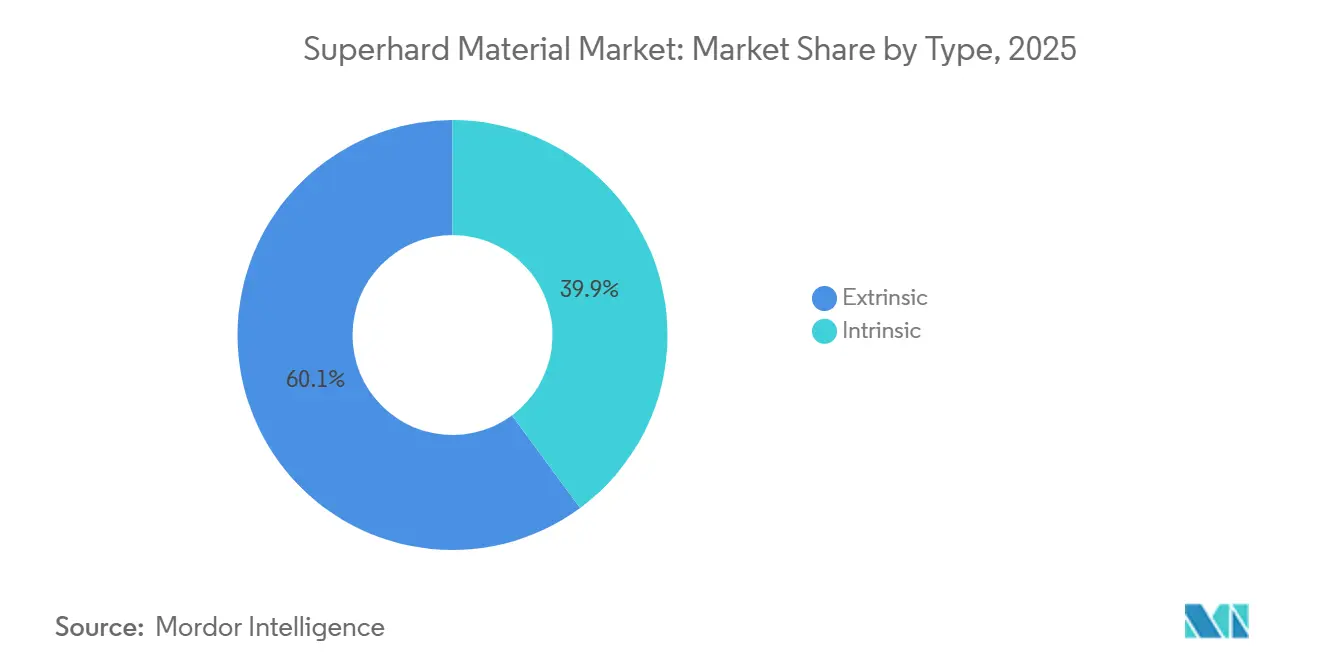
Extrinsic Materials Lead Share, While Intrinsic Materials Serve Premium ApplicationsExtrinsic superhard materials accounted for 60.12% of the superhard materials market share in 2025. HPHT and CVD synthetic production routes support their broad use in abrasive and tooling applications. These materials meet the needs of high-output operations that require consistent grades and repeatable production. The segment is closely tied to the output of synthetic diamond and cubic boron nitride, and its scale makes it relevant for cutting, grinding, drilling, and construction tools. Price pressure exists where high-output abrasive supply exceeds demand, placing a premium on converting material into higher-value products rather than on the sale of basic grit alone.
Intrinsic superhard materials are forecast to grow at a 6.24% CAGR through 2031. This category includes natural diamond single crystals and CVD substrates whose hardness derives from their crystallographic structure. Growth in this segment reflects use in quantum sensing, power semiconductor substrates, ultra-precision optics, and other specialized applications. These uses require controlled material quality and command a higher per-unit value than commodity grit. In June 2026, Element Six and Orbray announced a reproducible process for 3-inch wafer-scale single-crystal diamond, with 4-inch development underway at Element Six's CVD facility in Gresham, Oregon. This announcement highlights the importance of wafer-scale material production for the superhard materials market and illustrates the effort required to move specialty diamond from laboratory-scale capability to dependable, large-scale production. The gap between commodity output and the value available from downstream polycrystalline diamond compact (PDC) composites keeps specialty substrates distinct from the high-output abrasive business. The choice of material type, therefore, affects both technical performance and supplier economics.
By Cover:
PCD Holds the Largest Position While PCBN Addresses Ferrous MachiningPCD held 32.46% of the superhard material market share among cover types in 2025. It is used where wear resistance is required in non-ferrous metals, abrasive composites, and engineered wood. Electric vehicle production supports PCD demand, as aluminum machining is a key application. Its performance in these materials supports consistent machining and longer tool life. PCD is not suited to every metalworking process, as ferrous workpieces present chemical and thermal limitations, leaving its position strong but clearly defined by the material being machined.
PCBN is forecast to grow at a 6.67% CAGR through 2031. Its growth is linked to machining applications involving hardened steel, cast iron, and nickel superalloys that PCD cannot broadly serve. CBN grinding wheels are relevant to brake-rotor finishing and crankshaft machining in automotive production. Sumitomo Electric launched the coated SUMIBORON BNC2135 PCBN grade in January 2025 for interrupted machining of hardened steel, and in April 2026, it launched a binderless end mill featuring ultra-fine CBN grains for precision mold finishing. These launches reflect ongoing product development in grades designed for difficult ferrous and precision-finishing work. The superhard material market requires both PCD and PCBN because their strengths are complementary rather than interchangeable. Diamond materials also serve a specialized purpose in semiconductor polishing compounds and slurry formulations, where controlled abrasive behavior is more important than bulk hardness alone. Cover selection remains linked to machining conditions and the desired surface result.
By Form:
Polycrystalline Materials Lead Value While Composites Support DrillingPolycrystalline materials held a 46.04% value share in 2025. Mature High-Pressure High-Temperature (HPHT) sintering processes support consistent grain-size distributions for high-scale production. This form is used when producers require commercially viable manufacturing with repeatable quality, and it provides a broad base for many cutting and abrasive applications. Its established production route supports its position in the superhard material market, and it remains important where buyers need tools that combine proven performance with reliable availability.
Composite materials are forecast to grow at a 6.83% CAGR through 2031. Polycrystalline Diamond Compact (PDC) drill-bit cutters bond a diamond table to a tungsten-carbide substrate, combining abrasive-formation cutting performance with resistance to drill-string vibration. Growth is driven by directional-drilling requirements in deep wells, where the bond quality between diamond and substrate influences operational uptime during a drill run. Composite designs are valued for addressing the hardness-toughness trade-off. Their growth indicates that the superhard material market increasingly values forms engineered for specific operating environments.
By Application:
Cutting Tools Lead Demand While Diamond Drill Bits Grow FasterCutting tools accounted for 42.81% of the superhard material market share in 2025. The application spans automotive, aerospace, electronics, and general engineering, drawing demand from both routine machining and high-precision work. Polycrystalline Diamond (PCD) supports aluminum and composite machining, while Polycrystalline Cubic Boron Nitride (PCBN) supports steel and cast iron machining. This range gives cutting tools a broad manufacturing base and makes their application less dependent on any single end-use cycle than that of drilling tools.
Diamond drill bits are forecast to grow at a 7.07% CAGR through 2031. Growth is driven by critical-mineral exploration and recovered oil and gas capital expenditure across Australia, Canada, Africa, and Latin America. Demand for drill bits is tied to resource projects and is therefore sensitive to commodity prices and exploration budgets. Epiroc launched next-generation PCD drill bits for abrasive-ground surface mining in November 2025, with stated objectives of longer service life and lower cost per meter, highlighting competition around drilling performance rather than initial tool price alone. The superhard material market serves this application through engineered products designed to withstand harsh formations and repeated impacts. Saw blades and diamond discs serve stone and construction applications, with support from Asia-Pacific infrastructure programs. Shipbuilding is another specialized area where diamond abrasives are used for hull surface preparation and machining of composite materials. Construction tooling can have higher output requirements, while drilling products have more direct exposure to the resource cycle. Cutting tools provide a comparatively resilient link to broad manufacturing output, while diamond drill bits provide a stronger link to exploration and project activity. Together, these applications give the superhard material market a mix of industrial demand patterns.
By End-User Industry:
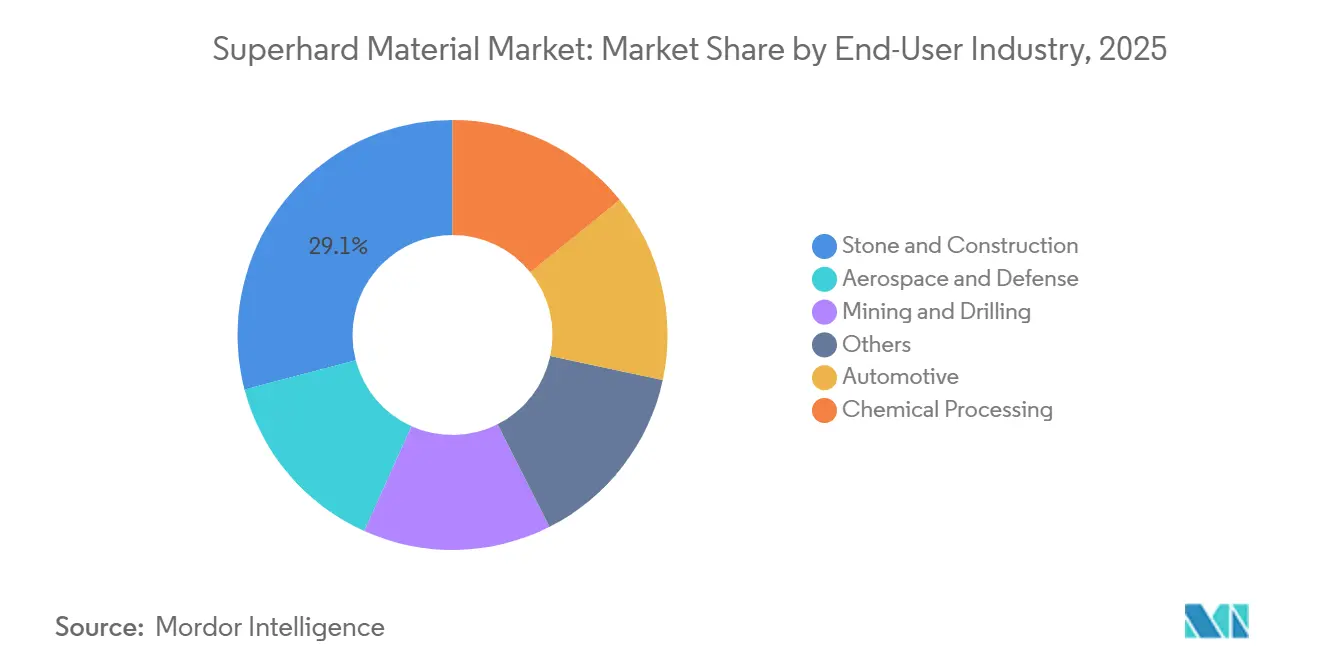
Stone and Construction Lead Share While Mining and Drilling Grow FasterStone and construction accounted for 29.07% of the superhard material market share in 2025. The segment is supported by construction activity in the Asia-Pacific region and by diamond blade use in large civil projects, including China's rail, metro, and urban development programs. Stone processing also requires consistent cutting tools across a large quantity of material, creating a sizable user base for blades, discs, and drilling equipment. The segment reflects the importance of infrastructure spending to the overall superhard material market.
Mining and drilling are forecast to expand at a 7.23% CAGR through 2031. Critical-mineral extraction programs in Australia, Canada, Africa, and Latin America support the segment's growth outlook, and recovered oilfield capital expenditure also contributes to demand for drilling products. The segment was affected by lower exploration budgets in 2020 and 2021, making current growth partly a recovery from a reduced base and partly a response to mineral demand. The superhard material market benefits when drilling programs require durable cutters capable of operating in abrasive and difficult formations. Automotive remains the second-largest end-user vertical, using PCBN for conventional powertrain steel machining and PCD for electric-vehicle aluminum applications. Aerospace and defense demand premium grades where inconsistent tool edges can affect titanium and nickel superalloy machining. Kennametal reported fiscal 2026 revenue of USD 2.357 billion, with organic growth of 20%, and highlighted wins in aerospace and defense as well as earthworks. This result illustrates demand across several end-user settings rather than a single application and reinforces the importance of premium tooling where performance consistency is critical.

Geography Analysis
APAC Superhard Material Market
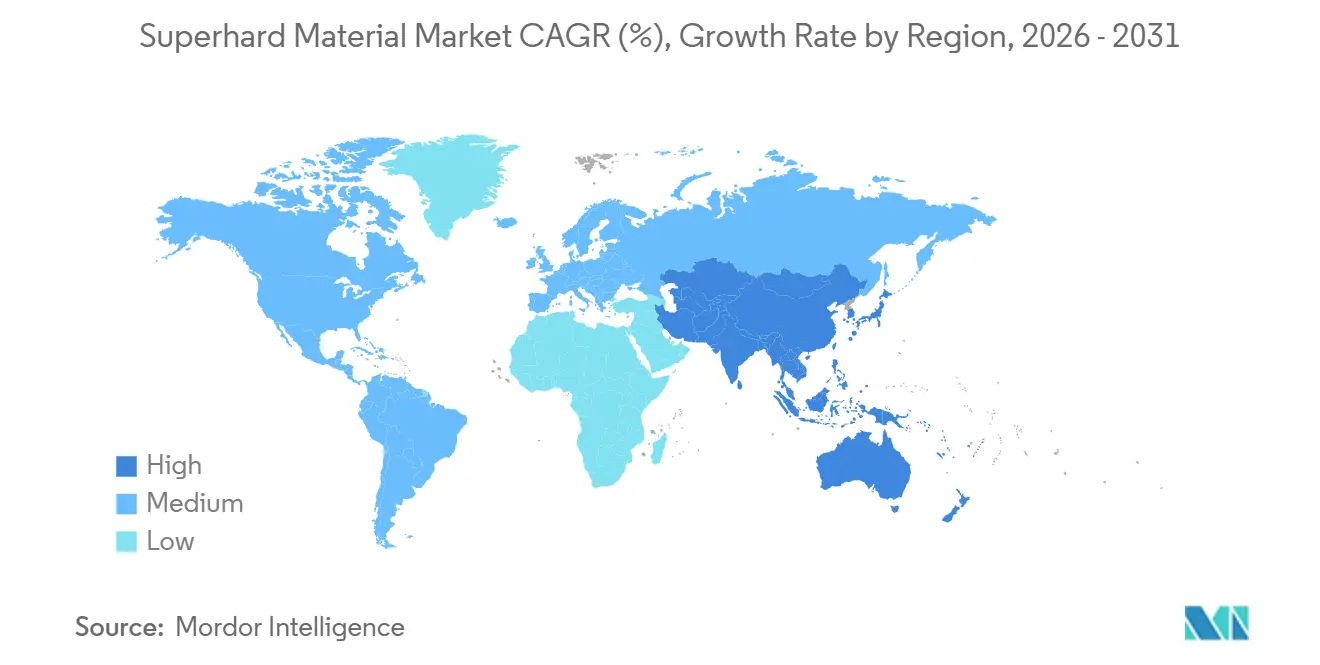
Asia-Pacific accounted for 41.32% of the superhard material market in 2025 and is forecast to grow at a 6.46% CAGR through 2031. The region serves as both a major production base and the largest source of demand. China drives high synthetic diamond and construction-tool activity. Japan and South Korea focus on high-value PCBN and monocrystalline tools for semiconductor applications. This creates distinct regional positions within the same supply chain. Asia-Pacific's scale significantly influences prices, production availability, and end-user demand across the superhard material market. China's construction activity and industrial base support a broad demand for diamond tools. Japan and South Korea have greater exposure to semiconductor tooling and specialized precision manufacturing. These markets are less dependent on commodity grit pricing, as their applications require controlled material quality and process knowledge. The region also benefits from infrastructure demand in India and expanding urban development in ASEAN economies, which support demand for blades, saws, drill bits, and industrial tooling. Asia-Pacific therefore combines large-scale demand with specialized semiconductor and precision manufacturing applications.
North America and Europe Superhard Material Market
North America and Europe represent a technology-intensive counterpart to Asia-Pacific's position. North America is supported by aerospace and defense machining, oil and gas drill-bit procurement, and investment in semiconductor fabrication. US fabrication investment drives demand for advanced diamond abrasives used in polishing and dicing. Reshoring further supports demand for precision tooling in battery, defense, and electronics manufacturing. Europe benefits from Germany's automotive machining base, Nordic mining-equipment production, and aerospace activity in France, the United Kingdom, and Italy. These regions favor grades that meet tight machining and finishing requirements.
MEA and South America Superhard Material Market
South America and the Middle East and Africa are import-dependent regions that offer demand growth linked to mining and infrastructure. Brazil and Argentina hold copper, lithium, and iron ore deposits that require diamond drill bits. South Africa's platinum-group metals and gold mining support specialized drilling demand. Saudi Arabia, the United Arab Emirates, and Egypt generate construction-tool demand through civil engineering and infrastructure activity. These areas present expansion opportunities for manufacturers that establish local distribution and application support, with both Asian suppliers and European premium producers as potential participants. Demand patterns in these regions remain tied to project timing, commodity cycles, and access to local supply.
Competitive Landscape
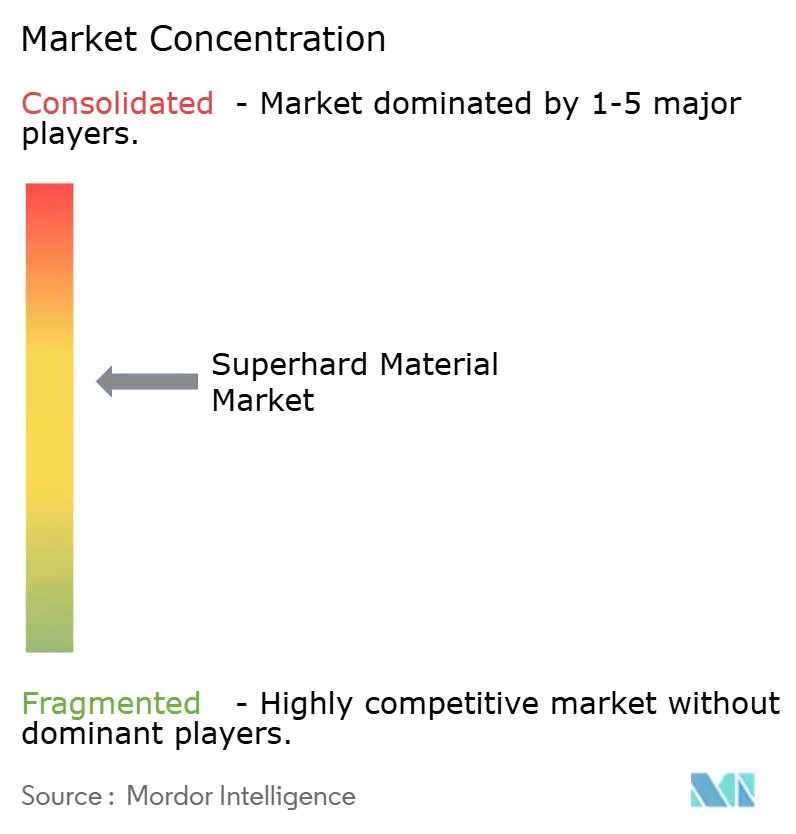
The superhard material market is moderately consolidated. High-volume synthetic diamond production is more price-sensitive, whereas engineered tools compete on application performance and technical expertise. Chinese grit producers include Zhengzhou Sino-Crystal Diamond, Zhongnan Diamond, SF Diamond, and Henan Huanghe Whirlwind. Precision-tool participants include Element Six, Hyperion Materials & Technologies, Sandvik, Sumitomo Electric, ILJIN Diamond, and Kennametal. These companies address different points of the value chain, and their strategies reflect the distinction between feedstock quantity and application-specific tool performance. At the finished-tool level, suppliers can differentiate through grain-size control, tool geometry, coating design, and process support for customers. This is especially relevant in semiconductor, aerospace, automotive, and drilling applications. As a result, competitive outcomes are not determined by raw material price alone. The superhard material market includes both price-led and technology-led competition.
Sandvik's April 2026 acquisition of K&Y Diamond illustrates investment in ultra-precision diamond tool capability. Hyperion Materials & Technologies completed its acquisition of Manar Tools in July 2026 to expand its precision-tooling presence in India and announced the acquisition of Electronica Tungsten in March 2026. These actions focus on application expertise, manufacturing capability, and geographic coverage, indicating that expansion can be pursued through both acquisitions and internal product development. They also demonstrate why local production and specialized tool knowledge matter in the superhard material market.
Semiconductor-grade Chemical Vapor Deposition (CVD) diamond remains an area where current wafer supply is limited in size, restricting immediate availability for larger power-electronics and AI-chip thermal-management applications. Element Six's partnership with Orbray addresses wafer-scale single-crystal diamond production. Discussions between Japan and the United States on synthetic diamond production reflect supply-chain interest and support a strategic focus on premium synthesis capacity outside China. Suppliers that can produce and qualify larger wafers could strengthen their position in this specialized segment of the superhard material market.
Superhard Material Industry Leaders
-
Element Six UK Ltd.
-
Sandvik AB
-
ILJIN DIAMOND CO., LTD.
-
Zhongnan Diamond Co., Ltd.
-
Henan Huanghe Whirlwind CO.,Ltd.
- *Disclaimer: Major Players sorted in no particular order
Superhard Material Market Companies Covered in this Report
- Asahi Diamond Industrial Co., Ltd.
- CERATIZIT S.A.
- Element Six UK Ltd.
- Henan Huanghe Whirlwind CO.,Ltd.
- Hyperion Materials & Technologies
- ILJIN DIAMOND CO., LTD.
- Kennametal Inc.
- Saint-Gobain
- Sandvik AB
- SF DIAMOND CO., LTD.
- Sumitomo Electric Industries, Ltd.
- Tomei Diamond Co.,Ltd.
- Tyrolit Group
- Zhengzhou Sino-Crystal Diamond Co., Ltd.
- Zhongnan Diamond Co., Ltd.
Recent Industry Developments in Superhard Material Market
- July 2026: Hyperion Materials & Technologies completed the acquisition of Manar Tools (Pune, India), a manufacturer of Polycrystalline Diamond (PCD) rotary tools, inserts, and gun drills, expanding its precision tooling presence in India's automotive and aerospace machining market.
- July 2026: Asahi Diamond Industrial commenced sales of ISO 9001-certified hub blades from its AA Diamond Technology joint venture with Tokyo Seimitsu, targeting advanced semiconductor device dicing applications for generative AI chips.
Global Superhard Material Market Report Scope
A superhard material is a solid substance with a Vickers hardness value exceeding 40 gigapascals (GPa), making it resistant to scratching, compression, and permanent deformation. These materials, such as diamond and cubic boron nitride, derive their extreme strength from dense, highly directional covalent bonds. Due to their durability and heat tolerance, they are widely used in heavy industry for cutting, drilling, and wear-resistant coatings.
The superhard material market is segmented by type, cover, form, application, end-user industry, and geography. By type, the market is segmented into intrinsic and extrinsic. By cover, the market is segmented into polycrystalline diamond (PCD), polycrystalline cubic boron nitride (PCBN), cubic boron nitride (CBN), and micron diamond. By form, the market is segmented into polycrystalline, composite, and monocrystalline. By application, the market is segmented into cutting tools, diamond drill bits, shipbuilding, saw blades, diamond discs, and others. By end-user industry, the market is segmented into automotive, stone and construction, chemical processing, aerospace and defense, mining and drilling, and others. The report also covers market size and forecasts for the superhard material across 15 countries in major regions. The market sizes and forecasts are provided in terms of value (USD).
Segmentation Overview
| Intrinsic |
| Extrinsic |
| Polycrystalline Diamond (PCD) |
| Polycrystalline Cubic Boron Nitride (PCBN) |
| Cubic Boron Nitride (CBN) |
| Micron Diamond |
| Polycrystalline |
| Composite |
| Monocrystalline |
| Cutting Tools |
| Diamond Drill Bits |
| Shipbuilding |
| Saw Blades |
| Diamond Discs |
| Others |
| Automotive |
| Stone and Construction |
| Chemical Processing |
| Aerospace and Defense |
| Mining and Drilling |
| Others |
| Asia-Pacific | China |
| India | |
| Japan | |
| South Korea | |
| ASEAN Countries | |
| Rest of Asia-Pacific | |
| North America | United States |
| Canada | |
| Mexico | |
| Europe | Germany |
| United Kingdom | |
| France | |
| Italy | |
| NORDIC Countries | |
| Rest of Europe | |
| South America | Brazil |
| Argentina | |
| Rest of South America | |
| Middle East and Africa | Saudi Arabia |
| South Africa | |
| Rest of Middle East and Africa |
| By Type | Intrinsic | |
| Extrinsic | ||
| By Cover | Polycrystalline Diamond (PCD) | |
| Polycrystalline Cubic Boron Nitride (PCBN) | ||
| Cubic Boron Nitride (CBN) | ||
| Micron Diamond | ||
| By Form | Polycrystalline | |
| Composite | ||
| Monocrystalline | ||
| By Application | Cutting Tools | |
| Diamond Drill Bits | ||
| Shipbuilding | ||
| Saw Blades | ||
| Diamond Discs | ||
| Others | ||
| By End-User Industry | Automotive | |
| Stone and Construction | ||
| Chemical Processing | ||
| Aerospace and Defense | ||
| Mining and Drilling | ||
| Others | ||
| By Geography | Asia-Pacific | China |
| India | ||
| Japan | ||
| South Korea | ||
| ASEAN Countries | ||
| Rest of Asia-Pacific | ||
| North America | United States | |
| Canada | ||
| Mexico | ||
| Europe | Germany | |
| United Kingdom | ||
| France | ||
| Italy | ||
| NORDIC Countries | ||
| Rest of Europe | ||
| South America | Brazil | |
| Argentina | ||
| Rest of South America | ||
| Middle East and Africa | Saudi Arabia | |
| South Africa | ||
| Rest of Middle East and Africa | ||
Key Questions Answered in the Report
What is current market size of Superhard Material Market?
The Superhard material market size was valued at USD 6.45 billion in 2025 and is estimated to grow from USD 6.78 billion in 2026 to reach USD 8.85 billion by 2031, at a CAGR of 5.46% during the forecast period (2026-2031).
Which superhard material type is growing fastest?
Intrinsic materials are forecast to grow at a 6.24% CAGR through 2031, supported by specialty uses in semiconductor substrates, quantum sensing, and ultra-precision optics.
Why are PCD and PCBN used in different machining applications?
PCD is well-suited to non-ferrous metals and abrasive composites, while PCBN is used in hardened steel, cast iron, and nickel alloy operations where diamond faces thermal and chemical limits.
Which application has the strongest growth outlook?
Diamond drill bits are forecast to grow at a 7.07% CAGR through 2031, supported by critical-mineral exploration and oil and gas drilling activity.