
Sulfur Dust Market Size and Share
Market Overview
| Study Period | 2022 - 2032 |
|---|---|
| Market Size (2027) | USD 1.37 Billion |
| Market Size (2032) | USD 1.54 Billion |
| Growth Rate (2027 - 2032) | 2.36 % |
| Fastest Growing Market | Asia-Pacific |
| Largest Market | Asia-Pacific |
| Market Concentration | Low |
Major Players *Disclaimer: Major Players sorted in no particular order Image © Mordor Intelligence. Reuse requires attribution under CC BY 4.0. | |
Sulfur Dust Market Analysis by Mordor Intelligence
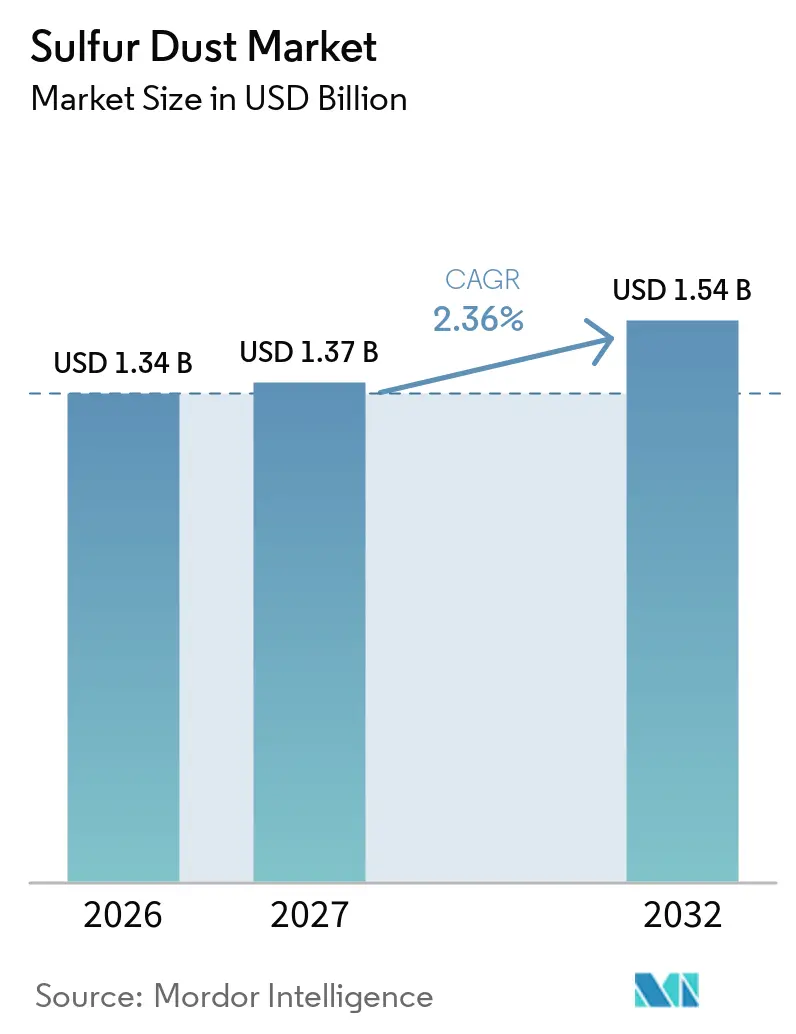
The Sulfur Dust Market size was valued at USD 1.34 billion in 2026 and is estimated to grow from USD 1.37 billion in 2027 to reach USD 1.54 billion by 2032, at a CAGR of 2.36% during the forecast period (2027-2032). The sulfur dust market is supported by the correction of soil sulfur deficiency in agricultural regions and by continued use in crop protection, fertilizers, rubber, and chemical processing. Agricultural demand provides a more stable base than short-cycle industrial buying because nutrient restoration programs usually extend over several growing seasons. Suppliers are placing more value on micronized, dispersible, and low-dust products as users seek easier handling and more consistent field application. Feedstock availability from refining and gas processing supports supply, but price changes can pressure processors that buy elemental sulfur without long-term supply arrangements.
Key Report Takeaways
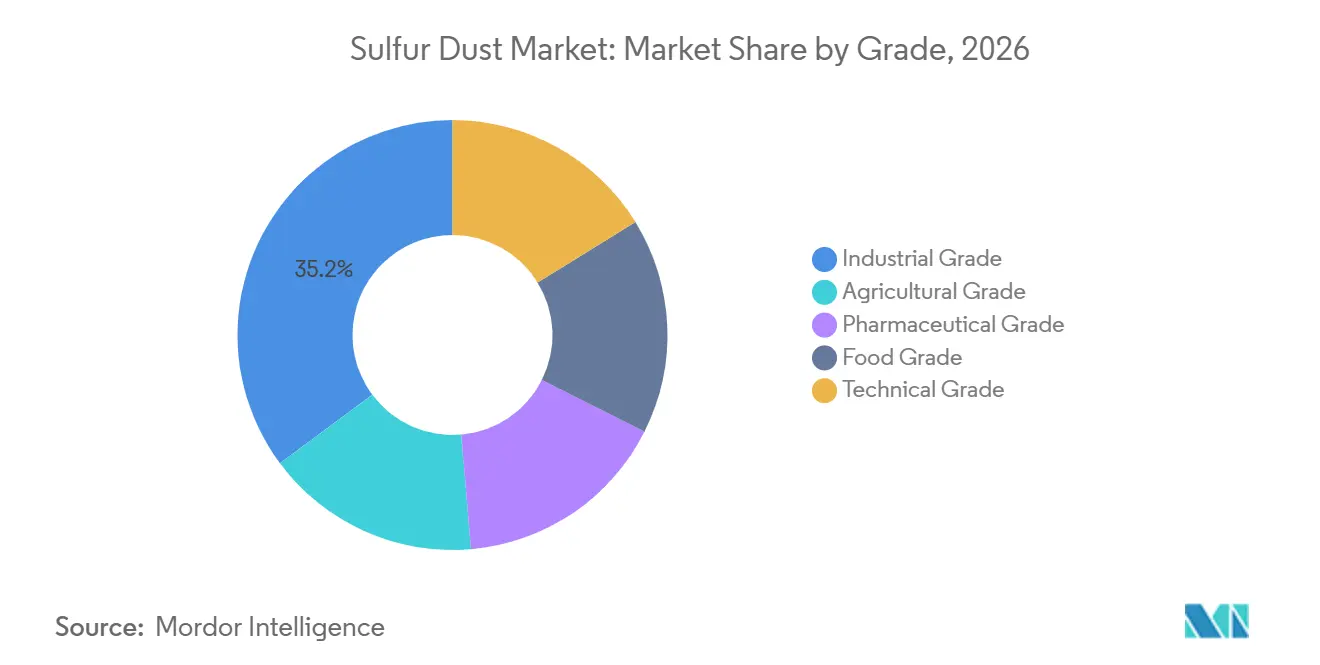
- By grade, industrial grade held 35.17% of the sulfur dust market share in 2026, while pharmaceutical grade is forecast to advance at a 2.78% CAGR through 2032.
- By form, powder held 54.83% of the sulfur dust market share in 2026 and is forecast to advance at a 2.86% CAGR through 2032.
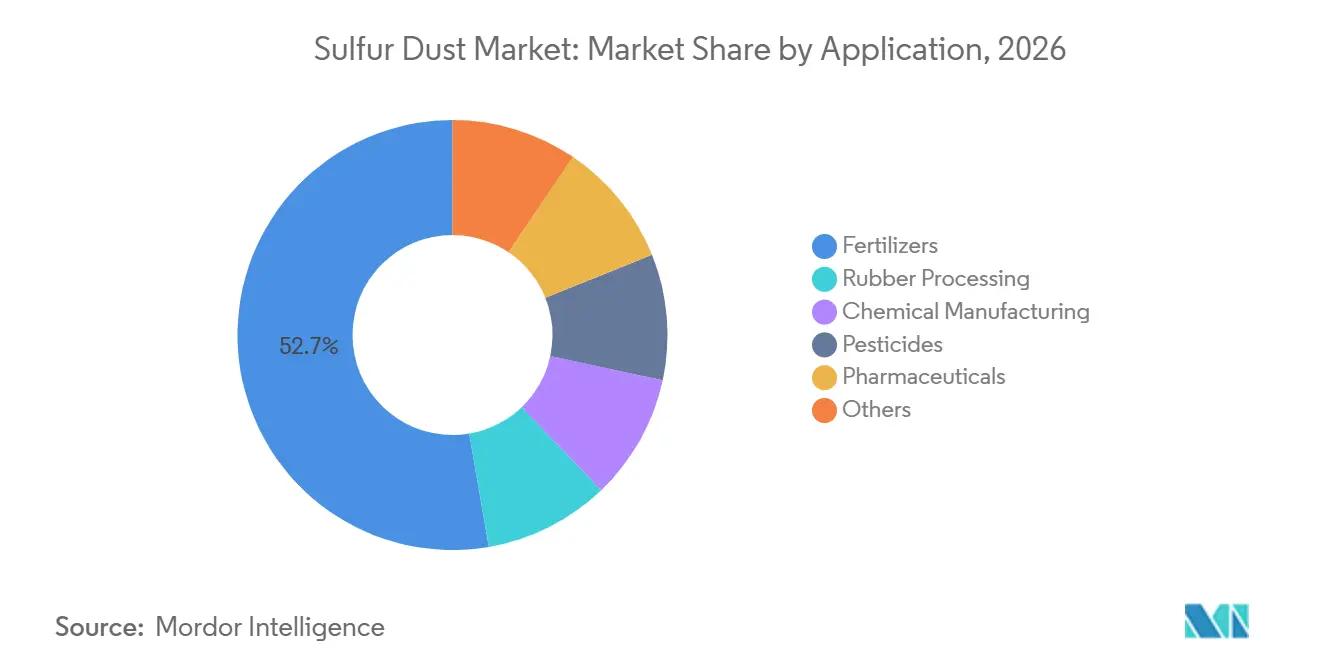
- By application, fertilizers held 52.69% of the sulfur dust market share in 2026, while pharmaceuticals are forecast to advance at a 3.19% CAGR through 2032.
- By geography, Asia-Pacific held 38.04% of the sulfur dust market share in 2026 and is forecast to advance at a 3.03% CAGR through 2032.
Note: Market numbers in this report are based on Mordor Intelligence's proprietary estimation framework, which combines nine months of actuals with Q4 projections for base year 2026.
Market Trends and Insights
Drivers Impact Analysis of Sulfur Dust Market*
| Driver | (~) % Impact on CAGR Forecast | Geographic Relevance | Impact Timeline |
|---|---|---|---|
| Expansion of Sulfur Fertilizer and Soil-Amendment Use | +1.0% | Global, with peak demand in APAC and South America | Long term (≥ 4 years) |
| Growth in Sulfur-Intensive Crop Production and Soil Sulfur Deficiency Correction | +0.6% | APAC core, spillover to South America and MEA | Long term (≥ 4 years) |
| Rising Demand for Micronized, Low-Dust Crop-Protection Formulations | +0.4% | North America & EU, expanding to APAC | Medium term (2-4 years) |
| Recovered Sulfur Availability from Refining and Gas Processing | +0.3% | Global, particularly Middle East and North America | Short term (≤ 2 years) |
| Demand for High-Purity and Custom Particle-Size Sulfur | +0.2% | North America & EU, APAC core | Medium term (2-4 years) |
| Source: Mordor Intelligence | |||
Expansion of Sulfur Fertilizer and Soil-Amendment Use
The sulfur dust market benefits from fertilizer programs designed to correct soil nutrient depletion. A 2025 review reported sulfur deficiency across 41% of India’s geographic area. This condition encourages fertilizer producers to include elemental sulfur in new nutrient blends. Grupa Azoty S.A. began producing POLIFOSKA Multi S, which contains 23% sulfur, at its Police plant in February 2025. The company also launched RSMS BioShot N(S) 26-3 in August 2025, a Urea Ammonium Nitrate (UAN) solution containing sulfur and organic sugars. Demand is therefore linked to longer soil restoration cycles rather than only to annual fertilizer purchases.
Growth in Sulfur-Intensive Crop Production and Soil Sulfur Deficiency Correction
Oilseeds, pulses, and sugarcane need sulfur in meaningful quantities, which links crop choices to demand in the sulfur dust market and keeps agricultural buying tied to cropping decisions. A 2025 study found that 70% of surveyed sugarcane soils in Odisha were sulfur-deficient, including 29.5% classified as acutely deficient. A 2025 rice-groundnut trial found that applying 40 kg of sulfur per hectare as bentonite sulfur produced a maximum system yield of 11.21 metric tons per hectare. These results give growers a practical reason to adopt sulfur-containing inputs where field conditions are limiting yields. Tessenderlo Kerley reported in 2025 that its thiosulfate fertilizers can supply sulfur while inhibiting soil nitrification. That dual function can strengthen adoption in precision nutrient programs.
Rising Demand for Micronized, Low-Dust Crop-Protection Formulations
The sulfur dust market is increasingly shaped by products that improve application control and reduce dust exposure. Micronized sulfur grades can support more even crop coverage, especially in foliar uses. Jaishil Sulphur & Chemical Industries markets Hariyali DF, an 80% elemental sulfur dispersible granule, for agricultural uses. The company describes a manufacturing capacity exceeding 50,000 metric tons per year. Sulfinova AS began construction of a new factory in the Aliaga Organized Industrial Zone in May 2025 to produce micronized sulfur for agriculture, rubber, and chemical applications. These investments shift competition toward particle consistency, field performance, and safer packaged formats.
Recovered Sulfur Availability from Refining and Gas Processing
Recovered sulfur from refining and gas processing provides the principal feedstock base for the sulfur dust market. The Mosaic Company reported that it purchased 2.9 million long tons of sulfur in 2025, with most supply coming from North American oil and gas refiners. Refiners remove sulfur to meet fuel-quality requirements, which can make the supply less responsive to sulfur prices than demand is. H.J. Baker distributes solid sulfur from multiple origins and uses storage and logistics facilities across major export corridors. This infrastructure can help buyers manage regional disruptions and timing differences between supply and demand. Changes in refinery throughput can still create uncertainty for processors that depend on merchant sulfur.
Restraints Impact Analysis of Sulfur Dust Market*
| Restraint | (~) % Impact on CAGR Forecast | Geographic Relevance | Impact Timeline |
|---|---|---|---|
| Dust Explosion, Fire, and Occupational-Handling Risk | -0.3% | Global, particularly North America and EU | Short term (≤ 2 years) |
| Volatility in Refining, Gas-Processing, and Energy-Linked Sulfur Supply | -0.2% | Global | Medium term (2-4 years) |
| Registration, Label, and Residue-Compliance Burden for Agricultural Uses | -0.1% | EU, North America, expanding to APAC | Long term (≥ 4 years) |
| Source: Mordor Intelligence | |||
Dust Explosion, Fire, and Occupational-Handling Risk
Sulfur handling requires strict controls because fine sulfur particles can create a combustible dust hazard. National Fire Protection Association (NFPA) 660, 2025 Edition, became effective in December 2024 and includes requirements for sulfur size reduction and handling[1]. The standard affects grinding, milling, packaging, storage, ventilation, and explosion protection. Smaller processors can face higher compliance costs because they may need specialized engineering and facility upgrades. These requirements can favor pre-packaged dispersible granules and suspension concentrates over loose material within the sulfur dust market. They can also raise the cost of entering the sulfur dust market for regional suppliers.
Volatility in Refining, Gas-Processing, and Energy-Linked Sulfur Supply
Feedstock costs in the sulfur dust market are linked to refinery throughput, natural gas processing, maintenance schedules, and energy prices. The Mosaic Company announced in December 2025 that it would idle single superphosphate production in Brazil and suspend future sulfur purchases after sulfur prices rose sharply. In January 2026, the company extended those curtailments following its review of sulfur costs. The company stated that every USD 10 per metric ton rise in sulfur costs above USD 500 per metric ton reduced quarterly Earnings Before Interest, Taxes, Depreciation, and Amortization (EBITDA) by USD 10 million. Processors that buy feedstock on the spot market can face margin pressure when finished-product prices are set before the season. Long-term supply agreements can reduce, but not eliminate, this exposure.
*Our forecasts treat driver/restraint impacts as directional, not additive. The impact forecasts reflect baseline growth, mix effects, and variable interactions.
Sulfur Dust Market Segment Analysis
By Grade:
Industrial Grade Leads, While Pharmaceutical Grade ExpandsIndustrial grade held 35.17% share in 2026. It is used in rubber vulcanization, pulp and paper operations, metal recovery, and chemical synthesis. Agricultural grade supports fertilizer applications in sulfur-deficient areas of the Asia-Pacific and South America. Technical grade and food grade serve narrower applications, including food preservation and specialty chemical processes.
Pharmaceutical grade is projected to advance at a 2.78% CAGR through 2032. The sulfur dust market size for pharmaceutical grade benefits from demand for high-purity inputs in dermatological products and pharmacopeia-compliant excipients. Merck KGaA renewed Good Manufacturing Practice (GMP) and Good Distribution Practice certifications in June 2025 for its Darmstadt excipient manufacturing activities, with certification running through June 2028. Such compliance requirements raise qualification needs for suppliers. They also make pharmaceutical applications less exposed to commodity pricing than many bulk uses. BASF participates through its broader chemicals and agricultural portfolio, while Merck KGaA operates in specialized life science and pharmaceutical applications.

By Form:
Powder Dominates Revenue and Leads Forward GrowthPowder held 54.83% share in 2026 and is projected to advance at a 2.86% CAGR through 2032. Its fine particle structure supports crop-protection coverage and soil-amendment applications. Powder also remains relevant in rubber processing because it can be blended into manufacturing systems. The form is widely used across fertilizers, pesticides, chemicals, and rubber. Its breadth of end uses gives it a stronger demand base than formats designed for a single handling method.
Granular sulfur serves applications that require lower dust during bulk storage, transport, and soil placement. National Company for Sulphur Products (NCSP) produces industrial and fertilizer-grade sulfur pastilles using steel belt cooling pastillation technology. These products can offer more controlled application and higher value than unformulated powder. The sulfur dust market continues to rely on powder, while specialty forms expand use in crop nutrition and crop protection.
By Application:
Fertilizers Drive Revenue While Pharmaceuticals Lead in GrowthFertilizers held 52.69% of the sulfur dust market size in 2026. The segment is supported by soil sulfur deficiency in agricultural areas of Asia-Pacific, South America, and Africa, which remain central demand areas for the sulfur dust market. Fertilizer manufacturers are combining sulfur with nitrogen, phosphorus, and micronutrient products to meet crop nutrient needs. Grupa Azoty S.A. introduced POLIFOSKA Multi S and FOLIRES in February 2025, adding sulfur-enriched products to its crop nutrition portfolio. These launches show how sulfur is being positioned as part of broader nutrient management programs.
Pharmaceuticals are projected to advance at a 3.19% CAGR through 2032, supported by demand for regulated sulfur-based ingredients. Chemical manufacturing uses elemental sulfur in sulfuric acid, carbon disulfide, thiosulfates, and related products, with those derivatives also supporting fertilizer innovation. Tessenderlo Kerley’s 2025 research on thiosulfate fertilizers shows how chemical innovation can support fertilizer use. Pesticides benefit from the use of sulfur-based fungicides in crop protection. Georgia Gulf Sulfur Corporation holds Organic Materials Review Institute listings for Yellow Jacket and Rocket product lines. Rubber processing and other industrial uses provide a stable demand base tied to manufacturing activity.
Geography Analysis
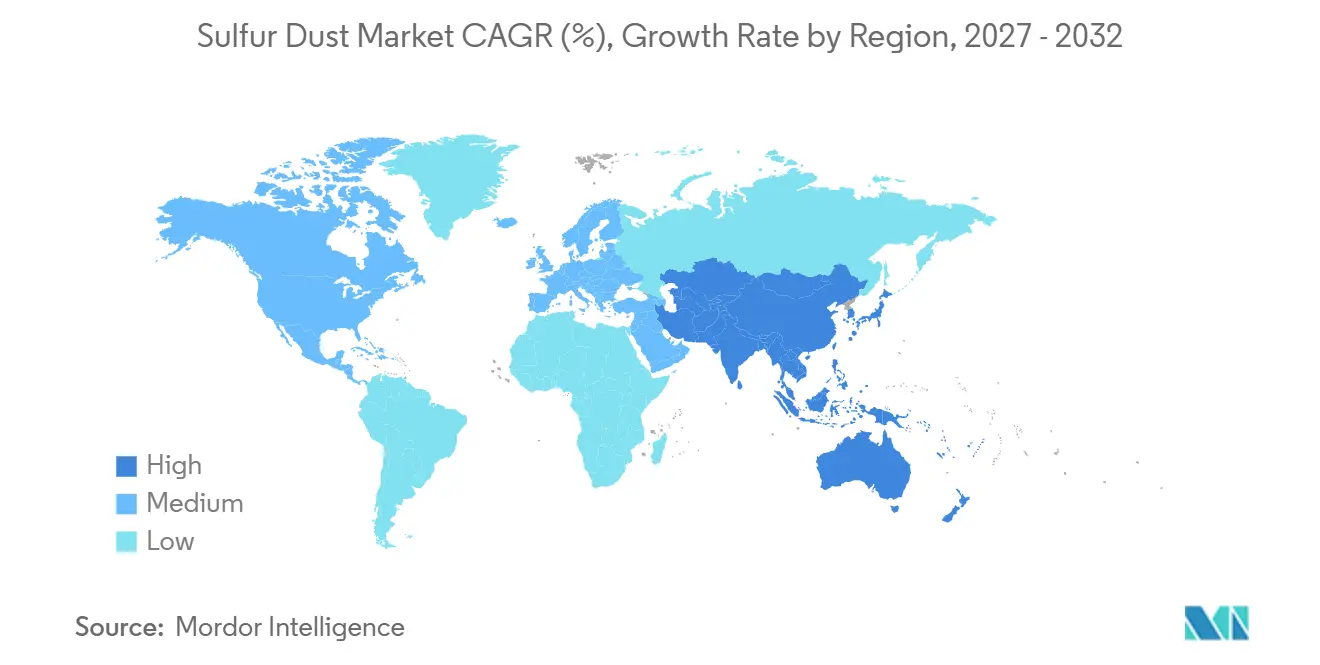
Asia-Pacific held a 38.04% share in 2026 and is projected to advance at a 3.03% CAGR through 2032. China combines chemical production with large agricultural demand in the sulfur dust market. India has widespread soil sulfur deficiency, which supports fertilizer use over several seasons. ASEAN countries add demand from agriculture, rubber, and chemical processing. Japan and South Korea support chemical-grade and rubber-grade sulfur powder applications through their advanced manufacturing sectors.
North America benefits from a developed recovered-sulfur logistics network that supports the sulfur dust market. H.J. Baker operates sulfur processing, storage, and export activities that serve fertilizer, rubber, and industrial users. A 2025 City of Los Angeles record documented a 10-year permit for H.J. Baker’s Port of Los Angeles facility. The Mosaic Company’s sulfur purchases show the scale of sulfur demand in North American-linked fertilizer supply chains. Georgia Gulf Sulfur Corporation renewed ISO 9001:2015 certification for 2025 through 2028 across facilities in Georgia, Texas, and Canada.
Europe combines strict product requirements with active fertilizer innovation in the sulfur dust market. The European Union fertilizing products framework includes labeling and nutrient composition requirements for CE-marked products containing elemental sulfur[2]. Grupa Azoty S.A. has expanded its sulfur-enriched fertilizer range in this setting. South America is driven by oilseed and sugarcane cultivation but can be disrupted by sulfur feedstock price increases. The Middle East and Africa are smaller by demand but remain important as a supply base, with NCSP supplying sulfur pastilles and related products from Saudi Arabia.
Competitive Landscape
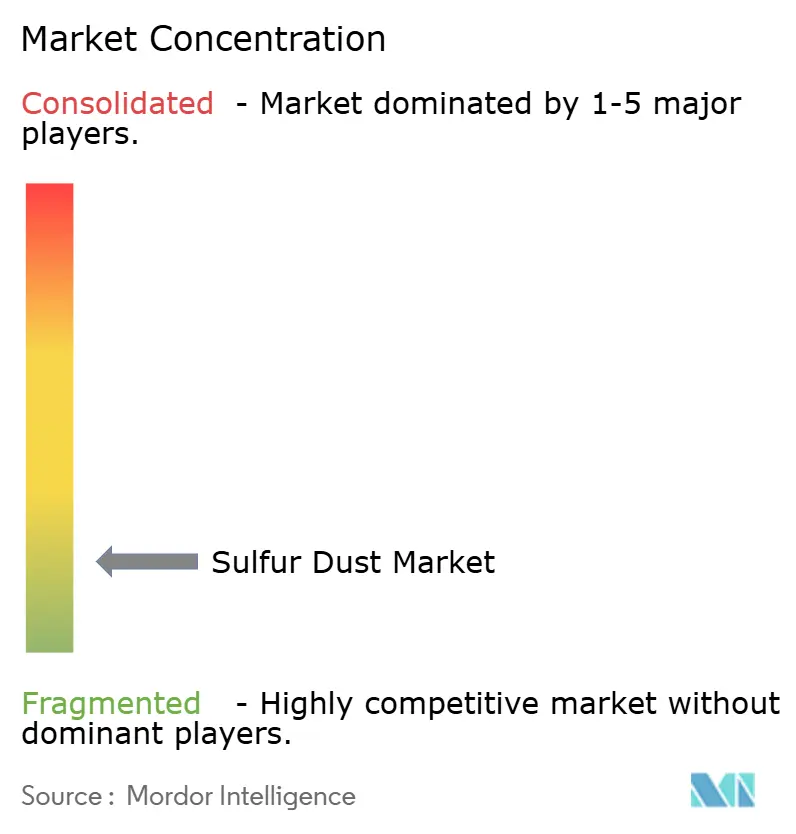
The sulfur dust market is highly fragmented, with the top five players including H.J. Baker, Tessenderlo Kerley, Grupa Azoty S.A., SML Limited, and Georgia Gulf Sulfur Corporation. BASF and Merck KGaA are diversified chemical groups with sulfur-related activities in wider portfolios. Georgia Gulf Sulfur Corporation, Grupa Azoty S.A., Jaishil Sulphur & Chemical Industries, Kanhaiya Chemicals, Mahaveer Surfactants Private Limited, Maruti Corporation, NCSP, SML Limited, Sulfinova AS, and Tessenderlo Kerley participate through processing, formulations, fertilizers, or derivative products. H.J. Baker and Jordan Sulphur add trading, distribution, and supply-chain capabilities. The Mosaic Company is an important downstream sulfur buyer for fertilizer production rather than a primary sulfur dust producer.
Competition in the sulfur dust market centers on particle size, product quality, agronomic performance, regulatory compliance, and dependable feedstock access. Sulfinova AS began construction on its Aliaga factory in May 2025 to expand micronized sulfur production. Grupa Azoty S.A. expanded its liquid sulfur fertilizer range with RSMS BioShot N(S) 26-3 in August 2025.
Tessenderlo Kerley completed the integration of Crop Vitality and NovaSource under one brand in January 2025. It opened a liquid fertilizer production facility in Defiance, Ohio, in August 2025 for sulfur-based crop nutrition products. The sulfur dust market gives an advantage to suppliers that can support application performance and compliance alongside physical supply. Companies with validated technical claims can differentiate their products in premium agricultural and specialty uses. Commodity processors remain exposed to feedstock cost changes and price-based competition.
Sulfur Dust Industry Leaders
-
H.J. Baker
-
Tessenderlo Kerley
-
Grupa Azoty S.A.
-
SML Limited
-
Georgia Gulf Sulfur Corporation
- *Disclaimer: Major Players sorted in no particular order
Sulfur Dust Market Companies Covered in this Report
- BASF
- Georgia Gulf Sulfur Corporation
- Grupa Azoty S.A.
- H.J. Baker
- Jaishil Sulphur & Chemical Industries
- Jordan Sulphur
- Kanhaiya Chemicals
- Mahaveer Surfactants Private Limited
- Maruti Corporation
- Merck KGaA
- NCSP
- SML Limited
- Sulfinova AS
- Tessenderlo Kerley
- The Mosaic Company
Recent Industry Developments in Sulfur Dust Market
- October 2026: The Mosaic Company indefinitely idled its South Fort Meade, Florida, fertilizer facility and filed a layoff notice affecting 199 workers, citing ongoing sulfur availability and affordability challenges. The shutdown highlights the sulfur dust market challenges by highlighting how sulfur supply constraints and higher input costs can disrupt fertilizer production and affect demand for sulfur-based agricultural products.
- March 2026: Tessenderlo Kerley completed its acquisition of a potassium sulfate (SOP) production plant in Sweden from Cinis Fertilizer AB. The acquisition supports the sulfur dust market indirectly by highlighting continued investment in sulfate-based fertilizer production, which depends on sulfur-bearing raw materials and related chemical processing.
Global Sulfur Dust Market Report Scope
Sulfur dust is a finely divided form of elemental sulfur used as a raw material and functional input in agricultural and industrial processes. Its chemical properties make it suitable for applications requiring sulfur supplementation, chemical synthesis, and material processing.
The Sulfur Dust Market is segmented by grade, form, application, and geography. By grade, the market is segmented into industrial grade, agricultural grade, pharmaceutical grade, technical grade, and food grade. By form, the market is segmented into powder, granular, and other forms. By application, the market is segmented into fertilizers, chemical manufacturing, pesticides, pharmaceuticals, rubber processing, and other applications. The report also covers the market size and forecasts for sulfur dust across 15 countries. For each segment, the market sizing and forecasts have been done on the basis of value (USD).
Segmentation Overview
| Industrial Grade |
| Agricultural Grade |
| Pharmaceutical Grade |
| Technical Grade |
| Food Grade |
| Powder |
| Granular |
| Others |
| Fertilizers |
| Chemical Manufacturing |
| Pesticides |
| Pharmaceuticals |
| Rubber Processing |
| Others |
| Asia-Pacific | China |
| India | |
| Japan | |
| South Korea | |
| ASEAN Countries | |
| Rest of Asia-Pacific | |
| North America | United States |
| Canada | |
| Mexico | |
| Europe | Germany |
| United Kingdom | |
| France | |
| Italy | |
| NORDIC Countries | |
| Rest of Europe | |
| South America | Brazil |
| Argentina | |
| Rest of South America | |
| Middle East and Africa | Saudi Arabia |
| South Africa | |
| Rest of Middle East and Africa |
| By Grade | Industrial Grade | |
| Agricultural Grade | ||
| Pharmaceutical Grade | ||
| Technical Grade | ||
| Food Grade | ||
| By Form | Powder | |
| Granular | ||
| Others | ||
| By Application | Fertilizers | |
| Chemical Manufacturing | ||
| Pesticides | ||
| Pharmaceuticals | ||
| Rubber Processing | ||
| Others | ||
| By Geography | Asia-Pacific | China |
| India | ||
| Japan | ||
| South Korea | ||
| ASEAN Countries | ||
| Rest of Asia-Pacific | ||
| North America | United States | |
| Canada | ||
| Mexico | ||
| Europe | Germany | |
| United Kingdom | ||
| France | ||
| Italy | ||
| NORDIC Countries | ||
| Rest of Europe | ||
| South America | Brazil | |
| Argentina | ||
| Rest of South America | ||
| Middle East and Africa | Saudi Arabia | |
| South Africa | ||
| Rest of Middle East and Africa | ||
Key Questions Answered in the Report
What is the size of the sulfur dust market?
The sulfur dust market size was valued at USD 1.34 billion in 2026 and is estimated to grow from USD 1.37 billion in 2027 to reach USD 1.54 billion by 2032, at a CAGR of 2.36% during the forecast period (2027-2032).
What is driving demand for sulfur dust?
Soil sulfur deficiency, fertilizer use, crop protection, rubber processing, and chemical manufacturing support demand.
Which form held the largest share in 2026?
Powder held a 54.83% share in 2026.
Which application held the largest share in 2026?
Fertilizers held a 52.69% share in 2026, supported by soil nutrient restoration needs in major agricultural regions.