
String Wound Filter Materials Market Size and Share
Market Overview
| Study Period | 2022 - 2032 |
|---|---|
| Market Size (2027) | USD 1.7 Billion |
| Market Size (2032) | USD 2.11 Billion |
| Growth Rate (2027 - 2032) | 4.37 % |
| Fastest Growing Market | Asia-Pacific |
| Largest Market | Asia-Pacific |
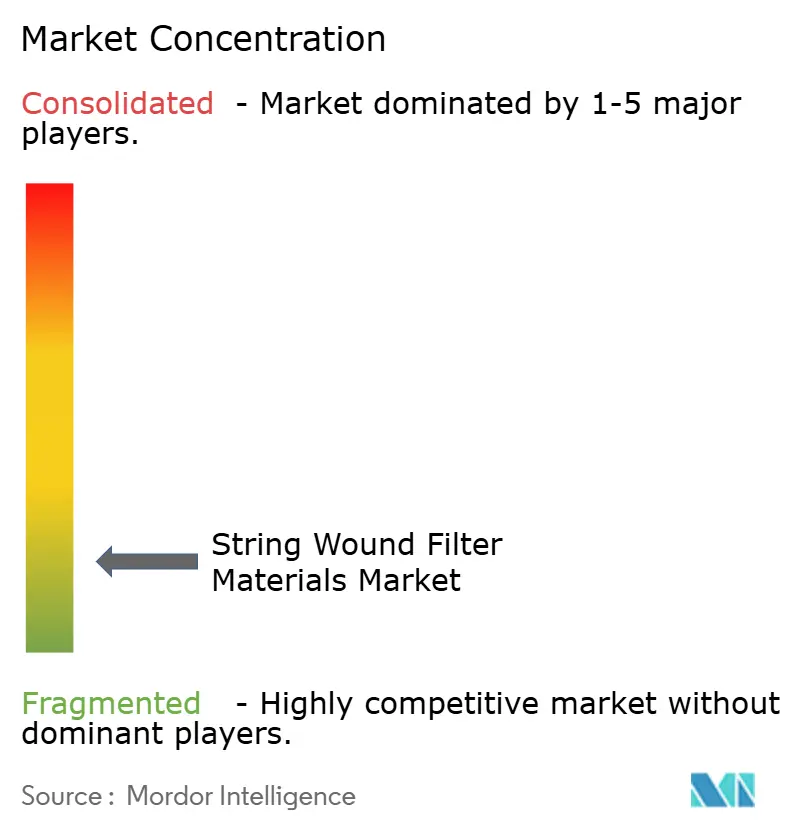
| Market Concentration | Low |
Major Players *Disclaimer: Major Players sorted in no particular order Image © Mordor Intelligence. Reuse requires attribution under CC BY 4.0. | |
String Wound Filter Materials Market Analysis by Mordor Intelligence
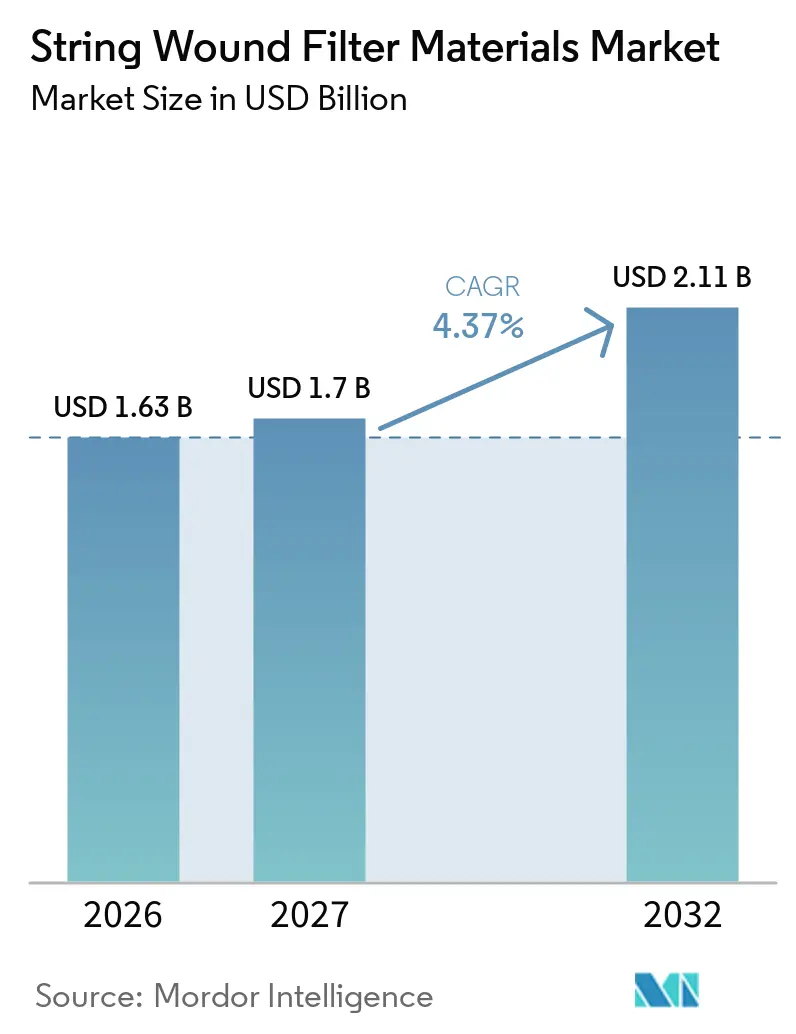
The String Wound Filter Materials Market size was valued at USD 1.63 billion in 2026 and is estimated to grow from USD 1.70 billion in 2027 to reach USD 2.11 billion by 2032, at a CAGR of 4.37% during the forecast period (2027-2032). The market is supported by water and wastewater projects, desalination investment, and the continued need to protect downstream membranes from suspended solids. String wound cartridges remain a practical first filtration stage because their depth structure holds contaminants through the media thickness and can reduce membrane fouling. More demanding water rules are also increasing the value of documented material quality and repeatable cartridge performance. Suppliers are responding through certification, localized production, and broader filtration portfolios, while competition is becoming more divided between standard products and qualified products for sensitive applications.
Key Report Takeaways
- By yarn type, polypropylene yarn held 58.13% of the string wound filter materials market share in 2026 and is forecast to advance at a 4.89% CAGR through 2032.
- By core material, polypropylene core held 64.36% of the string wound filter materials market share in 2026 and is forecast to advance at a 5.14% CAGR through 2032.
- By end-use industry, water and wastewater treatment held 40.78% of the string wound filter materials market share in 2026, while food and beverage is forecast to advance at a 5.47% CAGR through 2032.
- By geography, Asia-Pacific held 36.11% of the string wound filter materials market share in 2026 and is forecast to advance at a 5.33% CAGR through 2032.
Note: Market numbers in this report are based on Mordor Intelligence's proprietary estimation framework, which combines nine months of actuals with Q4 projections for base year 2026.
Market Trends and Insights
Drivers Impact Analysis of String Wound Filter Materials Market*
| Driver | (~) % Impact on CAGR Forecast | Geographic Relevance | Impact Timeline |
|---|---|---|---|
| Stricter Industrial Water-Quality and Reuse Requirements | +1.4% | Global, particularly North America, EU, and China | Short term (≤ 2 years) |
| Expansion of Desalination and Water-Stress Infrastructure | +1.2% | Middle East & Africa, South Asia, Mediterranean | Medium term (2-4 years) |
| High Dirt-Holding Capacity and Low Cost of String Wound Media | +0.9% | Global, amplified in APAC and emerging markets | Short term (≤ 2 years) |
| Replacement Demand from Consumable Cartridge Designs | +0.7% | North America, Europe, mature APAC markets | Medium term (2-4 years) |
| Polymer Yarn Localization Across Emerging Manufacturing Hubs | +0.5% | ASEAN, India, South America | Long term (≥ 4 years) |
| Source: Mordor Intelligence | |||
Stricter Industrial Water-Quality and Reuse Requirements
Tighter discharge and reuse requirements are moving filtration from a routine operating expense toward a compliance-related investment. EU Directive 2024/3019 entered into force in January 2025 and requires member states to transpose its provisions by July 2027. The directive sets a path toward quaternary treatment and micropollutant removal at large wastewater facilities, which raises the need for dependable pretreatment systems[1]. String wound cartridges are commonly used at the front of treatment trains, where they remove suspended solids before downstream processes. More restrictive operating targets can also shorten acceptable pressure-drop intervals and lead operators to replace cartridges more frequently. Work by the European Committee for Standardization (CEN) and the European Committee for Electrotechnical Standardization (CENELEC) on water standardization further supports a more consistent framework for water-system specifications.
Expansion of Desalination and Water-Stress Infrastructure
Desalination and reuse investment is widening the installed base that needs pretreatment media. The IDRA Desalination and Reuse Handbook 2025-2026 reported that desalination capacity had grown 40% since 2020 and reuse capacity had increased 52% over the same period. Reverse osmosis and membrane bioreactor systems need reliable solids removal to protect higher-value membranes. This connection makes each new desalination or reuse facility relevant to the string wound filter materials market. The World Bank has identified desalination and reuse as increasingly important responses to declining urban water availability. Demand is especially concentrated in the Middle East, North Africa, and South Asia, where water scarcity and industrial expansion occur together. Polypropylene and glass-fiber media are suited to many of these applications because they offer different balances of chemical resistance, temperature tolerance, and cost.
High Dirt-Holding Capacity and Low Cost of String Wound Media
String wound cartridges use graduated winding density to capture particles throughout the media depth rather than at a single surface. This structure gives them substantial dirt-holding capacity in applications with high suspended-solid loads. Water treatment, produced-water management, and chemical pretreatment often favor this format when a membrane or pleated filter would foul quickly. The value proposition is based on system cost as well as cartridge price, since housings, labor, disposal, and membrane protection affect the total operating cost. The string wound filter materials market, therefore, retains an opening in standard sediment-removal applications, even as alternative filter formats improve. Suppliers are also refining yarn spinning and winding methods to improve consistency without changing the basic cartridge design.
Replacement Demand from Consumable Cartridge Designs
String wound cartridges must be replaced after their depth media fills, which creates recurring demand after an installation is commissioned. This replacement cycle can reduce exposure to delays in new capital projects. New water plants, desalination systems, and food processing lines expand the installed base and support later cartridge purchases. Qualification also strengthens this pattern in regulated operations, because a validated micron rating, core, and yarn combination can be difficult to change. Pharmaceutical applications require documented material performance and controlled manufacturing practices, which can increase switching costs. Eaton introduced TOPCART HF cartridge housings in July 2025 for high-flow water treatment, hydrogen pretreatment, cooling systems, and chemical processes, adding equipment that can support recurring cartridge demand.
Restraints Impact Analysis of String Wound Filter Materials Market*
| Restraint | (~) % Impact on CAGR Forecast | Geographic Relevance | Impact Timeline |
|---|---|---|---|
| Substitution by Pleated, Melt-Blown, Bag, and Membrane Filters | -0.8% | North America, Europe, advanced APAC markets | Medium term (2-4 years) |
| Media Migration and Chemical Leaching Risk | -0.5% | Global, with regulatory scrutiny in EU and North America | Short term (≤ 2 years) |
| Fiber Shedding Under Thermal, Hydraulic, or Abrasive Stress | -0.4% | Global | Short term (≤ 2 years) |
| Source: Mordor Intelligence | |||
Substitution by Pleated, Melt-Blown, Bag, and Membrane Filters
Pleated, melt-blown, bag, and membrane formats compete most directly where operators need fine retention, low shedding, or a compact footprint. These alternatives can be preferred in high-specification facilities where the cost of contamination is greater than the cost of a filter element. Their position is strongest in North America, Europe, and advanced Asia-Pacific applications. String wound filters remain competitive where feed streams carry heavy sediment and depth loading is more important than absolute retention. The restraint is, therefore, concentrated in applications with demanding purity targets rather than across all filtration duties. Suppliers can limit substitution by offering more consistent winding, qualified materials, and clear application guidance.
Media Migration and Chemical Leaching Risk
Material migration is a significant qualification issue when filtered fluids enter pharmaceutical, food, or semiconductor processes. In these settings, operators assess extractables, leachables, and material compatibility before approving a cartridge. Food-contact requirements under FDA 21 Code of Federal Regulations (CFR) 177.1520 narrow the range of acceptable polypropylene compositions and additives. Poorly controlled yarn can fail testing and require a costly requalification process for the end user. This risk directs demand toward producers with documented quality systems and recognized compliance packages. NSF filtration standards also provide a widely used reference point for potable-water products in North America.
*Our forecasts treat driver/restraint impacts as directional, not additive. The impact forecasts reflect baseline growth, mix effects, and variable interactions.
String Wound Filter Materials Market Segment Analysis
By Yarn Type:
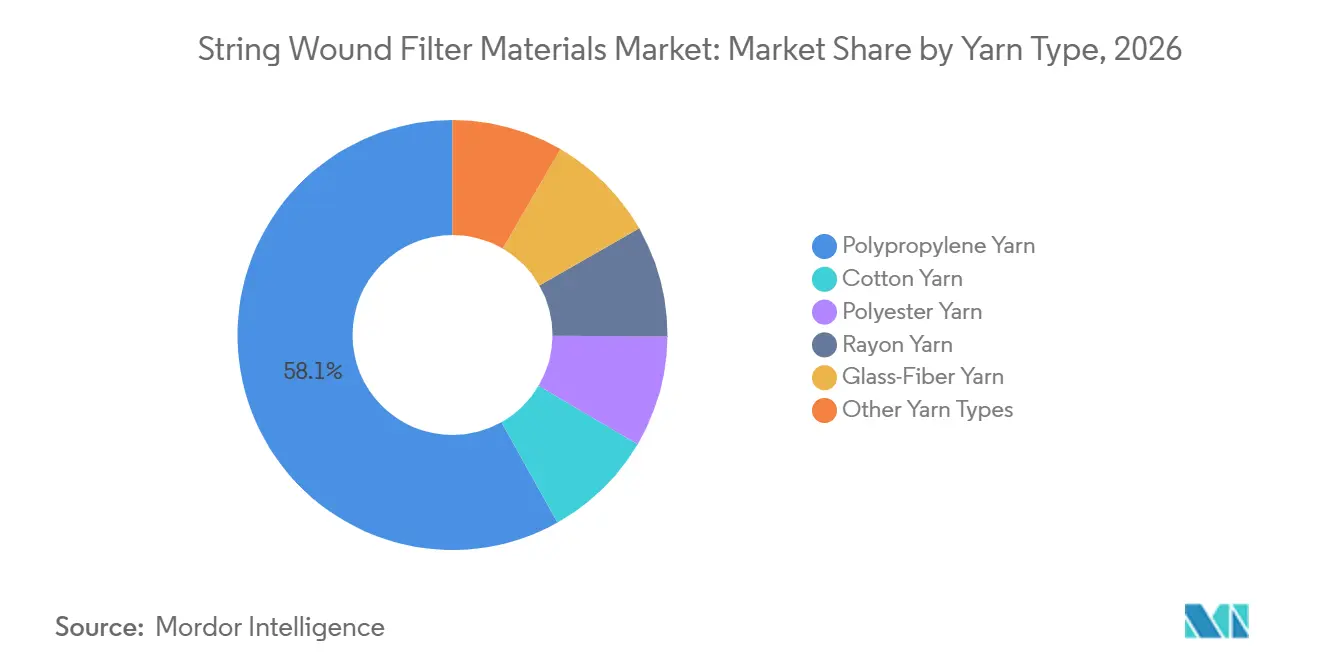
Polypropylene Yarn Combines Both Scale and GrowthPolypropylene yarn held 58.13% of the string wound filter materials market share in 2026 and is projected to advance at a 4.89% CAGR through 2032. Its broad use reflects chemical resistance, cost efficiency, and compatibility with food-contact requirements. The material is hydrophobic and resists many acids, alkalis, and organic solvents. These properties make it a common choice for water treatment, food and beverage production, and chemical pretreatment. The string wound filter materials market size for polypropylene yarn is supported by the expanding need for practical pretreatment in water-intensive industries.
Cotton yarn continues to serve potable-water and edible-oil applications where absorbency and taste neutrality are valued. Its use can be constrained when cotton input prices rise and industrial buyers focus on cost. Polyester offers higher thermal stability than polypropylene and is used in condensate and chemical-process duties that operate above 80 °C. Rayon and glass-fiber yarns serve more demanding duties, with glass fiber suited to high-temperature and chemically severe environments. These specialty materials command a higher unit price and remain important in petrochemical and semiconductor processing. More uniform yarn and pore structures are becoming relevant as buyers seek predictable retention and pressure-drop performance.

By Core Material:
Polypropylene Core Combines Both Scale and GrowthPolypropylene core held 64.36% of the string wound filter materials market share in 2026 and is projected to advance at a 5.14% CAGR through 2032. The segment benefits from the same cost and chemical-resistance profile that supports polypropylene yarn. Its compatibility with food-contact requirements and NSF/American National Standards Institute (ANSI) 42 and 61 certification expectations makes it widely relevant to potable water and food processing. Desalination and municipal water projects add demand for polymer-core cartridges. The string wound filter materials market size for polypropylene cores is therefore closely linked to water infrastructure spending.
Stainless-steel cores are used where cartridges need to withstand steam sterilization, higher differential pressures, or aggressive chemicals. They are relevant to water-for-injection systems that use steam-in-place cleaning and more intensive validation procedures. Tinned-steel cores provide an intermediate option for industrial water, oil, and gas duties requiring added corrosion resistance. Glass-filled polypropylene extends the pressure and temperature range of polymer cores while retaining food-contact applicability. These alternatives are valuable for specialized applications, although demand remains weighted toward standard polypropylene designs. Manufacturers can differentiate through core cleanliness, dimensional consistency, and support for application-specific validation.
By End-Use Industry:
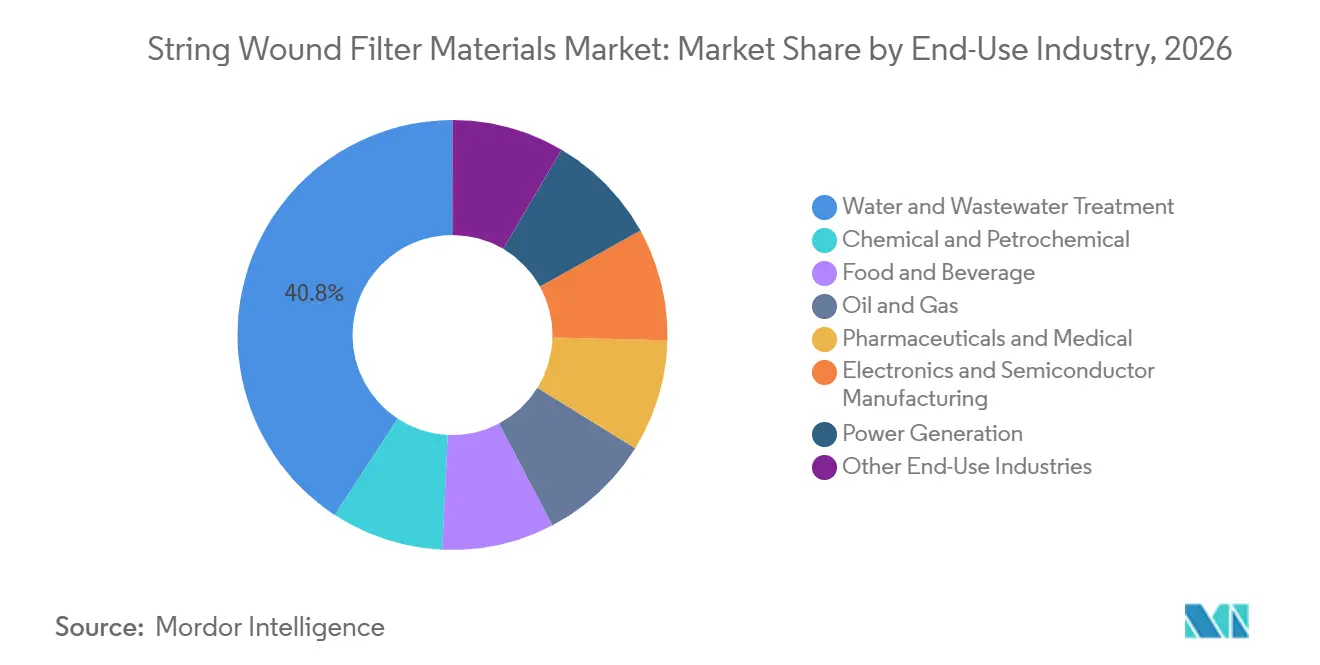
Water and Wastewater Treatment Anchors Demand While Food and Beverage Advances FasterWater and wastewater treatment held 40.78% of the string wound filter materials market share in 2026. The segment relies on pretreatment to protect reverse osmosis membranes, membrane bioreactors, and other downstream equipment from suspended solids. Each facility requires a dependable first-stage filter with an appropriate micron rating and media composition. Growth in reuse and desalination directly broadens this installed base. Water treatment will remain central to the string wound filter materials market because it combines high-volume filtration with regular replacement needs.
Food and beverage is projected to advance at a 5.47% CAGR through 2032. Breweries, dairy processors, juice manufacturers, and bottled-water facilities use cartridges for 5–25-micron pretreatment duties. These buyers place greater emphasis on hygienic design, traceable materials, and food-contact compliance. Chemical and petrochemical operations use polyester and glass-fiber media for some solvent-bearing feed streams. Oil and gas use polypropylene and cotton elements for produced-water management and hydraulic fracturing-fluid conditioning. Pharmaceuticals generate higher value per cartridge because qualification demands are more stringent, while electronics and semiconductor facilities are more likely to consider alternatives where fiber shedding creates a material risk.
Geography Analysis
Asia-Pacific
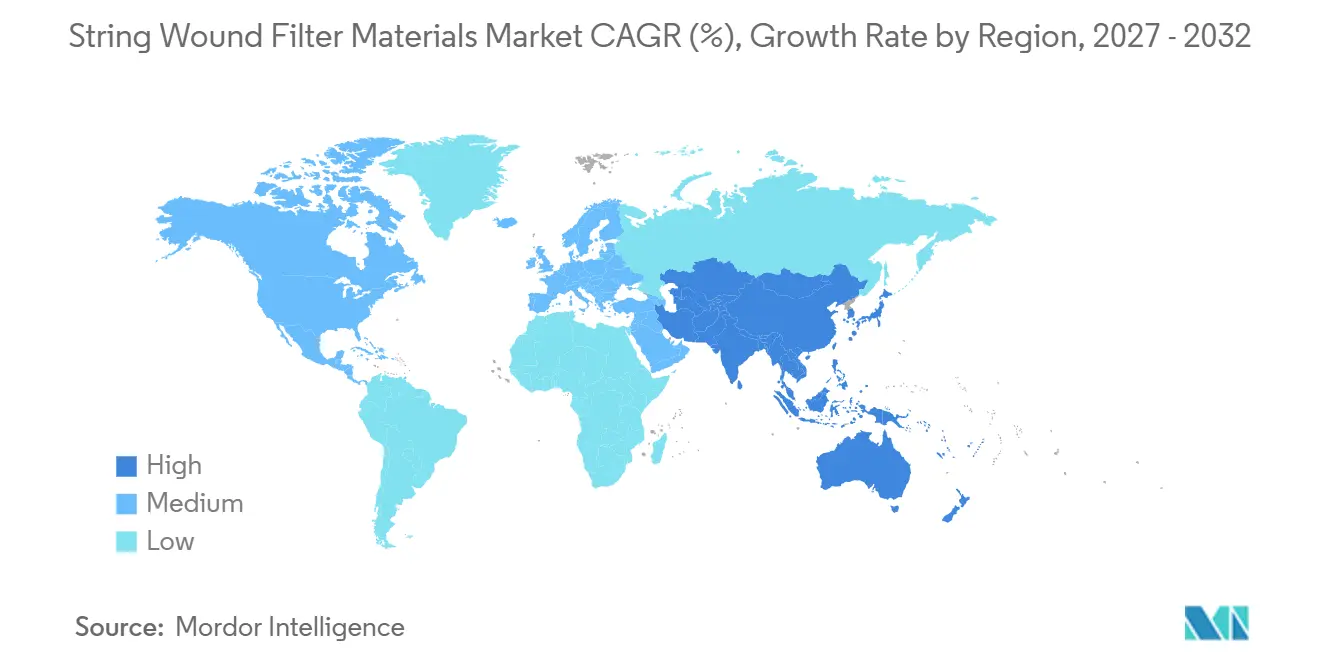
Asia-Pacific held 36.11% of the string wound filter materials market share in 2026 and is projected to advance at a 5.33% CAGR through 2032. China, India, and ASEAN economies combine water infrastructure development with growing food processing, electronics, and industrial activity. India’s water programs and expanding industrial base support demand for prefiltration products, while China’s water-quality controls increase the need for treatment equipment. Local winding and polypropylene-media production is expanding in Vietnam, Indonesia, and India, which is reducing reliance on imports for standard products. Cleanova inaugurated a 133,000 sq ft Center of Excellence in Chennai in March 2025, combining weaving, filtration, fabrication, cage manufacturing, and laboratory capabilities for industrial filtration applications. Feature-Tec Co., Ltd. renewed its ASME U Stamp and gained its first U2 Stamp certification in March 2025, supporting its ability to serve regulated pressure-equipment applications.
North America
North America has a mature base of water utilities, food processors, pharmaceutical manufacturers, and oil and gas operations. Regulatory influence from the United States Environmental Protection Agency’s National Pollutant Discharge Elimination System supports sustained attention to suspended solids and discharge quality. Produced-water management, pipeline protection, and hydraulic fracturing create a regional application base that differs from many other geographies. Coleman Filter Company, LLC supplies high-flow wound elements for these services. United Filters International operates facilities in Texas, California, and Ohio, and offers product lines certified to NSF/ANSI 42, 61, 53, and 372 standards. Condition-based change-out systems are also becoming more important because they can improve uptime while avoiding unnecessary replacement.
Europe, South America, and Middle East and Africa
Europe is shaped by the implementation of EU Directive 2024/3019, which supports upgrades to municipal and industrial wastewater treatment. Germany, France, Italy, and the Nordic countries have pharmaceutical and industrial facilities that require documented materials for specialized filtration. STRADOM S.A. operates within the European polypropylene yarn and fabrics supply base. South American demand centers on agri-processing, mining, municipal treatment, and export-oriented food and beverage production. The Middle East and Africa demand is closely associated with desalination, water reuse, and municipal water investment. The World Bank’s assessment of desalination and reuse highlights why these projects are becoming a longer-term structural response to water stress. Limited local winding capacity in several smaller markets creates opportunities for established suppliers with reliable polypropylene yarn supply chains.
Competitive Landscape
The string wound filter materials market is highly fragmented, with the top five players including Coats Group plc, SWM, Barnet, mmp Filter, and Cleanova. Eaton and Cleanova offer filtration equipment and cartridges within broader industrial filtration portfolios. Barnet and Coats Group plc contribute specialty fibers and technical yarns that support the material supply chain. Gopani Product Systems Private Limited, mmp Filter, Shelco Filters, Trinity Filtration Technologies Pvt. Ltd., United Filters International, and Coleman Filter Company, LLC provide cartridge or filtration products for specific industrial applications. FSI-Canton, LLC is active as a distribution and service provider. East Asia Textile Technology Ltd., Feature-Tec Co., Ltd., and STRADOM S.A. add regional materials and filtration capabilities. This mix gives buyers a choice between broad systems suppliers and focused cartridge specialists. It also means that commercial success can vary by application, certification requirement, and customer location.
Scale and certification increasingly distinguish suppliers from smaller local producers. Cleanova acquired Micronics Engineered Filtration Group in March 2025, strengthening its industrial-filtration platform and its manufacturing coverage across major regions. The company also expanded its India manufacturing and laboratory capability through its Chennai center. Eaton’s July 2025 TOPCART HF launch addressed high-flow industrial duties and expanded its cartridge-housing offering[2]. Feature-Tec Co., Ltd.’s ASME certification work is another example of investment intended to meet the qualification requirements of international industrial customers. These moves show why manufacturing scale alone is not sufficient. A supplier also needs the process controls and documented testing that customers can use during product approval. The capacity to serve several regions can further reduce delivery risk for multinational customers.
The strongest differentiation remains in applications that need controlled fiber release, traceable materials, and stable filtration performance. Semiconductor ultrapure-water systems and food-grade applications require extended validation and can favor established producers with documented manufacturing controls. NSF/ANSI certification remains an important market-access tool in North American potable-water applications. Mativ Holdings, Inc. operates the former SWM specialty-materials business and reported USD 177.2 million in fourth-quarter 2025 sales for its Filtration and Advanced Materials segment, reflecting its participation in filtration-media demand. The string wound filter materials market continues to offer room for regional producers, but certified products and dependable supply are becoming more important in higher-value uses. New entrants may be able to compete in standard applications with localized supply and custom dimensions. However, longer qualification periods remain a barrier where food, pharmaceutical, and semiconductor customers require proven material control.
String Wound Filter Materials Industry Leaders
-
Coats Group plc
-
SWM
-
Barnet
-
mmp Filter
-
Cleanova
- *Disclaimer: Major Players sorted in no particular order
String Wound Filter Materials Market Companies Covered in this Report
- Barnet
- Cleanova
- Coats Group plc
- Coleman Filter Company, LLC
- East Asia Textile Technology Ltd.
- Eaton
- Feature-Tec Co., Ltd.
- FSI-Canton, LLC
- Gopani Product Systems Private Limited
- mmp Filter
- Shelco Filters
- STRADOM S.A.
- SWM
- Trinity Filtration Technologies Pvt. Ltd.
- United Filters International
Recent Industry Developments in String Wound Filter Materials Market
- June 2026: ENPRESS Group acquired Johnson Filtration Products Inc. (JFPI), a manufacturer of depth-wound filter cartridges serving drinking water, beverage, automotive, textile, and plating industries. The acquisition strengthened ENPRESS Group's liquid filtration portfolio and expands its manufacturing and distribution capabilities for wound-filter products.
- March 2025: Cleanova acquired Micronics Engineered Filtration Group from Vance Street Capital, combining with Allied Filtration. It expanded its industrial filtration platform across the United States, Ireland, India, Brazil, China, and Australia.
Global String Wound Filter Materials Market Report Scope
String wound filter materials are used to manufacture depth filtration cartridges by winding yarn around a central core in a controlled pattern. The resulting structure traps suspended particles and contaminants while allowing fluids to pass through, supporting filtration across industrial and commercial processes.
The String Wound Filter Materials Market is segmented by yarn type, core material, end-use industry, and geography. By yarn type, the market is segmented into polypropylene yarn, cotton yarn, polyester yarn, rayon yarn, glass-fiber yarn, and other yarn types. By core material, the market is segmented into polypropylene core, stainless-steel core, tinned-steel core, glass-filled polypropylene core, and other core materials. By end-use industry, the market is segmented into water and wastewater treatment, chemical and petrochemical, food and beverage, oil and gas, pharmaceuticals and medical, electronics and semiconductor manufacturing, power generation, and other end-use industries. The report also covers the market size and forecasts for string wound filter materials across 15 countries. For each segment, the market sizing and forecasts have been done on the basis of value (USD).
Segmentation Overview
| Polypropylene Yarn |
| Cotton Yarn |
| Polyester Yarn |
| Rayon Yarn |
| Glass-Fiber Yarn |
| Other Yarn Types |
| Polypropylene Core |
| Stainless-Steel Core |
| Tinned-Steel Core |
| Glass-Filled Polypropylene Core |
| Other Core Materials |
| Water and Wastewater Treatment |
| Chemical and Petrochemical |
| Food and Beverage |
| Oil and Gas |
| Pharmaceuticals and Medical |
| Electronics and Semiconductor Manufacturing |
| Power Generation |
| Other End-Use Industries |
| Asia-Pacific | China |
| India | |
| Japan | |
| South Korea | |
| ASEAN Countries | |
| Rest of Asia-Pacific | |
| North America | United States |
| Canada | |
| Mexico | |
| Europe | Germany |
| United Kingdom | |
| France | |
| Italy | |
| NORDIC Countries | |
| Rest of Europe | |
| South America | Brazil |
| Argentina | |
| Rest of South America | |
| Middle East and Africa | Saudi Arabia |
| South Africa | |
| Rest of Middle East and Africa |
| By Yarn Type | Polypropylene Yarn | |
| Cotton Yarn | ||
| Polyester Yarn | ||
| Rayon Yarn | ||
| Glass-Fiber Yarn | ||
| Other Yarn Types | ||
| By Core Material | Polypropylene Core | |
| Stainless-Steel Core | ||
| Tinned-Steel Core | ||
| Glass-Filled Polypropylene Core | ||
| Other Core Materials | ||
| By End-Use Industry | Water and Wastewater Treatment | |
| Chemical and Petrochemical | ||
| Food and Beverage | ||
| Oil and Gas | ||
| Pharmaceuticals and Medical | ||
| Electronics and Semiconductor Manufacturing | ||
| Power Generation | ||
| Other End-Use Industries | ||
| By Geography | Asia-Pacific | China |
| India | ||
| Japan | ||
| South Korea | ||
| ASEAN Countries | ||
| Rest of Asia-Pacific | ||
| North America | United States | |
| Canada | ||
| Mexico | ||
| Europe | Germany | |
| United Kingdom | ||
| France | ||
| Italy | ||
| NORDIC Countries | ||
| Rest of Europe | ||
| South America | Brazil | |
| Argentina | ||
| Rest of South America | ||
| Middle East and Africa | Saudi Arabia | |
| South Africa | ||
| Rest of Middle East and Africa | ||
Key Questions Answered in the Report
What is the size of the string wound filter materials market?
The string wound filter materials market size was valued at USD 1.63 billion in 2026 and is estimated to grow from USD 1.70 billion in 2027 to reach USD 2.11 billion by 2032, at a CAGR of 4.37% during the forecast period (2027-2032).
What is driving demand for string wound filter materials?
Water and wastewater treatment, desalination, reuse systems, and recurring cartridge replacement are the main demand factors.
Which yarn type held the largest share in 2026?
Polypropylene yarn led with 58.13% share in 2026.
Which end-use industry is projected to advance fastest through 2032?
Food and beverage is projected to advance at a 5.47% CAGR through 2032.