
Streaming Studio Market Size and Share
Market Overview
| Study Period | 2020 - 2031 |
|---|---|
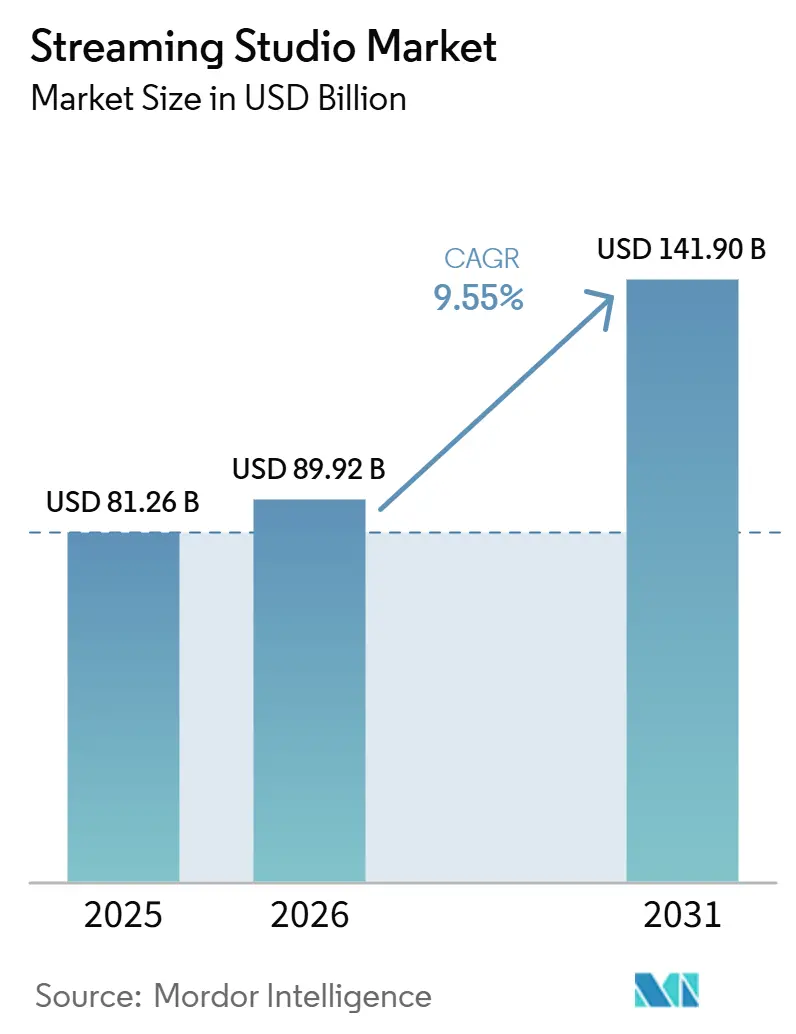
| Market Size (2026) | USD 89.92 Billion |
| Market Size (2031) | USD 141.90 Billion |
| Growth Rate (2026 - 2031) | 9.55 % |
| Fastest Growing Market | Asia-Pacific |
| Largest Market | North America |
| Market Concentration | Medium |
Major Players *Disclaimer: Major Players sorted in no particular order Image © Mordor Intelligence. Reuse requires attribution under CC BY 4.0. | |
Streaming Studio Market Analysis by Mordor Intelligence
The streaming studio market size was valued at USD 81.26 billion in 2025 and is projected to reach USD 141.9 billion by 2031, at a CAGR of 9.55% from 2026 to 2031. The market is expanding as entertainment budgets continue to move away from linear broadcast schedules and toward platform-commissioned content, which is raising demand for production capacity, editing infrastructure, and cloud-based workflows across the value chain. Large platform spending plans continue to support this shift, and that spending is pushing studios to add more flexible operating models that can handle both premium scripted projects and faster delivery cycles for live and near-live formats. The streaming studio market is also being shaped by wider use of AI tools in post-production, where lower per-scene costs are allowing more work to move through existing facilities instead of reducing overall output. Regional investment in virtual production, cloud collaboration, and localized content pipelines is widening the addressable base for the streaming studio market beyond traditional production centers. Competitive positioning is increasingly tied to scale, IP depth, workflow speed, and the ability to serve global platforms across multiple formats and territories.
Key Report Takeaways
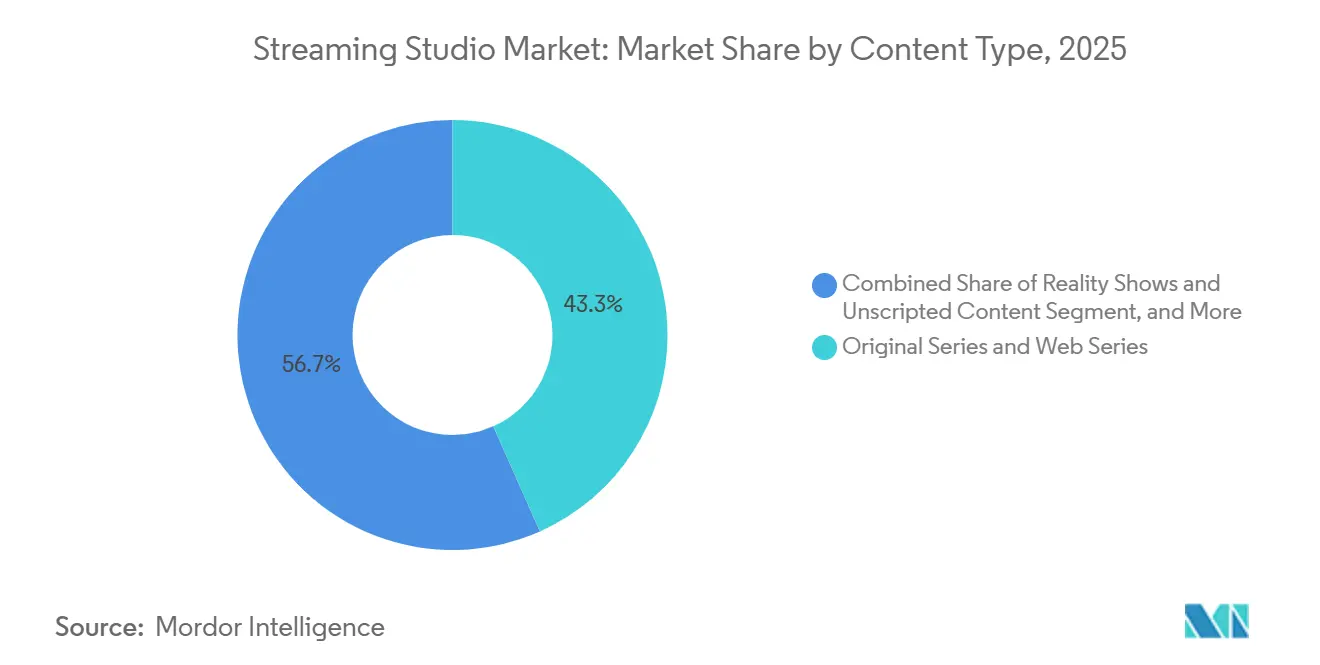
- By content type, original series and web series held 43.33% of the market of the streaming studio market in 2025, while animation and kids content are projected to expand at a 9.77% CAGR through 2031.
- By studio type, commercial production studios held 63.56% share of the streaming studio market size in 2025, while independent production studios are expected to record the highest CAGR at 9.92% through 2031.
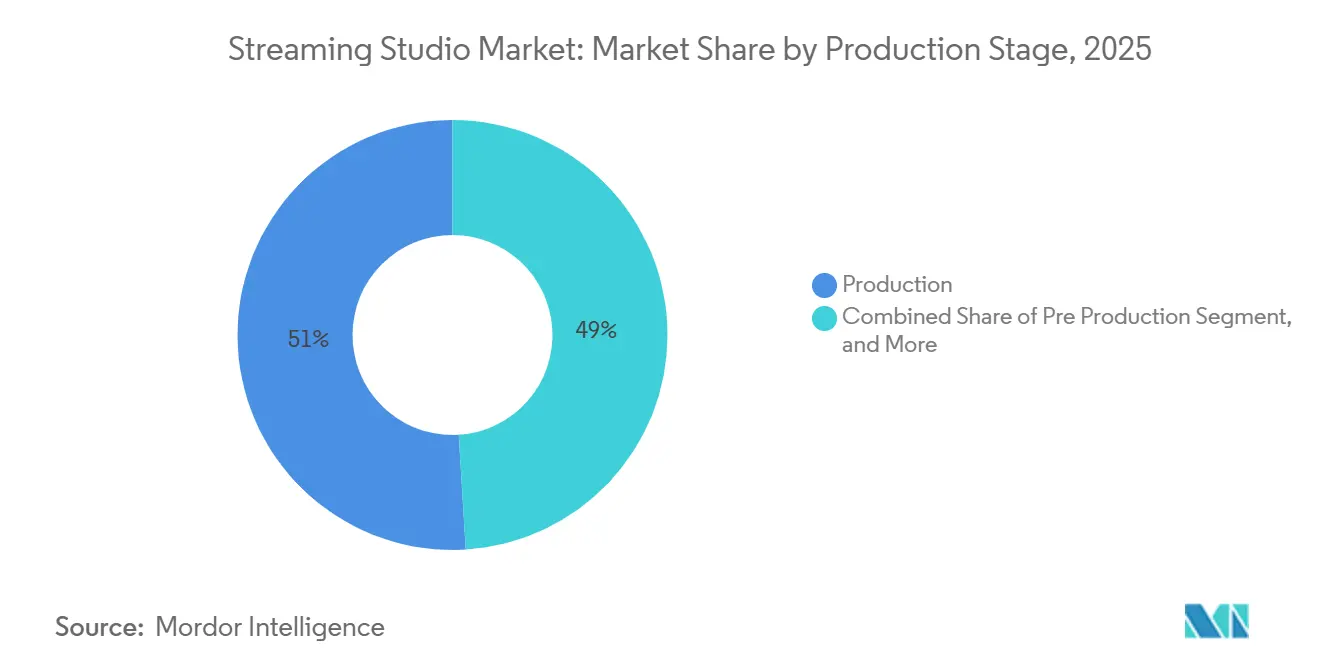
- By production stage, production accounted for 50.99% of the streaming studio market share in 2025, while post-production is projected to advance at a 10.14% CAGR through 2031.
- By end-user, streaming platforms held 51.15% of the market in 2025, while independent creators are expected to expand at a 10.22% CAGR through 2031.
- By geography, North America led with 38.77% share in 2025, while Asia-Pacific is projected to grow at the fastest CAGR of 10.26% through 2031.
Note: Market size and forecast figures in this report are generated using Mordor Intelligence’s proprietary estimation framework, updated with the latest available data and insights as of January 2026.
Market Trends and Insights
Drivers Impact Analysis of Streaming Studio Market*
| Driver | (~) % Impact on CAGR Forecast | Geographic Relevance | Impact Timeline |
|---|---|---|---|
| Rise of Streaming-First Production Budgets | +2.8% | Global | Short term (≤ 2 years) |
| Demand for Real-Time Content Turnaround | +1.9% | Global | Short term (≤ 2 years) |
| Cloud-Native Collaboration across Distributed Production Teams | +1.5% | Global, with Asia-Pacific and Europe expanding | Medium term (2-4 years) |
| AI-Assisted Editing, Logging, and Content Personalization | +1.3% | North America and EU, expanding to Asia-Pacific | Medium term (2-4 years) |
| Expansion of Virtual Studios for Live Events And Sports | +1.0% | North America, EU, Middle East | Medium term (2-4 years) |
| MicroLED and LED Volume Cost Declines | +0.8% | Global, with manufacturing concentration in Asia-Pacific | Long term (≥ 4 years) |
| Source: Mordor Intelligence | |||
Rise Of Streaming-First Production Budgets
The shift from network-led commissioning to platform-led commissioning has become a core operating model for the streaming studio market. Higher platform spending is supporting a broader pipeline of titles across multiple genres and budget levels, which keeps studio demand firm instead of concentrating it only in a few large productions. Netflix stated that its Media Production Suite was built to support productions across many territories, which shows how platform systems are now designed around a global production footprint rather than a single domestic hub. That operating model gives more room for localized originals, recurring serialized formats, and production partners that can deliver reliably at scale. The result is that the streaming studio market is benefiting from a wider commissioning base, not only from larger budgets at the top end.
Demand For Real-Time Content Turnaround
The streaming studio market is seeing stronger demand for infrastructure that can support faster production and delivery cycles. This shift matters because live sports, music, event programming, and weekly releases require facilities and teams that can move content through production and finishing with less delay. Amazon Web Services highlighted field-ready cloud-native workflows for media production at re:Invent 2025, which supports the view that streaming production is moving toward more immediate and distributed execution models.[1]Amazon Web Services, “AWS re:Invent 2025, Revolutionize Media Production, Field-Ready Cloud-Native Workflows,” AWS, youtube.com Faster turnaround also changes studio economics, because operators with real-time infrastructure can win more repeat assignments instead of relying only on one-off scripted projects. In practice, the streaming studio market is moving closer to an always-on service model for selected content categories.
Cloud-Native Collaboration Across Distributed Production Teams
Distributed production has created a durable infrastructure layer for the streaming studio market. Netflix said its Media Production Suite helps crews, vendors, and talent work across countries through a common production environment, which supports a more standardized workflow across geographically dispersed teams. Storj launched Production Cloud in September 2025 with frame-accurate cloud editing and distributed storage, which reflects active vendor investment in remote editorial and post-production needs. Cloud-based collaboration reduces the importance of physical proximity to legacy hubs when facilities can meet quality and delivery requirements through connected workflows. That is helping the streaming studio market broaden its production base across more cost-competitive territories while preserving access to premium-grade tools.
AI-Assisted Editing, Logging, And Content Personalization
AI is becoming a practical workflow layer in the streaming studio market, especially in post-production. Adobe released a January 2026 Premiere Pro update with object-aware mask tracking that runs up to 20 times faster than prior versions, which points to direct savings in time-intensive editorial tasks.[2]Adobe Inc., “New AI-Powered Video Editing Tools in Premiere, Plus Major Motion Design Upgrades in After Effects,” Adobe Official Blog, adobe.com Eluvio introduced inline frame-accurate AI video intelligence at NAB 2026 for live and VOD pipelines, which showed that AI features are moving into production environments rather than staying in isolated test tools. In the streaming studio market, that kind of adoption supports faster finishing cycles, more output per facility, and more flexibility for premium and mid-budget productions. AI use is therefore improving throughput without removing the need for specialized post-production capacity. It is strengthening the commercial case for studios that can combine creative labor with production-grade automation.
Restraints Impact Analysis of Streaming Studio Market*
| Restraint | (~) % Impact on CAGR Forecast | Geographic Relevance | Impact Timeline |
|---|---|---|---|
| High Upfront Cost of Virtual Studio Infrastructure | -2.5% | Global | Short term (≤ 2 years) |
| Limited Number of Skilled Virtual Production Specialists | -1.8% | North America, EU, expanding to Asia-Pacific | Medium term (2-4 years) |
| Workflow Interoperability and Asset Pipeline Fragmentation | -1.4% | Global | Medium term (2-4 years) |
| Power, Cooling, and Space Intensity of Large LED Installations | -0.9% | North America, EU | Long term (≥ 4 years) |
| Source: Mordor Intelligence | |||
High Upfront Cost Of Virtual Studio Infrastructure
Capital intensity remains a major restraint on the streaming studio market, especially for advanced virtual production builds. ROE Visual stated that Studio Ulster opened with LED volume capability and related production systems, and the supplied text described the total facility investment as substantial. Large projects of that kind are difficult for smaller operators to replicate without public support, private capital, or long-term customer visibility. This keeps advanced capacity concentrated in a narrower set of operators and locations even when demand is rising. As a result, the streaming studio market still has a two-tier structure between large, fully equipped facilities and smaller firms that must expand in phases.
Limited Number Of Skilled Virtual Production Specialists
Talent supply is a second structural restraint on the streaming studio market. ScreenSkills reported that a significant share of screen employers said skills shortages had materially affected budgets and finances, which shows that labor constraints are already shaping project execution. The Policy and Evidence Center also found that many recruitment difficulties were concentrated in mid-career roles, which is the level where virtual production expertise becomes operationally important. This shortage limits how quickly new facilities can ramp up utilization even after capital investment is in place. In the streaming studio market, that means throughput expansion depends not only on new infrastructure but also on the slower process of building experienced cross-disciplinary crews.
*Our forecasts treat driver/restraint impacts as directional, not additive. The impact forecasts reflect baseline growth, mix effects, and variable interactions.
Streaming Studio Market Segment Analysis
By Content Type:
Original Series Leads Revenue While Animation Expands QuicklyOriginal series and web series commanded 43.33% of the streaming studio market in 2025. That lead reflects the role of serialized proprietary IP in subscriber acquisition, retention, and long-cycle engagement across major platforms. Series formats also support repeat commissioning decisions because they can extend into multiple seasons and sustain audience attention for longer periods than a single feature release. In the streaming studio industry, this makes original series one of the most efficient formats for platforms that want to keep content pipelines active across the year.
Animation and kids content are projected to grow at a 9.77% CAGR through 2031, making it the fastest-growing content type. The supplied text stated that major SVOD platforms are expected to invest USD 4.8 billion in kids and family content in 2026, up from USD 4.6 billion in 2025 and USD 4.5 billion in 2024, which points to stable commissioning support for specialist studios. Xilam Animation reported that total sales rose 37% to EUR 5.8 million, or USD 6.6 million, in H1 2026, led by proprietary production deliveries, which illustrates healthy demand for delivered animation output. Documentary and non-fiction, movies and feature films, and unscripted formats filled the remaining share of the streaming studio market and remained relevant because they serve different costs, audiences, and scheduling needs. The repeat-viewing profile of children’s content and the lower per-hour cost structure of some nonfiction formats support continued mix diversification even while original series remain the core revenue anchor.



By Studio Type:
Commercial Studios Hold Scale While Independents Use ConsolidationCommercial production studios held 63.56% of the streaming studio market size in 2025. That position reflects their advantage in sound stages, established talent networks, integrated post-production, and long-standing IP libraries that are difficult to replicate quickly. Large commercial operators also have more capacity to absorb schedule changes, large cast productions, and multi-territory delivery requirements. In the streaming studio market, those factors continue to favor studios with broad infrastructure and proven execution depth.
Independent production studios are projected to grow at a 9.92% CAGR through 2031, which made them the fastest-growing studio type in the supplied text. Banijay Group announced that the combination of Banijay Entertainment and All3Media had been completed, creating a larger independent production platform with a substantial content library across multiple territories. The same announcement indicated that the combined business generated significant revenue and adjusted EBITDA, supporting the view that scale is becoming central to independent competitiveness. The streaming studio industry is, therefore, rewarding independents that can add distribution breadth, territory coverage, and deeper libraries through M&A. Digitally native production models are also widening the independent addressable base by combining creator management, production, and monetization under one operating structure.
By Production Stage:
Production Holds Share While Post-Production Gains SpeedProduction held 50.99% share of the streaming studio market in 2025. This reflected the weight of principal photography costs, including cast, crew, locations, equipment, and on-set technical support. It also showed that the largest spending pool still sits in the stage where content is physically captured, even as digital tools reshape upstream and downstream work. For the streaming studio market, production remains the main revenue anchor because most premium budgets still concentrate their largest cost block around active shoot periods.
Post-production is projected to advance at a 10.14% CAGR through 2031, making it the fastest-growing production stage. Adobe’s January 2026 update to Premiere Pro and Eluvio’s April 2026 inline AI launch both point to more automation, faster edits, and broader real-time processing inside professional media pipelines.[3]Adobe Inc., “New AI-Powered Video Editing Tools in Premiere, Plus Major Motion Design Upgrades in After Effects,” Adobe Official Blog, adobe.com That supports the supplied view that more finishing work is being completed per facility without proportional growth in headcount. Pre-production is also gaining importance because more planning, visualization, and environment design work is moving forward in the schedule to reduce costly on-set revisions. Together, these changes are stretching value creation across a wider part of the workflow instead of leaving production as the only area with rising strategic weight.
By End-Users:
Streaming Platforms Lead While Independent Creators Build DemandStreaming platforms held 51.15% of the streaming studio market in 2025. Their lead came from their role as the primary commissioning, financing, and distribution layer across the ecosystem. Large platforms also combine direct audience data, owned distribution, and in-house production capabilities, which gives them stronger control over spend allocation and content strategy. In the streaming studio market, that vertical integration keeps platforms at the center of demand creation for premium and recurring title pipelines.
Independent creators are projected to expand at a 10.22% CAGR through 2031, making them the fastest-growing end-user group in the supplied text. The Asia Video Industry Association stated in 2026 that streaming, social video, and connected TV are driving video revenue growth across Asia-Pacific, which supports the expansion of creator-led media as a commercial layer in professional production services. This matters because smaller facilities, LED rentals, and cloud editing providers can now serve demand pools that sit below the scale of traditional studio clients. Production studios, broadcasters, and television networks still occupy the next tier of end-user demand, but independent creators are increasing the breadth of paying customers across the streaming studio market. That change is widening the customer base for studio-grade infrastructure and creating more diverse demand across formats and budget sizes.
Geography Analysis
North America Streaming Studio Market
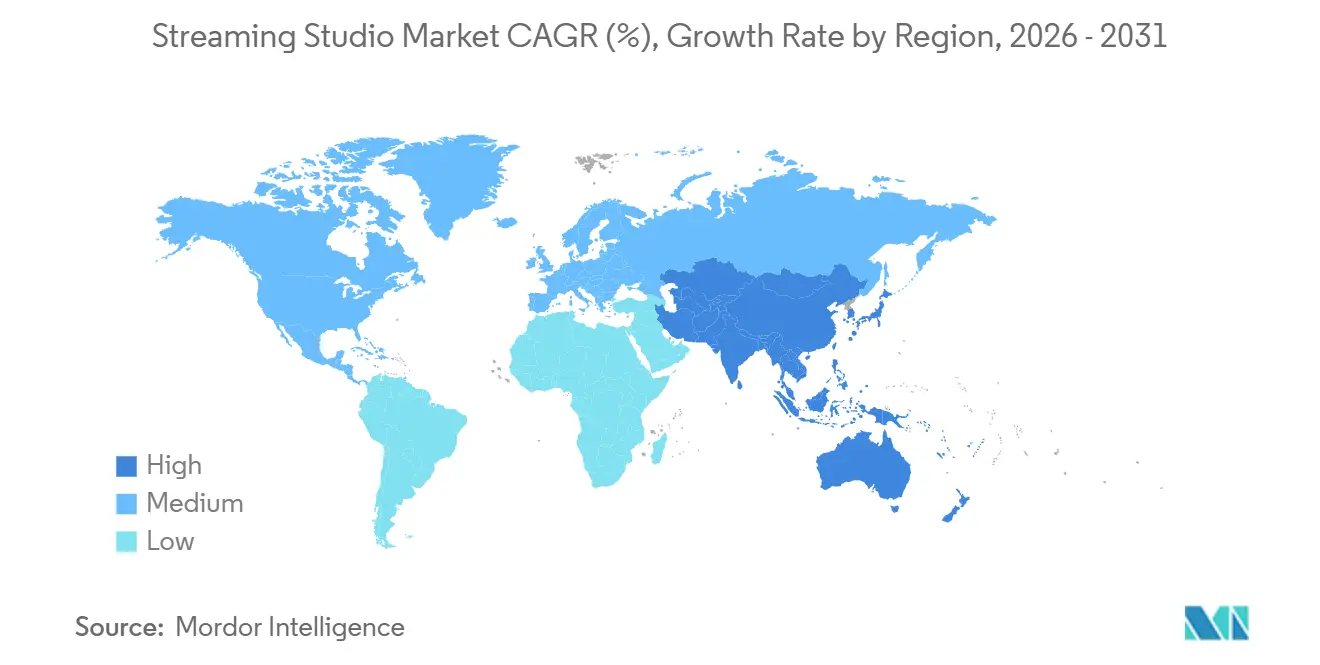
North America held 38.77% of the streaming studio market share in 2025, making it the largest regional segment. The region’s lead came from the concentration of major commissioning platforms, mature studio infrastructure, and dense pools of experienced production labor. Netflix’s production systems are already built to support work across many markets, but the company’s operating center and platform relationships still reinforce North America’s role in premium commissioning and workflow design. Canada is also strengthening its regional role through capacity additions and tax-efficient cross-border production routing, which supports North American depth beyond Los Angeles and New York. In the streaming studio market, that keeps North America is central both as a demand source and as a benchmark for technical and creative standards.
Europe Streaming Studio Market
Europe held a meaningful share of the streaming studio market and continued to widen its production footprint in 2025 and 2026. Banijay’s July 2026 merger completion expanded Europe’s already strong independent production base and gave the region more scale in platform-facing content supply. ROE Visual stated in September 2025 that it won the public tender for Croatia’s first virtual production studio, which showed how advanced infrastructure is spreading beyond older hubs such as London and Berlin. Europe’s position is also supported by established operators, multilingual production ecosystems, and policy frameworks that help local content investment reach a broader set of territories.
APAC, South America and MEA Streaming Studio Market
Asia-Pacific is projected to expand at a 10.26% CAGR through 2031, making it the fastest-growing region in the streaming studio market. The Asia Video Industry Association said in 2026 that streaming, social video, and connected TV are driving regional revenue growth, which supports continued expansion in commissioning and production demand AVIA.ORG. The American Society of Cinematographers reported that Toei unveiled Japan’s largest LED virtual production studio in 2025, which signaled serious in-house infrastructure commitment from a domestic film studio . LG also stated in December 2025 that its virtual production LED solution was powering Studio V in South Korea, reinforcing the region’s role in next-generation production environments. South America, the Middle East, and Africa still represented a smaller base, but their role is growing as streaming distribution expands and more local infrastructure investment begins to follow it.

Competitive Landscape
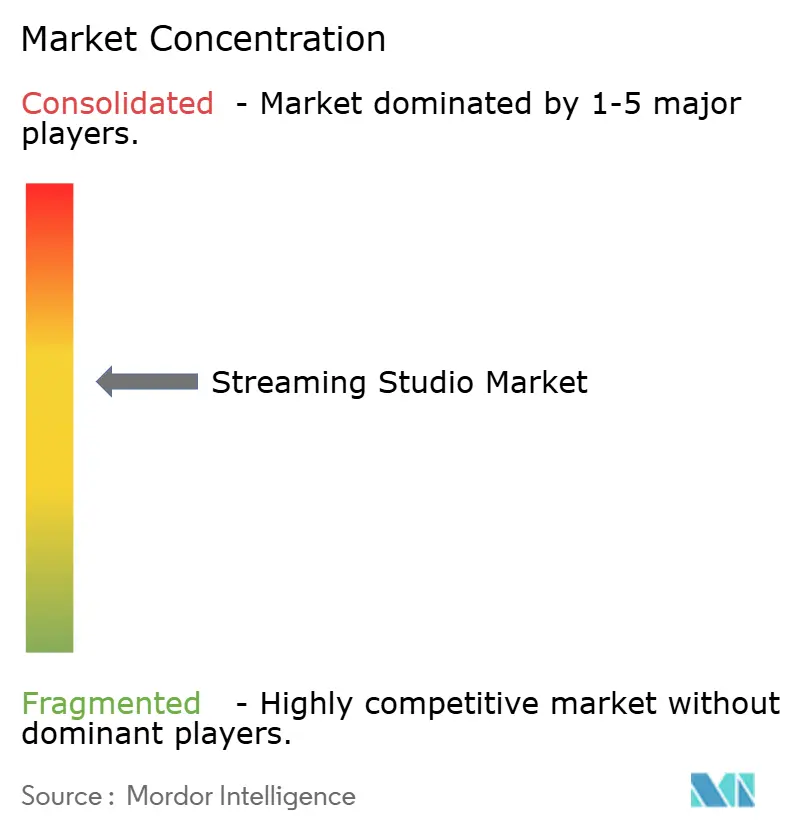
The streaming studio market had a moderately consolidated top tier and a highly fragmented lower tier. Large integrated studio groups, including Sony Pictures Entertainment, Warner Bros. Pictures, Universal Pictures, and NBCUniversal Television and Streaming, continued to hold structural advantages in IP depth, facilities, and talent access. Below that layer, several hundred independent producers competed across scripted, unscripted, animation, and documentary formats, which kept the broader field fragmented. In the streaming studio market, that mix means scale matters at the top, while specialization, relationships, and format expertise still matter across the wider supplier base. Competitive strength is therefore shaped by a studio’s ability to combine execution reliability with owned rights, broad libraries, and workflow capacity.
Consolidation has become a major strategic route for independents that want better access to global platforms. Banijay Group’s July 2026 completion of the All3Media combination created a larger independent company with a broader library and multi-territory operating reach. That move supports the view that platforms increasingly prefer production partners that can manage large slates, compliance requirements, and cross-border delivery. Creator-led hybrid companies are also adding competitive pressure by linking talent management, production, distribution, and monetization in one structure.
Technology adoption is creating a second clear layer of differentiation in the streaming studio market. Adobe’s 2026 editorial AI upgrades and Eluvio’s inline AI media tools showed that speed, automation, and processing intelligence are becoming commercially meaningful capabilities for studios and post facilities. Virtual production credentials matter as well, as shown by LED volume investment in markets such as Croatia, Northern Ireland, Japan, and South Korea. Operators that can pair scalable infrastructure with cloud-native workflows are likely to be better positioned in regional growth markets where platform demand is rising faster than local capacity. That is why competitive advantage in the streaming studio market is increasingly tied to workflow speed, technical range, and the ability to serve global buyers from multiple geographies.
Streaming Studio Industry Leaders
Netflix, Inc.
Amazon MGM Studios
The Walt Disney Studios
Warner Bros. Pictures
Apple Studios
- *Disclaimer: Major Players sorted in no particular order
Streaming Studio Market Companies Covered in this Report
- Netflix, Inc.
- Amazon MGM Studios
- The Walt Disney Studios
- Warner Bros. Pictures
- Sony Pictures Entertainment
- Paramount Pictures
- Universal Pictures
- Lionsgate Studios
- Apple Studios
- HBO
- NBCUniversal Television and Streaming
- Skydance Media
- Legendary Entertainment
- A24
- Fremantle
- Banijay Entertainment
- ITV Studios
- MRC
- CJ ENM
- Tencent Video

Recent Industry Developments in Streaming Studio Market
- July 2026: Banijay Entertainment and All3Media completed a USD 8 billion merger, creating the world's largest independent production company under joint ownership by Banijay Group and RedBird IMI, headquartered in London. The combined entity holds a content library exceeding 265,000 hours across 25 territories and generated approximately USD 4.9 billion in pro forma 2025 revenues, with expected cost synergies of approximately USD 57 million within one year of closing, per company disclosures.
- April 2026: Eluvio launched its inline frame-accurate AI Video Intelligence platform and next-generation Eluvio Video Intelligence Editor (EVIE) at NAB 2026, delivering real-time AI inference within the streaming media pipeline for both live and VOD content and enabling unlimited AI personalization without re-transcoding, described as the first commercially available solution of its kind.
- March 2026: Mediawan, Europe's leading independent studio, announced an agreement to acquire The North Road Company, the preeminent US-based independent studio founded by Peter Chernin, creating one of the world's largest independent studios with major creative hubs across five continents and capabilities spanning all genres, formats, and audiences.
- January 2026: Adobe released a significant AI tooling update to Premiere Pro, including object-aware mask tracking running up to 20 times faster than prior versions and redesigned shape masks with advanced creative controls, materially compressing labor requirements for the editorial phase of broadcast and streaming productions at scale.


Global Streaming Studio Market Report Scope
Streaming Studio Market refers to the ecosystem of physical and virtual production environments, tools, and services used to create, manage, and deliver live and on‑demand streaming content for OTT, social video, gaming, events, and enterprise communications.
The Streaming Studio Market Report is Segmented by Content Type (Movies and Feature Films, Original Series and Web Series, Documentary and Non-Fiction, Reality Shows and Unscripted Content, and Animation and Kids Content), Studio Type (Independent Production Studios, and Commerial Production Studios), Production Stage (Pre-Production, Production, Post-Production), End-Users (Streaming Platforms, Production Studios, Broadcasters and Television Networks, and Independent Creators), and Geography (North America, South America, Europe, Asia-Pacific, Middle East, Africa). The Market Forecasts are Provided in Terms of Value (USD).
| Movies and Feature Films |
| Original Series and Web Series |
| Documentary and Non-Fiction |
| Reality Shows and Unscripted Content |
| Animation and Kids Content |
| Other Content Types |
| Independent Production Studios |
| Commercial Production Studios |
| Pre Production |
| Production |
| Post-Production |
| Streaming Platforms |
| Production Studios |
| Broadcasters and Television Networks |
| Independent Creators |
| Other End-Users |
| North America | United States |
| Canada | |
| Mexico | |
| South America | Brazil |
| Argentina | |
| Chile | |
| Rest of South America | |
| Europe | Germany |
| United Kingdom | |
| France | |
| Italy | |
| Spain | |
| Rest of Europe | |
| Asia-Pacific | China |
| Japan | |
| India | |
| South Korea | |
| Australia | |
| Rest of Asia-Pacific | |
| Middle East | Saudi Arabia |
| United Arab Emirates | |
| Qatar | |
| Rest of Middle East | |
| Africa | South Africa |
| Egypt | |
| Nigeria | |
| Rest of Africa |
| By Content Type | Movies and Feature Films | |
| Original Series and Web Series | ||
| Documentary and Non-Fiction | ||
| Reality Shows and Unscripted Content | ||
| Animation and Kids Content | ||
| Other Content Types | ||
| By Studio Type | Independent Production Studios | |
| Commercial Production Studios | ||
| By Production Stage | Pre Production | |
| Production | ||
| Post-Production | ||
| By End-Users | Streaming Platforms | |
| Production Studios | ||
| Broadcasters and Television Networks | ||
| Independent Creators | ||
| Other End-Users | ||
| By Geography | North America | United States |
| Canada | ||
| Mexico | ||
| South America | Brazil | |
| Argentina | ||
| Chile | ||
| Rest of South America | ||
| Europe | Germany | |
| United Kingdom | ||
| France | ||
| Italy | ||
| Spain | ||
| Rest of Europe | ||
| Asia-Pacific | China | |
| Japan | ||
| India | ||
| South Korea | ||
| Australia | ||
| Rest of Asia-Pacific | ||
| Middle East | Saudi Arabia | |
| United Arab Emirates | ||
| Qatar | ||
| Rest of Middle East | ||
| Africa | South Africa | |
| Egypt | ||
| Nigeria | ||
| Rest of Africa | ||


Key Questions Answered in the Report
What is the streaming studio market size in 2025 and where is it headed by 2031?
The streaming studio market size was USD 81.26 billion in 2025 and is projected to reach USD 141.9 billion by 2031 at a 9.55% CAGR over 2026-2031.
Which content format leads revenue in streaming studio services?
Original series and web series led with 43.33% share in 2025 because serialized proprietary IP remains central to subscriber retention and repeat commissioning.
Which part of the production workflow is growing the fastest?
Post-production is the fastest-growing stage, with a 10.14% CAGR through 2031, supported by wider use of AI-assisted editing and media processing tools.
Why do commercial studios still hold the largest share?
Commercial production studios held 63.56% share in 2025 because they combine sound stages, established talent access, integrated post-production, and deeper IP assets.
Which end-user group is expanding the fastest?
Independent creators are the fastest-growing end-user category, with a 10.22% CAGR through 2031, as creator-led media increasingly uses professional studio and cloud workflow services.
Which region is growing the fastest for streaming studio activity?
Asia-Pacific is projected to grow at a 10.26% CAGR through 2031, helped by rising streaming-led video revenue and continued investment in regional production infrastructure.
Page last updated on:





