
Spray Pyrolysis Market Size and Share
Market Overview
| Study Period | 2022 - 2032 |
|---|---|
| Market Size (2027) | USD 266.31 Million |
| Market Size (2032) | USD 374.56 Million |
| Growth Rate (2027 - 2032) | 7.06 % |
| Fastest Growing Market | Asia-Pacific |
| Largest Market | Asia-Pacific |
| Market Concentration | Low |
Major Players *Disclaimer: Major Players sorted in no particular order Image © Mordor Intelligence. Reuse requires attribution under CC BY 4.0. | |
Spray Pyrolysis Market Analysis by Mordor Intelligence
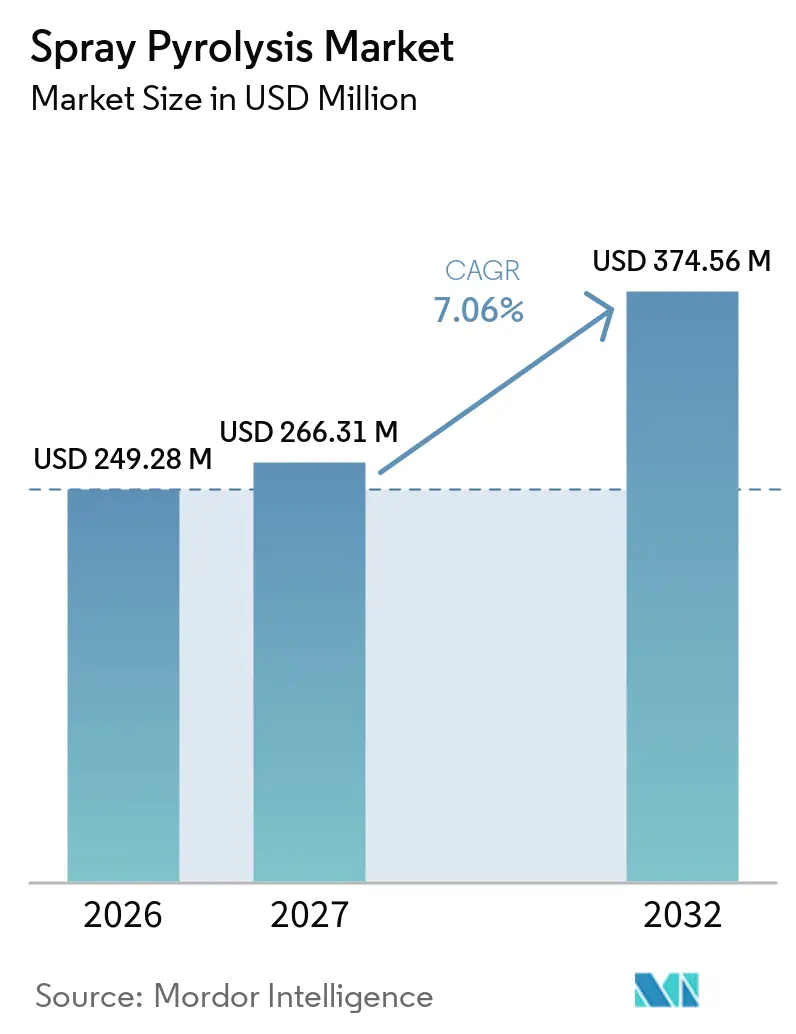
The Spray Pyrolysis Market size was valued at USD 249.28 million in 2026 and is estimated to grow from USD 266.31 million in 2027 to reach USD 374.56 million by 2032, at a CAGR of 7.06% during the forecast period (2027-2032). The spray pyrolysis market is supported by demand for scalable thin-film and powder production without the vacuum chambers used in many competing processes. This operating model can lower equipment and running costs when producers move from laboratory work to pilot production. Perovskite solar cells, nickel-rich battery cathodes, and transparent conductive oxide layers are expanding the set of uses for the technology. The spray pyrolysis market also faces limits in advanced semiconductor uses, where Chemical Vapor Deposition (CVD) and Atomic Layer Deposition (ALD) retain performance advantages for very small features. Public programs for domestic materials capacity can create early equipment opportunities, especially where coating and deposition infrastructure is being funded.
Key Report Takeaways
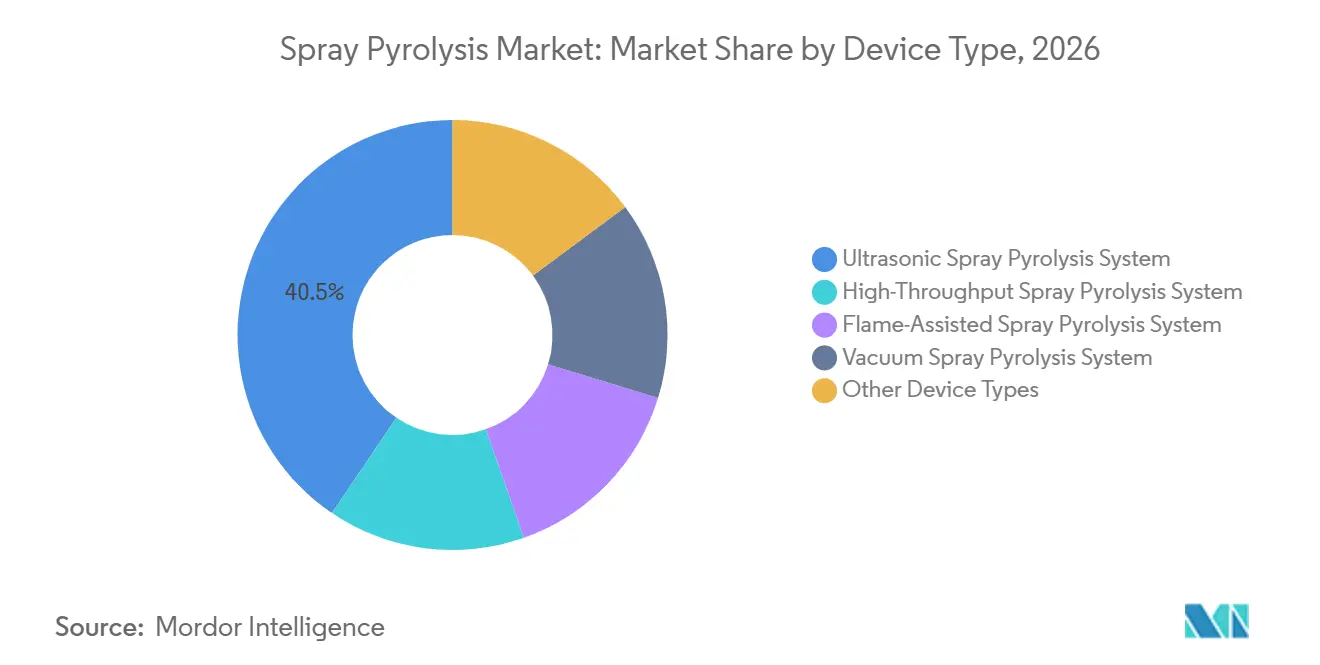
- By device type, ultrasonic spray pyrolysis systems held 40.53% of the spray pyrolysis market share in 2026 and are forecast to advance at a 7.93% CAGR through 2032.
- By application, nanoparticle synthesis held 32.78% of the spray pyrolysis market share in 2026, while thin and thick film deposition are forecast to advance at an 8.06% CAGR through 2032.
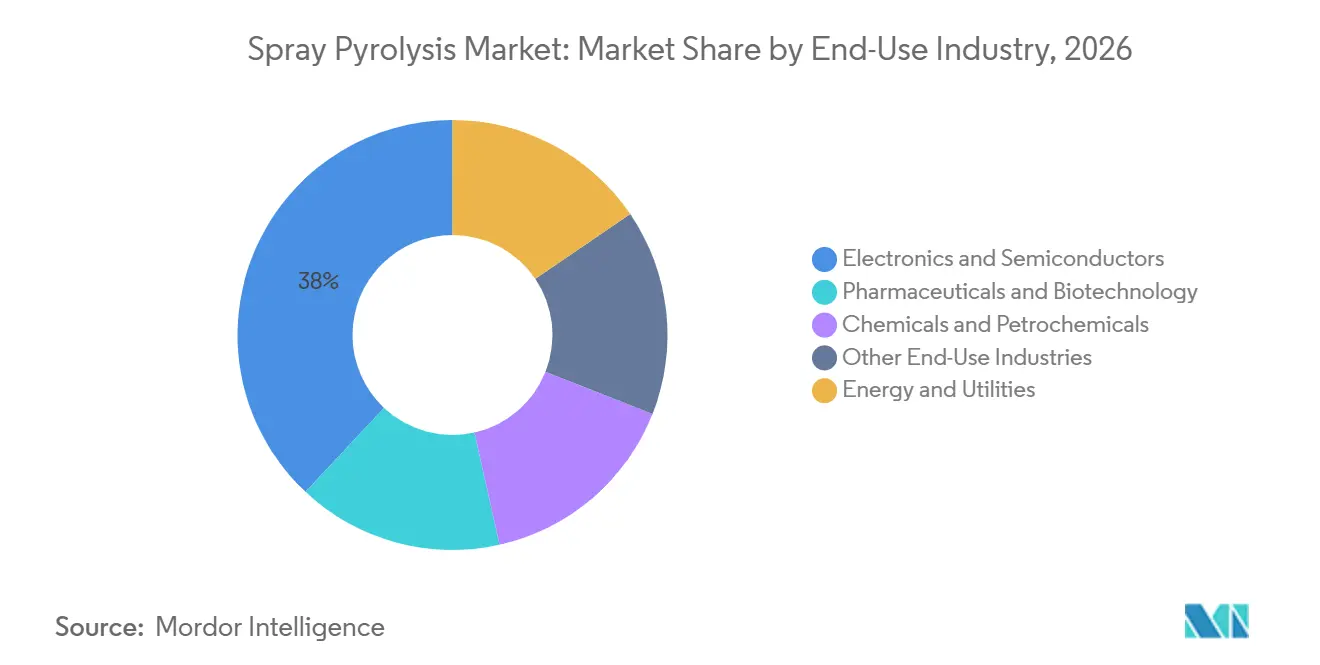
- By end-use industry, electronics and semiconductors held 38.01% of the spray pyrolysis market share in 2026, while energy and utilities are forecast to advance at an 8.24% CAGR through 2032.
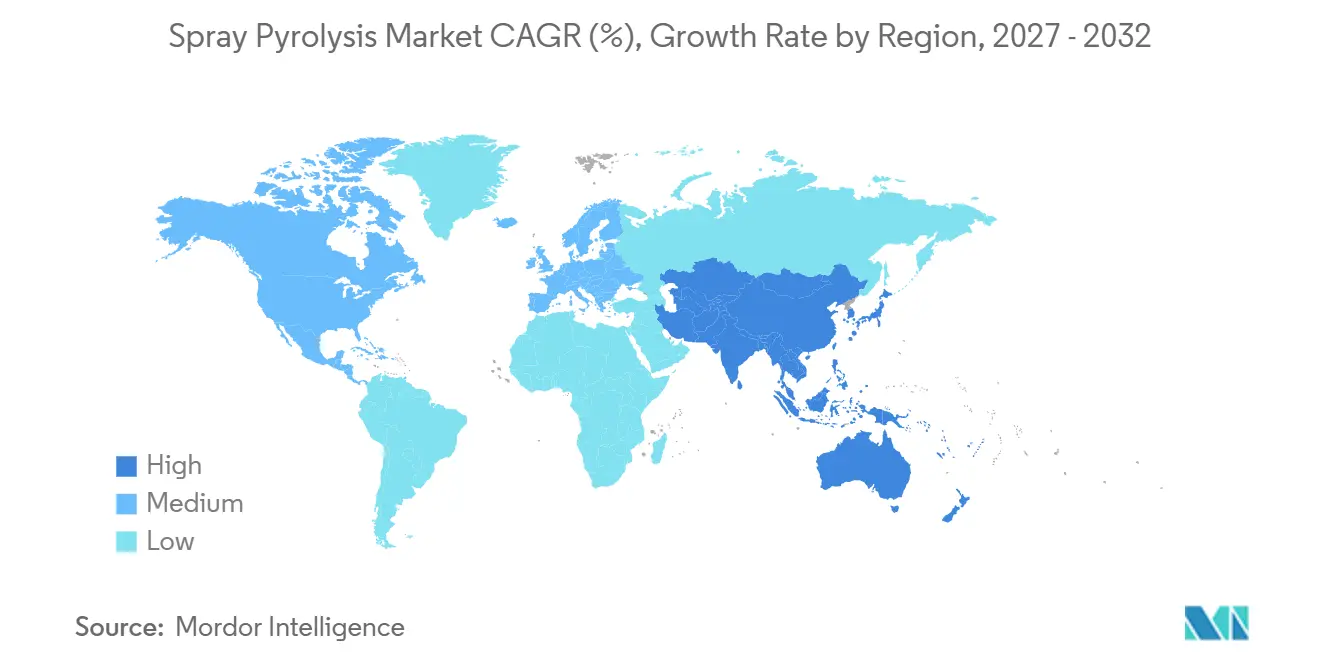
- By geography, Asia-Pacific held 35.17% of the spray pyrolysis market share in 2026 and is forecast to advance at an 8.12% CAGR through 2032.
Note: Market numbers in this report are based on Mordor Intelligence's proprietary estimation framework, which combines nine months of actuals with Q4 projections for base year 2026.
Market Trends and Insights
Drivers Impact Analysis of Spray Pyrolysis Market*
| Driver | (~) % Impact on CAGR Forecast | Geographic Relevance | Impact Timeline |
|---|---|---|---|
| Expansion of Thin-Film Solar and Perovskite Manufacturing | +2.0% | Global, led by APAC and Europe | Medium term (2-4 years) |
| Battery-Material Scale-Up and EV Energy-Storage Demand | +1.6% | Global, core gains in APAC and North America | Medium term (2-4 years) |
| Semiconductor and Optoelectronic Coating Complexity | +1.2% | APAC core, spillover to North America and Europe | Long term (≥ 4 years) |
| Government Funding for Domestic Advanced-Materials Capacity | +0.8% | North America and Europe | Short term (≤ 2 years) |
| Modular Scale-Up from Laboratory to Pilot Production | +0.6% | Global | Medium term (2-4 years) |
| Source: Mordor Intelligence | |||
Expansion of Thin-Film Solar and Perovskite Manufacturing
Perovskite photovoltaic production is moving from research projects toward commercial manufacturing candidates. The spray pyrolysis market benefits because open-air deposition can remove vacuum steps that constrain module throughput. A 2025 Matter study found that replacing vacuum thermal evaporation for electron-transport layers with open-air ultrasonic spray deposition reduced manufacturing costs by 26% in a 100 MW in-line perovskite module plant. The same study reported champion power-conversion efficiency of 20.3% in inverted device structures. Research presented at the 2025 IEEE Photovoltaic Specialists Conference projected a levelized cost of energy below USD 0.03/kWh for spray-manufactured perovskite modules at 10-15-year module lifetimes. Early pilot-line qualifications can, therefore, favor suppliers that demonstrate stable recipes before plant designs become fixed.
Battery-Material Scale-Up and EV Energy-Storage Demand
The spray pyrolysis market is gaining relevance in the production of nickel-rich cathode materials. Spray pyrolysis can provide a continuous route for single-crystal cathode powders and can avoid some multi-step, solvent-intensive precursor work. A June 2025 study reported that spray-pyrolysis-synthesized NCM90 achieved an initial discharge capacity of 225.7 mAh g⁻¹ and retained 84.5% capacity after 50 cycles. Tianjin University published a dedicated system design for nickel-rich cathode manufacturing in August 2025, signaling a shift toward equipment tailored to battery production conditions. Flame spray processing also supports work on Li-Mn-rich and Li-excess disordered rocksalt cathodes for larger stationary storage applications. This gives the spray pyrolysis market exposure to both electric vehicle and utility-scale battery demand.
Semiconductor and Optoelectronic Coating Complexity
More complex semiconductor and display structures are creating defined coating uses for solution routes. Spray pyrolysis can be relevant where vacuum methods create high material waste or cost. A 2025 Materials Letters paper reported in situ crystallization of InGaZnO thin films by spray pyrolysis without a separate post-deposition anneal. Research presented by the Society for Information Display reported high-k AlOx dielectrics made by spray pyrolysis for low-temperature polysilicon and oxide thin-film transistors. The spray pyrolysis market can benefit when in situ crystallization reduces processing steps and broadens the range of usable substrates. Sono-Tek Corporation’s work to support 300 mm wafers also shows supplier attention to larger semiconductor formats.
Government Funding for Domestic Advanced-Materials Capacity
Government programs are directing more capital toward domestic materials and coating capacity. The spray pyrolysis market can benefit because atmospheric equipment can fit the cost and footprint requirements of local production facilities. The U.S. Economic Development Administration awarded USD 48 million to the American Aerospace Materials Manufacturing Tech Hub in January 2025 to strengthen supply chains for advanced composite aerostructures. Canada partnered with MDS Coating Technologies Corporation in March 2025 to advance nano-coatings for aircraft engine compressor blades[1]. The New York State Microelectronics Innovation Challenge also supported the adaptation of ultrasonic spray coating for 300 mm silicon wafers. These programs reduce some of the risk associated with equipment trials and process qualification.
Restraints Impact Analysis of Spray Pyrolysis Market*
| Restraint | (~) % Impact on CAGR Forecast | Geographic Relevance | Impact Timeline |
|---|---|---|---|
| Competition from CVD, ALD, Sputtering, and Sol-Gel Routes | -1.5% | Global | Long term (≥ 4 years) |
| Process-Control Sensitivity and Reproducibility Risk | -1.0% | Global | Medium term (2-4 years) |
| High Capital, Skilled-Labor, and Abatement Requirements | -0.8% | Emerging markets and SMEs globally | Short term (≤ 2 years) |
| Source: Mordor Intelligence | |||
Competition from CVD, ALD, Sputtering, and Sol-Gel Routes
The spray pyrolysis market operates alongside established CVD, ALD, sputtering, and sol-gel processes. These methods retain clear advantages in semiconductor applications that require conformal coatings on high-aspect-ratio features. ALD is particularly important for structures that depend on atomic-scale thickness control and consistent step coverage. Qualified production processes are difficult to replace because a change in deposition route requires time, testing, and new validation. That qualification burden can outweigh expected cost savings even where spray pyrolysis is technically suitable. The technology is, therefore, more likely to complement incumbent methods in selected uses than replace them across advanced chip fabrication.
Process-Control Sensitivity and Reproducibility Risk
Spray pyrolysis depends on consistent substrate temperature, precursor concentration, carrier-gas flow, nozzle distance, and ambient humidity. Changes in these variables can affect film stoichiometry, morphology, and thickness uniformity. A 2025 study on SnO₂ films used a 2³ full-factorial design and found that concentration and variable interactions were important to process results. The spray pyrolysis market faces added validation demands in pharmaceutical and biotechnology applications, where coating uniformity can affect regulated product performance. Scale-up from small substrates to pilot systems can require substantial re-optimization. This raises the risk of delayed qualification and lower yields before a process is stabilized.
*Our forecasts treat driver/restraint impacts as directional, not additive. The impact forecasts reflect baseline growth, mix effects, and variable interactions.
Spray Pyrolysis Market Segment Analysis
By Device Type:
Ultrasonic Spray Pyrolysis System Leads Across Share and GrowthUltrasonic spray pyrolysis systems held 40.53% of the spray pyrolysis market size in 2026 and are projected to advance at a 7.93% CAGR through 2032. The combination of leading share and leading growth points to broader demand for ultrasonic systems rather than substitution by another device type. High-frequency transducers create narrower droplet distributions, which can support film uniformity and lower precursor waste. Reported droplet sizes range from 18-80 µm, providing control needed in coating processes. A 2025 study showed that Bayesian optimization can reduce the experimental cycles needed to refine ultrasonic spray parameters.
High-throughput spray pyrolysis systems use multi-nozzle arrangements for larger substrate formats and can support perovskite and battery-material scale-up. Flame-assisted spray pyrolysis systems serve continuous powder and nanoparticle production, including catalyst and cathode-material work. Vacuum spray pyrolysis systems address applications where atmospheric contamination is unsuitable, but a full CVD installation is not required. Other configurations include hybrid and custom equipment designed around nonstandard substrate geometry or temperature profiles. The spray pyrolysis industry includes suppliers that differentiate through atomization control, automation, thermal management, and application engineering.

By Application:
Nanoparticle Synthesis Holds Share as Thin and Thick Film Deposition AcceleratesNanoparticle synthesis held 32.78% of the spray pyrolysis market size in 2026. Demand comes from catalyst, pharmaceutical excipient, and functional-material production that needs controlled particle morphology and composition. Thin and thick film deposition are projected to advance at an 8.06% CAGR through 2032 as photovoltaic, display, and semiconductor users seek large-area films. This application uses atmospheric deposition to make compositionally graded and functional layers. Work published in 2025 found that structural measures such as X-ray diffraction peak intensity can support process control for SnO₂ films.
Powder production supports chemical processors that need metal-oxide powders with specified particle-size distributions. A robotic flame spray pyrolysis platform developed at ETH Zürich reduced operator workload by 2-3× and achieved composition accuracy within ±5% across 2 orders of magnitude. Industrial and functional coatings are used in electromagnetic interference shielding and energy-efficient window applications. Reported transparent conductive oxide coatings include zinc oxide, tin oxide, and indium tin oxide. Other applications include photocatalysis, gas sensing, and electrode coatings for hydrogen generation.
By End-Use Industry:
Electronics and Semiconductors Anchor Demand While Energy and Utilities Gain GroundElectronics and semiconductors held 38.01% of the spray pyrolysis market size in 2026. The segment uses transparent conductive oxides, dielectric layers, photoresist deposition in Microelectromechanical Systems (MEMS), and electromagnetic interference shielding. Research published in 2025 reported 25 nm Al₂O₃ gate dielectrics deposited by ultrasonic spray pyrolysis for Gallium Nitride (GaN) power transistors. Energy and utilities are projected to advance at an 8.24% CAGR through 2032. Its demand is tied to solid-oxide electrolysis cells, perovskite photovoltaics, and lithium-ion cathode manufacturing.
Pharmaceuticals and biotechnology require systems that meet coating validation requirements before production use. Sono-Tek Corporation secured orders above USD 5 million for MediCoat production systems in September 2025, with deliveries scheduled into 2026. Chemicals and petrochemicals use spray pyrolysis to make catalyst particles whose morphology can affect reaction behavior. Aerospace, defense, and research institutes also purchase systems for specialized coatings and materials development. These end uses provide demand across both standardized and customized equipment formats.
Geography Analysis
APAC Spray Pyrolysis Market
Asia-Pacific held 35.17% of the spray pyrolysis market share in 2026 and is projected to advance at an 8.12% CAGR through 2032. China’s battery and solar manufacturing expansion supports equipment demand for cathode materials and thin films. Tianjin University’s work on a dedicated system for nickel-rich cathodes reflects the region’s focus on production-oriented equipment development. South Korea and Japan provide electronics and display manufacturing ecosystems that need functional coating processes. India is developing capacity in scientific instruments and thin-film equipment, with Holmarc Opto-Mechatronics Ltd. and Navson Technologies Pvt. Ltd. active in the domestic supply chain.
North America and Europe Spray Pyrolysis Market
North America is supported by semiconductor, clean-energy, pharmaceutical, and advanced-material manufacturing. The New York State Microelectronics Innovation Challenge connected ultrasonic spray coating work to 300 mm silicon wafer applications. Government funding for aerospace materials manufacturing can also support related coating and deposition infrastructure. Canada adds a specialty channel through its nano-coating partnership with MDS Coating Technologies Corporation. Europe is supported by perovskite development and expanding domestic battery-cell production under Regulation (EU) 2023/1542.
South America and MEA Spray Pyrolysis Market
South America remains centered on academic and research-institute procurement, with Brazil and Argentina representing identified demand locations. Saudi Arabia and South Africa support demand in the Middle East and Africa through energy-diversification programs and renewable manufacturing initiatives. These regions primarily purchase laboratory and pilot-scale systems rather than high-throughput platforms. The spray pyrolysis market has a longer-term opportunity as local manufacturing capacity and project pipelines develop.
Competitive Landscape
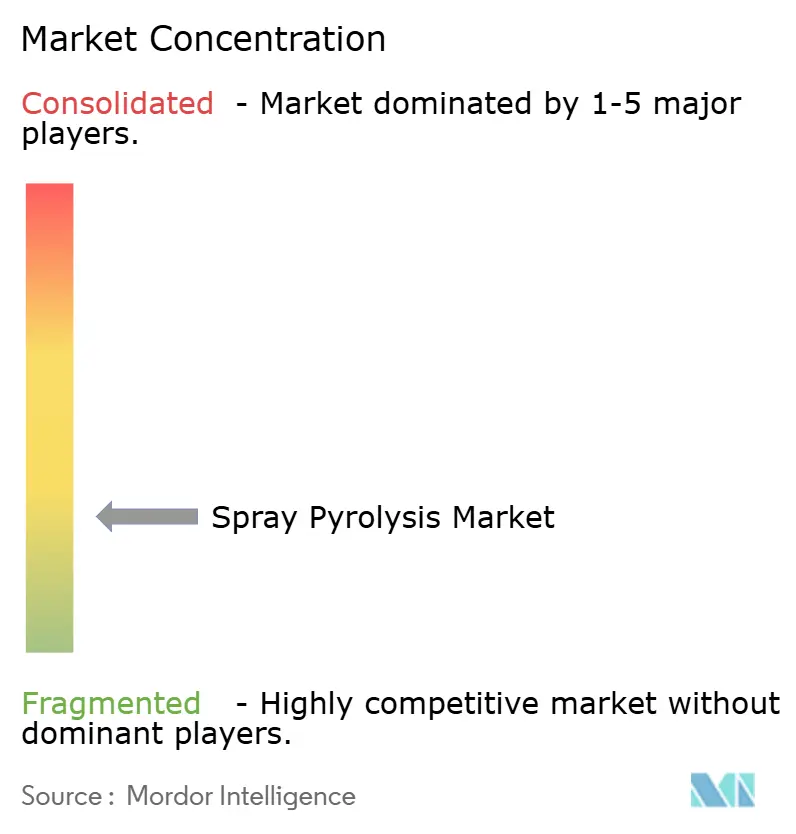
The spray pyrolysis market is highly fragmented, with the top five players including Sono-Tek Corporation, MTI Corporation, Holmarc Opto-Mechatronics Ltd., Siansonic, and Acmefil Engineering Systems Pvt. Ltd. Specialized manufacturers compete through customization, regional access, and pricing, while broader thin-film suppliers compete through automation and production capabilities. The spray pyrolysis market, therefore, combines local specialists with established equipment suppliers that have wider deposition portfolios.
Sono-Tek Corporation is moving toward higher-value production systems that integrate multi-axis robotics and Programmable Logic Controller (PLC)-based automation. It also showcased its SPT200 Photoresist Coating System with wafer handling at SEMICON West 2025 and previewed expanded support for 300 mm wafers[2]. The company received a USD 1.12 million order for a high-volume ultrasonic coating platform from a global medical diagnostics manufacturer in June 2025.
Process-control software, modular inline tools, and reactors for high-solid-loading cathode precursors are important areas for supplier differentiation. Automated process optimization can shorten recipe development, while roll-to-roll systems can serve larger perovskite module lines. Battery cathode reactors require thermal and feed control for demanding precursor chemistries. Quality management under ISO 9001 and equipment safety practices under SEMI S2 can be important for buyers in North America and Europe. The spray pyrolysis market rewards suppliers that can document repeatability and auditability alongside equipment performance.
Spray Pyrolysis Industry Leaders
-
Sono-Tek Corporation
-
MTI Corporation
-
Holmarc Opto-Mechatronics Ltd.
-
Siansonic
-
Acmefil Engineering Systems Pvt. Ltd.
- *Disclaimer: Major Players sorted in no particular order
Spray Pyrolysis Market Companies Covered in this Report
- Acmefil Engineering Systems Pvt. Ltd.
- Beneq
- Cheersonic Ultrasonic Equipments Co., Ltd.
- HANSUN ELECTRIC TECHNOLOGY CO., LIMITED
- Hielscher Ultrasonics GmbH
- Holmarc Opto-Mechatronics Ltd.
- Kurt J. Lesker Company
- MTI Corporation
- Navson Technologies Pvt. Ltd.
- Plasma-Therm LLC
- Shanghai Huashuo Intelligent Equipment Co., Ltd.
- Siansonic
- Sono-Tek Corporation
- ULVAC, Inc.
- Zhengzhou CY Scientific Instrument Co., Ltd.
Recent Industry Developments in Spray Pyrolysis Market
- October 2025: ETH Zürich’s Functional Materials Laboratory published AutoFSP, an automated robotic flame spray pyrolysis platform, in Digital Discovery, demonstrating a 2–3× reduction in operator workload, machine-readable documentation of synthesis steps, and compositional accuracy within ±5% across two orders of magnitude. The development supports the spray pyrolysis market by improving automation, reproducibility and throughput in materials synthesis for battery materials, catalysts and chromophores.
- September 2025: Sono-Tek Corporation showcased its SPT200 Photoresist Coating System with integrated wafer-handling automation at SEMICON West 2025 and previewed plans to expand support to 300 mm (12-inch) wafers. The demonstration supports the spray pyrolysis market by highlighting precision ultrasonic spray-coating capabilities for semiconductor wafer processing and advanced chip packaging, including applications that require uniform thin-film deposition.
Global Spray Pyrolysis Market Report Scope
Spray pyrolysis is a materials processing technique that uses aerosolized precursor solutions to produce thin films, powders, and functional materials through controlled thermal decomposition. The process enables the formation of materials with tailored composition and properties for research and industrial manufacturing.
The Spray Pyrolysis Market is segmented by device type, application, end-use industry, and geography. By device type, the market is segmented into ultrasonic spray pyrolysis systems, high-throughput spray pyrolysis systems, flame-assisted spray pyrolysis systems, vacuum spray pyrolysis systems, and others. By application, the market is segmented into thin and thick film deposition, nanoparticle synthesis, powder production, industrial and functional coatings, and other applications. By end-use industry, the market is segmented into electronics and semiconductors, energy and utilities, pharmaceuticals and biotechnology, chemicals and petrochemicals, and other end-use industries. The report also covers the market size and forecasts for spray pyrolysis across 15 countries. For each segment, the market sizing and forecasts have been done on the basis of value (USD).
Segmentation Overview
| Ultrasonic Spray Pyrolysis System |
| High-Throughput Spray Pyrolysis System |
| Flame-Assisted Spray Pyrolysis System |
| Vacuum Spray Pyrolysis System |
| Other Device Types |
| Thin and Thick Film Deposition |
| Nanoparticle Synthesis |
| Powder Production |
| Industrial and Functional Coatings |
| Other Applications |
| Electronics and Semiconductors |
| Energy and Utilities |
| Pharmaceuticals and Biotechnology |
| Chemicals and Petrochemicals |
| Other End-Use Industries |
| Asia-Pacific | China |
| India | |
| Japan | |
| South Korea | |
| ASEAN Countries | |
| Rest of Asia-Pacific | |
| North America | United States |
| Canada | |
| Mexico | |
| Europe | Germany |
| United Kingdom | |
| France | |
| Italy | |
| NORDIC Countries | |
| Rest of Europe | |
| South America | Brazil |
| Argentina | |
| Rest of South America | |
| Middle East and Africa | Saudi Arabia |
| South Africa | |
| Rest of Middle East and Africa |
| By Device Type | Ultrasonic Spray Pyrolysis System | |
| High-Throughput Spray Pyrolysis System | ||
| Flame-Assisted Spray Pyrolysis System | ||
| Vacuum Spray Pyrolysis System | ||
| Other Device Types | ||
| By Application | Thin and Thick Film Deposition | |
| Nanoparticle Synthesis | ||
| Powder Production | ||
| Industrial and Functional Coatings | ||
| Other Applications | ||
| By End-Use Industry | Electronics and Semiconductors | |
| Energy and Utilities | ||
| Pharmaceuticals and Biotechnology | ||
| Chemicals and Petrochemicals | ||
| Other End-Use Industries | ||
| By Geography | Asia-Pacific | China |
| India | ||
| Japan | ||
| South Korea | ||
| ASEAN Countries | ||
| Rest of Asia-Pacific | ||
| North America | United States | |
| Canada | ||
| Mexico | ||
| Europe | Germany | |
| United Kingdom | ||
| France | ||
| Italy | ||
| NORDIC Countries | ||
| Rest of Europe | ||
| South America | Brazil | |
| Argentina | ||
| Rest of South America | ||
| Middle East and Africa | Saudi Arabia | |
| South Africa | ||
| Rest of Middle East and Africa | ||
Key Questions Answered in the Report
What is the size of the spray pyrolysis market?
The spray pyrolysis market size was valued at USD 249.28 million in 2026 and is estimated to grow from USD 266.31 million in 2027 to reach USD 374.56 million by 2032, at a CAGR of 7.06% during the forecast period (2027-2032).
What is driving demand for spray pyrolysis equipment?
Thin-film solar production, battery-material scale-up, more complex semiconductor coatings, domestic materials funding, and modular pilot production support demand.
Which device type held the largest share in 2026?
Ultrasonic spray pyrolysis systems held 40.53% in 2026.
Which application is projected to grow the fastest through 2032?
Thin and thick film deposition are projected to advance at an 8.06% CAGR through 2032, supported by photovoltaic, display, and semiconductor coating uses.