
Specialty Polystyrene Resin Market Size and Share
Market Overview
| Study Period | 2021 - 2031 |
|---|---|
| Market Size (2026) | USD 142.74 Million |
| Market Size (2031) | USD 164.44 Million |
| Growth Rate (2026 - 2031) | 2.87 % |
| Fastest Growing Market | Asia-Pacific |
| Largest Market | Asia-Pacific |
| Market Concentration | Low |
Major Players *Disclaimer: Major Players sorted in no particular order Image © Mordor Intelligence. Reuse requires attribution under CC BY 4.0. | |
Specialty Polystyrene Resin Market Analysis by Mordor Intelligence
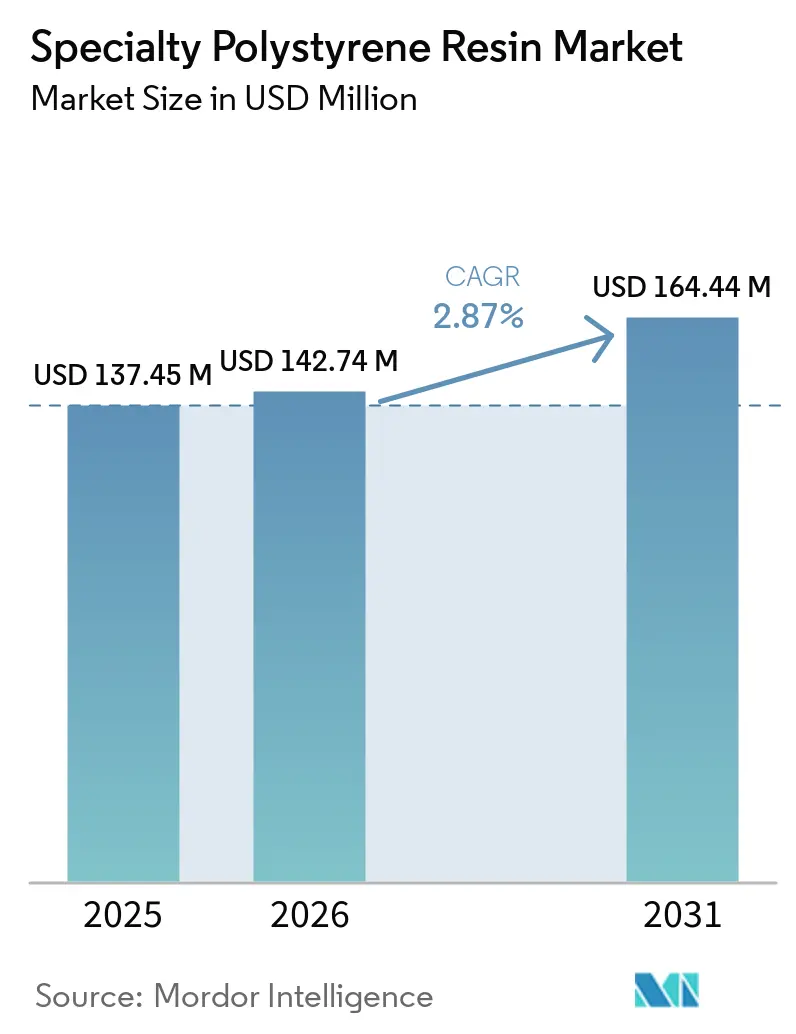
The specialty polystyrene resin market size was valued at USD 137.45 million in 2025 and is estimated to grow from USD 142.74 million in 2026 to reach USD 164.44 million by 2031, at a CAGR of 2.87% during the forecast period (2026-2031). The specialty polystyrene resin market is shifting toward grades that meet specific performance and certification requirements, rather than competing solely on resin output. Demand for graphite-infused, bio-attributed, and recycled-content grades is increasing as converters require materials that provide insulation, shock absorption, and traceable recycled content. Packaging restrictions are reducing demand for commodity foodservice applications, while building energy regulations, cold-chain requirements, and higher-performance logistics requirements are supporting specialty applications. Producers are rationalizing capacity, qualifying recycled content, and expanding targeted high-performance insulation capacity. This shift supports product value in the specialty polystyrene resin market, even as overall polystyrene resin output remains under pressure.
Key Report Takeaways
- By function, protection accounted for 42.34% of the specialty polystyrene resin market share in 2025, and is forecast to grow at a 3.24% CAGR through 2031.
- By application, protective packaging accounted for 39.56% of specialty polystyrene resin market share in 2025, while healthcare is forecast to grow at a 3.45% CAGR through 2031.
- By geography, Asia-Pacific accounted for 39.41% of the specialty polystyrene resin market share in 2025 and is projected to expand at a 3.31% CAGR through 2031.
Note: Market size and forecast figures in this report are generated using Mordor Intelligence’s proprietary estimation framework, updated with the latest available data and insights as of January 2026.
Global Specialty Polystyrene Resin Market Trends and Insights
Drivers Impact Analysis*
| Drivers | (~) % Impact on CAGR Forecast | Geographic Relevance | Impact Timeline |
|---|---|---|---|
| Growth in protective and thermal packaging demand | +0.7% | Global, with Asia-Pacific at the core and effects in North America and Europe | Medium term (2-4 years) |
| Energy-efficiency requirements in buildings | +0.8% | Europe, North America, and high-growth Asia-Pacific cities | Long term (≥ 4 years) |
| Healthcare and cold-chain packaging adoption | +0.6% | Global, with concentration in North American, European, and Asia-Pacific biopharma corridors | Medium term (2-4 years) |
| Lightweighting and impact-performance requirements in transportation | +0.4% | North American, European, and Asia-Pacific automotive manufacturing hubs | Long term (≥ 4 years) |
| Recycled-content qualification for food-contact and medical grades | +0.3% | Europe, with early adoption in North America | Short term (≤ 2 years) |
| Source: Mordor Intelligence | |||
Growth in Protective and Thermal Packaging Demand
Protective and thermal packaging supports demand for specialty expanded polystyrene (EPS) as direct-to-consumer distribution increases handling requirements for fragile and temperature-sensitive goods. Electronics, appliances, and industrial components require molded inserts with controlled shock absorption, differentiating specialty grades from standard bulk foam. The specialty polystyrene resin market also benefits from distributors’ need for lightweight, insulated packaging for last-mile delivery and air freight. Graphite-enhanced EPS provides thermal performance with thinner walls, reducing package weight while maintaining the required thermal payload. Japan recorded 111,000 tons of EPS shipments in 2025, with fisheries, agriculture, and protective logistics accounting for most shipments. This shipment pattern indicates that protective containers and cold-box applications remain relevant, even as electronics conversion slows.
Energy-Efficiency Requirements in Buildings
Building energy codes make insulation-grade specialty polystyrene resin a specified material rather than a discretionary construction input. The recast Energy Performance of Buildings Directive requires EU member states to establish minimum energy performance standards for new buildings and major renovations. These requirements support renovation activity across Europe’s aging building stock and generate recurring demand for insulation materials. Japan’s construction-material EPS shipments totaled 16,332 tons in 2025, an increase of 100.5% from the previous year, as highly insulated housing specifications gained adoption. BASF states that Neopor provides up to 30% better insulation performance per unit thickness than standard white EPS and is adding 55,116 tons of annual capacity at Ludwigshafen, with start-up targeted for early 2027. These factors enable the specialty polystyrene resin market to capture higher resin value in applications where insulation performance is more important than material use.
Healthcare and Cold-Chain Packaging Adoption
Temperature-sensitive pharmaceuticals, biologics, and clinical trial materials require passive shippers that meet validated temperature-control requirements during transit. EPS provides consistent thermal insulation and can be molded around defined payload sizes, supporting its use in controlled distribution systems. The opportunity is becoming increasingly specialized as pharmaceutical supply chains require tighter tolerances and documented packaging performance. Recycled-content qualification adds another procurement requirement, particularly when food-contact or medical-contact packaging must comply with regulatory standards for recycled plastics. This trend favors producers that can combine thermal performance, recycled content, and documentation capabilities for regulated customers.
Lightweighting and Impact-Performance Requirements in Transportation
Transportation applications drive demand for specialty polystyrene resin, where low weight and predictable energy absorption are required simultaneously. EPS is used in bumper energy absorbers, door-panel inserts, headrests, and child-seat energy-management systems because it can meet specific density and shape requirements. Electric vehicle designs also create applications for battery-module separators and floor-cavity fillers that provide thermal management and impact protection. These applications require tighter density control than standard packaging grades and can command higher specifications. Automotive and electronics supply chains across Asia-Pacific, North America, and Europe generate recurring demand for precision-molded foam components. Therefore, the specialty polystyrene resin market benefits from material selection decisions that prioritize safety, weight reduction, and consistent molded geometry.
Restraints Impact Analysis*
| Restraints | (~) % Impact on CAGR Forecast | Geographic Relevance | Impact Timeline |
|---|---|---|---|
| Single-use plastic restrictions and waste-management requirements | -0.5% | Europe, North America, and emerging Asia-Pacific jurisdictions | Short term (≤ 2 years) |
| Volatile styrene and hydrocarbon feedstock costs | -0.3% | Global, with acute exposure in Europe and Southeast Asia | Short term (≤ 2 years) |
| Collection density gaps for low-density EPS and specialty-grade recycling | -0.2% | Europe and North America, with effects in the Asia-Pacific | Medium term (2-4 years) |
| Source: Mordor Intelligence | |||
Single-Use Plastic Restrictions and Waste-Management Requirements
Restrictions on single-use expanded polystyrene (EPS) have reduced demand from large-scale foodservice applications and increased compliance costs for converters. By May 2025, at least 12 U.S. states had enacted statewide bans on EPS foodware, and New York extended its prohibition to polystyrene cold-storage containers effective January 1, 2026[1]New York State Department of Environmental Conservation, “DEC Reminds New Yorkers of Expanded Waste Reduction Laws Taking Effect January 1, 2026,” NYSDEC Press Release, dec.ny.gov.. The European Union has restricted the use of expanded polystyrene food and beverage containers under the Single-Use Plastics Directive since 2021. The Packaging and Packaging Waste Regulation took effect across the EU on August 12, 2026, introducing recyclability requirements and phasing in recycled-content obligations by 2030. Lower foodservice demand may shift producer capacity toward insulation and healthcare grades, potentially affecting specialty-material pricing. However, gaps in low-density EPS collection remain a constraint, as recycled-grade supply depends on adequate collection density and sorting capabilities.
Volatile Styrene and Hydrocarbon Feedstock Costs
Volatility in styrene monomer costs creates margin risk for specialty producers serving contract customers in healthcare and automotive applications. Benzene price pressure during the first quarter of 2026 affected styrene monomer markets and prompted increases in European polystyrene prices. Producers may face challenges in passing through rapid changes in input costs when customer contracts have fixed terms or require lengthy qualification cycles. This challenge is greater for smaller producers that lack integrated upstream feedstock positions. As a result, the specialty polystyrene resin market may consolidate around companies that can manage feedstock exposure across broader petrochemical portfolios. Price volatility also complicates procurement planning for converters that require stable supplies of qualified specialty grades.
*Our forecasts treat driver/restraint impacts as directional, not additive. The impact forecasts reflect baseline growth, mix effects, and variable interactions.
Segment Analysis
By Function: Protection Grades Lead Demand Through Dual-Use Performance
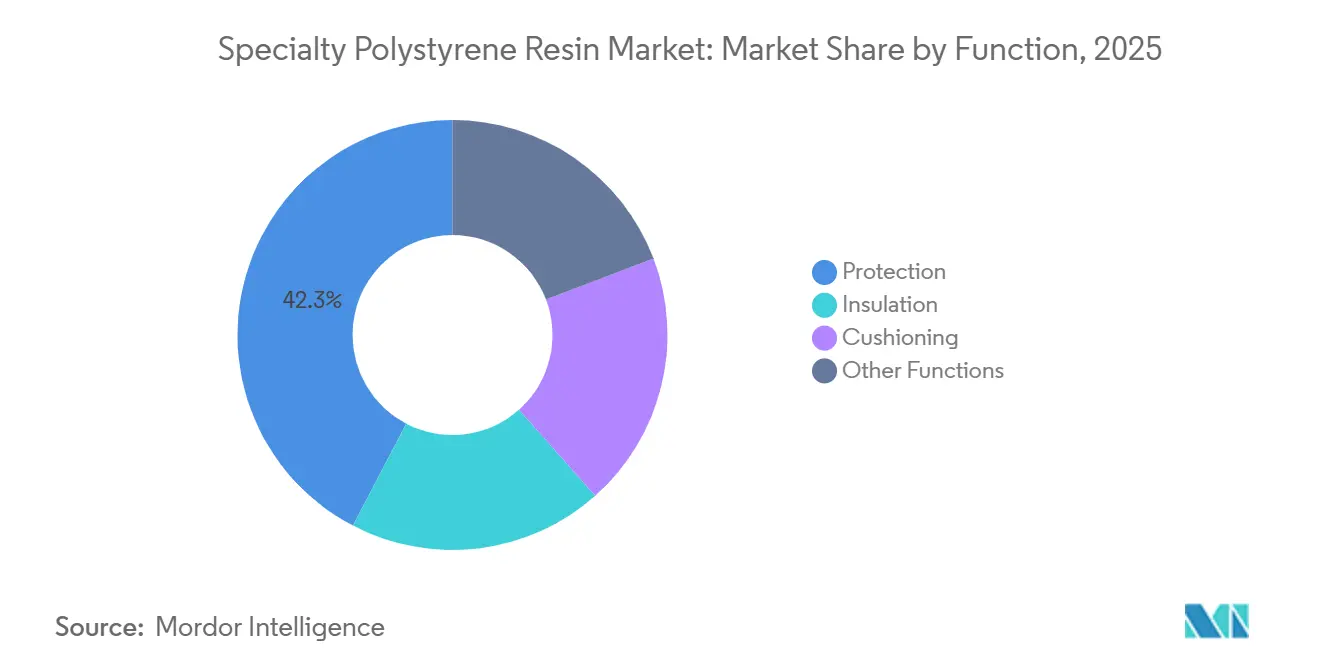
Protection accounted for 42.34% of the specialty polystyrene resin market share in 2025, making it the largest functional category. The specialty polystyrene resin market for protection is projected to expand at a CAGR of 3.24% from 2026 to 2031. This position reflects demand for shock-absorbing materials in protective packaging and safety-related transportation components. Specialty EPS protection grades are replacing alternative materials in applications that require precise weight, density, and energy-absorption characteristics. The category also benefits from the shift from bulk foam grades to precision-molded products, which can support higher value realization.
Cushioning grades primarily serve the electronics and appliances industries, where pack-out specifications require dimensional accuracy and high surface quality. These requirements differentiate specialty materials from commodity resin grades used in less demanding applications. Other functional applications include EPS geofoam for civil engineering, lightweight architectural profiles, and specialty horticultural containers. The functional mix is also shifting toward gray and recycled-content variants as brands incorporate sustainability requirements into procurement specifications. This shift can sustain per-unit resin value, even when demand growth remains limited.



By Application: Healthcare Expands Faster as Regulated Uses Grow
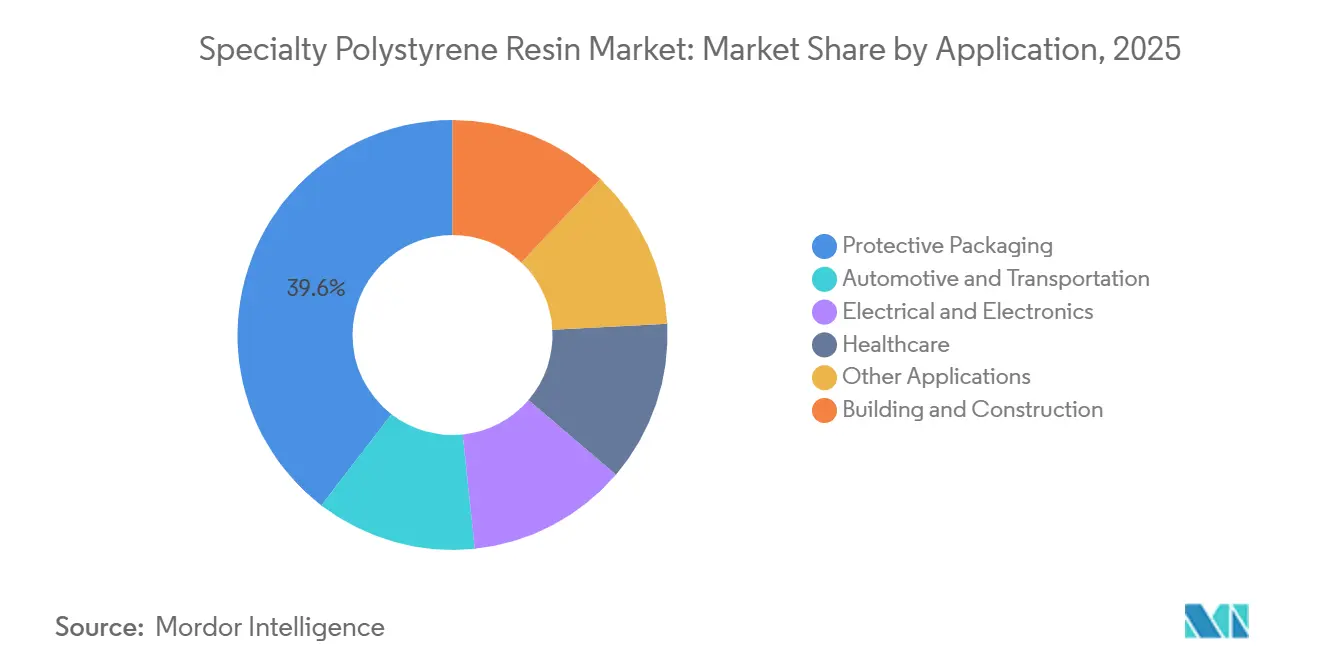
Protective packaging held 39.56% of the specialty polystyrene resin market share in 2025, supported by demand for molded inserts used in electronics and appliances. Established supply chains account for a significant share of the application’s size, while e-commerce generates additional demand across Asia-Pacific. However, foodservice restrictions and material substitution in consumer goods offset part of this growth in advanced economies. Healthcare is projected to grow at a CAGR of 3.45% from 2026 to 2031, making it the fastest-growing application. Temperature-sensitive pharmaceutical distribution, biologics cold chains, and clinical trial logistics are driving demand for validated passive EPS shippers.
Building and construction remain relevant, as insulation-grade EPS can be integrated into building envelopes through long-term renovation programs. Automotive and transportation applications include safety systems, door panels, and thermal-management components for electric vehicles. Electrical and electronics customers require custom-density and anti-static EPS packaging for components with stringent vibration-damping requirements. Evaluation and authorization requirements for recycled food-contact materials create an additional barrier for compliant recycled polystyrene grades. The specialty polystyrene resin market can therefore differentiate recycled-content materials based on regulatory compliance and performance.
Geography Analysis
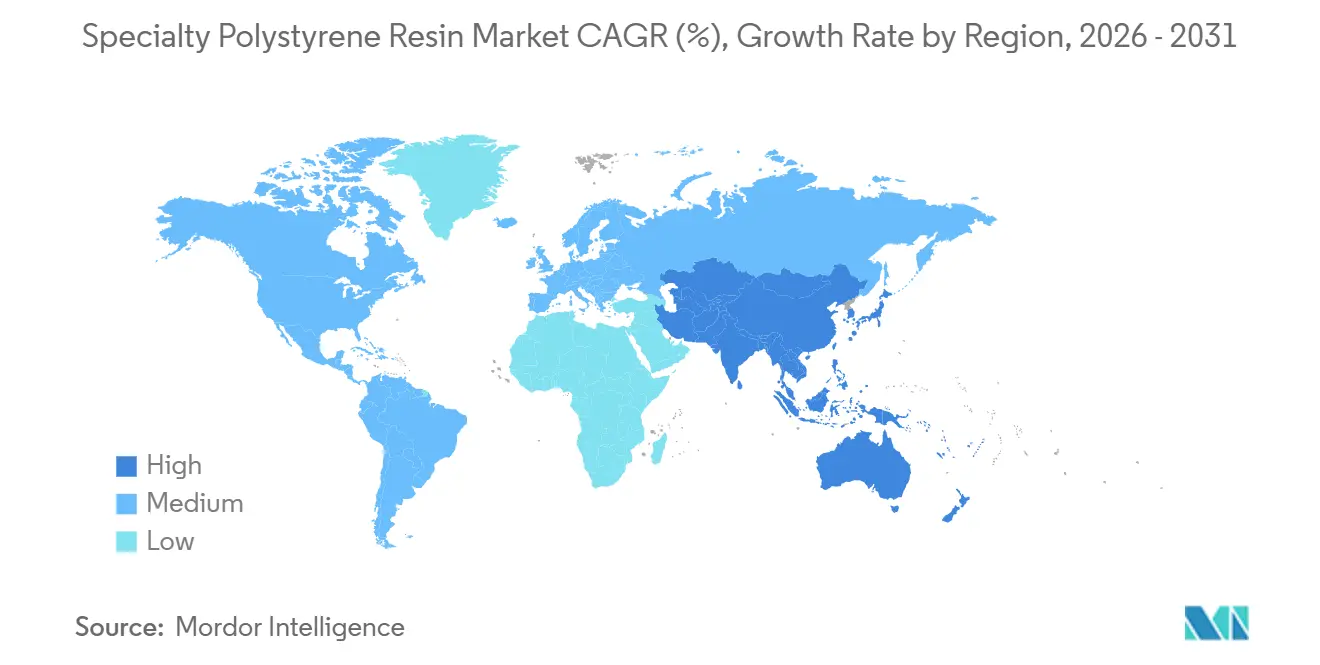
Asia-Pacific accounted for 39.41% of the specialty polystyrene resin market share in 2025 and is projected to expand at a CAGR of 3.31% through 2031. China remains the primary national demand center, supported by applications in e-commerce, protective packaging, and construction insulation. Although commodity polystyrene oversupply has weakened overall pricing, performance grades continue to see demand from sectors where multinational brands and healthcare supply chains require qualified materials. India also contributes to demand through residential construction and energy-efficient housing projects.
North America and Europe are mature markets with distinct regulatory frameworks and construction demand patterns. In the United States, foodservice restrictions are reducing demand for commodity grades, while energy-efficient home programs support demand for insulation grades. The European specialty polystyrene resin market is supported by requirements under the Energy Performance of Buildings Directive (EPBD) and the use of Expanded Polystyrene (EPS) in external thermal insulation composite systems. European Manufacturers of EPS (EUMEPS) identifies EPS-based external thermal insulation composite systems as a means of reducing thermal bridges and heating demand[2]EUMEPS, “ETICS with EPS,” EUMEPS, eumeps.eu.. The Packaging and Packaging Waste Regulation is also increasing the importance of recycled-content and recyclability requirements in European packaging procurement.
South America, the Middle East, and Africa represent smaller demand regions for specialty resin grades. Brazil and Argentina support demand for construction insulation and protective packaging as awareness of residential energy efficiency and e-commerce adoption increases. Saudi Arabia’s construction activity supports demand as insulation specifications continue to evolve. In South Africa, the pharmaceutical distribution network supports demand for validated cold-chain shippers in the specialty polystyrene resin market.

Competitive Landscape
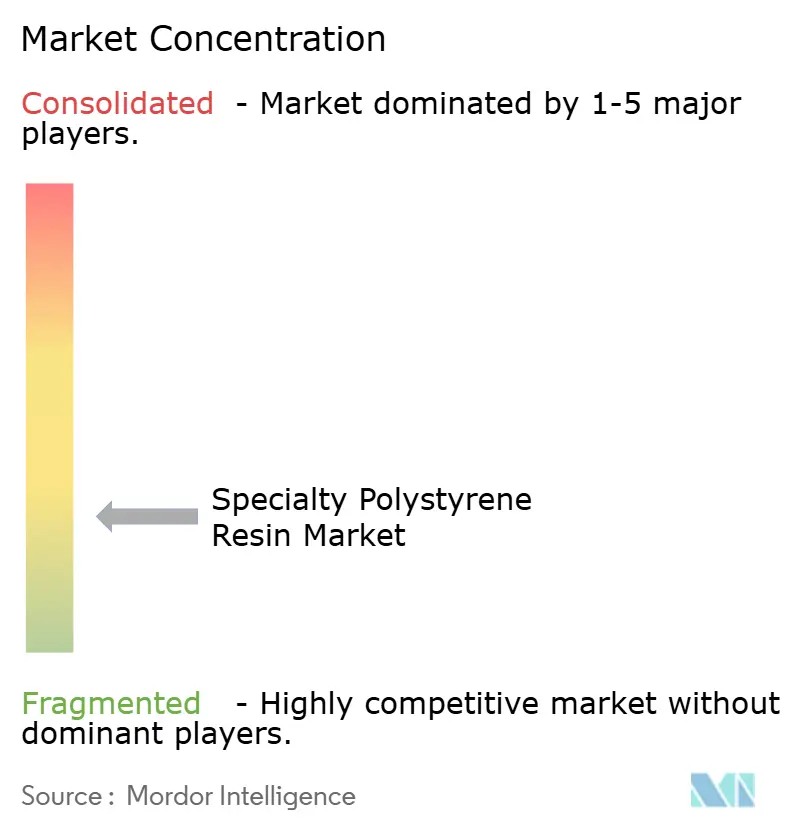
The specialty polystyrene resin market is fragmented, with key participants including BASF, INEOS Styrolution, Trinseo, Versalis S.p.A., LG Chem, and TotalEnergies. Regional EPS processors and specialty compounders, such as BEWI, Synthos, SUNPOR, and Epsilyte, further fragment the mid-tier competitive landscape. Competition in 2025 and 2026 centers on the qualification of recycled-content grades for food-contact and medical-contact applications. These grades require traceability and compliance documentation, creating barriers to entry for new suppliers. Producers that meet these requirements can address customer procurement mandates that combine material-performance specifications with recycled-content targets in the specialty polystyrene resin market.
Versalis inaugurated a mechanical recycling plant at Porto Marghera in March 2025, with a capacity of up to 20,000 tons per year of recycled crystal and expandable polystyrene. In October 2024, BASF committed to expanding Neopor capacity at Ludwigshafen by 50,000 tons per year, with the additional capacity scheduled to begin operations in early 2027. AmSty made its first commercial sales of PolyRenew certified recycled styrene through an International Sustainability and Carbon Certification (ISCC) PLUS-verified mass-balance approach in 2025. These developments indicate that the specialty polystyrene resin market is expanding, with recycled-feedstock supply and high-performance insulation capacity in parallel. They also enable downstream producers to offer certified recycled content without having to establish recycling capabilities at each site.
Capacity rationalization is occurring alongside investment in differentiated grades. Older commodity assets continue to face pressure from oversupply and legacy cost structures, while suppliers direct capital toward specialty applications with higher margins. Food-contact and medical recycled-content grades require extended qualification periods, as regulatory approval processes and customer validation requirements can be lengthy. The competitive landscape remains moderately concentrated, with a small group of integrated producers leading specialty capacity while regional processors retain an important role.
Specialty Polystyrene Resin Industry Leaders
BASF
Synthos
NOVA Chemicals Corporate
INEOS
Trinseo
- *Disclaimer: Major Players sorted in no particular order

Recent Industry Developments
- June 2026: INEOS Styrolution announced the permanent closure of its polystyrene production facility in Channahon, Illinois, with decommissioning scheduled for Q4 2026. The facility has an annual production capacity of approximately 441,000 tons and has operated for more than 60 years.
- March 2025: Versalis, Eni’s chemical subsidiary, inaugurated a mechanical recycling plant in Porto Marghera, Italy. The plant has an annual production capacity of up to 22,000 tons of recycled crystal polystyrene (r-GPPS) and recycled expandable polystyrene (r-EPS), using post-consumer EPS waste as feedstock.


Global Specialty Polystyrene Resin Market Report Scope
Specialty polystyrene resin is an advanced, high-performance polystyrene plastic engineered with specialized additives or copolymers to meet stringent technical, mechanical, and thermal requirements.
The specialty polystyrene resin market is segmented by function, application, and geography. By function, the market is segmented into protection, insulation, cushioning, and other functions. By application, the market is segmented into protective packaging, building and construction, automotive and transportation, electrical and electronics, healthcare, and other applications. The report also covers market size and forecasts for specialty polystyrene resin across 15 countries in major regions. The market sizes and forecasts are provided in terms of value (USD).
| Protection |
| Insulation |
| Cushioning |
| Other Functions |
| Protective Packaging |
| Building and Construction |
| Automotive and Transportation |
| Electrical and Electronics |
| Healthcare |
| Other Applications |
| Asia-Pacific | China |
| India | |
| Japan | |
| South Korea | |
| Rest of Asia-Pacific | |
| North America | United States |
| Canada | |
| Mexico | |
| Europe | Germany |
| United Kingdom | |
| France | |
| Italy | |
| Rest of Europe | |
| South America | Brazil |
| Argentina | |
| Rest of South America | |
| Middle East and Africa | Saudi Arabia |
| South Africa | |
| Rest of Middle East and Africa |
| By Function | Protection | |
| Insulation | ||
| Cushioning | ||
| Other Functions | ||
| By Application | Protective Packaging | |
| Building and Construction | ||
| Automotive and Transportation | ||
| Electrical and Electronics | ||
| Healthcare | ||
| Other Applications | ||
| By Geography | Asia-Pacific | China |
| India | ||
| Japan | ||
| South Korea | ||
| Rest of Asia-Pacific | ||
| North America | United States | |
| Canada | ||
| Mexico | ||
| Europe | Germany | |
| United Kingdom | ||
| France | ||
| Italy | ||
| Rest of Europe | ||
| South America | Brazil | |
| Argentina | ||
| Rest of South America | ||
| Middle East and Africa | Saudi Arabia | |
| South Africa | ||
| Rest of Middle East and Africa | ||


Key Questions Answered in the Report
What is current market size of Specialty Polystyrene Resin Market?
The specialty polystyrene resin market size was valued at USD 137.45 million in 2025 and is estimated to grow from USD 142.74 million in 2026 to reach USD 164.44 million by 2031, at a CAGR of 2.87% during the forecast period (2026-2031).
Which function held the largest share in 2025?
Protection held a 42.34% share in 2025 and is projected to grow at a 3.24% CAGR through 2031.
Which application is expected to grow fastest through 2031?
Healthcare is expected to record the fastest application CAGR at 3.45%, supported by validated cold-chain distribution needs.
Which region leads in demand for specialty polystyrene resin?
Asia-Pacific led with 39.41% share in 2025 and is forecast to expand at a 3.31% CAGR through 2031.
Page last updated on:





