
Spain Wire and Cable Market Size and Share
Market Overview
| Study Period | 2020 - 2031 |
|---|---|
| Forecast Data Period | 2026 - 2031 |
| Base Year Market Size (2025) | USD 0.95 Billion |
| Market Size (2026) | USD 1.01 Billion |
| Market Size (2031) | USD 1.27 Billion |
| Growth Rate (2026 - 2031) | 4.69 % |
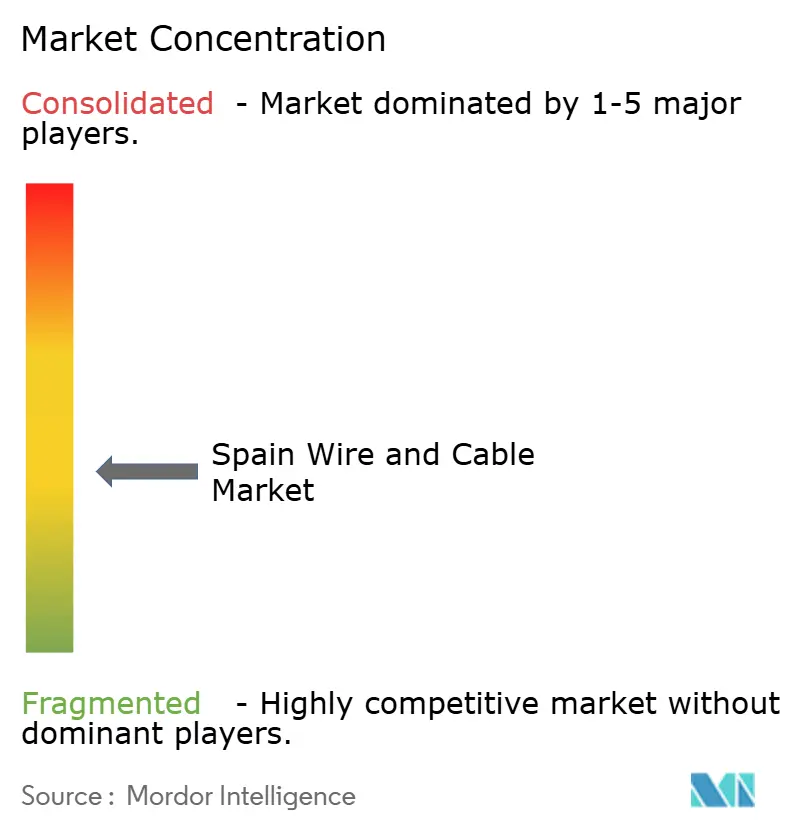
| Market Concentration | Medium |
Major Players *Disclaimer: Major Players sorted in no particular order Image © Mordor Intelligence. Reuse requires attribution under CC BY 4.0. | |
Spain Wire and Cable Market Analysis by Mordor Intelligence
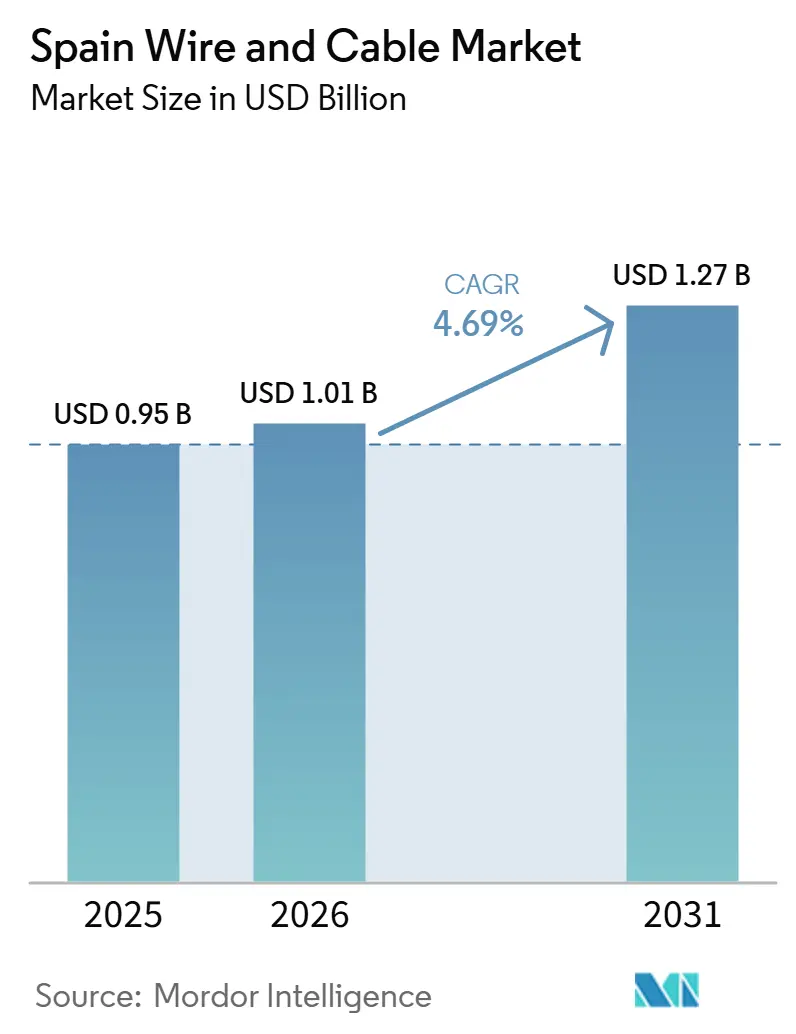
The Spain wire and cable market size was valued at USD 0.95 billion in 2025 and is estimated to grow from USD 1.01 billion in 2026 to reach USD 1.27 billion by 2031, at a CAGR of 4.69% during the forecast period (2026-2031). Renewable grid reinforcement, broadband expansion, and digital infrastructure investment support demand nationwide. Public and private investment have created a more stable demand base than in several Western European construction-led markets. Industrial cable revenue increased 9.2% in 2025, which indicated stronger spending on factory automation and electrification. Utilities add volume demand, while data center projects require higher-specification products and can lift revenue per installed kilometer. Copper prices and permitting delays remain immediate constraints, although the updated permitting rules could bring stalled renewable projects into procurement pipelines.
Key Report Takeaways
- By voltage, low-voltage cables held 42.11% of the Spain wire and cable market share in 2025, while extra- and high-voltage cables are projected to expand at a 5.12% CAGR through 2031.
- By cable type, power cables accounted for 33.12% of Spain wire and cable market share in 2025, while fiber-optic cables are expected to grow at a 6.11% CAGR through 2031.
- By conductor material, copper conductors held 51.22% share in 2025, while aluminum conductors are projected to record a 5.65% CAGR through 2031.
- By 2025, underground cables accounted for 49.87% of the market share, while submarine cables are expected to grow at a 6.12% CAGR through 2031.
- By end-user vertical, power infrastructure, including utilities and renewables, held 27.76% share in 2025, while telecommunications and data centers are projected to grow at a 6.98% CAGR through 2031.
- By insulation, insulated cables held 79.11% share in 2025 and are projected to remain the fastest-growing category at a 7.01% CAGR through 2031.
Note: Market size and forecast figures in this report are generated using Mordor Intelligence’s proprietary estimation framework, updated with the latest available data and insights as of January 2026.
Spain Wire and Cable Market Trends and Insights
Drivers Impact Analysis*
| DRIVER | (~) % IMPACT ON CAGR FORECAST | GEOGRAPHIC RELEVANCE | IMPACT TIMELINE |
|---|---|---|---|
| Renewable Generation and Grid Reinforcement | +1.6% | National, concentrated in Andalusia, Castile-La Mancha, and Aragon | Short term (≤ 2 years) |
| Fiber-to-the-Home and 5G Network Expansion | +0.9% | National, with early gains in Madrid, Barcelona, and Valencia | Short term (≤ 2 years) |
| Electrification of Transport and Charging Infrastructure | +0.7% | National, concentrated along the peninsular highway corridors | Medium term (2-4 years) |
| Data Center and Industrial Digitalization Investments | +0.6% | Aragon, Madrid, Catalonia, and Andalusia | Medium term (2-4 years) |
| EU-Funded Cross-Border and Island Interconnections | +0.4% | Canary Islands, Balearic Islands, and northern border zones with France and Portugal | Long term (≥ 4 years) |
| Premiumization Toward Fire-Safe and Low-Smoke Cables | +0.2% | National, driven by CPR compliance mandates across building and transit sectors | Medium term (2-4 years) |
| Source: Mordor Intelligence | |||
Renewable Generation and Grid Reinforcement
The Spain wire and cable market entered a higher investment cycle as Redeia committed EUR 1.551 billion (USD 1.71 billion) to the transmission grid in 2025, a 40.4% increase from 2024. The national 2025-2030 plan targets EUR 13.59 billion (USD 14.95 billion) in transmission spending, 66% above the prior five-year plan.[1]Redeia, “Redeia Smashes Its Investment Record With EUR 1.551 Billion to Enable the Energy Transition in Spain,” Redeia, redeia.com The European Investment Bank financed EUR 1.9 billion (USD 2.09 billion) in Spanish grid projects during 2025.[2]European Investment Bank, “Spanish Ministry of Economy and EIB to Finance Naturgy With EUR 870 Million to Reinforce and Digitalise Electricity Grids,” European Investment Bank, eib.org The July 2026 network update extended the plan to 6,700 km of new transmission lines and increased the number of grid positions for large energy-intensive users by 12%. Solar-heavy areas, including Andalusia and Aragon, increasingly require XLPE-insulated, aluminum-sheathed extra-high-voltage products that can withstand sustained thermal loads. This specification shift raises the value of each installed kilometer for suppliers serving transmission projects.
Fiber-to-the-Home and 5G Network Expansion
The Spain wire and cable market benefits from more than 18 million active FTTH lines in March 2026, representing over 91% of fixed broadband connections. PremiumFiber began operating in December 2025 as a joint venture of MasOrange, Vodafone Spain, and GIC, with coverage of more than 12 million FTTH premises. The structure treats fiber infrastructure as a shared wholesale asset rather than a network duplicated by every operator. This approach can favor high-fiber-count, small-diameter assemblies when operators add capacity to common routes. Such products can command a higher value than conventional single-mode cable used in simple access deployment. The expansion of 5G backhaul also supports demand for fiber routes in Madrid, Barcelona, Valencia, and other densely populated urban areas.
Electrification of Transport and Charging Infrastructure
Spain had 56,181 operational public charging points in June 2026, and fast chargers in the 50-150 kW range increased by nearly 21% during the year. MITECO awarded EUR 104.8 million (USD 119.6 million) for 341 fast-charging corridor projects and fleet electrification programs in June 2026. The program targets 2,674 additional charging points with a minimum capacity of 150 kW.[3]Ministerio para la Transición Ecológica y el Reto Demográfico, “El MITECO Concede Otros 104 Millones en Ayudas a la Movilidad Eléctrica,” MITECO, miteco.gob.es A high-power station typically needs a dedicated medium-voltage run, low-voltage distribution wiring, and separate signal and control cables. This creates several cable requirements at each site, unlike standard residential charging installations. Highway corridors and fleet depots, therefore, offer demand beyond conventional building wiring.
Data Center and Industrial Digitalization Investments
Amazon confirmed a total investment of EUR 33.7 billion (USD 39.8 billion) for its AWS Europe Spain Region in Aragon.[4]Amazon, “Amazon Increases Spain Investment to EUR 33.7 Billion,” Amazon, aboutamazon.com The program includes data center operations and related supply-chain employment. Large data centers require fiber assemblies for core connectivity, medium-voltage XLPE power cables for equipment feeds, and dense signal and control wiring for cooling and fire systems. These requirements make hyperscale facilities unusually cable-intensive for their footprint. Industrial digitalization also supports demand for industrial Ethernet, fieldbus, control, and machine wiring products. Aragon, Madrid, Catalonia, and Andalusia remain important locations because they combine power availability, industrial capacity, and digital infrastructure projects.
Restraints Impact Analysis*
| RESTRAINT | (~) % IMPACT ON CAGR FORECAST | GEOGRAPHIC RELEVANCE | IMPACT TIMELINE |
|---|---|---|---|
| Copper and Aluminum Price Volatility | -0.8% | Global supply chain, with direct cost pass-through to Spanish cable manufacturers | Short term (≤ 2 years) |
| Permitting Delays and Grid Congestion | -0.6% | National, most acute in Andalusia, Castile-La Mancha, and Catalonia | Short term (≤ 2 years) |
| Construction Cyclicality and Residential Demand Normalization | -0.4% | National, concentrated in metropolitan construction markets | Medium term (2-4 years) |
| Skilled Installation Capacity Constraints | -0.3% | National, most acute in remote renewable energy corridors | Medium term (2-4 years) |
| Source: Mordor Intelligence | |||
Copper and Aluminum Price Volatility
The copper-to-aluminum price ratio reached 4.3x in January 2026 and remained close to 4.2x in late June. This level exceeded the 3.5x-4.0x range at which cable buyers typically reconsider material choices. Prysmian reported that aluminum accounted for around 40% of its cable content by weight, up 3 percentage points over the past 5 years. Material substitution can reduce revenue from copper-intensive products, even when physical cable volumes remain stable. Spanish manufacturers also face costs related to adapting stranding and annealing lines for aluminum alloy conductors. Smaller domestic producers may struggle to absorb these investments without accepting pricing pressure.
Permitting Delays and Grid Congestion
Spain’s renewable pipeline has advanced faster than grid access and administrative approvals. Distribution grid nodes were saturated in 2024, while only 4.5 GW of the 40 GW requested in 2025 was connected. Royal Decree-Law 7/2026 introduced milestone-based deadlines, including the payment of 10% of connection works within 12 months after permit issuance. Projects that fail to meet these requirements can lose their permits. A project with grid access but without environmental or building clearance does not convert into a cable order. This gap can extend procurement lead times and defer revenue recognition for cable suppliers.
*Our forecasts treat driver/restraint impacts as directional, not additive. The impact forecasts reflect baseline growth, mix effects, and variable interactions.
Segment Analysis
By Voltage: Low-Voltage Demand Supports Daily Cable Volumes
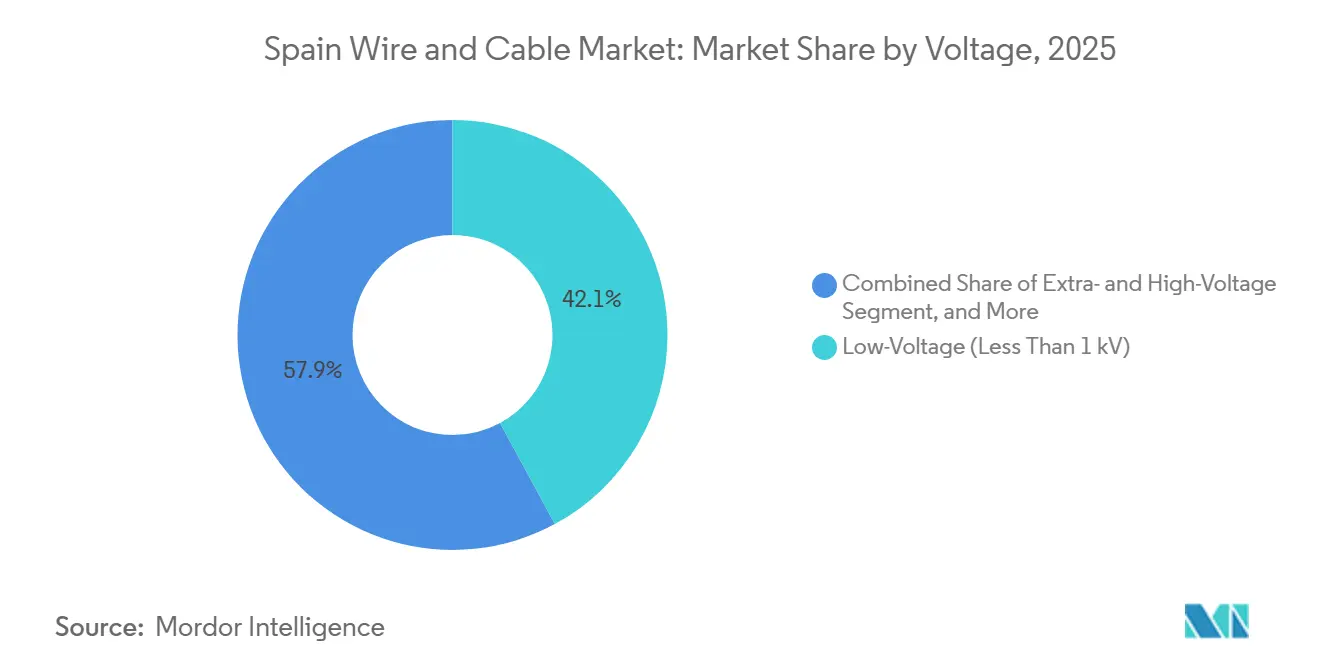
Low-voltage cables held 42.11% of total sector revenue in 2025, supported by residential wiring, commercial fit-outs, machine wiring, and EV charging distribution circuits. The Spain wire and cable market serves the broadest base of everyday electrical activity. Residential projects require building wire, while commercial facilities need power, control, and safety-related wiring. Industrial customers use the same voltage tier for machinery, internal distribution, and retrofit work. These varied uses make the category less dependent on a single project type. Medium-voltage cables connect substations with industrial parks, logistics sites, large commercial facilities, and renewable collection networks. The Balearic Islands' allocation of EUR 1.169 billion (USD 1.29 billion) under the grid plan supports the procurement of medium-voltage equipment for island reinforcement. Island projects offer demand that is less tied to mainland residential construction activity.
Extra- and high-voltage cables are projected to record a 5.12% CAGR through 2031, making this the fastest-growing voltage tier. Redeia invested EUR 1.424 billion (USD 1.57 billion) in transmission grid development and reinforcement during 2025. The Spain wire and cable market size for this tier benefits from the planned 6,700 km network expansion through 2030. The Bay of Biscay HVDC link will connect Gatika in Spain with Cubnezais in France through a 300 km, 400 kV submarine cable system. The link is scheduled to become operational in 2028. Such work requires specialized DC cable compounds and dedicated subsea installation capacity. Only a limited group of global manufacturers can fulfill those requirements. This creates a different competitive setting from the low-voltage segment.



By Cable Type: Fiber-Optic Cables Gain from Network Expansion
Power cables accounted for 33.12% of total sector revenue in 2025 and served applications from household circuits to major transmission systems. Their role across the voltage range makes them the largest cable-type category. Demand comes from new installations, maintenance work, and replacement needs. Utilities purchase large volumes for network development. Construction users need products for buildings and commercial facilities. Renewable projects require cables for collection, distribution, and connection. This wide range of uses keeps power cables central to the sector's total revenue. Signal and control products support industrial automation and building management systems.
Fiber-optic cables are forecast to expand at a 6.11% CAGR through 2031, supported by broadband and data center infrastructure. The active FTTH base exceeded 18 million lines in March 2026. PremiumFiber began with coverage of more than 12 million premises and continues to add duct capacity for wholesale demand. Network-sharing agreements can lead to added cable purchases when joint infrastructure needs more capacity. Coaxial and data cables continue to lose share as fiber replaces copper-based coaxial broadband designs. Data centers use high-fiber-count and compact optical assemblies that exceed typical FTTH performance requirements. This creates a higher-value optical category within the telecommunications and data centers vertical. The type mix increasingly reflects the importance of digital infrastructure in the Spain wire and cable market.
By Conductor Material: Copper Retains Its Position as Aluminum Use Rises
Copper conductors accounted for 51.22% of the conductor material segment in 2025, as their conductivity remains important in precision applications. EV charging systems use copper where performance and compact installation matter. Data center power distribution also relies on copper-intensive solutions in many locations. Signal-sensitive control wiring requires dependable electrical performance. The material is therefore important in electronics, power quality, and specialized industrial applications. Optical glass and polymer conductors serve the fast-growing fiber-optic part of the sector. The overall material mix reflects both high-specification uses and cost-sensitive infrastructure requirements.
Aluminum conductors are projected to grow at a 5.65% CAGR through 2031 as the copper-to-aluminum ratio remains near 4.2x. The pricing relationship has pushed developers and grid operators to reconsider conductor specifications. Aluminum is useful where weight and cost are more important than compact size. Large transmission projects increasingly use aluminum for overhead spans. Underground high-voltage projects also use aluminum alloy conductors in selected applications. This change favors producers with modern aluminum stranding capability. Suppliers optimized only for copper drawing may need additional investment to meet the new requirements. Material selection is therefore becoming a practical source of competitive differentiation across the Spain wire and cable market.
By Installation: Underground Networks Lead as Submarine Links Expand
Underground cables accounted for 49.87% of the installation segment in 2025, reflecting planning preferences in populated and environmentally sensitive areas. Burying cables can reduce visual impacts and minimize conflicts with land use. It is common in urban projects and in selected transmission corridors. Underground routes also support resilience objectives in areas where exposure is a concern. The 2021-2026 grid plan included upgrades to 8,000 km of existing network and 700 km of new submarine connections. This provided a base for installation spending that the newer plan extends. Overhead routes remain necessary for rural and agricultural connections.
Submarine cables are expected to grow at a 6.12% CAGR through 2031, making them the fastest-growing installation category. The Spanish wire and cable market has ongoing demand for permanent subsea links due to the Canary and Balearic Islands. The Bay of Biscay project received EUR 1.6 billion (USD 1.76 billion) in financing from the European Investment Bank. NKT completed 2 of 3 French landfalls as construction progressed in 2026. The Tenerife-La Gomera link was inaugurated in February 2026, following Prysmian's cable-laying work in 2025. Proposed projects, such as the Apollo-Link connection, could create future demand for HVDC cable and marine installation services. Subsea work requires specialized manufacturing and vessels, which limits the qualified supplier base.
By End-User Vertical: Utilities Lead Volume While Data Centers Grow Fastest
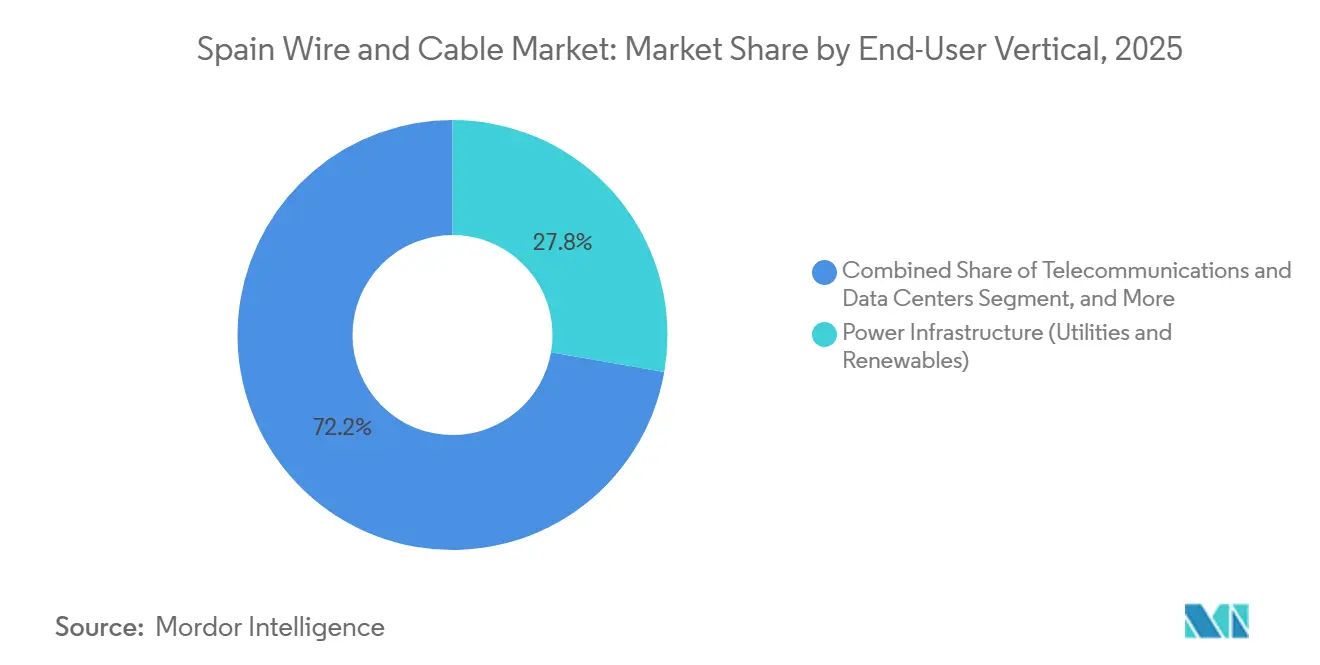
Power infrastructure, including utilities and renewables, held 27.76% of total sector revenue in 2025. The position reflects simultaneous transmission development and additions to renewable capacity. Utilities purchase cables for new lines, network reinforcement, substations, and replacement programs. Renewable developers require cables for collection grids and transmission connections. Commercial construction remains another major source of demand, particularly for hotel renovation and logistics facilities in Madrid and Barcelona. Residential construction contributed an important volume, but normalized as mortgage costs remained elevated through 2025. Automotive operations in Valencia and Navarre are adding demand for wiring harnesses and high-flex cables.
Telecommunications and data centers are expected to record a 6.98% CAGR through 2031, the highest rate among end-user categories. Amazon’s EUR 33.7 billion (USD 39.8 billion) commitment for its Spanish cloud region concentrates future cable demand in Aragon. Hyperscale construction requires medium-voltage power cables, high-density optical connections, and specialized signal and control products. These systems can carry higher specifications than standard commercial construction wiring. Industrial manufacturing also provides demand for industrial Ethernet and fieldbus products. Distributors can serve this business with fewer qualification barriers than major grid or hyperscale projects. This creates a more stable volume base when large infrastructure orders fluctuate.
By Insulation: Fire-Safety Rules Support Insulated Cable Demand
Insulated cables held 79.11% of the insulation segment in 2025, while non-insulated conductors mainly served overhead bare-aluminum transmission spans. Insulated products dominate buildings, commercial facilities, transport infrastructure, and most internal power distribution. The EU Construction Products Regulation classifies construction cables into 7 fire performance classes. Spain’s Low Voltage Electrotechnical Regulation requires at least Euroclass Cca-s1b,d1,a1 performance in public-occupancy buildings. The standard requires halogen-free and low-smoke characteristics in relevant applications. It provides a compliance floor for suppliers serving public buildings and transit locations. Producers of lower-specification cable cannot compete for work that requires this classification.
Insulated cables are also projected to grow at a 7.01% CAGR through 2031, an unusual case where the leading category also grows fastest. New construction increasingly specifies low-smoke, zero-halogen products. Replacement demand also comes from older public infrastructure and hospitality facilities that use pre-CPR cable. Prysmian introduced Afumex Data Centers and Exzhellent Data Centers product families in Spain in 2026. The company stated that the products can reduce acid-gas emissions by up to 34% compared with earlier LSZH designs. This development makes fire-safety specifications a product differentiator as well as a compliance requirement. Suppliers with qualified products can compete for higher-value building and data center work.
Geography Analysis
Madrid and Catalonia drive key commercial and digital infrastructure demand in the Spain wire and cable market, while Aragon plays an important role in large-scale data center investment. In June 2026, Spain’s Ministry of Digital Affairs is expected to earmark EUR 600-800 million (USD 678-904 million) for a bid to host an EU AI gigafactory. The proposal would strengthen Catalonia’s position alongside the existing Aragon hub. Andalusia, the country’s largest renewable energy region, received 61 of the 341 projects under the 2026 MOVES Corredores program. Solar and wind projects in the region require medium-voltage collection networks. The Canary Islands and the Balearic Islands form a distinct part of the Spain wire and cable market, as their physical geography drives the need for submarine cables. The Balearic Islands received EUR 1.169 billion (USD 1.29 billion) for grid investment under the 2021-2026 transmission plan.
Castile and León, Castile-La Mancha, Aragon, and Galicia support Spain’s inland transmission corridors. The planned 6,700 km of new lines will increase the importance of these regions through 2030. Galicia is expected to gain importance in July 2026, when Spain and Portugal inaugurate a new 400 kV interconnection in the north. Spain invested EUR 57.6 million (USD 65 million) in the project, which added 1,000 MW of bilateral exchange capacity. The EIB committed EUR 870 million (USD 960 million) to Naturgy’s distribution-grid work across Andalusia, Castile-La Mancha, Castile and León, Galicia, and Madrid. The program covers 2,300 km of new and reinforced network.
Valencia, the Basque Country, and Navarre combine demand from industrial, automotive, and onshore wind applications. The Valencia automotive cluster includes Ford, Stellantis, and Tier 1 suppliers such as Sumitomo Electric Bordnetze. These companies support procurement of structured harnesses and high-flex cables through established Iberian supply chains. Navarre’s wind corridor requires medium-voltage collection cables for new connections and turbine repowering. AFME reported 6.61% cumulative growth in Spain’s electrical material market during the first five months of 2026 compared with the same period in 2025. This performance indicates broader demand across smaller autonomous communities as infrastructure budgets are deployed.
Competitive Landscape
The Spain wire and cable market is moderately consolidated in high-voltage and submarine cable work, while mainstream installation products remain more fragmented. Prysmian and NKT hold major positions in this part of the market due to their manufacturing scale and cable-laying capabilities. Their vessel assets create a barrier that new entrants cannot quickly match. Domestic companies Top Cable and LA FARGA YOURCOPPERSOLUTIONS compete more actively in copper-intensive and low-voltage specialties. LAPP España serves industrial connectivity requirements. Hellenic Cables, Tele-Fonika Kable, and Elsewedy Electric compete in price-sensitive medium-voltage tenders. Regulated utility tariffs can limit the premiums that buyers accept in these tenders.
Nexans’ 2025-2028 strategy focuses on electrification solutions across the European grid and renewable energy applications. Prysmian has expanded its offering to include cable supply, accessories, installation engineering, and digital monitoring. This approach can create a different margin profile than cable-only sales. NKT reported a EUR 13.5 billion (USD 15.3 billion) transmission order backlog at the end of the first quarter of 2026. Its medium-voltage capacity expansion in Esposende, Portugal, is scheduled to become operational at the end of 2026. The location provides proximity to Iberian distribution-grid opportunities. Supplier strategies, therefore, vary by voltage class, project scale, and technical service capability.
Prysmian’s 2026 Spain catalog included fire-performance cable families certified to UNE-EN 50575. The company stated that the design reduced acid-gas emissions by up to 34% compared with earlier LSZH products. The July 2026 Digital Solutions agreement between Prysmian and Molex targets hyperscalers and data center infrastructure providers. Prysmian also announced EUR 1.25 billion (USD 1.41 billion) in global fiber-capacity investment. Open opportunities include hydrogen-ready cable sheathing, condition-monitoring systems for terrestrial high-voltage links, and submarine installation services for proposed Italy connections. No single supplier holds a dominant position across all these emerging requirements. Competition remains strongest where product qualification, installation capability, and local delivery must work together.
Spain Wire and Cable Industry Leaders
Prysmian Cables Spain, S.A.U.
Nexans
NKT A/S
Leoni AG
Belden Inc.
- *Disclaimer: Major Players sorted in no particular order

Recent Industry Developments
- July 2026: Spain's Ministry for Ecological Transition announced an extension of the national grid "megaplan" to 6,700 km of new transmission lines through 2030, 11% more than the previous draft, with grid positions for large energy-intensive consumers increasing 12%, directly enlarging the addressable high-voltage cable procurement pipeline for the back half of the forecast period.
- July 2026: The European Investment Bank and Spain's Ministry of Economy finalized EUR 870 million (USD 960 million) in financing for Naturgy's distribution grid reinforcement and digitalization program, covering 2,300 km of new construction and reinforcement across 5 autonomous communities and directly driving medium- and low-voltage cable demand across Andalusia, Galicia, and Madrid.
- July 2026: Spain and Portugal inaugurated the new 400 kV northern electricity interconnection, EUR 57.6 million (USD 65 million) on the Spanish side, increasing bilateral power-exchange capacity by 1,000 MW and requiring extensive extra-high-voltage underground cable installation across Galicia and northern Portugal.
- July 2026: Prysmian announced a Digital Solutions agreement with Molex targeting hyperscalers and data center infrastructure providers, with cumulative incremental revenue exceeding EUR 10 billion (USD 11.3 billion) through 2035, alongside a EUR 1.25 billion (USD 1.41 billion) global fiber-capacity investment that will more than double fiber production capacity in Europe.


Spain Wire and Cable Market Report Scope
The Spain Wire and Cable Market Report is Segmented by Voltage (Extra- and High-Voltage [Greater Than 35 kV], Medium-Voltage [1–35 kV], and Low-Voltage [Less Than 1 kV]), Cable Type (Power Cable, Fiber-Optic Cable, Signal and Control Cable, and Coaxial and Data Cable), Conductor Material (Copper, Aluminum, and Optical Glass / Polymer), Installation (Overhead, Underground, and Submarine), End-User Vertical (Residential Construction, Commercial Construction, Power Infrastructure, Telecommunications and Data Centers, Oil and Gas and Petrochemicals, Automotive and Mobility, and Industrial Manufacturing), and Insulation (Insulated, and Non-Insulated). The Market Forecasts are Provided in Terms of Value (USD).
| Extra- and High-Voltage (Greater Than 35 kV) |
| Medium-Voltage (1–35 kV) |
| Low-Voltage (Less Than 1 kV) |
| Power Cable |
| Fiber-Optic Cable |
| Signal and Control Cable |
| Coaxial and Data Cable |
| Copper |
| Aluminum |
| Optical Glass / Polymer |
| Overhead |
| Underground |
| Submarine |
| Residential Construction |
| Commercial Construction |
| Power Infrastructure (Utilities and Renewables) |
| Telecommunications and Data Centers |
| Oil and Gas and Petrochemicals |
| Automotive and Mobility |
| Industrial Manufacturing |
| Insulated |
| Non-Insulated |
| By Voltage | Extra- and High-Voltage (Greater Than 35 kV) |
| Medium-Voltage (1–35 kV) | |
| Low-Voltage (Less Than 1 kV) | |
| By Cable Type | Power Cable |
| Fiber-Optic Cable | |
| Signal and Control Cable | |
| Coaxial and Data Cable | |
| By Conductor Material | Copper |
| Aluminum | |
| Optical Glass / Polymer | |
| By Installation | Overhead |
| Underground | |
| Submarine | |
| By End-User Vertical | Residential Construction |
| Commercial Construction | |
| Power Infrastructure (Utilities and Renewables) | |
| Telecommunications and Data Centers | |
| Oil and Gas and Petrochemicals | |
| Automotive and Mobility | |
| Industrial Manufacturing | |
| By Insulation | Insulated |
| Non-Insulated |


Key Questions Answered in the Report
What is the size of the Spain wire and cable market?
The Spain wire and cable market was valued at USD 0.95 billion in 2025, is estimated at USD 1.01 billion in 2026, and is forecast to reach USD 1.27 billion by 2031 at a 4.69% CAGR. Grid reinforcement, fiber deployment, charging infrastructure, and digital infrastructure are the main sources of demand during the period. The outlook also depends on the speed of project permitting and manufacturers' ability to manage conductor-material costs.
Which voltage category leads demand in Spain?
Low-voltage cables led with 42.11% share in 2025 because they serve building wiring, commercial projects, industrial equipment, and EV charging distribution. Their wide customer base gives the Spain wire and cable market a steady source of daily installation and replacement demand. The demand is spread across homes, offices, retail sites, warehouses, small factories, public facilities, and charging locations, which reduces dependence on a narrow group of buyers. Low-voltage products also support replacement work when building owners update electrical systems to meet safety, capacity, or energy-efficiency requirements.
Why are fiber-optic cables growing in Spain?
Fiber-optic cables are expected to grow at a 6.11% CAGR through 2031 as FTTH expansion, 5G backhaul, network sharing, and data center connectivity increase demand. The Spain wire and cable market also benefits when shared networks need additional capacity in existing routes. Fiber operators can use these upgrades to improve resilience, support more wholesale customers, and accommodate higher traffic from cloud and mobile services without building entirely separate networks. The model can improve route utilization efficiency, but it still requires high-quality cable, ducts, connectors, and proper installation planning.
Which end-user category is expanding fastest?
Telecommunications and data centers are projected to grow at a 6.98% CAGR through 2031, supported by cloud infrastructure, fiber connectivity, and higher-specification power systems. These projects require a wider range of product types than standard commercial buildings, including power, optical, signal, and control cables. Their procurement often considers fire performance, power continuity, installation density, and future expansion capacity, which can favor suppliers with a broad range of qualified products. These conditions can make product approval, technical support, and delivery reliability as important as the initial cable price.
How do grid investments influence cable demand in Spain?
Transmission spending, new lines, interconnections, and renewable connections increase demand for medium-, high-, and extra-high-voltage cables. The Spain wire and cable market gains both from large transmission contracts and from distribution work that connects new renewable and industrial facilities. Grid projects also create demand for accessories, joints, terminations, and related installation support. The full project requirement can span several years, giving suppliers visibility but also making project timing and execution discipline important.
What is the main material challenge for cable producers?
Copper price volatility and aluminum substitution can pressure copper-intensive product revenue and require investment in aluminum conductor production capability. Manufacturers need to balance the performance requirements of precision applications with cost and weight constraints in major infrastructure projects. This decision is most important in applications where equipment space, thermal performance, product qualification, and project budgets must all be considered together. Suppliers that can offer both copper and aluminum options are better placed to address changing specifications without disrupting customer relationships and maintaining delivery schedules for complex infrastructure programs.
Page last updated on:





