
Spain Robotic Lawn Mower Market Size and Share
Market Overview
| Study Period | 2021 - 2031 |
|---|---|
| Forecast Data Period | 2026 - 2031 |
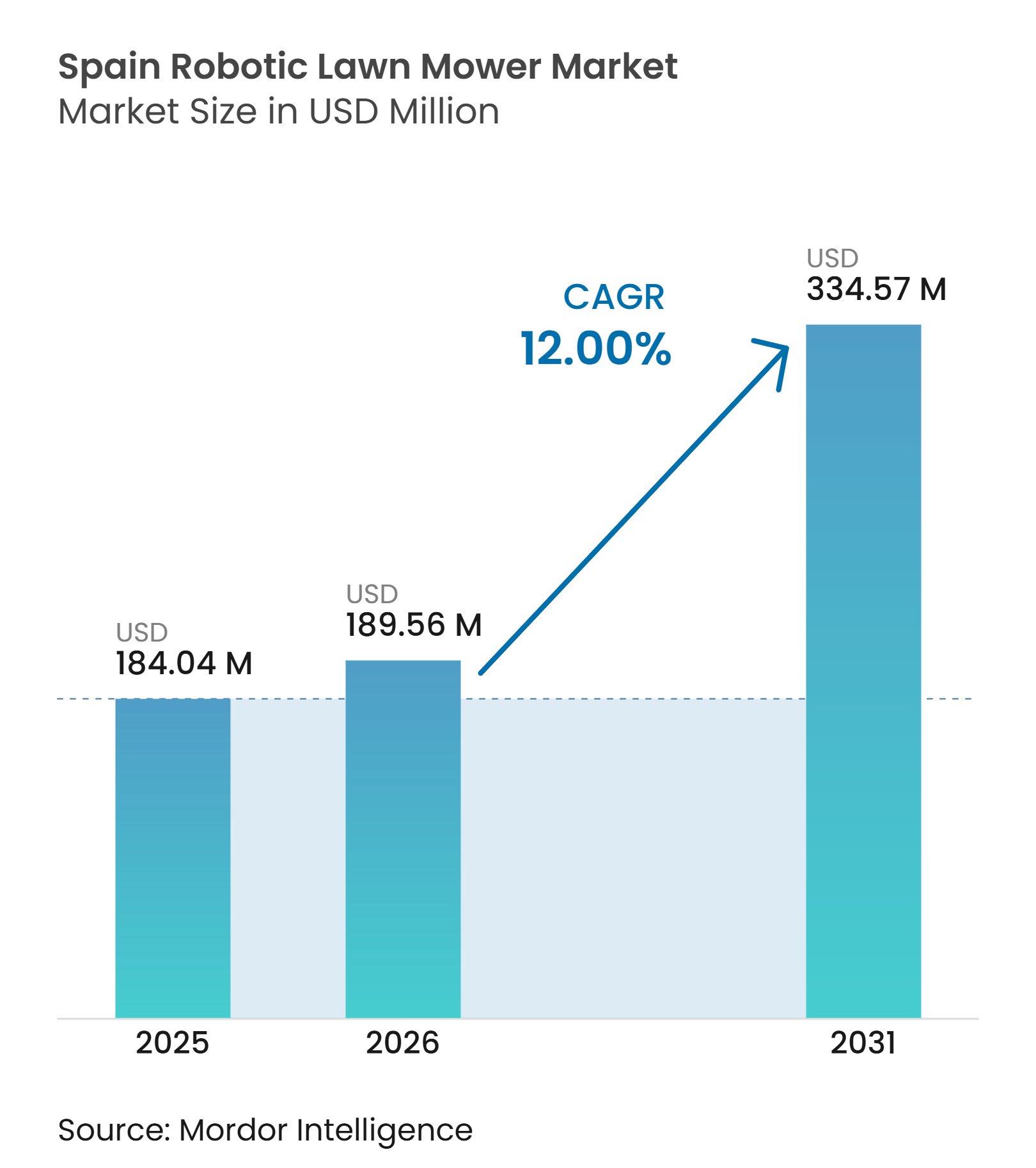
| Base Year Market Size (2025) | USD 184.04 Million |
| Market Size (2026) | USD 189.56 Million |
| Market Size (2031) | USD 334.57 Million |
| Growth Rate (2026 - 2031) | 12.00 % |
| Market Concentration | Medium |
Major Players *Disclaimer: Major Players sorted in no particular order Image © Mordor Intelligence. Reuse requires attribution under CC BY 4.0. | |
Spain Robotic Lawn Mower Market Analysis by Mordor Intelligence
The Spain robotic lawn mower market size was valued at USD 184 million in 2025 and is estimated to grow from USD 190 million in 2026 to reach USD 335 million by 2031, at a CAGR of 12% during the forecast period (2026-2031). The Spain robotic lawn mower market is supported by a shrinking pool of workers for outdoor maintenance and by household interest in connected equipment. Wire-free navigation reduces installation work, which can widen access beyond buyers comfortable with boundary-wire systems. Demand conditions differ sharply across the country because sustained grass growth is more common in wetter northern areas. Commercial buyers can use fleet software to manage equipment across multiple properties, while household buyers continue to account for the larger installed base. Water scarcity in southern regions limits the addressable area for natural-grass maintenance and requires location-specific sales planning.
Key Report Takeaways
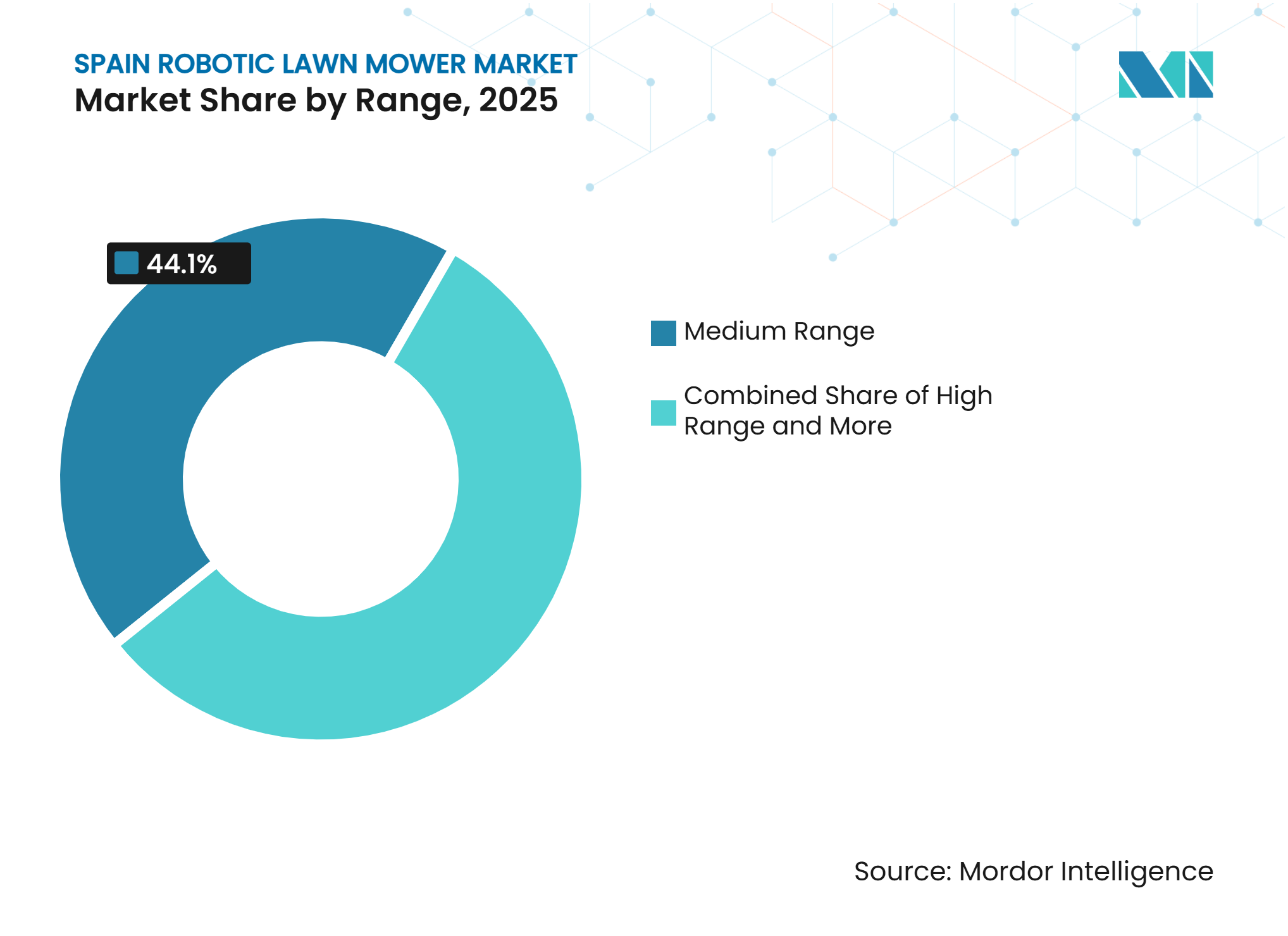
- By range, Medium Range held 44.1% of Spain robotic lawn mower market share in 2025, while High Range is forecast to grow at a CAGR of 15.6% from 2026 to 2031.
- By battery capacity, 20 to 30 V held 50.3% of Spain robotic lawn mower market size in 2025, while More Than 30 V is forecast to grow at a CAGR of 13.2% from 2026 to 2031.
- By sales channel, Retailers held 58% revenue share in 2025, while Online is forecast to grow at a CAGR of 16.4% from 2026 to 2031.
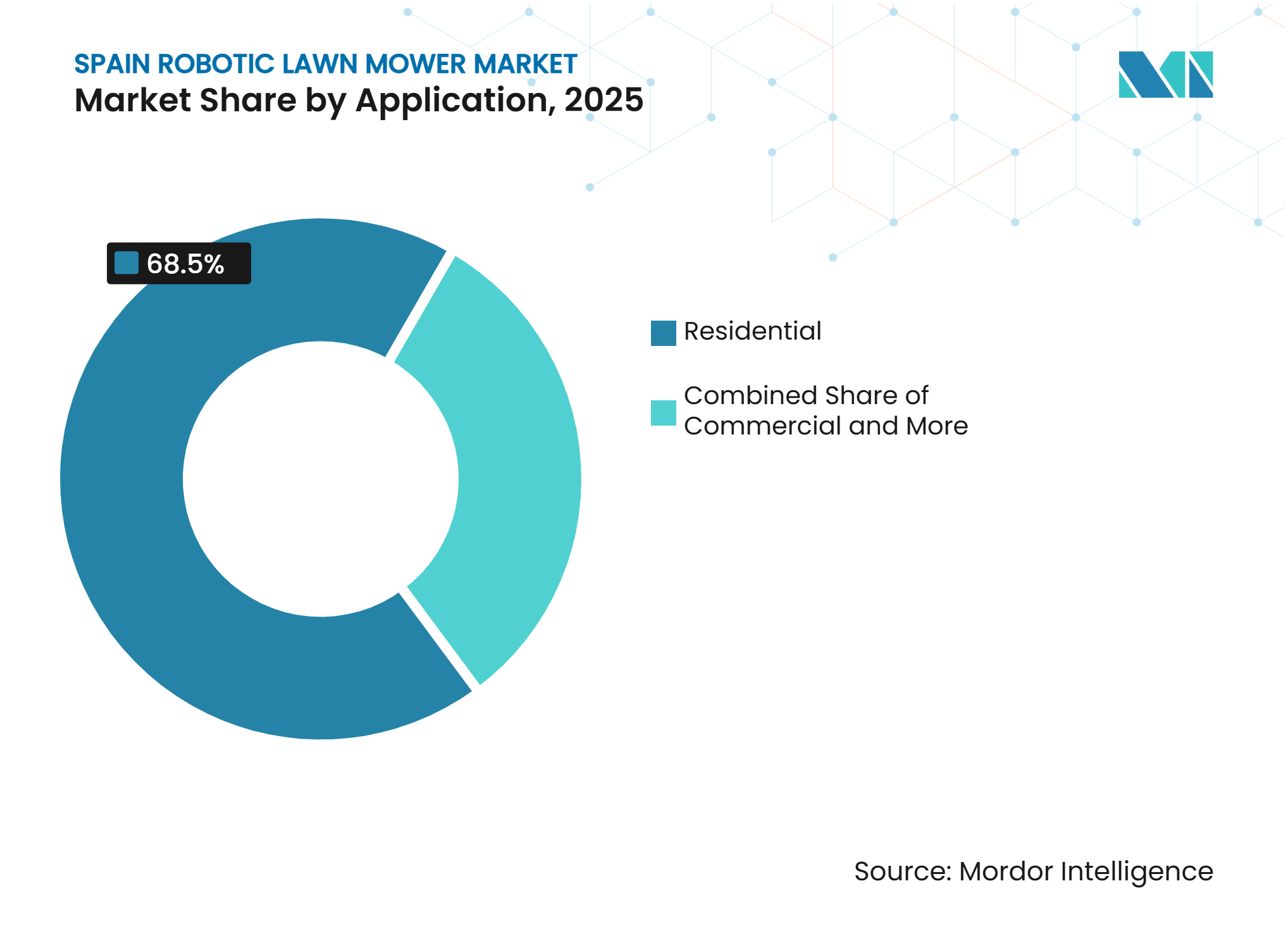
- By application, Residential held 68.5% revenue share in 2025, while Commercial is forecast to grow at a CAGR of 13% from 2026 to 2031.
- By end-user, Homeowners held 64.5% revenue share in 2025, while Landscaping Companies are forecast to grow at a CAGR of 13.1% from 2026 to 2031.
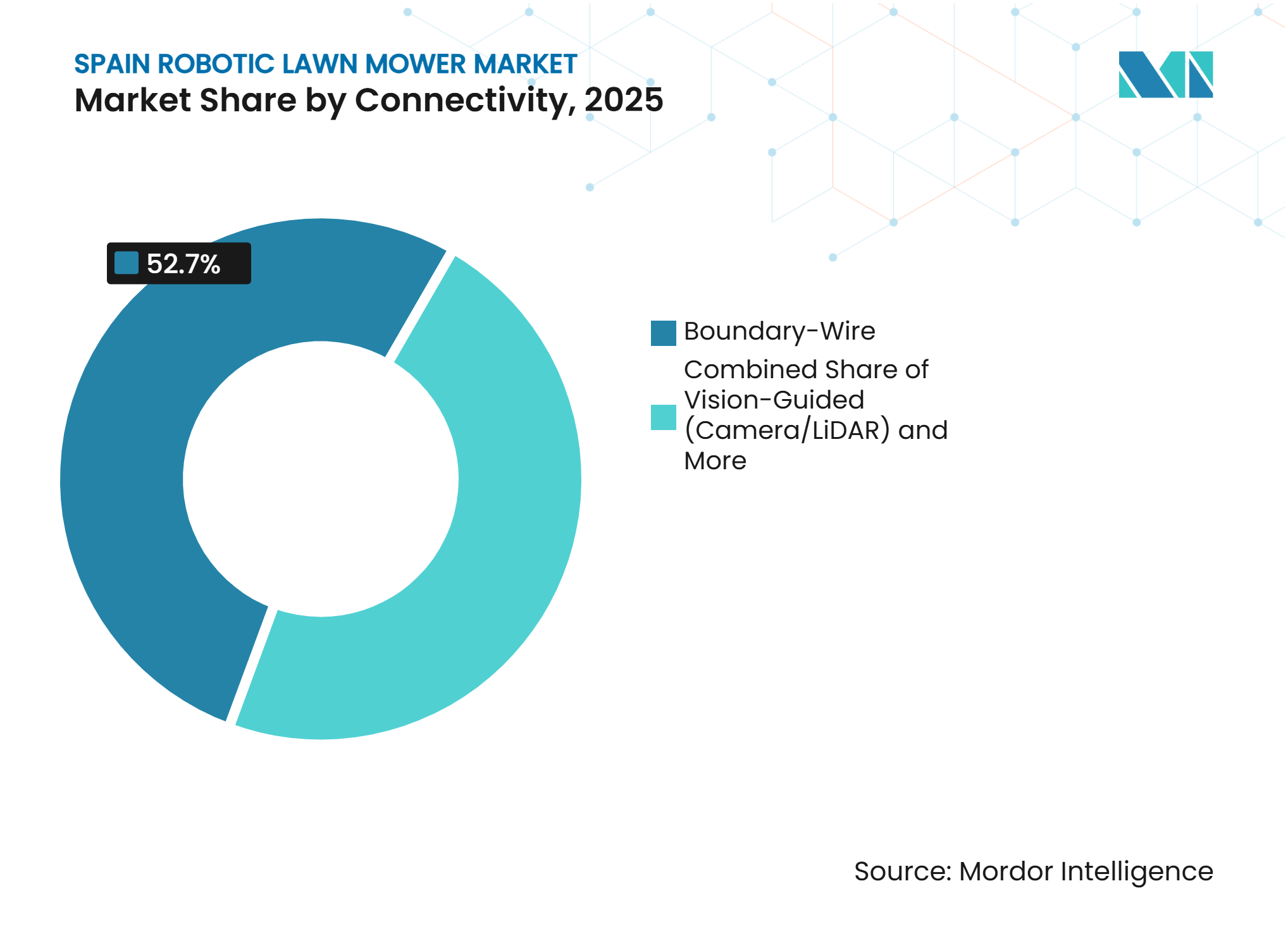
- By connectivity, Boundary-Wire held 52.7% revenue share in 2025, while Vision-Guided systems are forecast to grow at the fastest CAGR of 19.1% from 2026 to 2031.
Note: Market size and forecast figures in this report are generated using Mordor Intelligence’s proprietary estimation framework, updated with the latest available data and insights as of January 2026.
Market Trends and Insights
Drivers Impact Analysis of Spain Robotic Lawn Mower Market*
| Driver | (~) % Impact on CAGR Forecast | Geographic Relevance | Impact Timeline |
|---|---|---|---|
| Landscaping Labor Scarcity and Workforce Aging | +2.2% | National, especially commercial urban centers and northern Spain | Medium term (2-4 years) |
| Time-Saving Autonomous Lawn Care for Households | +1.9% | National, concentrated in northern Spain and suburban residential areas | Short term (≤ 2 years) |
| Smart-Home and Connected-Garden Adoption | +1.4% | National, including Madrid, Murcia, and Andalusia | Short term (≤ 2 years) |
| Quiet, Battery-Electric and Lower-Emission Lawn Maintenance | +1.1% | National, especially urban neighborhoods, hotels, and noise-sensitive parks | Medium term (2-4 years) |
| North-South Climate and Water-Suitability Differentiation | +1.7% | Northern Spain, with constrained household demand in the south | Long term (≥ 4 years) |
| Wire-Free RTK, Vision and LiDAR Expansion into Large Turf Sites | +2.3% | National, especially Catalonia, Madrid, and the Basque Country | Medium term (2-4 years) |
| Source: Mordor Intelligence | |||
Landscaping Labor Scarcity and Workforce Aging
Spain’s working-age population is projected to shrink by 30% by 2060, according to the Organization for Economic Co-operation and Development (OECD)[1]. The same organization expects Spain’s employment-to-population ratio to decline the most among its member countries. Retirements are expected to create more than 15 million job vacancies by 2035, including roles requiring practical outdoor skills. Landscaping providers, therefore, have a reason to use autonomous equipment where recurring mowing work is difficult to staff. In the Spain robotic lawn mower market, suppliers that combine equipment with fleet oversight can address recurring operating needs rather than only a one-time purchase, helping landscaping providers plan routine work, monitor asset availability, organize maintenance visits, and preserve service capacity when staffing becomes more difficult, while giving managers a basis to coordinate equipment use across contracts that have different lawn sizes, access times, and customer expectations. This supports a commercial proposition based on equipment availability and predictable service delivery, rather than a simple equipment transaction, because customers must sustain mowing operations across properties with different access conditions, maintenance needs, and schedules.
Smart-Home and Connected-Garden Adoption
Spain recorded a 43.4% adoption rate for connected home systems in 2024, exceeding the European Union average of 33%, according to the Observatorio Nacional de Tecnología y Sociedad (Ontsi). Internet-connected appliance use reached 19%, also above the European Union average reported by the observatory. These conditions support interest in equipment that can be scheduled, monitored, and adjusted through a mobile application. Connected gardens fit particularly well with premium residential properties in major metropolitan areas. The Spain robotic lawn mower industry can benefit when buyers view automated mowing as part of a wider household device ecosystem, especially when controls are easy to understand, notifications are useful, and connected features complement rather than complicate the ongoing care of a garden, which can make scheduled mowing feel consistent with the way buyers already manage household devices.
North-South Climate and Water-Suitability Differentiation
Rainfall conditions varied widely across Spain during the 2023-2024 hydrological year. Accumulation exceeded 1,500 l/m² in parts of the northwest, eastern Cantabrian region, and Pyrenees, while parts of Almería and Murcia received less than 80 l/m². Andalusia and Segura river basins received 52% and 50% of normal precipitation, respectively. Wetter northern locations support longer grass-growing periods and a more regular need for mowing. This difference means the Spain robotic lawn mower market needs separate product, service, and sales plans for northern and southern territories, with household propositions adapted to areas of regular grass growth and commercial propositions focused on irrigated sites that continue to maintain usable turf, so inventory, demonstrations, field support, and dealer activity reflect the local conditions that determine likely equipment use, rather than relying on a national approach that may overstate household demand in areas where water restrictions have reduced the practical need for regular mowing.
Wire-Free RTK, Vision and LiDAR Expansion into Large Turf Sites
Real-time kinematic positioning, vision systems, and light detection and ranging can support boundary-free navigation on larger maintained sites. Navimow states that its NavimowFleet platform allows a single operator to monitor location, performance, and technical status across a mower fleet. This capability matters to municipalities, golf courses, sports grounds, and hospitality sites that manage equipment across multiple locations. A shared control layer can reduce the time spent checking individual machines and assigning routine tasks. The Spain robotic lawn mower market can therefore extend beyond standard gardens where suppliers demonstrate dependable supervision and service support, since professional customers will assess equipment not only by coverage claims but also by how effectively it fits daily staffing, maintenance, reporting, and site-management procedures, including the ability to identify faults promptly and keep routine mowing work from interrupting other grounds responsibilities, which may involve coordinating access, responding to weather changes, maintaining several units, and demonstrating to the customer that the automated approach remains dependable over the full service period.
Restraints Impact Analysis of Spain Robotic Lawn Mower Market*
| Restraint | (~) % Impact on CAGR Forecast | Geographic Relevance | Impact Timeline |
|---|---|---|---|
| High Upfront Purchase and Installation Cost | -1.80% | National, especially lower-income regions | Short term (≤ 2 years) |
| Terrain, Garden Layout and Connectivity Constraints | -1.40% | National, including complex gardens and mountainous interiors | Medium term (2-4 years) |
| Water Scarcity and Lawn Substitution in Southern Spain | -1.20% | Andalusia, Murcia, Valencian Community, and coastal Catalonia | Long term (≥ 4 years) |
| Wildlife, Night-Operation and Shared-Space Safety Concerns | -0.80% | National, especially public parks and shared residential areas | Medium term (2-4 years) |
| Source: Mordor Intelligence | |||
High Upfront Purchase and Installation Cost
The initial cost of robotic equipment remains higher than that of conventional gasoline alternatives. Advanced wire-free models can require additional spending for connectivity or a reference-station arrangement, depending on the brand. Andalusia and Extremadura recorded unemployment above 16% in 2023, limiting disposable income for premium garden equipment in those regions, according to the Organization for Economic Co-operation and Development (OECD). Competition may narrow price gaps in the mid-range, but it does not remove the upfront commitment for many buyers. This constraint can delay the move from basic products to higher-function models in the Spain robotic lawn mower market, particularly when buyers must weigh the purchase against installation arrangements, data-service costs, warranty provisions, expected garden use, and uncertainty over the benefit delivered by advanced navigation, making a clear explanation of ownership costs important in both retail and online sales, particularly where buyers need to understand the difference between the initial purchase price, optional connectivity arrangements, installation support, and the ongoing requirements of keeping the equipment in useful working condition.
Water Scarcity and Lawn Substitution in Southern Spain
A University of Bern study published in 2025 documented near-complete reservoir depletion in Andalusia’s Axarquía region between 2019 and 2024[2]. The study linked the situation to meteorological drought and structural pressure on water resources. Homeowners and public authorities may respond by using drought-resistant planting and hardscape designs that do not require mowing. That response reduces lawn area rather than merely postponing mower purchases. The Spain robotic lawn mower market consequently has a smaller residential opportunity in affected southern zones than national totals alone may imply, while sales activity is more likely to center on maintained premium properties and commercial sites that can justify turf care within their own water-management arrangements, which makes the local quality and purpose of turf more important than broad population coverage, because professional grounds with regular visitor use can retain a practical maintenance requirement even where households choose drought-resistant plants, gravel, or other designs that eliminate grass-cutting needs.
*Our forecasts treat driver/restraint impacts as directional, not additive. The impact forecasts reflect baseline growth, mix effects, and variable interactions.
Spain Robotic Lawn Mower Market Segment Analysis
By Range:
Premium Models Gain Ground as Wire-Free Coverage ExpandsMedium Range held 44.1% of Spain robotic lawn mower market share in 2025, making it the largest range category. These products serve detached homes with standard gardens and provide the volume foundation for sales. High Range is forecast to grow at a CAGR of 15.6% from 2026 to 2031, making it the fastest range category. Wire-free navigation supports this growth by making broader site coverage more manageable. Low-range equipment remains relevant to smaller and price-sensitive gardens, although its appeal diminishes as mid-range features become more accessible and buyers place greater value on installation simplicity, reliable navigation, manageable charging intervals, and the ability to use a single product across multiple lawn areas.
High Range products suit professional properties that require wider coverage and more demanding performance on more demanding terrain. Spain had 496 golf courses in the 2024 submission by the Real Federación Española de Golf to the European Golf Association[3]. That estate includes 210 public-access 18-hole facilities and 170 private 18-hole facilities. Maintained playing surfaces on standard 18-hole courses will require equipment capable of covering substantial turf areas. The Spain robotic lawn mower market has a specific professional sales opportunity where larger-site equipment is paired with local service capacity, responsive repairs, operator training, and a clear plan for maintaining continuous operation during busy sporting, visitor, and seasonal maintenance periods.



By Battery Capacity:
Higher-Voltage Packs Enable Commercial-Grade PerformanceThe 20 to 30 V segment held 50.3% of the Spain robotic lawn mower market size in 2025 and was the largest battery category. It aligns with mid-range residential equipment used on gardens from 300 m² to 1,500 m². More Than 30 V is forecast to grow at a CAGR of 13.2% from 2026 to 2031, making it the fastest battery category. Longer runtime and stronger motor output support professional and high-range residential use. Less Than 20 V products remain an entry point for smaller gardens, but their capability is more limited when mowing schedules, grass density, slope conditions, and the need to return to the charging station create demands that exceed their intended use.
Higher-voltage systems are relevant where slopes and large sites require sustained traction and cutting performance. Golf fairways, municipal parks, and hotel grounds may involve gradients that are difficult for entry-level equipment to handle. All-wheel-drive configurations can require more power over a useful operating cycle. Commercial buyers are therefore likely to assess battery architecture alongside coverage and service requirements. Manufacturers addressing these sites need to match performance claims with practical operating conditions in Spain, including terrain changes, seasonal grass growth, access constraints, charging arrangements, operator availability, and the service response required when equipment is used across several managed areas.
By Sales Channel:
Online Commerce Reshapes the Purchase DecisionRetailers held 58% of sales in 2025 and were the largest channel for robotic lawn mowers. Physical stores remain useful where buyers need demonstrations, installation advice, and after-sales support. Online is forecast to grow at a CAGR of 16.4% from 2026 to 2031, making it the fastest sales channel. Mobile telephony was available in 99.5% of Spanish households in the fourth quarter of 2025. This access supports digital product research and comparison of technical equipment before purchase, allowing households to review coverage ratings, navigation features, warranty terms, retailer availability, installation requirements, and product suitability before committing to a relatively high-value garden purchase.
Broadband access reached 97.4% of Spanish households in 2025. Online research can make it easier for buyers to compare prices, features, and service offers across brands. Specialty stores retain a role for commercial customers who need installation and maintenance arrangements. Direct online channels can expand reach but may reduce the influence of dealer advice in the final decision. A balanced retail and digital approach can help suppliers serve both convenience-led household demand and higher-support professional purchasing, while giving prospective customers several ways to obtain product information, arrange installation, access repairs, and compare the practical value of available models.
By Application:
Commercial Adoption Accelerates Beyond the Residential BaseResidential equipment held 68.5% of sales in 2025 and was the largest application segment. The installed base is concentrated among homeowners with detached properties, especially in northern and central areas. Commercial is forecast to grow at a CAGR of 13% from 2026 to 2031, making it the fastest application segment. Municipalities, sports grounds, golf courses, and landscaping firms face recurring mowing work with staffing constraints. The Spanish robotic lawn mower market has room to grow as these organizations adopt multi-unit systems for routine maintenance, particularly when suppliers can demonstrate how equipment availability, service schedules, site mapping, and remote supervision fit within existing grounds-management responsibilities.
The Organization for Economic Co-operation and Development expects Spain’s old-age dependency ratio to increase from 0.34 per working-age person in 2023 to 0.75 by 2060. This long-term labor pressure is especially relevant to services that require routine outdoor work. Commercial buyers need remote diagnostics, fleet management, and dependable maintenance arrangements alongside the mower itself. Their purchasing process is often more formal than a household purchase and can take longer to complete. Suppliers with professional product lines can address this demand when they provide clear operating support and service commitments, because commercial customers need confidence that equipment performance, repair access, replacement units, and monitoring tools will support daily maintenance obligations.

By End-User:
Volume from Homeowners, Value Growth from Professional SegmentsHomeowners held 64.5% of sales by end-user in 2025 and were the largest end-user group. Their demand comes from maintained gardens around detached homes, particularly in locations with regular grass growth. Landscaping Companies are forecast to grow at a CAGR of 13.1% from 2026 to 2031, making it the fastest end-user category. Sports Grounds and Parks can use automated mowing during suitable off-hours to protect the availability of playing surfaces. Municipalities, golf courses, hospitality properties, and residential communities add further demand where outdoor spaces are shared or professionally maintained, since each setting requires regular mowing but may place different limits on access hours, noise, terrain, supervision, and the required level of operator control.
Landscaping companies can use robotic mowers to standardize recurring tasks across several client sites. Predictable equipment use can support a more consistent service offer than one based only on available labor. Remote oversight is particularly relevant for operators managing several properties in metropolitan areas. The Spain robotic lawn mower industry can gain from service models that combine mowing equipment with maintenance and monitoring. Such models must still account for site layout, local water conditions, and the safety requirements of each property, ensuring that the proposed equipment, operating timetable, maintenance plan, and level of remote oversight are appropriate for the condition and use of the grounds.
By Connectivity:
Vision-Guided Systems Challenge Boundary-Wire DominanceBoundary-Wire systems held 52.7% of sales in 2025 and were the largest connectivity category. Their position reflects an established installed base and familiarity among buyers and dealers. Vision-Guided systems are forecast to grow at the fastest CAGR of 19.1% from 2026 to 2031. Camera and LiDAR functions can remove the need for boundary wires and improve the fit for connected, multi-site operations. Camera and LiDAR functions can reduce dependence on physical perimeter infrastructure. Smart-GPS and Wi-Fi systems provide another wire-free option for common residential layouts, offering buyers a middle path between familiar boundary-wire products and more advanced camera-led systems that may suit sites needing stronger perception, mapping, or obstacle-management capabilities.
The Comisión Nacional de los Mercados y la Competencia reported 71.9% year-on-year growth in 5G mobile data traffic during the fourth quarter of 2025. Mobile internet access lines reached 58.2 million, while broadband penetration reached 130.7 lines per 100 inhabitants. This connectivity supports products that use remote monitoring, map updates, and fleet telemetry. Boundary-Wire systems can remain appropriate for buyers seeking a familiar, self-contained setup. Vision-Guided products are better positioned where commercial operators require a shared view of equipment across multiple sites, because connected mapping and telemetry can support routine checks, task allocation, maintenance planning, and a clearer record of how each unit is performing over time.
Geography Analysis
Northern Spain provides a stronger household setting for robotic mowing because regular rainfall supports longer grass-growing periods. Demand is strongest in Galicia, Asturias, Cantabria, the Basque Country, and Navarre, where gardens require recurring maintenance. These regions have conditions closer to northern European mowing environments than Spain’s drier southern areas. Detached homes with well-maintained gardens also support coverage by retailers and specialty stores. Product demonstrations and service networks can be more productive where lawn care is a recurring household need.
Southern mainland areas face a different demand profile because long-term water deficits reduce the extent of natural grass. Andalusia, Murcia, the Valencian Community, and coastal Catalonia continue to see demand from irrigated hotel grounds, golf-related properties, and premium residential communities. Commercial sites can remain active where captured or recycled water supports turf management. The Canary Islands support year-round grass growth, while the Balearic Islands have hotel and resort grounds that accommodate commercial equipment use. Suppliers should avoid treating these territories as equivalent residential markets.
Spain’s 43.4% connected-home adoption rate in 2024 supports interest in app-controlled garden equipment in major cities. Madrid, Barcelona, Valencia, and Seville contain premium residential properties that can adopt wire-free products earlier than smaller locations, while municipal green spaces create institutional demand beyond the north-south climate divide. These buyers can prioritize fleet management, maintenance terms, operating reliability, and documented service support over unit price. Geography therefore affects the lawn area available for automation and the service proposition needed to secure sales.
Competitive Landscape
Market Concentration
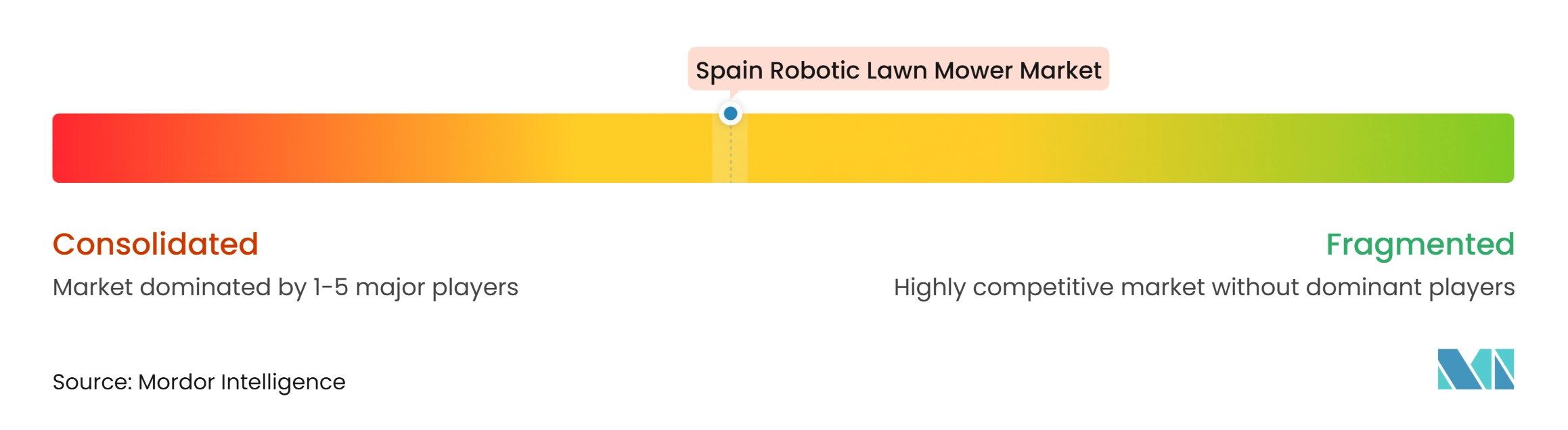
The Spain robotic lawn mower market is moderately concentrated, with established European manufacturers retaining dealer and after-sales advantages. Husqvarna AB, STIHL Pty Ltd, Honda Motor Co., Ltd., Robert Bosch GmbH, and Zucchetti Centro Sistemi S.p.a. operate in the approved competitive set. Husqvarna reported SEK 7.2 billion (USD 680.5 million) in global robotic mower net sales in 2024 and a connected-device base of 4.9 million units. These scale indicators relate to global activity, not to sales within Spain. MAMMOTION, ECOVACS, Dreame Global, Positec Group Ltd., STIGA S.p.A., Comercial Einhell SA, AL-KO Geräte GmbH, EcoFlow Inc., Sunseeker Intelligent Technology SE, and Navimow add pressure through product choice and online availability.
Husqvarna announced 13 boundary-wire-free models for the 2025 season, extending its portfolio across residential and professional use cases. STIHL introduced its next-generation iMOW lineup in 2025 with connected models distributed through its authorized dealer network. ECOVACS released the GOAT A and GOAT O series for European markets in February 2025, with Dual-LiDAR navigation and obstacle avoidance features. These moves show that wire-free navigation and channel coverage are central competitive priorities. For sellers, service quality and reliable installation remain as important as product specifications in higher-value purchases.
Regulation will add a further condition for connected equipment sold in Spain. Regulation (EU) 2023/1230 becomes fully applicable in January 2027 and includes cybersecurity requirements for machinery with connected functions, so manufacturers need to prepare documentation and product processes before those requirements apply. Spain also amends its outdoor-machinery noise rules through Royal Decree 302/2026 in April 2026. The competitive position of each supplier will depend on product capability, distribution, technical support, and readiness for these operating requirements.
Spain Robotic Lawn Mower Industry Leaders
-
Husqvarna AB
-
STIHL Pty Ltd
-
Honda Motor Co., Ltd.
-
Robert Bosch GmbH
-
Zucchetti Centro Sistemi S.p.a. (Ambrogio Robot)
- *Disclaimer: Major Players sorted in no particular order
Spain Robotic Lawn Mower Market Companies Covered in this Report
- Husqvarna AB
- STIHL Pty Ltd
- Honda Motor Co., Ltd.
- Robert Bosch GmbH
- Zucchetti Centro Sistemi S.p.a. (Ambrogio Robot)
- Positec Group Ltd.
- Navimow
- MAMMOTION
- ECOVACS
- Dreame Global
- STIGA S.p.A.
- Comercial Einhell SA
- AL-KO Geräte GmbH
- EcoFlow Inc.
- Sunseeker Intelligent Technology SE
Recent Industry Developments in Spain Robotic Lawn Mower Market
- April 2026: Spain enacts Royal Decree 302/2026, amending Royal Decree 212/2002 on environmental noise emissions from outdoor machinery. The decree updates compliance obligations for manufacturers, importers, and distributors of robotic lawn mowers in Spain, including revised airborne-noise measurement methods aligned with European Union Delegated Regulation 2024/1208, with emergency-market-procedure requirements effective from April 8, 2026.
- March 2025: Husqvarna AB announced 13 new boundary-wire-free robotic mower models for the 2025 season, bringing its wire-free portfolio to 24 models. Coverage spans 600 m² to more than 50,000 m² for residential and professional users, including golf courses, sports fields, and municipal parks.
- February 2025: ECOVACS released the GOAT A and GOAT O series for European markets from February 10, 2025. The GOAT O series includes HoloScope 360 Dual-LiDAR Navigation, AIVI 3D obstacle avoidance, a built-in TruEdge robotic trimmer, and 45% slope capability for gardens from 500 m² to 1,200 m².
Spain Robotic Lawn Mower Market Report Scope
A robotic lawn mower is an autonomous device equipped with sensors and programming to perform grass-cutting tasks without human intervention. These are used for residential and commercial purposes by homeowners, apartment owners, in parks and playgrounds, and in other places.
The Argentina Robotic Lawn Mower Market Report is Segmented by Range (Low Range, Medium Range, and High Range), by Battery Capacity (Less Than 20 V, 20 to 30 V, and More Than 30 V), by Sales Channel (Retailers, Specialty Stores and Online), by Application (Residential and Commercial), by End-User (Homeowners, Landscaping Companies, Sports Grounds and Parks, Municipalities, Golf Courses and Others), and by Connectivity (Boundary-Wire, Smart-GPS / Wi-Fi and Vision-Guided). The Market Forecasts are Provided in Terms of Value (USD).
Segmentation Overview
| Low Range |
| Medium Range |
| High Range |
| Less Than 20 V |
| 20 to 30 V |
| More Than 30 V |
| Retailers |
| Specialty Stores |
| Online |
| Residential |
| Commercial |
| Homeowners |
| Landscaping Companies |
| Sports Grounds and Parks |
| Municipalities |
| Golf Courses |
| Others |
| Boundary-Wire |
| Smart-GPS / Wi-Fi |
| Vision-Guided (Camera/LiDAR) |
| By Range | Low Range |
| Medium Range | |
| High Range | |
| By Battery Capacity | Less Than 20 V |
| 20 to 30 V | |
| More Than 30 V | |
| By Sales Channel | Retailers |
| Specialty Stores | |
| Online | |
| By Application | Residential |
| Commercial | |
| By End-User | Homeowners |
| Landscaping Companies | |
| Sports Grounds and Parks | |
| Municipalities | |
| Golf Courses | |
| Others | |
| By Connectivity | Boundary-Wire |
| Smart-GPS / Wi-Fi | |
| Vision-Guided (Camera/LiDAR) |
Key Questions Answered in the Report
What is the Spain robotic lawn mower market size?
The Spain robotic lawn mower market is valued at USD 190 million in 2026 and is forecast to reach USD 335 million by 2031.
What is the forecast growth rate for robotic lawn mowers in Spain?
Robotic lawn mower sales in Spain are forecast to grow at a CAGR of 12% from 2026 to 2031.
Which range category leads sales in Spain?
Medium Range led sales with a 44.1% revenue share in 2025.
What limits residential demand in southern Spain?
Water scarcity reduces the natural-grass area available for mowing in southern Spain.