
Spain Pet Treats Market Size and Share
Market Overview
| Study Period | 2021 - 2031 |
|---|---|
| Forecast Data Period | 2026 - 2031 |
| Base Year Market Size (2025) | USD 498.18 Million |
| Market Size (2026) | USD 534.94 Million |
| Market Size (2031) | USD 766.67 Million |
| Growth Rate (2026 - 2031) | 7.46 % |
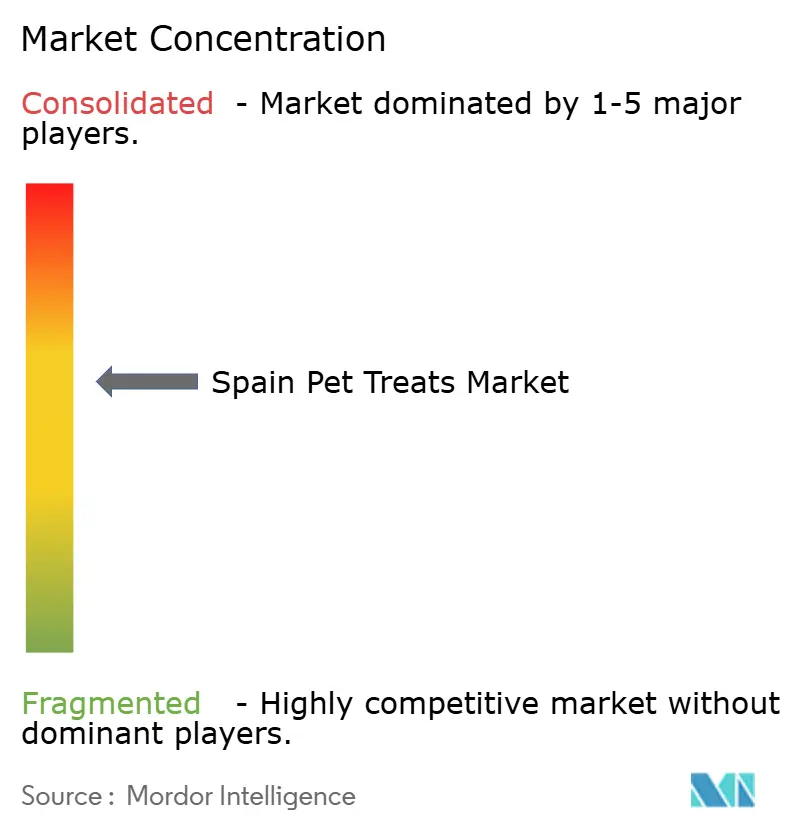
| Market Concentration | Medium |
Major Players
*Disclaimer: Major Players sorted in no particular order Image © Mordor Intelligence. Reuse requires attribution under CC BY 4.0. |
|
Spain Pet Treats Market Analysis by Mordor Intelligence
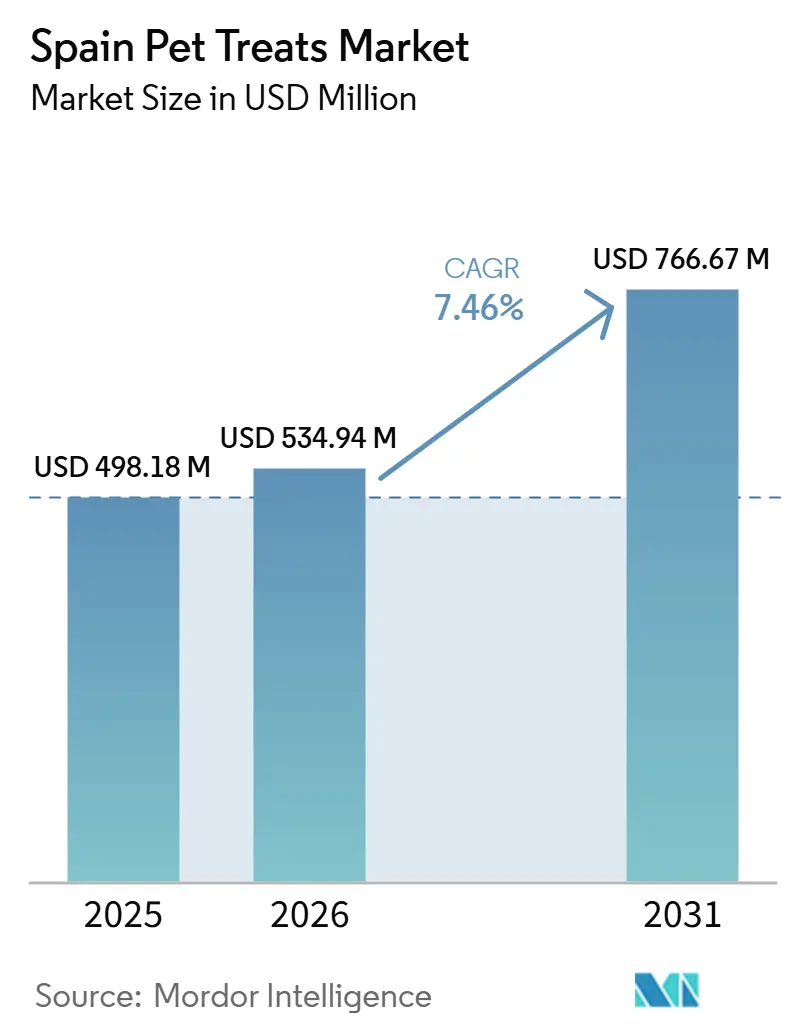
The Spain pet treats market was valued at USD 498.10 million in 2025 and is forecasted to grow from USD 534.94 million in 2026 to reach USD 766.67 million by 2031, at a CAGR of 7.46% during the forecast period from 2026 to 2031. The market is showing sustained growth as Spanish households increasingly treat snacks and indulgence purchases as a regular part of pet care rather than an occasional add-on. The broader pet food market is also supportive, with the Asociación Nacional de Fabricantes de Alimentos para Animales de Compañía (ANFAAC) reporting EUR 2.178 billion (USD 2.48 billion) in total Spanish pet food sales in 2025, up from EUR 2.053 billion (USD 2.34 billion) in 2024, while cat snacks recorded 26.7% value growth in the same year[1]Source: News Article, "Sales of the Spanish pet food industry grew by 6% in 2025," anfaac.org. The market is also benefiting from premiumization, as buyers are shifting toward functional, natural, and higher-protein formats that carry better pricing and stronger repeat demand. Mass retail continues to anchor volume, while online and specialist channels are shaping the premium end of demand and helping brands expand assortment visibility. Competition remains balanced between multinational portfolios and Spain-based producers, providing room for both scale-led and niche-led expansion strategies.
Key Report Takeaways
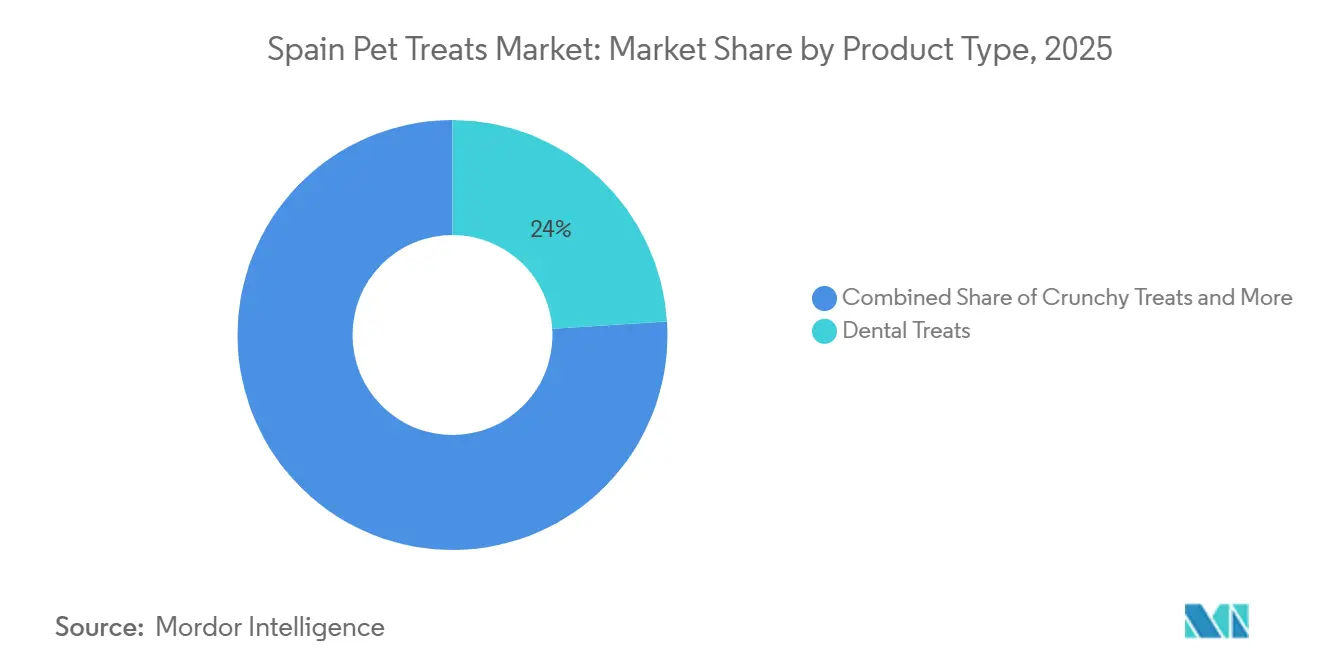
- By sub product, dental treats were the largest segment and held 24.0% of the Spain pet treats market share in 2025, while freeze-dried and jerky treats are the fastest growing segment and are anticipated to expand at an 8.4% CAGR between 2026 and 2031.
- By pet type, dogs were the largest segment and held 62.8% of the Spain pet treats market size in 2025, and dogs are also the fastest growing segment and are anticipated to expand at a 7.8% CAGR between 2026 and 2031.
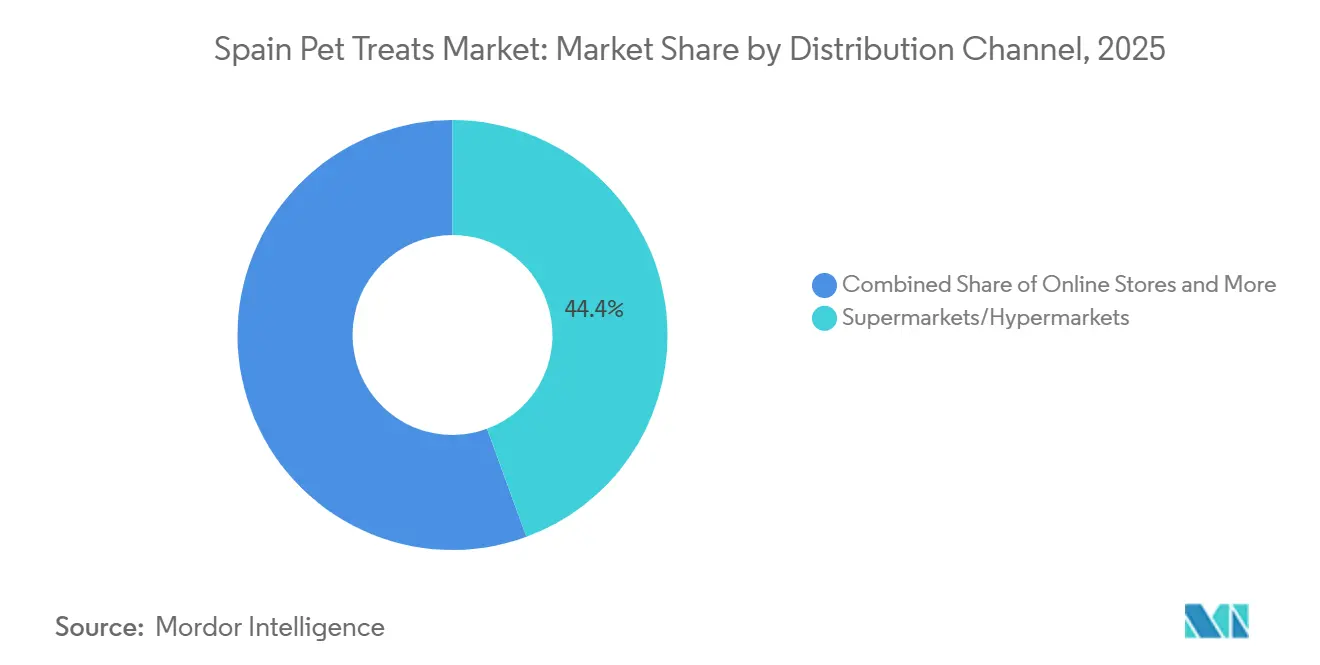
- By distribution channel, supermarkets and hypermarkets are the largest segment and held 44.4% of the market share in 2025, while the online channel is the fastest growing segment and is anticipated to expand at an 8.2% CAGR between 2026 and 2031.
Note: Market size and forecast figures in this report are generated using Mordor Intelligence’s proprietary estimation framework, updated with the latest available data and insights as of January 2026.
Spain Pet Treats Market Trends and Insights
Drivers Impact Analysis*
| Driver | (~) % Impact on CAGR Forecast | Geographic Relevance | Impact Timeline |
|---|---|---|---|
| Humanization of pets driving premium treat purchases | +2.1% | National, with highest intensity in Madrid, Barcelona, and coastal urban hubs | Short term (≤ 2 years) |
| Rising demand for functional and dental health benefits | +1.5% | National, with veterinary channel pull strongest in urban centers | Medium term (2-4 years) |
| Expansion of e-commerce and replenishment buying | +1.2% | National, with early leadership in Madrid, Barcelona, and Valencia | Short term (≤ 2 years) |
| Strong supermarket and hypermarket reach supporting impulse purchases | +1.0% | National, with penetration consistent across rural and urban Spain | Short term (≤ 2 years) |
| Growth of natural, clean-label, and limited-ingredient formulations | +1.3% | National, with premium concentration in specialty retail in major cities | Medium term (2-4 years) |
| Upcycling of meat by-products to improve sustainability and margin | +0.5% | National, with supply chain advantages near Murcia and Castile livestock regions | Long term (≥ 4 years) |
| Source: Mordor Intelligence | |||
Humanization of Pets Driving Premium Treat Purchases
Spain's shift in pet ownership from utility to companionship is influencing treat selection and purchase frequency. Asociación Nacional de Fabricantes de Alimentos para Animales de Compañía (ANFAAC) stated in 2025 that pets are increasingly viewed as family members, directly linking this change to strong growth in indulgence and snack products. As a result, the Spain pet treats market is becoming less dependent on occasional purchases and more aligned with everyday reward habits. This trend is also strengthening the position of branded products that associate feeding with bonding, routine, and care. This behavioral shift supports stronger pricing power in the Spain pet treats market, even as shoppers remain selective in other parts of the pet food basket.
Rising Demand for Functional and Dental Health Benefits
The dental treats category is benefiting from growing owner awareness of oral care costs and the practical appeal of chew-based daily maintenance. Regulatory activity also supports this trend, with the European Commission authorizing a preparation of Bifidobacterium longum CNCM I-5642 as a zootechnical additive for dogs in September 2025. This decision indicates that the functional pipeline remains active and that health-positioned claims will stay commercially relevant as new approvals are incorporated into products. In the Spain pet treats market, this is expanding the role of treats from reward items to routine wellness products with more consistent purchase patterns.
Expansion of E-Commerce and Replenishment Buying
ANFAAC reported that specialist retail and online channels together recorded a 4.9% revenue increase in 2025. This indicates a steady shift toward planned replenishment rather than impulse-led basket additions. The channel mix in the Spain pet treats market is therefore becoming more supportive of premium products, deeper assortment, and repeat purchases. As online penetration rises, brands with stronger product education and clearer differentiation are better positioned to convert shoppers into recurring buyers.
Growth of Natural, Clean-Label, and Limited-Ingredient Formulations
Natural and limited-ingredient positioning is gaining relevance as owners pay closer attention to protein source, ingredient familiarity, and overall product simplicity. In the Spain pet treats market, this trend is supporting the growth of premium and regionally differentiated products in specialist and higher-value channels. Affinity Petcare S.A. registered the "LIBRA affinity MEDITERRANEAN BALANCE" trademark in September 2025, having filed it in May 2025, covering edible treats for animals and pet food[2]Source: Article, "LIBRA affinity MEDITERRANEAN BALANCE our Mediterranean recipe - EU Trademark Details,"trademarkelite.com. This indicates that local ingredient identity is becoming a viable positioning tool rather than a packaging detail. For the Spain pet treats market, this creates more opportunity for domestic producers that can align regional sourcing narratives with premium treat demand.
Restraints Impact Analysis*
| Restraint | (~) % Impact on CAGR Forecast | Geographic Relevance | Impact Timeline |
|---|---|---|---|
| Volatility in animal protein and specialty ingredient costs | -1.5% | National, most acute for mid-tier and economy treat producers | Short term (≤ 2 years) |
| Tightening European Union scrutiny on functional claims and ingredient use | -0.8% | European Union-wide, directly applicable to Spain under Regulation (EC) No. 767/2009 | Medium term (2-4 years) |
| High price sensitivity in mass-market purchases | -1.2% | National, highest in secondary cities and rural Spain | Short term (≤ 2 years) |
| Competition from fresh, human-grade, and homemade alternatives | -0.9% | Urban concentration in Madrid, Barcelona, Bilbao, and Zaragoza | Long term (≥ 4 years) |
| Source: Mordor Intelligence | |||
Volatility in Animal Protein and Specialty Ingredient Costs
Ingredient inflation remains one of the most immediate pressures on the Spain pet treats market. In December 2025, the Ministry of Agriculture, Fisheries and Food (MAPA) reported that additive and premix prices were affected by disrupted Chinese exports and logistics constraints linked to the Strait of Hormuz. MAPA also highlighted upward pressure on fish meal prices following reduced Peruvian anchovy quota allocations in 2025. This is relevant to the Spain pet treats market because premium and functional products typically contain additional active ingredients, meaning input cost pressures can affect both mainstream and higher-value formulations simultaneously.
High Price Sensitivity in Mass-Market Purchases
The Spain pet treats market shows a clear split between premium buyers and value-conscious households. ANFAAC reported that dog dry food volume fell 3.3% in 2025 even as value held steady, indicating continued cost sensitivity in the broader pet food basket. Premium treat buyers, often driven by humanization trends and a focus on pet health, continue to trade up to functional and natural formats, while budget-conscious households increasingly rely on private-label options and promotional packs. In this environment, mid-tier branded products face pressure when private-label and promotional packs offer easy switching options at checkout. As a result, the Spain pet treats market can continue growing in value while experiencing uneven brand loyalty and more selective repeat purchasing behavior in the mass segment. This divergence suggests that long-term growth will increasingly depend on brands clearly positioning themselves at either end of the price spectrum rather than occupying the middle ground.
*Our forecasts treat driver/restraint impacts as directional, not additive. The impact forecasts reflect baseline growth, mix effects, and variable interactions.
Segment Analysis
By Sub Product: Freeze-Dried and Jerky Treats Outpace a Dentally Driven Market
Dental treats accounted for 24.0% of the Spain pet treats market share in 2025, making them the largest sub-product category. Their position reflects mainstream availability combined with a clear wellness benefit that owners can readily understand. Dental formats perform well across both mass retail and specialist channels, giving them broader commercial reach than many niche formats. Products in this segment also benefit from repeat purchases, as owners typically buy them as part of a routine rather than as an occasional reward.
Freeze-dried and jerky treats are anticipated to grow at an 8.4% CAGR between 2026 and 2031, making them the fastest-growing sub-product category in the Spain pet treats market. This growth is driven by strong demand for visible protein content, simpler ingredient profiles, and a less processed image. It also aligns with the premium "real food" positioning gaining traction in the market, as buyers seek products that feel closer to fresh or high-quality home feeding. The segment is growing not only due to novelty, but because it aligns with how higher-value shoppers increasingly define quality.



By Pets: Dogs Command Share While Cats Represent the Fastest-Moving Opportunity
Dogs accounted for 62.81% of the Spain pet treats market in 2025, making them the largest pet-type segment by a wide margin. The segment benefits from broader format coverage, more routine treat occasions, and stronger visibility across retail shelves. Dogs are also anticipated to expand at a 7.82% CAGR between 2026 and 2031, meaning the leading segment is still growing faster than many mature consumer categories. This combination of scale and growth gives canine treats a strong position in the Spain pet treats market and indicates that category expansion is not yet close to saturation.
The cat segment also remains an important opportunity in the market. ANFAAC reporting showed that cat snacks in Spain increased by 26.7% in value and 14.1% in volume in 2025, far ahead of dog snacks, which grew by 1.3% in value. This gap suggests the Spain pet treats market has meaningful room to expand beyond its dog-led base as product innovation becomes more balanced. It also indicates that cats are shifting from a historically narrower treat assortment toward a stronger role in premium and functional purchasing. Other pets remain a small part of the Spain pet treats market but continue to benefit from the broader trend of companion care now reaching more species-specific feeding occasions.
By Distribution Channel: Online Accelerates as Supermarkets Anchor Volume
Supermarkets and hypermarkets held 44.4% of the Spain pet treats market value in 2025, maintaining their position as the leading distribution channel. Their strength stems from convenience, shopper traffic, and the ease of adding treats to regular grocery purchases. This channel supports national scale and keeps mainstream products visible across a broad shopper base. It also allows value-tier and mid-tier formats to sustain volume even as premium products gain traction in other channels.
The online channel in the Spain pet treats market is anticipated to expand at an 8.2% CAGR between 2026 and 2031, making it the fastest-growing distribution segment. Online growth is supported by richer product comparison, broader assortment availability, and stronger replenishment behavior compared to most physical formats. Speciality stores also remain relevant, as premium, natural, and functional products often require more explanation at the point of sale. This creates a two-speed structure in the Spain pet treats market, with supermarkets anchoring volume and online plus specialist retail driving value growth. The channel mix is therefore shifting toward greater premium conversion while retaining the broad accessibility that sustains overall category volume.
Geography Analysis
The Spain pet treats market is anticipated to expand at a 7.46% CAGR between 2026 and 2031. This positions Spain among the more active growth markets in Europe for pet treats, particularly when compared with more mature markets where treat penetration is already higher. The broader pet food base has also remained supportive, reflecting steady growth in overall pet ownership and spending on pet care products. As a result, the Spain pet treats market is well-positioned, with growing domestic demand and clear room for premium expansion.
Within the country, Madrid, Barcelona, and Valencia continue to shape the premium segment of the Spain pet treats market. These urban areas support stronger specialist retail coverage, more developed online demand, and greater acceptance of natural and functional products. Higher disposable incomes and greater awareness of pet nutrition in these cities also contribute to stronger demand for differentiated treat formats. They also provide the strongest conditions for higher-priced product formats such as freeze-dried, jerky, and advanced dental treats. Secondary cities such as Seville, Bilbao, Zaragoza, and Malaga represent the next layer of opportunity as retail networks and logistics coverage improve. This indicates that growth in the Spain pet treats market is broadening beyond the core urban cluster while the largest cities retain their premium pull.
Spain also functions as a supply and export platform, not only as a consumer market. The country's established food processing infrastructure and access to quality raw materials support competitive manufacturing for both domestic and international demand. Export activity strengthens scale economics for Spain-based manufacturers and supports wider formulation and packaging capabilities. In the Spain pet treats market, this export orientation allows local producers to compete more effectively against import-reliant rivals and gives domestic manufacturing a stronger strategic role than local demand alone would suggest[3]Source: News Article, "Spanish Petfood Market Grows Steadily," internationalpetfood.com.
Competitive Landscape
The Spain pet treats market is moderately concentrated, with global companies holding the leading revenue positions while local and private-label players maintain a meaningful presence. Mars, Incorporated and Nestlé Purina Pet Care are the most prominent multinational players, covering mass, dental, and functional segments with broad brand portfolios. Their scale is an advantage in the Spain pet treats market, as they combine national distribution with research-backed positioning and strong shelf access. Domestic firms also hold strategic relevance by leveraging local sourcing, regional flavor identity, and faster adaptation to Spain-specific demand patterns.
Mars, Incorporated strengthened its Spanish production base in 2024 when its Arévalo (Ávila) facility received support for a Line 2 expansion, increasing wet pet food capacity by 42,000 metric tons and materially lifting plant output. In May 2025, Alinatur acquired a majority stake in Pet Snack Company, expanding its reach across dry, semi-wet, wet, and snack formats under a single structure. These developments indicate that the Spain pet treats market is being shaped by both manufacturing scale and targeted brand differentiation, rather than price competition alone.
The main gaps in the Spain pet treats market include cat-focused functional products, breed-specific premium lines, and protein platforms linked to sustainability or food sensitivity. Private-label suppliers are relevant in dental and crunchy formats, particularly where benefit differences are difficult for consumers to assess quickly. Online subscription models and data-driven personalization are also gaining importance, as they improve repeat conversion and enable more precise targeting by life stage, size, and feeding need. Companies that can support claims with stronger documentation are likely to maintain pricing power more effectively in the Spain pet treats market. This keeps competition balanced across scale, regulatory compliance, and product clarity, rather than allowing any single approach to dominate the category.
Spain Pet Treats Industry Leaders
-
Mars, Incorporated
-
Nestlé Purina PetCare (Nestlé S.A.)
-
Affinity Petcare S.A. (Agrolimen, S.A.)
-
Hill’s Pet Nutrition, Inc (Colgate-Palmolive Company)
-
Farmina Pet Foods Holding B.V
- *Disclaimer: Major Players sorted in no particular order

Recent Industry Developments
- September 2025: Affinity Petcare S.A. saw its European Union trademark for “LIBRA affinity MEDITERRANEAN BALANCE” registered at the European Union Intellectual Property Office, covering edible treats for animals and pet food. The trademark, filed in May 2025, positions a Mediterranean-ingredient treat concept that signals a strategy to leverage Spain’s geographic ingredient identity in both domestic and export treat markets
- September 2025: The European Commission issued Implementing Regulation (EU) 2025/1776, authorizing a preparation of Bifidobacterium longum CNCM I-5642 as a zootechnical additive, physiological condition stabilizer, for dogs. The authorization, held by Nestlé Enterprises S.A., opens a commercially significant regulatory pathway for probiotic-functional treat formats across the European Union, including Spain.
- May 2025: Alinatur, Murcia, Spain, acquired a majority stake in Pet Snack Company, which markets products including the “Mediterranean natural” Serrano Snacks range. This acquisition made Alinatur the only Spanish national manufacturer covering dry, semi-wet, wet, and snack product types within a single operational structure, materially expanding its private-label treat manufacturing capability.


Spain Pet Treats Market Report Scope
Pet treats are snack and reward products formulated for companion animals and are used for indulgence, training, oral care, and functional health support.
The Spain pet treats market is segmented by sub product type (crunchy treats, dental treats, freeze-dried and jerky treats, soft and chewy treats, and other treats), by pet type (dogs, cats, and other pets), and by distribution channel (convenience stores, online channel, specialty stores, supermarkets and hypermarkets, and other channels). The market forecasts are provided in terms of value (USD) and volume (metric tons).
| Crunchy Treats |
| Dental Treats |
| Freeze-Dried and Jerky Treats |
| Soft and Chewy Treats |
| Other Treats |
| Cats |
| Dogs |
| Other Pets |
| Convenience Stores |
| Online Channel |
| Specialty Stores |
| Supermarkets and Hypermarkets |
| Other Channels |
| By Sub Product | Crunchy Treats |
| Dental Treats | |
| Freeze-Dried and Jerky Treats | |
| Soft and Chewy Treats | |
| Other Treats | |
| By Pets | Cats |
| Dogs | |
| Other Pets | |
| By Distribution Channel | Convenience Stores |
| Online Channel | |
| Specialty Stores | |
| Supermarkets and Hypermarkets | |
| Other Channels |


Key Questions Answered in the Report
What is the 2026 value of Spain pet treats market?
The Spain pet treats market stands at USD 534.94 million in 2026.
Which sub-product is leading in Spain?
Dental treats are the largest sub-product segment and held 24.0% share in 2025, helped by clear oral care positioning and repeat-use behavior.
How important is online retail for pet treats in Spain?
The online channel is the fastest-growing route to market and is anticipated to expand at an 8.2% CAGR between 2026 and 2031.
Which product type is growing the fastest?
Freeze-dried and jerky treats are anticipated to expand at an 8.4% CAGR between 2026 and 2031, making them the fastest-growing sub-product format.
Page last updated on:





