
Market Overview
| Study Period | 2020 - 2031 |
|---|---|
| Forecast Data Period | 2026 - 2031 |
| Base Year Market Size (2025) | USD 517.13 Million |
| Market Size (2026) | USD 563.61 Million |
| Market Size (2031) | USD 866.79 Million |
| Growth Rate (2026 - 2031) | 8.99 % |
| Market Concentration | Medium |
Major Players *Disclaimer: Major Players sorted in no particular order Image © Mordor Intelligence. Reuse requires attribution under CC BY 4.0. | |
Spain Blood Glucose Monitoring Devices Market Analysis by Mordor Intelligence
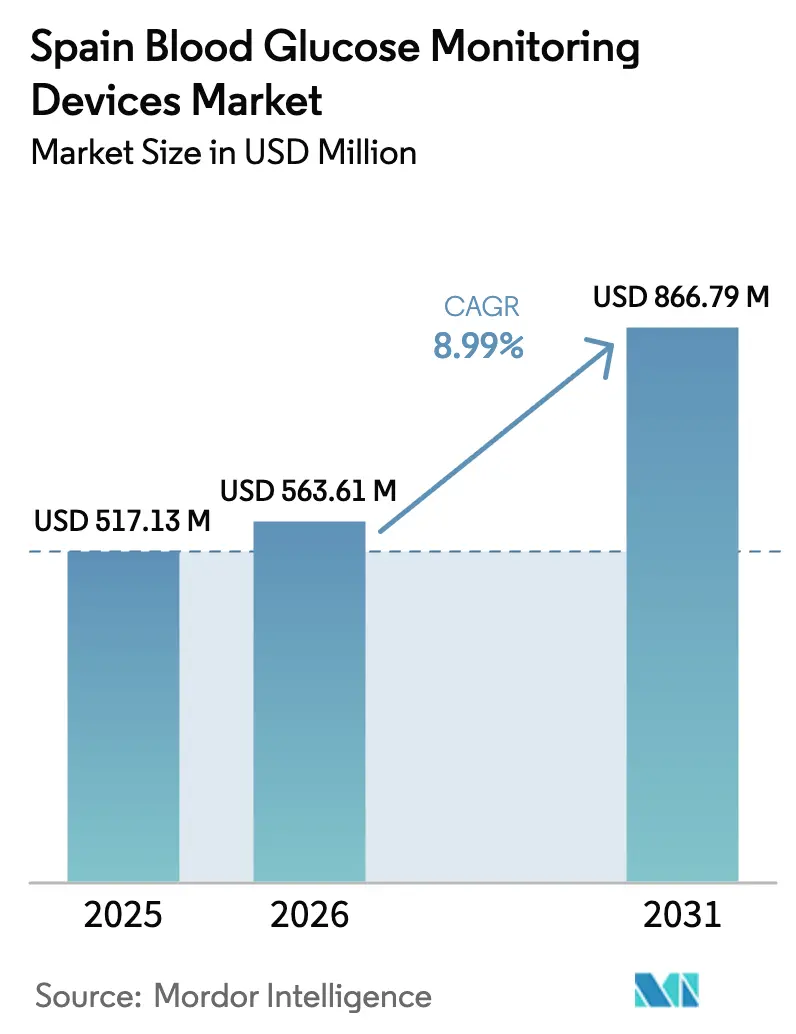
Spain Blood Glucose Monitoring Devices Market size in 2026 is estimated at USD 563.61 million, growing from 2025 value of USD 517.13 million with 2031 projections showing USD 866.79 million, growing at 8.99% CAGR over 2026-2031.
In Spain According to WHO, as of 25 June 2022, a total of 102,258,825 vaccine doses have been administered. Regardless of previous diabetes history, admission hyperglycemia is a significant predictor of all-cause death in non-critically hospitalized COVID-19 patients. Spain was among the nations most severely impacted by the COVID-19 pandemic in 2020. A total countrywide lockdown was implemented from 14 March 2020 through 21 June 2020 to limit the epidemic due to an increase in instances.
The government reinstated a state of emergency on October 25 due to a return of cases after a nearly 4-month period during which certain restrictive measures had been lifted. This included partial lockdown measures with movement limitations that would extend until May 9 of 2021.
Critical elements of the therapy of type 1 diabetes include medical devices (T1D). Devices include insulin pumps, continuous glucose monitors (CGMs), and blood glucose meters. These gadgets are linked to better glucose management and decreased hypoglycemia.
Note: Market size and forecast figures in this report are generated using Mordor Intelligence’s proprietary estimation framework, updated with the latest available data and insights as of 2026.
Spain Blood Glucose Monitoring Devices Market Trends and Insights
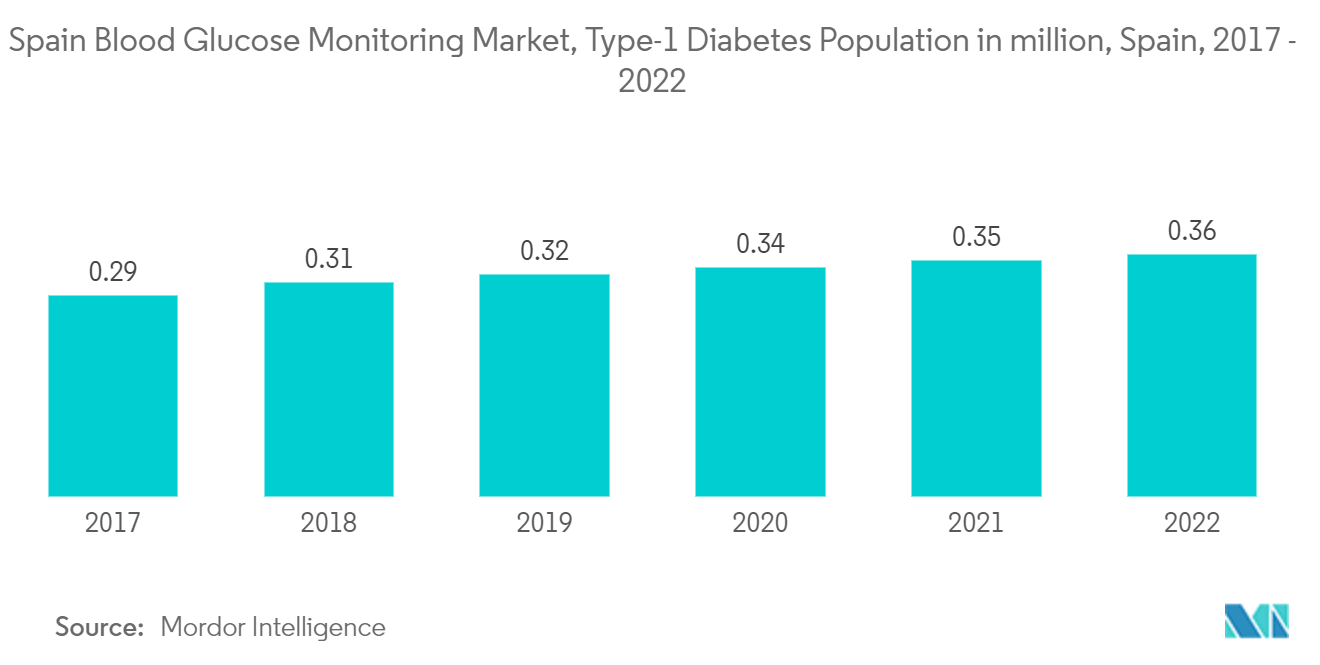
Increasing Type-1 diabetes population across Spain
Over the forecast period, the population of people with type 1 diabetes in Spain increased at a rate greater than 3%. In 2021, over 0.35 million people will live with type 1 diabetes. Diabetes is thought to affect up to 13.8% of adults in Spain, with approximately 6% having undiagnosed diabetes. Similar prevalence rates have been observed in Spain's five million-person Valencian Community. In this field, primary care physicians monitor most diabetic patients and work closely with endocrinologists to handle more complicated cases. Numerous studies have found that people with diabetes are more likely to have severe COVID-19 episodes, have poorer outcomes, and have a higher mortality rate. The SED expects the fatality rate to increase, as the mortality risk for the diabetic population in Spain is estimated to be around 7.3%, compared to 0.9%-3% for the non-diabetic population.
As a result of the factors above, the growth of the studied market in Spain is anticipated.
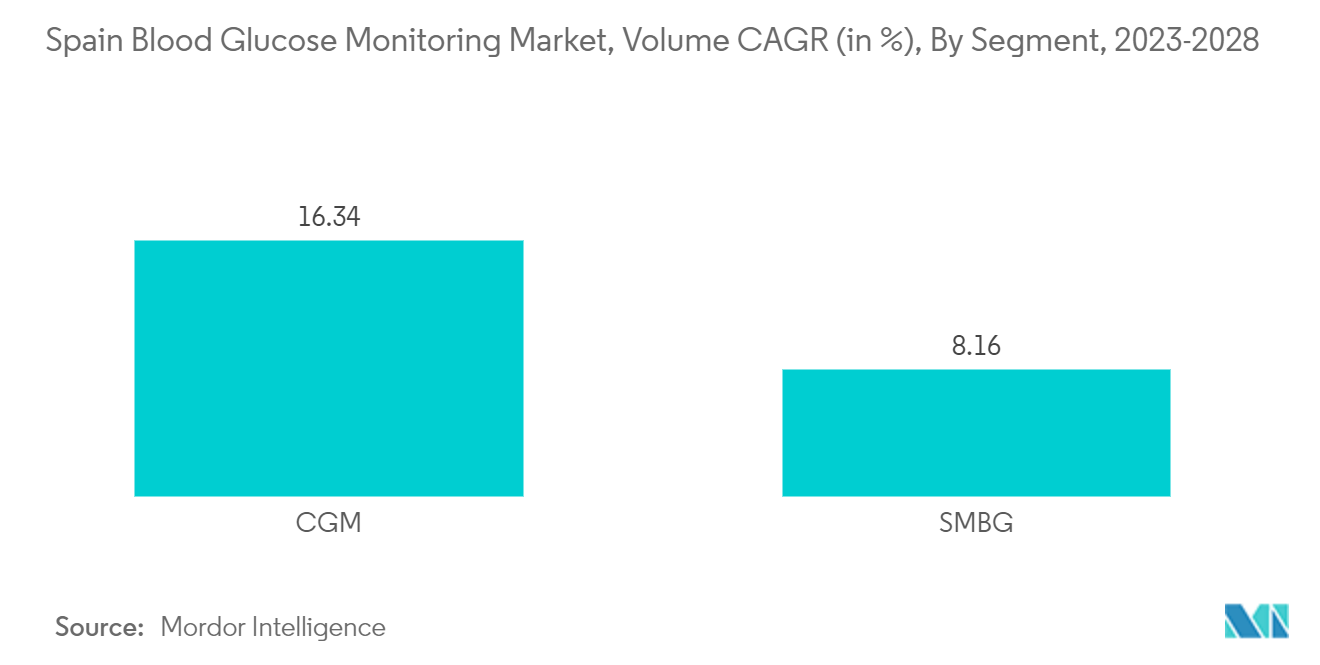
Continuous Glucose Monitoring Holds Highest CAGR in Spain Blood Glucose Monitoring Devices Market.
The COVID-19 pandemic underscores the imperative of maintaining good glycemic control in patients with diabetes, as numerous observational studies have indicated that poorly managed diabetes is linked to an elevated risk of hospitalization and mortality from viral illnesses. The frequency of glucose level monitoring varies depending on the type of diabetes, which varies from patient to patient. Patients with Type-1 diabetes must regularly monitor their blood glucose levels to track their blood glucose levels and adjust insulin dosing accordingly. Modern CGM devices provide a comprehensive representation of blood glucose patterns and trends, in contrast to traditional glucose level checks at predetermined intervals. Additionally, contemporary continuous glucose monitoring devices can either retrospectively display blood glucose level trends by downloading data or provide a real-time depiction of glucose levels through receiver displays.
The use of CGM by Type-1 diabetic patients is much less as compared to Type-2 diabetic patients. However the expenditure of Type-1 diabetic patients on these devices is nearly double that of Type-2 diabetics. The newest CGM models, the Abbott Freestyle Libre and the Dexcom G6 overcame many technical barriers. However, high costs and uncertainties about their efficacy and necessity have kept CGM from being widely used by people with Type-2 diabetes. Continuous glucose monitoring devices are becoming cheaper with new technologies, like cell phone integration.
Competitive Landscape
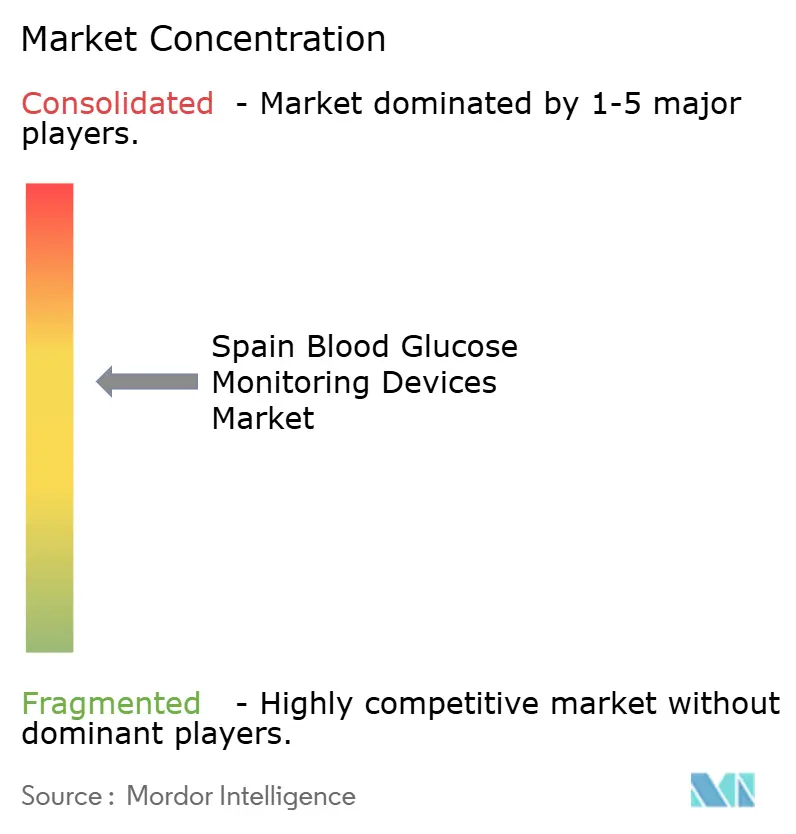
The Spain blood glucose monitoring devices market is moderately fragmented, with few major manufacturers present in the market for CGM devices, and very high market competition in the SMBG market. The CGM devices market is dominated by a few major players, like Dexcom, Medtronic, Abbott, and Senseonics. The market for BGM devices comprises more generic players like Roche, LifeScan, Arkray, Ascensia, etc. Technological innovations in the recent past helped the companies to strengthen their market presence.
Spain Blood Glucose Monitoring Devices Industry Leaders
-
Roche
-
Abbott
-
Medtronics
-
Dexcom
-
LifeScan
- *Disclaimer: Major Players sorted in no particular order
Market Opportunities and Future Outlook
Spain's Digital Health Strategy 2021-2026 and the Espana Digital initiative support a coordinated push to expand CGM and SMBG data use within National Health System workflows, including primary care and endocrinology. An investment of 220 million EUR in autonomous communities for digital health projects through December 2025 supports digital-health projects that integrate CGM with mobile applications and remote monitoring.
Real Decreto 415/2026, published May 2026, formalizes Health Technology Assessment processes for digital medical devices and diagnostic in vitro technologies, which affects the evidentiary requirements for CGM and connected BGM solutions. AEMPS market-control activity also reinforces compliant labeling, post-market surveillance readiness, and distributor quality systems across online and offline channels, providing a clearer basis for evidence-based adoption and monitoring. Manufacturers with Spain portfolios (Abbott, Dexcom, Medtronic, Roche, LifeScan) can align product upgrades and data services with the evolving HTA evaluation approach as digital health governance deepens.
Recent Industry Developments
- May 2026: Abbott Laboratories secured CE Mark for the Libre Duo system, described as the first dual glucose-ketone sensing technology for people with diabetes. The approval enables planned launches in select European countries later in 2026. This development expands Abbott's portfolio in point of care glucose management and may broaden market access for integrated metabolic sensing solutions.
- February 2026: Roche Diagnostics filed a workforce reduction plan (ERE) impacting 50 employees at its Sant Cugat del Vallès headquarters in Spain. The move indicates ongoing optimization of its Spanish footprint and may affect local service and support for diabetes devices.
- February 2026: Roche Diagnostics filed a workforce reduction plan (ERE) impacting 50 employees at its Sant Cugat del Vallès headquarters in Spain. The move indicates ongoing optimization of its Spanish footprint and may affect local service and support for diabetes devices.
Research Methodology Framework and Report Scope
Market Definition and Coverage
This market covers revenue earned in Spain from devices and consumables used to measure blood glucose, including self-monitoring meters and strips and continuous glucose monitoring systems and related wearables, across hospital, clinic, pharmacy, and home-care use.
Scope exclusions: We exclude diabetes drugs, insulin delivery devices (such as pens or pumps), and general lab analyzers not used for patient-level blood glucose monitoring.
Segmentation Overview
- Device
- Self-monitoring blood glucose devices
- Glucometer Devices
- Test Strips
- Lancets
- Continuous blood glucose monitoring devices
- Sensors
- Durables (Receivers and Transmitters)
- Self-monitoring blood glucose devices
- Distribution Channel
- Online
- Offline
Data Sources, Market Sizing, and Validation
Desk Research
Desk research was used to set the demand boundaries and to build realistic guardrails for volumes, pricing, and clinical use in Spain. We relied on public health and utilization signals, such as diabetes prevalence and treatment patterns, then mapped those signals to device adoption pathways across care settings.
Sources reviewed include non-paywalled publications and datasets such as the Spanish Ministry of Health, the World Health Organization, OECD health statistics, Eurostat, and the International Diabetes Federation, along with peer-reviewed clinical journals on CGM and SMBG outcomes. To complement this, we also used company filings and investor presentations, procurement and tender notices where available, reputable press, and paid subscriptions for company financials and intelligence, and for patent databases to understand product cycles. The examples listed here are indicative only, and many other sources were also used for data collection, cross-checking, and clarifying open questions.
Primary Interviews and Surveys
Primary work focused on validating how monitoring is used and paid for in Spain, since that directly drives unit demand and repeat consumable consumption. We spoke with a mix of channel participants, clinicians, and operational roles involved in diabetes care pathways, and the feedback was used to confirm adoption levels for CGM versus SMBG, typical replacement cycles, and realistic price bands after public procurement effects.
Distribution of primary research fieldwork respondents
| Company type | Respondent position |
|---|---|
| Top tier: 33% | CXOs: 17% |
| Mid tier: 45% | Functional/Unit leaders: 31% |
| Smaller Players: 22% | Managers: 52% |
Market-Sizing & Forecasting
Sizing starts from a top-down demand pool build that uses Spain-specific diabetes and monitoring signals to reconstruct likely testing and sensing volumes. These volumes are then converted into value using price ranges that match observed purchasing behavior. We corroborate totals using selective bottom-up approximations, such as sampled SKU price checks, distributor channel checks, and limited supplier revenue roll-ups, which helps adjust for over-counting and missing gaps.
Key model inputs include diabetes prevalence and diagnosed population trends, the share of patients on intensive insulin regimens who typically test more often, CGM adoption in eligible cohorts, average strip consumption per active SMBG user, sensor wear duration and replacement frequency, and observable procurement effects that compress pricing in public channels. For forecasting, scenario analysis was used around reimbursement and adoption speed, followed by smoothing of the resulting time series so short-term volatility does not overstate long-term growth. Where a clean bottom-up roll-up was not possible, we filled gaps using coverage ratios from interviews and then rechecked the output against independent demand indicators, so the final number stays realistic.
Data Validation & Update Cycle
Outputs are checked in several steps, starting with basic variance checks by year so sudden jumps in units, pricing, or mix are explained by a clear trigger rather than a modeling error. We also compare implied per-patient consumption levels with what clinicians and channel respondents consider typical for Spain, and revisit outliers before sign-off.
Before publication, the model and key assumptions go through an internal analyst review so math, definitions, and time series logic remain consistent across the report. Reports are refreshed annually, and interim updates are triggered when a material event shifts pricing, reimbursement, or uptake. Right before delivery, we do a final pass to ensure clients receive the latest updated view.
Mordor Intelligence's Spain Blood Glucose Monitoring Devices Market Size Compared Against Other Published Estimates
Published market sizes often differ because firms do not line up on what they count, which year they anchor to, and how they treat pricing in channels influenced by public reimbursement and tenders. Differences also show up when one model is unit-led, covering strips and sensors, and another is value-led with broader average prices.
The benchmark table shows a noticeable spread, and in Mordor Intelligence's model the Spain total counts SMBG and CGM together but keeps only glucose monitoring components and associated durables, instead of folding in insulin delivery or wider diabetes management hardware. Gaps can also come from how quickly CGM adoption is assumed to rise, whether strip usage is modeled per active user or per diagnosed patient, and how currency timing and inflation pass-through are handled across years.
Benchmark comparison
| Source | Market Size | Gaps in Research Methodology |
|---|---|---|
| Mordor Intelligence | USD 563.61 M (2026) | |
| Regional Consultancy A | USD 482.60 M (2026) | Uses a narrower value pool with more conservative CGM uptake assumptions and tends to average pricing without explicitly modeling strip consumption intensity and sensor replacement cycles. |
| Trade Journal B | USD 600.00 M (2026) | Likely applies broader category inclusion (adjacent diabetes care hardware) and uses higher blended ASP progression, without showing clear links to per-user consumption or tender-linked price effects. |
Looking across the three figures, the main takeaway is that scope boundaries and the way consumable volumes are translated into value explain most of the gap, more than small math differences. By tying value back to usage drivers like active-user counts, strip frequency, and sensor replacement, we keep the estimate traceable to inputs that can be rechecked and updated as Spain adoption and pricing change.
Key Questions Answered in the Report
How big is the Spain Blood Glucose Monitoring Devices Market?
The Spain Blood Glucose Monitoring Devices Market size is expected to reach USD 563.61 million in 2026 and grow at a CAGR of 8.99% to reach USD 866.79 million by 2031.
What is the current Spain Blood Glucose Monitoring Devices Market size?
In 2026, the Spain Blood Glucose Monitoring Devices Market size is expected to reach USD 563.61 million.
Who are the key players in Spain Blood Glucose Monitoring Devices Market?
Roche, Abbott, Medtronics, Dexcom and LifeScan are the major companies operating in the Spain Blood Glucose Monitoring Devices Market.
What years does this Spain Blood Glucose Monitoring Devices Market cover, and what was the market size in 2025?
In 2025, the Spain Blood Glucose Monitoring Devices Market size was estimated at USD 563.61 million. The report covers the Spain Blood Glucose Monitoring Devices Market historical market size for years: 2019, 2020, 2021, 2022, 2023 and 2024. The report also forecasts the Spain Blood Glucose Monitoring Devices Market size for years: 2026, 2027, 2028, 2029, 2030 and 2031.