
Southeast Asia Commercial Dishwasher Market Size and Share
Market Overview
| Study Period | 2021 - 2032 |
|---|---|
| Forecast Data Period | 2027 - 2032 |
| Base Year Market Size (2026) | USD 114.56 Million |
| Market Size (2027) | USD 120.86 Million |
| Market Size (2032) | USD 170.15 Million |
| Growth Rate (2027 - 2032) | 7.08 % |
| Market Concentration | Medium |
Major Players *Disclaimer: Major Players sorted in no particular order Image © Mordor Intelligence. Reuse requires attribution under CC BY 4.0. | |
Southeast Asia Commercial Dishwasher Market Analysis by Mordor Intelligence
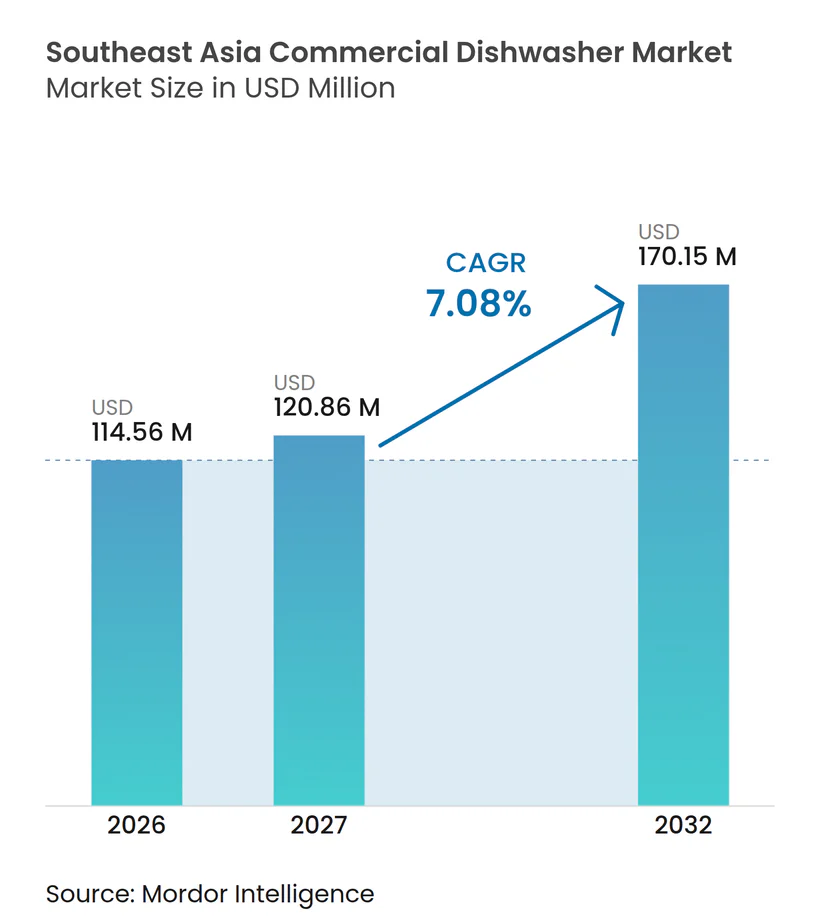
The Southeast Asia commercial dishwasher market size was valued at USD 114.56 million in 2026, is estimated at USD 120.86 million in 2027, and is forecast to reach USD 170.15 million by 2032, growing at a CAGR of 7.08% during 2027-2032. The Southeast Asia commercial dishwasher market is benefiting from the formalization of foodservice infrastructure, tighter kitchen labor conditions, and more systematic food hygiene requirements. Organized restaurant chains and hotels create more predictable replacement cycles than independent outlets because they specify equipment across multiple sites. Central kitchens are becoming a distinct source of demand as public meal programs, cloud kitchens, and institutional caterers concentrate food preparation in fewer, higher-throughput sites. Manufacturers are responding by combining water and energy efficiency with service coverage, remote monitoring, and machine designs suited to local voltage, water quality, and kitchen layouts. Capital constraints among small operators and uneven utility infrastructure still slow adoption outside major cities.
Key Report Takeaways
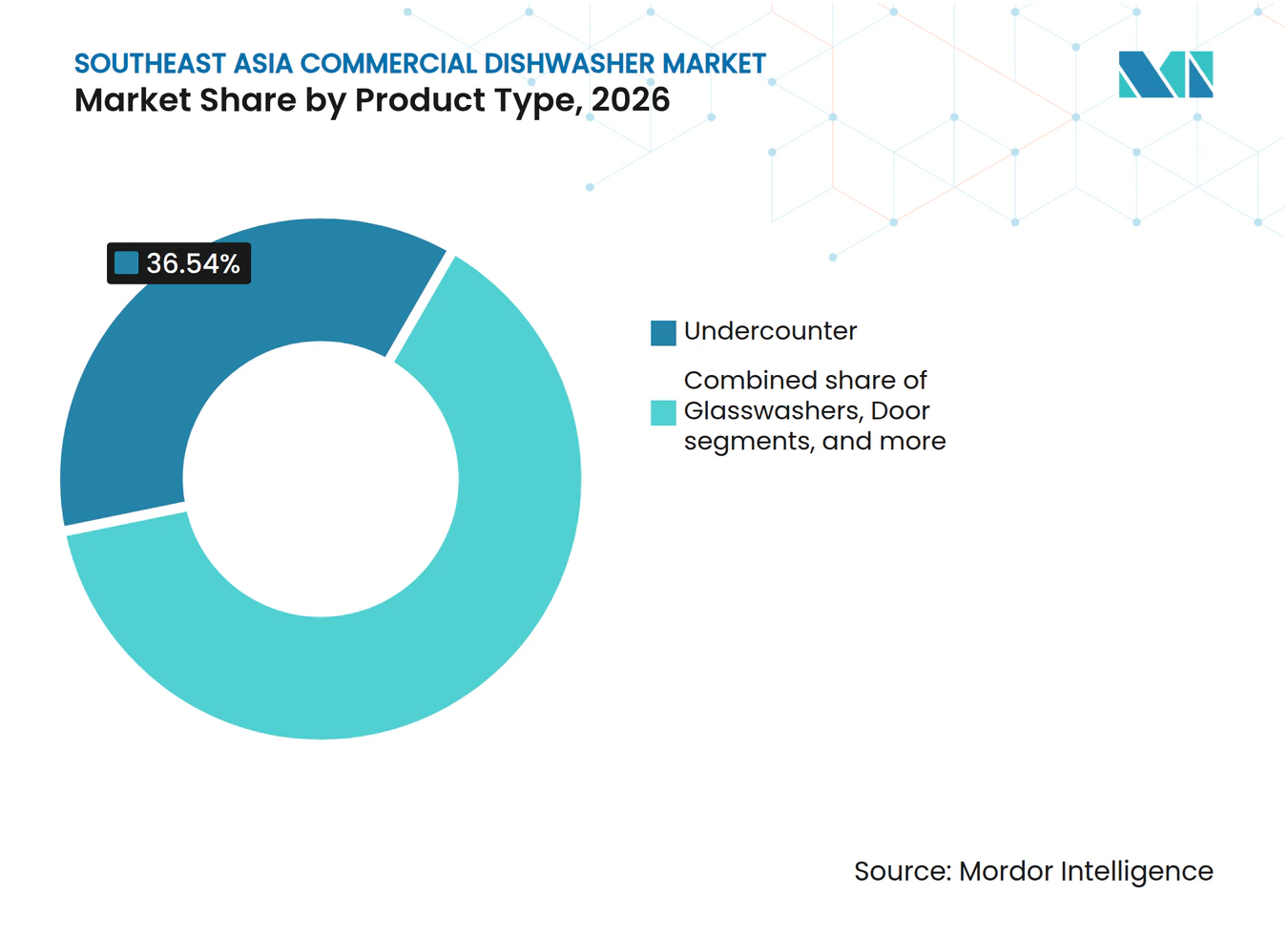
- By product type, undercounter dishwashers accounted for 36.54% of the Southeast Asia commercial dishwasher market in 2026, while rack and conveyor dishwashers are projected to record a CAGR of 7.87% between 2027 and 2032.
- By capacity, machines processing 50–150 racks per hour accounted for 40.12% of the market in 2026, while machines processing more than 150 racks per hour are projected to register a CAGR of 8.13% between 2027 and 2032.
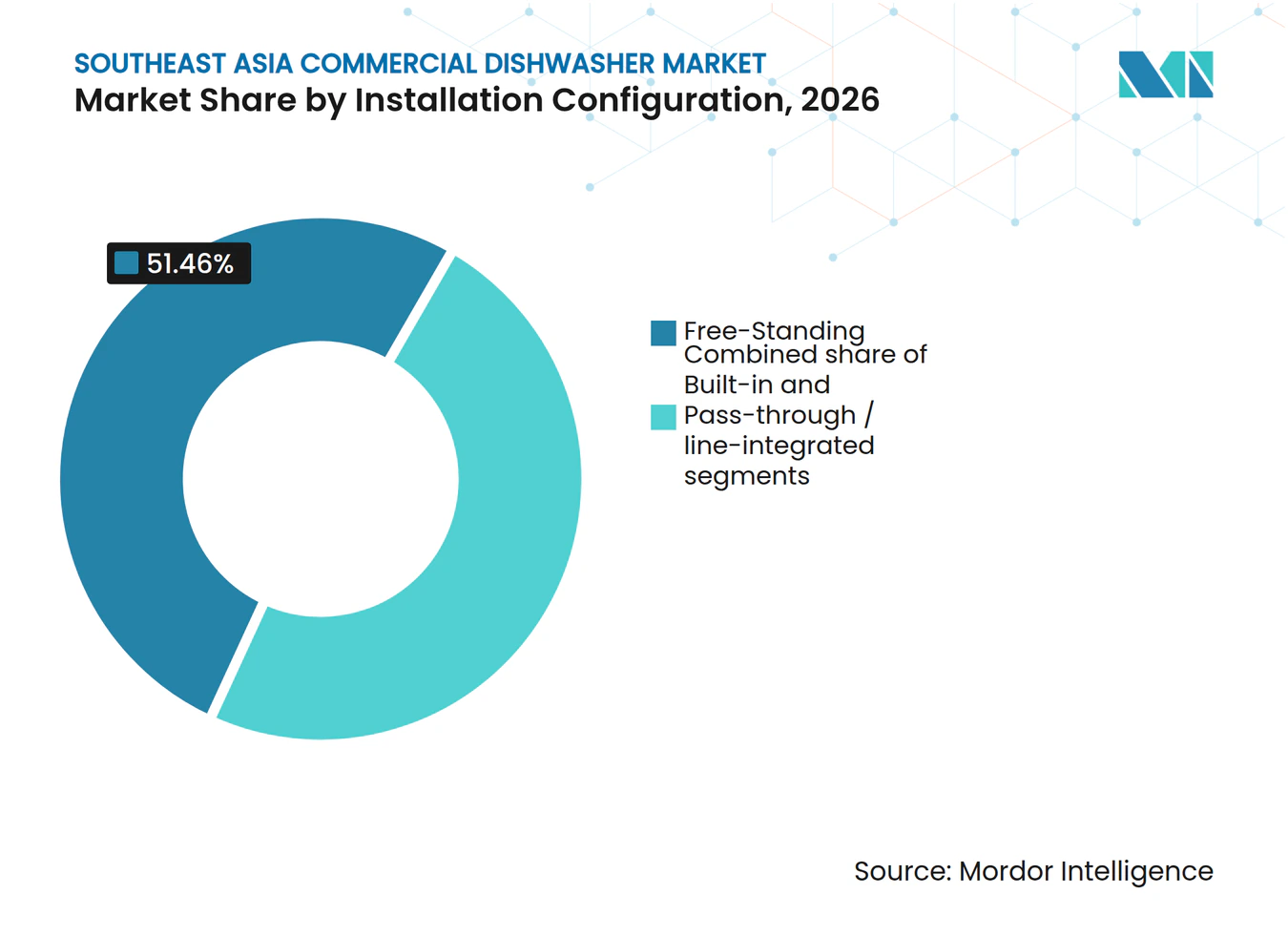
- By installation configuration, free-standing dishwashers accounted for 51.46% of the market in 2026, while built-in and under-counter integrated configurations are projected to achieve a CAGR of 8.37% between 2027 and 2032.
- By price range, mid-range dishwashers accounted for 58.62% of the market in 2026, while premium dishwashers are projected to register a CAGR of 8.28% between 2027 and 2032.
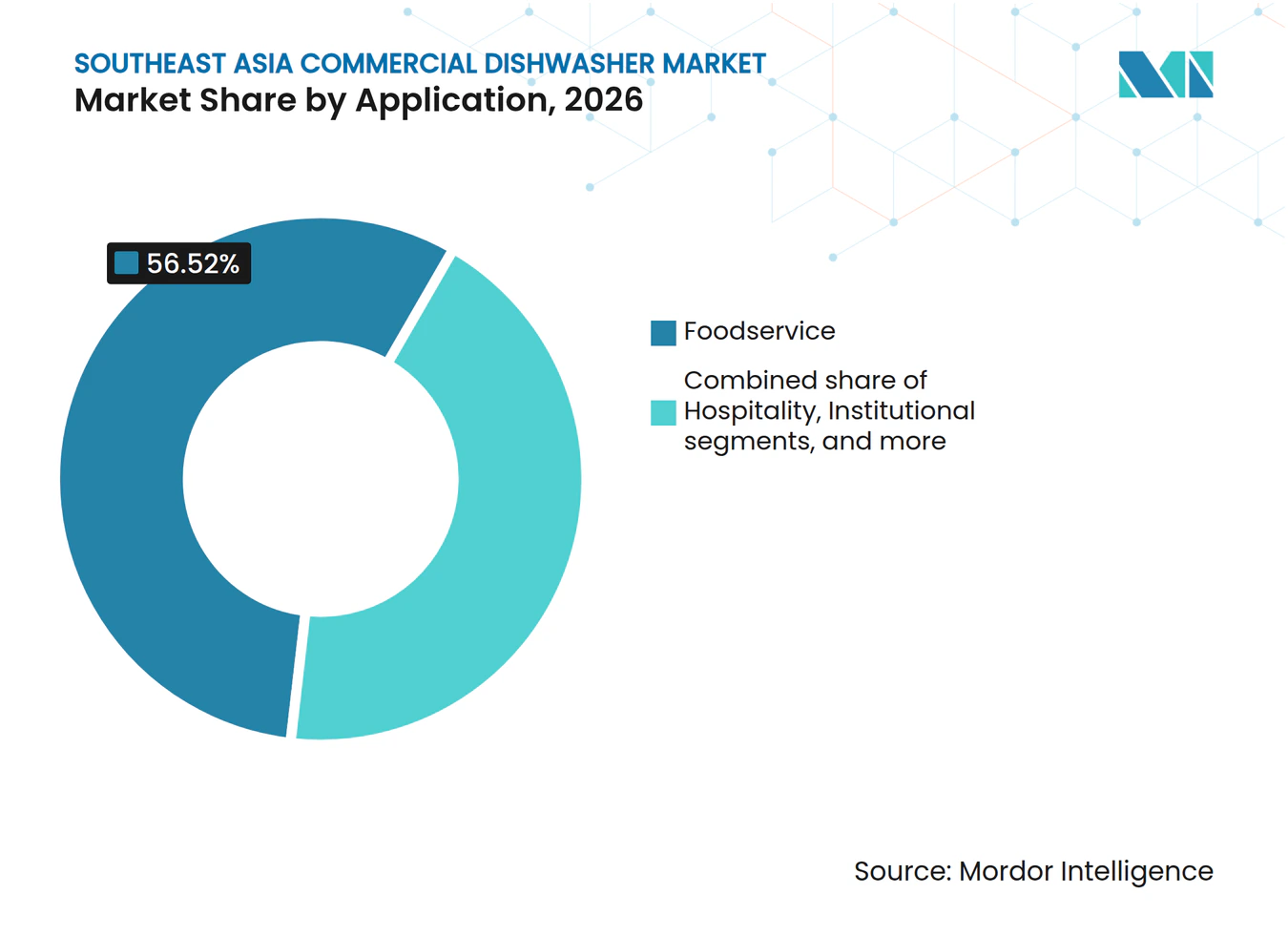
- By application, foodservice accounted for 56.52% of the market in 2026, while catering and central kitchens are projected to record a CAGR of 8.22% between 2027 and 2032.
- By distribution channel, dealers and distributors accounted for 81.15% of the market in 2026, while direct sales are projected to achieve a CAGR of 8.19% between 2027 and 2032.
- By geography, Indonesia accounted for 32.26% of the Southeast Asia commercial dishwasher market in 2026, while Vietnam is projected to register a CAGR of 7.25% between 2027 and 2032.
Note: Market numbers in this report are based on Mordor Intelligence's proprietary estimation framework, which combines nine months of actuals with Q4 projections for base year 2026.
Market Trends and Insights
Drivers Impact Analysis of Southeast Asia Commercial Dishwasher Market *
| Driver | (~) % Impact on CAGR Forecast | Geographic Relevance | Impact Timeline |
|---|---|---|---|
| Expansion of Organized Foodservice, Hotels and QSR Chains | +2.30% | Indonesia, Vietnam, Thailand, Philippines | Short term (≤ 2 years) |
| Commercial Kitchen Labor Shortages and Automation Adoption | +1.60% | Singapore, Malaysia, Thailand, Indonesia, Vietnam | Medium term (2-4 years) |
| Stricter Food-Hygiene and HACCP Compliance Requirements | +1.00% | Singapore, Malaysia, Vietnam, broader ASEAN | Medium term (2-4 years) |
| Water, Energy and Chemical-Saving Requirements | +0.70% | Singapore, Thailand, Malaysia | Long term (≥ 4 years) |
| High-Density Central Kitchens and Institutional Catering Growth | +0.50% | Indonesia, Vietnam, Thailand | Medium term (2-4 years) |
| Localized Machines for Voltage, Water Hardness and Asian Washware Conditions | +0.30% | All markets, especially Indonesia and Vietnam | Long term (≥ 4 years) |
| Source: Mordor Intelligence | |||
Expansion of Organized Foodservice, Hotels and QSR Chains
Thailand's HRI sector was projected to reach USD 35.4 billion in 2025. Organized restaurant and hotel groups purchase equipment based on standardized site specifications. This procurement approach supports recurring equipment orders and planned replacement cycles. Indonesia had 4,584 star-rated hotels with 461,766 rooms in 2024, following an 11% annual increase in room supply[1]. The Philippines foodservice sector was expected to return to USD 14 billion in sales in 2025 as restaurant chains expanded and tourism recovered. These market conditions increased demand for equipment that could be installed consistently across restaurants, hotel kitchens, and catering units.
Commercial Kitchen Labor Shortages and Automation Adoption
Labor availability is encouraging foodservice operators to consider warewashing automation as a direct response to staffing pressure. Singapore's Food Services Industry Digital Roadmap identifies autonomous kitchens as a productivity solution, and Enterprise Development Grants support relevant adoption[2]. Commercial dishwashers are easier to evaluate than many kitchen automation systems because the labor task, wash cycle, and sanitation outcome are clearly defined. In October 2025, MEIKO presented its M-iFlow IPB automated infeed module at HOST Milan and stated that it can reduce staffing needs at the infeed workstation by up to 50% compared with a standard flight-type system. Automated handling can also improve ergonomics at a repetitive and wet workstation. The Southeast Asia commercial dishwasher market therefore gains from buyer interest in equipment that protects throughput when staff is difficult to recruit or retain.
Stricter Food-Hygiene and HACCP Compliance Requirements
Regulatory frameworks governing food safety across Southeast Asia have materially tightened since 2025. In January 2025, Singapore passed the Food Safety and Security Act (FSSA), consolidating and strengthening its food safety regime under the Singapore Food Agency (SFA), with Tranche 1 covering defined food and non-packaged drinking water coming into force in November 2025[3]. Malaysia's revised MS 1480 standard aligns its HACCP approach with updated Codex principles and includes sanitation expectations for food establishments. In August 2025, Vietnam updated its consolidated Law on Food Safety. The ASEAN General Principles of Food Hygiene provide a common regional reference point for national food safety systems. Commercial machines can provide repeatable wash temperatures and records that support HACCP and ISO 22000 procedures, which manual washing cannot document as consistently.
Water, Energy and Chemical-Saving Requirements and Localized Machine Design
Utility costs and site conditions are making total operating costs higher in purchasing decisions. MEIKO stated that its M-iQ conveyor installation at IKEA Singapore reduced energy and water use by 30%[4]. Winterhalter introduced EcoPilot as part of its connected services in 2025, using site wash data to shift between fast and eco programs. Singapore's Green Mark 2021 framework sets energy performance requirements for eligible building projects, adding a procurement reason to select efficient equipment. Machines also need to match local water hardness, drainage conditions, voltage, washware, and service practices. Suppliers that combine water treatment, durable components, and local technical support can reduce disruption for operators and distributors.
Restraints Impact Analysis of Southeast Asia Commercial Dishwasher Market *
| Restraint | (~) % Impact on CAGR Forecast | Geographic Relevance | Impact Timeline |
|---|---|---|---|
| High Upfront Cost and Long Payback for Small Foodservice Operators | -1.20% | Indonesia, Vietnam, Philippines | Medium term (2-4 years) |
| Inconsistent Water, Drainage and Electrical Infrastructure | -0.80% | Secondary and tertiary cities in Indonesia, Philippines, Vietnam | Long term (≥ 4 years) |
| Fragmented After-Sales Service and Spare-Parts Availability | -0.60% | Markets outside Tier-1 cities, particularly the Philippines and the rest of Southeast Asia | Medium term (2-4 years) |
| Variable Water Hardness, Chemical Formulation and Operator Practices | -0.50% | Malaysia, Singapore, coastal Vietnam, Indonesia | Long term (≥ 4 years) |
| Source: Mordor Intelligence | |||
High Upfront Cost and Long Payback for Small Foodservice Operators
Capital cost remains a material barrier for independent restaurants, cafés, and small hotels. Vietnam's foodservice sector lost more than 50,000 businesses in the first half of 2025 amid cost pressures, according to iPOS.vn and Nestlé Professional. Consolidation can remove potential buyers while increasing purchasing power among the larger operators that remain. A dishwasher purchase of USD 2,000-15,000 can still require a multi-year payback decision for a small operator. Flight-type systems require much larger commitments, so they are generally limited to central kitchens, institutional catering, airports, and large hotels. Rental, financing, and Equipment-as-a-Service offerings could help reduce the entry barrier without changing machine performance or sanitation requirements.
Inconsistent Water, Drainage and Electrical Infrastructure
Water, drainage, and electrical conditions can reduce machine reliability outside major urban centers. PAM Jaya is continuing new water treatment and non-revenue-water initiatives in Jakarta, which indicates that water infrastructure remains an active area of investment. Variable pressure, water quality, and drainage design can increase service calls and undermine expected wash performance. In July 2025, Ecolab launched ReadyDose in Southeast Asia, including a DelimeR product for limescale deposits on commercial dish machines. Fragmented spare-parts access can extend downtime in secondary cities, which makes distributors central to the customer experience. These conditions make localized specifications, water treatment, technician training, and readily available parts necessary elements of a supplier's offer.
*Our forecasts treat driver/restraint impacts as directional, not additive. The impact forecasts reflect baseline growth, mix effects, and variable interactions.
Southeast Asia Commercial Dishwasher Market Segment Analysis
By Product Type:
Rack/Conveyor Growth Reflects Higher-Volume Kitchen DemandUndercounter dishwashers held 36.54% of the Southeast Asia commercial dishwasher market share in 2026. They suit cafés, bars, small hotels, and restaurant outlets that have tight back-of-house space and limited staff. Their compact footprint supports the region's large base of small and midsize operators. Winterhalter introduced the U50 Gen 3 in Vietnam during 2025 with connected controls for small and midsize commercial kitchens. Door and hood-type units serve restaurants and hotel kitchens that need more throughput during peak service. Glasswashers remain relevant in beverage-led hospitality settings where glass quality and fast turnaround matter.
Rack/conveyor dishwashers are forecast to expand at a 7.87% CAGR through 2032. The Southeast Asia commercial dishwasher market size for this product type benefits from central kitchens, institutional contracts, and hotel banqueting operations. These systems reduce manual handling when paired with automated rack transport and suitable infeed arrangements. Winterhalter's MT series is designed for high-volume operations and offers a modular configuration that can be adapted to site requirements. Flight-type systems remain a smaller category, but they fit airport catering, industrial canteens, and very large kitchens. Demand growth depends on projects that combine high meal volumes with enough space, utility capacity, and service support.



By Capacity:
High-Volume Equipment Gains from Centralized Food ProductionThe 50-150 racks/hour capacity band commanded 40.12% of the Southeast Asia commercial dishwasher market share in 2026. This capacity range suits mid-size hotels, restaurant chains, institutional cafeterias, and facilities handling 100-300 covers per meal period. It provides a balance between output, footprint, and capital cost. Hood dishwashers from global suppliers address this tier with standardized operating controls and sanitation cycles. Below-50 racks/hour equipment continues to serve cafés, bars, and smaller restaurants. Buyers in that lower tier are particularly sensitive to financing terms and local after-sales coverage.
Above-150 racks/hour machines are projected to grow at an 8.13% CAGR through 2032. This capacity tier is closely linked to central kitchens and institutional caterers that must process concentrated meal volumes. Indonesia's national meal program adds a public-sector route to demand for commercial kitchen equipment. In October 2025, MEIKO demonstrated automated infeed technology for flight-type dishwashers, showing how high-volume systems can reduce labor at the wash line. HACCP documentation and ISO 22000 procedures also support the use of repeatable, measurable washing processes in these settings. Infrastructure readiness remains necessary because these systems have greater demands for water, drainage, power, and maintenance.
By Installation Configuration:
Integrated Designs Gain in New Kitchen ProjectsFree-standing dishwashers accounted for 51.46% of the Southeast Asia commercial dishwasher market share in 2026. Their leading position reflects a retrofit-heavy pattern, where operators add equipment to existing kitchen layouts. The format covers compact undercounter units and larger hood-type machines that can be placed near established preparation and washing areas. Free-standing equipment also gives operators flexibility when lease terms or kitchen layouts change. It remains practical for independent restaurants that do not control a purpose-built site. This design will continue to serve broad demand, especially in locations where renovation budgets are limited.
Built-in and under-counter integrated configurations are forecast to grow at an 8.37% CAGR through 2032. The Southeast Asia commercial dishwasher market size for integrated installations rises as chains and new hospitality projects standardize kitchen workflows during the design stage. Integrated stations can support cleaner dirty-to-clean movement, which is relevant for food safety procedures. Electrolux Professional highlighted restaurant chains as a growth priority in Asia during its 2025 investor presentation. The company's NeoBlue Touch undercounter model is designed for restaurant and fast-food operations that need compact, connected equipment. This trend is strongest where restaurant construction and hotel refurbishment plans include professional kitchen designers.

By Price Range:
Mid-Range Volume Coexists with Premium Efficiency DemandMid-range dishwashers held 58.62% of the Southeast Asia commercial dishwasher market share in 2026. This category serves organized restaurant chains, midscale hotels, and institutional operators that require commercial-grade performance without the cost of premium imported equipment. European and Japanese suppliers compete with Chinese manufacturers that offer lower upfront prices and localized features. Economy models remain relevant where manual washing is still available, and financing is limited. The mid-range category is also where distributor influence is most important because buyers need installation, training, service, and access to parts. Total operating cost can become an effective sales argument when suppliers demonstrate water, energy, chemical, and labor effects.
Premium dishwashers are forecast to expand at an 8.28% CAGR through 2032. International hotel brands and multi-outlet restaurant groups are more likely to specify efficient equipment to meet internal sustainability and performance requirements. MEIKO reported group turnover of EUR 467 million (USD 549.33 million) in 2025, supporting its premium position across commercial warewashing markets. Connected features allow operators to compare wash cycles and respond to faults before service disruption becomes severe. Winterhalter's connected service offer includes EcoPilot, Remote Services, and EasyAccess functions for professional warewashing sites. Premium adoption will depend on whether suppliers can demonstrate a clear lifecycle advantage against lower-priced alternatives.
By Application:
Foodservice Leads While Catering and Central Kitchens AdvanceFoodservice operators accounted for 56.52% of the Southeast Asia commercial dishwasher market share in 2026. Restaurant chains, cafés, quick-service outlets, and full-service restaurants create the largest installed base of commercial dishwashers. Thailand's restaurant and hotel consumption category grew 6.0% in 2025, supporting foodservice activity despite slower overall economic growth. Hospitality remains a significant application because hotels need dependable warewashing for restaurants, banquets, room service, and staff dining. Institutional uses include hospitals, universities, corporate dining, and public facilities. Each setting requires a different combination of throughput, sanitation records, footprint, and service response.
Catering and central kitchens are forecast to grow at an 8.22% CAGR through 2032. These operations produce a high number of meals from centralized sites, which raises washing loads and the value of high-capacity equipment. Hangry's October 2025 funding was intended to upgrade kitchen infrastructure and expand into Malaysia. Government meal programs add another category of centralized food production in Indonesia. Buyers in this segment prioritize rack throughput, verified sanitation, labor efficiency, and operating cost per rack. This use case supports more demand for conveyor and flight-type systems than conventional restaurant applications.
By Distribution Channel:
Dealer Coverage Remains Essential as Direct Sales ExpandDealers and distributors held 81.15% of the Southeast Asia commercial dishwasher market share in 2026. This structure reflects the region's fragmented geography, varied languages, and need for local installation and repair capability. Distributors often supply adjacent equipment and can bundle installation, detergent, maintenance, and parts support. Their service quality strongly affects the customer experience for international suppliers. MEIKO's regional presence in Kuala Lumpur supports its wider Southeast Asia customer base. The dealer model will remain important in markets where travel between customer sites and access to trained technicians are difficult.
Direct sales are forecast to grow at an 8.19% CAGR through 2032. In May 2024, HOSHIZAKI consolidated Technolux and HKR Equipment as direct subsidiaries in the Philippines, strengthening its service and sales coverage. A direct model can improve installation consistency and shorten the path between the manufacturer, technician, and end user. Remote diagnostics can further support this approach by identifying issues without an immediate site visit. HOSHIZAKI's investment in ARICO gives it a production and logistics base in Vietnam, which can support regional responsiveness. Direct sales will grow most where manufacturers can build enough local service capacity without weakening productive dealer relationships.
Geography Analysis
Indonesia
Indonesia held 32.26% of the Southeast Asia commercial dishwasher market share in 2026. Its HRI sector reached USD 29.2 billion in 2024, with 231,514 foodservice outlets, 4,584 star-rated hotels, and 461,766 hotel rooms. The Free Nutritious Meals Program had 16,503 central kitchens operating in November 2025 and aims to reach 30,000 by 2027. These kitchens create demand that is less tied to tourism and independent restaurant investment. Their requirements favor durable equipment with high throughput, predictable sanitation, and local maintenance support. Hotel expansion into secondary cities adds another channel for equipment placement. Water treatment and drain design remain important compliance and operating issues, particularly outside established hospitality centers.
Vietnam
Vietnam is forecast to record the fastest country CAGR of 7.25% through 2032. International arrivals reached 19.1 million in the first 11 months of 2025, exceeding the 2019 record of 18 million, while accommodation and food services revenue rose 14.6% year on year. HOSHIZAKI acquired a 51% stake in ARICO in February 2025 for JPY 13 billion (USD 0.08 billion), establishing its first Southeast Asian production base. This investment reflects the value of shorter supply chains and more local support in a rapidly expanding foodservice equipment environment. Winterhalter also introduced a Vietnam-focused U50 Gen 3 offering for hotels, cafés, and commercial kitchens in 2025. Cloud kitchens and restaurant modernization broaden demand beyond established hotels. Vietnam's food safety law and the formalization of food businesses strengthen the value of controlled wash processes.
Thailand, Philippines, Malaysia, Singapore, and Rest of Southeast Asia
Thailand's HRI sector was projected to reach USD 35.4 billion in 2025, and spending in restaurants and hotels rose 6.0% during the year. The Philippines was expected to return to USD 14 billion in foodservice sales in 2025, supporting restaurant and hotel equipment demand. Malaysia combines a broad foodservice base with a regional service role, including MEIKO's Southeast Asia presence in Kuala Lumpur. Singapore is a high-specification setting where food safety rules and Green Mark requirements favor efficient, documented systems. Cambodia, Myanmar, Laos, and Brunei remain earlier-stage opportunities that depend on tourism investment and the formalization of hospitality infrastructure. Across these markets, suppliers need different combinations of price, efficiency, water treatment, local service, and regulatory documentation.
Competitive Landscape
Market Concentration
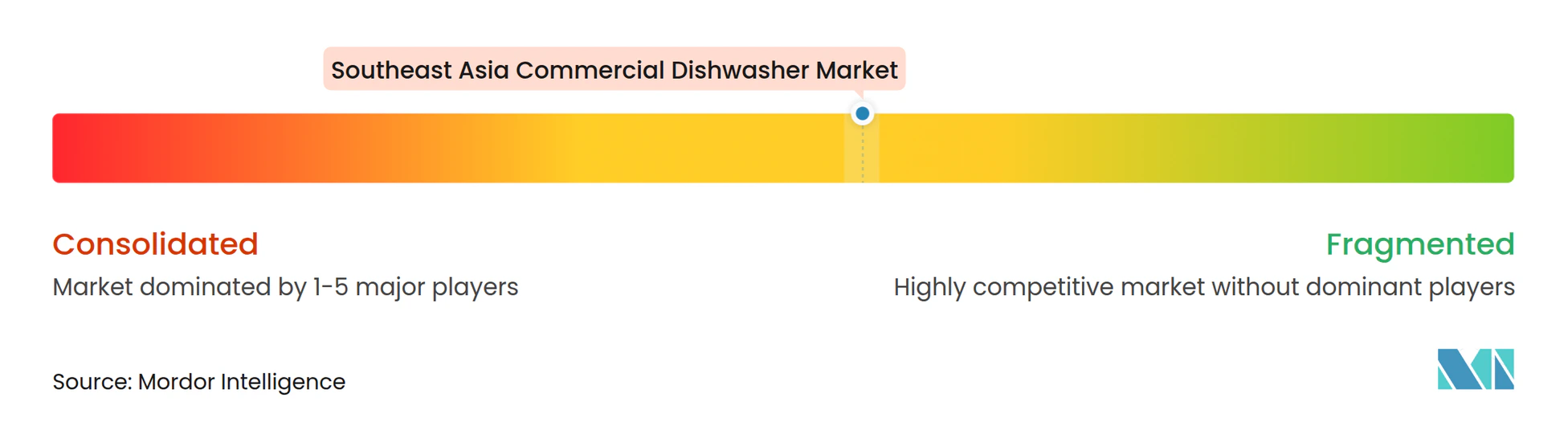
The Southeast Asia commercial dishwasher market includes global suppliers such as Winterhalter, MEIKO, Electrolux Professional, HOSHIZAKI, and Hobart (ITW), as well as Chinese, Korean, and Southeast Asian manufacturers. The top seven players are estimated to collectively hold 45–55% of Southeast Asia’s commercial dishwasher market revenue in 2025, indicating moderate market fragmentation. International suppliers compete through equipment reliability, lifecycle operating cost, sanitation records, and remote monitoring. MEIKO's M-iQ installation at IKEA Singapore delivered 30% energy and water savings, which demonstrates the efficiency case used in premium selling. Regional manufacturers compete strongly where upfront price, local specifications, and lead times are the primary decision factors. The market is therefore neither concentrated around one supplier nor purely price-led. It is shaped by the ability to support customers after installation.
Leading companies are expanding digital functions and regional operating assets. HOSHIZAKI's ARICO acquisition in Vietnam gives the group a production base that can reduce supply-chain distance for Southeast Asian customers. Electrolux Professional manufactures several dishwasher types for Asian markets and has added Veetsan, a Chinese dishwasher producer, to its portfolio. Winterhalter's connected services package adds EcoPilot, Remote Services, and EasyAccess to its equipment offer. MEIKO's M-iFlow IPB module shows a further move toward automated dishwashing lines. These moves improve the value proposition for multi-site chains and central kitchens that require visibility, uptime, and lower labor dependence.
Regulatory compliance favors suppliers that can provide repeatable wash parameters and operating records. Singapore's Food Safety and Security Act, Malaysia's MS 1480 revision, and Vietnam's food safety law increase the relevance of sanitation processes that can be documented. Smaller operators still face affordability and maintenance concerns, leaving room for distributors, rentals, and bundled service offers. Local competitors can remain credible when they provide compatible voltage, water pressure, and washware specifications. The competitive balance is likely to depend on after-sales execution as much as on machine features. No verified combined market-share figure for leading companies was supplied, so a numerical concentration assessment cannot be substantiated.
Southeast Asia Commercial Dishwasher Industry Leaders
-
Winterhalter Gastronom GmbH
-
MEIKO Maschinenbau GmbH & Co. KG
-
Electrolux Professional AB
-
HOSHIZAKI Corporation
-
HOBART (ITW)
- *Disclaimer: Major Players sorted in no particular order
Southeast Asia Commercial Dishwasher Market Companies Covered in this Report
- Winterhalter Gastronom GmbH
- MEIKO Maschinenbau GmbH & Co. KG
- Electrolux Professional AB
- HOSHIZAKI Corporation
- Fagor Professional, ONNERA Group
- Comenda, Ali Group S.r.l.
- DIHR, Ali Group S.r.l.
- Hobart (ITW)
- Washtech, Ali Group S.r.l.
- Champion Industries, Ali Group S.r.l.
- JEMI
- Colged S.r.l.
- Silanos S.r.l.
- KRUPPS S.r.l.
- Reeum Wash Co., Ltd.
- Shin Jin Master Co., Ltd.
- Zhejiang Hatton Cleaning Technology Co., Ltd.
- Shanghai Veetsan Commercial Equipment Co., Ltd.
- Southpro Kitchen Equipment Co., Ltd.
- Koyo Manufacturer (M) Sdn Bhd
- PT Nayati Indonesia, Klineco
Recent Industry Developments in Southeast Asia Commercial Dishwasher Market
- May 2026: Winterhalter commercially expanded its Next Level Services ecosystem, including the EcoPilot AI (up to 17% energy reduction), Remote Services diagnostics platform, and EasyAccess QR-based operator support across Spanish-language hospitality markets following the October 2025 HOST Milan global launch, reflecting the product line's global rollout trajectory after its debut in 2025.
- January 2026: Electrolux Professional Group acquired Royal Range (California, USA), a manufacturer of professional cooking equipment including ranges, ovens, and fryers, expanding its Food Americas manufacturing footprint and reinforcing the group's multi-category commercial kitchen equipment strategy alongside its dishwasher portfolio.
- November 2025: Winterhalter launched the MT Series high-volume modular conveyor dishwasher line, capable of handling up to 355 racks per hour, with a fully retrofittable modular design enabling operators to add wash, rinse, or drying zones post-installation without replacing the base unit.
- October 2025: MEIKO unveiled the M-iFlow IPB automated infeed module for M-iQ flight-type dishwashers at HOST Milan, demonstrating live staffless operation at the dishwasher infeed section and reducing required headcount at that workstation by up to 50% compared to a standard M-iQ without the module.
Southeast Asia Commercial Dishwasher Market Report Scope
Commercial dishwashers are heavy-duty cleaning machines designed to meet the high-volume sanitation needs of professional kitchens and foodservice establishments. The Southeast Asia commercial dishwasher market is segmented by product type, capacity, installation configuration, price range, application, distribution channel, and country. By product type, the market is segmented into rack/conveyor, undercounter, door or hood type, glasswashers, and flight-type/continuous conveyor dishwashers. By capacity, the market is segmented into below 50 racks/hour, 50–150 racks/hour, and above 150 racks/hour. By installation configuration, the market is segmented into free-standing, built-in/under-counter integrated, and pass-through/line-integrated. By price range, the market is segmented into economy, mid-range, and premium. By application, the market is segmented into foodservice, hospitality, institutional, catering and central kitchens, and others. By distribution channel, the market is segmented into direct sales and dealers and distributors. By country, the market is segmented into Indonesia, Thailand, Vietnam, Philippines, Malaysia, Singapore, and the Rest of Southeast Asia. The report offers the market size in value terms in USD for all the above-mentioned segments.
Segmentation Overview
| Rack/Conveyor |
| Undercounter |
| Door or Hood Type |
| Glasswashers |
| Flight-type / continuous conveyor dishwashers |
| Below 50 racks/hour |
| 50–150 racks/hour |
| Above 150 racks/hour |
| Free-Standing |
| Built-in / under-counter integrated |
| Pass-through / line-integrated |
| Economy |
| Mid-Range |
| Premium |
| Foodservice |
| Hospitality |
| Institutional |
| Catering and Central Kitchens |
| Others |
| Direct Sales |
| Dealers and Distributors |
| Indonesia |
| Thailand |
| Vietnam |
| Philippines |
| Malaysia |
| Singapore |
| Rest of Southeast Asia |
| By Product Type | Rack/Conveyor |
| Undercounter | |
| Door or Hood Type | |
| Glasswashers | |
| Flight-type / continuous conveyor dishwashers | |
| By Capacity | Below 50 racks/hour |
| 50–150 racks/hour | |
| Above 150 racks/hour | |
| By Installation Configuration | Free-Standing |
| Built-in / under-counter integrated | |
| Pass-through / line-integrated | |
| By Price Range | Economy |
| Mid-Range | |
| Premium | |
| By Application | Foodservice |
| Hospitality | |
| Institutional | |
| Catering and Central Kitchens | |
| Others | |
| By Distribution Channel | Direct Sales |
| Dealers and Distributors | |
| By Country | Indonesia |
| Thailand | |
| Vietnam | |
| Philippines | |
| Malaysia | |
| Singapore | |
| Rest of Southeast Asia |
Key Questions Answered in the Report
What is driving demand for commercial dishwashers in Southeast Asia?
Formal foodservice growth, kitchen labor pressure, food safety compliance, and central kitchen development are supporting demand. The category is forecast to grow at a 7.08% CAGR from 2027 to 2032.
Why do dealers remain important for commercial dishwasher sales in Southeast Asia?
Dealers and distributors held an 81.15% share in 2026 because they provide local installation, service, training, and parts support across fragmented geographies.
Which country has the largest demand base for commercial dishwashers in Southeast Asia?
Indonesia held 32.26% of regional value in 2026, supported by a large hotel, restaurant, and institutional base and the Free Nutritious Meals Program.
Why are premium commercial dishwashers gaining adoption?
Premium models are projected to grow at an 8.28% CAGR through 2032 because hotel groups and multi-site operators value lower utility use, connected monitoring, and documented sanitation.
What limits adoption among smaller foodservice businesses?
Upfront machine costs, long payback periods, uneven water and electrical infrastructure, and inconsistent spare-parts access remain important barriers.