
South Korea Wire and Cable Market Size and Share
Market Overview
| Study Period | 2020 - 2031 |
|---|---|
| Forecast Data Period | 2026 - 2031 |
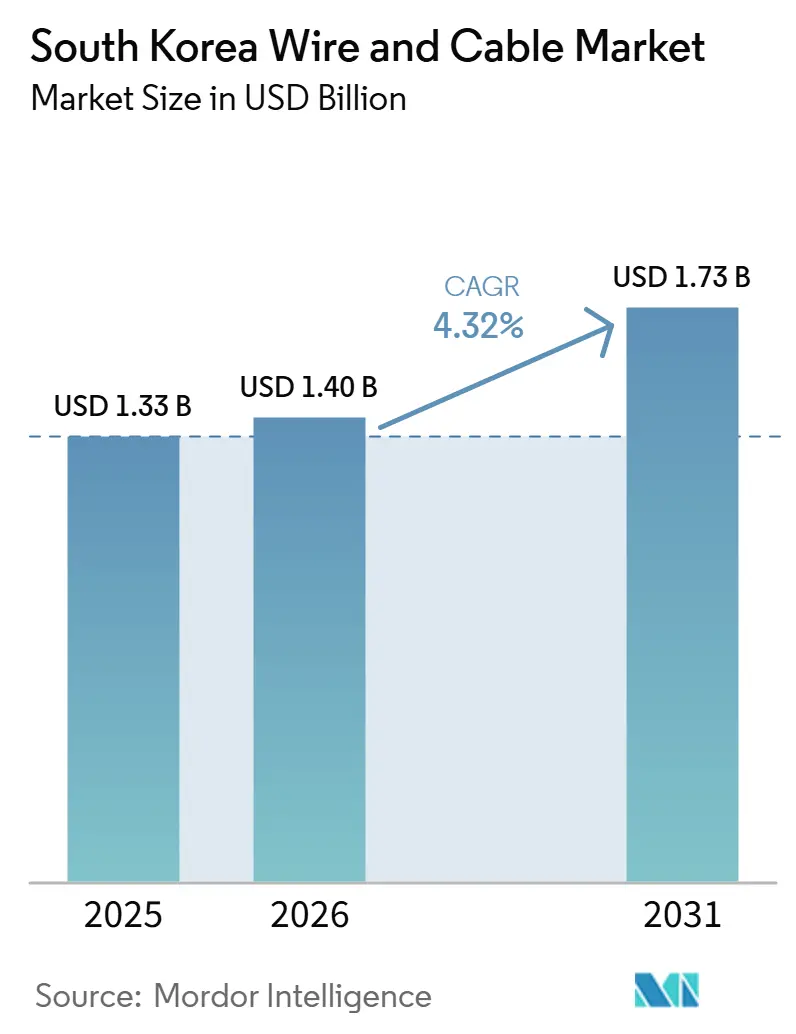
| Base Year Market Size (2025) | USD 1.33 Billion |
| Market Size (2026) | USD 1.40 Billion |
| Market Size (2031) | USD 1.73 Billion |
| Growth Rate (2026 - 2031) | 4.32 % |
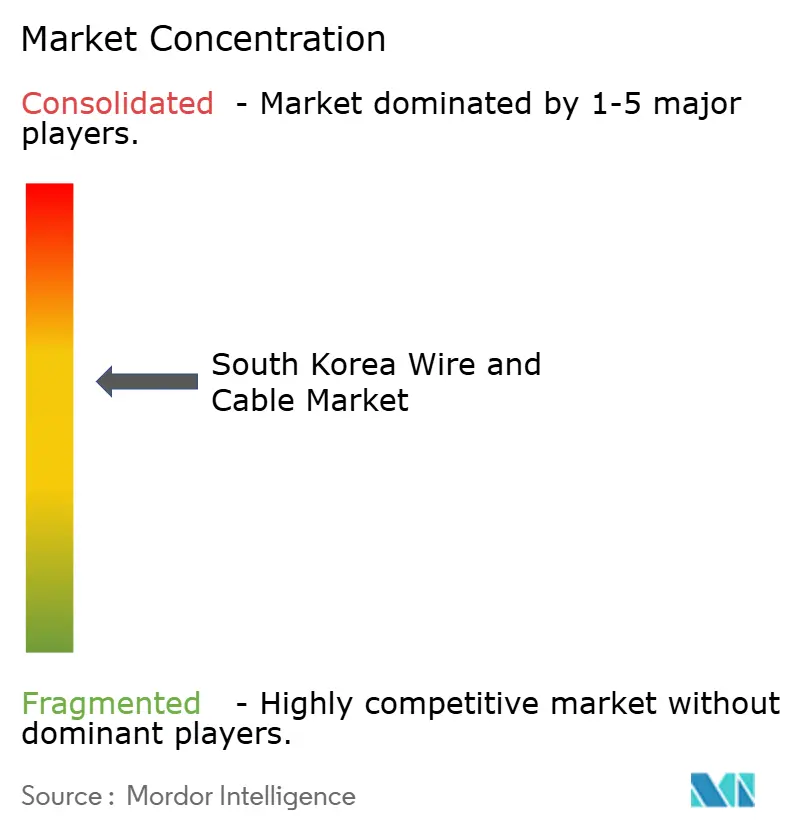
| Market Concentration | Medium |
Major Players *Disclaimer: Major Players sorted in no particular order Image © Mordor Intelligence. Reuse requires attribution under CC BY 4.0. | |
South Korea Wire and Cable Market Analysis by Mordor Intelligence
The South Korea wire and cable market size was valued at USD 1.33 billion in 2025 and estimated to grow from USD 1.40 billion in 2026 to reach USD 1.73 billion by 2031, at a CAGR of 4.32% during the forecast period (2026-2031). Grid modernization is increasing demand for higher-voltage cable systems as transmission routes connect new generation capacity with major load centers. AI data centers and semiconductor facilities require power, fiber-optic, and control cables, which broadens demand beyond traditional utility projects. Offshore wind projects are creating demand for submarine export cables and associated installation services along the western and southwestern coasts. Qualified suppliers are expanding their manufacturing and installation capabilities while pursuing overseas projects, thereby supporting export opportunities. Copper price movements, lengthy project schedules, and limited cable-laying capacity continue to affect procurement costs and delivery schedules.
Key Report Takeaways
- By voltage, low-voltage cables held 39.99% of the South Korea wire and cable market share in 2025, while extra- and high-voltage cables are projected to expand at a 5.21% CAGR through 2031.
- By cable type, power cable accounted for 31.11% of the South Korea wire and cable market size in 2025, while fiber-optic cable is expected to expand at a 6.01% CAGR through 2031.
- By conductor material, copper held 55.65% of the segment share in 2025, while aluminum is projected to grow at a 5.01% CAGR through 2031.
- By 2025, underground cables accounted for 50.12% of the market share, while submarine cables are projected to grow at a 4.98% CAGR through 2031.
- By end-user vertical, power infrastructure, utilities, and renewables held 24.77% share in 2025, while telecommunications and data centers are expected to grow at a 6.32% CAGR through 2031.
- By insulation, insulated cables held 80.13% share in 2025 and are projected to expand at a 5.98% CAGR through 2031.
Note: Market size and forecast figures in this report are generated using Mordor Intelligence’s proprietary estimation framework, updated with the latest available data and insights as of January 2026.
South Korea Wire and Cable Market Trends and Insights
Drivers Impact Analysis*
| DRIVER | (~) % IMPACT ON CAGR FORECAST | GEOGRAPHIC RELEVANCE | IMPACT TIMELINE |
|---|---|---|---|
| Grid Modernization and HVDC Expansion | +1.2% | National, with focus on western coastal corridors and the Greater Seoul Area grid | Long term (≥ 4 years) |
| AI Data Center and Semiconductor Power Demand | +1.0% | Greater Seoul Area, Ulsan, Donghae, Sejong, Chungcheong, and Yeongnam | Medium term (2-4 years) |
| Offshore Wind and Renewable Interconnection | +0.8% | Sinan, Jeonnam, Yeonggwang, and South Jeolla | Long term (≥ 4 years) |
| Smart Grid, EV Charging, and Distributed Energy Deployment | +0.4% | National, with early activity in Seoul, Busan, Daegu, and Ulsan | Medium term (2-4 years) |
| Hybrid Power and Data Cabling for Smart Factories | +0.3% | Gyeonggi, Chungnam, and Ulsan industrial clusters | Medium term (2-4 years) |
| Submarine Cable Localization and Export Capacity Expansion | +0.2% | Dangjin and export markets | Long term (≥ 4 years) |
| Source: Mordor Intelligence | |||
Grid Modernization and HVDC Network Expansion
KEPCO began full-scale construction of the West Coast HVDC Energy Highway in March 2026. The program includes 4 transmission lines spanning 1,070 km and has a first-phase completion target of 2030. The wider program is scheduled through 2038, which provides a long procurement horizon for the South Korea wire and cable market and its qualified suppliers. Cables for 500 kV and higher HVDC projects require XLPE insulation designed for an 80°C conductor temperature. LS Cable and System passed international prequalification testing for a 525 kV, 80°C-class HVDC submarine cable in July 2026, and stated that the product can raise transmission capacity by up to 25% compared with the prior standard. Taihan Cable and Solution won the KRW 146.3 billion (USD 96.5 million) Phase 2 contract for the East Coast-Seoul HVDC project, including the installation of 86 km of cable.[1]Korea Electric Power Corporation, “KEPCO Launches Full-Scale Construction of West Coast HVDC Energy Highway,” The Asia Business Daily, asiae.co.kr
AI Data Center and Semiconductor Cluster Power Demand
The planned expansion of AI data centers is increasing requirements for power distribution, fiber interconnection, and signal cables. South Korea plans 18.4 GW of AI data center capacity by 2035, with 8.4 GW planned by 2029 under a first-phase investment of KRW 550 trillion (USD 379.3 billion). Seoul had a grid self-sufficiency rate of 11.6% in 2025, which directs large facilities toward Ulsan, Donghae, and Sejong. These locations need new high-voltage connections from regional substations and create demand across the South Korea wire and cable market, including power and communications products. KEPCO projected that data center power demand would reach 7,343 MW by 2027, up from 906 MW in 2023, while available supply would cover only about half of that requirement. Gaon Cable reported KRW 64 billion (USD 44.1 million) in first-half 2026 operating profit, up 42% year over year, supported by demand for distribution cables and bus ducts tied to AI data centers and renewable projects.[2]LS Cable and System, “LS Cable Commercializes HVDC Submarine Cable With 25% Higher Capacity,” Seoul Economic Daily, sedaily.com
Offshore Wind and Renewable Energy Interconnection
Offshore wind projects require high-capacity submarine export cables for sites located 20 km to 60 km from shore in the South Korea wire and cable market. The 1 GW Haesong Offshore Wind project off Sinan County selected LS Cable and System and LS Marine Solution as preferred suppliers in May 2026. The arrangement covers cable supply, installation, operations, and maintenance within one project structure. Installation capacity is a key constraint, as South Korea had only 2 dedicated cable-laying vessels in mid-2025. Taihan Cable and Solution acquired the Skandi Connector with KRW 100 billion (USD 69 million) in financing from the Export-Import Bank of Korea, adding capacity for upcoming offshore projects. The shared grid-connection model in Haenam is expected to reduce total connection-line length by 59% and lower aggregate investment by KRW 3.6 trillion (USD 2.48 billion), concentrating demand at coastal landing points.
Smart Grid, EV Charging, and Distributed Energy Deployment
South Korea aims to install 1.23 million EV charging stations by 2030, including 145,000 fast chargers. This rollout supports distributed demand for low- and medium-voltage cables in residential, commercial, and highway locations across the South Korea wire and cable market. Hyundai Motor Group completed a vehicle-to-grid pilot in Jeju in July 2026. The pilot provides operating experience for bidirectional power flows and future residential cable specifications. The Ministry of Climate, Energy, and Environment also started a distribution-line energy storage system program in July 2026 with KRW 558.6 billion (USD 385.2 million) in funding over 5 years. The program may defer some low-voltage replacements, while supporting demand for armored, low-smoke, zero-halogen, and bidirectional-rated assemblies at energy storage connection points.[3]Hyundai Motor Group, “Electric Cars Can Power Home Appliances, Hyundai Motor Group Launches Full-Scale V2G Demonstration,” Maeil Business Newspaper, mk.co.kr
Restraints Impact Analysis*
| RESTRAINT | (~) % IMPACT ON CAGR FORECAST | GEOGRAPHIC RELEVANCE | IMPACT TIMELINE |
|---|---|---|---|
| Copper and Aluminum Price Volatility | -0.8% | Global supply chain, with high exposure in domestic high-voltage manufacturing | Short term (≤ 2 years) |
| High Installation Cost and Long Project Lead Times | -0.5% | National, especially western and southern offshore projects | Long term (≥ 4 years) |
| Limited Cable-Laying and Testing Infrastructure | -0.3% | West Sea and South Sea project areas | Long term (≥ 4 years) |
| Qualification Bottlenecks for Advanced Cable Materials | -0.2% | National, especially commercial construction and industrial manufacturing | Medium term (2-4 years) |
| Source: Mordor Intelligence | |||
Copper and Aluminum Price Volatility
Copper price volatility remains a direct cost issue for manufacturers across the South Korea wire and cable market with long delivery cycles. Fixed-price supply agreements can weaken margins when metal prices rise after bids are submitted. Manufacturers are responding with copper-linked pricing and monthly LME adjustment mechanisms. These arrangements move part of the commodity risk to developers and alter the structure of cable procurement. The change can extend order-to-delivery cycles because customers must account for variable material costs. Aluminum substitution is gaining attention in grid distribution and data center projects where technical requirements permit it, although copper remains necessary for some high-voltage and compact urban uses.
High Installation Cost and Long Project Lead Times
HVDC and submarine cable projects can take 9 years or more from design to commissioning. KEPCO is seeking to shorten this schedule by completing basic design for the West Coast Energy Highway within 2026. Turnkey projects require suppliers to coordinate specialty accessories, civil works, tunnel preparation, and vessel availability. These requirements make installation and project integration a major cost factor, beyond cable manufacturing alone. An IEC 62067 qualification for ultra-high-voltage products can add 18 to 24 months to the project participation timeline. A procurement investigation into alleged misappropriation of submarine cable technology also raised the possibility of supplier disruption and contract restructuring during project delivery.
*Our forecasts treat driver/restraint impacts as directional, not additive. The impact forecasts reflect baseline growth, mix effects, and variable interactions.
Segment Analysis
By Voltage: High-Voltage Cables Support Grid Modernization
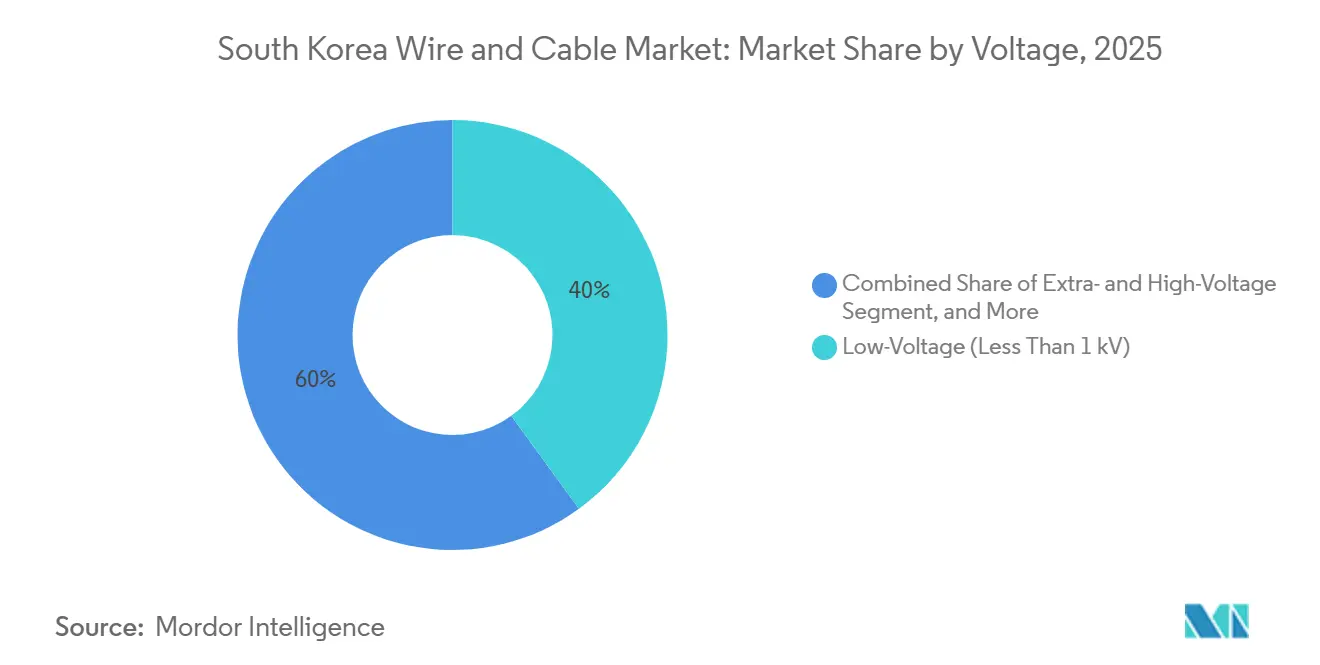
Low-voltage cables held 39.99% segment share in 2025, supported by residential and commercial construction in urban development corridors. Extra- and high-voltage cables are projected to grow at a 5.21% CAGR from 2026 to 2031. KEPCO procurement and regional power connections for data centers support this higher growth rate. The East Coast-Seoul project awarded Taihan Cable and Solution KRW 146.3 billion (USD 96.5 million) for 86 km of 500 kV HVDC XLPE cable work in June 2026. Medium-voltage cables serve EV fast chargers and distributed energy storage systems. Low-voltage demand remains linked to building activity and grid-edge installations.[4]Taihan Cable and Solution, “Taihan Cable Lands USD 97 Million Deal as Korea Overhauls Its Power Grid,” The Korea Times, koreatimes.co.kr
Extra- and high-voltage demand in the South Korea wire and cable market is driven by transmission investments with regulatory backing and long delivery schedules. Low-voltage demand is more exposed to mature urban construction conditions and energy storage projects that can defer some physical upgrades. Only manufacturers with IEC 62067 certification can compete for many 500 kV-class contracts. New suppliers may require 18 to 24 months to complete qualification. This supports the position of LS Cable and System, Taihan Cable and Solution, Iljin Electric, and Gaon Cable in premium projects. It also sustains higher pricing in qualified high-voltage product categories than in broader commodity cable categories.



By Cable Type: Fiber-Optic Cables Gain from Digital Infrastructure
Power cables accounted for 31.11% of the segment value in 2025, supported by utility procurement, EV charging, and semiconductor power distribution. Fiber-optic cables are expected to grow at a CAGR of 6.01% through 2031. Data center interconnections, 5G-to-6G backhaul upgrades, and enterprise networks at semiconductor and smart factory sites support fiber demand. KT planned KRW 8 trillion (USD 5.52 billion) in network infrastructure investment over three years, covering data center interconnection, 6G capability, and 90 terabits per second of subsea capacity. Fiber-optic products benefit from both backbone and last-mile network investments.
Demand for signal and control cables is also rising in the South Korean wire and cable market as smart factories add automation equipment and connected systems. These facilities require combined power and data capabilities in armored assemblies. Coaxial and data cables remain relevant in broadcast and industrial automation, although fiber substitution limits their role in high-bandwidth applications. The AUG East cable is an 8,900 km submarine fiber link connecting South Korea with eight countries, including Singapore, Taiwan, and Japan. Construction of its Saemangeum landing station is scheduled to begin in January 2027. The project can support demand for landing equipment, terrestrial fiber distribution, and related cabling through the late 2020s.
By Conductor Material: Copper Leads, While Aluminum Use Increases
Copper held 55.65% of the segment share in 2025 due to its conductivity and established use in high-voltage products. Aluminum is projected to expand at a CAGR of 5.01% through 2031. The conductor mix is changing as cable producers consider aluminum for cost-sensitive distribution applications. Aluminum is more suitable where cable size and performance requirements allow its use. Copper remains important in extra-high-voltage systems, where performance requirements are more demanding. Optical glass and polymer conductors support the growing fiber-optic cable category.
The shift toward aluminum does not replace copper across all applications. Extra-high-voltage cables require high conductivity, and compact urban installations can limit aluminum use because it may require a larger cross-section to deliver equivalent ampacity. Manufacturers that can process aluminum conductors can reduce exposure to copper cost fluctuations in medium-voltage distribution work. This is important as grid expansion programs emphasize cost efficiency in lower-voltage procurement. The South Korea wire and cable market, therefore, requires both materials rather than a complete shift from one conductor to another. Product design and project specifications determine the selection of conductors.
By Installation: Underground Cables Lead and Submarine Cables Expand
Underground cables held 50.12% of the segment share in 2025. Dense urban areas and restrictions on overhead cable routes support this position in Seoul, Busan, and Incheon. Underground projects also serve redevelopment sites, EV charging installations beneath roads and parking structures, and data center campuses. Overhead cable installations remain important in rural and industrial transmission corridors, where rights-of-way and lower installation costs favor aerial routes. Submarine cables are projected to grow at a CAGR of 4.98% from 2026 to 2031. Offshore wind connections, island transmission, and subsea infrastructure plans support this growth.
Demand is not the only constraint for submarine cable projects. Manufacturing capability and vessel availability influence project timing and execution. Taihan Cable plans to begin operations at its Dangjin Submarine Cable Plant 2 in 2027. The facility is designed for 640 kV-class HVDC submarine cable production and is expected to have five times the capacity of the first plant. LS GreenLink began construction of a 201-meter VCV tower in Chesapeake, Virginia, with commercial production targeted for the first quarter of 2028. Overseas production enables South Korean suppliers to participate in North American HVDC and offshore wind procurement.
By End-User Vertical: Data Centers Change Cable Demand
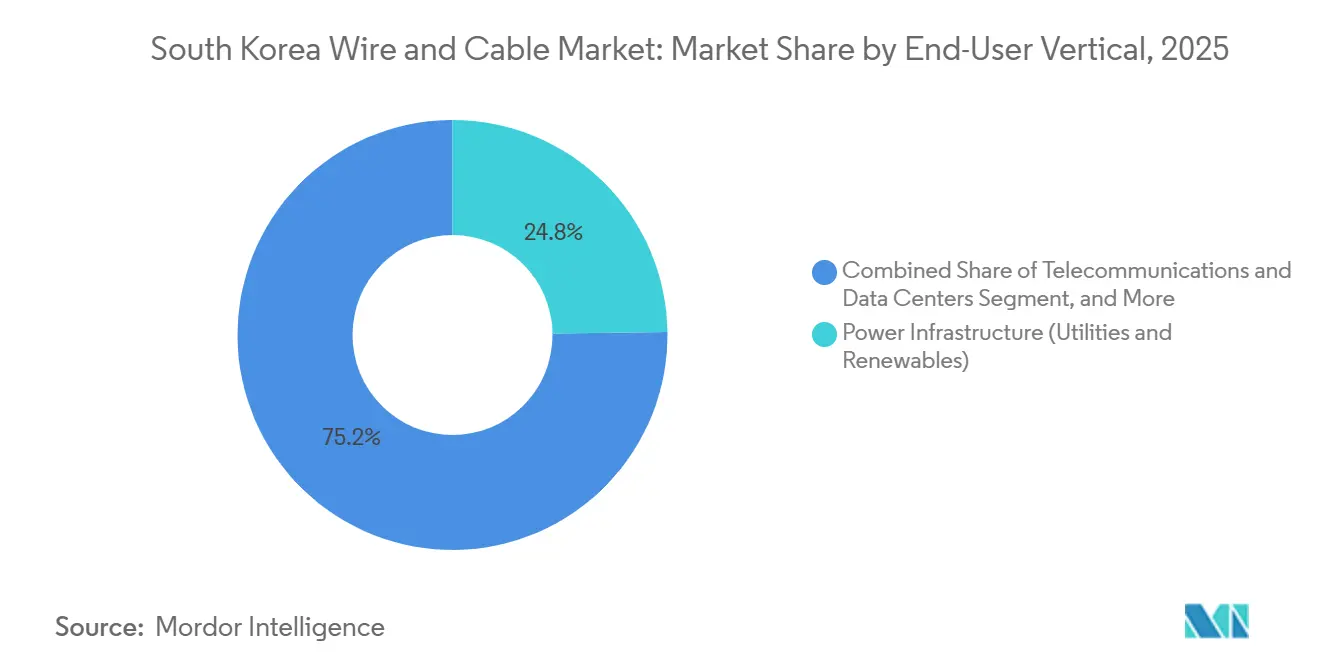
Power infrastructure, utilities, and renewables accounted for 24.77% of the segment value in 2025. Telecommunications and data centers are projected to record the highest end-user growth, at a CAGR of 6.32% through 2031. AI infrastructure requires power, fiber-optic, and signal and control cables at the same sites. Gaon Cable supplied power distribution cable to SK Hynix's semiconductor cluster in Yongin in July 2026. Its US subsidiary also held a bus duct supply portfolio valued at KRW 4 trillion (USD 2.76 billion) for global AI data centers.
Industrial manufacturing creates demand for armored and shielded hybrid power and data cable assemblies. Smart factory projects require more instrumentation and connected automation than conventional facilities. Residential and commercial construction provide a broad base for low- and medium-voltage cable demand, although this demand follows housing cycles. Oil, gas, and petrochemical facilities in Ulsan, Yeosu, and Daesan require fire-resistant and intrinsically safe cables. Automotive and mobility demand is shifting from conventional wiring harnesses toward EV powertrains and vehicle-to-grid charging cables. These requirements connect automotive cable capabilities with broader power-distribution investments.
By Insulation: Insulated Cables Remain the Main Product Category
Insulated cables held 80.13% of the segment share in 2025 and are projected to expand at a CAGR of 5.98% through 2031. Underground, submarine, and commercial building applications require electrical isolation and environmental protection. KS C IEC 60502 and IEC 60332 requirements support the use of insulated cable in utility and commercial applications. Non-insulated products, including bare aluminum and copper conductors, are used mainly in overhead rural and industrial transmission. These routes operate under conditions that reduce the need for protective sheathing. Therefore, installation conditions and compliance requirements drive product selection.
Demand for insulated cable is shifting toward higher-performance compounds. XLPE is replacing some traditional PVC use in medium- and high-voltage applications. Manufacturers increasingly use LSZH compounds in buildings, tunnels, and public spaces where low-toxic gas emissions are required during a fire. These specifications can increase average selling prices compared with standard PVC-insulated products. New LSZH formulations may require 12 to 18 months of Korean certification. Established suppliers with approved compound libraries, therefore, have an advantage in building cable upgrades. These material qualification requirements also affect the South Korea wire and cable industry.
Geography Analysis
The Greater Seoul Area is expected to account for 75% of existing data center operating capacity and 68% of the development pipeline in 2025. This area includes Seoul, Gyeonggi, and Incheon, and it remains the largest concentration of construction activity and data center cable demand. Seoul is expected to record a grid self-sufficiency rate of 11.6% in 2025, the lowest regional level in the country. This limitation creates demand for high-voltage transmission routes that feed the capital region. The South Korea wire and cable market also benefits when projects move to Ulsan, Donghae, Sejong, Yeongnam, and Honam, as each regional location requires new grid connections. Incheon illustrates this pressure, as KEPCO determined that all 24 large-scale data center power applications submitted since mid-2025 could not receive a supply.
South Jeolla, Sinan County, and Dangjin are key coastal locations for offshore wind and submarine cable activity in the South Korea wire and cable market. Taihan Cable's Dangjin Plant 2 is scheduled to start operations in 2027 and will include a 187-meter VCV tower and 640 kV HVDC capability. The 1 GW Haesong project off Sinan and the 532 MW Anma project in Yeonggwang are important near-term projects for cable demand. The shared connection model in Haenam is expected to reduce the length of the connection line by 59% and save KRW 3.6 trillion (USD 2.48 billion). This structure consolidates procurement at coastal landing points instead of spreading it across individual project routes. LS Cable and System's Jeju HVDC Lines 2 and 3 provide an operating reference for longer undersea HVDC routes.
The southeastern industrial corridor includes Busan, Ulsan, and the Gyeongsang provinces. Heavy industry, shipbuilding, and automotive manufacturing support the procurement of medium- and high-voltage cables in this region. SK Telecom plans to develop a KRW 140 trillion (USD 96.6 billion) AI data center cluster in Ulsan and Yeongnam, which would increase demand for high-voltage and fiber-optic cable systems. The Chungcheong corridor connects northwestern renewable generation zones with southeastern manufacturing loads and links to phased HVDC construction. Samsung and SK groups announced KRW 90 trillion (USD 62.1 billion) in AI data center investments in the Honam region near the Solaseado solar complex in Haenam. These projects shift part of future cable demand toward energy-surplus coastal regions.
Competitive Landscape
The South Korea wire and cable market has distinct competitive conditions across high-voltage and commodity cable products. LS Cable and System and Taihan Cable and Solution lead domestic extra-high-voltage and submarine cable activity. IEC qualification records, project financing capabilities, and large backlogs of large orders support their positions. LS Cable and System is expected to record a quarterly backlog of KRW 750 billion (USD 517.2 million) in the first quarter of 2026, compared with KRW 280 billion in 2022. Taihan Cable is expected to report a KRW 3.66 trillion (USD 2.52 billion) backlog at the end of 2025. Prysmian, Nexans, and NKT compete in specialized categories, such as fire-resistant building cables and high-voltage accessories.
LS Cable and System is building overseas capacity through LS GreenLink in Virginia to serve North American HVDC demand. Taihan Cable has expanded its marine project capabilities through agreements with Jan De Nul and Boskalis. These initiatives combine domestic cable manufacturing with overseas production and installation partnerships. At the medium- and low-voltage levels, Daewon Cable, TMC, Samji Electronics, and other domestic producers compete more directly on price, delivery time, and local customer access. Companies with 500 kV and higher certifications can secure higher-value work, while commodity suppliers face stronger material cost pressures and price competition. KESCO and IEC standards are becoming increasingly central to supplier qualification across these product categories.
A prosecution investigation into alleged submarine cable technology misappropriation by Taihan Cable has added supply-chain integrity and ESG criteria to project qualification discussions. This development may affect how large public infrastructure projects evaluate suppliers. Iljin Electric is expected to win high-voltage cable contracts in Singapore, Malaysia, and the United Kingdom during 2026. The Singapore contract is valued at KRW 108.6 billion (USD 74.9 million), the Malaysia contract at KRW 62.1 billion (USD 42.8 million), and the United Kingdom contract at KRW 84.5 billion (USD 58.3 million). These awards highlight the export potential of IEC-certified South Korean suppliers. The South Korea wire and cable market remains more concentrated in high-voltage and submarine cable work than in standard cable categories.
South Korea Wire and Cable Industry Leaders
LS Cable & System Co., Ltd.
NKT A/S
Nexans S.A.
Prysmian S.p.A.
Fujikura Ltd.
- *Disclaimer: Major Players sorted in no particular order

Recent Industry Developments
- July 2026: LS Cable and System became the first South Korean company to pass international prequalification testing for a 525 kV, 80°C-class HVDC submarine cable, increasing transmission capacity by up to 25% over the prior 70°C-standard product. The certification establishes a supply foundation for the government's West Coast Energy Highway and positions LS Cable and System to compete in next-generation national grid contracts without requiring additional type tests after contract award.
- July 2026: Gaon Cable reported record first-half 2026 consolidated operating profit of KRW 64 billion (USD 44.1 million), a 42% year-on-year increase, driven by surging demand for distribution cables and bus duct systems serving U.S. AI data centers and renewable energy infrastructure. Consolidated sales reached KRW 1.633 trillion (USD 1.13 billion) for the first half of 2026.
- July 2026: Iljin Electric won a KRW 84.5 billion (USD 58.3 million) contract to supply ultra-high-voltage cables in the United Kingdom, marking its first entry into the European high-voltage transmission market. This followed a KRW 108.6 billion (USD 74.9 million) Singapore contract in May and a KRW 62.1 billion (USD 42.8 million) Malaysia contract for 275 kV data center cables in June, establishing Iljin Electric as a multi-market exporter of ultra-high-voltage cable systems.
- July 2026: Taihan Cable and Solution secured KRW 100 billion (USD 69 million) in financing from the Export-Import Bank of Korea to acquire the Skandi Connector, a 10,000-ton-class dedicated cable-laying vessel. The acquisition gives Taihan a second installation vessel alongside its PALOS vessel and supports independent turnkey submarine cable installation for HVDC and offshore wind projects.


South Korea Wire and Cable Market Report Scope
The South Korea Wire and Cable Market Report is Segmented by Voltage (Extra- and High-Voltage [Greater Than 35 kV], Medium-Voltage [1–35 kV], and Low-Voltage [Less Than 1 kV]), Cable Type (Power Cable, Fiber-Optic Cable, Signal and Control Cable, and Coaxial and Data Cable), Conductor Material (Copper, Aluminum, and Optical Glass / Polymer), Installation (Overhead, Underground, and Submarine), End-User Vertical (Residential Construction, Commercial Construction, Power Infrastructure, Telecommunications and Data Centers, Oil and Gas and Petrochemicals, Automotive and Mobility, and Industrial Manufacturing), and Insulation (Insulated, and Non-Insulated). The Market Forecasts are Provided in Terms of Value (USD).
| Extra- and High-Voltage (Greater Than 35 kV) |
| Medium-Voltage (1–35 kV) |
| Low-Voltage (Less Than 1 kV) |
| Power Cable |
| Fiber-Optic Cable |
| Signal and Control Cable |
| Coaxial and Data Cable |
| Copper |
| Aluminum |
| Optical Glass / Polymer |
| Overhead |
| Underground |
| Submarine |
| Residential Construction |
| Commercial Construction |
| Power Infrastructure (Utilities and Renewables) |
| Telecommunications and Data Centers |
| Oil and Gas and Petrochemicals |
| Automotive and Mobility |
| Industrial Manufacturing |
| Insulated |
| Non-Insulated |
| By Voltage | Extra- and High-Voltage (Greater Than 35 kV) |
| Medium-Voltage (1–35 kV) | |
| Low-Voltage (Less Than 1 kV) | |
| By Cable Type | Power Cable |
| Fiber-Optic Cable | |
| Signal and Control Cable | |
| Coaxial and Data Cable | |
| By Conductor Material | Copper |
| Aluminum | |
| Optical Glass / Polymer | |
| By Installation | Overhead |
| Underground | |
| Submarine | |
| By End-User Vertical | Residential Construction |
| Commercial Construction | |
| Power Infrastructure (Utilities and Renewables) | |
| Telecommunications and Data Centers | |
| Oil and Gas and Petrochemicals | |
| Automotive and Mobility | |
| Industrial Manufacturing | |
| By Insulation | Insulated |
| Non-Insulated |


Key Questions Answered in the Report
What is the size of the South Korea wire and cable market?
The South Korea wire and cable market is estimated at USD 1.40 billion in 2026 and is forecast to reach USD 1.73 billion by 2031, growing at a 4.32% CAGR.
What is driving wire and cable demand in South Korea?
HVDC grid construction, AI data centers, semiconductor clusters, offshore wind connections, EV charging, and smart-grid upgrades are supporting demand.
Which voltage category is growing fastest in South Korea?
Extra- and high-voltage cables are projected to grow at a 5.21% CAGR through 2031, supported by HVDC transmission projects.
Which cable type has the highest expected growth?
Fiber-optic cable is expected to expand at a 6.01% CAGR through 2031 as data center and telecommunications networks expand.
Why are submarine cables important for South Korea?
Submarine cables connect offshore wind projects and island grids, while HVDC routes require specialized production and vessel installation capacity.
Which end users are expected to increase cable procurement most rapidly?
Telecommunications and data centers are projected to grow at a 6.32% CAGR through 2031, driven by AI infrastructure and digital network requirements.
Page last updated on:





