
South Korea Industrial Press Machines Market Size and Share
Market Overview
| Study Period | 2020 - 2031 |
|---|---|
| Forecast Data Period | 2026 - 2031 |
| Base Year Market Size (2025) | USD 0.68 Billion |
| Market Size (2026) | USD 0.73 Billion |
| Market Size (2031) | USD 0.99 Billion |
| Growth Rate (2026 - 2031) | 6.28 % |
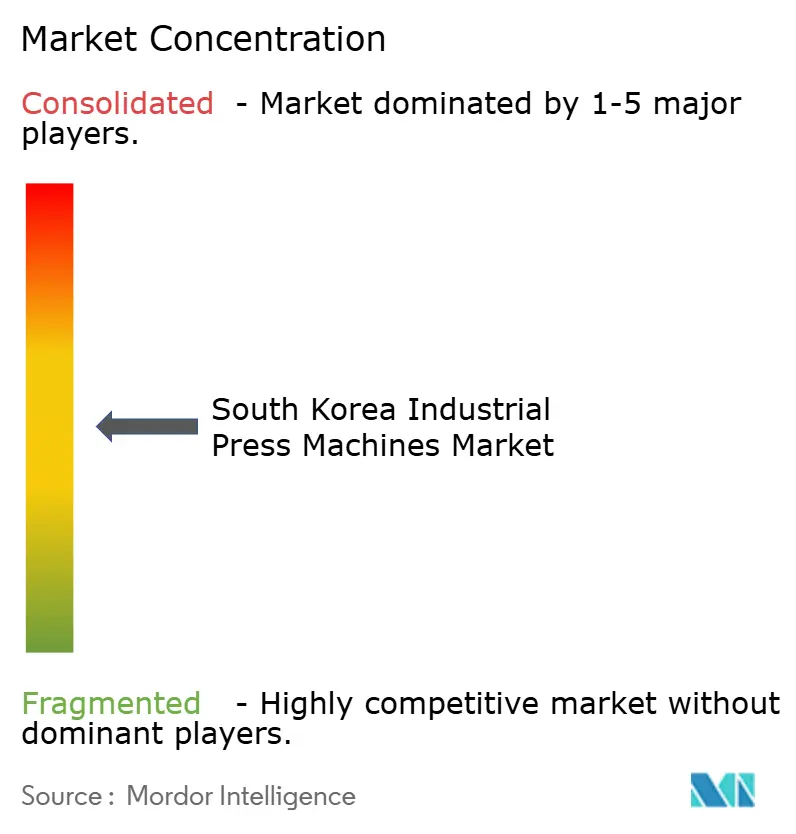
| Market Concentration | Medium |
Major Players *Disclaimer: Major Players sorted in no particular order Image © Mordor Intelligence. Reuse requires attribution under CC BY 4.0. | |
South Korea Industrial Press Machines Market Analysis by Mordor Intelligence
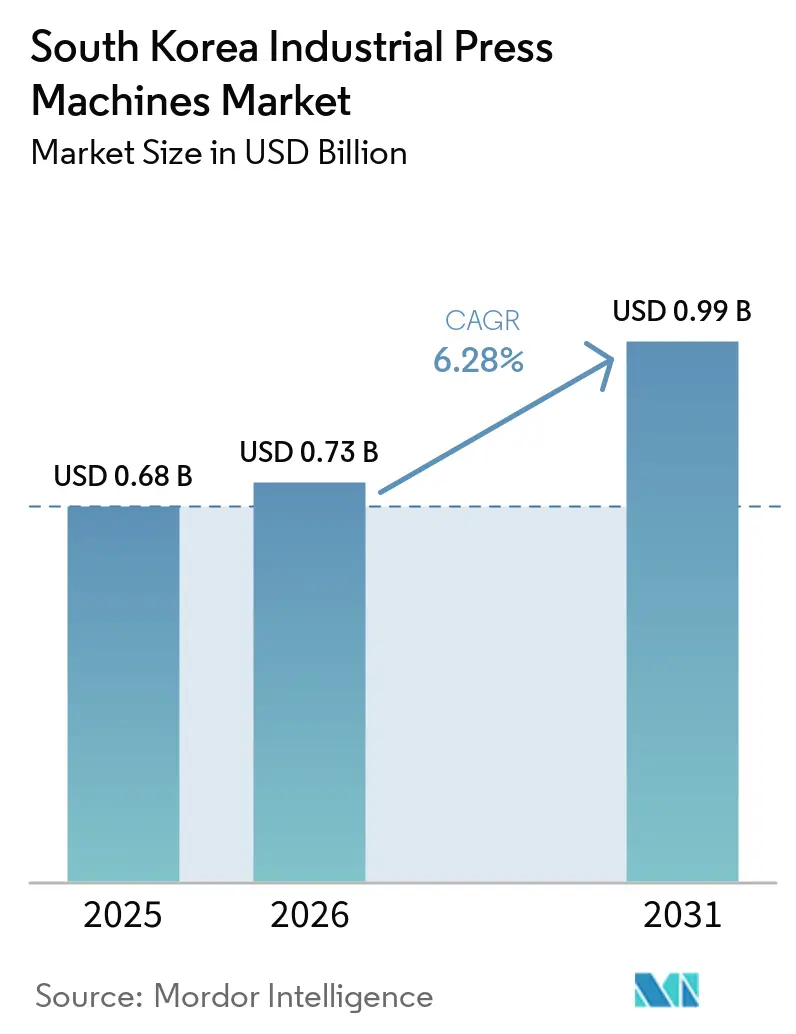
The South Korea Industrial Press Machines Market size is expected to grow from USD 0.68 billion in 2025 to USD 0.73 billion in 2026 and is forecast to reach USD 0.99 billion by 2031 at 6.28% CAGR over 2026-2031.
The South Korea industrial press machines market is supported by simultaneous investment in electric vehicle production, battery manufacturing, and digital factory equipment. Automotive producers, battery companies, and component suppliers are renewing press fleets during the same period, which broadens demand beyond a single buyer group. Demand is shifting toward equipment that can form advanced high-strength steel, aluminum battery components, and precision electrical parts. These needs favor servo and hybrid systems because they offer greater control of slide motion, force, and repeatability. Imported drives and control systems remain a cost and delivery risk, although public programs and domestic investment are supporting equipment modernization.
Key Report Takeaways
- By drive or actuation technology, hydraulic presses held 32.5% of the South Korea industrial press machines market share in 2025, while servo-mechanical presses are projected to record an 8.2% CAGR through 2031.
- By press force or capacity, the 101–500 ton segment held 33.1% of the South Korea industrial press machines market share in 2025, while the above-2,000 ton segment is projected to expand at a 6.9% CAGR through 2031.
- By application or process, stamping, blanking, and punching accounted for 30.0% of the South Korea industrial press machines market size in 2025, while assembly, press-fitting, and joining are projected to grow at a 7.0% CAGR through 2031.
- By end-use industry, automotive and transportation accounted for 43.0% of demand in 2025, while medical and precision manufacturing is projected to grow at a 7.5% CAGR through 2031.
Note: Market size and forecast figures in this report are generated using Mordor Intelligence’s proprietary estimation framework, updated with the latest available data and insights as of January 2026.
South Korea Industrial Press Machines Market Trends and Insights
Drivers Impact Analysis*
| Driver | (~) % Impact on CAGR Forecast | Geographic Relevance | Impact Timeline |
|---|---|---|---|
| EV and Battery Manufacturing Capacity Expansion | +1.5% | National, concentrated in Chungnam, Gyeonggi, and Ulsan corridors | Medium term (2-4 years) |
| Demand for High-Strength and Lightweight Automotive Components | +1.2% | National, with concentration in the Ulsan and Busan-Gyeongnam automotive belt | Medium term (2-4 years) |
| Replacement of Aging Press Equipment with Servo and Connected Systems | +0.9% | National, particularly Gyeonggi-do and Gyeongnam machinery clusters | Short term (≤ 2 years) |
| Expansion of Precision Stamping for Automotive Electronics and Battery Enclosures | +0.7% | Gyeonggi-do, Chungnam, and the Ulsan-Busan corridor | Medium term (2-4 years) |
| Growing Availability of Korean-Origin Press Controls and Automation Components | +0.5% | National, focused on the Daejeon R&D cluster and Gyeonggi production zones | Long term (≥ 4 years) |
| National Smart Factory Program for Press Equipment Digitalization | +0.4% | National, including Gyeongbuk, Jeonnam, and Jeonbuk programs | Short to medium term (1-3 years) |
| Source: Mordor Intelligence | |||
EV and Battery Manufacturing Capacity Expansion
Battery capacity investment is increasing demand for press equipment used for cell casings, module frames, and pack enclosures. LG Energy Solution, SK On, and Samsung SDI are expanding or upgrading production assets that require deep drawing, precision stamping, and related tooling. SK On is advancing Seosan Plant 3 toward 14 GWh of annual capacity by 2028, which supports demand for these forming operations. Each battery format requires a distinct die configuration so that plant upgrades can increase tooling needs beyond the effect of higher output alone. Hyundai Motor’s Ulsan EV-focused plant is operating and produces EV models with large battery systems, extending demand to direct OEM forming lines. Korean and Japanese producers continue to hold a leading position in global battery cell supply, keeping South Korea relevant to the supply of stamped battery hardware.[1]
Demand for High-Strength and Lightweight Automotive Components
The weight of electric vehicle batteries is increasing the need for steel parts that provide strength with less material. Third-generation advanced high-strength steel has narrower forming limits and requires accurate control of tonnage, blank-holder force, and springback. Hyundai Steel began commercial production of third-generation advanced high-strength steel in early 2026, with 1.2 GPa tensile strength and a stated 10% body-in-white weight reduction. Conventional equipment installed during the 1990s and early 2000s may not provide the control needed for these grades. The South Korea industrial press machines market, therefore, benefits from a shift toward servo-mechanical and servo-hydraulic equipment. The Ministry of Trade, Industry, and Resources allocated KRW 382.7 billion (USD 265.6 million) to EV and hydrogen vehicle research and development across 44 new projects in 2026, reinforcing lightweighting requirements in vehicle supply chains.[2]
Replacement of Aging Press Equipment with Servo and Connected Systems
Many Korean mechanical and hydraulic presses installed in the 1990s and early 2000s are nearing the end of their useful operating life. This replacement cycle can continue even when automotive output growth slows, since maintenance costs and energy performance also guide purchasing decisions. A 2026 repair tender for a 600 ton hydraulic press from the Korea Institute of Industrial Technology illustrates the continuing maintenance burden for aging assets. Servo retrofits can reduce energy use by 30% to 50% compared with fixed-speed hydraulic drives, with a three-to-five-year payback on heavily used lines. Connected systems also provide data that can help operators track die condition and reduce unplanned stoppages. The South Korea industrial press machines market gains from replacement demand because upgrades can improve productivity without requiring additional factory space.
Expansion of Precision Stamping for Automotive Electronics and Battery Enclosures
Battery enclosures and EV electronic housings require aluminum components with tight flatness control to maintain IP67 sealing performance. Conventional mechanical presses may not consistently achieve these tolerances at production speed, which increases interest in servo-controlled equipment. The southeastern Ulsan, Busan, and Changwon cluster had an estimated 150,000–200,000 metric tons of annual aluminum stamping capacity for battery casings in 2026. The 5052-H32 aluminum alloy, with 230 MPa tensile strength, is used for EV battery tray covers supplied to battery producers. Hyundai Motor’s Anseong battery assembly plant uses Korean-made equipment for notching, stacking, and cell-finishing processes. This expands the South Korea industrial press machines market buyer base from traditional stampers to battery assemblers and direct OEM operations.
Restraints Impact Analysis*
| Restraint | (~) % Impact on CAGR Forecast | Geographic Relevance | Impact Timeline |
|---|---|---|---|
| High Tooling, Die, and Press-Line Capital Requirements | -1.1% | National, most acute in automotive-focused Gyeongnam and Gyeonggi regions | Medium term (2-4 years) |
| Volatility in Automotive and General Machinery Capital Expenditure | -0.8% | National, across all manufacturing clusters | Short term (≤ 2 years) |
| Dependence on Imported Servo Drives and Precision Hydraulic Controls | -0.5% | National, most acute in high-precision servo press applications | Long term (≥ 4 years) |
| Limited Availability of Advanced Die-Design and Press-Commissioning Engineers | -0.4% | National, particularly in the Gyeongnam machinery hub | Medium to long term (3-5 years) |
| Source: Mordor Intelligence | |||
High Tooling, Die, and Press-Line Capital Requirements
A complete automotive tandem stamping line requires presses, tooling, dies, coil-feed systems, transfer equipment, and in-line inspection. This full investment can cost tens of millions of USD, which limits self-funded purchases by smaller tier-1 and tier-2 suppliers. Presses are classified as hazardous machinery under Article 74 of the Enforcement Decree of the Occupational Safety and Health Act and require Korean Certification before commissioning. Certification can take three to six months, while biennial safety inspections add to ownership costs. A die set for third-generation advanced high-strength steel can exceed USD 1 million because it needs high-hardness inserts that address faster wear at 1.2 GPa tensile strength. These costs concentrate procurement within larger supply chains and limit the range of active buyers in the South Korea industrial press machines market.
Volatility in Automotive and General Machinery Capital Expenditure
Press equipment purchases are closely tied to automotive investment cycles, which have become less regular during the EV transition. Trade policy uncertainty, variable EV demand, and shifts in demand for internal combustion engine parts can defer equipment orders. SK On reduced the planned investment for Seosan Plant 3 from KRW 1.75 trillion (USD 1.21 billion) to KRW 936.4 billion (USD 649.8 million) in December 2025 and moved completion back by 1 year. The Korea Automobile Manufacturers Association projected exports of 2.75 million units for 2026, a 1.1% increase from 2025, which limits demand created by volume growth alone. Construction equipment, appliances, and consumer durable manufacturers also adjust capital expenditure when export demand and raw material costs change. This creates uneven order timing that equipment suppliers must manage with longer order books.
*Our forecasts treat driver/restraint impacts as directional, not additive. The impact forecasts reflect baseline growth, mix effects, and variable interactions.
Segment Analysis
By Drive/Actuation Technology: Hydraulic Presses Lead Installed Demand While Servo Systems Gain Orders
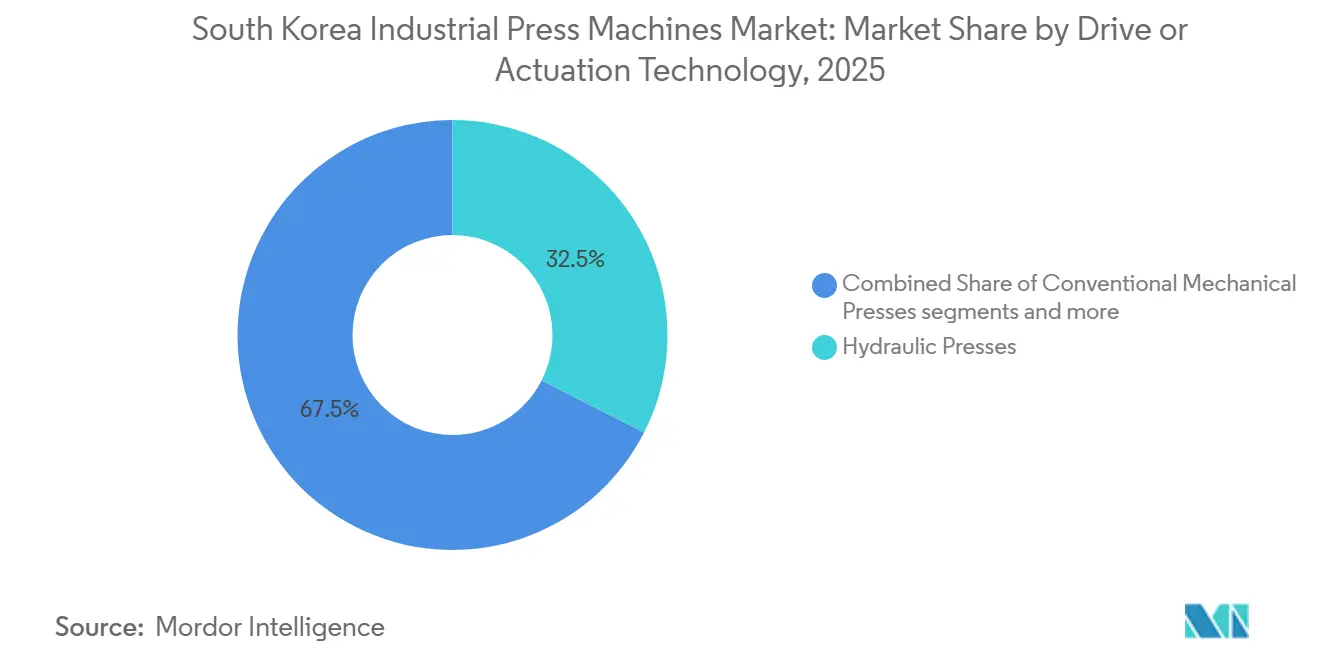
Hydraulic presses held 32.5% of the South Korea industrial press machines market share in 2025. They are used for deep drawing, heavy forging, and compression molding in automotive and industrial machinery production. Their operating range spans 30 to 8,000 tons, supporting use across different workpiece sizes and materials. SIMPAC’s Incheon-area plants produce more than 1,200 units a year across mechanical, hydraulic, and servo configurations. This production base helps domestic suppliers serve standard and mid-capacity requirements. Mechanical presses continue to support high-speed blanking for appliance and electronics parts. Their cost per stroke remains attractive where part shapes are mature, and production volumes are stable. Pneumatic and hybrid systems serve lighter assembly and joining work in electronics and medical applications. This mix preserves hydraulic presses as the largest installed technology category in the South Korea industrial press machines market.
Servo-mechanical presses are projected to grow at an 8.2% CAGR from 2026 to 2031. Programmable slide motion supports battery-enclosure forming and EV motor-core lamination. These processes require repeatable motion profiles and close control during forming. The Korea Electrical and Electronic Technology Institute has identified the localization of CNC and servo-drive technology as a priority. More than 95% of these systems are sourced from Japan and Germany, which adds cost and lengthens lead times. Servo drives can recover deceleration energy that fixed-speed equipment releases as heat. This can lower electricity use per part by up to 30%, strengthening the purchase case for high-utilization lines. The growth of servo equipment raises the value of orders even where press unit sales do not rise at the same rate.

By Press Force/Capacity: Mid-Range Equipment Holds the Largest Base, While Heavy Presses Expand
The 101–500 ton category held 33.1% of South Korea's industrial press machine market share in 2025. It is well-suited to automotive tier-1 suppliers making body members, door panels, and related structural parts. These suppliers need flexible equipment that can support recurring programs without the footprint of very large press lines. The up-to-100-ton category serves electronics, appliances, and medical precision stamping. Compact servo-electric systems are increasingly used in these applications instead of older pneumatic equipment. The 501–1,000 ton and 1,001–2,000 ton ranges serve structural automotive work and general forging. Demand in these middle categories remains supported by established OEM supply chains. The segment structure reflects a large base of suppliers producing standard vehicle and industrial components.
The above 2,000-ton class is projected to grow at a 6.9% CAGR from 2026 to 2031. Large battery trays require high forming forces while maintaining panel flatness. Manufacturers are also replacing multi-piece welded assemblies with large stamped unibody parts. These changes increase demand for high-capacity equipment in automotive and battery applications. JNH Press developed an 8,000 ``ton forging press and exported 4,000 ton aluminum forging lines, indicating a domestic capability in heavy equipment. Hyundai Motor Group is investing KRW 36.2 trillion (USD 25.1 billion) in production-facility optimization from 2026 to 2030. This investment supports potential upgrades at Ulsan and Asan facilities. Heavy presses therefore have a smaller current base but a stronger growth profile than the overall South Korea industrial press machines market.
By Application/Process: Stamping Remains the Largest Use, While Joining Records Faster Growth
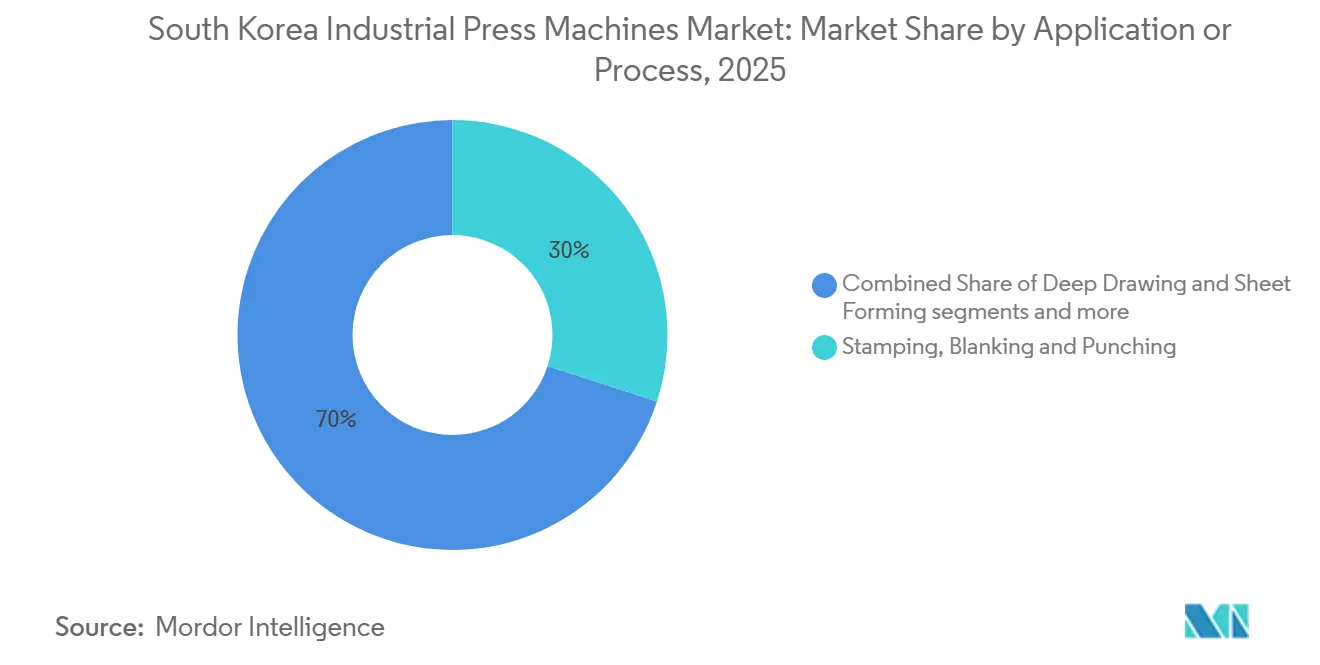
Stamping, blanking, and punching accounted for 30.0% of the South Korea industrial press machines market size in 2025. Automotive body-panel volumes remain the main source of demand for these processes. EV structures also require substantial stamped surface area, which supports continued use of high-volume stamping cells. Deep drawing and sheet forming serve battery casings, fuel tanks, and white goods shells. Forging, powder compaction, and compression molding support industrial machinery, energy, and medical production. These applications provide demand across a broader base of manufacturing customers. The continued scale of vehicle production keeps conventional stamping central to press utilization. It also makes process reliability and die changeover time important purchase criteria.
Assembly, press-fitting, and joining are projected to grow at a 7.0% CAGR from 2026 to 2031. EV powertrain lines use press-fit joining for rotor shafts, bearing races, and connector housings. These tasks require tight tolerances and can replace separate fixturing steps. IATF 16949-compliant stamping cells with full PPAP Level 3 documentation are becoming an important qualification factor for direct OEM supply. This raises the technical standard for equipment buyers in automotive and medical work. The government committed KRW 18 trillion (USD 12.5 billion) to future mobility financing, including KRW 9.7 trillion (USD 6.7 billion) for the auto parts industry’s fundamentals in 2026. The funding is expected to support precision press-assembly investment by tier-1 and tier-2 suppliers. The South Korea industrial press machines market is therefore gaining demand from equipment that combines forming and precision joining.
By End-Use Industry: Automotive Provides the Largest Demand Base While Medical Manufacturing Grows Faster
Automotive and transportation accounted for 43.0% of end-use demand in 2025. Hyundai, Kia, and GM Korea production ecosystems support a large local requirement for body, chassis, and powertrain components. South Korea recorded USD 72.0 billion in automotive exports in 2025, its third consecutive year above USD 70.0 billion. This export base supports high stamping demand per unit of domestic manufacturing capacity. Electrical and electronics manufacturing represents the next large end-use area. It requires lead frames, connectors, motor laminations, and other precision-stamped parts. The 2026 Smart Manufacturing Innovation Support Program includes 30 autonomous factory installations and 400 AI-specialized smart factory deployments.[3] These programs support press equipment investment across automotive, electronics, medical, and general manufacturing facilities.
Medical and precision manufacturing are projected to grow at a 7.5% CAGR from 2026 to 2031. Pharmaceutical device manufacturers use powder-compaction presses for tablet production. Surgical instrument companies use micro-stamping lines for endoscopes and catheter components. These uses require controlled force, repeatability, and clean production conditions. Aerospace and defense manufacturing is also expected to grow above the average rate as Korea Aerospace Industries expands domestic production for the KF-21 Boramae program. This work requires large-capacity titanium and aluminum forging presses. Industrial machinery, appliances, and construction equipment form the next demand tier. Their procurement cycles generally lag automotive activity by 12 to 18 months. The South Korea industrial press machines market will remain dependent on automotive demand while drawing growth from specialized precision applications.
Geography Analysis
Gyeonggi-do accounted for 38.1% of registered machinery companies in South Korea, making it the largest industrial machinery concentration. The region includes SIMPAC facilities in Incheon’s Bupyeong, Geomdan, and Kajwa areas, as well as JNH Press in Siheung. Its equipment supply base sits close to large automotive and component manufacturing sites. GM Korea is investing USD 300 million in production-facility modernization and press procurement at Bupyeong in 2026. Kia’s Hwaseong EVO Plant produces 50,000 electric PV5 units a year. Planned expansion at EVO Plant West is expected to lift capacity to 200,000 units when it is completed in mid-2027. Tier-1 stamping sites across the Pyeongtaek-Asan corridor add further demand for mid- and large-capacity equipment. These factors make Gyeonggi-do the most active near-term order area within the South Korea industrial press machines market.
Changwon and Ulsan form the country’s heavy-machinery and automotive production belt. Changwon National Industrial Complex contains 2,922 companies and approximately 116,700 employees, including 1,521 machinery businesses. Hyundai WIA’s main plants are located in this industrial base. The complex has held Smart Leading Industrial Complex status since 2019, supporting digital manufacturing and automation investment. Ulsan contains Hyundai Motor’s large integrated automotive manufacturing facility. The Ulsan-Mipo National Industrial Complex is receiving KRW 29 billion (USD 20.1 million) through 2028 for Manufacturing AI Transformation projects, including predictive maintenance and press-process optimization. Hyundai Mobis plans battery-system and thermal-management production lines in Ulsan and Changwon by 2030. This southeastern area remains important for high-capacity equipment, automation upgrades, and automotive supplier demand.
Chungnam hosts SK On’s Seosan complex and Samsung SDI’s domestic operations. These facilities create demand for aluminum enclosure stamping and battery module assembly lines. Daejeon houses the Korea Electrical and Electronic Technology Institute and related precision machinery institutes. Their work on servo controls and AI-based die monitoring informs press equipment specifications used across the country. Gyeongbuk, Jeonnam, and Jeonbuk were selected as pilot regions in 2025 under the Region-Specific Smart Factory Construction program. The program provides KRW 16.45 billion (USD 11.4 million) in combined government and local investment. Participating small and medium-sized companies can receive 50% to 80% of smart factory construction costs. These regions should widen demand for press and automation upgrades by the end of the forecast period.
Competitive Landscape
The South Korea industrial press machines market exhibits a medium level of market concentration. SIMPAC and JNH Press are significant domestic participants, while AIDA Engineering, Schuler AG through Schuler AG, and Komatsu Industries serve high-precision servo and large-tonnage requirements. SIMPAC produces more than 1,200 units annually across mechanical presses from 35 to 3,000 tons, hydraulic presses from 30 to 8,000 tons, and servo presses from 150 to 3,000 tons. This product breadth gives SIMPAC a broad domestic tonnage offering. JNH Press completed its second Siheung plant in August 2025, adding manufacturing and research capacity. The company also has a portfolio of 56 patents. These investments show a domestic effort to compete in heavy forging equipment. The market remains divided between domestic capability in standard and mid-range presses and overseas strength in precision systems.
The acquisition of Hyundai WIA’s machine tool division by SMAC was completed in March 2025 for KRW 340 billion (USD 235.9 million). The combined business has a network across 29 countries. The transaction broadens the combined product and distribution base. It also supports potential efficiencies in parts procurement and warranty management. ANDRITZ and AIDA are expanding digital monitoring platforms alongside press hardware. These systems use equipment data to support lifecycle service relationships. Schuler and Feintool jointly developed an 8,800 kN HFA fineblanking system in January 2026. The project shows how partnership-based research and development can sustain leadership in precision press technology. The South Korea industrial press machines market offers opportunities where domestic producers can link hardware, controls, and service more closely.
Mid-capacity servo presses for small and medium-sized Korean manufacturers remain an area with limited coverage from global suppliers. Global OEM project complexity and lead times can favor large conglomerate buyers over smaller factories. IoT retrofit kits are another opportunity because many mechanical and hydraulic presses need digital upgrades to meet energy and operating requirements. Domestic firms can build on servo-drive research at the Korea Electrical and Electronic Technology Institute. Public smart manufacturing programs also provide a route for these upgrades. The outcome will depend on how effectively domestic manufacturers combine localized controls with press engineering. Competitive conditions will remain strongest in high-value servo and heavy-press applications.
South Korea Industrial Press Machines Industry Leaders
-
SIMPAC INC.
-
JNH Press Co., Ltd.
-
Hyundai WIA Corporation
-
Korea Heavy Machinery Co., Ltd.
-
Kukil Precision Machinery Co., Ltd.
- *Disclaimer: Major Players sorted in no particular order
Recent Industry Developments
- September 2026: Kia accelerates EVO Plant West construction at Hwaseong Autoland in Gyeonggi, targeting mid-2027 completion with 200,000-unit annual capacity for the electric PV5 and PV7, creating sustained demand for servo stamping and press-assembly lines across the capital-region corridor.
- July 2026: Hyundai WIA announces KRW 400 billion (USD 277.6 million) in mid-to-long-term robotics investment that includes robot production facilities at its Changwon plant and targets an increase in robot-related sales from KRW 250 billion (USD 173.5 million) to KRW 400 billion (USD 277.6 million) by 2028.
- June 2026: The Ministry of Trade, Industry, and Energy designates the Ulsan-Mipo National Industrial Complex as a Manufacturing AI testbed and commits KRW 29 billion (USD 20.1 million) through 2028 for AI-based predictive maintenance and process optimization for press and forming equipment.
- March 2026: GM Korea confirms USD 600 million for Bupyeong plant investment, including USD 300 million for new press equipment and facility modernization for small-SUV production.
South Korea Industrial Press Machines Market Report Scope
The South Korea Industrial Press Machines Market is Segmented by Drive Technology (Conventional Mechanical Presses, Hydraulic Presses, Pneumatic Presses, and More), by Press Force (Up To 100 Tons, 101–500 Tons, 501–1,000 Tons, and More), by Application (Forging, Powder Compaction, and More), by End-Use Industry (Aerospace and Defense, Electrical and Electronics, and More). The Market Forecasts are Provided in Terms of Value (USD).
| Conventional Mechanical Presses |
| Servo-Mechanical Presses |
| Hydraulic Presses |
| Pneumatic Presses |
| Other and Hybrid Presses |
| Up to 100 Tons |
| 101–500 Tons |
| 501–1,000 Tons |
| 1,001–2,000 Tons |
| Above 2,000 Tons |
| Stamping, Blanking and Punching |
| Deep Drawing and Sheet Forming |
| Forging |
| Straightening and General Forming |
| Compression Molding |
| Powder Compaction |
| Assembly, Press-Fitting and Joining |
| Other Press Applications |
| Automotive and Transportation |
| Aerospace and Defense |
| Industrial Machinery and Equipment |
| Electrical and Electronics |
| Appliances and Consumer Durables |
| Construction and Heavy Equipment |
| Energy and Power Equipment |
| Metal Products and General Manufacturing |
| Medical and Precision Manufacturing |
| Other End-Use Industries |
| By Drive / Actuation Technology | Conventional Mechanical Presses |
| Servo-Mechanical Presses | |
| Hydraulic Presses | |
| Pneumatic Presses | |
| Other and Hybrid Presses | |
| By Press Force / Capacity | Up to 100 Tons |
| 101–500 Tons | |
| 501–1,000 Tons | |
| 1,001–2,000 Tons | |
| Above 2,000 Tons | |
| By Application / Process | Stamping, Blanking and Punching |
| Deep Drawing and Sheet Forming | |
| Forging | |
| Straightening and General Forming | |
| Compression Molding | |
| Powder Compaction | |
| Assembly, Press-Fitting and Joining | |
| Other Press Applications | |
| By End-Use Industry | Automotive and Transportation |
| Aerospace and Defense | |
| Industrial Machinery and Equipment | |
| Electrical and Electronics | |
| Appliances and Consumer Durables | |
| Construction and Heavy Equipment | |
| Energy and Power Equipment | |
| Metal Products and General Manufacturing | |
| Medical and Precision Manufacturing | |
| Other End-Use Industries |
Key Questions Answered in the Report
What is the forecast growth rate for industrial press machines in South Korea?
The South Korea industrial press machines market is projected to grow at a 6.28% CAGR from 2026 to 2031, reaching USD 0.99 billion.
Which press technology holds the largest share in South Korea?
Hydraulic presses led with 32.5% share in 2025 because they serve deep drawing, forging, and compression molding applications.
Which press technology is growing fastest in South Korea?
Servo-mechanical presses are projected to grow at an 8.2% CAGR through 2031, supported by battery enclosures and EV motor-core lamination.
Which end-use sector creates the greatest demand for press equipment in South Korea?
Automotive and transportation accounted for 43.0% of end-use demand in 2025, supported by major domestic vehicle production ecosystems.
Why are large press machines gaining demand in South Korea?
The above 2,000-ton category is projected to grow at a 6.9% CAGR as large battery trays and stamped unibody components require higher forming force.
What limits the adoption of new industrial press lines in South Korea?
High costs for press lines, dies, automation, certification, and inspections can limit investment by smaller automotive suppliers.