
South Korea Fire Truck Market Size and Share
Market Overview
| Study Period | 2019 - 2032 |
|---|---|
| Forecast Data Period | 2027 - 2032 |
| Base Year Market Size (2026) | USD 129.15 Million |
| Market Size (2027) | USD 137.58 Million |
| Market Size (2032) | USD 188.76 Million |
| Growth Rate (2027 - 2032) | 6.53 % |
| Market Concentration | Medium |
Major Players *Disclaimer: Major Players sorted in no particular order Image © Mordor Intelligence. Reuse requires attribution under CC BY 4.0. | |
South Korea Fire Truck Market Analysis by Mordor Intelligence
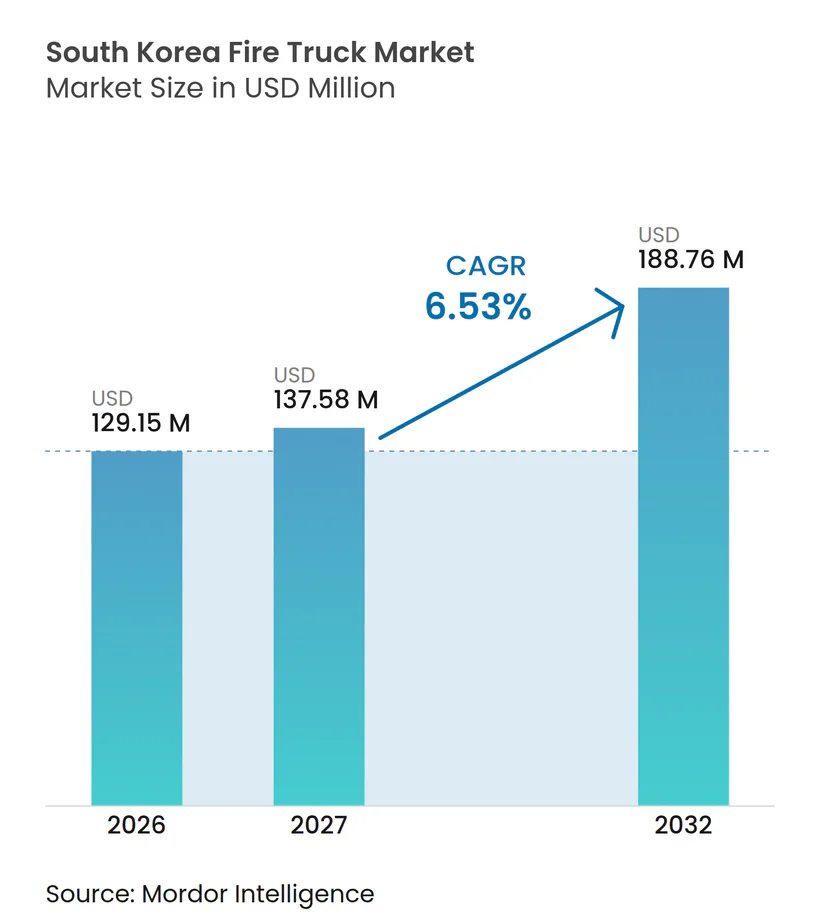
The South Korea fire truck market size was valued at USD 129.15 million in 2026 and is expected to grow from USD 137.58 million in 2027 to USD 188.76 million by 2032, at a CAGR of 6.53% during 2027-2032. Replacement needs across municipal fleets, more demanding high-rise response requirements, and continued investment in wildland and aviation firefighting assets support the South Korea fire truck market. Dense development in Seoul and other large cities is increasing the value of aerial platforms, while industrial facilities and airports require equipment that differs from that of standard municipal pumpers. Public procurement remains central to the South Korea fire truck market because the National Fire Agency sets specifications and regional authorities purchase much of the fleet. Local manufacturers have an advantage in conventional vehicle categories, although imported suppliers remain important for specialized aircraft rescue and firefighting vehicles and large wildland equipment. Electric-vehicle incidents are also changing equipment specifications, particularly for low-clearance, remotely operated, and battery-focused suppression systems.
Key Report Takeaways
- By vehicle type, pumper fire trucks and engines held a 39.23% share in 2026, while aerial fire trucks are projected to grow at a 7.38% CAGR through 2032.
- By propulsion type, internal combustion engine vehicles held a 90.28% share in 2026, while battery-electric vehicles are projected to grow at an 11.22% CAGR through 2032.
- By vehicle capacity, the 5,000–10,000 liter category held a 41.39% share in 2026, while the 10,001–20,000 liter category is projected to grow at a 7.49% CAGR through 2032.
- By end user, municipal fire departments held a 43.45% share in 2026, while airports are projected to grow at a 7.19% CAGR through 2032.
- By geography, the Seoul Capital Area held a 33.61% share in 2026, while Gangwon is projected to grow at a 7.64% CAGR through 2032.
Note: Market numbers in this report are based on Mordor Intelligence's proprietary estimation framework, which combines nine months of actuals with Q4 projections for base year 2026.
Market Trends and Insights
Drivers Impact Analysis of South Korea Fire Truck Market*
| Driver | (~) % Impact on CAGR Forecast | Geographic Relevance | Impact Timeline |
|---|---|---|---|
| Replacement of Aging Provincial and Municipal Fleets | +1.4% | National, with the largest replacement volumes in Seoul, Gyeonggi, and South Gyeongsang | Medium term (2–4 years) |
| High-Rise Urban Response Requirements | +1.1% | Seoul Capital Area, Busan, and Incheon, with demand extending to Daejeon and Sejong | Medium term (2–4 years) |
| Wildland Fire Suppression Fleet Localization | +0.8% | Gangwon and North and South Gyeongsang, with national support | Long term (≥ 4 years) |
| Airport and Military ARFF Modernization | +0.7% | Incheon, Gimpo, Gimhae, Jeju, and military air bases nationwide | Medium term (2–4 years) |
| Electric-Vehicle Fire Response Equipment Demand | +0.6% | National, with the highest concentration in Seoul, Gyeonggi, and Incheon | Short term (≤ 2 years) |
| Connected, Remote-Controlled, and Robotic Apparatus Adoption | +0.5% | National, with early deployments in Busan, Daegu, and Gwangju | Long term (≥ 4 years) |
| Source: Mordor Intelligence | |||
Replacement of Aging Provincial and Municipal Fleets
The National Fire Agency administers a centrally coordinated replacement framework through the Multiple Award Schedule, which sets vehicle specifications for approved suppliers. Many provincial vehicles entered service in the early 2010s and remain in use after substantial operational mileage. Local budget sequencing can delay replacement awards by one to three fiscal years after a vehicle reaches its recommended service life. The 2025 manufacturing specifications describe an upgrade cycle that also places older internal combustion vehicles under updated emissions and noise requirements [1]. This makes regulatory compliance an additional reason to retire vehicles before mechanical failure. The South Korea fire truck market, therefore, benefits from demand that is not limited to population growth or new station construction.
High-Rise Urban Response Requirements
Aerial truck procurement is closely tied to the composition of urban building stock. Seoul has a large stock of residential buildings above 15 floors, creating response needs that older 27-meter articulated platforms cannot always meet. Regional fire authorities are moving toward 46-meter and 53-meter platforms to improve reach at taller properties. Regional procurement now includes 46-meter articulated platforms outside Seoul. In April 2025, Busan Fire and Disaster Headquarters tested a new high-performance fire truck at the 411-meter LCT Landmark Tower in Haeundae; the vehicle is rated to deliver foam to a height of more than 400 meters [2]. Such demonstrations give fire authorities a practical reference point when defining high-rise response specifications in the South Korea fire truck market.
Wildland Fire Suppression Fleet Localization
Wildland firefighting creates demand for equipment that can traverse difficult terrain while carrying a sufficient water capacity. Imported high-performance vehicles have filled this role, including Mercedes-Benz Unimog-based units. The Korea Forest Service deployed high-performance wildfire suppression vehicles with 3,500-liter tanks during the March 2025 wildfires in Uiseong and Sancheong. The Ministry of Science and ICT and the Ministry of the Interior and Safety also announced an initiative in May 2025 to develop a domestic 6,000-liter wildfire suppression vehicle. The planned vehicle is intended to use a converted military chassis and reduce dependence on imported large-format equipment. Until domestic alternatives become available at scale, procurement of imported specialist vehicles remains part of the South Korea fire truck market.
Airport and Military ARFF Modernization
Airport rescue and firefighting fleets must meet the category requirements for the largest aircraft at each airport. Korea Airports Corporation manages 14 civil airports, and their fleets require periodic replacement as vehicles age [3]. Incheon International Airport uses Oshkosh Striker 8×8 and 6×6 vehicles, while other airports use Striker variants procured across several purchasing rounds. Civil airport replacement activity coincides with defense-sector procurement for aircraft rescue and firefighting equipment. ARFF technology also has industrial relevance, as high-foam-output vehicles are used to protect nuclear power plants and petrochemical sites. This overlap supports demand for high-foam-output equipment beyond airport operations.
Restraints Impact Analysis of South Korea Fire Truck Market*
| Restraint | (~) % Impact on CAGR Forecast | Geographic Relevance | Impact Timeline |
|---|---|---|---|
| Long Replacement Cycles and Budget Timing | -1.1% | National, most acute in provincial municipalities outside the Seoul metropolitan area | Medium term (2–4 years) |
| High Certification and Customization Costs for Imported Specialty Vehicles | -0.8% | National, concentrated in ARFF and large wildland apparatus categories | Long term (≥ 4 years) |
| Chassis, Powertrain, and Aftermarket Parts Dependence | -0.7% | National, primarily affecting high-performance wildland and ARFF vehicle categories | Long term (≥ 4 years) |
| Limited Domestic ARFF and Large-Wildfire Vehicle Capability | -0.6% | Civil airports and wildland fire-prone regions, including Gangwon and Gyeongsang | Long term (≥ 4 years) |
| Source: Mordor Intelligence | |||
Long Replacement Cycles and Budget Timing
Fire truck purchases follow multi-year local government budget frameworks that do not always align with National Fire Agency fleet standards. Smaller provincial departments can postpone procurement for two to three fiscal years after a vehicle reaches its recommended service life. They may instead extend maintenance contracts for older units. This approach can place pressure on parts availability for older chassis generations and reduce readiness. Large capital items, including aerial platforms and tankers, compete with personnel and routine operating budgets. The resulting pattern produces uneven order volumes and restricts the smooth annual growth that would otherwise support the South Korea fire truck market.
High Certification and Customization Costs for Imported Specialty Vehicles
Imported ARFF vehicles and large wildland trucks must meet Korean road vehicle requirements and National Fire Agency vehicle specifications. Foreign suppliers must adapt configurations for Korean operating practices, road noise requirements, emissions rules, and foam and pump performance standards. These changes add cost and can extend delivery lead times by four to eight months beyond the global production queue. Compliance costs remain largely fixed even when procurement volumes are small. This can make a single order less attractive for a supplier without a Korean distributor or service presence. The lack of a mutual-recognition framework with European type approval regimes continues to raise entry costs in the South Korea fire truck market.
*Our forecasts treat driver/restraint impacts as directional, not additive. The impact forecasts reflect baseline growth, mix effects, and variable interactions.
South Korea Fire Truck Market Segment Analysis
By Vehicle Type:
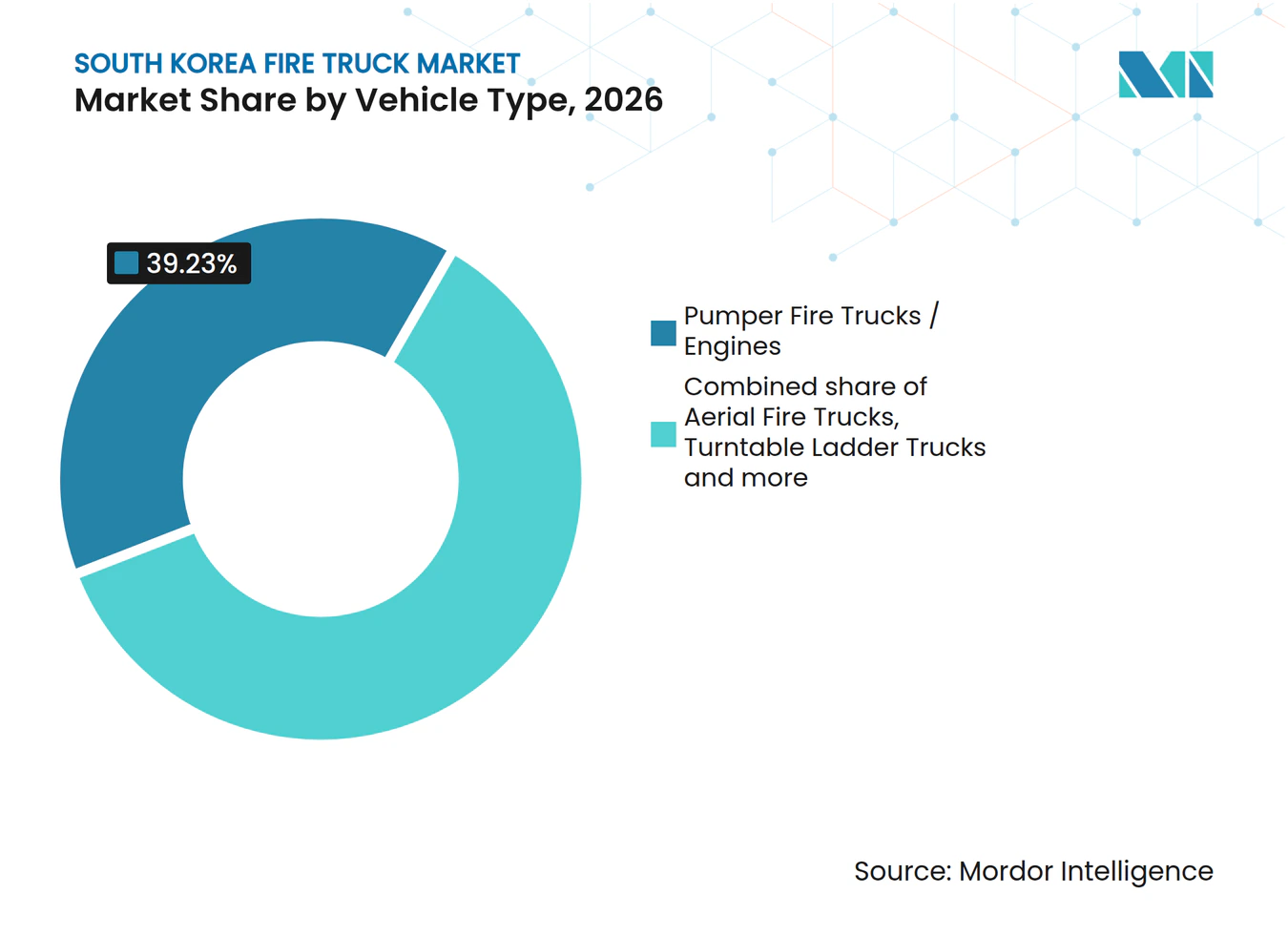
Pumpers Lead, While Aerial Vehicles Support High-Rise ResponsePumper fire trucks and engines held 39.23% of revenue in 2026. They are the primary vehicle class at municipal stations and across many industrial brigade fleets. The Multiple Award Schedule identifies pumpers as baseline equipment for fire stations, which supports repeat purchasing even when budgets are constrained. Aerial fire trucks are forecast to record a 7.38% CAGR through 2032, faster than the overall South Korea fire truck market. Demand is shifting toward longer-reach equipment for use in taller buildings. Hyundai Everdigm held the majority of the domestic aerial apparatus segment, supported by its position as the sole authorized supplier for certain government procurement routes.
Turntable ladder trucks and articulated aerial platforms complement each other, as operators require both reach and flexibility in congested locations. Tanker fire trucks are gaining traction due to demand from wildland and rural municipalities, particularly in Gangwon and Gyeongsang provinces. Rescue fire trucks maintain a stable role in public-sector procurement. ARFF, wildland, chemical, and foam vehicles represent smaller but technically demanding categories with the highest import dependence, where per-unit costs remain significant. Remotely operated demolition and firefighting vehicles are also moving into wider deployment, with regional fire headquarters such as Daegu adding units for industrial-complex fires in 2025.



By Propulsion Type:
Internal Combustion Engines Dominate, While Battery-Electric Vehicles Grow QuicklyInternal combustion engine vehicles accounted for 90.28% of the South Korea fire truck market in 2026. Korean vehicle builders continue to rely on diesel commercial chassis from Hyundai, Daewoo, and European suppliers. Battery alternatives have not yet matched diesel platforms in hydraulic pump output or sustained operating range across all use cases. Battery-electric vehicles are forecast to grow at an 11.22% CAGR through 2032, the fastest growth rate among propulsion types in the South Korea fire truck market. Public agencies are beginning to include zero-emission requirements in relevant tenders. Electric equipment is particularly relevant for compact, low-clearance units used in underground parking environments.
Hybrid vehicles can serve as a transition option for aerial platforms that require sustained hydraulic power while reducing idle emissions. Hydrogen fuel cells and other propulsion types remain in the pre-commercial stage, and no National Fire Agency-approved municipal vehicle has been documented in active service to date. Recent emissions thresholds are tightening the permitted emissions range for older internal combustion equipment, which may accelerate the retirement of aging diesel vehicles in the coming years. An automatic battery-fire reporting pilot gives stations in pilot zones an additional reason to consider EV-capable response vehicles. This represents a shift in operational requirements rather than a broad replacement of conventional fire engines.
By Vehicle Capacity:
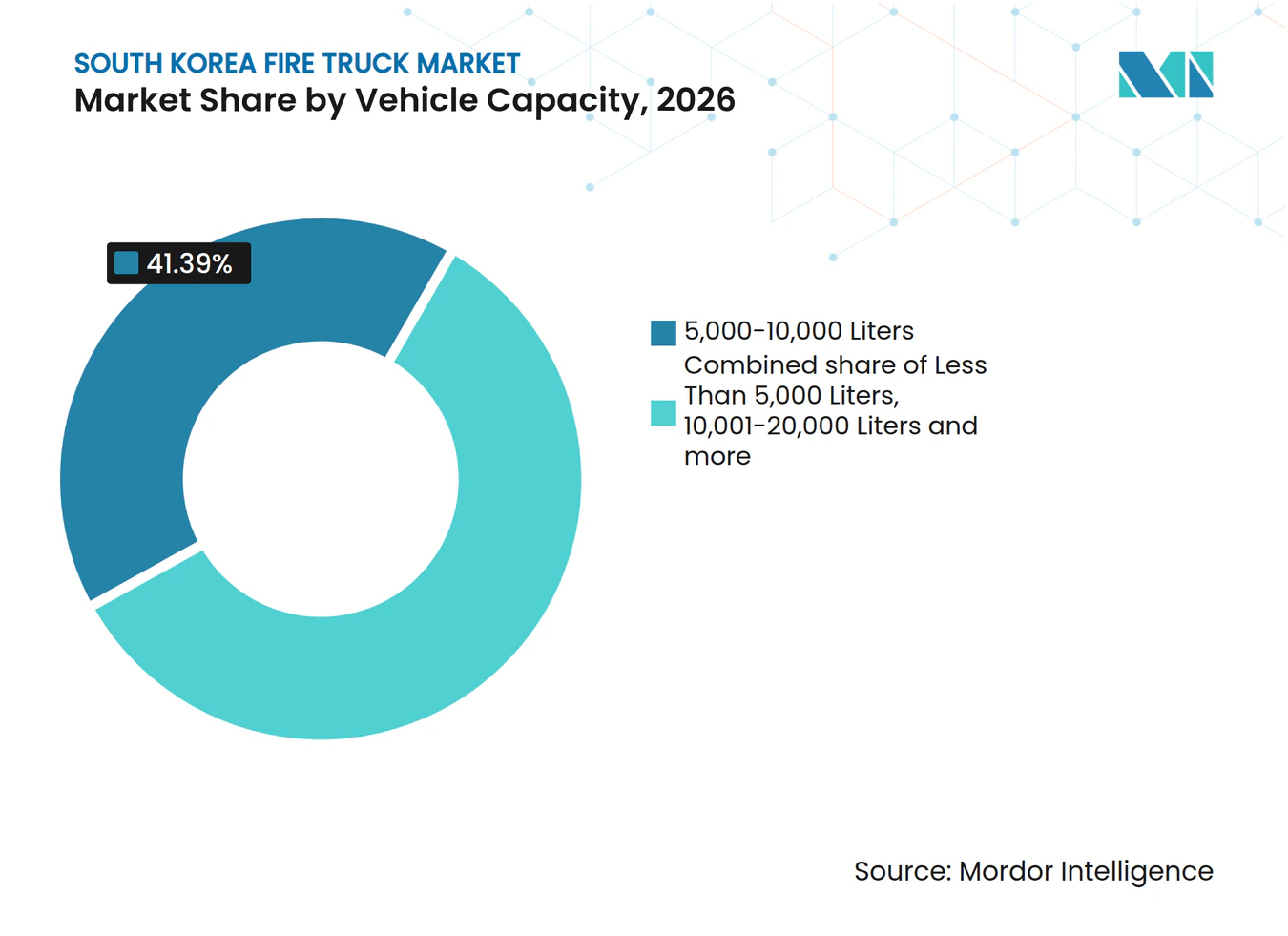
Mid-Range Vehicles Remain Core, While Larger Units Serve Wildland OperationsThe 5,000–10,000 liter category accounted for 41.39% of the South Korea fire truck market in 2026. National Fire Agency specifications identify this range as the standard configuration for primary municipal pumper and tanker vehicles. These vehicles can support multi-structure response while still operating on narrow roads common in older neighborhoods. The 10,001–20,000 liter category is forecast to grow at a 7.49% CAGR through 2032. Forestry and wildland agencies are driving that growth as they seek greater water capacity and off-road capability. The Korea Forest Service’s work with 3,500-liter specialist vehicles and the planned 6,000-liter domestic vehicle show how this part of the South Korea fire truck market is evolving.
The less-than-5,000-liter category serves a different purpose. Compact first-response vehicles can enter narrow alleys and underground parking areas where larger vehicles cannot operate effectively. Vehicles above 20,000 liters remain limited to industrial locations, military air bases, ports, and dedicated on-site brigades. The 5,000–10,000 liter class is also moving beyond generic pumper design. Some vehicles include high-reach nozzles and compressed air foam systems. This allows a station to combine capabilities in fewer vehicles, although it increases unit cost and equipment complexity. The capacity mix, therefore, reflects both municipal access constraints and specialist risk environments.

By End User:
Municipal Departments Provide the Largest Base, While Airports Grow FastestMunicipal fire departments accounted for 43.45% of demand in 2026. The National Fire Agency funding framework allocates apparatus budgets through the metropolitan and provincial fire headquarters and their subordinate stations. Korea’s public-sector fire protection model supports this position. Large industrial locations coordinate with public departments rather than routinely building independent primary suppression fleets. Airports are forecast to grow at a 7.19% CAGR through 2032 as aircraft rescue and firefighting fleets move through replacement cycles. Incheon International Airport and the 14 airports managed by Korea Airports Corporation maintain dedicated firefighting fleets.
Industrial and commercial facilities form the second-largest end-user cohort. Demand is concentrated in Ulsan petrochemical complexes, shipyards, and the Pohang steel corridor. These buyers commonly seek high-capacity chemical, foam, or industrially adapted ARFF units. Their direct contracts can create a more accessible route for international suppliers than the public Multiple Award Schedule. Military procurement follows multi-year defense acquisition cycles, which creates uneven order timing. Forestry agencies are becoming more important end users, following the Korea Forest Service's December 2025 deployment of 64 multipurpose wildfire suppression vehicles built on a domestic military vehicle platform. These distinct purchasing channels provide the South Korea fire truck market with multiple sources of demand.
Geography Analysis
The Seoul Capital Area accounted for 33.61% of demand in 2026, the largest regional share in the South Korea fire truck market. Seoul, Incheon, and Gyeonggi combine high population density, extensive high-rise housing, transit infrastructure, and a large electric-vehicle base. The Seoul metropolitan core has one of the highest population densities in the region. Regional procurement includes aerial platforms, EV-capable suppression equipment, robotic vehicles, and specialized rescue units. The Ministry of Land, Infrastructure, and Transport's pilot program covers a large fleet of Hyundai, Kia, and BMW vehicles and connects battery-fire warnings to emergency dispatch.
The Busan-Ulsan Industrial Belt and Daegu-Gyeongsang industrial areas form the second major demand cluster. The region combines port, petrochemical, shipbuilding, aviation, and wildland fire risks. Daegu deployed its first remotely operated destruction and water cannon vehicle at Seobu Fire Station in August 2025 to cover industrial complexes with sandwich-panel factories. Busan has also deployed advanced high-rise response equipment, including several SKY CAFS-equipped vehicles that have recently entered service.
Gangwon is forecast to grow at a 7.64% CAGR through 2032, the fastest regional rate in the South Korea fire truck market. Its mountainous terrain and dry spring weather create sustained exposure to wildland fires. Provincial agencies participated in specialized forest-fire vehicle tender rounds during 2025. Daejeon-Sejong-Chungcheong and Gwangju-Jeolla require rescue, command, and specialist equipment as administrative and service demands develop. The National Fire Agency plans to expand its large-capacity water cannon system to the Honam region and to add 18 unmanned firefighting robots nationwide over the next two years. Jeju maintains a smaller, self-sufficient fleet, making timely replacement and manufacturing capacity on the mainland important.
Competitive Landscape
Market Concentration
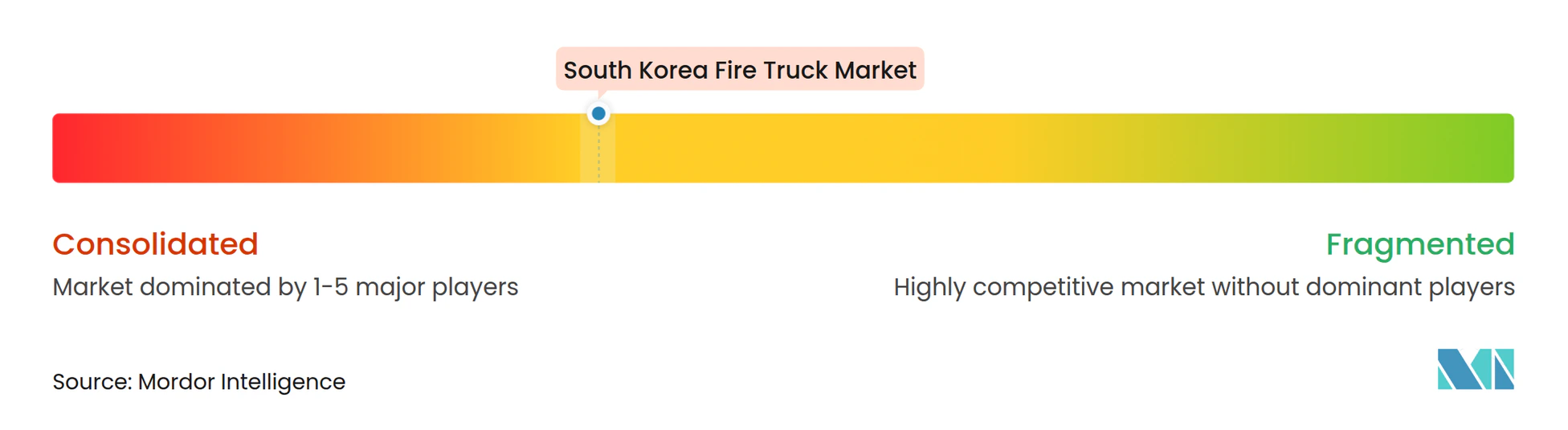
The South Korea fire truck market is moderately concentrated within domestic standard vehicle categories. Hyundai Everdigm holds a dominant position in aerial apparatus, accounting for the majority of that segment, supported by its role as the sole authorized supplier in certain government procurement routes. Its production scale and broad technology portfolio reinforce this position. ENPLUS, Jinwoo SMC, Namyoung Motor, Semyeong ENG, and Korea Fire Truck compete across pumpers, tankers, and rescue vehicles, primarily through the National Fire Agency's procurement system. International firms maintain a narrower presence in specialized equipment, particularly airport rescue vehicles, major aerial platforms, and high-performance wildland systems.
Rosenbauer's Panther vehicles serve airport and nuclear power plant applications, while Oshkosh Striker vehicles are deployed at Incheon and within the Korea Airports Corporation portfolio. Hyundai Everdigm signed a significant supply contract with Iraq's Ministry of Interior, covering aerial ladder trucks, pumpers, water tenders, and rescue vehicles. This export order demonstrates how an established domestic supplier is leveraging its production base for opportunities outside Korea. The company also exhibited aerial ladder trucks and unmanned water cannon robots at the International Fire & Safety Expo Korea.
Technology integration is an important competitive factor in the South Korea fire truck market. Hyundai Motor Group donated four unmanned firefighting robots, designed for electric-vehicle fires in underground parking facilities, to the National Fire Agency in February 2026, and the agency plans to scale the fleet toward 100 units. FIRESYSTEC and AMTEC INC. are targeting EV fire suppression equipment, an area where established aerial and pumper suppliers have more limited product coverage. National Fire Agency certification and Korean road safety compliance requirements continue to shape supplier eligibility, favoring companies with local service networks and established relationships. Korean firms are also pursuing export opportunities by developing localized wildland equipment and robotic apparatus.
South Korea Fire Truck Industry Leaders
-
ENPLUS Co., Ltd.
-
Hyundai Everdigm Corp.
-
Jinwoo SMC Co., Ltd.
-
Semyeong ENG Co., Ltd.
-
FIRESYSTEC INC.
- *Disclaimer: Major Players sorted in no particular order
South Korea Fire Truck Market Companies Covered in this Report
- ENPLUS Co., Ltd.
- Hyundai Everdigm Corp.
- Jinwoo SMC Co., Ltd.
- Namyoung Motor Co., Ltd.
- Semyeong ENG Co., Ltd.
- FIRESYSTEC INC.
- SHINJEONG
- Hanseo Precision Industry Co., Ltd.
- Korea Fire Truck Co., Ltd.
- KCP Co., Ltd.
- AMTEC INC.
- Oshkosh Corporation
- Rosenbauer International AG
- Pierce Manufacturing Inc.
- E-ONE, Inc.
- Ferrara Fire Apparatus, Inc.
- Gimaex GmbH
- Smeal Fire Apparatus Co.
- KME Fire Apparatus
- Volvo Group
Recent Industry Developments in South Korea Fire Truck Market
- September 2026: Tata Daewoo Mobility delivered two remote-breach water cannon trucks built on its MAXEN heavy-truck platform to the Hanoi Fire and Rescue Police in Vietnam.
- September 2026: The Philippine Department of the Interior and Local Government announced plans to acquire 1,500 fire trucks through a government-to-government agreement with South Korea.
- April 2026: The National Fire Agency announced plans to add 18 unmanned firefighting robots over two years, with a long-term goal of 100 units across all regional fire headquarters.
- February 2026: Hyundai Motor Group donated four unmanned firefighting robots designed for electric-vehicle fires to the National Fire Agency.
- December 2025: The Korea Forest Service deployed 64 multipurpose wildfire suppression vehicles built on a domestic military vehicle platform.
South Korea Fire Truck Market Report Scope
The South Korea fire truck market is segmented by vehicle type into pumper fire trucks and engines, aerial fire trucks, turntable ladder trucks, articulated aerial platform trucks, tanker fire trucks and water tenders, rescue fire trucks, aircraft rescue and firefighting vehicles, wildland fire trucks, other special purpose fire trucks, chemical and foam fire trucks, command and communications vehicles, and unmanned, robotic, and demolition fire trucks.
By propulsion type, the market includes internal combustion engine, hybrid electric, battery electric, and hydrogen fuel cell and other alternative propulsion vehicles.
By vehicle capacity, the market covers fire trucks with capacities of less than 5,000 liters, 5,000 to 10,000 liters, 10,001 to 20,000 liters, and more than 20,000 liters.
By end user, the market is divided into municipal fire departments, industrial and commercial facilities, airports, military and defense, forestry and wildland agencies, and infrastructure, utilities, and transport operators.
The cross-segmentation analysis by vehicle type and end user covers pumper fire trucks and engines, aerial fire trucks, tanker fire trucks and water tenders, rescue fire trucks, aircraft rescue and firefighting vehicles, wildland fire trucks, and special purpose fire trucks across end-user groups.
By geography, the South Korea fire truck market is assessed across the Seoul Capital Area, Busan and Ulsan Industrial Belt, Daegu and Gyeongsang Industrial Areas, Daejeon, Sejong, and Chungcheong, Gwangju and Jeolla, Gangwon, and Jeju.
Segmentation Overview
| Pumper Fire Trucks / Engines |
| Aerial Fire Trucks |
| Turntable Ladder Trucks |
| Articulated Aerial Platform Trucks |
| Tanker Fire Trucks / Water Tenders |
| Rescue Fire Trucks |
| Aircraft Rescue and Firefighting Vehicles |
| Wildland Fire Trucks |
| Other Special Purpose Fire Trucks |
| Chemical and Foam Fire Trucks |
| Command and Communications Vehicles |
| Unmanned, Robotic, and Demolition Fire Trucks |
| Internal Combustion Engine |
| Hybrid Electric |
| Battery Electric |
| Hydrogen Fuel Cell and Other Alternative Propulsion |
| Less Than 5,000 Liters |
| 5,000-10,000 Liters |
| 10,001-20,000 Liters |
| More Than 20,000 Liters |
| Municipal Fire Departments |
| Industrial and Commercial Facilities |
| Airports |
| Military and Defense |
| Forestry and Wildland Agencies |
| Infrastructure, Utilities, and Transport Operators |
| Pumper Fire Trucks / Engines by End User |
| Aerial Fire Trucks by End User |
| Tanker Fire Trucks / Water Tenders by End User |
| Rescue Fire Trucks by End User |
| Aircraft Rescue and Firefighting Vehicles by End User |
| Wildland Fire Trucks by End User |
| Special Purpose Fire Trucks by End User |
| Seoul Capital Area |
| Busan and Ulsan Industrial Belt |
| Daegu and Gyeongsang Industrial Areas |
| Daejeon, Sejong, and Chungcheong |
| Gwangju and Jeolla |
| Gangwon |
| Jeju |
| Vehicle Type | Pumper Fire Trucks / Engines |
| Aerial Fire Trucks | |
| Turntable Ladder Trucks | |
| Articulated Aerial Platform Trucks | |
| Tanker Fire Trucks / Water Tenders | |
| Rescue Fire Trucks | |
| Aircraft Rescue and Firefighting Vehicles | |
| Wildland Fire Trucks | |
| Other Special Purpose Fire Trucks | |
| Chemical and Foam Fire Trucks | |
| Command and Communications Vehicles | |
| Unmanned, Robotic, and Demolition Fire Trucks | |
| Propulsion Type | Internal Combustion Engine |
| Hybrid Electric | |
| Battery Electric | |
| Hydrogen Fuel Cell and Other Alternative Propulsion | |
| Vehicle Capacity | Less Than 5,000 Liters |
| 5,000-10,000 Liters | |
| 10,001-20,000 Liters | |
| More Than 20,000 Liters | |
| End User | Municipal Fire Departments |
| Industrial and Commercial Facilities | |
| Airports | |
| Military and Defense | |
| Forestry and Wildland Agencies | |
| Infrastructure, Utilities, and Transport Operators | |
| Cross-Segmentation by Vehicle Type and End User | Pumper Fire Trucks / Engines by End User |
| Aerial Fire Trucks by End User | |
| Tanker Fire Trucks / Water Tenders by End User | |
| Rescue Fire Trucks by End User | |
| Aircraft Rescue and Firefighting Vehicles by End User | |
| Wildland Fire Trucks by End User | |
| Special Purpose Fire Trucks by End User | |
| Geography | Seoul Capital Area |
| Busan and Ulsan Industrial Belt | |
| Daegu and Gyeongsang Industrial Areas | |
| Daejeon, Sejong, and Chungcheong | |
| Gwangju and Jeolla | |
| Gangwon | |
| Jeju |
Key Questions Answered in the Report
What is the forecast growth rate for the South Korea fire truck market?
The South Korea fire truck market is projected to grow at a 6.53% CAGR from 2027 to 2032, reaching USD 188.76 million by 2032.
Which vehicle type leads demand in South Korea?
Pumper fire trucks and engines led demand with 39.23% share in 2026 because they remain baseline equipment for municipal fire stations.
Which fire truck category is growing fastest in South Korea?
Aerial fire trucks are forecast to grow at a 7.38% CAGR through 2032, supported by high-rise response needs.
Why are battery-electric fire vehicles gaining attention?
Battery-electric vehicles are forecast to grow at an 11.22% CAGR through 2032, supported by the need to address EV fires in underground parking areas.
Which end user will grow fastest through 2032?
Airports are forecast to grow at a 7.19% CAGR as aircraft rescue and firefighting fleets enter replacement cycles.