
Market Overview
| Study Period | 2020 - 2031 |
|---|---|
| Forecast Data Period | 2026 - 2031 |
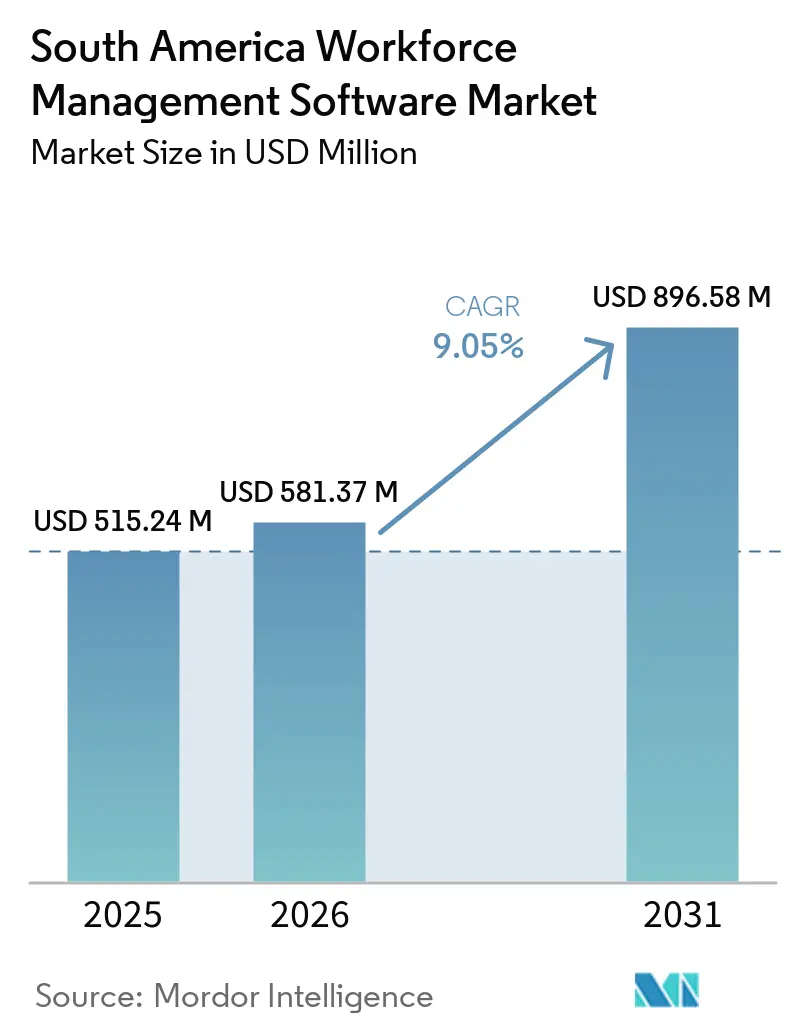
| Base Year Market Size (2025) | USD 515.24 Million |
| Market Size (2026) | USD 581.37 Million |
| Market Size (2031) | USD 896.58 Million |
| Growth Rate (2026 - 2031) | 9.05 % |
| Market Concentration | Medium |
Major Players *Disclaimer: Major Players sorted in no particular order Image © Mordor Intelligence. Reuse requires attribution under CC BY 4.0. | |
South America Workforce Management Software Market Analysis by Mordor Intelligence
The South America Workforce Management Software Market size was valued at USD 515.24 million in 2025 and is estimated to grow from USD 581.37 million in 2026 to reach USD 896.58 million by 2031, at a CAGR of 9.05% during the forecast period (2026-2031). Brazil's digital labor requirements are moving workforce management software from an operational tool to a compliance requirement for employers that report payroll, hours, and occupational health events. The combined use of eSocial, FGTS Digital, and employer access to social-security leave information has shortened procurement decisions, especially for companies that still use manual records. Cloud systems are expanding access for mid-sized employers because subscription pricing and standardized interfaces reduce the effort required for implementation. Global providers are strengthening their integrated platforms, while regional vendors compete by offering payroll localization and labor-law configuration. Demand also benefits from complex scheduling needs in retail, logistics, agribusiness, and healthcare, although currency volatility and legacy system integration remain material obstacles.
Key Report Takeaways
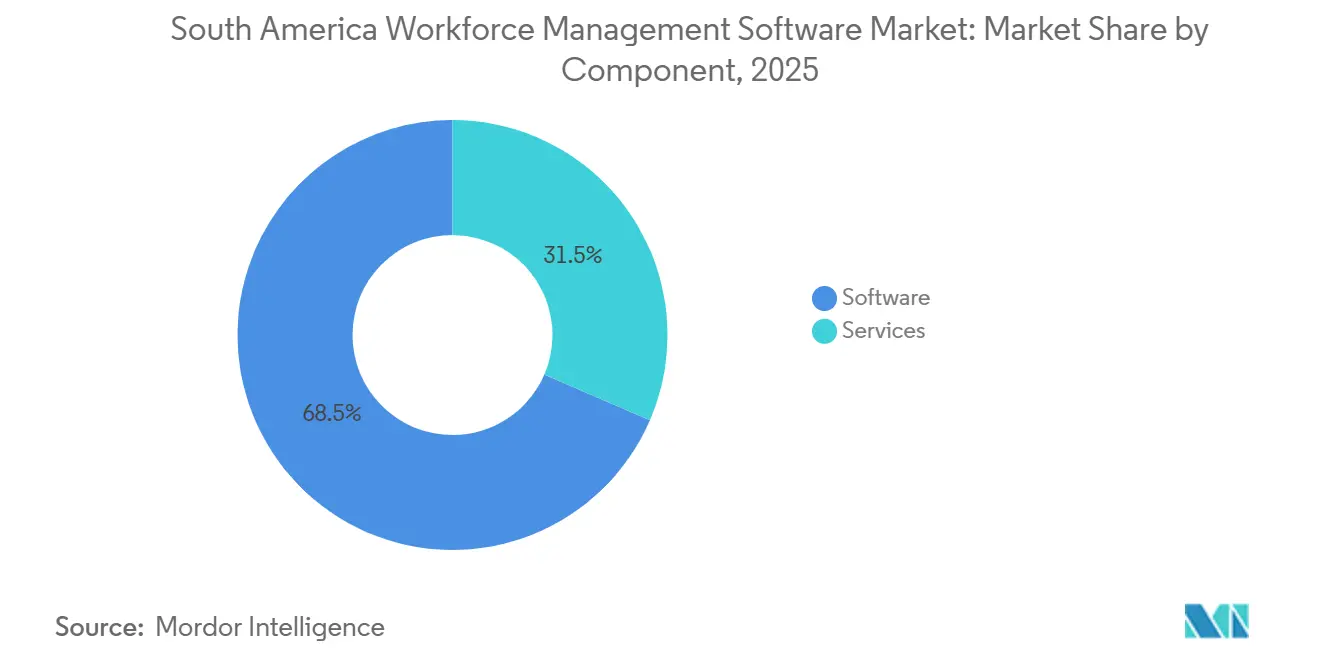
- By component, software held 68.52% of the South America workforce management software market share in 2025, while services are projected to expand at a 9.28% CAGR through 2031.
- By software type, time and attendance management held 34.26% of the South America workforce management software market share in 2025, while workforce analytics is projected to expand at a 9.32% CAGR through 2031.
- By deployment mode, cloud accounted for 66.43% of the South America workforce management software market size in 2025 and is projected to expand at a 9.56% CAGR through 2031.
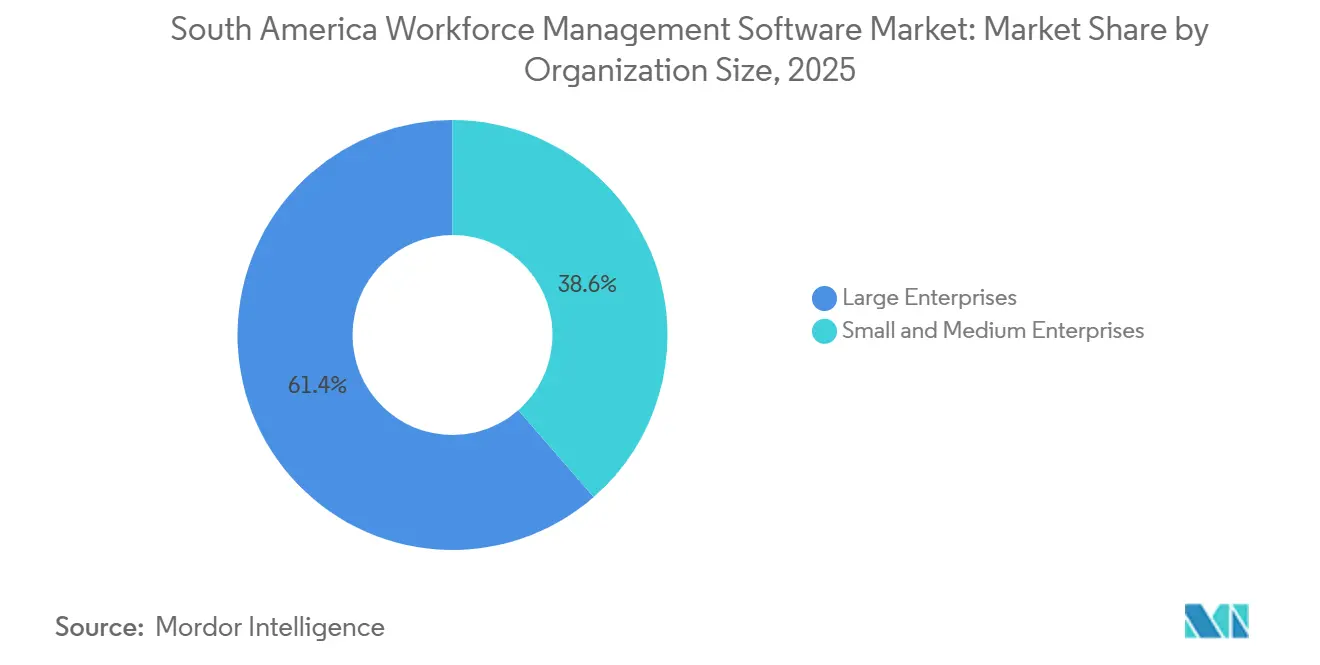
- By organization size, large enterprises held 61.42% of the South America workforce management software market share in 2025, while SMEs are projected to expand at a 9.69% CAGR through 2031.
- By end-use industry, consumer goods and retail accounted for 22.31% of the South America workforce management software market in 2025, while healthcare is projected to expand at a 10.06% CAGR through 2031.
- By geography, Brazil held 56.28% of revenue in 2025, while Colombia is projected to expand at a 9.73% CAGR through 2031.
Note: Market size and forecast figures in this report are generated using Mordor Intelligence’s proprietary estimation framework, updated with the latest available data and insights as of January 2026.
South America Workforce Management Software Market Trends and Insights
Drivers Impact Analysis*
| Driver | (~) % Impact on CAGR Forecast | Geographic Relevance | Impact Timeline |
|---|---|---|---|
| Brazil's Digital Labor Compliance and Auditability Requirements | +2.3% | Brazil, with spillover to Argentina, Chile, and Colombia as peer nations adopt similar digital reporting mandates | Short term (≤ 2 years) |
| Cloud Adoption Among Mid-Sized Employers | +1.8% | Brazil, Chile, Colombia, and Argentina, with early gains in São Paulo, Bogotá, and Santiago | Medium term (2-4 years) |
| Expansion of Shift-Intensive Retail, Logistics and Agribusiness Operations | +1.5% | Brazil, Argentina, Chile, and Colombia | Medium term (2-4 years) |
| AI-Enabled Labor Forecasting to Reduce Overtime Penalties | +1.1% | Brazil, Colombia, and Chile | Medium term (2-4 years) |
| Biometric Attendance to Reduce Payroll Fraud in Logistics Hubs | +0.9% | Brazil, Argentina, and Colombia | Short term (≤ 2 years) |
| Offline-First Workforce Management for Remote Industrial Sites | +0.5% | Interior Brazil and the rest of South America, particularly mining and energy sites | Long term (≥ 4 years) |
| Source: Mordor Intelligence | |||
Brazil's Digital Labor Compliance and Auditability Requirements
Brazil's digital labor framework is a leading driver of the South America workforce management software market. eSocial and FGTS Digital provide authorities with access to payroll, working hours, and occupational health information through integrated reporting processes. A consolidated MTE ordinance recently brought key electronic labor obligations under a common framework, reducing uncertainty for employers that had delayed investment in automated records and reporting. Updated eSocial guidance introduced validation rules and substantial fines for inaccurate employee data. Employers, therefore, need systems that connect attendance, leave, payroll inputs, and compliance records rather than relying on separate timekeeping applications.
Cloud Adoption Among Mid-Sized Employers
Cloud adoption among mid-sized employers is widening the addressable base for the South America workforce management software market. Employers with 200 to 999 workers often need enterprise-level compliance controls but lack large internal technology teams. Subscription pricing can replace the higher initial cost of on-premises software and allows adoption in smaller stages. Chile's Exempt Resolution No. 38, which took effect in April 2025, required a government-authorized electronic attendance registration system and created a clear need for compatible digital tools. This requirement supports cloud-compatible products that can work with the certification framework and protect employee information.
Expansion of Shift-Intensive Retail, Logistics and Agribusiness Operations
Retail, logistics, and agribusiness operations are increasing demand for scheduling and attendance functions across the South America workforce management software market. These sectors manage large hourly workforces, changing demand patterns, and multiple work locations. Formal labor practices and e-commerce fulfillment needs make accurate staffing plans more valuable for employers. Retail groups need to coordinate store schedules, peak periods, overtime, and attendance across distributed networks. Logistics operators also need labor information that can align warehouse activity, delivery cycles, and staffing levels. The need becomes more acute during seasonal demand periods and harvest cycles, when manual allocation can lead to costly overtime and limited visibility.
AI-Enabled Labor Forecasting to Reduce Overtime Penalties
AI-enabled labor forecasting is becoming more relevant to buyers in the South America workforce management software market. Employers increasingly need tools that do more than record past attendance and leave events. Forecasting functions can identify staffing gaps, overtime exposure, absence patterns, and recurring scheduling pressures before they become payroll issues. This capability has greater value in Brazil because overtime rules, compensatory time arrangements, and sector-specific labor limits require detailed planning. SAP SuccessFactors introduced suite-wide agentic AI in its 1H 2026 release, including capabilities for workforce administration, scheduling, and payroll.[1]SAP, “SAP SuccessFactors 1H 2026 Release,” SAP News, news.sap.comAI functions can make scheduling more consistent when they are built on reliable labor and payroll data. They may also help supervisors evaluate proposed shifts against policy rules before approving them.
Restraints Impact Analysis*
| Restraint | (~) % Impact on CAGR Forecast | Geographic Relevance | Impact Timeline |
|---|---|---|---|
| Legacy Payroll and ERP Integration Friction | -2.0% | Brazil, Argentina, Chile, and Colombia, with Brazil most affected | Medium term (2-4 years) |
| Currency Volatility Increasing Effective SaaS Costs | -1.5% | Argentina, Brazil, and Colombia, with Argentina most affected | Short term (≤ 2 years) |
| Uneven Broadband and Data-Center Coverage Outside Capital Cities | -1.1% | Rest of South America, interior Brazil, and rural Argentina | Long term (≥ 4 years) |
| Biometric-Data Governance and Persistent Monitoring Concerns | -0.9% | Brazil, Chile, and Argentina | Medium term (2-4 years) |
| Source: Mordor Intelligence | |||
Legacy Payroll and ERP Integration Friction
Legacy payroll and ERP integration remains a significant restraint for the South America workforce management software market. Employers often operate regional payroll or ERP systems with proprietary data structures that require custom interfaces. The challenge is most evident in Brazil, where payroll can include profit-sharing, night-shift differentials, and hazard pay. Generic integration approaches may not generate the reconciliation logic needed for these elements. A phased migration can reduce disruption, but it can also leave data split between workforce and payroll systems for a period. This extends project timelines and reduces the immediate return from automation.
Currency Volatility Increasing Effective SaaS Costs
Currency volatility creates a structural pricing challenge in the South America workforce management software market. A subscription priced in USD can become more expensive in the local currency, even when the software and service levels do not change. This issue is particularly acute in Argentina and can also affect procurement decisions in Brazil and Colombia. SMEs are more exposed because they may not have treasury resources to manage foreign-exchange risk. Multi-year contracts can become harder to approve when future local-currency costs remain uncertain. The result can be delayed cloud adoption and continued use of older on-premises tools.
*Our forecasts treat driver/restraint impacts as directional, not additive. The impact forecasts reflect baseline growth, mix effects, and variable interactions.
Segment Analysis
By Component: Services Revenue Accelerates on a Compliance-Led Foundation
Software held 68.52% of the South America workforce management software market size in 2025. The share reflected employer demand for suites that bring time and attendance, scheduling, and analytics into a common workflow. Integrated software is useful when attendance inputs need to connect with payroll, leave, and labor reporting requirements. It also provides a foundation for employers that want to add more advanced functions after initial compliance needs are addressed. The software category remains central because it carries the core recordkeeping, workflow, and reporting functions that buyers require. Its position is supported by the need to manage recurring labor events across multiple locations and employee groups.
Services are projected to expand at a 9.28% CAGR through 2031, faster than the other component segment. Implementation, customization, and managed support are becoming more important as mid-sized buyers adopt systems without dedicated internal teams. Providers often must configure local eSocial requirements, payroll connections, and data management processes during deployment. Data-governance advice also extends work beyond a one-time implementation, particularly where employers need support for local privacy and labor requirements. Regional integrators can help global suppliers reach Brazil, Colombia, and Argentina without building every delivery capability internally. The South America workforce management software industry therefore has recurring services potential as buyers seek continued compliance support after go-live.


By Software Type: Analytics Becomes the Upsell Pathway in a Compliance-First Market
Time and attendance management held 34.26% of the South America workforce management software market size in 2025. The category serves a broad need because employers must collect reliable hours and attendance information before they can improve scheduling or payroll accuracy. Brazil's eSocial obligations and Chile's authorized electronic attendance system reinforce the role of this basic capability. It gives employers a traceable source for working-time records and supports regular reporting. For many buyers, it is the first application selected when replacing manual processes. This makes time and attendance a practical entry point for wider workforce platform adoption.
Workforce analytics is projected to expand at a 9.32% CAGR through 2031. Employers are using analytics to move from recording labor events toward examining overtime risk, absenteeism patterns, and scheduling effectiveness. Workforce scheduling and absence and leave management also support retail, logistics, and manufacturing employers that need better control of changing shifts. Fatigue and task management remains smaller, but it is relevant for agribusiness and mining settings where workload and safety documentation need closer attention.
By Deployment Mode: Cloud Retains Leadership in Share and Growth
Cloud deployment accounted for 66.43% of the South America workforce management software market size in 2025. It also represents the leading deployment approach because it supports frequent updates, centralized access, and easier connections to digital reporting workflows. Large employers are completing cloud migration programs, while many SMEs are selecting cloud systems as their first formal workforce management platform. This creates two sources of demand rather than a single replacement cycle. Cloud services can also make standard updates more manageable when labor rules or reporting layouts change. The deployment model, therefore, aligns with both compliance needs and the practical limits of internal IT resources.
Cloud deployment is projected to expand at a 9.56% CAGR through 2031. Employers may find that certified cloud controls offer stronger data protection practices than self-managed local servers, thereby reducing a historic objection to migration. On-premises systems still persist in financial services and energy, where internal audit standards can require greater separation of data layers. Hybrid approaches are also relevant for organizations that need cloud workforce functions to exchange data with an existing payroll system. Open interfaces and certified middleware can make this transition more manageable. The South America workforce management software market therefore retains a meaningful cloud runway even though cloud already held the largest share in 2025.
By Organization Size: Regulatory Requirements Expand the SME Opportunity
Large enterprises held 61.42% of the South America workforce management software market in 2025. Their share reflected larger workforces, higher spending per employee, and more complex compliance needs across legal entities and countries. Enterprise buyers also tend to require broad functionality across time, scheduling, absence, analytics, and reporting. Global vendors compete fiercely for these accounts by offering breadth of platforms and AI-supported workflows. Larger businesses can fund structured deployments and manage the integration work required with payroll and ERP systems. Their established technology budgets have therefore supported the early revenue base for full-suite providers.
SMEs are projected to expand at a 9.69% CAGR through 2031. Preconfigured local subscriptions can reduce the customization effort that previously made workforce tools difficult for smaller employers to purchase. eSocial requirements apply to Brazilian employers regardless of size, giving small firms a compliance incentive to adopt digital systems. Mobile-first interfaces and simpler onboarding can also reduce the technical capability needed for implementation. Local vendors are well-placed to combine payroll localization with pricing designed for small businesses. The South America workforce management software industry gains a broader customer base as regulatory obligations and accessible delivery models bring more SMEs into formal software use.
By End-Use Industry: Healthcare Grows Faster While Retail and Logistics Anchor Demand
Consumer goods and retail held 22.31% of the South America workforce management software market share in 2025. Retail employers manage large hourly workforces across store networks, so peak-season staffing, shift changes, and attendance control remain constant concerns. The scale of these operations makes manual scheduling less sustainable as the number of locations and workforce size increase. Consumer goods businesses also need labor visibility across production, distribution, and sales operations. The segment's leading position reflects the density of workforce transactions that must be managed every day. It will remain important for vendors that can provide practical scheduling and compliance functions at scale.
Healthcare is projected to expand at a 10.06% CAGR through 2031. Hospital networks are digitizing clinical rostering, nurse fatigue management, and labor compliance for staff who work continuous shifts. Healthcare providers need schedules that maintain staffing levels while accounting for overtime rules and patient safety requirements. Manufacturing, logistics, and transportation are also important demand centers because shift patterns and operational timing require close coordination of labor. BFSI, energy and utilities need accurate hours documentation for audit and regulatory purposes, while IT and telecommunications use project-time records for client billing. The automotive sector adds demand where just-in-time production schedules require workforce plans that align with production runs.
Geography Analysis
Brazil held 56.28% of the South America workforce management software market share in 2025. Its position reflects the region's largest and most complex formal labor environment. eSocial and FGTS Digital require employers to manage digital payroll, hours, and occupational health information through connected workflows. Consolidated MTE Ordinance No. 1 has further standardized electronic labor requirements since January 2026. The updated eSocial environment adds urgency because inaccurate employee data can trigger fines of up to BRL 44,396.84 (USD 8,30) at the stated 2025 average exchange rate.[2]Brazilian Ministry of Labour and Employment, “Novo Módulo de Relatórios Gerenciais do eSocial Já Está Disponível,” Brazilian Ministry of Labour and Employment, gov.br Brazil also has a large base of employers in retail, logistics, agribusiness, and industry that need continuous scheduling and attendance control.
Chile has established clearer digital attendance requirements through Exempt Resolution No. 38, which took effect in April 2025. The rule requires a government-authorized electronic attendance system and includes privacy protections such as limits on continuous employee geolocation monitoring. Argentina is developing, with employers in technology and financial services investing in cloud-based HR systems, although foreign-exchange pressure remains a barrier. Colombia is projected to expand at a 9.73% CAGR through 2031, the fastest rate among the geographies stated. Its position as a nearshore talent hub supports demand from technology firms and capability centers. Buk projected significant revenue growth in Colombia and identified Bogotá and Medellín as primary demand centers for large enterprises.
The rest of South America represented a smaller revenue base in 2025, but it offers a growing opportunity as formal employment and digital labor systems develop. Peru and Ecuador are at earlier stages of compliance digitization, with export-oriented agribusiness and mining employers beginning to adopt cloud workforce tools. These companies often need worker records across sites with limited broadband connectivity. Offline-first mobile tools can capture attendance without continuous connections and synchronize data when coverage returns. This capability is particularly relevant for mining, energy, and interior agribusiness locations. Providers that establish distribution relationships before regulations become more prescriptive can build familiarity and local support in these markets. The South America workforce management software market can therefore gain from solutions designed for dispersed worksites rather than only capital-city offices.
Competitive Landscape
The South America workforce management software market has a dual competitive structure. Global vendors compete on platform breadth, AI capabilities, and integration with broader human capital systems. Regional providers compete through labor-law configuration, payroll localization, and familiarity with Brazil's CLT and eSocial requirements. ADP raised the enterprise platform threshold when it acquired WorkForce Software in 2024 and launched the unified ADP WorkForce Suite in November 2025. The suite brought time, scheduling, absence, and analytics together across ADP Workforce Now, Lyric HCM, and Global Payroll.
Oracle introduced 8 Fusion Agentic Applications for HR in April 2026, including the Workforce Operations Command Center for scheduling, time, and absence operations.[3]Oracle, “Oracle Introduces Fusion Agentic Applications for HR,” Oracle News, oracle.com Oracle expanded this work in August 2026 with further HR applications and AI agents for workforce development, internal mobility, and skills needs. SAP SuccessFactors also released suite-wide agentic AI in April 2026 and set out its Autonomous HCM direction in May 2026. Workday and Google Cloud expanded their partnership in May 2026 to place Workday's Sana Self-Service Agent in Gemini Enterprise for governed conversational HR and finance workflows.
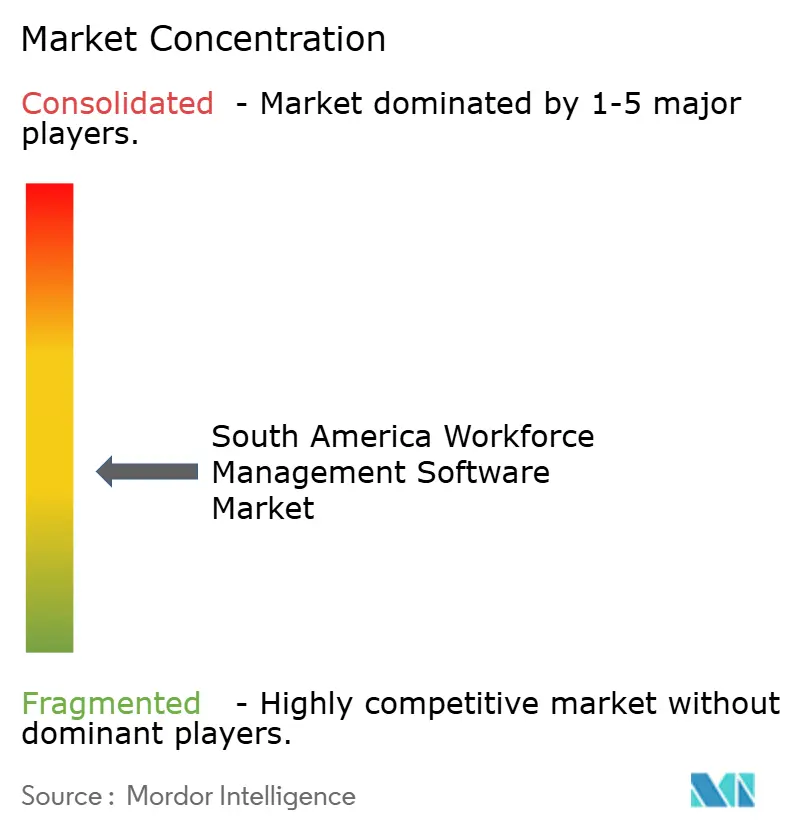
Regional competitors have durable positions in the SME and mid-market tiers of the South America workforce management software market. Sólides serves more than 50,000 companies with an all-in-one HR and payroll platform. Senior Sistemas reports that its HCM platform is used by more than 5,200 HR departments across South America and highlights its ISO 27001 certification and LGPD alignment. The logistics vertical offers room for systems that connect labor scheduling with warehouse task assignment and productivity measures. Quinyx and Deputy have limited distribution in the region, which may make them potential acquisition options for companies seeking a faster regional presence. The available evidence indicates a fragmented field of global, regional, and niche providers, with no combined market share disclosed for the leading vendors.
South America Workforce Management Software Industry Leaders
Automatic Data Processing, Inc.
Oracle Corporation
SAP SE
Ultimate Kronos Group, Inc.
Workday, Inc.
- *Disclaimer: Major Players sorted in no particular order

Recent Industry Developments
- August 2026: Oracle announced new Fusion Agentic Applications and AI agents for HR, expanding its workforce management capabilities with tools for accelerating workforce development, strengthening internal mobility, and responding to emerging skills needs. The applications are built into Oracle Fusion Cloud HCM and run on Oracle Cloud Infrastructure, extending Oracle's agentic workforce management architecture beyond its April 2026 initial release.
- May 2026: Workday and Google Cloud announced an expanded strategic partnership to embed Workday's Sana Self-Service Agent into Google Gemini Enterprise for governed, conversational HR and finance workflows. The partnership includes collaboration with Accenture, Deloitte, and KPMG supported by Google Cloud's innovation fund to accelerate deployment of agentic HR use cases including time-off management and timesheet approvals.
- April 2026: SAP SuccessFactors released its 1H 2026 update introducing suite-wide agentic AI across recruiting, workforce administration, payroll, and learning, alongside a native integration with SmartRecruiters connecting AI-enabled recruiting with core HR and onboarding. The release positions SAP's "Autonomous HCM" strategy, unveiled at SAP Sapphire in May 2026, as the competitive response to Workday's and Oracle's agentic workforce management launches.
- April 2026: Oracle introduced 8 Fusion Agentic Applications for HR at the Oracle AI World Tour in New York, including the Workforce Operations Command Center, targeting scheduling, time, and absence operations. The applications use coordinated AI-agent teams that can autonomously execute multi-step HR workflows within enterprise approval guardrails.


South America Workforce Management Software Market Report Scope
The South America workforce management software market covers software solutions that help organizations optimize workforce planning, time and attendance tracking, employee scheduling, labor forecasting, absence management, payroll integration, and compliance management. The report analyzes market trends, growth drivers, challenges, competitive dynamics, and opportunities across key South American countries. It also segments the market by deployment type, organization size, end-user industry, and country.
The South America Workforce Management Software Market Report is Segmented by Component (Software, and Services), Software Type (Time and Attendance Management, Workforce Scheduling, Workforce Analytics, Absence and Leave Management, and Fatigue and Task Management), Deployment Mode (Cloud, and On-Premises), Organization Size (Large Enterprises, and Small and Medium Enterprises), End-Use Industry (BFSI, Consumer Goods and Retail, Automotive, Energy and Utilities, Healthcare, Manufacturing, IT and Telecommunications, Logistics and Transportation, and Other End-Use Industries), and Geography (Brazil, Argentina, Chile, Colombia, and Rest of South America). The Market Forecasts are Provided in Terms of Value (USD).
By Component
| Software |
| Services |
By Software Type
| Time and Attendance Management |
| Workforce Scheduling |
| Workforce Analytics |
| Absence and Leave Management |
| Fatigue and Task Management |
By Deployment Mode
| Cloud |
| On-Premises |
By Organization Size
| Large Enterprises |
| Small and Medium Enterprises |
By End-Use Industry
| BFSI |
| Consumer Goods and Retail |
| Automotive |
| Energy and Utilities |
| Healthcare |
| Manufacturing |
| IT and Telecommunications |
| Logistics and Transportation |
| Other End-Use Industries |
By Geography
| Brazil |
| Argentina |
| Chile |
| Colombia |
| Rest of South America |
| By Component | Software |
| Services | |
| By Software Type | Time and Attendance Management |
| Workforce Scheduling | |
| Workforce Analytics | |
| Absence and Leave Management | |
| Fatigue and Task Management | |
| By Deployment Mode | Cloud |
| On-Premises | |
| By Organization Size | Large Enterprises |
| Small and Medium Enterprises | |
| By End-Use Industry | BFSI |
| Consumer Goods and Retail | |
| Automotive | |
| Energy and Utilities | |
| Healthcare | |
| Manufacturing | |
| IT and Telecommunications | |
| Logistics and Transportation | |
| Other End-Use Industries | |
| By Geography | Brazil |
| Argentina | |
| Chile | |
| Colombia | |
| Rest of South America |


Key Questions Answered in the Report
What is the South America workforce management software market size?
The South America Workforce Management Software Market size was valued at USD 515.24 million in 2025 and is estimated to grow from USD 581.37 million in 2026 to reach USD 896.58 million by 2031, at a CAGR of 9.05% during the forecast period (2026-2031).
Which country leads demand for workforce management software in South America?
Brazil led with 56.28% of revenue in 2025 because digital labor reporting, large formal employment, and complex compliance requirements support adoption.
Which deployment model is growing fastest in South America?
Cloud deployment held 66.43% of revenue in 2025 and is projected to expand at a 9.56% CAGR through 2031.
Why are SMEs adopting workforce management platforms?
SMEs need accessible tools for eSocial compliance, attendance, scheduling, and payroll workflows, supported by localized subscriptions and simpler onboarding.
Which end-use sector is projected to grow fastest?
Healthcare is projected to expand at a 10.06% CAGR through 2031 as hospital networks digitize clinical rostering, fatigue management, and labor compliance.
What constraints affect adoption of workforce management platforms?
Legacy payroll and ERP integration, currency volatility, uneven connectivity, and concerns about biometric-data governance can delay buying decisions and deployments.
Page last updated on:





