
South America Video Surveillance Storage Market Size and Share
Market Overview
| Study Period | 2020 - 2031 |
|---|---|
| Forecast Data Period | 2026 - 2031 |
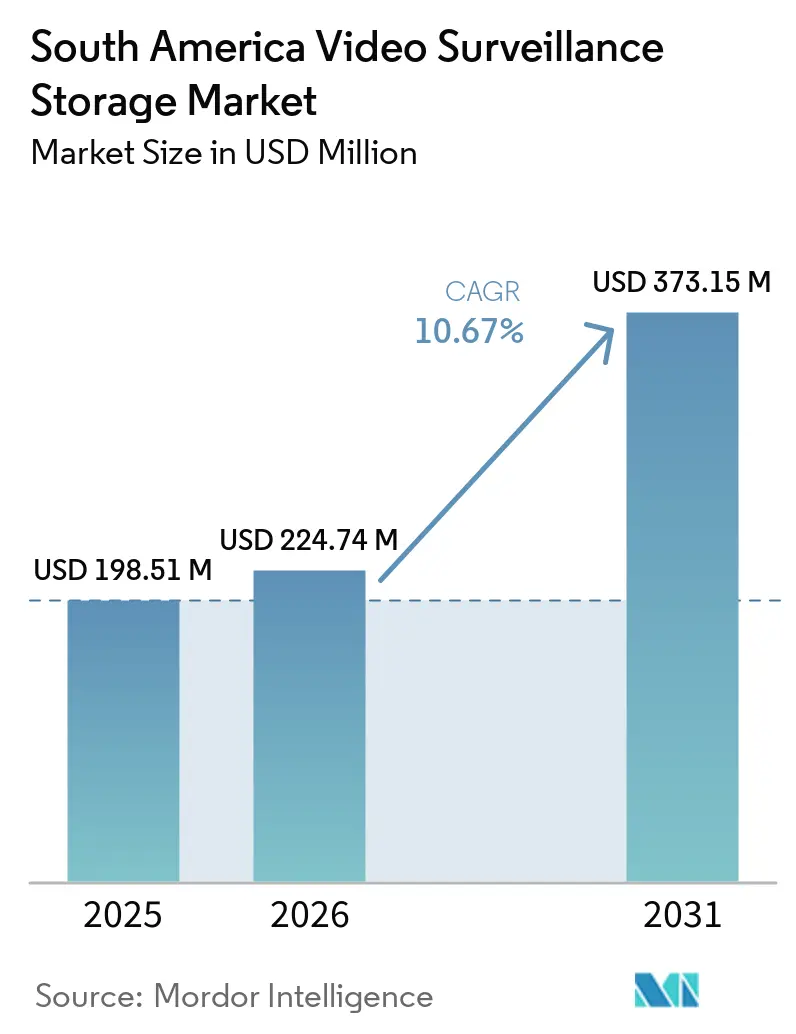
| Base Year Market Size (2025) | USD 198.51 Million |
| Market Size (2026) | USD 224.74 Million |
| Market Size (2031) | USD 373.15 Million |
| Growth Rate (2026 - 2031) | 10.67 % |
| Market Concentration | Medium |
Major Players *Disclaimer: Major Players sorted in no particular order Image © Mordor Intelligence. Reuse requires attribution under CC BY 4.0. | |
South America Video Surveillance Storage Market Analysis by Mordor Intelligence
The South America video surveillance storage market size was valued at USD 198.51 million in 2025 and estimated to expand from USD 224.74 million in 2026 to reach USD 373.15 million by 2031, at a CAGR of 10.67% during the forecast period 2026-2031. Public safety modernization is increasing the volume of video retained by municipal and national agencies. The replacement of analog recording systems with IP cameras is also changing storage requirements across commercial and public sites. Higher camera resolution and the wider use of artificial intelligence are increasing the amount of video and related metadata stored at each location. Cloud capacity in Brazil is making hybrid deployments more practical for organizations that need centralized access to recorded footage. The South America video surveillance storage market is therefore shifting from isolated hardware purchases toward recurring upgrades across storage, software, and managed services.
Key Report Takeaways
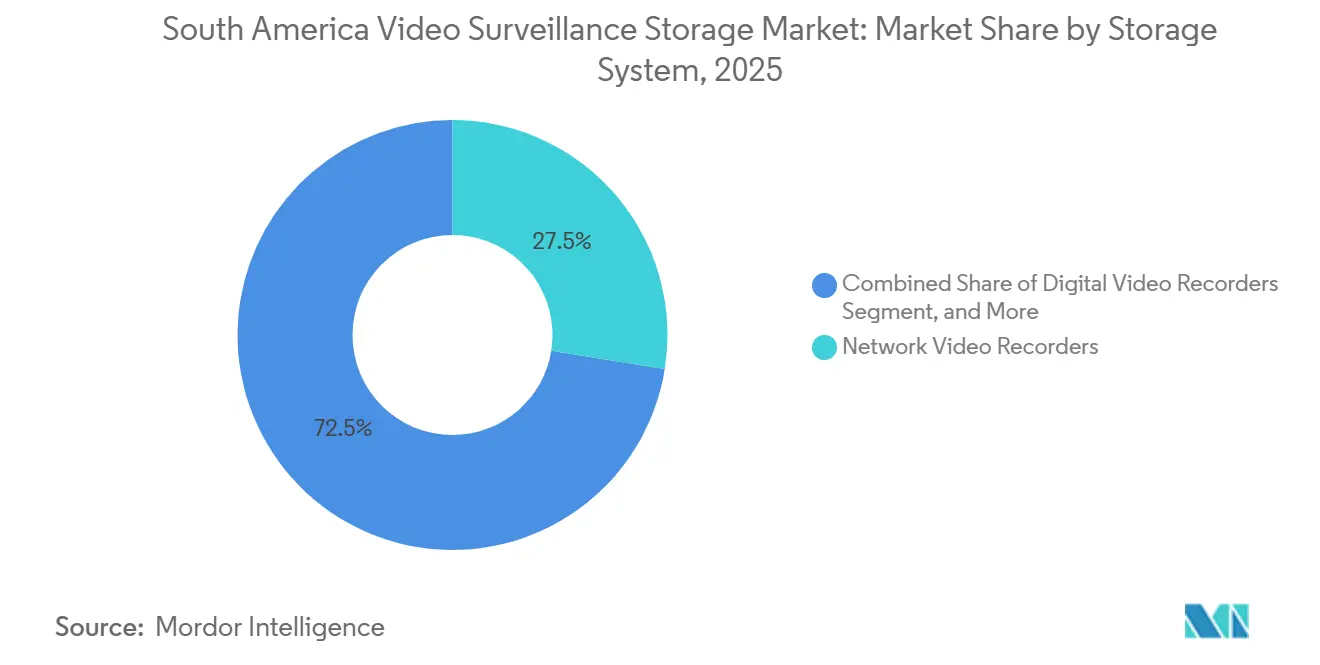
- By storage system, NVRs held 27.52% of the South America video surveillance storage market share in 2025, while hyperconverged infrastructure-based surveillance storage is projected to expand at an 11.25% CAGR through 2031.
- By offering, hardware accounted for 64.83% of revenue in 2025, while software and solutions is projected to expand at an 11.40% CAGR through 2031.
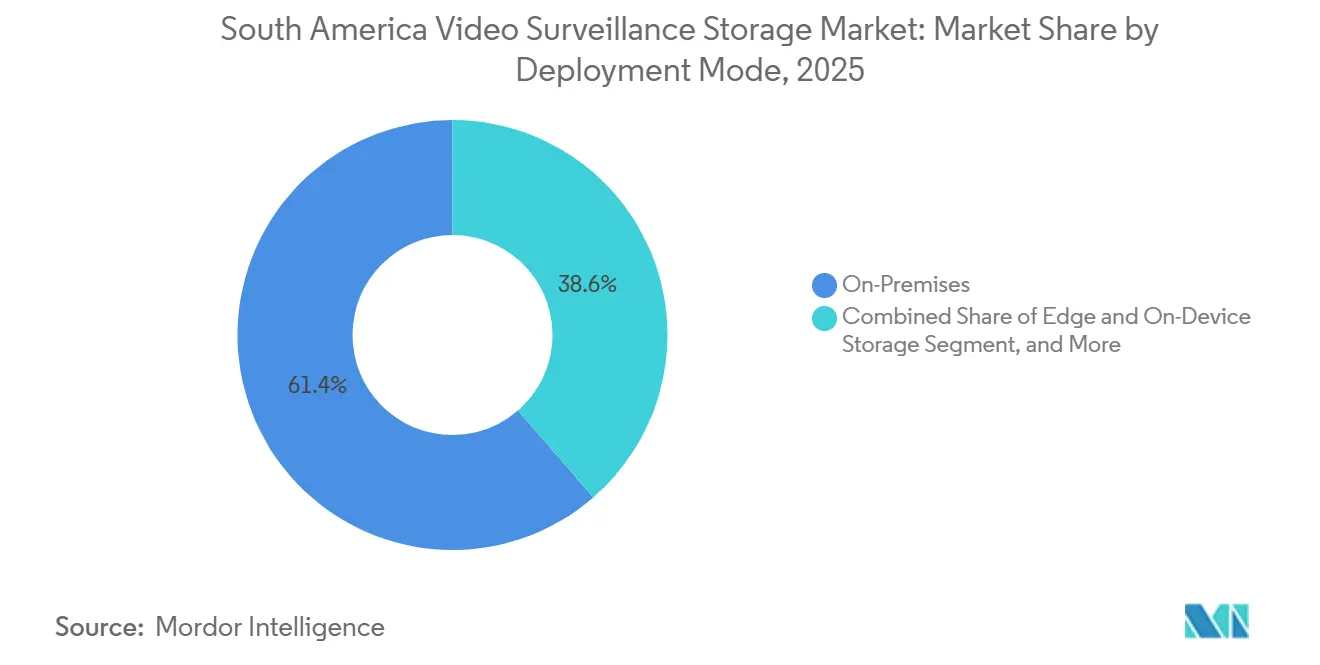
- By deployment mode, on-premises deployment held 61.36% of revenue in 2025, while cloud and video surveillance as a service is projected to expand at an 11.19% CAGR through 2031 in the South America video surveillance storage market.
- By storage media, hard disk drives accounted for 54.23% of revenue in 2025, while solid-state drives are projected to expand at an 11.68% CAGR through 2031.
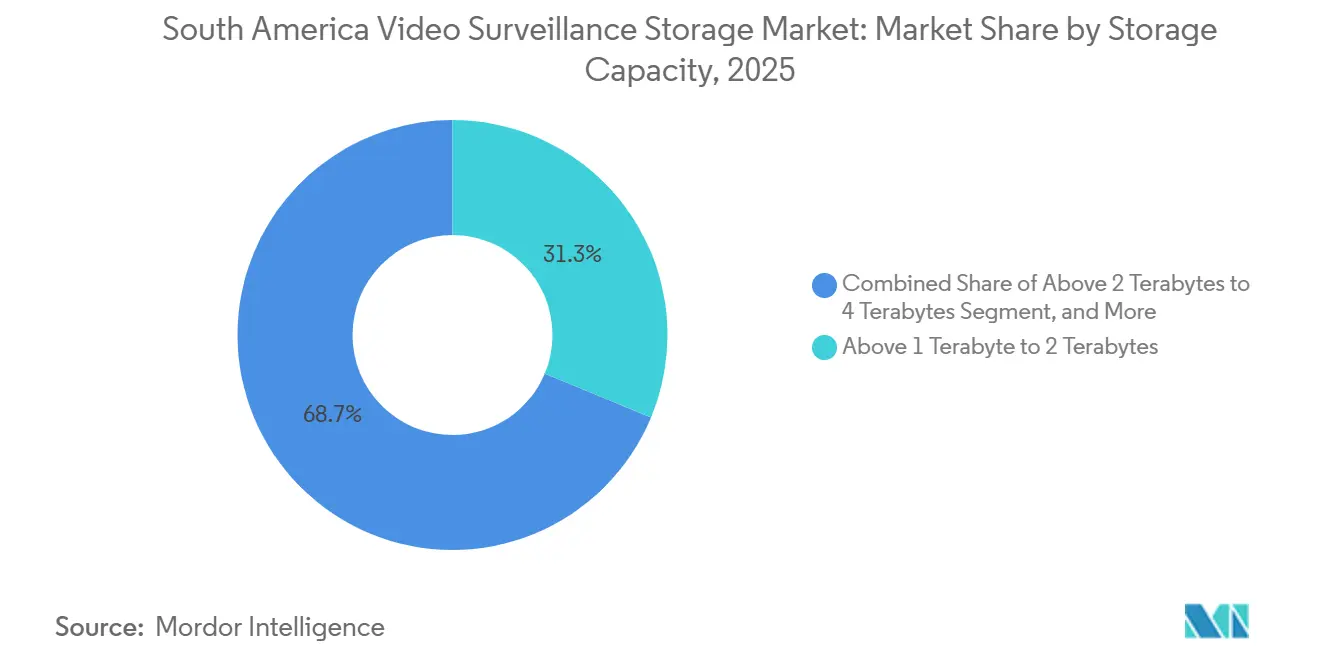
- By storage capacity, the above 1 terabyte to 2 terabytes tier held 31.27% of revenue in 2025, while the above 4 terabytes tier is projected to expand at an 11.86% CAGR through 2031 in the South America video surveillance storage market.
- By organization size, large enterprises accounted for 58.64% of revenue in 2025, while small and medium-sized enterprises are projected to expand at an 11.45% CAGR through 2031.
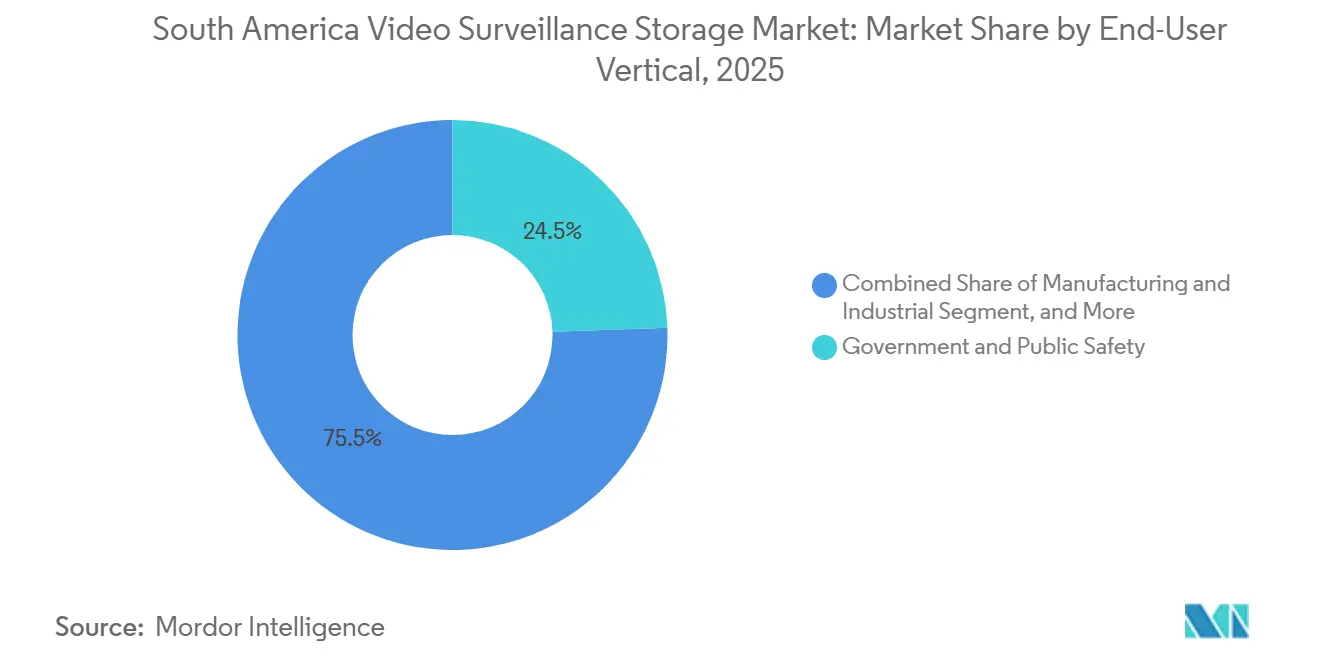
- By end-user vertical, government and public safety held 24.47% of revenue in 2025, while transportation and logistics is projected to expand at an 11.56% CAGR through 2031.
- By application, public safety and law enforcement accounted for 28.16% of revenue in 2025, while traffic monitoring and automatic number-plate recognition is projected to expand at an 11.59% CAGR through 2031.
- By geography, Brazil held 43.72% of revenue in 2025, while Argentina is projected to expand at an 11.46% CAGR through 2031.
Note: Market size and forecast figures in this report are generated using Mordor Intelligence’s proprietary estimation framework, updated with the latest available data and insights as of January 2026.
Market Trends and Insights
Drivers Impact Analysis of South America Video Surveillance Storage Market*
| Driver | (~) % Impact on CAGR Forecast | Geographic Relevance | Impact Timeline |
|---|---|---|---|
| Expansion of Smart-City and Public-Safety Video Networks | +2.8% | Brazil, Colombia, Argentina, Rest of South America | Short term (≤ 2 years) |
| Migration From Analog Recording to IP and AI-Enabled Surveillance | +2.3% | Brazil, Argentina, Colombia | Medium term (2-4 years) |
| Rising Demand for High-Resolution and Continuous Video Retention | +1.9% | Brazil, Colombia, Rest of South America | Medium term (2-4 years) |
| Growth of Cloud and Hybrid Video Storage Among Multi-Site Organizations | +1.6% | Brazil, Colombia, Argentina | Medium term (2-4 years) |
| Local Data Processing for Connectivity-Constrained Surveillance Sites | +1.0% | Rest of South America, Brazil remote regions | Long term (≥ 4 years) |
| Regional Data-Center Expansion Enabling Lower-Latency Video Storage | +0.8% | Brazil, Colombia | Long term (≥ 4 years) |
| Source: Mordor Intelligence | |||
Expansion of Smart-City and Public-Safety Video Networks
Public safety programs are creating a sustained requirement for centralized recording and searchable archives across the South America video surveillance storage market. Rio de Janeiro's CIVITAS center raised its annual operating budget from BRL 16 million to BRL 180 million in 2026 and managed more than 10,000 monitoring devices.[1] The city planned 6,000 city-owned super-cameras by the end of 2026, compared with 5,300 cameras at the June 2024 launch. These installations need storage that can support continuous recording, rapid retrieval, and system expansion without interrupting control-room operations. Medellín's planned C5i command center will combine cameras, automatic number-plate recognition readers, and IoT sensors under a unified dispatch platform. The South America video surveillance storage market benefits when such projects move from trial systems to permanent city infrastructure.
Migration From Analog Recording to IP and AI-Enabled Surveillance
The move from analog DVR systems to IP-based recording changes both the scale and character of storage demand. A 4K IP camera using H.265 encoding can generate 2 TB of raw video monthly during continuous recording, while AI functions add event images and searchable records. Replacing older equipment also requires sites to reconsider retention policies, network capacity, and the design of their recording platform. Seagate introduced its 32 TB SkyHawk AI drive in January 2026 for AI-enabled NVR systems that retain annotated footage.[2] The drive supports more than 10,000 hours of AI-annotated video and has a workload rating 3 times that of standard surveillance drives. This replacement cycle supports demand in the South America video surveillance storage market because higher-resolution cameras require compatible recording and archive capacity.
Rising Demand for High-Resolution and Continuous Video Retention
Higher image quality is raising the storage allocation needed for each camera and each retention period. A network of 50 4K cameras recording continuously can generate 100 TB of data per month. Operators are using tiered designs that place recent footage on SSD cache, routine footage on hard disk drives, and long-term archives in cloud repositories. CIVITAS Rio recorded 6.1 million license-plate reads each day in July 2025, showing the volume of data created by high-frequency city systems. Investigations often require footage from weeks or months before an event, which makes short retention periods less acceptable for public agencies. The South America video surveillance storage market also sees stronger demand from remote industrial locations where recording loss can create compliance and operating risks.
Growth of Cloud and Hybrid Video Storage Among Multi-Site Organizations
Multi-site organizations are adopting hybrid storage to centralize forensic access and maintain copies away from the monitored location. This approach can simplify updates and provide a common interface for retail chains, financial institutions, and transport operators. Hybrid configurations also retain local capacity when a site has poor connectivity or needs immediate access to recordings. Alibaba Cloud launched its first South America cloud region in Brazil in August 2026 with 2 data centers in São Paulo.[3] Local cloud infrastructure can support providers that need Brazil-based processing and storage for surveillance workloads. The South America video surveillance storage market gains a broader customer base as smaller organizations consider subscription-based video recording services rather than complete on-site systems.
Restraints Impact Analysis of South America Video Surveillance Storage Market*
| Restraint | (~) % Impact on CAGR Forecast | Geographic Relevance | Impact Timeline |
|---|---|---|---|
| High Infrastructure and Lifecycle Costs for Long-Term Video Retention | -1.8% | Brazil, Argentina, Rest of South America | Short term (≤ 2 years) |
| Bandwidth, Power Reliability, and Connectivity Gaps | -1.3% | Rest of South America, Brazil remote regions, Colombia rural areas | Medium term (2-4 years) |
| Fragmented Privacy and Facial-Recognition Governance | -0.9% | Brazil, Colombia, Argentina | Medium term (2-4 years) |
| Import Duties, Currency Volatility, and Replacement-Part Lead Times | -0.7% | Argentina, Brazil, Rest of South America | Short term (≤ 2 years) |
| Source: Mordor Intelligence | |||
High Infrastructure and Lifecycle Costs for Long-Term Video Retention
Long retention periods increase the total cost of surveillance systems because storage requirements rise with resolution and metadata use. Hardware costs can be difficult for municipal buyers to fund when surveillance upgrades compete with other public services. Many local governments continue to use hybrid DVR and analog systems because full replacement needs state or federal co-financing. Hyperconverged platforms can reduce management complexity, but they require a larger initial investment than a standard NVR refresh. This cost gap can delay adoption by public buyers with limited capital budgets. The South America video surveillance storage market therefore remains sensitive to financing structures and procurement timing.
Bandwidth, Power Reliability, and Connectivity Gaps
Remote mining, agribusiness, and energy sites often lack sufficient uplink capacity for continuous high-definition video transfer. Local recording remains necessary when cloud upload is intermittent or unavailable. Power outages also require equipment with backup power and temporary local buffering, adding costs at the site level. These conditions create demand for edge storage while limiting the pace of cloud-only deployments. Vendors must support both urban hybrid systems and self-contained remote installations across the region. The South America video surveillance storage market consequently requires products that can operate under uneven network and power conditions.
*Our forecasts treat driver/restraint impacts as directional, not additive. The impact forecasts reflect baseline growth, mix effects, and variable interactions.
South America Video Surveillance Storage Market Segment Analysis
By Storage System:
NVRs Anchor the Market While HCI Supports Large-Scale DeploymentsNVRs held 27.52% of the storage system segment in 2025, making them the established recording architecture for commercial and government sites. Their installed base reflects straightforward integration with IP cameras and broad availability through regional suppliers. Municipal agencies often favor NVRs because local partners can configure and support systems without extensive internal IT resources. NAS and DAS systems serve enterprise users that operate campuses or distributed locations. DVRs retain a limited role at public sites where capital constraints delay a complete IP transition.
Hyperconverged infrastructure-based surveillance storage is projected to expand at an 11.25% CAGR from 2026 to 2031. City-scale control rooms need combined processing and storage capacity for real-time analytics and continuous video recording. Pooling resources across nodes reduces the risk associated with a single appliance failure. Axis Communications introduced the AXIS S1228 AI-Optimized Server in June 2025 with 28 simultaneous stream licenses and 12 TB of local storage. The product illustrates how compute and recording functions are moving closer together in the South America video surveillance storage market.

By Offering:
Hardware Leads While Software Changes Contract StructuresHardware accounted for 64.83% of the offering segment in 2025 because initial projects require drives, NVRs, servers, and storage enclosures. Hardware retained a substantial position as older DVR systems were replaced with IP-focused equipment. Government and enterprise buyers also need physical capacity at sites that cannot rely on continuous connectivity. Professional services support integration, commissioning, and capacity planning for larger deployments. These requirements keep equipment spending central even when operators introduce cloud tools.
Software and solutions is projected to expand at an 11.40% CAGR from 2026 to 2031. Video management platforms increasingly include AI-based search, cloud synchronization, and automated retention controls as standard functions. Managed services are relevant to financial services and retail organizations that lack dedicated security IT teams. Open platforms can support camera fleets that include equipment from several generations and different suppliers. This flexibility changes the South America video surveillance storage market by moving part of the customer relationship toward subscriptions, updates, and archive management.
By Deployment Mode:
On-Premises Systems Remain Established While Cloud Adoption AdvancesOn-premises deployment accounted for 61.36% of the market in 2025, supported by data control requirements and a large installed base of local recording systems. Government agencies frequently operate networks where local storage is a practical requirement rather than a preference. Unreliable connectivity in some municipalities also makes local recording essential for continuous capture. Organizations handling biometric imagery must consider rules governing sensitive personal data. These factors preserve a major role for local equipment in the South America video surveillance storage market.
Cloud and video surveillance as a service is projected to expand at an 11.19% CAGR from 2026 to 2031. Multi-site retailers, financial institutions, and transportation operators value centralized management without a large initial hardware purchase. Edge and on-device storage remain relevant for fleets, mines, and agricultural sites with intermittent connectivity. Hybrid systems pair local NVR caches with cloud upload for flagged events and longer archive periods. This model lets users retain operational control while extending access beyond the physical site.
By Storage Media:
Hard Disk Drives Retain Cost Leadership While SSDs Support Edge UseHard disk drives held 54.23% of the storage media segment in 2025 because they provide cost-effective capacity for continuous writing. Their role remains important in NVR, NAS, and server systems that must retain large volumes of footage. Hybrid architectures use SSD cache for faster retrieval while using HDDs for the main video archive. Seagate began shipping 32 TB capacities globally in January 2026, including the SkyHawk AI drive for surveillance recording. Larger drives can reduce the number of devices needed for long retention periods in the South America video surveillance storage market.
Solid-state drives are projected to expand at an 11.68% CAGR from 2026 to 2031. They are suited to edge NVRs and vehicle systems where fast random access supports real-time analysis. Capacities between 2 TB and 8 TB are increasingly practical for single-camera or small edge sites with shorter retention needs. SSDs also support applications that require quick retrieval of frames during an investigation. WD reported fiscal year 2026 revenue of USD 12.919 billion, reflecting enterprise storage demand that supports continuing investment in capacity roadmaps.
By Storage Capacity:
Higher Resolution Shifts Demand Toward Larger TiersThe above 1 terabyte to 2 terabytes tier held 31.27% of the storage capacity segment in 2025. It aligns with small government sites and commercial facilities using 8-16 HD cameras with 30-60 day retention requirements. Standard NVR appliances and NAS enclosures commonly support this capacity range. The above 2 terabytes to 4 terabytes tier supports mid-sized sites with more cameras and analytical workloads. The up to 1 terabyte tier is becoming less suitable as 4K cameras become more common.
The above 4 terabytes tier is projected to expand at an 11.86% CAGR from 2026 to 2031. Higher resolutions, AI-generated records, and extended public-sector retention requirements are increasing demand for multi-terabyte configurations. Government specifications increasingly call for 30-90 days of continuous recording. Larger buyers are also considering petabyte-class HCI and SAN systems to consolidate fragmented site-level deployments. Seagate's Mozaic 4+ platform reached capacities up to 44 TB and indicates further scope for higher-capacity storage.
By Organization Size:
Large Enterprises Anchor Volume While SMEs Broaden DemandLarge enterprises accounted for 58.64% of the market in 2025 because they operate more cameras and retain footage for longer periods. Government bodies, banks, airports, and large retailers use formal procurement procedures and multi-year service arrangements. Their budgets support NAS, SAN, and HCI systems that can be expanded over time. These customers create large and predictable purchase cycles for suppliers and integrators. The South America video surveillance storage market size for this group reflects established governance requirements and recurring equipment refreshes.
Small and medium-sized enterprises are projected to expand at an 11.45% CAGR from 2026 to 2031. Cloud-based video surveillance services reduce the need for businesses to buy and manage complete on-site systems. Subscription plans can make AI-supported analytics and secure off-site recording accessible to smaller operators. Telecom providers and security integrators are bundling connectivity with video services in retail, hospitality, and logistics. Improved broadband in secondary cities supports wider use of these offerings.
By End-User Vertical:
Government Leads While Transportation and Logistics AdvancesGovernment and public safety held 24.47% of the end-user vertical in 2025. National and municipal camera programs need continuous recording, extended retention, and evidence retrieval across large networks. Banking, financial services, and insurance form the second-largest vertical because branch and ATM operations retain surveillance footage. Healthcare, manufacturing, energy, and utilities also need recording systems for perimeter protection and process safety. Government demand reflects the scale and continuity of public safety programs.
Transportation and logistics is projected to expand at an 11.56% CAGR from 2026 to 2031. Mass-transit operators are adding onboard cameras and connecting vehicle footage with centralized command systems. Dahua Technology and Grupo NSO deployed AI-enabled onboard video monitoring across São Paulo's public transit fleet in August 2026. The implementation combined vehicle-level storage with central monitoring infrastructure. Retail demand is also increasing as loss prevention programs require longer retention and synchronized multi-site records.
By Application:
Public Safety Leads While Traffic Monitoring and ANPR AdvancesPublic safety and law enforcement accounted for 28.16% of the application segment in 2025. City networks must record around the clock and allow investigators to search footage collected over long periods. These operational requirements create higher storage spending per camera than many commercial applications. Perimeter protection and retail loss prevention also use cloud-connected systems with motion-triggered archive functions. The South America video surveillance storage market continues to depend on public applications that require reliable evidence retention.
Traffic monitoring and automatic number-plate recognition is projected to expand at an 11.59% CAGR from 2026 to 2031. These systems retain vehicle images, plate numbers, timestamps, and location data for structured and rapid queries. CIVITAS Rio recorded 6.1 million license-plate reads each day in July 2025. Large traffic systems therefore require sustained write capacity and well-organized archives. Residential monitoring and industrial safety applications are also increasing in secondary cities across Brazil, Colombia, and Argentina.
Geography Analysis
São Paulo and Salvador Video Surveillance Storage Market
Brazil held 43.72% of the South America video surveillance storage market share in 2025. Its scale reflects urban concentration and sustained investment in public safety technology. Programs in São Paulo, Rio de Janeiro, Fortaleza, Salvador, and other cities are creating parallel procurement cycles for recording infrastructure. Salvador launched its Salvador Segura program in July 2026, targeting 10,000 cameras connected to a real-time AI platform. The city purchased 2,000 additional units as part of the program.
Brazil and Argentina Video Surveillance Storage Market
Brazil also gained additional local cloud capacity when Alibaba Cloud launched 2 data centers in São Paulo in August 2026. This infrastructure can support video service providers and enterprise users that require lower-latency regional hosting. Argentina is projected to expand at an 11.46% CAGR from 2026 to 2031 despite currency volatility and import constraints. The San Isidro deployment using Milestone's XProtect platform managed more than 2,600 cameras. It was associated with a 14% reduction in crime over 2 years.
South America Video Surveillance Storage Market
Colombia contributes demand through urban security programs and the planned Medellín C5i center. The center will integrate cameras, ANPR readers, and IoT sensors through one AI-driven dispatch platform. Peru also has a developing multi-year pipeline for on-premises and edge storage across urban security networks. Chile, Uruguay, and Ecuador remain smaller markets with expanding camera coverage in cities and critical infrastructure. Connectivity conditions across the Rest of South America make locally resilient storage designs important. These country differences require the South America video surveillance storage market to support both cloud-connected urban systems and edge deployments.
Competitive Landscape
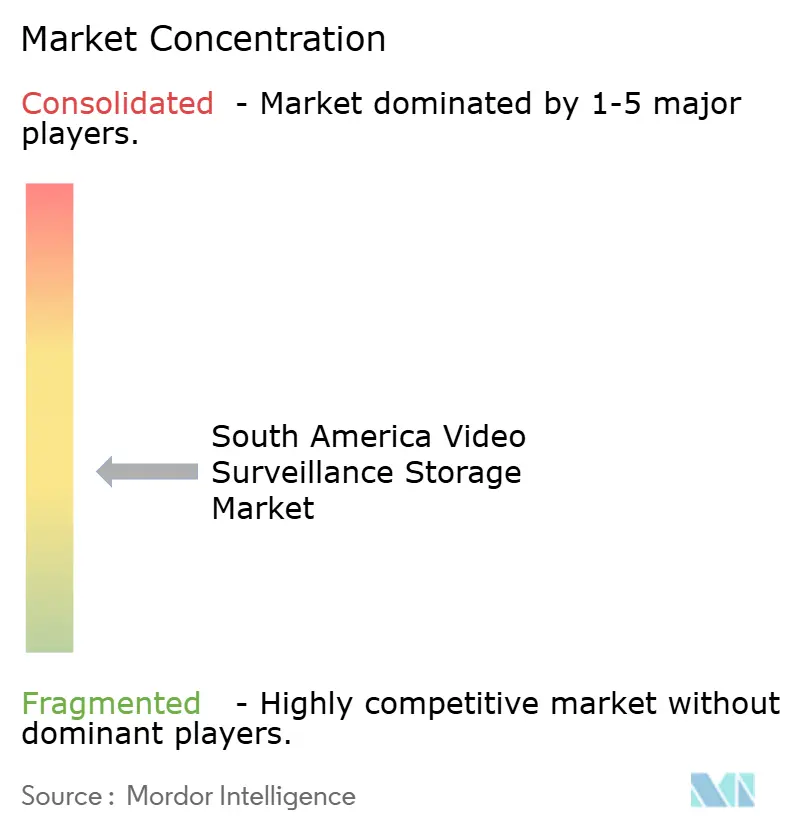
The South America video surveillance storage market has a moderately fragmented structure across storage media, appliances, software, and integration services. Seagate and WD compete in the storage media layer, while Synology and QNAP serve smaller and mid-sized enterprise systems. Genetec and Milestone Systems influence architecture decisions through video management software rather than direct control of hardware revenue. This division means buyers often assemble solutions from multiple vendors. Local service capacity and compatibility with existing camera systems are important selection factors.
Hikvision and Dahua Technology compete through integrated NVR and camera systems and local operating capabilities. Intelbras uses regional distribution and price-focused products that fit municipal and secondary-city budgets. Hanwha Vision opened its Innovation and Technology Experience center in São Paulo in August 2026. The facility demonstrated the company's AI camera and video management portfolio to enterprise and government buyers. These investments show that suppliers are competing through solution support and local engagement, not only through product specifications.
Seagate's Mozaic 4+ platform, with capacities up to 44 TB, supports storage providers seeking lower cost per terabyte for large archives. HCI platforms, SME edge subscriptions, and AI-indexed archive services remain areas where market leadership is not yet concentrated. Genetec convened more than 150 executives from 40 channel partners at its Elevate'26 event in São Paulo during May 2026. Partner networks help software companies influence customer architecture choices across a fragmented supplier base. The South America video surveillance storage market is likely to remain competitive because different suppliers control different parts of the solution.
South America Video Surveillance Storage Industry Leaders
-
Hangzhou Hikvision Digital Technology Co., Ltd.
-
Dahua Technology Co., Ltd.
-
Western Digital Corporation
-
Seagate Technology Holdings plc
-
Axis Communications AB
- *Disclaimer: Major Players sorted in no particular order
South America Video Surveillance Storage Market Companies Covered in this Report
- Western Digital Corporation
- Seagate Technology Holdings plc
- Toshiba Electronic Devices and Storage Corporation
- Hangzhou Hikvision Digital Technology Co., Ltd.
- Dahua Technology Co., Ltd.
- Axis Communications AB
- Hanwha Vision Co., Ltd.
- Synology Inc.
- QNAP Systems, Inc.
- VIVOTEK Inc.
- MOBOTIX AG
- i-PRO Co., Ltd.
- Milestone Systems A/S
- Genetec Inc.
- Verkada Inc.
- Avigilon Corporation
- Arecont Vision Costar, LLC
- March Networks Corporation
- GeoVision Inc.
- Uniview Technologies Co., Ltd.
- Tiandy Technologies Co., Ltd.
- Intelbras S.A. Indústria de Telecomunicação Eletrônica Brasileira
- Infinova International, Inc.
- Pelco, Inc.
Recent Industry Developments in South America Video Surveillance Storage Market
- August 2026: Hanwha Vision inaugurated the Hanwha Innovation and Technology Experience center in São Paulo, demonstrating its AI camera and VMS portfolio to enterprise and government buyers across Brazil and South America, marking a significant market-development investment that extends the company's competitive presence beyond product distribution.
- August 2026: Alibaba Cloud launched its first South America cloud region with 2 data centers in São Paulo, providing enterprises, governments, and VSaaS providers direct access to cloud storage infrastructure with local data-residency compliance for mission-critical surveillance workloads.
- August 2026: Dahua Technology and Grupo NSO deployed AI-enabled onboard video monitoring across São Paulo's public transit fleet, integrating on-vehicle edge storage with central command infrastructure and establishing a reference architecture for mass-transit surveillance storage at scale in South America.
- May 2026: Seguritech signed a contract with the city of Medellín, Colombia, to construct and operate Colombia's first C5i command center, integrating thousands of cameras, ANPR readers, and IoT sensors under a centralized AI-driven dispatch platform, generating sustained demand for large-scale video management and storage infrastructure.
South America Video Surveillance Storage Market Report Scope
The South America Video Surveillance Storage Market refers to the industry focused on the deployment and management of storage solutions used to retain, process, and retrieve video data generated by surveillance systems across countries such as Brazil, Argentina, Chile, Colombia, and Peru.
The South America Video Surveillance Storage Market Report is Segmented by Storage System (Network Attached Storage, Storage Area Network, Direct Attached Storage, Network Video Recorders, Digital Video Recorders, Hyperconverged Infrastructure-Based Surveillance Storage, and Other Storage Systems), Offering (Hardware, Software and Solutions, Managed Services, and Professional Services), Deployment Mode (On-Premises, Cloud and Video Surveillance as a Service, Edge and On-Device Storage, and Hybrid Storage), Storage Media (Hard Disk Drives, Solid-State Drives, and Hybrid Media Architectures), Storage Capacity (Up to 1 Terabyte, Above 1 Terabyte to 2 Terabytes, Above 2 Terabytes to 4 Terabytes, and Above 4 Terabytes), Organization Size (Small and Medium-Sized Enterprises and Large Enterprises), End-User Vertical (Government and Public Safety, Banking, Financial Services, and Insurance, Retail and Consumer Goods, Transportation and Logistics, Manufacturing and Industrial, Healthcare and Life Sciences, Energy and Utilities, Education, Residential and Multi-Unit Housing, Mining and Remote Sites, and Media and Entertainment), Application (Public Safety and Law Enforcement, Traffic Monitoring and Automatic Number-Plate Recognition, Retail Loss Prevention, Perimeter and Intrusion Protection, Industrial Safety and Process Monitoring, Remote-Site and Mining Surveillance, and Residential Monitoring), and Geography (Brazil, Argentina, Colombia, and Rest of South America). The Market Forecasts are Provided in Terms of Value (USD).
Segmentation Overview
| Network Attached Storage |
| Storage Area Network |
| Direct Attached Storage |
| Network Video Recorders |
| Digital Video Recorders |
| Hyperconverged Infrastructure-Based Surveillance Storage |
| Other Storage Systems |
| Hardware |
| Software and Solutions |
| Managed Services |
| Professional Services |
| On-Premises |
| Cloud and Video Surveillance as a Service |
| Edge and On-Device Storage |
| Hybrid Storage |
| Hard Disk Drives |
| Solid-State Drives |
| Hybrid Media Architectures |
| Up to 1 Terabyte |
| Above 1 Terabyte to 2 Terabytes |
| Above 2 Terabytes to 4 Terabytes |
| Above 4 Terabytes |
| Small and Medium-Sized Enterprises |
| Large Enterprises |
| Government and Public Safety |
| Banking, Financial Services, and Insurance |
| Retail and Consumer Goods |
| Transportation and Logistics |
| Manufacturing and Industrial |
| Healthcare and Life Sciences |
| Energy and Utilities |
| Education |
| Residential and Multi-Unit Housing |
| Mining and Remote Sites |
| Media and Entertainment |
| Public Safety and Law Enforcement |
| Traffic Monitoring and Automatic Number-Plate Recognition |
| Retail Loss Prevention |
| Perimeter and Intrusion Protection |
| Industrial Safety and Process Monitoring |
| Remote-Site and Mining Surveillance |
| Residential Monitoring |
| Brazil |
| Argentina |
| Colombia |
| Rest of South America |
| By Storage System | Network Attached Storage |
| Storage Area Network | |
| Direct Attached Storage | |
| Network Video Recorders | |
| Digital Video Recorders | |
| Hyperconverged Infrastructure-Based Surveillance Storage | |
| Other Storage Systems | |
| By Offering | Hardware |
| Software and Solutions | |
| Managed Services | |
| Professional Services | |
| By Deployment Mode | On-Premises |
| Cloud and Video Surveillance as a Service | |
| Edge and On-Device Storage | |
| Hybrid Storage | |
| By Storage Media | Hard Disk Drives |
| Solid-State Drives | |
| Hybrid Media Architectures | |
| By Storage Capacity | Up to 1 Terabyte |
| Above 1 Terabyte to 2 Terabytes | |
| Above 2 Terabytes to 4 Terabytes | |
| Above 4 Terabytes | |
| By Organization Size | Small and Medium-Sized Enterprises |
| Large Enterprises | |
| By End-User Vertical | Government and Public Safety |
| Banking, Financial Services, and Insurance | |
| Retail and Consumer Goods | |
| Transportation and Logistics | |
| Manufacturing and Industrial | |
| Healthcare and Life Sciences | |
| Energy and Utilities | |
| Education | |
| Residential and Multi-Unit Housing | |
| Mining and Remote Sites | |
| Media and Entertainment | |
| By Application | Public Safety and Law Enforcement |
| Traffic Monitoring and Automatic Number-Plate Recognition | |
| Retail Loss Prevention | |
| Perimeter and Intrusion Protection | |
| Industrial Safety and Process Monitoring | |
| Remote-Site and Mining Surveillance | |
| Residential Monitoring | |
| By Geography | Brazil |
| Argentina | |
| Colombia | |
| Rest of South America |
Key Questions Answered in the Report
What is the South America video surveillance storage market size?
The South America video surveillance storage market size was USD 224.74 million in 2026 and is forecast to reach USD 373.15 million by 2031 at a 10.67% CAGR. The forecast reflects demand from public programs, enterprise retention requirements, and more data-intensive camera systems.
What is driving demand for video surveillance storage in South America?
Public safety networks, IP camera upgrades, higher resolution video, AI metadata, and hybrid storage adoption are increasing retention needs. City command centers and distributed enterprise locations need capacity that supports recording, retrieval, and continuing system expansion.
Which storage system is most widely used for video surveillance?
NVRs held 27.52% of the storage system segment in 2025 because they integrate readily with IP camera networks. They remain especially relevant to commercial and government users that need locally managed recording systems.
Why are hard disk drives important for surveillance recording?
HDDs held 54.23% of storage media revenue in 2025 because they provide large capacity for continuous video recording at lower cost. They are commonly paired with SSD cache where investigators need faster access to recent or flagged footage.
Which end-user vertical is expanding fastest?
Transportation and logistics is projected to expand at an 11.56% CAGR through 2031 as transit systems add onboard and centralized video monitoring. This deployment model links vehicle-level recording with control rooms that coordinate security and operational responses.
Which country leads regional revenue?
Brazil held 43.72% of regional revenue in 2025, supported by large municipal and public safety camera programs. Its expanding local cloud infrastructure also supports hybrid video services for enterprises and public agencies.