
South America Unitary Heater Market Size and Share
Market Overview
| Study Period | 2020 - 2031 |
|---|---|
| Forecast Data Period | 2026 - 2031 |
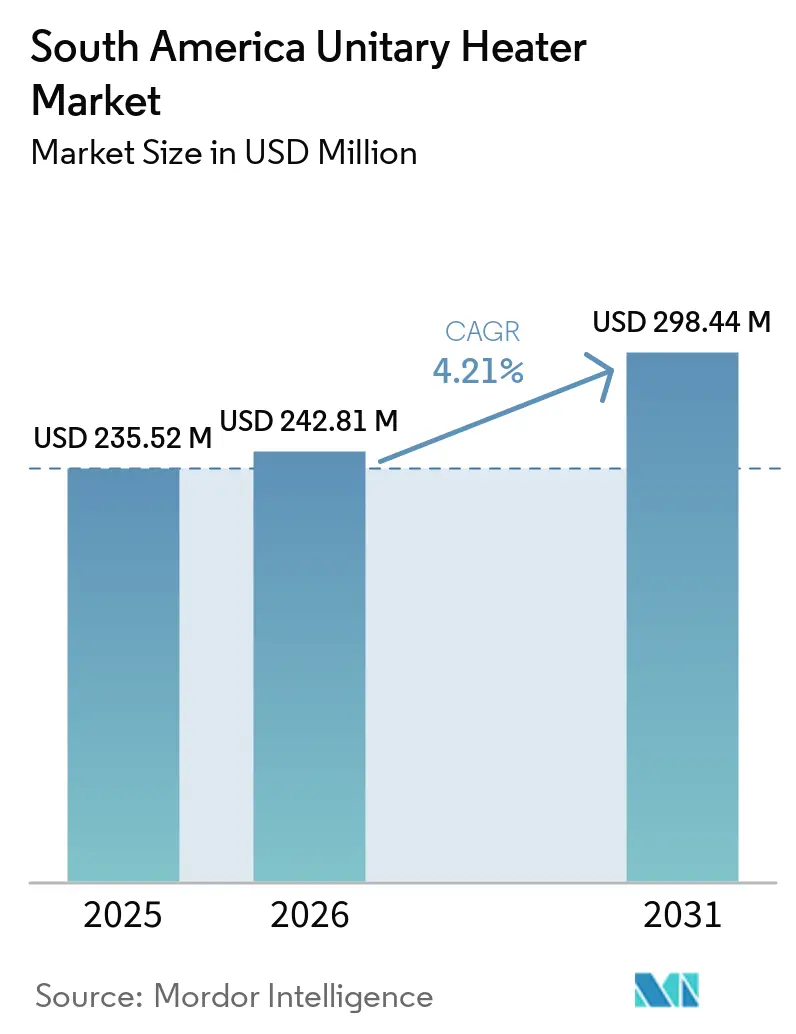
| Base Year Market Size (2025) | USD 235.52 Million |
| Market Size (2026) | USD 242.81 Million |
| Market Size (2031) | USD 298.44 Million |
| Growth Rate (2026 - 2031) | 4.21 % |
| Market Concentration | Low |
Major Players *Disclaimer: Major Players sorted in no particular order Image © Mordor Intelligence. Reuse requires attribution under CC BY 4.0. | |
South America Unitary Heater Market Analysis by Mordor Intelligence
The South America Unitary Heater Market size was valued at USD 235.52 million in 2025 and is estimated to grow from USD 242.81 million in 2026 to reach USD 298.44 million by 2031, at a CAGR of 4.21% during the forecast period (2026-2031). Industrial construction, cold-chain expansion, and energy-efficiency requirements support equipment demand across the region, with manufacturing and mining sites favoring robust systems for enclosed work areas, logistics operators focusing on docks and transition zones, and commercial projects placing more weight on documented efficiency and alignment with building standards, so manufacturers and distributors need portfolios that address country-level infrastructure, climate, and building-use differences. Operators are placing greater weight on operating costs when selecting heating systems, which favors efficient gas-fired, electric, and digitally controlled equipment. Procurement also reflects local fuel access, because many interior locations lack pipeline gas connections, and buyers must assess electric capacity, liquefied petroleum gas delivery, existing boiler infrastructure, conventional gas piping, installation timing, maintenance needs, and supplier support in relation to the site, whether it is a mature industrial location, a remote mining operation, or a new logistics facility. Global manufacturers use distributors and installers to reach projects requiring site-specific design and commissioning, with local partners interpreting building layouts, coordinating access to installation areas, assessing available services, supporting replacements in occupied facilities, and providing the technical support industrial and logistics projects require. The South America unitary heater market, therefore, combines replacement demand in established industrial sites with new installations in logistics, food processing, and commercial buildings, creating demand across distinct facility types, operating conditions, and procurement approaches throughout the forecast period from 2026 to 2031.
Key Report Takeaways
- By product type, gas-fired unit heaters held 44.63% of the South America Unitary Heater Market share in 2025, while electric unit heaters are forecast to grow at a 4.87% CAGR through 2031.
- By installation type, horizontal units held 42.52% share in 2025, while suspended units are forecast to grow at a 4.53% CAGR through 2031.
- By application, industrial facilities held a 46.71% share of the South America Unitary Heater Market in 2025, while commercial buildings are forecast to grow at a 4.83% CAGR through 2031.
- By end-user industry, manufacturing held 29.76% share in 2025, while warehousing and logistics are forecast to grow at a 4.58% CAGR through 2031.
- By distribution channel, HVAC distributors and representatives held 52.53% share in 2025, while online retail is forecast to grow at a 4.62% CAGR through 2031.
- By geography, Brazil accounted for 30.53% of the South America Unitary Heater Market in 2025, while Colombia is forecast to grow at a 5.62% CAGR through 2031.
Note: Market size and forecast figures in this report are generated using Mordor Intelligence’s proprietary estimation framework, updated with the latest available data and insights as of January 2026.
South America Unitary Heater Market Trends and Insights
Drivers Impact Analysis*
| Driver | (~) % Impact on CAGR Forecast | Geographic Relevance | Impact Timeline |
|---|---|---|---|
| Industrial and Commercial Construction Expansion | +1.1% | Brazil, Colombia, Chile, Argentina | Short term (≤ 2 years) |
| Growth of Warehousing, Cold Storage, and Food Processing | +0.9% | Brazil, Chile, Colombia | Short term (≤ 2 years) |
| Energy-Efficiency Requirements and Operating-Cost Reduction | +0.7% | Brazil, Argentina, Chile | Medium term (2-4 years) |
| Electrification of Space Heating | +0.6% | Brazil, Chile | Medium term (2-4 years) |
| Retrofit Demand for Aging Heating Systems | +0.4% | Brazil, Argentina | Medium term (2-4 years) |
| Digital Controls and Multi-Unit System Connectivity | +0.2% | Brazil, Colombia | Long term (≥ 4 years) |
| Source: Mordor Intelligence | |||
Industrial and Commercial Construction Expansion
Industrial relocation has concentrated manufacturing and logistics investment in São Paulo’s secondary cities and Colombia’s Atlantic coast free-trade zones. These facilities need engineered heating systems to support workplace conditions and stable processes. Chilean mining construction also supports demand for durable equipment in underground and high-altitude sites. Gas-fired and infrared products can be used in these settings when their fuel and ventilation requirements are met. New facilities serving lithium processing, copper smelting, and agro-exports require multi-zone controls and corrosion-resistant housings. This activity raises the value of heating systems specified at the design stage in the South America unitary heater market, because the equipment must work alongside ventilation, process layouts, safety requirements, and the construction schedule.
Growth of Warehousing, Cold Storage, and Food Processing
Cold storage investment creates recurring demand for heating in loading docks and anterooms beside refrigerated chambers. Emergent Cold expanded its Olivo site in Santiago in March 2026 to 33,000 pallet positions, describing it as the largest automated food cold storage facility in South America.[1]Emergent Cold, “Emergent Cold Inaugurates the Largest Automated Food Cold Storage Facility in South America,” Emergent Cold, emergentcoldlatam.com. The development illustrates the larger facilities being built for food distribution. Maersk opened a 17,500 m² integrated packing and cold-storage hub in Olmos, Peru, in July 2025 for fruit exports. Such sites require temperature control in staging zones without disrupting vehicle movement. The South America unitary heater market benefits because heating systems are usually included in the design of these enclosed work areas, where workers, loading activity, and temperature-sensitive operations meet.[2]A.P. Møller–Maersk, “Maersk Launches Integrated Packing and Cold Storage Hub to Boost Peru’s Fruit Exports,” A.P. Møller–Maersk, maersk.com.
Energy-Efficiency Requirements and Operating-Cost Reduction
Brazil published CGIEE Resolution No. 4 on September 26, 2025, establishing minimum energy-efficiency indices for new buildings nationwide. Federal public buildings must reach PBE Edifica level A from 2027 under the resolution. Commercial structures in municipalities with more than 100,000 residents must meet at least level C from 2028. The requirements raise the importance of documented equipment performance in building specifications. Facility managers also use multiyear operating-cost projections when assessing replacement projects. These factors support efficient products and strengthen the role of certified performance data in the South America unitary heater market, especially where developers need to show that a new building meets applicable efficiency requirements.[3]Ministry of Mines and Energy, “Resolução CGIEE Nº 4, de 26 de Setembro de 2025,” Ministry of Mines and Energy, gov.br.
Electrification of Space Heating
Electric heaters offer a practical option where pipeline gas is unavailable. Their installation can be simpler in warehouses, workshops, and distribution centers with sufficient electrical capacity. Reznor presented the EUHC Compact Electric Unit Heater at AHR Expo 2026 with multiple mounting options and standard 24-volt controls. The launch shows that manufacturers continue to develop electric product lines. Schwank also documented a hybrid arrangement that combines heat pumps for base demand with electric radiant heaters for peak demand. This product direction broadens choices for buyers in the South America unitary heater market who need to manage fuel access and on-site emissions while retaining the ability to heat targeted work areas.
Restraints Impact Analysis*
| Restraint | (~) % Impact on CAGR Forecast | Geographic Relevance | Impact Timeline |
|---|---|---|---|
| High Upfront Cost of High-Efficiency Equipment | -1.0% | Argentina, Venezuela, Colombia interior | Short term (≤ 2 years) |
| Uneven Natural Gas and Electricity Infrastructure | -0.8% | Colombia interior, Venezuela, Rest of South America | Medium term (2-4 years) |
| Currency Volatility and Imported Component Costs | -0.6% | Argentina, Venezuela | Short term (≤ 2 years) |
| Limited Heating Demand in Tropical and Warm-Climate Areas | -0.5% | Northern Brazil, Venezuela, Ecuador, northern Colombia | Long term (≥ 4 years) |
| Source: Mordor Intelligence | |||
High Upfront Cost of High-Efficiency Equipment
High-efficiency heaters with condensing burners, modulating controls, or building-management integration cost more than conventional products. That cost is a barrier for small and medium-sized industrial operators with limited access to equipment finance. The issue is particularly important where local-currency borrowing costs are high and imported equipment is priced in USD. Larger multinational operators and public projects can more readily specify premium systems. Many other buyers continue to choose basic gas-fired equipment because the upfront cost is lower. This creates a split in the South America unitary heater market between projects that prioritize lifecycle performance and those that prioritize initial cost. The difference is most visible when an operator must decide whether energy savings and controls justify a higher purchase price.
Uneven Natural Gas and Electricity Infrastructure
Pipeline gas access and electricity quality vary widely across South America. Some interior Colombian locations lack pipeline gas and must use liquefied petroleum gas or electric equipment. Remote areas in Chile can face similar connection constraints. Venezuela’s gas infrastructure also limits the practical use of some fuel-dependent products. These gaps make product selection dependent on local infrastructure rather than heating need alone. The South America unitary heater market must therefore accommodate electric, gas-fired, hydronic, and portable alternatives for different site conditions.
*Our forecasts treat driver/restraint impacts as directional, not additive. The impact forecasts reflect baseline growth, mix effects, and variable interactions.
Segment Analysis
By Product Type: Gas-Fired Equipment Leads as Electric Heaters Gain Ground
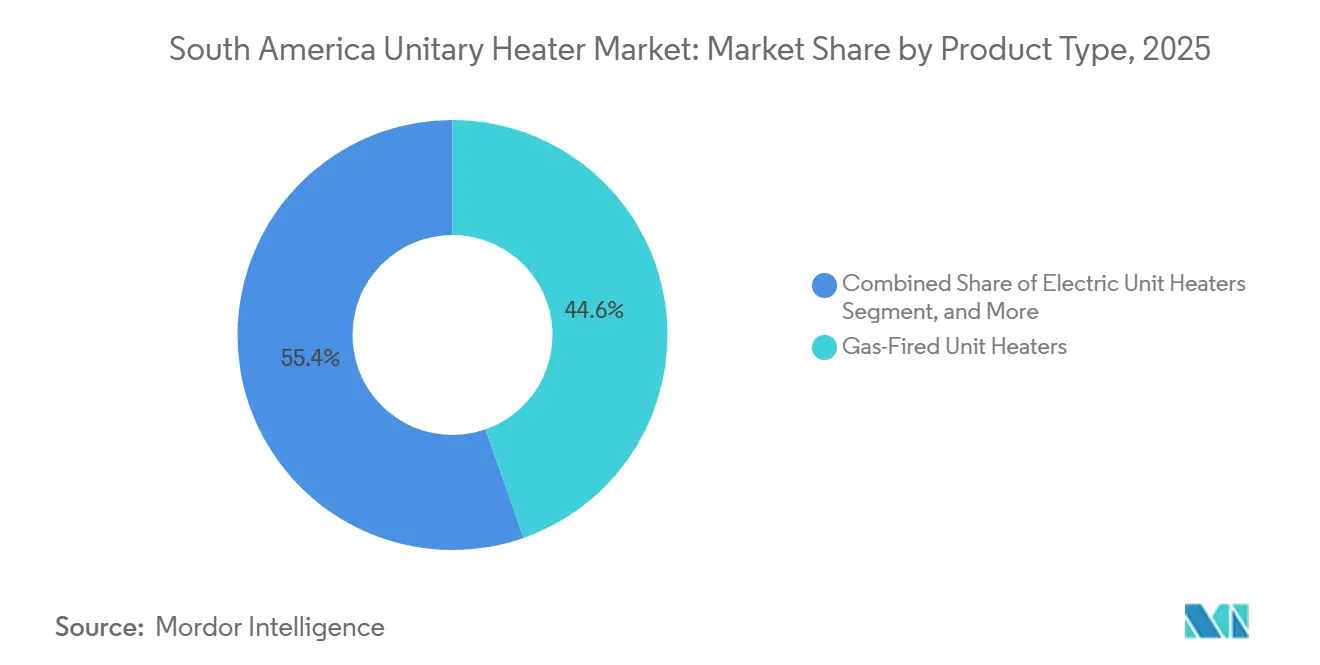
Gas-fired unit heaters held 44.63% of product-type revenue in 2025. Their position reflects the installed base in manufacturing plants and cold-storage anterooms where natural gas or propane connections are available. The systems remain familiar to contractors and maintenance teams in Brazil and Argentina. Hydronic unit heaters serve institutional facilities and older commercial buildings with central boiler systems. Infrared and radiant products support high-ceiling industrial sites and agricultural greenhouse applications. Electric unit heaters are forecast to grow at a 4.87% CAGR from 2026 to 2031. Their growth reflects rising attention to fuel availability, operating costs, and installation simplicity. Facilities without pipeline access support the South America unitary heater market size for electric equipment.
Manufacturers are expanding non-gas options as customer requirements change. Modine stated in its 2026 market commentary that heat-pump-based and electric solutions were becoming standard development items in its product roadmap. Reznor introduced the EUHC Compact Electric Unit Heater and the UWS Hydronic Unit Heater at AHR Expo 2026.[4]Reznor LLC, “Reznor Showcases New Innovations at AHR 2026,” Reznor HVAC, reznorhvac.com. Those products address facilities that need alternatives to conventional gas-fired equipment. Electric products are suitable for sites that do not want liquefied petroleum gas supply arrangements. Hydronic equipment can also pair with efficient boilers or heat-pump systems. Product competition in the South America unitary heater market is increasingly based on fuel flexibility, controls, and installation requirements. Gas-fired equipment nevertheless remains relevant where supply infrastructure and existing designs favor it.



By Installation Type: Suspended Units Advance in High-Bay Logistics Spaces
Horizontal unit heaters held 42.52% of installation-type revenue in 2025. Their lead reflects versatility across standard ceiling heights and compatibility with gas-fired and electric configurations. Manufacturing sites and commercial buildings use them because they can be adapted to a variety of layouts. Vertical systems serve constrained mechanical rooms and other spaces with limited horizontal clearance. Wall-mounted and portable models are used in workshops and agricultural sheds where permanent installations are less practical. Suspended unit heaters are forecast to grow at a 4.53% CAGR from 2026 to 2031. They support high-bay logistics and cold-storage areas that need heating without blocking forklifts or staging activity. This placement approach is important to the South America unitary heater market as warehouse construction expands.
Suspended equipment is well-suited to loading docks and enclosed processing areas. Overhead placement can preserve usable floor area in facilities with frequent vehicle movement. It can also support cleaning practices in food-processing environments where floor-level equipment may create operational constraints. Emergent Cold reported 110 food warehouses across 11 countries and 6 active expansion projects in South America in 2026. Its network points to continued demand for heating layouts that can be replicated across warehouses. Reznor designed its UWS Hydronic Unit Heater for use with high-efficiency boilers or hot-water heat pump systems. The South America unitary heater market will continue to use horizontal systems broadly, while suspended systems gain where warehouse geometry favors ceiling installation.
By Application: Industrial Facilities Anchor Demand, Commercial Buildings Accelerate
Industrial facilities held 46.71% of application revenue in 2025. Manufacturing plants, mining and processing sites, food and beverage factories, and agricultural infrastructure support this position. Brazil’s southern states have meaningful industrial heating demand because winter conditions increase the need for enclosed workplace heating. Gas-fired systems are common where fuel connections are available. Residential buildings, garages, and workshops form a smaller application base because many areas have warm climates. Commercial buildings are forecast to grow at a 4.83% CAGR from 2026 to 2031. The South America unitary heater market share for industrial facilities, therefore, remains significant even as commercial activity gains momentum.
Distribution centers, food-service buildings, hospitals, and universities contribute to commercial demand. Brazil’s building-efficiency rules create an added reason to specify equipment with clear performance documentation. New commercial projects in larger municipalities will be subject to the level C requirement from 2028. Commercial buyers also value systems that can integrate with building controls. Industrial sites tend to focus on durability, fuel availability, and process requirements. The two application groups often use different procurement routes and product configurations. The South America unitary heater market can be served through distributors that support design, installation, and commissioning. Demand will remain linked to construction timing and building-use requirements.
By End-User Industry: Manufacturing Anchors Volume, Logistics Builds Momentum
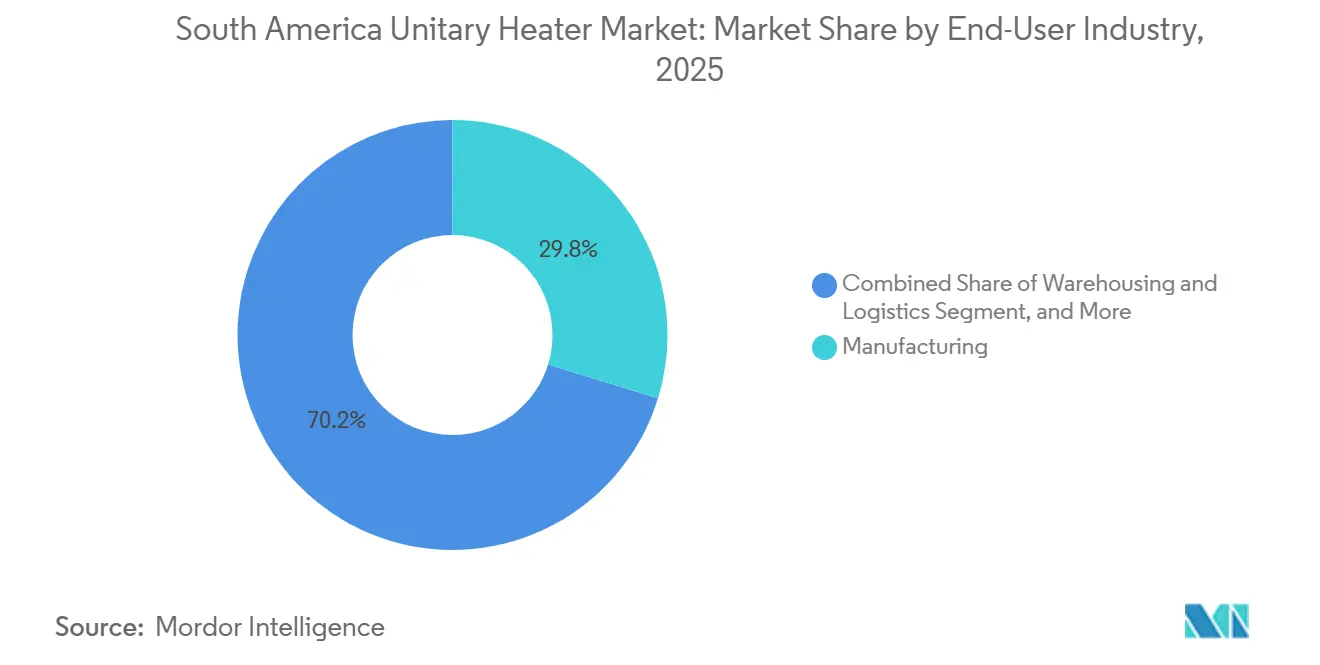
Manufacturing held 29.76% of end-user revenue in 2025. Automotive and food-processing clusters in Brazil, petrochemical complexes in Argentina, and copper-processing sites in Chile maintain a large installed base of gas-fired and hydronic heaters. These facilities support replacement demand when equipment reaches the end of its operating life. They also require retrofits when operators improve controls or energy performance. Food processing, cold storage, agriculture, oil and gas, and mining are smaller end-user groups with specialized needs. Hazardous locations can require explosion-proof configurations. Warehousing and logistics are forecast to grow at a 4.58% CAGR from 2026 to 2031. This makes logistics the strongest growth area within the South America unitary heater market.
Logistics developers often specify heating systems at the building design stage. That approach can result in bulk procurement rather than isolated replacement orders. Cold-chain facilities are particularly relevant because docks and anterooms need conditions that protect both workers and operations. Maersk’s 2025 Olmos facility serves avocado, blueberry, and mango export supply chains from a 17,500 m² site. Institutional and public facilities provide another stable source of demand through tender cycles. Their purchases can place greater weight on operating performance and compliance than small private projects do. The South America unitary heater market benefits from this mix of replacement-led manufacturing demand and new logistics construction. End-user requirements will continue to shape the choice of controls, mounting, fuel, and safety features.
By Distribution Channel: Specialists Command Sales as Digital Channels Gain Share
HVAC distributors and representatives held 52.53% of distribution-channel revenue in 2025. Their position reflects the technical nature of unit-heater selection and the need for site surveys, load calculations, installation coordination, and commissioning. Contractors and end users use distributors when projects require product configuration or local service. Direct sales serve large industrial accounts and institutional buyers that purchase high volumes or need customized systems. Big-box and specialty retail channels mainly serve small commercial, residential, and light-industrial buyers. Online retail is forecast to grow at a 4.62% CAGR from 2026 to 2031. This channel broadens access to standard electric and compact gas models in the South America unitary heater market.
Digital purchasing is more practical for standardized equipment than for large engineered systems. Small contractors can compare product availability and specifications without relying entirely on local inventory. Online platforms can also support buyers in regions with limited distributor coverage. However, complex projects continue to require on-site engineering and post-installation support. Glen Dimplex Americas announced capital investments in production lines and manufacturing equipment at its London, Ontario, facility in June 2026. The company said the investment would support new heating product launches for North American and export markets. The South America unitary heater market will therefore retain a strong specialist distribution base, while digital channels serve a wider set of standardized purchases.
Geography Analysis
Brazil accounted for 30.53% of regional revenue in 2025, giving it the largest share in the South America unitary heater market. Manufacturing, food processing, and cold storage are concentrated in the southern states, where seasonal conditions support investment in heating. São Paulo’s logistics network also creates demand for systems in distribution facilities. Federal facilities must meet PBE Edifica level A from 2027, and qualifying commercial buildings must meet level C from 2028. Peru remains relevant to cold-chain development following Maersk's opening of its Olmos packing and storage hub in 2025.
Argentina and Chile provide important demand in industrial and mining settings. Argentina’s manufacturing and petrochemical sites sustain replacement demand for gas-fired and hydronic systems, although financing conditions can favor lower-cost equipment. Chile supports demand from mining and downstream processing, where equipment must operate under demanding site conditions. Chile’s thermal rules are scheduled to take effect on November 28, 2026, and will require new building permits to meet higher thermal-transmittance standards.
Colombia is forecast to grow at a 5.62% CAGR from 2026 to 2031, the fastest geographic rate in the South America unitary heater market. Growth is associated with logistics construction around Bogotá and cold-storage investment on the Atlantic coast. Emergent Cold reported 7 warehouses in Colombia with a combined storage capacity of 507,000 m³ in 2025. Infrastructure remains important because some interior areas lack pipeline gas. Electric and liquefied petroleum gas equipment therefore have a role where gas connections are unavailable.
Competitive Landscape
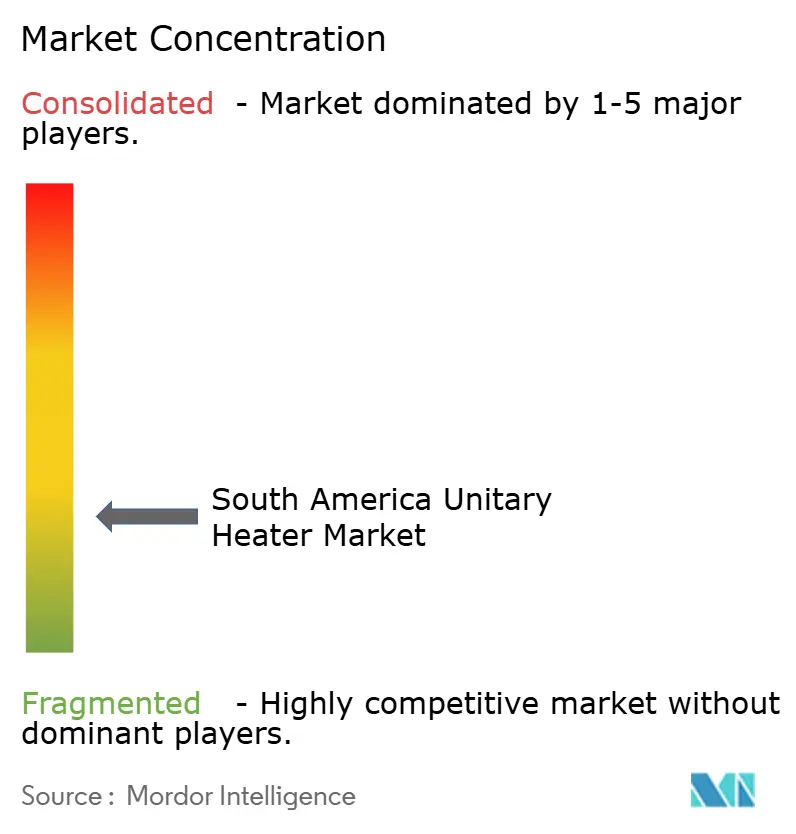
The South America unitary heater market is fragmented at the manufacturing level and fragmented in project execution. Modine Manufacturing Company, Reznor LLC, and Schwank GmbH supply mid-range and premium equipment through regional distributors and HVAC representatives. Local contractors and installers remain important because they adapt equipment to specific site conditions. Competition is based on efficiency, fuel options, controls, service support, and compliance documentation. The supplied evidence does not provide a verified combined share for leading suppliers, so a concentration score cannot be assigned.
Schwank has added hydrogen-compatible industrial heaters to its 2026 product portfolio. The company also presented a hybrid configuration that pairs heat pumps with electric radiant heaters for peak demand. Reznor showcased electric, hydronic, and dock-heating products at AHR Expo 2026. Glen Dimplex Americas announced an investment in new production lines and manufacturing equipment during June 2026.
Connected controls are an additional competitive area for logistics operators with multiple sites. Hazardous-location products offer a specialized opportunity because standard commercial heaters cannot meet every industrial requirement. Distributors can strengthen their position through load calculations, design support, and commissioning services. Online sellers compete most directly for standardized units, rather than complex engineered systems. The South America unitary heater market combines global product development with local installation capability.
South America Unitary Heater Industry Leaders
Modine Manufacturing Company
Trane Technologies plc
Daikin Industries, Ltd.
Lennox International, Inc.
Armstrong International, Inc.
- *Disclaimer: Major Players sorted in no particular order

Recent Industry Developments
- June 2026: Glen Dimplex Americas announced capital investments in its London, Ontario production facility, including new production lines and advanced manufacturing equipment intended to enable new heating product launches for North American and export markets.
- March 2026: Emergent Cold expanded its Olivo facility in Santiago to 33,000 pallet positions. The company described the site as South America’s largest automated food cold-storage facility, and the project formed part of its USD 500 million Chile expansion plan.
- February 2026: Reznor LLC showcased the EUHC Compact Electric Unit Heater, the UWS Hydronic Unit Heater, and the DTH Docked Trailer Heater at AHR Expo 2026.
- September 2025: Brazil’s Ministry of Mines and Energy published CGIEE Resolution No. 4, establishing minimum energy-efficiency indices for new buildings nationwide.


South America Unitary Heater Market Report Scope
The South America Unitary Heater Market comprises self-contained, individual heating devices designed to provide localized space heating across various environments. These units, powered by gas, electricity, hot water (hydronic), or infrared technology, are installed horizontally, vertically, or suspended in commercial, industrial, and residential spaces. Distributed through direct sales and specialized HVAC channels, they are widely used across manufacturing, warehousing, agriculture, and institutional facilities in the region to maintain targeted temperatures, prevent freezing, and ensure occupant comfort.
The South America Unitary Heater Market Report is Segmented by Product Type (Gas-Fired Unit Heaters, Electric Unit Heaters, Hydronic Unit Heaters, and Infrared or Radiant Heaters), Installation Type (Horizontal Unit Heaters, Vertical Unit Heaters, Suspended Unit Heaters, and Wall-Mounted and Portable Units), Application (Commercial Buildings, Industrial Facilities, and Residential Buildings, Garages, and Workshops), End-User Industry (Manufacturing, Warehousing and Logistics, Food Processing and Cold Storage, Agriculture and Greenhouses, Oil and Gas, Petrochemicals, and Mining, and Institutional and Public Facilities), Distribution Channel (Direct Sales, HVAC Distributors and Representatives, Online Retail, and Big-Box Retail and Specialty Retail), and Geography (Brazil, Argentina, Colombia, Chile, and Rest of South America). The Market Forecasts are Provided in Terms of Value (USD).
| Gas-Fired Unit Heaters |
| Electric Unit Heaters |
| Hydronic Unit Heaters |
| Infrared or Radiant Heaters |
| Horizontal Unit Heaters |
| Vertical Unit Heaters |
| Suspended Unit Heaters |
| Wall-Mounted and Portable Units |
| Commercial Buildings |
| Industrial Facilities |
| Residential Buildings, Garages, and Workshops |
| Manufacturing |
| Warehousing and Logistics |
| Food Processing and Cold Storage |
| Agriculture and Greenhouses |
| Oil and Gas, Petrochemicals, and Mining |
| Institutional and Public Facilities |
| Direct Sales |
| HVAC Distributors and Representatives |
| Online Retail |
| Big-Box Retail and Specialty Retail |
| Brazil |
| Argentina |
| Colombia |
| Chile |
| Rest of South America |
| By Product Type | Gas-Fired Unit Heaters |
| Electric Unit Heaters | |
| Hydronic Unit Heaters | |
| Infrared or Radiant Heaters | |
| By Installation Type | Horizontal Unit Heaters |
| Vertical Unit Heaters | |
| Suspended Unit Heaters | |
| Wall-Mounted and Portable Units | |
| By Application | Commercial Buildings |
| Industrial Facilities | |
| Residential Buildings, Garages, and Workshops | |
| By End-User Industry | Manufacturing |
| Warehousing and Logistics | |
| Food Processing and Cold Storage | |
| Agriculture and Greenhouses | |
| Oil and Gas, Petrochemicals, and Mining | |
| Institutional and Public Facilities | |
| By Distribution Channel | Direct Sales |
| HVAC Distributors and Representatives | |
| Online Retail | |
| Big-Box Retail and Specialty Retail | |
| By Geography | Brazil |
| Argentina | |
| Colombia | |
| Chile | |
| Rest of South America |


Key Questions Answered in the Report
What is the size of the South America unitary heater market?
The South America unitary heater market was valued at USD 235.52 million in 2025 and is estimated at USD 242.81 million in 2026. It is forecast to reach USD 298.44 million by 2031.
What is driving demand for unitary heaters in South America?
Industrial construction, cold-chain facilities, food processing, and building-efficiency requirements are supporting demand for heating equipment.
Which product type leads unitary-heater demand in South America?
Gas-fired unit heaters held 44.63% of product-type revenue in 2025. Electric unit heaters are forecast to grow at a 4.87% CAGR through 2031.
Which application is growing fastest for unitary heaters in South America?
Commercial buildings are forecast to grow at a 4.83% CAGR from 2026 to 2031, supported by distribution centers and institutional facilities.
Which country is growing fastest for unitary-heater installations?
Colombia is forecast to grow at a 5.62% CAGR through 2031, supported by logistics construction and cold-storage investment.
How are unitary heaters sold in South America?
HVAC distributors and representatives led distribution with 52.53% share in 2025. Online retail is forecast to grow at a 4.62% CAGR through 2031.
Page last updated on:





