
Market Overview
| Study Period | 2020 - 2031 |
|---|---|
| Forecast Data Period | 2026 - 2031 |
| Base Year Market Size (2025) | USD 6.42 Billion |
| Market Size (2026) | USD 7.14 Billion |
| Market Size (2031) | USD 10.57 Billion |
| Growth Rate (2026 - 2031) | 8.16 % |
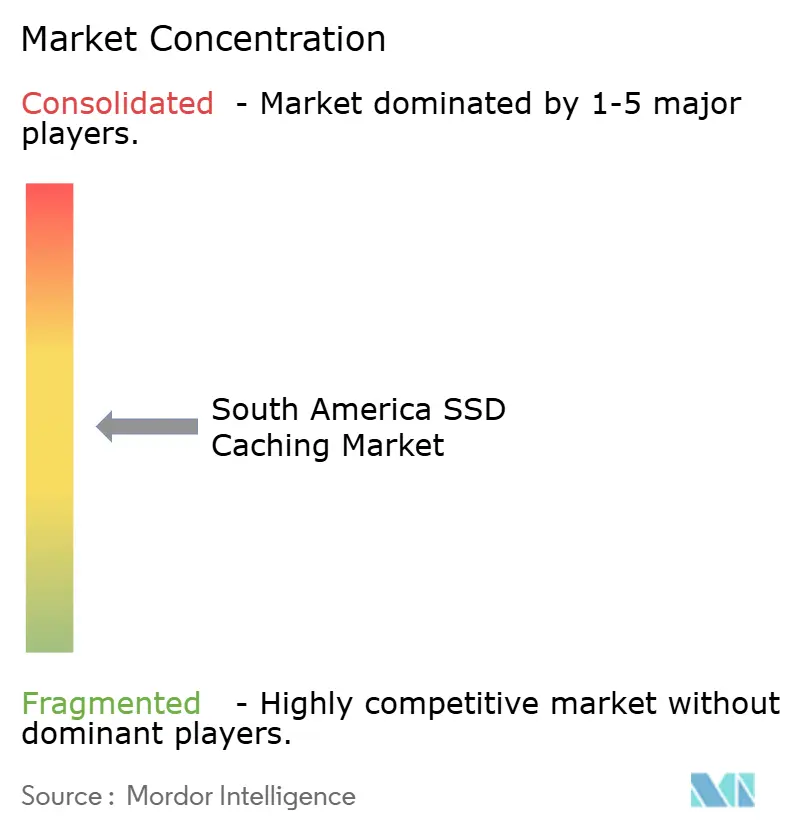
| Market Concentration | Medium |
Major Players *Disclaimer: Major Players sorted in no particular order Image © Mordor Intelligence. Reuse requires attribution under CC BY 4.0. | |
South America SSD Caching Market Analysis by Mordor Intelligence
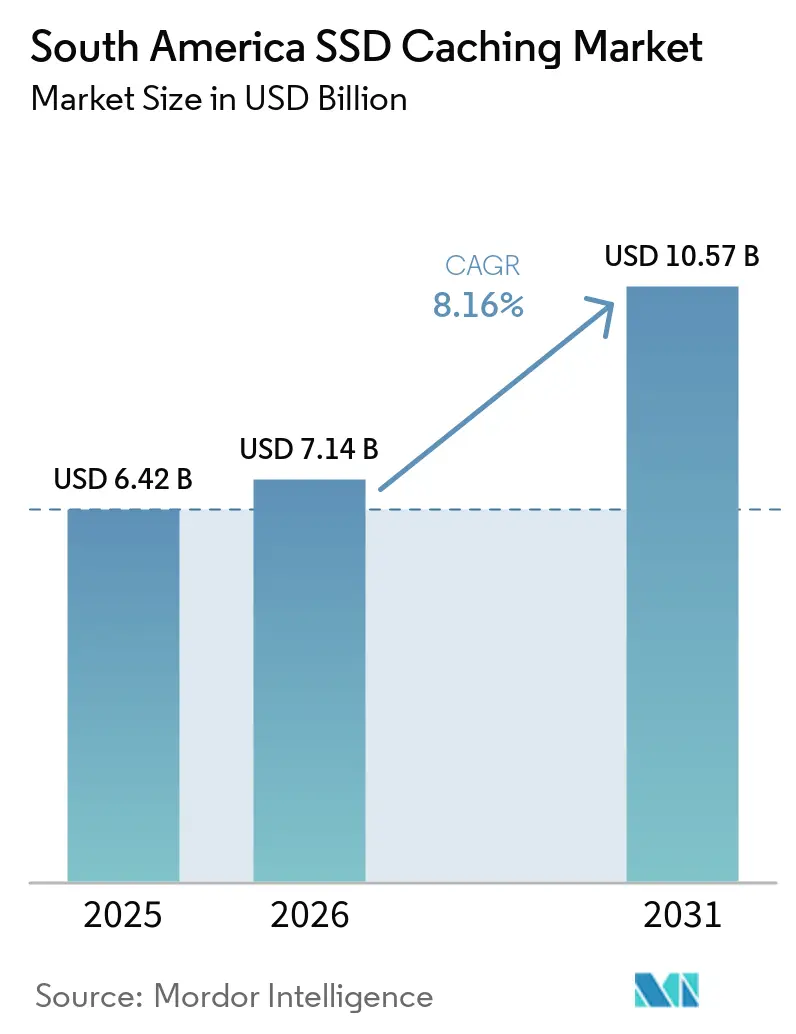
The South America SSD caching market size was valued at USD 6.42 billion in 2025 and estimated to grow from USD 7.14 billion in 2026 to reach USD 10.57 billion by 2031, at a CAGR of 8.16% during the forecast period (2026-2031). Data center investment, AI infrastructure deployment, and regulatory requirements for data handling are supporting demand for faster storage systems across the region. New capacity in Brazil is increasing the need for server-attached storage that can maintain reliable response times as workloads expand. Buyers are also placing greater value on software that can manage cache policies across mixed storage environments. This favors suppliers that combine enterprise SSD hardware, local delivery capabilities, and software support. Import costs and longer qualification cycles may still affect purchasing decisions, especially where enterprises depend on overseas components.
Key Report Takeaways
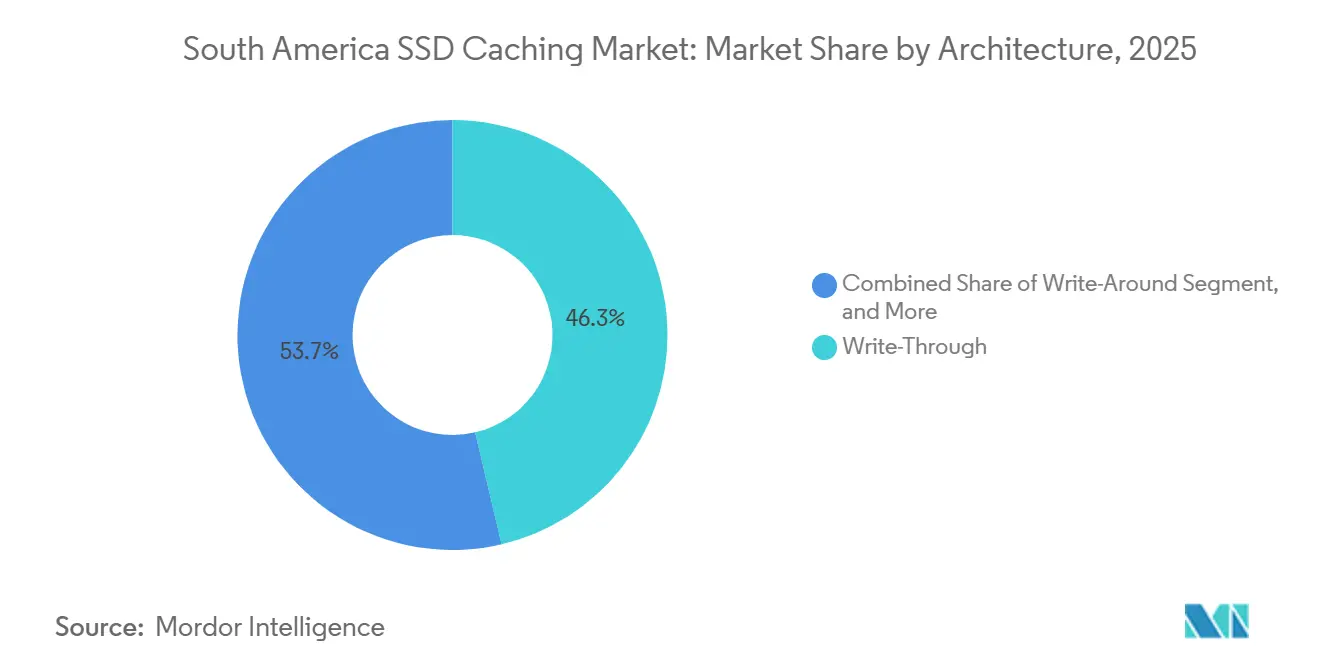
- By architecture, Write-Through accounted for 46.34% of the South America SSD Caching Market share in 2025, while Write-Back is projected to expand at a 8.82% CAGR through 2031.
- By component, Hardware accounted for 64.18% of revenue in 2025, while Software is projected to expand at a 8.57% CAGR through 2031.
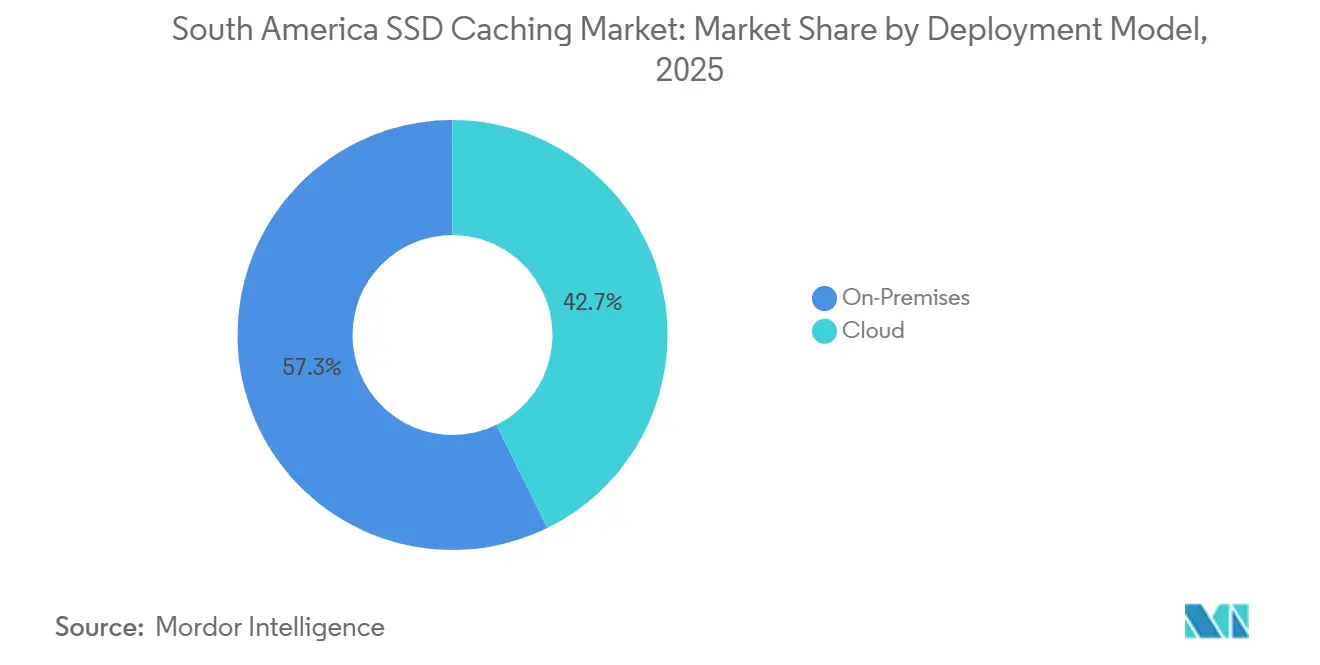
- By deployment model, On-Premises accounted for 57.26% of revenue in 2025, while Cloud is projected to expand at a 8.93% CAGR through 2031.
- By application, Enterprise Servers accounted for 71.39% of revenue in the South America SSD caching market in 2025 and are projected to expand at a 9.21% CAGR through 2031.
- By geography, Brazil held 60.27% of revenue in the South America SSD caching market in 2025, while Chile is projected to expand at a 9.16% CAGR through 2031.
Note: Market size and forecast figures in this report are generated using Mordor Intelligence’s proprietary estimation framework, updated with the latest available data and insights as of January 2026.
Market Trends and Insights
Drivers Impact Analysis of South America SSD Caching Market*
| Driver | (~) % Impact on CAGR Forecast | Geographic Relevance | Impact Timeline |
|---|---|---|---|
| Cloud and Data Center Expansion | +2.3% | South America, concentrated in Brazil, Chile, and Colombia | Short term (≤ 2 years) |
| Enterprise Data Analytics and AI Workloads | +1.9% | Brazil and Chile, with spillover to Argentina and Colombia | Short term (≤ 2 years) |
| NVMe Migration for Virtualization Density | +1.4% | Brazil and Chile, emerging in Colombia | Medium term (2-4 years) |
| Edge Computing Deployment in Major Metros | +0.9% | Brazil, with emerging activity in Santiago, Bogotá, and Buenos Aires | Medium term (2-4 years) |
| Data Residency and Auditability Requirements | +0.8% | Brazil, Argentina, and Colombia, with early gains in São Paulo, Buenos Aires, and Bogotá | Long term (≥ 4 years) |
| SSD Cost Performance Improvements Versus HDD | +0.6% | South America | Short term (≤ 2 years) |
| Source: Mordor Intelligence | |||
Cloud and Data Center Expansion
Data center construction is expected to drive steady demand for SSD caching in new enterprise and colocation server deployments. Brazil remains the primary hub of this activity, with new facilities expanding server capacity and increasing storage throughput requirements. Equinix is expected to open its SP6 facility in São Paulo in April 2026, with an investment of BRL 569.1 million (USD 114 million), as part of its broader BRL 1.5 billion (USD 300 million) expansion program in Brazil. This investment will support colocation customers requiring storage systems that deliver predictable performance for business applications. New facilities will also create opportunities for suppliers that can qualify hardware and caching software early in the commissioning process. The South American SSD caching market will benefit, as each new rack requires storage configurations that support both read- and write-intensive workloads.
Enterprise Data Analytics and AI Workloads
Banking, retail, and telecommunications companies are moving from batch processing toward real-time analytics and AI services. These workloads place greater pressure on data access and write performance than traditional business applications. Solidigm found that NVMe SSD offload for key-value cache operations reduced time to first token from 39 seconds to 1.43 seconds in its tested configuration.[1] The same work showed that SSD-based vector retrieval can increase query throughput while reducing DRAM use for large vector sets. This makes write-back caching more relevant for AI inference systems that need to reduce idle time across computing resources. The South America SSD caching market is therefore gaining support from enterprises that need faster response times without a proportionate expansion of GPU memory or system DRAM.
NVMe Migration for Virtualization Density
Enterprises are replacing SATA and SAS storage designs with NVMe systems to support denser virtualized workloads. This change is often more demanding in Brazil and Argentina because many organizations must update their protocols, caching rules, and storage management processes simultaneously. Samsung began mass production of the PM1763 PCIe Gen6 enterprise SSD in July 2026, with sequential read speeds up to 28,400 MB/s and write speeds up to 21,900 MB/s. Micron also entered high-volume production of the 9650 PCIe Gen6 SSD in March 2026, with sequential reads up to 28 GB/s and up to 5.5 million random read IOPS. These platforms raise the performance ceiling for enterprise caching tiers and can extend the useful life of server infrastructure. Intel Open Cache Acceleration Software supports transitions between write-back, write-through, and write-around modes without stopping I/O, thereby reducing operational disruption during migration.
Edge Computing Deployment in Major Metros
Edge deployments are broadening the demand base beyond large data centers in São Paulo and other established hubs. Brazil’s Ministry of Communications reported that more than 90% of national data center capacity is concentrated in São Paulo, Rio de Janeiro, and Ceará. This concentration increases the case for local processing capacity closer to users in secondary cities and industrial areas. Eletronet is expanding to 26,000 km of fiber routes and 255 edge data centers across 23 Brazilian states by the end of 2026. Smaller edge facilities have less room for excess infrastructure, so SSD caching can help them meet latency requirements with compact hardware. The South America SSD caching market can benefit as 5G, industrial systems, and connected public services require localized processing.
Restraints Impact Analysis of South America SSD Caching Market*
| Restraint | (~) % Impact on CAGR Forecast | Geographic Relevance | Impact Timeline |
|---|---|---|---|
| Dependence on Imported NAND and Currency Volatility | -1.6% | Brazil and Argentina, with the strongest effect in São Paulo and Buenos Aires | Short term (≤ 2 years) |
| Legacy SAN Integration Complexity | -0.9% | Brazil and Argentina, with earlier mitigation in Chile and Colombia | Medium term (2-4 years) |
| Certification Driven Sales Cycle Delays | -0.6% | South America, especially government and financial services | Medium term (2-4 years) |
| All Flash Array Substitution of Hybrid Caching | -0.5% | Brazil and Chile, concentrated among enterprises with high AI workload ratios | Long term (≥ 4 years) |
| Source: Mordor Intelligence | |||
Dependence on Imported NAND and Currency Volatility
Imported NAND components and exchange-rate movements can make enterprise SSD procurement difficult to plan. Brazil’s GECEX Resolution raised duties on certain NAND flash memory components, increasing cost exposure for buyers without access to duty relief or local supply arrangements. Argentina faces an additional challenge because dollar-denominated technology contracts are affected by peso movements. These conditions can extend approval cycles and favor suppliers with local assembly, distribution, or import-exemption eligibility. Consequently, the South America SSD caching market may see procurement concentrate among vendors that can manage local logistics and compliance requirements.
Legacy SAN Integration Complexity
Many enterprises in Brazil and Argentina still operate Fiber Channel SAN systems designed around older block storage protocols. Moving these systems to NVMe over Fabrics or software-defined caching can require changes to network fabric, host adapters, and management tools. NetApp FlexCache write-back permits cached writes to be acknowledged without waiting for origin-volume synchronization, which can support distributed environments during modernization. However, many installations require parallel operation of legacy and modern systems before the transition can be completed. A limited supply of NVMe and software-defined storage specialists can also add to service costs and project timelines. This restraint is less severe in markets where legacy Fibre Channel deployments are less deeply embedded, including Chile and Colombia. The South America SSD caching market must therefore accommodate longer modernization programs in these countries.
*Our forecasts treat driver/restraint impacts as directional, not additive. The impact forecasts reflect baseline growth, mix effects, and variable interactions.
South America SSD Caching Market Segment Analysis
By Architecture:
Write-Through Holds the Largest Revenue Position While Write-Back ExpandsWrite-Through held 46.34% of 2025 revenue, giving it the largest regional revenue position by architecture. Financial transaction systems, healthcare records, and enterprise resource planning applications use this approach because each write is confirmed with durable storage. This process supports data consistency, where incomplete transactions can create operational or regulatory problems. Established storage environments across the region were often designed around these synchronous rules, and replacing them requires software changes and application validation. As a result, Write-Through continues to serve organizations that prioritize predictable write behavior and controlled operational risk.
Write-Back is projected to grow at an 8.82% CAGR through 2031, the fastest rate among architecture types. It allows writes to be acknowledged at the cache before the origin storage system is updated. This approach can reduce delays for AI inference, high-volume databases, and other workloads that require frequent writes. Samsung’s PM1763 and Micron’s 9650 provide higher throughput for enterprise NVMe tiers that support this use case. Write-Around remains relevant for streaming, backup, and archive workloads where writes bypass the cache, while policy engines can assign different cache modes without replacing the storage environment.

By Component:
Hardware Leads Revenue as Software Becomes More ImportantHardware accounted for 64.18% of 2025 revenue, making it the largest component in the South America SSD caching market. Enterprise SSDs, storage controllers, and host bus adapters are required before most caching software can be deployed in business-critical servers. New data center capacity in Brazil, Chile, and Colombia continues to require qualified physical storage hardware. Hardware spending is high because organizations need enterprise-grade reliability, security features, and vendor certification for sensitive or high-volume systems. The segment, therefore, remains the revenue foundation of the regional storage build-out.
Software is projected to grow at an 8.57% CAGR through 2031, the fastest rate across components. Software-defined caching separates policy management from the replacement cycle for physical devices. This allows organizations to improve tiering, prefetching, and cache allocation while retaining installed NVMe hardware. Nutanix added external storage relationships with NetApp, Lenovo ThinkSystem, and Dell PowerStore, increasing its ability to support mixed storage estates.[2] Its Unified Storage achieved NVIDIA certification in May 2026, and software upgrades can be attractive where imports, tariffs, and lead times make hardware purchases harder to approve.
By Deployment Model:
On-Premises Systems Retain Revenue Leadership While Cloud Use GrowsOn-Premises deployments accounted for 57.26% of 2025 revenue in the South America SSD caching market by deployment model. Enterprises retain these systems when personal, financial, or operational data must stay within national jurisdictions. On-site storage also remains common in large facilities that operate their own server infrastructure. ByteDance’s data center complex under construction in Ceará is estimated to involve BRL 200 billion (USD 39 billion) over 10 years, while Ascenty announced a USD 1.2 billion plan for 4 AI-focused data centers in São Paulo state. These investments show why locally controlled infrastructure will remain important for caching demand during the forecast period.
Cloud deployments are projected to expand at an 8.93% CAGR through 2031. Cloud-native caching designs can support applications that need scalable computing and responsive access to shared data. AWS reported that its tiered key-value cache on SageMaker HyperPod achieved up to a 2.7-fold improvement in time-to-first-token during validation. Hybrid designs can use on-premises NVMe storage as a high-performance layer and cloud object storage for lower-cost capacity. Nutanix Unified Storage 5.3 supports smart tiering to Google Cloud and S3-compatible storage, helping organizations retain local control over sensitive data.
By Application:
Enterprise Servers Lead Both Revenue and GrowthEnterprise Servers held 71.39% of 2025 revenue, and the application’s South America SSD caching market size is projected to grow at a 9.21% CAGR through 2031. This application leads because new enterprise and hyperscale servers require caching for databases, virtual machines, AI processing, and business software. Data center operators need read and write performance that remains stable as servers are added. Dell began local production of AI servers at its Hortolândia facility in São Paulo in January 2026, and it began local manufacturing of Dell XC hyperconverged appliances with Nutanix there in December 2025. These developments can reduce delivery delays and some import-related exposure for customers buying server-attached storage configurations.
Personal Computing represents the remaining application demand and has a more limited role in the South America SSD caching market. Consumer and small-business users can use software caching to improve systems that combine SSDs and HDDs. Romex Software offers PrimoCache for Windows systems that use SSD read and write caches to accelerate performance on slower storage devices. Kingston Technology and ADATA supply NVMe SSDs that support personal computer performance upgrades. The segment faces substitution risk because falling NVMe costs can encourage all-SSD devices rather than separate SSD cache and HDD capacity tiers.
Geography Analysis
Brazil SSD Caching Market
Brazil held 60.27% of the 2025 regional revenue, the largest South America SSD caching market share by country. Its position reflects the concentration of hyperscale, colocation, and enterprise IT investment in the country. ByteDance is building a large data center complex in Ceará, with an estimated investment of BRL 200 billion (USD 39 billion). Dell’s local production of AI servers in São Paulo also supports shorter delivery cycles for enterprise infrastructure. Storage suppliers with distribution and service capabilities in São Paulo and Ceará may have an advantage as projects move from construction to equipment qualification.
Chile SSD Caching Market
Chile is projected to expand at a 9.16% CAGR through 2031, the fastest rate in the South America SSD caching market. AWS committed USD 4 billion in May 2025 for its first Chile Region in Santiago, with operations expected by late 2026.[3] Microsoft also launched its Chile Central cloud region as part of a USD 3.3 billion capital commitment. These projects are strengthening Santiago’s role as a regional cloud location. Chile’s Digital Transformation Strategy 2035 also emphasizes cybersecurity and data governance, which supports investment in storage systems for regulated users.
South America SSD Caching Market
Argentina and Colombia have different demand conditions within the region. Colombia benefits from e-invoicing, 5G deployment, and the formation of the Colombian Association of Data Centers and Data Technology in August 2025. These factors support structured investment in enterprise storage and related infrastructure. Argentina faces currency controls and broader economic uncertainty that can delay large technology purchases. The September 2025 cooperation memorandum between Brazil’s data protection authority and Argentina’s access-to-information agency provides a framework for future regulatory coordination. Peru, Uruguay, and Ecuador remain smaller markets, but cloud and managed-service providers are extending coverage into these countries. Their contribution to the South America SSD caching market is expected to rise as edge connectivity and regional cloud services broaden access to modern storage systems.
Competitive Landscape
The South America SSD caching market has a concentrated hardware supply layer and a more fragmented software and integration layer. Samsung, SK hynix through Solidigm, and Micron are major suppliers of NAND and enterprise SSD products. Their product roadmaps influence the performance, availability, and qualification schedules of downstream storage systems. Samsung began mass production of the PM1763 PCIe Gen6 enterprise SSD in July 2026. Micron entered high-volume production of its 9650 PCIe Gen6 SSD in March 2026. These launches can lead to qualification cycles that favor established vendors at large customer accounts.
Software is becoming a stronger point of competition because buyers need consistent policies across varied hardware environments. NetApp’s FlexCache write-back feature can acknowledge writes from the cache without waiting for synchronization with the origin volume. This can improve application response times for distributed environments. Nutanix is extending its storage integration capabilities across hardware platforms, while its Unified Storage received NVIDIA certification for enterprise AI workloads. These moves show that the ability to manage mixed storage systems is increasingly important. Suppliers that combine policy software, NVMe support, and local technical service may be better positioned as enterprise deployments become more complex.
Kioxia announced the GP1 Series PCIe 6.0 NVMe SSD in August 2026 with up to 10 million random read IOPS for AI applications.[4] The launch shows that AI-oriented caching is attracting product investment from suppliers beyond the main hardware leaders. Dell’s local AI server production and its local Nutanix appliance manufacturing create a configuration and delivery advantage in Brazil. Edge sites in secondary Brazilian cities and AI inference caching remain areas where supplier positions are still forming. The South America SSD caching market is unlikely to be controlled by a single participant because software providers, system integrators, and hardware suppliers address different parts of the buying process. Vendors will compete on product qualification, local availability, integration support, and the ability to address AI and hybrid-cloud workloads.
South America SSD Caching Industry Leaders
-
Samsung Electronics Co., Ltd.
-
Intel Corporation
-
Micron Technology, Inc.
-
Kioxia Holdings Corporation
-
SK hynix Inc.
- *Disclaimer: Major Players sorted in no particular order
South America SSD Caching Market Companies Covered in this Report
- Samsung Electronics Co., Ltd.
- Intel Corporation
- Micron Technology, Inc.
- Kioxia Holdings Corporation
- SK hynix Inc.
- Western Digital Corporation
- Solidigm Technology
- Kingston Technology Company, Inc.
- ADATA Technology Co., Ltd.
- Transcend Information Inc.
- QNAP Systems, Inc.
- NetApp, Inc.
- Dell Technologies Inc.
- Hewlett Packard Enterprise Company
- Lenovo Group Limited
- Huawei Technologies Co., Ltd.
- Pure Storage, Inc.
- DataCore Software Corporation
- Nutanix, Inc.
- Microchip Technology Inc.
Recent Industry Developments in South America SSD Caching Market
- August 2026: Kioxia announced the GP1 Series PCIe 6.0 NVMe SSD featuring XL-FLASH Gen2 memory and up to 10 million random read IOPS. Evaluation samples are scheduled for select customers by the end of 2026.
- August 2026: DE-CIX and Eletronet announced a partnership to expand Brazil’s internet interconnection infrastructure. Eletronet is extending its network to 26,000 km of fiber routes and 255 edge data centers across 23 Brazilian states by the end of 2026.
- June 2026: Ada Infrastructure announced construction of 3 Brazilian data centers with planned investment of BRL 2.7 billion (USD 540 million) by 2030. The first campus is in Franco da Rocha, São Paulo, and another is in the Rio de Janeiro metropolitan area.
- June 2026: Ascenty announced a USD 1.2 billion plan for 4 AI-dedicated data centers across São Paulo state. The first facility is targeted to begin operations in Q3 2027.
South America SSD Caching Market Report Scope
SSD caching uses solid-state drives (SSDs) as high-speed cache storage to improve the performance of frequently accessed data and applications by reducing latency and accelerating data retrieval. The South America SSD caching market report covers solutions, software, and services deployed across enterprise data centers, cloud environments, and other IT infrastructure. It analyzes market trends, growth drivers, challenges, competitive landscape, and demand across key countries in South America.
The South America SSD Caching Market Report is Segmented by Architecture (Write-Through, Write-Back, and Write-Around), Component (Hardware, and Software), Deployment Model (On-Premises, and Cloud), Application (Enterprise Servers, and Personal Computing), and Geography (Brazil, Argentina, Chile, Colombia, and Rest of South America). The Market Forecasts are Provided in Terms of Value (USD).
Segmentation Overview
By Architecture
| Write-Through |
| Write-Back |
| Write-Around |
By Component
| Hardware |
| Software |
By Deployment Model
| On-Premises |
| Cloud |
By Application
| Enterprise Servers |
| Personal Computing |
By Geography
| Brazil |
| Argentina |
| Chile |
| Colombia |
| Rest of South America |
| By Architecture | Write-Through |
| Write-Back | |
| Write-Around | |
| By Component | Hardware |
| Software | |
| By Deployment Model | On-Premises |
| Cloud | |
| By Application | Enterprise Servers |
| Personal Computing | |
| By Geography | Brazil |
| Argentina | |
| Chile | |
| Colombia | |
| Rest of South America |
Key Questions Answered in the Report
What is the size of the South America SSD caching market?
The South America SSD caching market size is estimated at USD 7.14 billion in 2026 and is forecast to reach USD 10.57 billion by 2031 at an 8.16% CAGR.
What is driving demand for SSD caching in South America?
Data center construction, AI workloads, NVMe migration, edge computing, and data-handling requirements are expanding demand for fast storage systems.
Which architecture leads regional SSD caching revenue?
Write-Through led with 46.34% of 2025 revenue because enterprises continue to prioritize consistent and reliable write processing.
Which deployment model is growing fastest?
Cloud is projected to grow at an 8.93% CAGR through 2031 as cloud-native and hybrid caching systems gain wider use.
Which application has the highest growth potential?
Enterprise Servers held 71.39% of 2025 revenue and are projected to grow at a 9.21% CAGR through 2031.
Which country is growing fastest for SSD caching?
Chile is projected to grow at a 9.16% CAGR through 2031, supported by cloud infrastructure investment in Santiago.