
Market Overview
| Study Period | 2020 - 2031 |
|---|---|
| Forecast Data Period | 2026 - 2031 |
| Base Year Market Size (2025) | USD 15.46 Billion |
| Market Size (2026) | USD 16.18 Billion |
| Market Size (2031) | USD 20.42 Billion |
| Growth Rate (2026 - 2031) | 4.76 % |
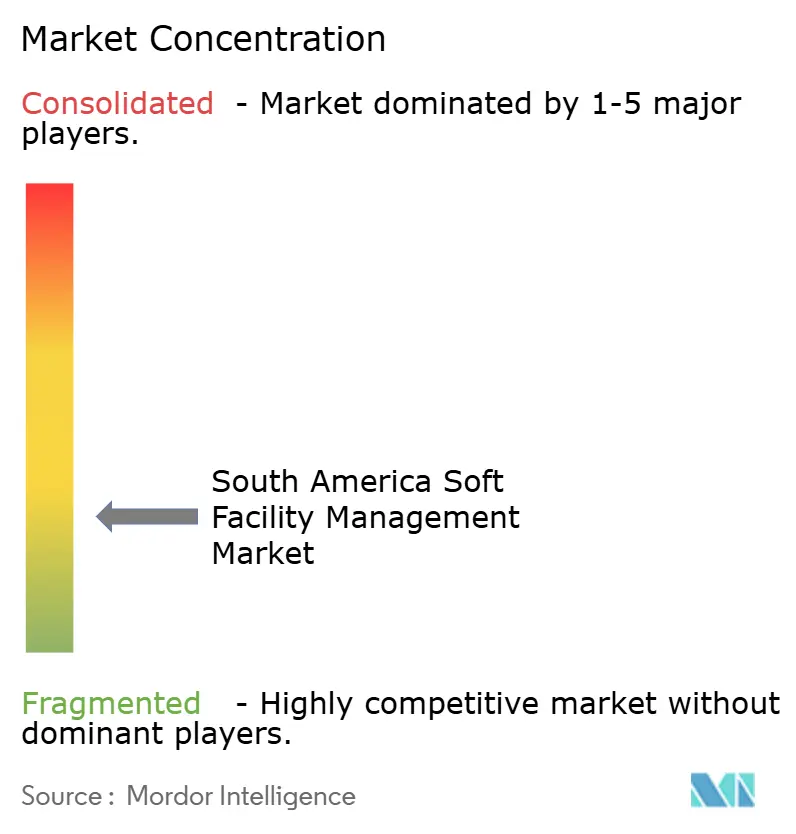
| Market Concentration | Low |
Major Players *Disclaimer: Major Players sorted in no particular order Image © Mordor Intelligence. Reuse requires attribution under CC BY 4.0. | |
South America Soft Facility Management Market Analysis by Mordor Intelligence
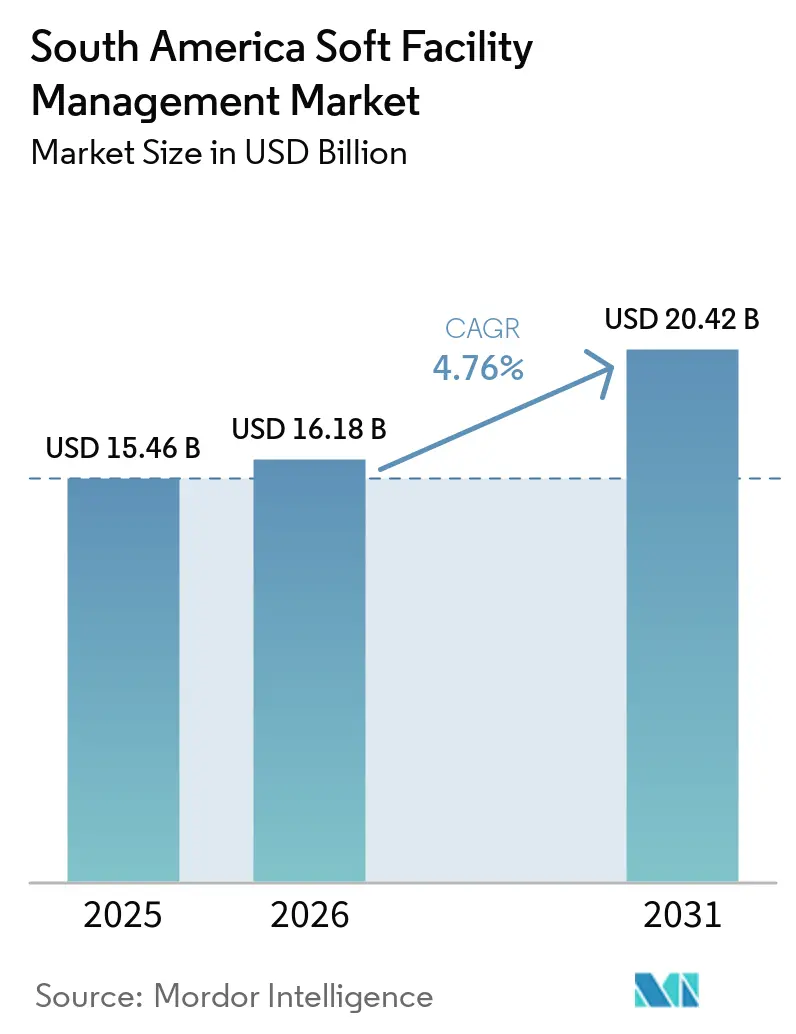
The South America soft facility management market size was valued at USD 15.46 billion in 2025 and is estimated to expand from USD 16.18 billion in 2026 to reach USD 20.42 billion by 2031, at a CAGR of 4.76% during the forecast period 2026-2031. Commercial real estate recovery, logistics development, and data center construction are widening the need for cleaning, security, catering, and workplace support across major cities. Public-private partnership projects are adding long operating periods to hospitals and infrastructure assets, which supports recurring service contracts. Organizations are also shifting non-core work to specialist providers so they can focus capital and management effort on their main activities. This change favors providers that can manage several sites, document service performance, and meet environmental and labor requirements. Labor availability, wage pressure, informal competition, and currency movements will continue to shape contract margins and provider selection.
Key Report Takeaways
- By service type, Cleaning Services held 34.42% of the South America soft facility management market share in 2025, while Security Services is projected to expand at a 4.93% CAGR through 2031.
- By end user, Commercial held 39.57% of the South America soft facility management market share in 2025, while Public/Infrastructure is projected to expand at a 5.11% CAGR through 2031.
- By contract mode, In-House represented 48.23% of regional revenue in 2025, while Integrated and Bundled Contracts are projected to expand at a 5.23% CAGR through 2031.
- By contract duration, Medium-Term Contracts represented 42.17% of regional revenue in 2025, while Long-Term Contracts are projected to expand at a 5.36% CAGR through 2031.
- By geography, Brazil represented 39.22% of regional revenue in 2025, while Argentina is projected to expand at a 5.31% CAGR through 2031.
Note: Market size and forecast figures in this report are generated using Mordor Intelligence’s proprietary estimation framework, updated with the latest available data and insights as of January 2026.
Market Trends and Insights
Drivers Impact Analysis of South America Soft Facility Management Market*
| Driver | (~) % Impact on CAGR Forecast | Geographic Relevance | Impact Timeline |
|---|---|---|---|
| Commercial Real Estate and Logistics-Facility Expansion | +1.1% | Brazil, Colombia, and Argentina | Medium term (2-4 years) |
| Healthcare and Public-Infrastructure Investment | +0.9% | Brazil, Argentina, and Colombia | Long term (≥ 4 years) |
| Increasing Outsourcing of Non-Core Facility Functions | +0.8% | South America, especially Brazil's Southeast and Northeast | Short term (≤ 2 years) |
| Digital Workforce Management and Smart-Building Adoption | +0.6% | Brazil, Bogotá, and Buenos Aires | Medium term (2-4 years) |
| Remote-Site Operations in Mining and Energy | +0.5% | Peru, Argentina, Chile, Colombia, and Brazil | Medium term (2-4 years) |
| Formalization of Facility Services in Secondary Cities | +0.3% | Brazil and Colombia | Long term (≥ 4 years) |
| Source: Mordor Intelligence | |||
Commercial Real Estate and Logistics-Facility Expansion
The South America soft facility management market benefits as commercial occupiers take up better-quality space in major regional cities, creating recurring demand for cleaning, access control, guarding, waste handling, and front-of-house support. Declining Grade-A office vacancy in São Paulo has supported recurring demand for cleaning and security services. As office occupancy increases, clients require services that can adapt to changing footfall, shared work areas, visitor volumes, and daily security conditions. Logistics facilities and data centers require continuous service coverage because their operating schedules and uptime requirements are more demanding than those of traditional offices. Recent data center developments in Brazil, including projects by Equinix, Omnia Data Centers, and Pátria Investimentos, expand demand beyond the São Paulo-Rio de Janeiro corridor and encourage providers to offer occupancy-based cleaning, flexible staffing, and continuous support.
Healthcare and Public-Infrastructure Investment
Healthcare and public infrastructure investment supports the South America soft facility management market through long concession periods, defined operating requirements, and public procurement standards that are often stricter than those in ordinary corporate contracts. Hospital public-private partnership contracts in Brazil often span extended periods and include cleaning, security, catering, waste management, infection-control routines, and performance reporting from the start of operations. The Inter-American Development Bank supported a hospital public-private partnership for the Hospital Regional do Mato Grosso do Sul, covering construction and long-term operations. A contract for Minas Gerais' HoPE Complex was awarded with International Finance Corporation advisory support and included ongoing maintenance and support services.[1] The New Development Bank approved the concept for a USD 320 million Brazil Smart Hospital Project in July 2025, signaling further public investment in health assets that need professional operating support.[2] The South America soft facility management market can therefore gain a more predictable contract pipeline, provided suppliers can meet the service, workforce, and compliance terms required over the full life of an asset.
Increasing Outsourcing of Non-Core Facility Functions
Increasing outsourcing of non-core functions remains a direct source of demand for the South America soft facility management market, particularly where clients want to simplify staffing, supervision, procurement, and compliance management. Outsourced facilities contracts in Brazil increased 18% between June and October 2024, while 84% of clients reported improved legal certainty after outsourcing regulation was consolidated. Data centers, corporate campuses, hospitals, and industrial sites need service providers to manage activities that do not define their primary business but still affect safety, worker experience, and continuity of operations. Brazil's planned data center investment also points to demand for dedicated cleaning, access control, physical security, and reactive support across large sites. JLL integrated Schneider Electric's facilities management across 6 South American countries through common processes, Corrigo software, and real-time reporting.[3] This model reduces the burden of supervising separate local vendors and raises the value of providers that can make service delivery consistent across borders, building types, and client locations.
Digital Workforce Management and Smart-Building Adoption
Digital workforce management and smart-building adoption can help the South America soft facility management market move beyond labor-based service pricing and strengthen the connection between service delivery, building performance, and documented outcomes. The International Energy Agency noted that sensors and monitoring software can significantly reduce energy consumption in commercial buildings. Providers can use these tools to connect cleaning, security, energy monitoring, incident response, workforce dispatch, and inspection records with measurable building outcomes. Cushman and Wakefield launched its Brazil Virtual Technician Program in February 2026, linking field staff to remote specialists through wearable devices and digital inspection workflows. The program serves hospitals, data centers, and distributed commercial portfolios where specialist support cannot always be present on site, and rapid problem resolution is important. Limited awareness of Internet of Things tools among healthcare facility managers remains a barrier, but it creates an opening for providers that combine technology education, staff training, and daily service delivery.
Restraints Impact Analysis of South America Soft Facility Management Market*
| Restraint | (~) % Impact on CAGR Forecast | Geographic Relevance | Impact Timeline |
|---|---|---|---|
| Labor Turnover and Shortage of Trained Service Personnel | -1.0% | Brazil, Argentina, and Colombia | Medium term (2-4 years) |
| Inflation, Wage Escalation, and Consumables Cost Volatility | -0.9% | Argentina, Brazil, and Colombia | Short term (≤ 2 years) |
| Informal Competition and Uneven Regulatory Enforcement | -0.7% | Brazil, Colombia, and Argentina | Long term (≥ 4 years) |
| Fragmented Service Standards Across Multisite and Cross-Border Contracts | -0.4% | Brazil and Colombia cross-border portfolios | Long term (≥ 4 years) |
| Source: Mordor Intelligence | |||
Labor Turnover and Shortage of Trained Service Personnel
Labor turnover and shortages of trained personnel constrain the South America soft facility management market, particularly where contracts require rapid mobilization, defined service levels, and supervisors who can manage a large, dispersed workforce. Rising labor costs and increased employee benefit requirements in Brazil place pressure on provider margins, as fixed-price contract renewals may not fully offset these expenses. This situation can lead to challenging negotiations when buyers prioritize price. Shortages are more acute in supervisory and technical roles that require knowledge of building systems, digital controls, labor practices, and compliance reporting. Vacancies in secondary cities can delay contract mobilization, particularly when a new site requires trained personnel from the start of operations. Brazil's psychosocial risk obligations and credential requirements for certain maintenance activities further increase workforce planning requirements for providers serving institutional and public-private partnership sites.
Inflation, Wage Escalation, and Consumables Cost Volatility
Inflation, wage escalation, and volatile consumables prices can weaken the economics of the South America soft facility management market because many labor and supply costs change more quickly than contract prices. Argentina is particularly exposed because local currency contracts can lose value while imported cleaning chemicals, equipment, replacement materials, and consumables are priced in USD. This creates pressure on both service revenue and input costs when the Argentine peso weakens, making frequent contract review and clear indexation provisions more important. Brazil and Colombia face a less severe currency position, but chemicals, transportation, waste disposal, and protective materials can still change faster than contract price adjustments. Longer supply agreements can help larger providers manage costs, secure needed stock, and maintain service quality during procurement volatility. Smaller operators may lack the purchasing scale or financial capacity to use these arrangements, which can widen the difference between them and larger competitors.
*Our forecasts treat driver/restraint impacts as directional, not additive. The impact forecasts reflect baseline growth, mix effects, and variable interactions.
South America Soft Facility Management Market Segment Analysis
By Service Type:
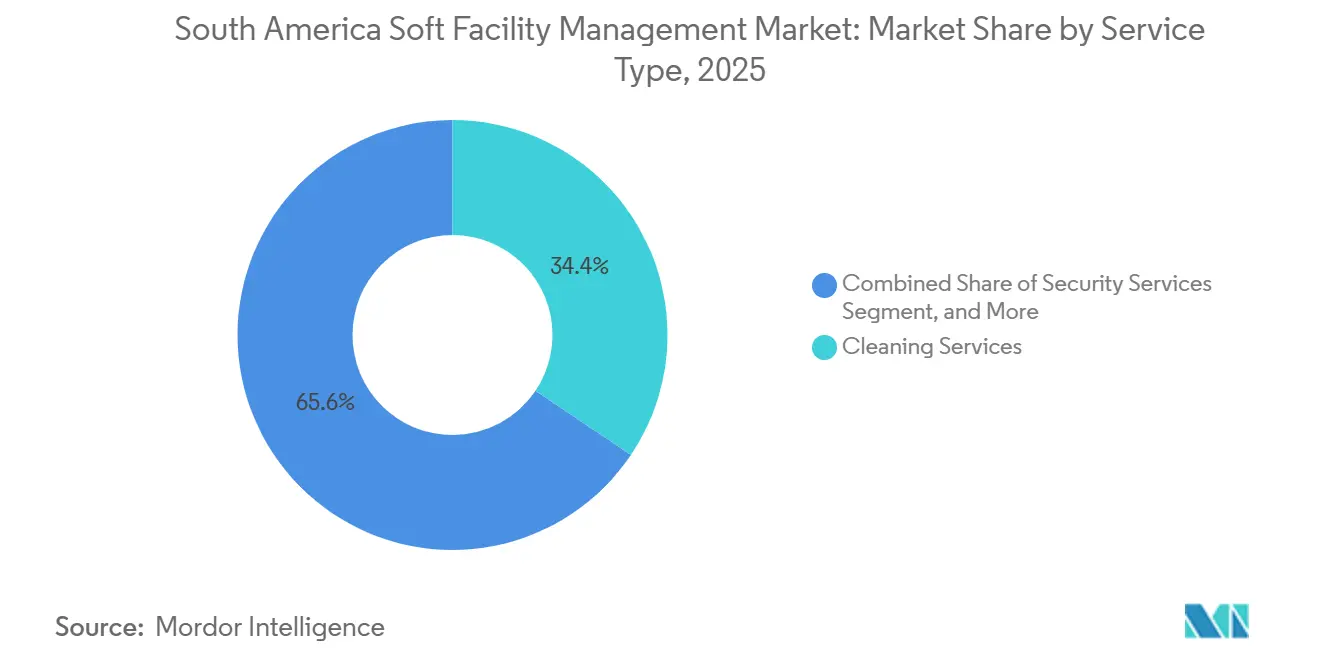
Cleaning Services Supports Revenue While Security Services Expands FasterCleaning Services held 34.42% of the South America soft facility management market size in 2025. It is often the first service that an organization transfers from an internal team to a specialist provider because it can be mobilized quickly and needs limited capital from the client. The initial contract can create a working relationship that later extends to other services. Catering Services, Office Support, and Landscaping Services provide additional revenue where sites need regular food, reception, transport coordination, or grounds support. Catering is particularly important at remote mining camps, hospital concessions, and data center campuses, where daily site operations depend on reliable food services. Cleaning specifications are becoming more detailed in hospitals and food-service environments, which raises the importance of trained staff and documented procedures.
Security Services is projected to expand at a 4.93% CAGR through 2031, the highest rate among service types. Urban safety concerns and demand from remote mining, energy, and logistics sites support the need for physical guarding and access control. Video surveillance tools can make security contracts more differentiated than conventional labor-based cleaning contracts and allow higher-value reporting. Other Soft FM Services include pest control, document management, shuttle coordination, and reception services that can deepen client relationships after cleaning or security has become established. The South America soft facility management market gives suppliers a reason to combine these activities within broader bundled contracts.

By End User:
Commercial Occupiers Lead While Public Infrastructure Builds Long-Term DemandCommercial held 39.57% of the South America soft facility management market size in 2025. Corporate offices, retail properties, and logistics assets in Brazil's Southeast and Bogotá's business districts provide a broad base for routine cleaning, guarding, and workplace support. These clients commonly seek regular service schedules, clear performance standards, and flexible coverage as occupancy patterns change. Commercial sites can adopt integrated service agreements as they reduce the number of individual vendors they must supervise. The large installed base of office and logistics space makes this segment important for providers with multi-site operating capability.
Public/Infrastructure is projected to expand at a 5.11% CAGR through 2031, the fastest among end users. Hospital and transit public-private partnerships in Brazil are including facility obligations that were previously managed in-house or through informal arrangements. These contracts often use service-level agreements, transparent procurement, and long operating periods. Such conditions favor providers with certified processes, auditable labor practices, and reliable governance. The Institutional segment includes universities, schools, and corporate campuses, while industrial locations in Brazil and Argentina require regular support services and strict site controls.
By Contract Mode:
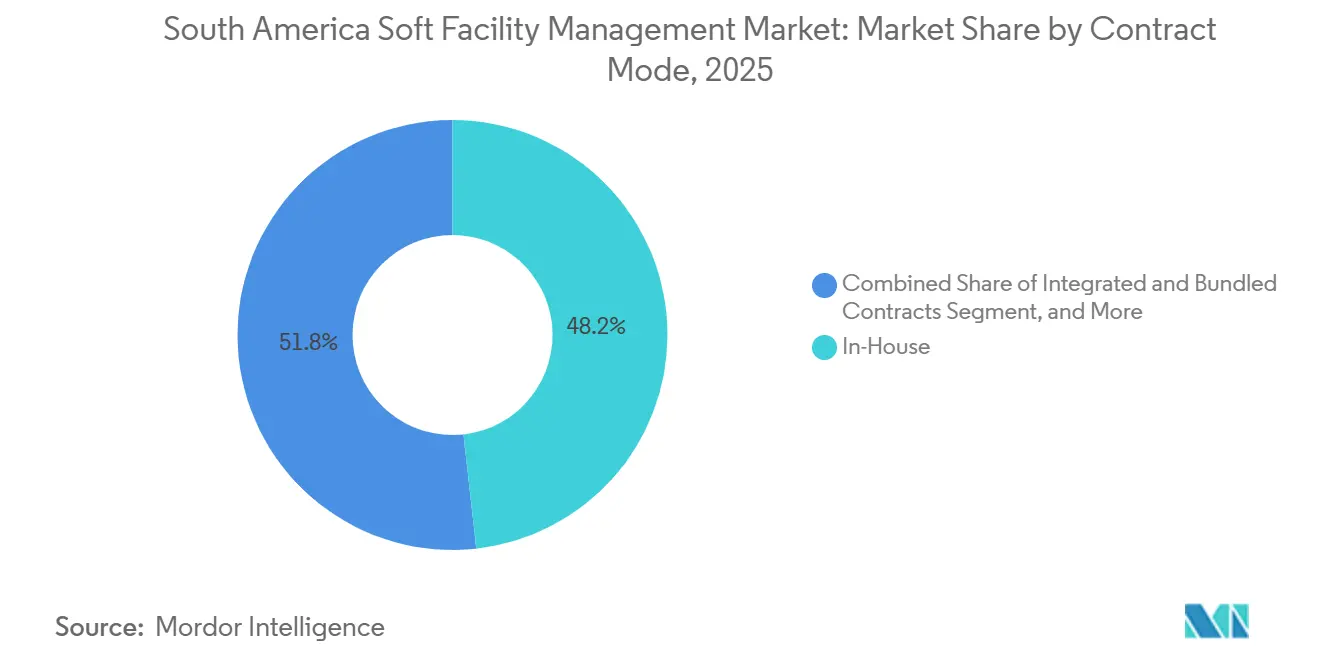
In-House Delivery Remains Important While Integrated Contracts Gain GroundIn-House delivery accounted for 48.23% of regional revenue in 2025. Many industrial groups and public hospitals retained direct teams to manage payroll, union relationships, and production schedules. Rising labor regulation and wage costs are making this approach less attractive for some organizations. The in-house base, therefore, represents a significant pool of operations that outside providers may convert over time. Outsourced arrangements cover established third-party contracts for cleaning, security, and catering.
Integrated and Bundled Contracts are projected to expand at a 5.23% CAGR through 2031. Large companies and institutions are reducing the number of single-service vendors and assigning broader responsibility to 1 provider. These agreements can include service-level governance, digital performance dashboards, and shared accountability across service lines. JLL's work with Schneider Electric across 6 South American countries shows how common processes and software can support this approach. The South America soft facility management market increasingly favors suppliers able to provide consistent data, controls, and delivery across locations.
By Contract Duration:
Medium-Term Agreements Lead While Long-Term Contracts Change CompetitionMedium-Term Contracts, covering 1-3 years, accounted for 42.17% of regional revenue in 2025. Corporate and institutional buyers use this duration to retender contracts, assess performance, and update service requirements without making extended commitments. Short-Term Contracts, lasting less than 1 year, remain useful for small businesses and project-based work. They are common in Brazil's retail, hospitality, and construction settings, where service demand can change quickly. Medium-term agreements also let buyers adjust staffing and pricing terms as operating conditions change.
Long-Term Contracts, lasting more than 3 years, are projected to expand at a 5.36% CAGR through 2031. Hospital, transit, and administrative-building concessions in Brazil and Argentina can run for 25-30 years and require continuing cleaning, catering, and security coverage. These contracts require providers to manage infection control, dietary compliance, security standards, and sustained workforce performance. São Paulo awarded a 30-year Administrative Center concession in February 2026 with mandatory LEED Gold performance requirements. The South America soft facility management market consequently rewards operational depth, compliance capability, and sound contract management.
Geography Analysis
Brazil Soft Facility Management Market
Brazil held 39.22% of regional revenue in 2025. It remains the region's largest commercial base because it combines a large corporate economy, established outsourcing practices, and a broad mix of industrial, logistics, healthcare, and public assets. São Paulo's declining Grade-A office vacancy rate is supporting demand for premium office cleaning and security services. Novo PAC investments are strengthening the pipeline of concession assets that require long-term operating services. Data center projects in Ceará, Porto Alegre, Recife, Belém, and Brasília are extending demand beyond the São Paulo-Rio de Janeiro corridor. The South America soft facility management market also benefits from a substantial in-house service base that can transition to specialist contractors. ABNT facility management standards and LEED requirements are raising procurement standards across institutional and public infrastructure accounts.
Argentina Soft Facility Management Market
Argentina is projected to expand at a 5.31% CAGR through 2031, the fastest rate in the region. Government-supported infrastructure plans provide a base of demand even when private-sector budget decisions are affected by macroeconomic uncertainty. Buenos Aires Province allocated ARS 1.91 trillion, USD 1.29 billion, across 20 water, road, and energy projects in January 2026. Buenos Aires continues to hold the largest concentration of institutional properties, corporate campuses, and multinational occupiers in the country. Currency volatility makes contract pricing and imported consumables more difficult to manage. Simplia Facility Solutions consolidated 3 Buenos Aires offices into a single smart building in 2026, reflecting greater emphasis on coordinated operations and digital site management.
Andean South America Soft Facility Management Market
Colombia and the Rest of South America provide a further source of demand for the South America soft facility management market. Bogotá has attracted provider investment and remains a regional center for corporate services, banking, insurance, and retail activity. Sodexo opened a Global Business Services center in Bogotá to support regional functions across North and South American operations. Peru, Chile, Ecuador, and smaller markets are shaped by mining and energy activity, which require catering, accommodation management, cleaning, and security at remote sites. Tgestiona announced its planned Colombian entry in July 2026 to serve banking, insurance, and retail clients with integrated property and facility management services.
Competitive Landscape
The South America soft facility management market was moderately fragmented, with leading outsourced providers collectively holding a modest share of addressable revenue. ISS A/S, Sodexo S.A., CBRE Group, Jones Lang LaSalle, and Cushman and Wakefield have strengths in multinational account management, standard processes, and cross-border reporting. Brazilian providers, including Grupo GPS Participações S.A., Grupo Verzani and Sandrini, Brasanitas Serviços Integrados, and Manserv, bring local labor networks and practical experience across different regulatory and union settings. Providers are moving from simple headcount-based pricing toward contracts supported by data, service-level measures, and centralized operations. This raises the importance of dashboards, computerized maintenance systems, predictive visibility, and command-center capabilities. Firms that cannot provide clear operating data can face a disadvantage in large institutional and concession accounts.
Cushman and Wakefield's wearable-based Virtual Technician Program in Brazil demonstrates how technology can support field teams and strengthen client retention. Grupo GPS expanded through acquisitions, maintained a large workforce, and delivered strong revenue growth, highlighting how local-scale providers are broadening their service capabilities. Sodexo's global integrated facility management partnership with Clariant across multiple locations and countries also demonstrates continued demand for single-provider coordination. Long-duration public-private partnership contracts can favor providers with ABNT, ISO 41001, and LEED-related credentials because they require reliable evidence of quality, labor compliance, and environmental performance.
Compass Group exited its Chilean and Colombian operations in March 2025, which shifted contracts toward Newrest Group International and changed the regional provider mix. Johnson Controls, Siemens, ABM Industries, OCS Group, and Apleona have limited direct South American soft facility management delivery relative to the core providers discussed above. Regional specialists such as Tgestiona, Grupo Orbenk, Simplia Facility Solutions, and Caterwest are more closely aligned with local cleaning, catering, security, and outsourced support needs. The South America soft facility management industry rewards firms that can operate across remote industrial sites and complex urban assets without losing control of compliance.
South America Soft Facility Management Industry Leaders
-
Sodexo S.A.
-
ISS A/S
-
Grupo Verzani & Sandrini S.A.
-
Compass Group PLC
-
Grupo GPS Participacoes S.A.
- *Disclaimer: Major Players sorted in no particular order
South America Soft Facility Management Market Companies Covered in this Report
- ISS A/S
- Sodexo S.A.
- Compass Group PLC
- CBRE Group, Inc.
- Jones Lang LaSalle Incorporated
- Cushman & Wakefield plc
- Aramark
- Grupo GPS Participacoes S.A.
- Grupo Verzani & Sandrini S.A.
- Brasanitas Servicos Integrados Ltda.
- Manserv Montagem e Manutencao S.A.
- Prosegur Compania de Seguridad, S.A.
- Securitas AB
- Grupo EULEN S.A.
- Newrest Group International S.A.S.
- Ecolab Inc.
- ABM Industries Incorporated
- Johnson Controls International plc
- Siemens Aktiengesellschaft
- Veolia Environnement S.A.
- Apleona GmbH
- OCS Group Limited
Recent Industry Developments in South America Soft Facility Management Market
- July 2026: Tgestiona, a Peruvian soft FM and integrated services firm with 25 years of operational history, announced its planned entry into the Colombian market, targeting banking, insurance, and retail sectors in Bogotá with integrated property and facility management services, a sign of cross-border market formalization driven by demand concentration in Colombia's tier-1 commercial hub.
- July 2026: Aramark Chile acquired the Innovalim production facility in Pudahuel, establishing its third food production plant and adding "cook and chill" distribution capacity as part of its growth strategy toward 2030. The acquisition followed the earlier purchase of Vendomática and Aramark's 2024 plant launch, reflecting a multi-year regional consolidation drive.
- June 2026: Sodexo S.A. was selected by Clariant, a global specialty chemicals company, for a new 5-year global integrated FM partnership covering more than 50 sites across 13 countries in Europe, the Americas, and Asia-Pacific, including cleaning, grounds maintenance, building upkeep, and technical support services. Mobilization is set for October 2026.
- March 2026: Omnia Data Centers and Pátria Investimentos broke ground on a BRL 11 billion first-phase data center in Ceará's Pecém Industrial Port Complex for TikTok/ByteDance, expanding high-specification FM demand at hyperscale volume in Brazil's Northeast.
South America Soft Facility Management Market Report Scope
South America Soft Facility Management Market refers to outsourced and in-house non-technical services that support the cleanliness, safety, comfort, and day-to-day functionality of buildings and workplaces. It includes cleaning and janitorial services, security, catering, reception, office support, landscaping, waste management, pest control, and workplace assistance.
The South America Soft Facility Management Market Report is Segmented by Service Type (Office Support and Landscaping Services, Cleaning Services, Catering Services, and Other Service Types), End User (Commercial, Institutional, Public/Infrastructure, and Industrial), Contract Mode (In-House, Outsourced, and Integrated and Bundled Contracts), Contract Duration (Short-Term, Medium-Term, and Long-Term Contracts), and Geography (Brazil, Argentina, Colombia, and Rest of South America). The Market Forecasts are Provided in Terms of Value (USD).
Segmentation Overview
By Service Type
| Office Support and Landscaping Services |
| Cleaning Services |
| Catering Services |
| Security Services |
| Other Service Types |
By End User
| Commercial |
| Institutional |
| Public/Infrastructure |
| Industrial |
| Other End Users |
By Contract Mode
| In-House |
| Outsourced |
| Integrated and Bundled Contracts |
By Contract Duration
| Short-Term Contracts, Less Than One Year |
| Medium-Term Contracts, One to Three Years |
| Long-Term Contracts, More Than Three Years |
By Geography
| Brazil |
| Argentina |
| Colombia |
| Rest of South America |
| By Service Type | Office Support and Landscaping Services |
| Cleaning Services | |
| Catering Services | |
| Security Services | |
| Other Service Types | |
| By End User | Commercial |
| Institutional | |
| Public/Infrastructure | |
| Industrial | |
| Other End Users | |
| By Contract Mode | In-House |
| Outsourced | |
| Integrated and Bundled Contracts | |
| By Contract Duration | Short-Term Contracts, Less Than One Year |
| Medium-Term Contracts, One to Three Years | |
| Long-Term Contracts, More Than Three Years | |
| By Geography | Brazil |
| Argentina | |
| Colombia | |
| Rest of South America |
Key Questions Answered in the Report
What is the South America soft facility management market size?
The regional sector is estimated at USD 16.18 billion in 2026 and is forecast to reach USD 20.41 billion by 2031 at a 4.75% CAGR. The forecast reflects recurring needs across commercial, public, industrial, and institutional sites.
Which service type leads South America soft facility management?
Cleaning Services led with 34.42% share in 2025. Security Services is projected to record the fastest service-type CAGR of 4.93% through 2031 because sites increasingly require physical guarding, access control, and technology-enabled monitoring.
Why are public-private partnerships important for soft facility management providers?
Hospital, transit, and administrative concessions can run for 25-30 years and include cleaning, security, catering, waste management, and performance obligations. These arrangements can provide longer operating visibility when providers meet detailed contractual standards.
Which end user is expected to expand fastest through 2031?
Public/Infrastructure is projected to expand at a 5.11% CAGR, supported by hospital and infrastructure concessions with long operating periods. Buyers in this group often require documented service levels, auditable labor practices, and reliable site governance.
Which country has the largest regional share?
Brazil held 39.22% of regional revenue in 2025, supported by its corporate base, outsourcing practices, infrastructure pipeline, and data center investment. Its broad mix of cities and asset types also creates demand for multi-site service delivery.
What are the main operating challenges for providers?
Skilled labor shortages, wage escalation, volatile consumables costs, informal competition, and uneven service standards can limit margins and complicate delivery. These issues are most difficult when providers operate under fixed-price agreements or across remote locations.