
South America Single-use Plastic Packaging Market Size and Share
Market Overview
| Study Period | 2020 - 2031 |
|---|---|
| Forecast Data Period | 2026 - 2031 |
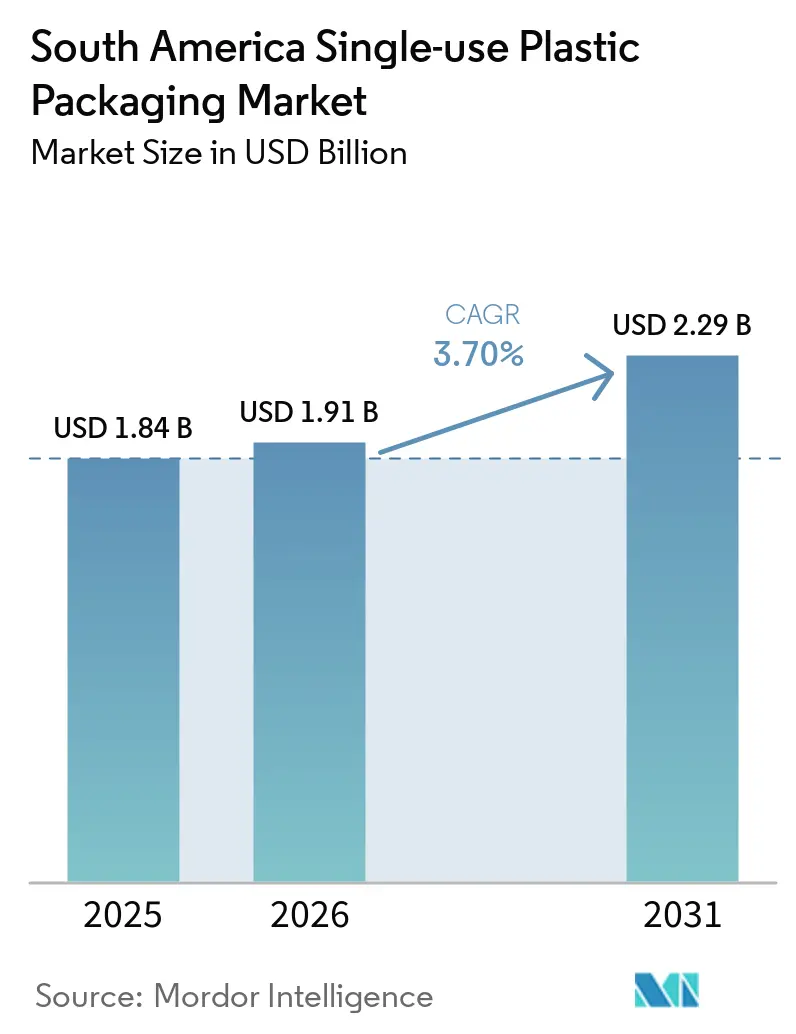
| Base Year Market Size (2025) | USD 1.84 Billion |
| Market Size (2026) | USD 1.91 Billion |
| Market Size (2031) | USD 2.29 Billion |
| Growth Rate (2026 - 2031) | 3.70 % |
| Market Concentration | Medium |
Major Players *Disclaimer: Major Players sorted in no particular order Image © Mordor Intelligence. Reuse requires attribution under CC BY 4.0. | |
South America Single-use Plastic Packaging Market Analysis by Mordor Intelligence
The South America Single-use Plastic Packaging Market size was valued at USD 1.84 billion in 2025 and is estimated to grow from USD 1.91 billion in 2026 to reach USD 2.29 billion by 2031, at a CAGR of 3.70% during the forecast period 2026-2031. Urban food consumption, quick-service restaurants, and delivery services support demand for hygienic and protective packs. E-commerce also favors lightweight packaging that protects goods while limiting parcel volume. Packaging suppliers are adjusting their product designs as recycling rules become more demanding in several countries. This creates room for recyclable mono-material packs, although higher resin costs and uneven recycling systems remain material constraints.
Key Report Takeaways
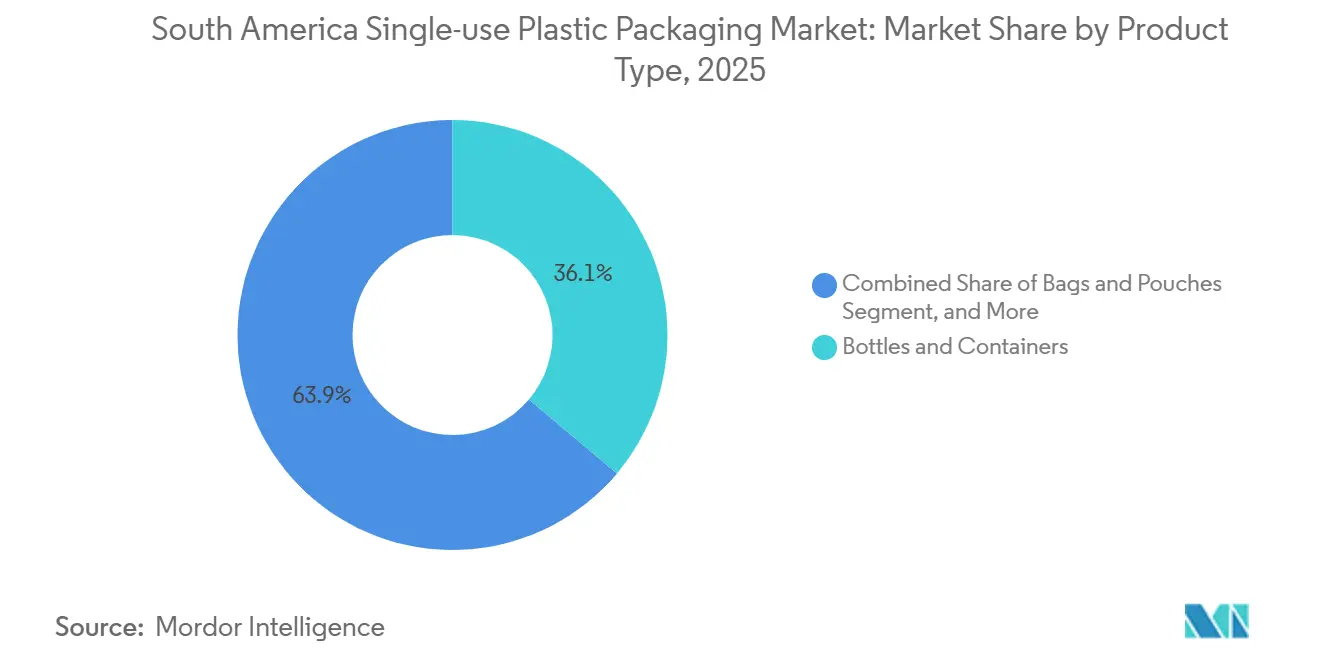
- By product type, Bottles and Containers held 36.14% of the South America Single-use Plastic Packaging Market share in 2025, while Bags and Pouches recorded the highest projected CAGR at 4.83% through 2031.
- By material type, Polyethylene held 35.05% of revenue in 2025, while Polylactic Acid recorded the highest projected CAGR at 4.62% through 2031.
- By packaging format, Rigid Packaging accounted for 54.08% of revenue in the South America Single-use Plastic Packaging Market 2025, while Flexible Packaging recorded the highest projected CAGR at 4.41% through 2031.
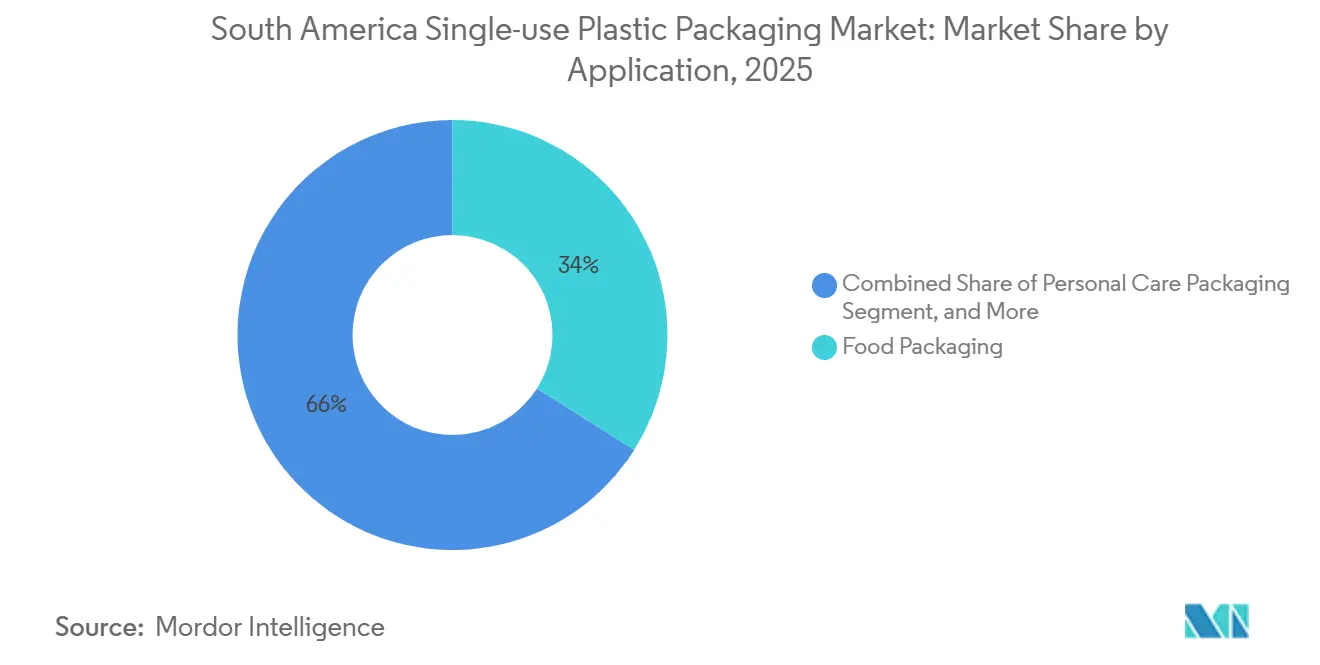
- By application, Food Packaging held 33.97% of revenue in 2025, while Personal Care Packaging recorded the highest projected CAGR at 4.67% through 2031.
- By end user, Consumer Goods Manufacturers accounted for 28.80% of revenue in the South America Single-use Plastic Packaging Market 2025, while E-Commerce and Delivery Platforms recorded the highest projected CAGR at 4.76% through 2031.
- By geography, Brazil held 31.01% of the South America Single-use Plastic Packaging Market share in 2025, while Colombia recorded the highest projected CAGR at 4.18% through 2031.
Note: Market size and forecast figures in this report are generated using Mordor Intelligence’s proprietary estimation framework, updated with the latest available data and insights as of January 2026.
Market Trends and Insights
Drivers Impact Analysis of South America Single-use Plastic Packaging Market*
| Driver | (~) % Impact on CAGR Forecast | Geographic Relevance | Impact Timeline |
|---|---|---|---|
| Expansion of Food Delivery and Quick-Service Restaurants | +0.8% | Brazil, Argentina, Colombia, Chile | Short term (≤ 2 years) |
| Growth of Packaged Food and Beverage Consumption | +0.7% | Brazil, Argentina, Colombia, Chile | Medium term (2-4 years) |
| E-Commerce and Quick-Commerce Fulfillment Demand | +0.6% | Brazil, Colombia, Chile | Short term (≤ 2 years) |
| Conversion From Rigid to Flexible Single-Use Formats | +0.5% | Brazil, Colombia, Argentina | Medium term (2-4 years) |
| Expansion of Recyclable Mono-Material Packaging | +0.4% | Brazil, Chile, Colombia | Long term (≥ 4 years) |
| Growth of Food, Agricultural, and Export Supply Chains | +0.3% | Brazil, Argentina, Colombia | Medium term (2-4 years) |
| Source: Mordor Intelligence | |||
Expansion of Food Delivery and Quick-Service Restaurants
Food delivery and quick-service restaurants require packaging that protects food and supports safe handling. The South America Single-use Plastic Packaging Market benefits when delivery operators use sealed bags, trays, and pouches for each order. Cloud kitchens use film pouches, tamper-evident trays, and heat-sealed bags because these formats are well-suited to rapid preparation cycles. Drive-through and app-based orders can include several individually packed items in one protected outer bag. This can increase the packaging used per order, even as restaurant menus become simpler. The requirement for secure delivery packaging, therefore, supports stable demand for converters as foodservice channels expand.
Growth of Packaged Food and Beverage Consumption
Brazil’s processed-food output grew 4.2% year over year in 2025, led by poultry, instant coffee, and fruit concentrates that need barrier packaging during export transport. Pouches have gained use for condiments as retailers and foodservice companies seek refill-friendly formats. This shift can reduce the material weight of each unit while increasing the number of packaged units used in a category. Functional beverages, energy drinks, and chilled dairy products also require clear PET and PP containers with barrier properties. Growth in convenience retail creates further demand for affordable packs that can protect products through fragmented distribution networks. These needs keep food and beverage consumption central to the South America Single-use Plastic Packaging Market.
E-Commerce and Quick-Commerce Fulfillment Demand
Brazilian e-commerce accounted for 12% of retail sales in 2024, making parcel protection an important source of packaging demand. Parcel carriers use dimensional-weight pricing, which rewards packs that reduce both weight and unused space. Air-pillow films, bubble wrap, and form-fit polybags can protect while using limited material. Sealed Air installed bubble-on-demand equipment in Mercado Libre fulfillment centers, which reduced packaging cost per parcel by 18% and void fill by 35%. Quick-commerce operators also need films that can support temperature-sensitive deliveries in warm conditions. These requirements support flexible protective formats across the South America Single-use Plastic Packaging Market.
Conversion From Rigid to Flexible Single-Use Formats
Brands are moving selected products from rigid containers to flexible formats to lower transport weight and simplify storage. This conversion changes product mix even when total resin use per package declines. Stand-up pouches suit condiments, liquid dairy products, and dry ingredients because they use less storage space than many rigid packs. Flexible mono-material packs can also allow shorter production runs and faster print changes for regional promotions. Amcor’s digital flexographic presses reduced setup time from 4 hours to 45 minutes, supporting 5,000-unit promotional runs. This flexibility helps brand owners introduce limited-edition products without major investments in rigid-pack tooling.
Restraints Impact Analysis of South America Single-use Plastic Packaging Market*
| Restraint | (~) % Impact on CAGR Forecast | Geographic Relevance | Impact Timeline |
|---|---|---|---|
| Single-Use Plastic Restrictions and Extended Producer Responsibility Costs | -0.6% | Brazil, Chile, Argentina, Colombia | Short term (≤ 2 years) |
| Volatility in Petrochemical Resin Prices | -0.5% | Brazil, Argentina, Colombia, Chile | Short term (≤ 2 years) |
| Limited Food-Grade Recycled Resin Availability | -0.3% | Brazil, Argentina, Colombia | Medium term (2-4 years) |
| Fragmented Collection Systems for Multilayer Packaging | -0.2% | Regional spill-over to all geographies | Long term (≥ 4 years) |
| Source: Mordor Intelligence | |||
Single-Use Plastic Restrictions and Extended Producer Responsibility Costs
Brazil’s Federal Decree No. 12,688/2025 established a national reverse-logistics framework for plastic packaging. The framework set a 32% recovery target and 22% recycled-content requirement for 2026, with different implementation dates for large and smaller companies.[1] Chile introduced further requirements in February 2026 that restricted the use of single-use products in food establishments. Foodservice operators can provide certain products off-premises only when they meet compostability requirements or are requested by consumers. These rules increase the importance of certified recyclable and compostable designs. They also raise compliance, testing, and documentation costs for converters that rely on multi-material structures.[2]
Volatility in Petrochemical Resin Prices
Petrochemical resin costs place pressure on converters because PE, PP, and PET are core inputs for most packaging formats. Higher feedstock costs can be difficult to pass through when converters have fixed customer contracts. Supply pressure has a greater effect on companies that buy resin on the spot market than on those that buy through direct supply arrangements. Argentina faces additional exposure to currency depreciation, which can raise the local cost of dollar-denominated inputs. Domestic capacity constraints can force converters to use freight-loaded resin supplies, which raises operating costs. The South America Single-use Plastic Packaging Market, therefore, remains sensitive to shifts in resin availability and input pricing.
*Our forecasts treat driver/restraint impacts as directional, not additive. The impact forecasts reflect baseline growth, mix effects, and variable interactions.
South America Single-use Plastic Packaging Market Segment Analysis
By Product Type:
Flexible Formats Challenge Bottle DominanceBottles and Containers held 36.14% of 2025 revenue, supported by beverage, pharmaceutical, and personal care applications that require rigidity and product visibility. PET and PP bottles remain important in organized retail, particularly for branded products that require tamper-evident packaging and clear presentation. The share of the South America Single-use Plastic Packaging Market held by these formats reflects their fit with high-volume consumer products. This makes rigid bottles an important source of stable demand in the South America Single-use Plastic Packaging Market. Bags and Pouches are projected to grow at a 4.83% CAGR through 2031. Their growth reflects demand for lightweight packs used for condiments, dairy products, and dry food ingredients.
Trays, Cups, and Lids serve the foodservice and restaurant delivery sectors, where volume follows prepared-meal orders. Thermoforming improvements can reduce tray gauge while retaining the required strength for handling. Clamshells remain useful for fresh produce and bakery items because they allow product visibility. Films and Wraps support industrial stretch-film, agricultural mulch, and food heat-seal applications. Paper alternatives may limit growth in selected secondary-packaging uses. Constantia Flexibles launched a mono-material PE zipper pouch in Chile that was designed for LDPE collection systems.
By Material Type:
Bio-Based Polymers Expand Within a Polyethylene BasePolyethylene accounted for 35.05% of material revenue in 2025 because it is used in films, bags, and bottles. Its broad use and cost profile sustain demand in the South America Single-use Plastic Packaging Market. It also provides converters with a widely available resin base for various end uses in the South America Single-use Plastic Packaging Market. PP is widely used for closures, microwave-safe trays, and heat-resistant foodservice containers. PET remains important for clear bottles and food trays. PET spot prices reached USD 1.06 per kilogram in 2025, while recycled PET was priced at USD 1.12 per kilogram.
Polystyrene and expanded polystyrene face lower market access as restrictions take effect in Chile and Brazilian municipalities. This supports demand for PP and PET alternatives in several foodservice uses. Polylactic Acid is projected to record a 4.62% CAGR through 2031, the fastest rate among the listed materials. Brazil’s sugarcane-based ethanol supply chain supports the development of bio-based materials. Braskem presented bio-based and circular polyolefin grades for food-contact, healthcare, and hygiene uses in 2026. Brazil also reduces the import duty on PLA used in food-contact applications, thereby supporting adoption by certified converters.
By Packaging Format:
Flexible Packs Gain Ground Against a Rigid BaseRigid Packaging accounted for 54.08% of revenue in 2025, supported by beverage bottles, pharmaceutical containers, and food-grade clamshells. Its position reflects the structural strength needed during storage and distribution. Established PET and PP bottle tooling also creates switching costs for brands with large product portfolios. Flexible Packaging is forecast to grow at a 4.41% CAGR through 2031. Stand-up pouches and e-commerce mailer films support this growth in food, personal care, and delivery uses.
Carriers use dimensional-weight pricing that favors packs with less void space and lower transport weight. This provides a practical reason for brands to use form-fit flexible structures rather than certain rigid alternatives. Semi-Rigid Packaging includes thermoformed trays, lidded containers, and clamshells. It supports ready-to-eat and meal-kit applications that need both presentation and efficient storage. AluPak launched a plasma-coated mono-PE pouch in Chile that matched the barrier performance of foil-laminate packaging while remaining recyclable. Such formats can support conversion away from some multi-material semi-rigid structures.
By Application:
Personal Care Outpaces Food in Growth RateFood Packaging held 33.97% of application revenue in 2025, reflecting demand from food processing and export supply chains. Poultry, coffee, and fruit concentrates require packaging that protects goods during storage and transport. Beverage Packaging remains important because of carbonated drinks, chilled dairy products, and functional beverages. The South America Single-use Plastic Packaging Market size for Food Packaging is driven more by high volumes than by premium pricing. Personal Care Packaging is projected to grow at a 4.67% CAGR through 2031.
Cosmetics and hygiene brands use refill-compatible dispensers and single-serve sachets to reach different consumer groups. Natura reported that 68% of its product launches in 2024 used refillable or recyclable packaging, compared with 52% in 2022. Pharmaceutical packaging benefits from certification requirements for product-contact materials. Household and institutional products use single-use packs as private-label cleaning products expand in modern trade. Industrial and agricultural packaging supports grain, seed, fertilizer, and export handling. PE bulk liners and woven bags retain value where products need protection during field use and distribution.

By End User:
E-Commerce Changes Packaging PrioritiesConsumer Goods Manufacturers accounted for 28.80% of end-user revenue in 2025 because they supply food, beverage, and personal care products in high volumes. Their demand spans organized retail and modern trade across Brazil, Argentina, and Colombia. Foodservice and Quick-Service Restaurants also require tamper-evident packs for delivery orders. Retailers and supermarkets continue to use shelf-ready formats, though their relative spending is diluted as online commerce grows. E-Commerce and Delivery Platforms are forecast to expand at a 4.76% CAGR through 2031.
Fulfillment centers operated by delivery platforms and online retailers require protective packs for a broad range of goods. Healthcare and Pharmaceutical Manufacturers use certified PP, PE, and PET containers that carry higher unit values than many commodity formats. Environmental documentation has become more relevant to packaging suppliers serving consumer goods companies. Unilever and Nestlé require regional suppliers to achieve ISO 14001 certification and sign the New Plastics Economy pledge by 2026. These requirements make material traceability and end-of-life design part of the supplier selection process. The South America Single-use Plastic Packaging Market gains from this demand, but suppliers must also meet higher environmental documentation standards.
Geography Analysis
Brazil Single-use Plastic Packaging Market
Brazil accounted for 31.01% of 2025 revenue, giving it the largest share in the South America Single-use Plastic Packaging Market. The country’s food-processing base and beverage production support repeated demand for bottles, films, pouches, and containers. Processed-food output grew 4.2% in 2025, and e-commerce represented 12% of total retail sales. The national reverse-logistics rules are pushing manufacturers and converters toward post-consumer resin. Braskem, Amcor, and Sealed Air pledged USD 180 million for mechanical-recycling investments linked to Brazil’s compliance period. IFC invested up to EUR 65 million (USD 70.2 million) in America Embalagens in October 2025 to expand and modernize its rigid plastic tube production in São Paulo.[3]
Argentina and Colombia Single-use Plastic Packaging Market
Argentina is the second-largest geography by revenue and operates within a difficult macroeconomic environment. Currency depreciation raises the local cost of resin that is priced in USD. This pressure can limit converters' ability to recover higher input costs through selling prices. Colombia is forecast to record the highest geographic CAGR at 4.18% through 2031. Nearshoring investment, urban consumption, and agro-food exports support demand for barrier packaging. Plastipak invested USD 35 million in a PET bottle plant in Bogotá to supply Coca-Cola FEMSA and Postobon, with an estimated capacity of 400 million units.
South America Single-use Plastic Packaging Market
A strict framework for single-use plastics shapes Chile’s demand. New requirements took effect in February 2026 for food establishments, restricting the use of specified single-use products. The rules encourage converters to develop mono-material, compostable, and bio-based formats. Venezuela faces import restrictions and foreign-exchange scarcity that limit investment in converters. This supports continued use of older rigid packaging formats. Peru, Ecuador, Uruguay, Bolivia, and Paraguay provide additional demand from urban foodservice and agricultural exports. Recycling and collection systems in these countries remain less developed than those in Brazil and Chile.
Competitive Landscape
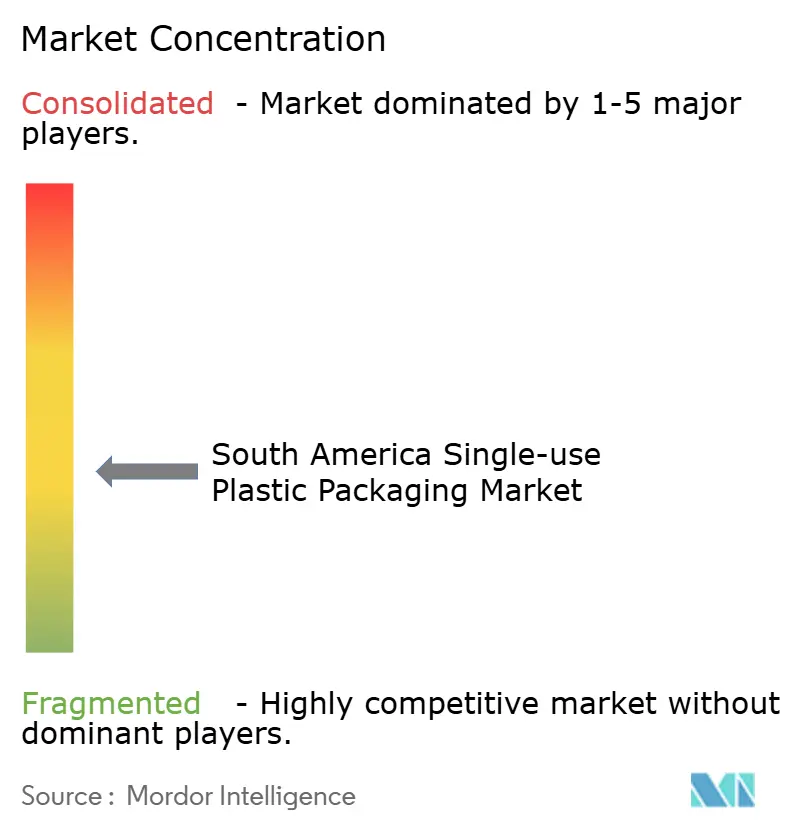
The South America Single-use Plastic Packaging Market is moderately fragmented, with Amcor, Braskem, Sealed Air, Sonoco, and Plastipak collectively accounting for domainating share of regional revenue. The remaining revenue is shared among mid-sized specialists and domestic converters. Large suppliers are expanding recycled-content capacity in Brazil and building plants in Colombia and Chile. This approach supports regulatory compliance while reducing logistics exposure. Amcor completed its acquisition of Berry Global in April 2025, creating a combined company with annualized sales above USD 23 billion. The transaction expanded Amcor’s packaging capabilities and access to recycled-content sourcing networks.[4]
Sealed Air deployed bubble-on-demand equipment in Mercado Libre fulfillment centers to reduce packaging cost and void fill. Braskem operates the Cazoolo circular-packaging design lab, where it develops recyclable mono-material formats with converters and brand owners. Braskem also completed its first commercial sale of chemically recycled circular PE to Copobras Group for pet-food flexible packaging, under ISCC Plus certification. These actions extend competition beyond resin supply and standard converting services. Suppliers that offer design support, certified materials, and recycling links can build deeper customer relationships. The South America Single-use Plastic Packaging Market also has room for specialists who can meet technical and certification requirements.
Pharma-grade EVOH pouch converting remains a specialized area because clean-room qualification and ANVISA certification create entry barriers. ZARAPLAST, Valgroup, and Petropack compete in commodity segments by offering short lead times, customized printing, and lower minimum order quantities. Such companies can serve orders that larger suppliers may not handle efficiently. ProAmpac rebranded TC Transcontinental Packaging’s South American operations in March 2026, covering converting assets in Colombia and Panama. This move added to regional consolidation in flexible packaging. Competition remains active because domestic firms retain relationships with local food, agricultural, and consumer-goods customers.
South America Single-use Plastic Packaging Industry Leaders
-
Amcor plc
-
Berry Global Group, Inc.
-
Sealed Air Corporation
-
Mondi plc
-
Sonoco Products Company
- *Disclaimer: Major Players sorted in no particular order
South America Single-use Plastic Packaging Market Companies Covered in this Report
- Amcor plc
- Berry Global Group, Inc.
- Sealed Air Corporation
- Mondi plc
- Sonoco Products Company
- Huhtamäki Oyj
- ProAmpac Holdings Inc.
- Constantia Flexibles Group GmbH
- Coveris Management GmbH
- Transcontinental Inc.
- Winpak Ltd.
- ALPLA Werke Alwin Lehner GmbH & Co KG
- Plastipak Holdings, Inc.
- Valgroup Participações S.A.
- Logoplaste Group
- AptarGroup, Inc.
- CCL Industries Inc.
- Gerresheimer AG
- Graham Packaging Company, L.P.
- Comar, LLC
- ZARAPLAST S.A.
- Petropack S.A.
- EMUSA
- Megapack
Recent Industry Developments in South America Single-use Plastic Packaging Market
- June 2026: Amcor deployed Brazil’s first Moda Vac rotary vacuum chamber sealing technology at Barra Mansa Alimentos, working with the company’s deboning lines in Sertãozinho. Three system lines that replace up to 9 belt chamber machines are targeted for completion in 2026.
- April 2026: Braskem showcased bio-based and circular polyolefin solutions at Interpack 2026 in Düsseldorf. The company highlighted I’m Green bio-based PE grades for food-contact applications and Medcol V7040 for healthcare and hygiene uses.
- March 2026: ProAmpac rebranded TC Transcontinental Packaging’s South American operations under the ProAmpac identity. ProAmpac operates converting assets in Colombia and Panama, including Olefinas, Banaplast, Trilex, Supraplast, and Chemplast del Sur.
- February 2026: Chile’s Ministry of the Environment informed municipalities of new requirements for single-use plastics that took effect on February 13, 2026. The rules restrict the provision of single-use plastic products in food establishment.
South America Single-use Plastic Packaging Market Report Scope
The South America Single-Use Plastic Packaging Market refers to disposable packaging solutions designed for one-time use across various industries in the region. This includes rigid, flexible, and semi-rigid formats such as bottles, pouches, trays, and films manufactured from polymers like polyethylene and polypropylene, as well as bioplastics like polylactic acid. These packaging products are primarily used by the food and beverage, personal care, and pharmaceutical sectors, as well as retail and foodservice outlets, for their convenience, cost-effectiveness, and product protection.
The South America Single-use Plastic Packaging Market Report is Segmented by Product Type (Bottles and Containers, Bags and Pouches, Trays, Cups, and Lids, Clamshells, Films and Wraps, and Other Product Types), Material Type (Polyethylene, Polypropylene, Polyethylene Terephthalate, Polystyrene and Expanded Polystyrene, Polylactic Acid, and Other Material Types), Packaging Format (Rigid Packaging, Flexible Packaging, and Semi-Rigid Packaging), Application (Food Packaging, Beverage Packaging, Personal Care Packaging, Pharmaceutical Packaging, Household and Institutional Packaging, and Industrial and Agricultural Packaging), End User (Foodservice and Quick-Service Restaurants, Retail and Supermarkets, E-Commerce and Delivery Platforms, Consumer Goods Manufacturers, Healthcare and Pharmaceutical Manufacturers, and Personal Care and Cosmetics Manufacturers), and Geography (Brazil, Argentina, Colombia, Chile, and Rest of South America). The Market Forecasts are Provided in Terms of Value (USD).
Segmentation Overview
| Bottles and Containers |
| Bags and Pouches |
| Trays, Cups, and Lids |
| Clamshells |
| Films and Wraps |
| Other Product Types |
| Polyethylene |
| Polypropylene |
| Polyethylene Terephthalate |
| Polystyrene and Expanded Polystyrene |
| Polylactic Acid |
| Other Material Types |
| Rigid Packaging |
| Flexible Packaging |
| Semi-Rigid Packaging |
| Food Packaging |
| Beverage Packaging |
| Personal Care Packaging |
| Pharmaceutical Packaging |
| Household and Institutional Packaging |
| Industrial and Agricultural Packaging |
| Foodservice and Quick-Service Restaurants |
| Retail and Supermarkets |
| E-Commerce and Delivery Platforms |
| Consumer Goods Manufacturers |
| Healthcare and Pharmaceutical Manufacturers |
| Personal Care and Cosmetics Manufacturers |
| Brazil |
| Argentina |
| Colombia |
| Chile |
| Rest of South America |
| By Product Type | Bottles and Containers |
| Bags and Pouches | |
| Trays, Cups, and Lids | |
| Clamshells | |
| Films and Wraps | |
| Other Product Types | |
| By Material Type | Polyethylene |
| Polypropylene | |
| Polyethylene Terephthalate | |
| Polystyrene and Expanded Polystyrene | |
| Polylactic Acid | |
| Other Material Types | |
| By Packaging Format | Rigid Packaging |
| Flexible Packaging | |
| Semi-Rigid Packaging | |
| By Application | Food Packaging |
| Beverage Packaging | |
| Personal Care Packaging | |
| Pharmaceutical Packaging | |
| Household and Institutional Packaging | |
| Industrial and Agricultural Packaging | |
| By End User | Foodservice and Quick-Service Restaurants |
| Retail and Supermarkets | |
| E-Commerce and Delivery Platforms | |
| Consumer Goods Manufacturers | |
| Healthcare and Pharmaceutical Manufacturers | |
| Personal Care and Cosmetics Manufacturers | |
| By Geography | Brazil |
| Argentina | |
| Colombia | |
| Chile | |
| Rest of South America |
Key Questions Answered in the Report
What is the South America Single-use Plastic Packaging Market size?
The South America Single-use Plastic Packaging Market was valued at USD 1.84 billion in 2025 and is estimated at USD 1.91 billion in 2026. It is forecast to reach USD 2.29 billion by 2031 at a 3.70% CAGR.
Which product category leads demand in South America?
Bottles and Containers led product demand with 36.14% of revenue in 2025, supported by beverage, pharmaceutical, and personal care requirements.
Which packaging format is expanding fastest?
Flexible Packaging is forecast to grow at a 4.41% CAGR through 2031 as brands seek lower transport weight and more efficient parcel protection.
Why are recyclable designs becoming more important?
Recovery and recycled-content requirements in Brazil and restrictions in Chile are encouraging converters to use recyclable mono-material and compostable designs.
Which country has the highest demand?
Brazil held 31.01% of 2025 revenue, supported by food processing, beverage production, e-commerce, and investment in recycling capacity.
What constrains packaging suppliers in the region?
Resin price volatility, restrictions on selected single-use formats, limited food-grade recycled resin, and fragmented collection systems constrain supplier operations.