
South America Pouch Packaging Market Size and Share
Market Overview
| Study Period | 2020 - 2031 |
|---|---|
| Forecast Data Period | 2026 - 2031 |
| Base Year Market Size (2025) | USD 2.03 Billion |
| Market Size (2026) | USD 2.14 Billion |
| Market Size (2031) | USD 2.72 Billion |
| Growth Rate (2026 - 2031) | 4.91 % |
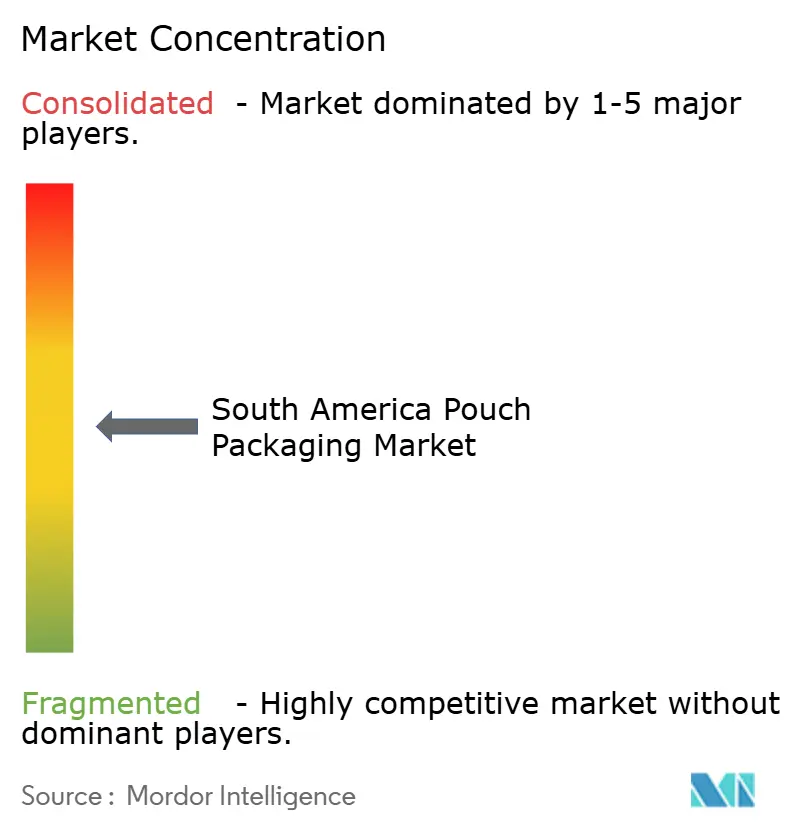
| Market Concentration | Medium |
Major Players *Disclaimer: Major Players sorted in no particular order Image © Mordor Intelligence. Reuse requires attribution under CC BY 4.0. | |
South America Pouch Packaging Market Analysis by Mordor Intelligence
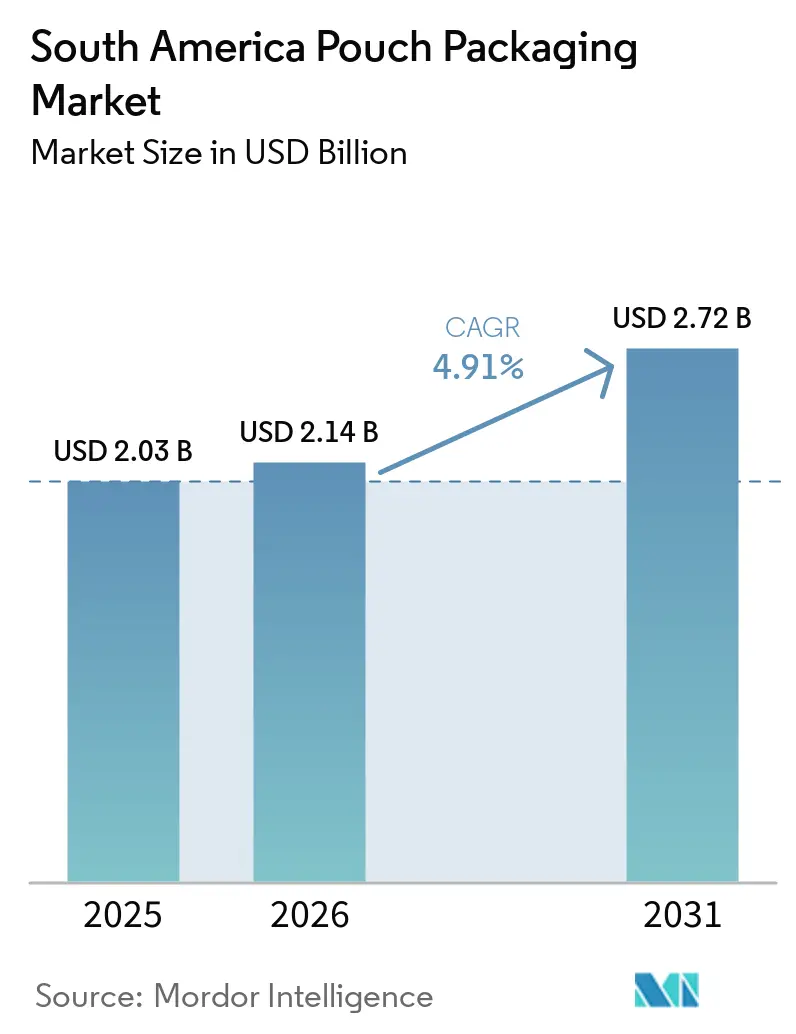
The South America pouch packaging market size is projected to expand from USD 2.03 billion in 2025 and USD 2.14 billion in 2026 to USD 2.72 billion by 2031, registering a CAGR of 4.91% between 2026 to 2031. Demand is moving from rigid containers toward flexible formats in food, personal care, pharmaceuticals, and beverages. This shift reflects lower material use, easier transport, and a better fit with modern retail requirements. Brazil remains the region’s main production and demand center because of its large flexible packaging base and food processing activity. Converters are balancing price-sensitive demand with stricter expectations for recyclable packaging. Companies that can secure circular resin, high-barrier capability, and reliable local service are better placed to serve brand owners across the region.
Key Report Takeaways
- By material, polyethylene held 32.46% of the South America pouch packaging market share in 2025, while biodegradable and compostable formats are projected to expand at a 5.14% CAGR through 2031.
- By product type, stand-up pouches accounted for 33.42% of the South America pouch packaging market size in 2025, while spouted pouches are expected to expand at a 5.11% CAGR through 2031.
- By closure type, zipper closures held 31.22% revenue share in 2025, while spout-and-cap closures are projected to expand at a 5.24% CAGR through 2031.
- By end-user industry, food accounted for 52.37% share in 2025, while medical and pharmaceutical applications are projected to expand at a 5.41% CAGR through 2031.
- By geography, Brazil held 41.14% share in 2025, while Argentina is projected to expand at a 5.36% CAGR through 2031.
Note: Market size and forecast figures in this report are generated using Mordor Intelligence’s proprietary estimation framework, updated with the latest available data and insights as of January 2026.
Market Trends and Insights
Drivers Impact Analysis of South America Pouch Packaging Market*
| Driver | (~) % Impact on CAGR Forecast | Geographic Relevance | Impact Timeline |
|---|---|---|---|
| Shift From Rigid to Flexible Packaging | +1.4% | Global, concentrated in Brazil and Argentina | Short term (≤ 2 years) |
| Expansion of Organized Retail and Modern Trade | +0.9% | Brazil, Colombia, Chile, Peru | Medium term (2-4 years) |
| Growth of Lightweight and Portable Food Packaging | +0.7% | Brazil, Argentina, Rest of South America | Short term (≤ 2 years) |
| Adoption of Recycle-Ready Mono-Material Pouches | +0.5% | Brazil, with early spillover to Chile and Colombia | Medium term (2-4 years) |
| Localized High-Barrier and Retort Capability | +0.3% | Brazil and Argentina | Long term (≥ 4 years) |
| Premium Pet Food and Portion-Control Packaging | +0.2% | Brazil and Argentina | Medium term (2-4 years) |
| Source: Mordor Intelligence | |||
Shift From Rigid to Flexible Packaging
The shift from rigid packaging to pouches supports demand across South America’s food processing sector. Pouches can substantially reduce packaging weight compared with glass or metal alternatives, which can lower freight costs on export and domestic distribution routes. Flexible packaging demand for polyethylene has continued to outpace rigid-plastic demand as brand owners adapt lines for pouch-compatible form-fill-seal systems.[1] Once a producer invests in pouch filling equipment, returning to rigid formats can require further capital spending. Retort and aseptic pouches are also widening the use of flexible packaging in shelf-stable proteins, ready-to-eat meals, and infant nutrition. This gives the South America pouch packaging market a more durable base of demand than a short-term format preference.
Expansion of Organized Retail and Modern Trade
Organized retail favors pouches because retailers need shelf-ready packs, standardized displays, and formats that support repeat purchases. Cencosud allocated substantial capital expenditure, with the majority directed toward store growth and greenfield development across its South American operations.[2] Jerónimo Martins opened numerous Ara stores and integrated dozens of Colsubsidio stores in Colombia, increasing the reach of formal grocery retail in the Bogotá area. These networks rely on shorter refresh cycles and packaging that meets display requirements. Resealable and shelf-stable pouches fit those requirements in food, dairy, snacks, and personal care. The South America pouch packaging market, therefore, benefits as modern trade gains share from informal retail channels.
Growth of Lightweight and Portable Food Packaging
Urbanization has increased demand for portable, portioned, and easy-to-store food packaging across the region. South America’s urbanization rate exceeded 82%, supporting formats that fit single-person households and consumption outside the home.[3] Sachets and stick packs can also reduce the immediate purchase cost for households facing inflation. Brazil’s food processing sector makes a significant contribution to the national economy and depends on flexible packaging for food distribution and exports. Lower pack weight can improve freight efficiency and reduce cold-chain energy needs for frozen protein and dairy products. Hospital, foodservice, and institutional channels also use individual-serving pouches for medical nutrition and ready-to-heat meals.
Adoption of Recycle-Ready Mono-Material Pouches
Brazil’s Federal Decree No. 12,688/2025 created a national reverse-logistics framework for plastic packaging. The decree places recovery obligations on manufacturers, importers, distributors, and retailers according to the plastic mass they place on the market. Flexible packaging contained limited recycled content in early 2026, compared with the higher statutory target cited in the draft. This gap increases pressure on brands to use structures that can be certified and recovered. Braskem and Antilhas developed a fully polyethylene stand-up pouch for the Mãe Terra brand, using electron-beam printing to avoid lamination while maintaining printability and barrier performance. The South America pouch packaging market can reward converters that establish mono-material capabilities before customer procurement requirements become more demanding.
Restraints Impact Analysis of South America Pouch Packaging Market*
| Restraint | (~) % Impact on CAGR Forecast | Geographic Relevance | Impact Timeline |
|---|---|---|---|
| Volatile Polyethylene and Polypropylene Resin Costs | -0.5% | Global, acute in Brazil | Short term (≤ 2 years) |
| Underdeveloped Collection and Recycling Infrastructure | -0.4% | Brazil and Argentina, with spillover to Colombia and Peru | Long term (≥ 4 years) |
| Capital Intensity of High-Speed Filling and Retort Equipment | -0.3% | Brazil and Argentina | Medium term (2-4 years) |
| Technical Trade-Offs Between Recyclability and Barrier Performance | -0.2% | Brazil and Chile | Long term (≥ 4 years) |
| Source: Mordor Intelligence | |||
Volatile Polyethylene and Polypropylene Resin Costs
Polyethylene and polypropylene represent a substantial share of pouch converters’ material costs. South American producers are exposed to external pricing changes because regional steam crackers depend mainly on naphtha feedstocks. Polyethylene and polypropylene prices returned to elevated levels before supply disruptions in the Middle East affected pricing. Braskem raised domestic LDPE, HDPE, and LLDPE prices, while Brazil imposed an antidumping duty on U.S.-origin polyethylene. These pressures limit sourcing flexibility and can narrow margins for smaller and mid-sized converters.
Underdeveloped Collection and Recycling Infrastructure
Flexible plastics represent a large part of household packaging waste, yet collection systems remain less developed than those for rigid PET and paper. This limits the supply of traceable post-consumer material available for pouch production. Brazil entered 2026 with 5% recycled content in flexible packaging against the 22% target specified by the national framework PLANALTO.GOV.BR. Argentina had no extended producer responsibility rules or recycled-content mandates for flexible formats by mid-2026, according to the draft. Informal and inconsistent collection systems make it difficult to secure material at industrial volumes. Mono-material designs can improve recyclability, but collection, sorting, and reprocessing capacity must also expand for the claimed circular outcome to be realized.
*Our forecasts treat driver/restraint impacts as directional, not additive. The impact forecasts reflect baseline growth, mix effects, and variable interactions.
South America Pouch Packaging Market Segment Analysis
By Material:
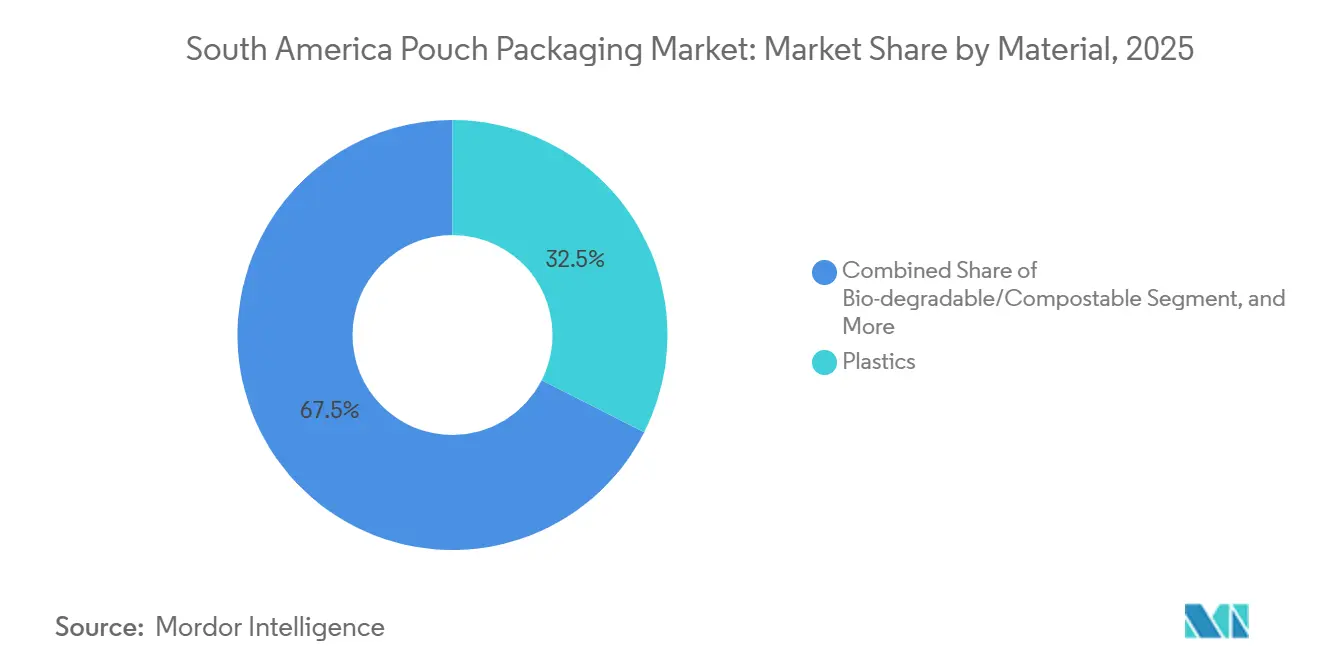
Polyethylene Leads as Bio-Based and Compostable Grades Gain GroundPolyethylene held 32.46% of the South America pouch packaging market share in 2025, making it the largest material category. Its position reflects cost competitiveness, broad converter compatibility, and production availability from Braskem’s regional operations. Blown-film and cast-extrusion lines in Brazil, Argentina, and Chile are designed for LDPE, LLDPE, and metallocene polyethylene grades. These grades serve food, agro-industrial, and consumer goods packaging applications. Polypropylene has an important role in hot-fill and retort uses because it offers stronger heat resistance than polyethylene. PET and PVC remain relevant for selected transparent, thermoformed, and specialty pouch uses.
Biodegradable and compostable formats are projected to expand at a 5.14% CAGR from 2026 to 2031, the fastest rate among material subsegments. Brands are assessing these options as they seek packaging with clearer end-of-life credentials. Braskem’s I’m green bio-based polyethylene is produced from sugarcane ethanol and can be used as a food-contact material. The company states that the material has a certified negative cradle-to-gate carbon footprint. Aluminum foil remains important in pharmaceutical packs, high-barrier retort pouches, and premium foods where oxygen and moisture protection requirements are high. At the same time, recycled-content targets and mono-material redesign programs are encouraging suppliers to reconsider multilayer structures.

By Product Type:
Stand-Up Formats Anchor Volume as Spouted Pouches AccelerateStand-up pouches held 33.42% of the product category in 2025, giving them the leading position in the South America pouch packaging market. They are widely used in food, pet care, and personal care because they provide shelf visibility, portability, and compatibility with zipper and spout closures. Existing form-fill-seal equipment in Brazil and Argentina is already configured for common stand-up pouch dimensions. This installed base supports continued use across high-volume packaged goods. Flat pillow and side-seal formats remain common in commodity food and single-serve applications. Retort and aseptic designs are also being adopted for processed meats, ready meals, and infant nutrition that require ambient shelf life.
Spouted pouches are projected to expand at a 5.11% CAGR from 2026 to 2031. Beverage, baby food, condiment, and personal care applications use this format when controlled dispensing and resealing are needed. SIG consolidated its bag-in-box and spouted pouch operations in South America in March 2026, naming its Vinhedo facility as the regional hub. The company described the facility as one of its largest spouted pouch operations globally in the draft. Stick packs and sachets serve price-sensitive customers who purchase smaller units of nutrition, detergent, and pharmaceutical products. Rollstock and premade pouches also support co-manufacturers and brand-owned lines that handle many product variations.
By Closure Type:
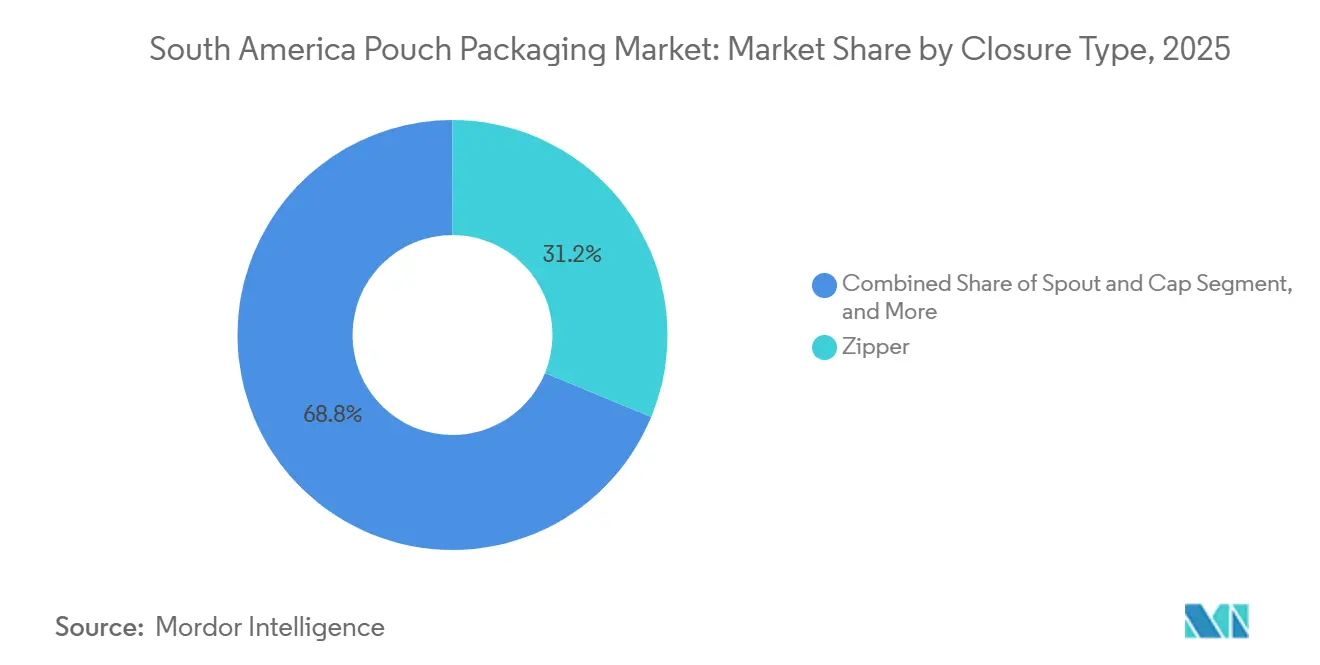
Zipper Formats Define Resealability PremiumZipper closures accounted for 31.22% of the closure category in 2025. This leading South America pouch packaging market share reflects demand for packs that can be opened and resealed in frozen food, pet food, snacks, and dry goods. Zippers cost more than tear-notches because of added tooling and material. Brand owners increasingly accept that cost because resealability can reduce waste and help maintain freshness. Tear-notches remain important in commodity single-serve products, pharmaceutical sachets, and personal care packs. These applications prioritize low cost and high-speed filling over repeat use.
Spout-and-cap closures are projected to expand at a 5.24% CAGR from 2026 to 2031, the fastest rate among closure configurations. Their use is increasing in liquid foods, beverages, and personal care products that need controlled dispensing. The closure is integral to the wider use of spouted pouches in baby food, applesauce, sports nutrition, and pet food in sauce. Slider closures occupy a more premium tier because they provide simple reclosure with an audible snap. They are used in protein snacks, cheese, and frozen meals, especially in Brazil and Argentina. As organized retail raises presentation standards, dispensing precision and resealability are becoming more important in category positioning.
By End-User Industry:
Food Underpins Market Scale as Medical and Pharmaceutical OutpacesFood held 52.37% of the South America pouch packaging market size in 2025 and remained the largest end-user category. The category includes candy, frozen protein, dairy, dry cereals, sauces, condiments, meat, poultry, and pet food. South America’s agricultural export base supports demand for flexible formats that protect food during storage and transport. Brazil’s food processing sector made a significant contribution to the country’s GDP in 2025. Brazil’s pet sector generated substantial revenue, with pet food accounting for the largest share of this revenue.
Medical and pharmaceutical packaging is projected to expand at a 5.41% CAGR from 2026 to 2031. Healthcare infrastructure, generic drug distribution, and demand for child-resistant and tamper-evident structures support this outlook. Braskem presented its I’m green Medcol VV7040 bio-based LDPE grade for blow-fill-seal pharmaceutical packaging at Pharmapack Europe in January 2026. The material was designed for existing pharmaceutical packaging processes. Beverage demand is supported by spouted and retort pouches used in foodservice and export channels. Personal care, cosmetics, home care, and household products use refill pouches to reduce material use and support convenient replenishment.
Geography Analysis
Brazil Pouch Packaging Market
Brazil held 41.14% of the South America pouch packaging market share in 2025 and remained the region’s largest country market. Its food processing base, consumer goods manufacturing capacity, and modern retail network support consistent demand. The Brazilian supermarket sector generated BRL 1.145 trillion, equal to USD 196.1 billion at the 2025 average exchange rate used in the draft. That revenue increased 7.32% in nominal terms during 2025. Federal Decree No. 12,688/2025 is reshaping packaging development by setting reverse-logistics obligations for plastic packaging. In June 2026, Amcor installed Moda rotary vacuum chamber sealing technology at Barra Mansa Alimentos in Brazil, using 3 high-speed lines to replace as many as 9 belt chamber machines.
Argentina and Andean South America Pouch Packaging Market
Argentina is projected to expand at a 5.36% CAGR from 2026 to 2031, the fastest country rate cited for the South America pouch packaging market. Its food processing corridor includes Buenos Aires, Córdoba, and Rosario, where converters produce retort and high-barrier formats for meat, dairy, and ready-to-eat exports. Currency stabilization in 2025 reduced the cost of imported functional ingredients and supported renewed investment in premium flexible packs. Colombia also benefits from the further development of organized retail. Ara’s 225 new stores and 71 integrated Colsubsidio stores increased the reach of packaged food channels in 2025. Chile attracts demand for higher-specification personal care and wine-format pouches. Peru gained strategic importance after Amcor installed an MDO line at its local facility in October 2025 to supply recycle-ready flexible films.
Western and Southern South America Pouch Packaging Market
Rest of South America includes Ecuador, Bolivia, Paraguay, and Uruguay. This group is fragmented because regulatory rules, converter capacity, and retail development differ by country. Bolivia and Paraguay depend heavily on supply from Brazilian and Argentine converters. Ecuador’s fresh produce and floriculture exports create demand for specialty barrier pouches on refrigerated air-freight routes. Organized retail is expanding outside the major markets and is supporting shelf-stable and portion-controlled products. This creates a broader secondary demand base for regional pouch suppliers.
Competitive Landscape
The South America pouch packaging market is moderately concentrated in high-barrier and specialized flexible packaging. Commodity applications are more fragmented because regional converters can serve local accounts and smaller orders. Amcor, ProAmpac, Mondi, Constantia Flexibles, and SIG Group compete through material portfolios, equipment expertise, and recyclable packaging options. These companies can serve multinational consumer goods brands with operations in South America. ProAmpac completed its acquisition of TC Transcontinental Packaging for USD 1.51 billion in March 2026. The transaction added film, mono-material, and fiber-based packaging capabilities across a larger manufacturing network.
Toppan Packaging completed its first year as an integrated platform in April 2026 following the acquisition of Sonoco’s flexible and thermoformed packaging business in April 2025. The company is combining Japanese barrier-material expertise with manufacturing assets in the Americas. Constantia Flexibles launched its EcoVer Mono-PP Retort Pouch in August 2025 for ready-to-eat meals and wet pet food. The product uses recyclable polypropylene and addresses a long-standing barrier and recyclability challenge. ProAmpac also expanded its ProActive Recyclable portfolio with high-barrier retort pouch solutions in April 2026. These moves show that high-performance recyclable structures are central to competition among larger suppliers.
Regional companies such as ZARAPLAST, Bolsafilm, and Plastrela Embalagens Flexíveis compete through shorter cycle times and closer service for mid-sized customers. Their position is stronger where customers need customized formats or lower volumes that large multinational suppliers may not prioritize. Brazilian bio-polymer converters that work with Braskem can offer circular and bio-based polyethylene options with traceable sourcing. The main open opportunities remain recycle-ready mono-material retort pouches for protein processors and small-format stick-pack lines for suburban and informal retail. Smaller converters face pressure from volatile resin costs and the capital needed for high-speed filling and retort equipment. The competitive environment therefore favors both technology investment and local operational responsiveness.
South America Pouch Packaging Industry Leaders
-
Amcor plc
-
ProAmpac Holdings, Inc.
-
Mondi plc
-
Constantia Flexibles Group GmbH
-
Huhtamäki Oyj
- *Disclaimer: Major Players sorted in no particular order
South America Pouch Packaging Market Companies Covered in this Report
- Amcor plc
- ProAmpac Holdings, Inc.
- Mondi plc
- Constantia Flexibles Group GmbH
- Huhtamaki Oyj
- Sonoco Products Company
- Gualapack S.p.a.
- SIG Group AG
- Sealed Air Corporation
- Uflex Ltd.
- Berry Global Group, Inc.
- Toppan Holdings Inc.
- ZARAPLAST S.A.
- Plastrela Embalagens Flexiveis Ltda
- Bolsafilm S.A.
- Transcontinental Inc.
- FlexPak Services
- Coveris Holdings S.A.
- Aluflexpack AG
- Bischof + Klein SE and Co. KG
Recent Industry Developments in South America Pouch Packaging Market
- June 2026: Amcor installed the first Moda rotary vacuum chamber sealing technology in Brazil at Barra Mansa Alimentos' facility in partnership with the beef producer, deploying 3 Moda Vac high-speed systems that replaced up to 9 belt chamber machines. The installation increased production capacity and set a new benchmark for vacuum sealing efficiency in South America's protein packaging sector.
- May 2026: SIG Group announced an investment of BRL 170 million, equal to USD 29 million at the 2026 exchange rate used in the draft, to modernize its Campo Largo and Vinhedo manufacturing facilities in Brazil. The investment targets advanced production line capabilities for long-life beverage and food packaging.
- April 2026: CD&R completed the acquisition of Sealed Air Corporation at an enterprise value of USD 10.3 billion. Sealed Air now operates as a privately held company, with planned investment in packaging innovation and geographic expansion across food and e-commerce protection applications.
- April 2026: Toppan Packaging marked its first anniversary as an integrated platform following its April 2025 acquisition of Sonoco Products Company’s Flexible and Thermoformed Packaging businesses. The company expanded its global capabilities across flexible and thermoformed formats.
South America Pouch Packaging Market Report Scope
South America Pouch Packaging Market refers to the production, distribution, and use of flexible pouch-style containers made from plastic films, paper, aluminum foil, and multilayer laminates for packaging solid, liquid, and semi-liquid products. It includes flat, stand-up, spouted, retort, sachet, and other pouch formats used across food and beverage, personal care, healthcare, pet food, household, and industrial applications.
The South America Pouch Packaging Market Report is Segmented by Material (Plastics [Polyethylene (PE), Polypropylene (PP), Polyethylene Terephthalate (PET), Polyvinyl Chloride Resin (PVC), and Other Plastics], Paper, Aluminum Foil, and Bio-degradable/Compostable), Product Type (Flat (Pillow and Side-Seal), Stand-Up, Spouted, Retort, Aseptic, Stick-Pack / Sachet, and Rollstock / Premade Pouch), Closure Type (Zipper, Spout and Cap, Tear-Notch, and Slider, and Other Closure Type), End-User Industry (Food [Candy and Confectionery, Frozen Foods, Fresh Produce, Dairy Products, Dry Foods and Cereals, Meat, Poultry and Seafood, Pet Food, and Other Foods], Beverage [Alcoholic, and Non-Alcoholic], Medical and Pharmaceutical, Personal Care and Cosmetics, Home Care and Household, and Other End-User Industry), and Geography (Brazil, Argentina, Colombia, Chile, and Peru). The Market Forecasts are Provided in Terms of Value (USD).
Segmentation Overview
| Plastics | Polyethylene (PE) |
| Polypropylene (PP) | |
| Polyethylene Terephthalate (PET) | |
| Polyvinyl Chloride Resin (PVC) | |
| Other Plastics | |
| Paper | |
| Aluminum Foil | |
| Bio-degradable/Compostable |
| Flat (Pillow and Side-Seal) |
| Stand-Up |
| Spouted |
| Retort |
| Aseptic |
| Stick-Pack / Sachet |
| Rollstock / Premade Pouch |
| Zipper |
| Spout and Cap |
| Tear-Notch |
| Slider |
| Other Closure Type |
| Food | Candy and Confectionery |
| Frozen Foods | |
| Fresh Produce | |
| Dairy Products | |
| Dry Foods and Cereals | |
| Meat, Poultry and Seafood | |
| Pet Food | |
| Other Foods (Sauces, Condiments, Spreads) | |
| Beverage | Alcoholic |
| Non-Alcoholic | |
| Medical and Pharmaceutical | |
| Personal Care and Cosmetics | |
| Home Care and Household | |
| Other End-User Industry |
| Brazil |
| Argentina |
| Colombia |
| Chile |
| Peru |
| Rest of South America |
| By Material | Plastics | Polyethylene (PE) |
| Polypropylene (PP) | ||
| Polyethylene Terephthalate (PET) | ||
| Polyvinyl Chloride Resin (PVC) | ||
| Other Plastics | ||
| Paper | ||
| Aluminum Foil | ||
| Bio-degradable/Compostable | ||
| By Product Type | Flat (Pillow and Side-Seal) | |
| Stand-Up | ||
| Spouted | ||
| Retort | ||
| Aseptic | ||
| Stick-Pack / Sachet | ||
| Rollstock / Premade Pouch | ||
| By Closure Type | Zipper | |
| Spout and Cap | ||
| Tear-Notch | ||
| Slider | ||
| Other Closure Type | ||
| By End-User Industry | Food | Candy and Confectionery |
| Frozen Foods | ||
| Fresh Produce | ||
| Dairy Products | ||
| Dry Foods and Cereals | ||
| Meat, Poultry and Seafood | ||
| Pet Food | ||
| Other Foods (Sauces, Condiments, Spreads) | ||
| Beverage | Alcoholic | |
| Non-Alcoholic | ||
| Medical and Pharmaceutical | ||
| Personal Care and Cosmetics | ||
| Home Care and Household | ||
| Other End-User Industry | ||
| By Geography | Brazil | |
| Argentina | ||
| Colombia | ||
| Chile | ||
| Peru | ||
| Rest of South America | ||
Key Questions Answered in the Report
What is the South America pouch packaging market size?
The South America pouch packaging market size is USD 2.14 billion in 2026 and is projected to reach USD 2.72 billion by 2031, at a 4.91% CAGR. Food, consumer goods, and flexible-packaging conversion support demand across the region, while recyclable designs and high-barrier applications continue to influence supplier investment and customer purchasing requirements.
Which material leads pouch packaging demand in South America?
Polyethylene led the material category with a 32.46% share in 2025, supported by its cost position and compatibility with regional converting equipment. LDPE, LLDPE, and metallocene grades serve many food and consumer applications.
Which pouch product type is expanding most quickly in South America?
Spouted pouches are projected to expand at a 5.11% CAGR through 2031 because liquid food, beverage, and personal care products need controlled dispensing. The format also provides practical resealing for products used over several occasions.
Which end-user category has the largest demand for pouches?
Food held 52.37% share in 2025, supported by packaged foods, frozen protein, dairy, sauces, and pet food. The regions agricultural production and export activity also reinforce demand for protective flexible formats.
Why are mono-material pouch structures becoming more important in Brazil?
Federal Decree No. 12,688/2025 set reverse-logistics obligations for plastic packaging, increasing demand for recyclable structures that can support recovery targets. Brands and converters are therefore prioritizing simpler structures that can be better aligned with collection systems.
Which country has the strongest outlook for pouch packaging demand?
Argentina is projected to expand at a 5.36% CAGR through 2031, while Brazil remained the largest country market with 41.14% share in 2025. Argentinas established food-processing corridor supports retort and high-barrier pouch conversion.