
South America Pin-Based Access Control Market Size and Share
Market Overview
| Study Period | 2020 - 2031 |
|---|---|
| Forecast Data Period | 2026 - 2031 |
| Base Year Market Size (2025) | USD 210.81 Million |
| Market Size (2026) | USD 244.56 Million |
| Market Size (2031) | USD 326.28 Million |
| Growth Rate (2026 - 2031) | 5.94 % |
| Market Concentration | Low |
Major Players *Disclaimer: Major Players sorted in no particular order Image © Mordor Intelligence. Reuse requires attribution under CC BY 4.0. | |
South America Pin-Based Access Control Market Analysis by Mordor Intelligence
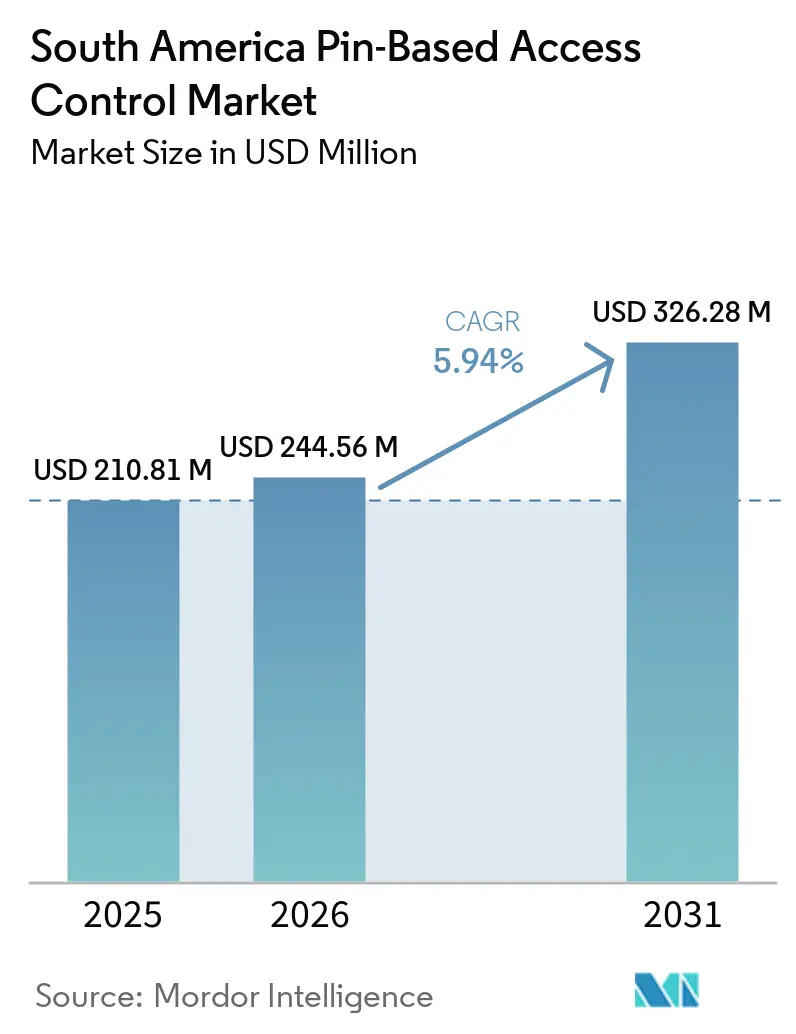
The South America Pin-Based Access Control Market size is projected to expand from USD 210.81 million in 2025 to USD 244.56 million in 2026, and to USD 326.28 million by 2031, registering a CAGR of 5.94% between 2026 and 2031. Rising concern about crime and data protection is moving access control from a discretionary purchase to a compliance and operating requirement. Brazil’s data protection framework requires organizations to implement security measures to protect personal data, thereby supporting demand for auditable entry controls. Cloud administration is expanding access for smaller buyers who previously could not justify the cost of on-site servers or specialized staff. Large projects in logistics, transport, commercial property, and multi-tenant buildings are also creating new installation opportunities. The South America Pin-Based Access Control Market remains exposed to the faster adoption of biometric and mobile credentials, although PINs continue to serve as a fallback within multi-factor systems.
Key Report Takeaways
- By component, hardware held 72.12% of the South America Pin Based Access Control Market share in 2025, while services are forecast to grow at an 6.44% CAGR through 2031.
- By organization size, large enterprises held 61.28% of the South America Pin-Based Access Control Market share in 2025, while SMEs recorded the highest projected CAGR at 6.23% through 2031.
- By end-user industry, banking and financial services accounted for 28.14% of the South America PIN-based access control market size in 2025, while IT and telecommunications are advancing at a 7.12% CAGR through 2031.
- By deployment mode, networked on-premises systems held 46.82% share in 2025, while cloud-managed deployment is projected to expand at an 6.01% CAGR through 2031.
- By authentication mode, card and PIN held 38.61% share in 2025, while PIN with biometric or multi-factor authentication is forecast to grow at a 6.53% CAGR through 2031.
- By geography, Brazil held 35.69% share in 2025, while Colombia is forecast to record the highest CAGR at 7.01% through 2031.
Note: Market size and forecast figures in this report are generated using Mordor Intelligence’s proprietary estimation framework, updated with the latest available data and insights as of January 2026.
Market Trends and Insights
Drivers Impact Analysis of South America Pin-Based Access Control Market*
| Driver | (~) % Impact on CAGR Forecast | Geographic Relevance | Impact Timeline |
|---|---|---|---|
| Rising Security and Privacy Concerns | +2.0% | Brazil and Colombia core, with spillover to Argentina, Chile, and Venezuela | Short term (≤ 2 years) |
| Affordable Security Adoption by Small and Medium-Sized Enterprises | +1.6% | Brazil, Colombia, and Argentina, with secondary uptake in Chile and Peru | Medium term (2-4 years) |
| Cloud-Managed and Mobile-Enabled PIN Administration | +1.2% | Brazil primary, expanding to Colombia, Chile, and urban Argentina | Medium term (2-4 years) |
| Growth of Commercial, Logistics, and Multi-Tenant Facilities | +1.0% | Brazil logistics corridors, Colombia’s 4G infrastructure belt, and Chilean port zones | Medium term (2-4 years) |
| Compatibility With Existing Access-Control Infrastructure | +0.8% | South America-wide, concentrated in the large-enterprise installed base | Long term (≥ 4 years) |
| Retrofit Demand From High-Crime Urban Corridors | +0.6% | São Paulo, Rio de Janeiro, Bogotá, Medellín, and Buenos Aires | Medium term (2-4 years) |
| Source: Mordor Intelligence | |||
Rising Security and Privacy Concerns
Rising security and privacy concerns are supporting structured procurement in the South America Pin-Based Access Control Market. Brazil, Colombia, and Mexico accounted for 70% of homicides in the Americas, concentrating security pressure in major commercial and financial corridors. Brazil’s LGPD requires processing agents to adopt security measures that protect personal data.[1] ANPD Resolution No. 23, published in December 2024, set requirements for security measures by small processing agents. These requirements favor systems that create reliable entry records and can support audits. Facilities using mechanical locks are therefore more likely to replace them with networked PIN or card-and-PIN systems.
Affordable Security Adoption by Small and Medium-Sized Enterprises
Small and medium-sized enterprises are becoming more accessible customers for the South America Pin-Based Access Control Market because cloud subscriptions reduce initial costs. Monthly per-door pricing eliminates the need for an on-site server and reduces the scale of the initial installation. Many smaller firms have identified security gaps even when capital spending remains limited. Local providers and global vendors can address this demand with tiered offers and managed services. Rising labor costs for guarding also encourage smaller sites to use electronic entry controls instead of staffed access points.
Cloud-Managed and Mobile-Enabled PIN Administration
Cloud-managed administration is changing how buyers assess the South America PIN-based access control market. It allows a multi-site operator to manage access rights, alerts, and audit records without visiting each facility. This model is particularly relevant to logistics networks, retail chains, and co-working sites that operate several locations. HID trained more than 500 integrators across South American cities during its 2025 roadshow, showing continued vendor investment in channel capabilities for connected credentials.[2] Hybrid systems also allow customers to retain their installed controllers while adding cloud-based oversight. PIN credentials can remain part of those systems as a fallback factor, preserving demand for compatible readers and controllers.
Growth of Commercial, Logistics, and Multi-Tenant Facilities
New facilities are creating a direct installation pipeline for the South America Pin-Based Access Control Market. CEVA Logistics invested more than BRL 100 million in 2025 to expand its Brazilian contract logistics footprint by more than 150,000 square meters. Logistics sites require perimeter controls and separate access zones for workers, visitors, and cargo areas. Multi-tenant commercial and residential properties also need systems that can change access rights without relying on constant on-site staffing. Colombia’s fourth-generation transport program is creating additional security needs around toll facilities, warehouses, and logistics nodes. These projects favor networked solutions that can connect with broader building, traffic, and surveillance systems.[3]
Restraints Impact Analysis of South America Pin-Based Access Control Market*
| Restraint | (~) % Impact on CAGR Forecast | Geographic Relevance | Impact Timeline |
|---|---|---|---|
| Biometric and Mobile Authentication Substitution | -1.4% | Brazil primary, with Argentina and Colombia secondary | Medium term (2-4 years) |
| PIN Theft, Shoulder Surfing, and Credential Sharing | -1.0% | South America-wide, concentrated in high-density urban commercial zones | Short term (≤ 2 years) |
| Inflation-Driven Hardware and Installation Costs | -0.8% | Argentina most acute, Venezuela, with secondary effects in Brazil and Colombia | Medium term (2-4 years) |
| Fragmented Installer Capability and After-Sales Support | -0.5% | Secondary cities across Brazil, Colombia, and Peru, and rural markets | Long term (≥ 4 years) |
| Source: Mordor Intelligence | |||
Biometric and Mobile Authentication Substitution
Biometric and mobile credentials are limiting the addressable base for PIN-only systems in the South America Pin-Based Access Control Market. HID reported that 73% of organizations used biometrics as part of their multi-factor authentication strategy in 2025. A November 2025 Brazilian survey found that facial recognition had become more popular than fingerprint recognition for authentication. Brazil’s General Sports Law took effect in June 2026 and requires facial biometrics at large arenas and stadiums. PINs are not always eliminated because many organizations use them as a backup factor in a multi-factor configuration. Even so, large regulated sites are likely to allocate more spending to biometrics and mobile access.
PIN Theft, Shoulder Surfing, and Credential Sharing
PIN theft, shoulder surfing, and credential sharing create a trust challenge for single-factor deployments. High-traffic bank branches, retail sites, and corporate lobbies can expose users while they enter a code. Financial institutions are particularly cautious when access points protect cash, servers, or restricted records. The result is a preference for card-and-PIN or PIN with biometric authentication, rather than a complete withdrawal from PIN technology. Vendors that position the PIN as a controlled fallback within a layered system can reduce this concern.
*Our forecasts treat driver/restraint impacts as directional, not additive. The impact forecasts reflect baseline growth, mix effects, and variable interactions.
South America Pin-Based Access Control Market Segment Analysis
By Component:
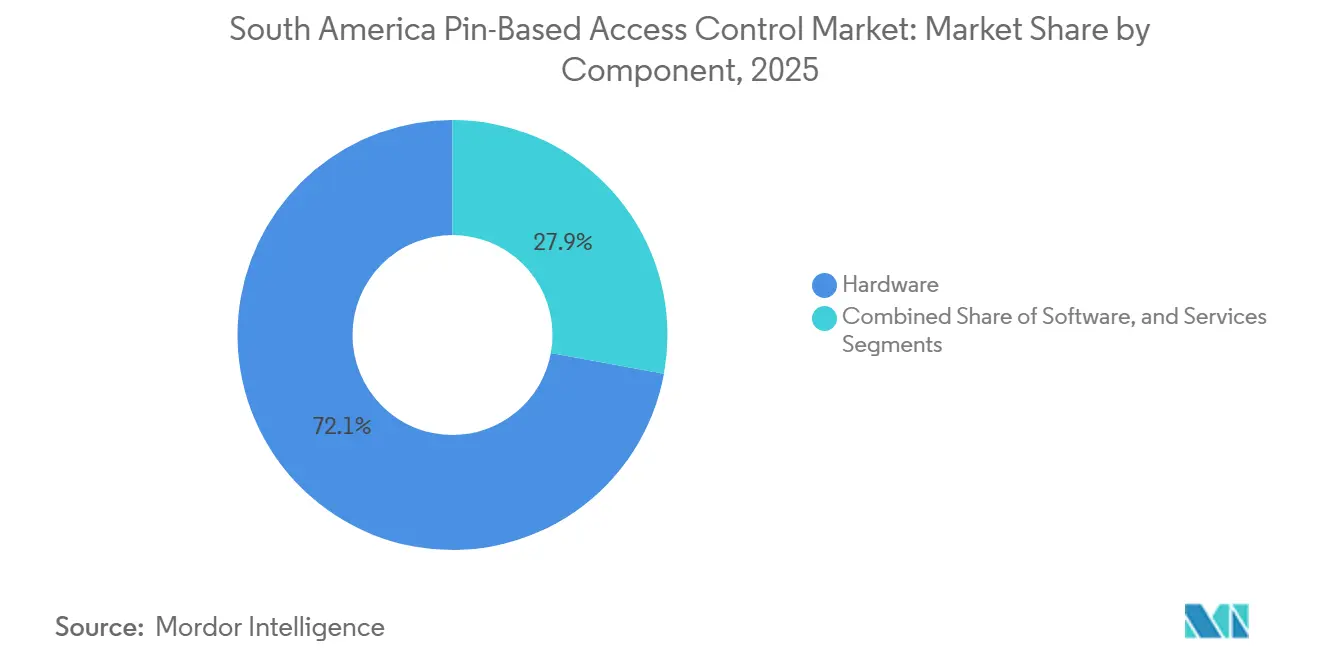
Services Are the Faster-Growing Revenue StreamHardware held 72.12% of the South America Pin-Based Access Control Market share in 2025 because every new system requires readers, controllers, locks, and cabling. Keypad readers and PIN controllers remain important because they provide offline-capable access. Hardware also remains necessary when a site adds cloud administration to an existing door network. Software supports centralized control, audit records, and mobile administration across multiple doors.
Services are forecast to grow at an 6.44% CAGR through 2031, the highest rate among components. Installation, managed monitoring, subscriptions, and technical support create recurring revenue after the equipment sale. This is important for integrators who want longer customer relationships rather than isolated installation contracts. Brazilian public tenders increasingly require cybersecurity-related capabilities for integrated access systems, which can support service proposals with monitoring and compliance support. The South America Pin-Based Access Control Market is therefore likely to reward suppliers that can pair hardware with ongoing support.

By Organization Size:
SMEs Are Expanding AdoptionLarge enterprises held 61.28% of the South America Pin-Based Access Control Market share in 2025 because they manage complex facilities, larger budgets, and formal audit requirements. Banks, government organizations, and technology companies often use layered systems with PIN, card, and biometric readers. Their multi-site estates also support higher spending per contract. These buyers will continue to drive large projects and replacement demand.
SMEs are forecast to grow at an 6.23% CAGR through 2031. Cloud-managed platforms reduce the need for dedicated servers, internal IT teams, and large installation contracts. Smaller firms can use electronic access controls to reduce staffing costs at entry points. LGPD obligations apply to private entities that process personal data, regardless of organization size. This broadens the compliance case for auditable entry records among smaller Brazilian businesses.
By End-User Industry:
Financial Services Leads and IT and Telecom Grows FastestBanking and financial services accounted for 28.14% of the South America PIN-based access control market size in 2025. Branches, ATM rooms, server areas, and cash-handling zones require controlled entry and traceable records. Financial institutions also face regulatory and internal requirements for physical security. This supports regular replacement and upgrade activity for readers and controllers.
IT and telecommunications are projected to grow at a 7.12% CAGR through 2031. Data centers, co-location facilities, telecom switching stations, and corporate campuses require multiple controlled zones. Government, retail, healthcare, utilities, and residential buildings remain additional demand pools. Healthcare and utilities often favor networked or hybrid systems because offline operation and building-system integration remain important. Multi-tenant residential buildings are also adopting cloud-managed PIN intercoms to reduce routine doorman labor.
By Deployment Mode:
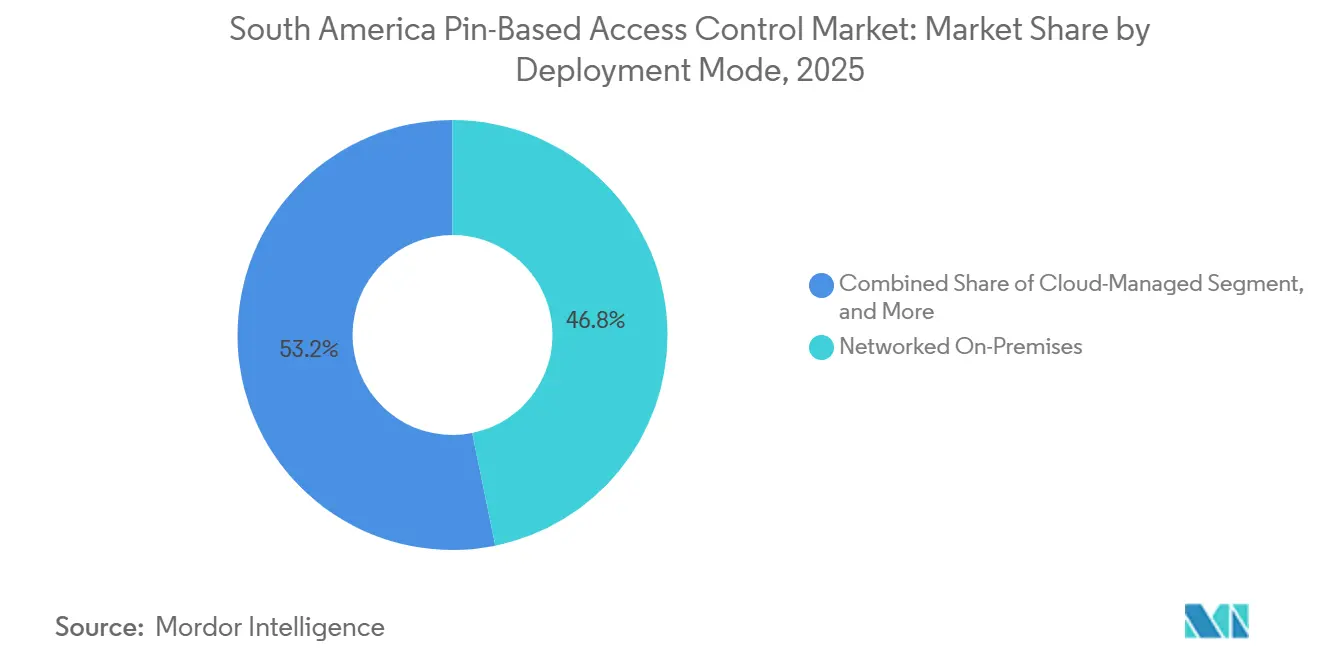
Cloud Management Is Changing System EconomicsNetworked on-premises systems held 46.82% of revenue in 2025, reflecting a large installed base of controllers, panels, and local servers. These systems remain common where sites need direct control, offline reliability, or close integration with building systems. Standalone units also remain relevant for smaller shops, residential buildings, and sites with limited IT infrastructure. The installed base will keep networked systems important throughout the forecast period.
Cloud-managed deployment is projected to grow at an 6.01% CAGR through 2031. Subscription pricing can shift spending from capital budgets to operating budgets, which is useful for expanding logistics and property portfolios. ZKTeco USA launched Cielo365 in June 2025 to help customers move compatible legacy equipment to cloud management without replacing installed hardware. Hybrid deployment can therefore extend the life of existing controllers while adding centralized administration. The South America Pin-Based Access Control Market is shifting toward connected management rather than an immediate replacement of all local systems.[4]
By Authentication Mode:
Card and PIN Has Scale While Multi-Factor Systems Gain GroundCard and PIN held 38.61% of the South America Pin-Based Access Control Market share in 2025. It combines a physical credential with a memorized code and can meet common audit needs without a full biometric deployment. PIN-only systems remain relevant where cost and simplicity are the primary requirements. Mobile credential and PIN systems are gaining use in co-working sites, technology campuses, and logistics parks.
PIN with biometric or multi-factor authentication is forecast to grow at a 6.53% CAGR through 2031. This configuration provides stronger identity verification while retaining the PIN as a familiar fallback factor. It is particularly relevant to sites with regulated data, high-value assets, or high visitor traffic. HID’s 2025 research showed broad organizational use of biometrics within multi-factor authentication. The South America PIN-Based Access Control Market will continue to see demand for PIN-compatible products as the authentication mix becomes more layered.
Geography Analysis
Brazil Pin-Based Access Control Market
Brazil held 35.69% of the South America Pin-Based Access Control Market share in 2025. Its large commercial property base, concentration of financial institutions, and LGPD framework support steady demand for auditable access systems. LGPD Article 46 requires security measures for personal data, while ANPD Resolution No. 23 established additional requirements for small processing agents. CEVA’s 2025 expansion illustrates the role of warehouses in driving demand for new facility security. Biometric adoption is a meaningful competitive risk, but PINs remain relevant as a backup layer within multi-factor systems.
Colombia Pin-Based Access Control Market
Colombia is forecast to grow at an 7.01% CAGR through 2031, the fastest rate in the South America Pin-Based Access Control Market. Transport and logistics investment is increasing the number of sites requiring managed entry controls. The fourth-generation road program is creating needs at toll facilities, warehouses, and associated service locations. Government surveillance and facial recognition projects also require controlled entry points at facilities. Colombia’s higher cost of physical guarding supports the use of electronic controls among SMEs in Bogotá, Medellín, and Cali.
South America Pin-Based Access Control Market
Chile is preparing for a data protection statute that will take effect in December 2026. This is encouraging earlier demand for access systems capable of maintaining reliable logs. Venezuela continues to have constrained formal-sector purchasing, but critical infrastructure and financial institutions maintain selective demand. Peru, Uruguay, Ecuador, and Bolivia add a broad pool of smaller opportunities, while Colombia and Peru offer unit opportunities, and Brazil and Chile support larger average installation values.
Competitive Landscape
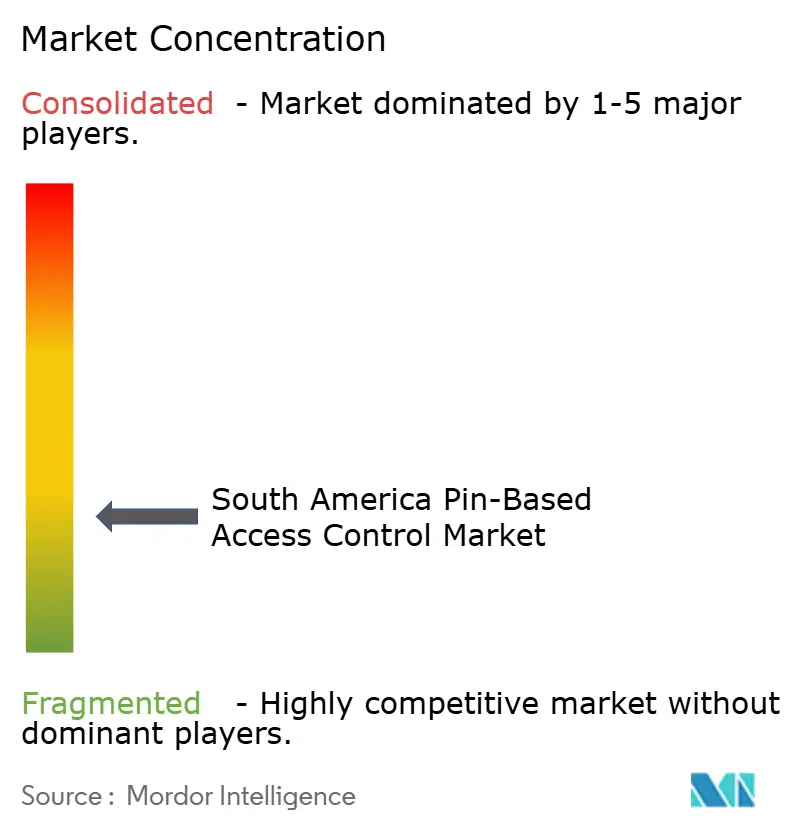
The South America Pin-Based Access Control Market is fragmented. Allegion, HID, and dormakaba have established brands and integrator networks in major cities. ZKTeco, Hikvision, and Dahua compete strongly on price in smaller business and mid-market projects. This creates a divide between suppliers focused on integrated systems and vendors focused on accessible hardware. Secondary cities remain important because installation and after-sales coverage are less developed there.
Allegion announced its acquisition of ELATEC for EUR 330 million (USD 385.42 million) in June 2025, adding multi-technology reader and credential capabilities. HID completed its acquisition of Calmell Group in July 2025 to strengthen its smart ticketing and public transport credential portfolio. ZKTeco entered an exclusive distribution agreement with WEG in Brazil during 2025, extending its national access-control distribution and support coverage. These actions show that product breadth, distribution reach, and credential interoperability are becoming more important than a standalone keypad offer.
Cloud-oriented regional suppliers also compete by replacing large initial payments with monthly operating costs. Control iD and Magikey target co-working, condominium, retail, and multi-site customers that need simpler administration. Suprema expanded its controller portfolio in June 2025 with the CoreStation 20 and Door Interface module. Dormakaba signed an agreement in July 2025 to divest its Brazilian Forponto time-recording and local access-control business to Kiza. The South America Pin-Based Access Control Market favors vendors that can support compliance, maintain local service coverage, and connect installed hardware to cloud tools.
South America Pin-Based Access Control Industry Leaders
-
Allegion plc
-
HID Global Corporation
-
Hangzhou Hikvision Digital Technology Co., Ltd.
-
Zhejiang Dahua Technology Co., Ltd.
-
dormakaba Holding GmbH
- *Disclaimer: Major Players sorted in no particular order
South America Pin-Based Access Control Market Companies Covered in this Report
- Allegion plc
- dormakaba Holding GmbH
- HID Global Corporation
- Hangzhou Hikvision Digital Technology Co., Ltd.
- Zhejiang Dahua Technology Co., Ltd.
- Axis Communications AB
- Avigilon Corporation
- SALTO Systems, S.L.
- Nedap N.V.
- Identiv, Inc.
- Napco Security Technologies, Inc.
- Suprema Inc.
- ZKTeco Co., Ltd.
- Anviz Global Inc.
- Gallagher Group Limited
- Paxton Access Limited
- Inner Range Pty Ltd
- Keri Systems, Inc.
- Essex Electronics, Inc.
- DoorKing, Inc.
- Silgan Holdings Inc.
- ALPLA Werke Alwin Lehner GmbH & Co KG
Recent Industry Developments in South America Pin-Based Access Control Market
- August 2026: Hikvision Brasil participated in Exposec 2026 in Brazil, showcasing integrated access-control and video surveillance solutions. This reinforced its strategy of pairing CCTV infrastructure with PIN and biometric access-control hardware in commercial and industrial sites.
- June 2026: Brazil’s General Sports Law took effect, mandating face biometrics as the exclusive access-control method at large arenas and stadium venues. This policy shapes how PIN-based systems are positioned within multi-factor configurations.
- June 2025: HID Global Corporation completed the acquisition of Calmell Group, expanding its portfolio into smart-ticketing solutions and strengthening its presence in South America’s public transport sector.
- June 2025: dormakaba Holding GmbH and Co. KGaA signed an agreement to divest Forponto Informática S.A. to Kiza Ltda. The transaction reflected dormakaba’s focus on its global portfolio while preserving international product distribution in Brazil.
South America Pin-Based Access Control Market Report Scope
The South America Pin-Based Access Control Market refers to security systems that utilize numeric keypads and personal identification numbers (PINs) to regulate entry to buildings and restricted areas. These systems include hardware such as keypad readers and electronic locks, as well as on-premises or cloud-based management software. Deployed in standalone, networked, or hybrid environments, supporting various authentication modes (from PIN-only to multi-factor), they provide businesses, government facilities, and residential complexes across the region with a cost-effective and scalable way to manage physical access and security.
The South America Pin-Based Access Control Market Report is Segmented by Component (Hardware, (Keypad Readers, PIN Controllers, Electronic Locks and Door Hardware, and Power, Cabling, and Ancillary Hardware), Software (On-Premises Access-Control Software, Cloud-Based Access-Control Software, and Mobile and Web Administration), and Services (Professional Services, and Managed Services)), Organization Size (Small and Medium-Sized Enterprises, and Large Enterprises), End-User Industry (Banking and Financial Services, Government Services, Retail, Information Technology and Telecommunications, Healthcare, Power and Utilities, Residential, and Other End-User Industries), Deployment Mode (Standalone, Networked On-Premises, Cloud-Managed, and Hybrid), Authentication Mode (PIN Only, Card and PIN, Mobile Credential and PIN, and PIN With Biometric or Multi-Factor Authentication), and Geography (Brazil, Argentina, Colombia, Chile, Venezuela, and Rest of South America). The Market Forecasts are Provided in Terms of Value (USD).
Segmentation Overview
| Hardware | Keypad Readers |
| PIN Controllers | |
| Electronic Locks and Door Hardware | |
| Power, Cabling, and Ancillary Hardware | |
| Software | On-Premises Access-Control Software |
| Cloud-Based Access-Control Software | |
| Mobile and Web Administration | |
| Services | Professional Services |
| Managed Services |
| Small and Medium-Sized Enterprises |
| Large Enterprises |
| Banking and Financial Services |
| Government Services |
| Retail |
| Information Technology and Telecommunications |
| Healthcare |
| Power and Utilities |
| Residential |
| Other End-User Industries |
| Standalone |
| Networked On-Premises |
| Cloud-Managed |
| Hybrid |
| PIN Only |
| Card and PIN |
| Mobile Credential and PIN |
| PIN With Biometric or Multi-Factor Authentication |
| Brazil |
| Argentina |
| Colombia |
| Chile |
| Rest of South America |
| By Component | Hardware | Keypad Readers |
| PIN Controllers | ||
| Electronic Locks and Door Hardware | ||
| Power, Cabling, and Ancillary Hardware | ||
| Software | On-Premises Access-Control Software | |
| Cloud-Based Access-Control Software | ||
| Mobile and Web Administration | ||
| Services | Professional Services | |
| Managed Services | ||
| By Organization Size | Small and Medium-Sized Enterprises | |
| Large Enterprises | ||
| By End-User Industry | Banking and Financial Services | |
| Government Services | ||
| Retail | ||
| Information Technology and Telecommunications | ||
| Healthcare | ||
| Power and Utilities | ||
| Residential | ||
| Other End-User Industries | ||
| By Deployment Mode | Standalone | |
| Networked On-Premises | ||
| Cloud-Managed | ||
| Hybrid | ||
| By Authentication Mode | PIN Only | |
| Card and PIN | ||
| Mobile Credential and PIN | ||
| PIN With Biometric or Multi-Factor Authentication | ||
| By Geography | Brazil | |
| Argentina | ||
| Colombia | ||
| Chile | ||
| Rest of South America | ||
Key Questions Answered in the Report
What is the South America Pin-Based Access Control Market size?
The South America Pin-Based Access Control Market was USD 244.56 million in 2026 and is forecast to reach USD 326.28 million by 2031, at a 5.94% CAGR.
What is driving demand for PIN-based access control in South America?
Security concerns, data-protection obligations, cloud-managed administration, and new logistics and commercial facilities are key demand factors.
Which component has the largest share?
Hardware held 72.12% share in 2025 because readers, controllers, locks, and cabling are required in initial installations.
Which buyer group is growing fastest?
SMEs are forecast to grow at an 6.23% CAGR through 2031 as cloud subscriptions reduce initial costs and staffing needs.
Which country is growing fastest?
Colombia is forecast to grow at an 7.01% CAGR through 2031, supported by transport, logistics, and urban security demand.
How do biometrics affect PIN-based access systems?
Biometrics limit demand for PIN-only systems, but PINs continue to be used as a fallback credential within multi-factor deployments.