
South America Pharmaceutical Plastic Packaging Market Size and Share
Market Overview
| Study Period | 2020 - 2031 |
|---|---|
| Forecast Data Period | 2026 - 2031 |
| Base Year Market Size (2025) | USD 1.86 Billion |
| Market Size (2026) | USD 2.01 Billion |
| Market Size (2031) | USD 2.91 Billion |
| Growth Rate (2026 - 2031) | 7.68 % |
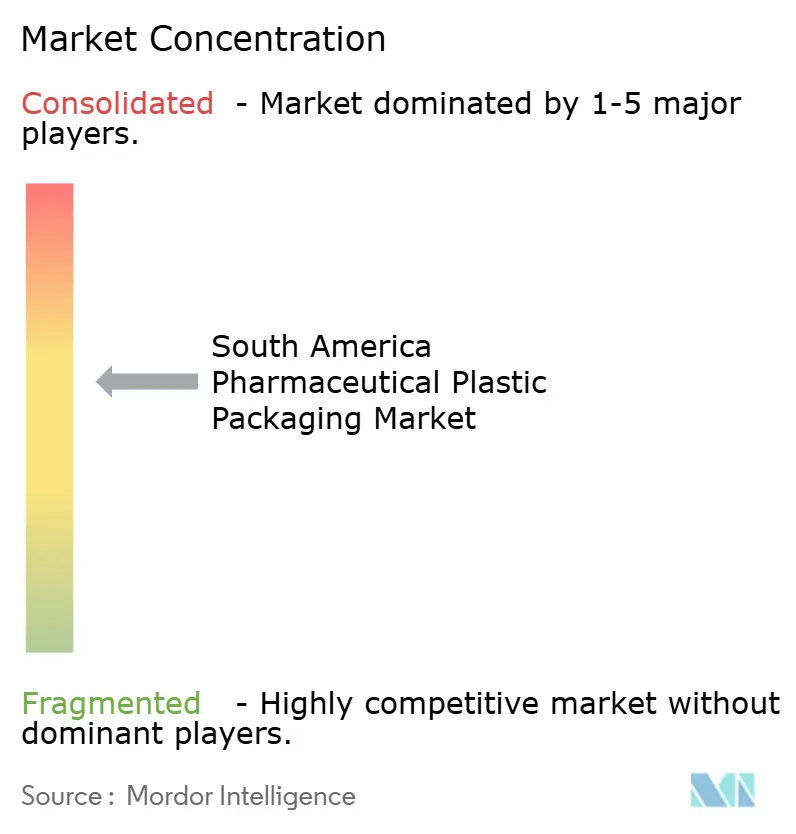
| Market Concentration | Medium |
Major Players *Disclaimer: Major Players sorted in no particular order Image © Mordor Intelligence. Reuse requires attribution under CC BY 4.0. | |
South America Pharmaceutical Plastic Packaging Market Analysis by Mordor Intelligence
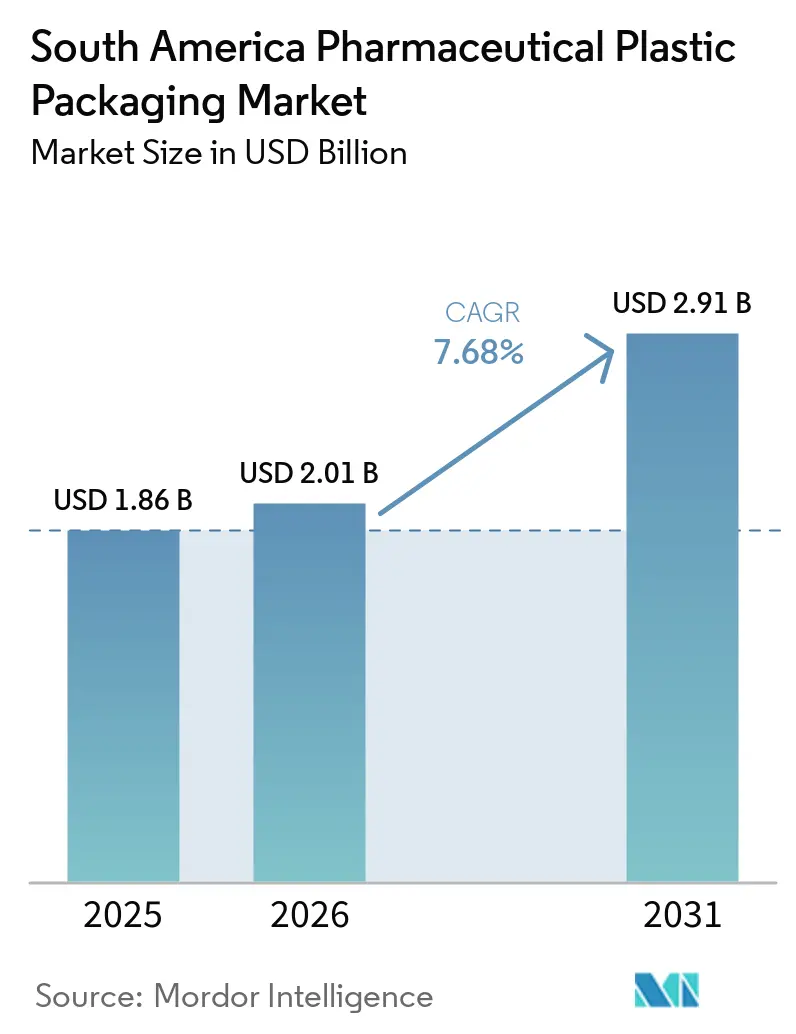
The South America pharmaceutical plastic packaging market size was USD 1.86 billion in 2025 and is forecast to reach USD 2.91 billion by 2031 at a CAGR of 7.68% during 2026-2031. Public procurement, generic substitution policies, and local drug production are raising demand for primary containers across the region. Brazil remains the central demand base because its domestic drug makers procure packaging at large scale. The South America pharmaceutical plastic packaging market also faces a shift toward biologics, injectable therapies, and self-administered products that require more specialized containers. Traceability requirements and limited cold-chain capacity favor suppliers that can provide reliable barrier performance alongside print-compatible surfaces. Competitive strategies therefore combine local production, established regulatory knowledge, and investment in higher-value injectable and recyclable formats.
Key Report Takeaways
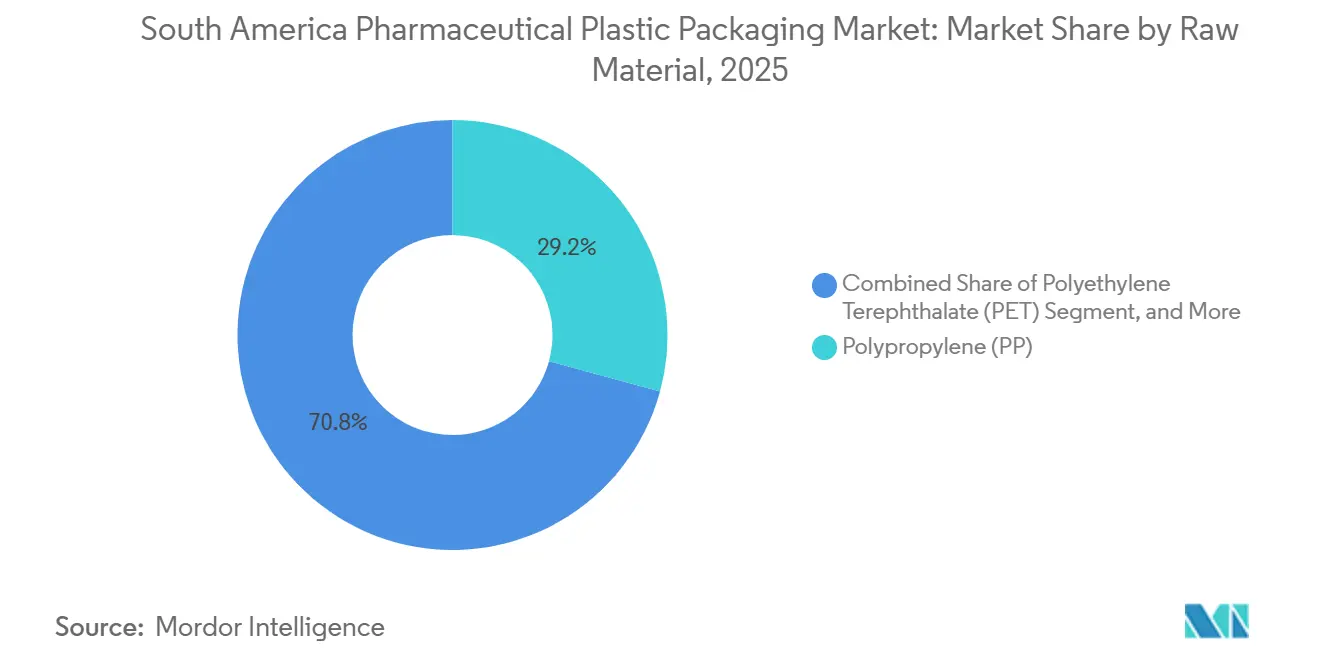
- By raw material, polypropylene held 29.23% of the South America pharmaceutical plastic packaging market share in 2025, while COP/COC is projected to expand at an 8.11% CAGR through 2031.
- By product type, bottles and solid containers held a 29.44% share in 2025, while pre-fillable syringes and cartridges are projected to expand at an 8.23% CAGR through 2031.
- By packaging format, rigid packaging held 72.13% of the South America pharmaceutical plastic packaging market share in 2025, while flexible packaging is projected to expand at an 8.42% CAGR through 2031.
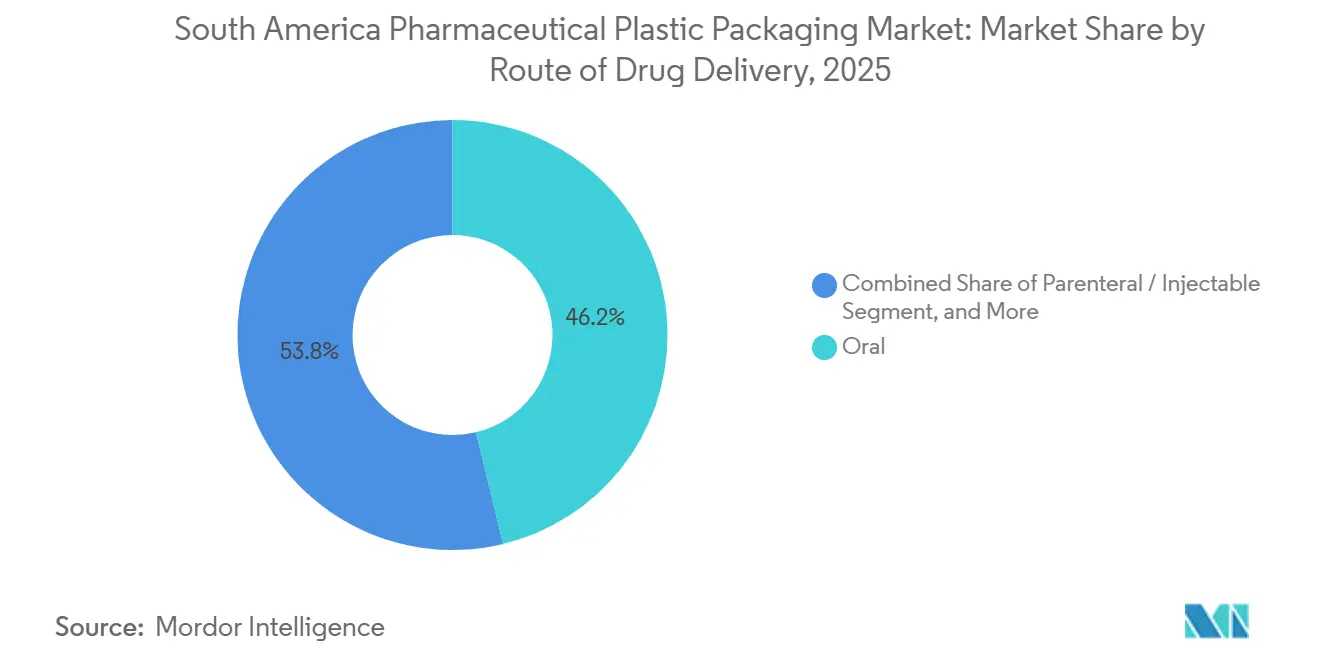
- By route of drug delivery, the oral route held 46.23% of demand in 2025, while parenteral and injectable delivery is projected to expand at an 8.22% CAGR through 2031.
- By end-user, pharma manufacturers held 64.36% of demand in 2025, while home-care settings are projected to expand at an 8.16% CAGR through 2031.
- By geography, Brazil held 35.66% of demand in 2025, while Colombia is projected to expand at an 8.18% CAGR through 2031.
Note: Market size and forecast figures in this report are generated using Mordor Intelligence’s proprietary estimation framework, updated with the latest available data and insights as of January 2026.
Market Trends and Insights
Drivers Impact Analysis of South America Pharmaceutical Plastic Packaging Market*
| Driver | (~) % Impact on CAGR Forecast | Geographic Relevance | Impact Timeline |
|---|---|---|---|
| Expansion of Generic-Drug Manufacturing | +2.5% | Brazil, Argentina, Colombia, Chile | Short term (≤ 2 years) |
| Growth in Biologics and Injectable Therapies | +1.8% | Brazil, Argentina, Colombia | Long term (≥ 4 years) |
| Serialization and Traceability Upgrades | +1.2% | Brazil, Argentina, Colombia | Short term (≤ 2 years) |
| Shift Toward Lightweight and Recyclable Packaging | +0.9% | Brazil, Chile, Colombia | Medium term (2-4 years) |
| Regionalization of Critical-Medicine Supply | +0.7% | South America-wide | Medium term (2-4 years) |
| Validated Barrier Packaging for Sensitive Formulations | +0.5% | Brazil, Argentina | Long term (≥ 4 years) |
| Source: Mordor Intelligence | |||
Expansion of Generic-Drug Manufacturing
Brazil's generic drug sector is the largest single source of packaging demand in the region. ANVISA indicated that a large share of generic drugs sold in Brazil were produced domestically in recent years. The continued localization of production supports recurring demand for bottles, blister packs, and closures. Argentina's Ministry of Health reported that generic medications accounted for a substantial share of its pharmaceutical market. Larger domestic manufacturers are narrowing their polymer grade panels, which reduces the requalification burden under ANVISA requirements. This standardization favors packaging suppliers with approved material specifications and high-throughput PP lines. Generic production also concentrates purchasing decisions among major drug manufacturers. That concentration can make volume contracts more predictable for converters that already meet the required standards. PP bottles, blister packs, and polypropylene closures remain aligned with the needs of high-volume tablet and solid-dose production. Suppliers must also maintain reliable quality documentation because established grades are difficult to replace once a drug product is qualified. The South America pharmaceutical plastic packaging market benefits from this base of routine demand even when specialized formats receive more attention. Local manufacturing capacity, therefore, supports volume continuity across several national procurement systems.
Growth in Biologics and Injectable Therapies
Biologics are shifting demand toward primary containers with stricter performance requirements. COP and COC received formal European Pharmacopeia recognition in 2025 through new chapters from the European Directorate for the Quality of Medicines.[1] The recognition helps reduce documentation barriers for biosimilar developers using these materials. COP and COC provide low extractables, low protein adsorption, optical clarity, and dimensional precision. These attributes are important for biologics and injectable fill-finish operations. The South America pharmaceutical plastic packaging market consequently has a higher need for qualified cartridges and related primary components. West Pharmaceutical Services raised its organic revenue outlook, while High-Value Product component revenue increased significantly, indicating sustained global investment in injectable containment systems. Locally produced GLP-1 pen devices have also created demand for cartridge packaging at Brazilian fill-finish sites. Existing regional supply has limited capacity for COP and COC cartridges manufactured to the required tolerances, creating import dependency while qualification programs develop. Suppliers that combine material expertise with validated manufacturing can address this requirement.
Serialization and Traceability Upgrades
Serialization is changing the technical requirements for pharmaceutical packaging in Brazil and Argentina. Brazil's 2026 DataMatrix requirement for secondary drug packaging adds pressure to improve printability and in-line inspection. Argentina's Disposición 2891/2026 required QR or Data Matrix codes on secondary pharmaceutical packaging from May 16, 2026.[2] The rule provided a six-month transition period for GS1-compliant coding. These measures require converters to evaluate substrates, inks, primers, and vision systems. The South America pharmaceutical plastic packaging market gains demand for technically compliant films and containers as these rules take effect. Glossy PP and PET surfaces can require surface treatment or primers to keep codes durable through distribution. This requirement is particularly relevant where packaging is handled across long supply chains and variable climates. Suppliers with validated printing processes are better placed to meet the new requirements. Smaller converters that rely on untreated commodity films may face qualification barriers. Similar frameworks under consideration in Colombia and Chile extend the relevance of these investments beyond Brazil and Argentina. Traceability upgrades, therefore, make technical capability a more important basis for supplier selection.
Shift Toward Lightweight and Recyclable Packaging
Packaging buyers are increasing their focus on recyclable formats and lower material use. Constantia Flexibles' PERPETUA ALTA is a mono-polypropylene laminate for pharmaceutical sachets and stick packs. The laminate received Class B certification from RecyClass and was a finalist in the 2026 De Gouden Noot packaging innovation award. Its design is compatible with established PP recycling streams. The development shows that recyclable pharmaceutical formats are moving into commercial applications. It also provides a reference for converters evaluating mono-material flexible packs. Klöckner Pentaplast completed its restructuring in January 2026, eliminating EUR 1.3 billion in funded debt and receiving EUR 349 million in new capital. The company can direct capital toward kpNext recyclable pharmaceutical blister films that fit PP, PET, and HDPE recycling streams. Pharmaceutical-grade recycled PP and PET remain unavailable at scale in South America. Recyclable designs, therefore, still depend mainly on virgin resin until collection and reverse-logistics systems improve.
Restraints Impact Analysis of South America Pharmaceutical Plastic Packaging Market*
| Restraint | (~) % Impact on CAGR Forecast | Geographic Relevance | Impact Timeline |
|---|---|---|---|
| Availability of Alternative Packaging Materials | -0.8% | Brazil, Argentina, injectable segment | Long term (≥ 4 years) |
| Volatility in Polymer and Additive Costs | -0.6% | South America-wide | Short term (≤ 2 years) |
| Limited Pharmaceutical-Grade Recyclate and Reverse Logistics | -0.4% | Brazil, Colombia, Chile | Medium term (2-4 years) |
| Fragmented Validation Capacity for Advanced Formats | -0.3% | Brazil, Argentina, Colombia | Long term (≥ 4 years) |
| Source: Mordor Intelligence | |||
Availability of Alternative Packaging Materials
Glass remains an established alternative for injectable pharmaceutical products. Borosilicate Type I vials, ampoules, and prefillable glass syringes have established regulatory acceptance. SCHOTT Pharma reported continued revenue growth, reflecting sustained demand for glass pharmaceutical packaging.[3] Glass-to-polymer conversion requires requalification studies, stability data, and regulatory submissions. These requirements delay material changes for many mid-tier drug manufacturers. Aluminum foil laminates and non-plastic blister materials also compete in selected solid-dose applications. The cost and duration of qualification can limit polymer conversion in tender-led public programs. Price pressure makes it harder to justify a switch when established glass formats already meet the drug product specification. High-value biologics can support polymer adoption where break resistance, weight, or device integration are important. However, glass remains relevant in vials, ampoules, and syringe applications. The South America pharmaceutical plastic packaging market must therefore compete on a clear technical or operating benefit. Material choice will continue to depend on product stability, regulation, and the cost of changing validated packaging systems.
Volatility in Polymer and Additive Costs
PP and PET pricing is linked to global propylene and paraxylene derivative markets. These inputs can be affected by crude oil movements, logistics disruptions, and refinery capacity changes. South American converters also import a significant share of pharmaceutical-grade resin. Currency depreciation, especially in Argentina, can raise local input costs even when global commodity prices are stable. Public tenders often fix per-unit drug procurement prices for extended periods. This limits a converter's ability to pass input increases through the supply chain.
Specialty additives add a second cost risk for pharmaceutical-grade materials. UV stabilizers, antioxidants, and nucleating agents come from a concentrated international supplier base. Smaller regional buyers can face allocation constraints during periods of tight supply. Margin pressure may reduce the capital available for new equipment and material qualification. It can also make price negotiations with drug manufacturers more difficult. The South America pharmaceutical plastic packaging market remains exposed, where packaging suppliers cannot align resin contracts with customer pricing terms.
*Our forecasts treat driver/restraint impacts as directional, not additive. The impact forecasts reflect baseline growth, mix effects, and variable interactions.
South America Pharmaceutical Plastic Packaging Market Segment Analysis
By Raw Material:
Polypropylene Holds Volume Leadership While COP/COC Advances in BiologicsPolypropylene held 29.23% of the South America pharmaceutical plastic packaging market share in 2025. Its position reflects compatibility with solid oral dosage forms and an economical fit for high-volume generic production. PP bottles, closures, and strip packs support Brazil's domestic generic drug manufacturing base. Regulatory acceptance from ANVISA and ANMAT also supports continued use of these established materials. PET provides chemical resistance and optical clarity for liquid oral formulations and selected parenteral containers. HDPE is used for moisture-sensitive products because its barrier performance exceeds standard PP grades in those applications. LDPE remains relevant for eye drops, nasal sprays, squeeze containers, and unit-dose formats. Its lower oxygen barrier limits its use compared with HDPE and PP in more demanding applications.
COP and COC are projected to expand at an 8.11% CAGR through 2031, the highest rate among material categories. Their low extractables profile and glass-like clarity support biologics and biosimilar fill-finish requirements. Their dimensional precision also fits cartridges and other injection-related components. EDQM's 2025 pharmacopoeial chapters make submissions easier for developers using COP and COC. Bio-based and recycled plastics are still at an early adoption stage because qualified pharmaceutical-grade recyclate is not available in sufficient regional volumes. Supply arrangements with qualified overseas resin producers can give converters a compliance advantage as sustainability requirements tighten. Material selection in the South America pharmaceutical plastic packaging industry is consequently separating between broad-volume generic needs and more demanding injectable applications.

By Product Type:
Bottles Anchor Demand While Pre-Fillable Syringes and Cartridges Lead GrowthBottles and solid containers accounted for 29.44% of the South America pharmaceutical plastic packaging market size in 2025. This share reflects the large volume of oral tablets, capsules, and related generic medicines made in Brazil and Argentina. High-throughput bottling lines are designed around public procurement volumes and established dispensing practices. Blister packs and strip packs also have a substantial role in over-the-counter and hospital-dispensed solid doses. PVC-PVDC and aluminum-plastic constructions remain common in these formats. Closures, caps, and lids maintain demand because every primary container requires an engineered closing component. Vials and ampoules serve parenteral medicines in both glass and plastic constructions. IV bags and flexible bags remain important for institutional infusion therapy and single-use contamination control.
Pre-fillable syringes and cartridges are projected to expand at an 8.23% CAGR through 2031. Demand comes from self-administration for diabetes, obesity, autoimmune conditions, and oncology. SCHOTT Pharma introduced a ready-to-use COC polymer cartridge for biologics, biosimilars, and emergency drugs in 2025. The product reflects the wider move toward ready-to-use delivery systems at fill-finish operations. Pouches, stick packs, and sachets address pediatric, geriatric, and home-care needs where unit dosing is important. ANVISA Good Manufacturing Practice requirements and ISO 15223-related labeling needs also shape product qualification. The South America pharmaceutical plastic packaging market has room for suppliers that can support both established oral formats and higher-specification injectable products.
By Packaging Format:
Rigid Packaging Leads While Flexible Formats Serve New UsesRigid packaging held 72.13% of the South America pharmaceutical plastic packaging market share in 2025. Bottles, blister cavities, vials, and pre-fillable syringes are central to hospital pharmacy and retail dispensing practices. These formats provide tamper evidence and clear unit-dose presentation. The installed base of generic manufacturing lines also represents long-term capital investment in rigid container systems. These lines cannot be easily shifted to flexible alternatives. ANVISA Good Manufacturing Practice guidance requires reliable container-closure integrity testing. Rigid systems often provide a more established route through multiyear stability studies. The result is a durable role for rigid formats across the region's broad pharmaceutical product base.
Flexible packaging is projected to expand at an 8.42% CAGR through 2031, the highest rate across the reported segmentation types. Home-care dispensing, ambulatory treatment, and single-dose sachets support this momentum. Flexible packs can serve pediatric and geriatric patients who need convenient doses. Mono-PP laminates and recyclable blister films are lowering the qualification barrier for more sustainable flexible options. Multilayer barrier films can also support cold-chain biologics in home-care distribution. Lower weight and thermal-response characteristics are relevant for last-mile delivery across varied geographies. Flexible formats complement rigid packaging rather than displace it across the South America pharmaceutical plastic packaging market.
By Route of Drug Delivery:
Oral Products Lead While Parenteral Delivery AcceleratesThe oral route accounted for 46.23% of packaging demand in 2025. Tablets, capsules, syrups, and oral powders dominate many public health procurement programs. Brazil's domestic production of generic drugs supports demand for PP bottles, PET containers, blister packs, and closures. ANVISA reported that domestically produced drugs accounted for most generic drugs sold in Brazil. Ophthalmic and nasal formats remain smaller specialty applications associated with eye drops, nasal sprays, and related unit-dose containers. Topical and transdermal products also support localized pain management and hormone therapy protocols, maintaining a diverse demand base beyond oral medicines.
Parenteral and injectable delivery is projected to expand at an 8.22% CAGR through 2031. Biosimilar launches, hospital formularies, and self-administration programs are supporting this direction. Pen injectors and autoinjectors require cartridges, needle shields, and luer-lock closures at each fill-finish stage. The growth of teleconsultations in Brazil supports the infrastructure case for home-based care. Injectable formats require strong barrier performance and reliable dimensional tolerances. These technical requirements encourage packaging suppliers to develop specialized polymer capabilities. The South America pharmaceutical plastic packaging market is increasingly linked to the operating requirements of injectable drug delivery systems.
By End-User:
Pharma Manufacturers Lead Procurement While Home Care Gains GroundPharma manufacturers held 64.36% of end-user demand in 2025. This concentration reflects industrial-scale purchasing of packaging materials and components. Large generic manufacturers set material specifications, contract volumes, and pricing terms for their suppliers. The role is especially visible in Brazil and Argentina, where domestic firms supply public tender programs. Standardization around ANVISA-approved grades can improve production consistency for these manufacturers. It can also make established converter relationships more durable. CDMOs form a secondary user group where fill-finish capacity is being developed. Hospitals and clinics continue to procure IV bags, pre-filled syringes, and other institutional formats.
Home-care settings are projected to expand at an 8.16% CAGR through 2031. Diabetes, oncology, and autoimmune care are moving toward more self-administered treatment in Brazil, Colombia, and Chile. EMS launched Olire and Lirux injectable pens through Brazilian pharmacy chains in August 2025. The launch covered obesity and diabetes applications and created a domestic channel for self-injection devices. Hospital and clinic procurement will remain a steady contributor because infusion therapy and hospital pharmacies still require disposable formats. The home-care channel adds to these needs instead of replacing them. The South America pharmaceutical plastic packaging market needs packaging that supports patient handling, safe delivery, and reliable medicine protection outside clinical settings.
Geography Analysis
Brazil Pharmaceutical Plastic Packaging Market
Brazil accounted for 35.66% of the South America pharmaceutical plastic packaging market share in 2025. Its domestic generic drug production provides the region's largest concentration of routine packaging demand. ANVISA's 2026 DataMatrix requirement requires Brazilian converters to improve printability and in-line inspection capabilities. The October 2025 introduction of GTIN validation in electronic invoices adds to the traceability requirement. Brazil's Regulatory Agenda for 2026-2027 covers 161 priority topics, increasing the importance of packaging documentation and stability testing. These compliance demands require coordination among drug makers, material suppliers, and converters.
Brazil's manufacturing investments also support future primary packaging volumes. Laboratório Cristália assumed operations of Takeda's former Jaguariúna solid-medicines plant in August 2026. The facility had an existing ANVISA Good Manufacturing Practices certification, which substantially increased Cristália's capacity, depending on the formulation type. Brazil's manufacturing base has high volumes of solid oral dosage production. This structure reinforces demand for PP bottles, blister packs, closures, and related formats. Suppliers with traceability and quality systems can benefit from these capacity additions. Brazil will remain the principal geographic focus for the South America pharmaceutical plastic packaging market. Brazilian demand includes the daily packaging needs of locally produced generic medicines. This makes delivery reliability important for suppliers serving high-volume production lines. Solid-dose output requires consistent bottles, closures, and blister-pack materials. Packaging validation must remain aligned with each medicine's approved specification. The certification status of a production site also affects the timing of new packaging orders. Existing Good Manufacturing Practices documentation can shorten the path to resumed production. Manufacturing transfers require coordination between drug makers and packaging suppliers. That coordination extends to material specifications, closures, labels, and secondary-packaging codes. The focus on local output reduces dependence on packaged imports for routine medicines. It also makes Brazilian production decisions significant for regional packaging suppliers. Technical converters can differentiate through traceability, printing, and quality-control systems. These capabilities are relevant for both routine generic medicines and more specialized formats. Brazil's demand base combines established volume with rising compliance requirements. This combination supports investment in production systems that can handle different rigid and flexible formats.
South America Pharmaceutical Plastic Packaging Market
Colombia is projected to expand at an 8.18% CAGR through 2031, the fastest reported country rate. Its risk-based inspection approach supports pharmaceutical facility approvals and makes Bogotá a location for fill-finish activity. Argentina is responding to ANMAT's traceability requirements through faster qualification of print-compatible PP and PET films. Chile is advancing sustainability requirements that encourage recyclable PET and mono-PP substrates among importers and repackagers. Peru, Ecuador, Bolivia, Uruguay, and Paraguay remain smaller markets with distinct distribution roles. Peru and Colombia benefit from documentation coordination under Andean Community health policy. Uruguay and Paraguay function largely as import channels for Brazilian and Argentine packaged medicines under Mercosur preferences. This geographic diversity requires suppliers to adapt packaging documentation and logistics to national operating conditions.
Competitive Landscape
The South America pharmaceutical plastic packaging market has a moderately concentrated global-player tier and a fragmented group of regional converters. Global suppliers compete through technical capability, broad product portfolios, and manufacturing scale. Regional suppliers compete through proximity, local regulatory knowledge, service, and shorter lead times. Amcor completed its acquisition of Berry Global in fiscal 2025 and reported USD 285 million in synergies by the end of fiscal 2026. The combined organization has flexible and rigid formats in one portfolio. Its Brazil and Argentina operations also provide a near-shoring advantage for regional drug manufacturers.
AptarGroup completed the acquisition of Sommaplast in December 2025. Sommaplast is a São Paulo-based supplier of oral-dosing packaging solutions, including closures, droppers, dispensers, and dosing cups. The deal strengthened Aptar's Brazilian manufacturing base and its relationships with regional pharmaceutical customers. Gerresheimer agreed to sell its Primary Packaging Plastics business and Centor to Apax funds. The transaction separates a broad plastic packaging platform from Gerresheimer's focus on higher-value injectable delivery systems. The divested business may have greater flexibility to invest in PP-based rigid pharmaceutical packaging capacity.
SCHOTT Pharma and West Pharmaceutical Services compete in premium injectable containment. SCHOTT's ready-to-use COC polymer cartridge supports biologics, biosimilars, and emergency drug applications. West's Crystal Zenith COP components address similar demand for high-value injectable containment. West also renewed cross-licensing and distributorship agreements with Daikyo, effective July 14, 2026, covering closures, vials, cartridges, and syringes. Videplast, Plastimax, and Inden Pharma compete through local service and ANVISA knowledge but face capital limits in premium injectable formats. The South America pharmaceutical plastic packaging industry remains divided between high-volume generic packaging and technically demanding biologics packaging. The injectable tier requires more than basic container supply.
South America Pharmaceutical Plastic Packaging Industry Leaders
-
Amcor plc
-
Gerresheimer AG
-
ALPLA Werke Alwin Lehner GmbH & Co KG
-
Klöckner Pentaplast Group
-
AptarGroup, Inc.
- *Disclaimer: Major Players sorted in no particular order
South America Pharmaceutical Plastic Packaging Market Companies Covered in this Report
- Amcor plc
- Gerresheimer AG
- ALPLA Werke Alwin Lehner GmbH & Co KG
- Klockner Pentaplast Group
- AptarGroup, Inc.
- Silgan Holdings Inc.
- Greiner Packaging International GmbH
- West Pharmaceutical Services, Inc.
- Becton, Dickinson and Company
- Schott Pharma AG & Co. KGaA
- Constantia Flexibles Group GmbH
- Tekni-Plex, Inc.
- Pretium Packaging, L.L.C.
- Drug Plastics and Glass Company, Inc.
- Plastipak Holdings, Inc.
- Comar, LLC
- Nolato AB
- Videplast Industria de Embalagens Ltda
- Plastimax SA
- Inden Pharma
- LOG Plastic Products
- Eurofarma Embalagens
- Frapak Packaging B.V.
Recent Industry Developments in South America Pharmaceutical Plastic Packaging Market
- August 2026: Laboratório Cristália assumed operations of Takeda's former solid-medicines manufacturing plant in Jaguariúna, São Paulo, following approval by Brazil's Conselho Administrativo de Defesa Econômica. The facility held an existing ANVISA Good Manufacturing Practices certificate, increased Cristália's production capacity by 50-70% depending on formulation type, and brought its operational network to 11 plants across Brazil.
- July 2026: Gerresheimer AG entered definitive agreements to divest its global Primary Packaging Plastics business and Centor to Apax Partners for a combined enterprise value of EUR 1.5 billion, USD 1.65 billion at the reported current rate. The Primary Packaging Plastics business generated EUR 570 million in 2025 revenue across 15 sites and 2,400 employees.
- March 2026: Amcor plc reported USD 285 million in total synergies from its all-stock acquisition of Berry Global in fiscal 2026. Integration of the combined flexible and rigid packaging portfolio was substantially complete.
- January 2026: Klöckner Pentaplast completed its financial restructuring and emerged from Chapter 11 proceedings. The company eliminated EUR 1.3 billion in funded debt and received EUR 349 million in new capital to support investment in recyclable rigid and flexible pharmaceutical packaging.
South America Pharmaceutical Plastic Packaging Market Report Scope
The South America Pharmaceutical Plastic Packaging Market refers to the production and supply of polymer-based primary and secondary packaging solutions designed to protect, preserve, and deliver pharmaceutical products across the region. It includes plastic bottles, blister packs, vials, ampoules, syringes, cartridges, dropper and nasal-spray bottles, caps and closures, pouches, tubes, and related containers made from materials such as PP, PE, PET, HDPE, LDPE, PVC, and PVDC.
The South America Pharmaceutical Plastic Packaging Market Report is Segmented by Material (Polypropylene (PP), Polyethylene Terephthalate (PET), High-Density Polyethylene (HDPE), Low-Density Polyethylene (LDPE), Cyclic Olefin Polymer / Copolymer (COP/COC), and Bio-Based and Recycled Plastics), Product Type (Bottles and Solid Containers, Vials and Ampoules, Pre-Fillable, Syringes and Cartridges, Blister Packs and Strip Packs, Pouches / Stick Packs / Sachets, Closures, Caps and Lids, and IV Bags and Flexible Bags), Format (Rigid, and Flexible), Route (Oral, Parenteral / Injectable, Ophthalmic / Nasal, and Topical / Transdermal), End-User (Pharma Manufacturers, Contract Development and Manufacturing Organizations (CDMOs), Hospitals and Clinics, and Home-Care Settings), and Geography (Brazil, Argentina, Colombia, Chile, and Rest of South America). The Market Forecasts are Provided in Terms of Value (USD).
Segmentation Overview
| Polypropylene (PP) |
| Polyethylene Terephthalate (PET) |
| High-Density Polyethylene (HDPE) |
| Low-Density Polyethylene (LDPE) |
| Cyclic Olefin Polymer / Copolymer (COP/COC) |
| Bio-Based and Recycled Plastics |
| Bottles and Solid Containers |
| Vials and Ampoules |
| Pre-Fillable Syringes and Cartridges |
| Blister Packs and Strip Packs |
| Pouches / Stick Packs / Sachets |
| Closures, Caps and Lids |
| IV Bags and Flexible Bags |
| Rigid |
| Flexible |
| Oral |
| Parenteral / Injectable |
| Ophthalmic / Nasal |
| Topical / Transdermal |
| Pharma Manufacturers |
| Contract Development and Manufacturing Organizations (CDMOs) |
| Hospitals and Clinics |
| Home-Care Settings |
| Brazil |
| Argentina |
| Colombia |
| Chile |
| Rest of South America |
| By Raw Material | Polypropylene (PP) |
| Polyethylene Terephthalate (PET) | |
| High-Density Polyethylene (HDPE) | |
| Low-Density Polyethylene (LDPE) | |
| Cyclic Olefin Polymer / Copolymer (COP/COC) | |
| Bio-Based and Recycled Plastics | |
| By Product Type | Bottles and Solid Containers |
| Vials and Ampoules | |
| Pre-Fillable Syringes and Cartridges | |
| Blister Packs and Strip Packs | |
| Pouches / Stick Packs / Sachets | |
| Closures, Caps and Lids | |
| IV Bags and Flexible Bags | |
| By Packaging Format | Rigid |
| Flexible | |
| By Route of Drug Delivery | Oral |
| Parenteral / Injectable | |
| Ophthalmic / Nasal | |
| Topical / Transdermal | |
| By End-User | Pharma Manufacturers |
| Contract Development and Manufacturing Organizations (CDMOs) | |
| Hospitals and Clinics | |
| Home-Care Settings | |
| By Geography | Brazil |
| Argentina | |
| Colombia | |
| Chile | |
| Rest of South America |
Key Questions Answered in the Report
What is the South America pharmaceutical plastic packaging market size?
The market was USD 1.86 billion in 2025 and is forecast to reach USD 2.91 billion by 2031, at a CAGR of 7.68% during 2026-2031.
Which material leads pharmaceutical plastic packaging demand in South America?
Polypropylene led the material category with a 29.23% share in 2025 because it is widely used in solid-dose generic medicines.
Which packaging format is expanding fastest in South America?
Flexible packaging is projected to expand at an 8.42% CAGR through 2031, supported by home-care and unit-dose applications.
Why are pre-fillable syringes and cartridges gaining demand?
They are projected to expand at an 8.23% CAGR through 2031 as self-administered therapies and injectable biologics become more common.
Which country has the largest demand for pharmaceutical plastic packaging?
Brazil held 35.66% of regional demand in 2025, supported by its domestic generic drug manufacturing base.
Which country is projected to expand fastest through 2031?
Colombia is projected to expand at an 8.18% CAGR through 2031, supported by pharmaceutical facility approvals and fill-finish activity.