
South America Pharmaceutical Glass Vials and Ampoules Market Size and Share
Market Overview
| Study Period | 2020 - 2031 |
|---|---|
| Forecast Data Period | 2026 - 2031 |
| Base Year Market Size (2025) | USD 267.53 Million |
| Market Size (2026) | USD 291.28 Million |
| Market Size (2031) | USD 428.12 Million |
| Growth Rate (2026 - 2031) | 8.01 % |
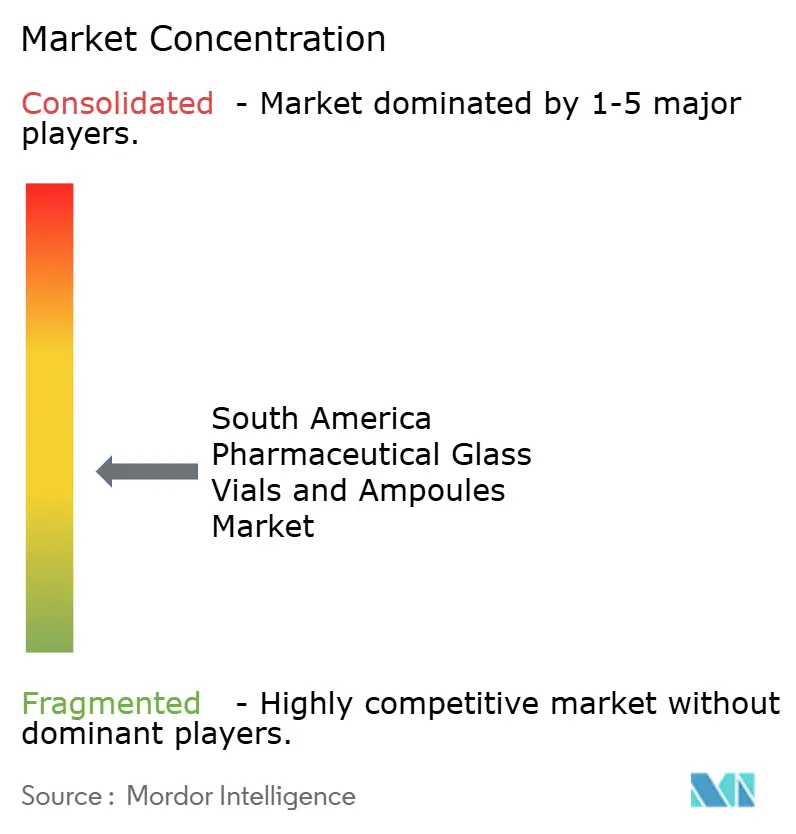
| Market Concentration | Medium |
Major Players *Disclaimer: Major Players sorted in no particular order Image © Mordor Intelligence. Reuse requires attribution under CC BY 4.0. | |
South America Pharmaceutical Glass Vials and Ampoules Market Analysis by Mordor Intelligence
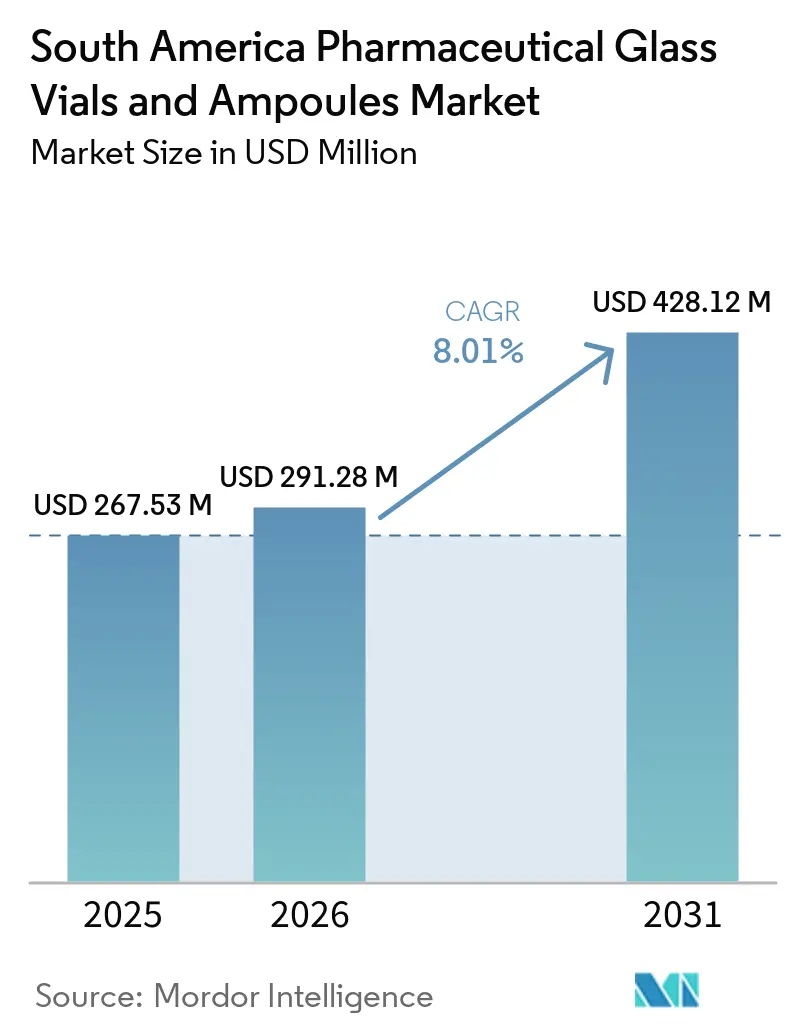
The South America Pharmaceutical Glass Vials and Ampoules Market size was valued at USD 267.53 million in 2025 and estimated to grow from USD 291.28 million in 2026 to reach USD 428.12 million by 2031, at a CAGR of 8.01% during the forecast period (2026-2031). The South America Pharmaceutical Glass Vials and Ampoules Market is supported by a broader buildout of injectable medicine capacity, particularly in Brazil. New aseptic lines require validated primary containers before commercial batches can begin. This requirement favors suppliers that can provide consistent glass quality, documentation, and dependable delivery. Type I borosilicate formats and ready-to-use sterile products are becoming more relevant as biologics output expands. Energy exposure and lengthy qualification requirements continue to limit the speed at which new capacity can enter the South America Pharmaceutical Glass Vials and Ampoules Market.
Key Report Takeaways
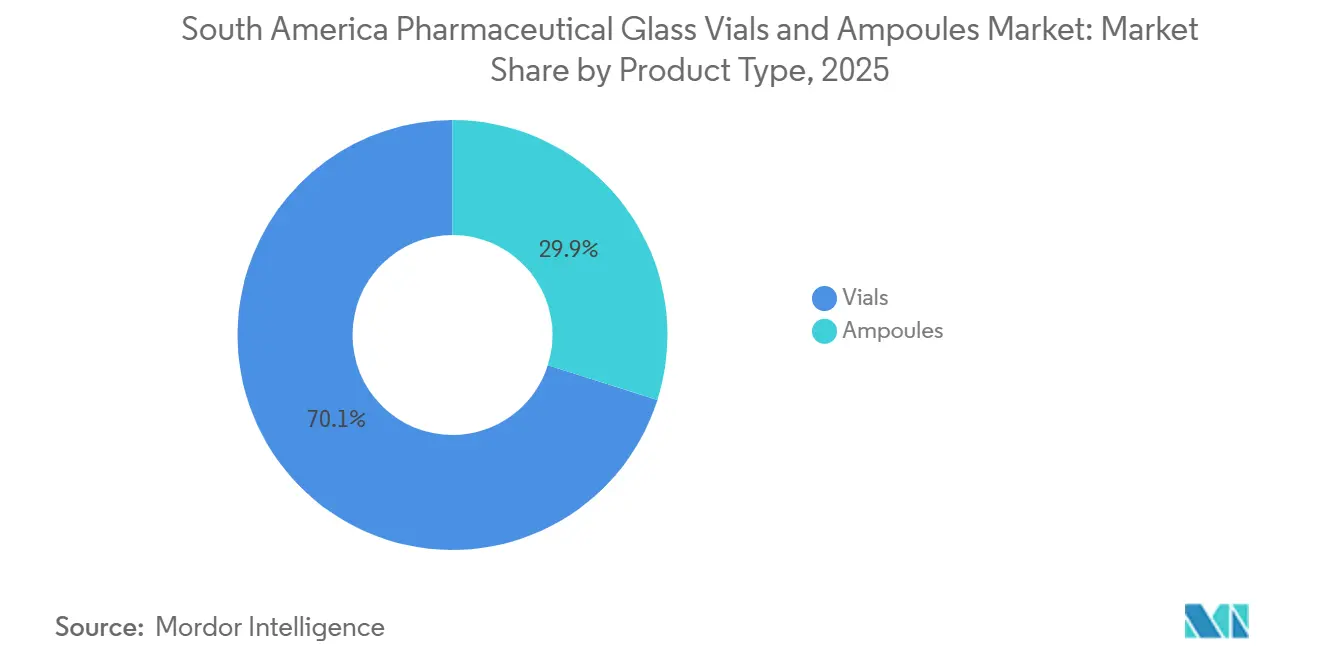
- By product type, vials held 70.12% South America Pharmaceutical Glass Vials and Ampoules Market revenue share in 2025 and are forecast to grow at an 8.57% CAGR through 2031.
- By glass type, Type I borosilicate glass accounted for 61.45% of revenue in 2025 and is forecast to grow at an 8.78% CAGR through 2031.
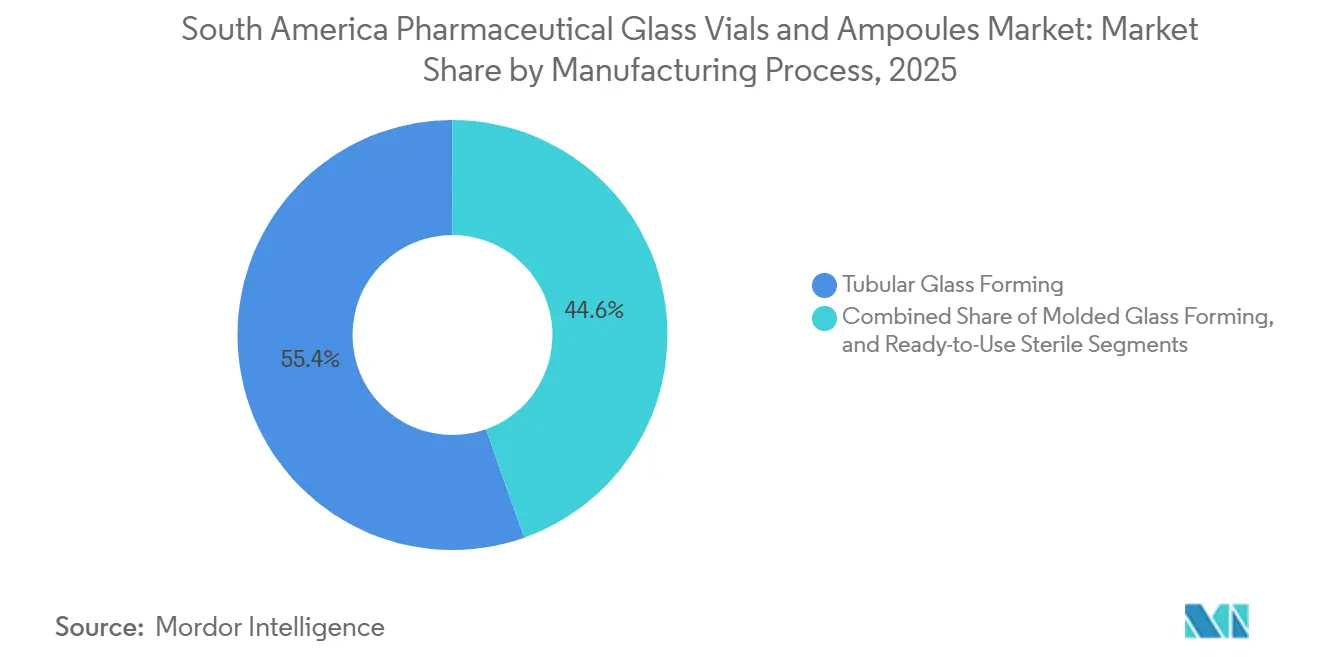
- By manufacturing process, tubular glass forming accounted for 55.42% of the South America Pharmaceutical Glass Vials and Ampoules Market revenue in 2025, while ready-to-use sterile conversion is forecast to grow at an 8.62% CAGR through 2031.
- By application, vaccines accounted for 30.36% of revenue in 2025, while biologics and biosimilars are forecast to grow at an 8.81% CAGR through 2031.
- By geography, Brazil accounted for 34.46% of the South America Pharmaceutical Glass Vials and Ampoules Market revenue share in 2025, while Chile is forecast to grow at a 9.01% CAGR through 2031.
Note: Market size and forecast figures in this report are generated using Mordor Intelligence’s proprietary estimation framework, updated with the latest available data and insights as of January 2026.
South America Pharmaceutical Glass Vials and Ampoules Market Trends and Insights
Drivers Impact Analysis*
| Driver | (~) % Impact on CAGR Forecast | Geographic Relevance | Impact Timeline |
|---|---|---|---|
| Expansion of Injectable Drug Manufacturing | +2.0% | Brazil and Argentina, with spillover to Chile and the rest of South America | Medium term (2-4 years) |
| Growth of Vaccine and Biosimilar Production | +1.8% | Brazil, with expansion to Argentina and the rest of South America | Short term (≤ 2 years) |
| Rising Demand for Type I Glass Containers | +1.5% | Brazil and Chile | Long term (≥ 4 years) |
| Increasing Regional Pharmaceutical Self-Sufficiency | +1.2% | Brazil, Argentina, and Chile | Medium term (2-4 years) |
| Qualification of Local Fill-and-Finish Capacity | +0.9% | Brazil and Argentina | Medium term (2-4 years) |
| Container Availability as a Supply Differentiator | +0.6% | South America, concentrated in Brazil | Short term (≤ 2 years) |
| Source: Mordor Intelligence | |||
Expansion of Injectable Drug Manufacturing
Injectable medicine projects are increasing demand for qualified vials and ampoules in the South America Pharmaceutical Glass Vials and Ampoules Market. Novo Nordisk committed DKK 8 billion (USD 1.10 billion) in April 2025 to expand injectable treatment production in Montes Claros, Brazil, with completion expected in 2028.[1]Novo Nordisk, “Novo Nordisk Announces DKK 8 Billion Investment in Expansion of Production Facilities in Montes Claros, Brazil,” Novo Nordisk, novonordisk.com The project includes aseptic lines, cold storage, and a quality-control laboratory, while each fill-finish line needs a validated container system before medicines can be released. Hipolabor announced BRL 330 million (USD 58.9 million) in phased investment for 2026 to 2028, and Aché began operating a 40 million-unit injectable and ophthalmic facility in Pernambuco in February 2026. These projects create demand near manufacturing clusters and make fast supplier substitution difficult. Suppliers that meet delivery and validation requirements are better placed to serve this demand.
Growth of Vaccine and Biosimilar Production
Vaccine and biosimilar production supports the South America Pharmaceutical Glass Vials and Ampoules Market because these medicines are commonly administered by injection. Brazil and India formalized 3 Productive Development Partnerships in February 2026 to support local production of biosimilars for nivolumab and pertuzumab, while Blau Farmacêutica completed domestic development of a pembrolizumab biosimilar in January 2026. These products need containers that protect sensitive formulations, with Type I borosilicate glass relevant for protein stability and extractables control. Fiocruz's Novo Centro de Processamento Final is designed to produce 120 million vials annually once operational.[2]SKAN, “Partnership for Global Health: The Collaboration with Bio-Manguinhos,” SKAN, skan.com Patent expiries for pembrolizumab in 2028 and semaglutide in 2026 are encouraging biosimilar preparation. This activity shifts procurement toward recurring supply agreements established early in the production plan.
Rising Demand for Type I Glass Containers
Type I borosilicate glass is increasingly used for injectable therapies requiring high chemical resistance in the South America Pharmaceutical Glass Vials and Ampoules Market. SCHOTT Pharma outlined a 2025 FIOLAX® Pro roadmap for Type I clear borosilicate tubing, and its Itupeva facility has supplied regional ampoules, vials, and cartridges for more than 25 years. Gerresheimer, Stevanato Group, and SCHOTT Pharma created the Alliance for RTU in October 2024 to support the development of ready-to-use sterile vials and cartridges. RTU formats use Type I tubing and can eliminate the need for washing, sterilization, and depyrogenation at fill-finish sites. A change from Type II to Type I requires a new container-closure qualification cycle. This can extend supply agreements and strengthen demand for formats with established technical documentation.
Increasing Regional Pharmaceutical Self-Sufficiency
Pharmaceutical self-sufficiency programs are supporting local validation of packaging systems in the South America Pharmaceutical Glass Vials and Ampoules Market. Brazil's pharmaceutical sector generated BRL 220 billion (USD 39.3 billion) in 2026, and IQVIA projected 10.6% growth in the sector. The federal government has signed 31 Productive Development Partnerships since 2023 for medicines, vaccines, and strategic health inputs, increasing the need for suppliers that support regulatory submissions. A dedicated injectable facility began operating in Joinville, with an investment exceeding BRL 160 million (USD 28.1 million), extending production beyond established corridors. Locally qualified containers can reduce lead times and the risk of breakage. Their availability can influence how quickly new plants reach commercial output.[3]EMS, “EMS Recebe Aval da Anvisa e Consolida Potência na Saúde com OZIVY,” EMS, ems.com.br
Restraints Impact Analysis*
| Restraint | (~) % Impact on CAGR Forecast | Geographic Relevance | Impact Timeline |
|---|---|---|---|
| High Energy Intensity of Pharmaceutical Glass Melting | -0.8% | South America, most acute in Brazil and Argentina | Long term (≥ 4 years) |
| Stringent Container-Closure and Extractables Qualification | -0.6% | Brazil and Argentina | Short term (≤ 2 years) |
| Import Exposure to Specialized Tubular Glass and RTU Formats | -0.5% | South America, most acute in Argentina and Chile | Medium term (2-4 years) |
| Breakage and Reject Costs on Long Multimodal Routes | -0.3% | Rest of South America, Chile, and Argentina inland routes | Medium term (2-4 years) |
| Source: Mordor Intelligence | |||
High Energy Intensity of Pharmaceutical Glass Melting
Glass furnaces for pharmaceutical products operate above 1,500°C, exposing the South America Pharmaceutical Glass Vials and Ampoules Market to fluctuations in energy costs. Energy accounted for 25% to 35% of tubular-glass conversion costs in the supplied research, while Brazilian natural-gas prices can reflect import parity and exchange-rate movements. These conditions pressure converters when pharmaceutical customers cannot accept higher packaging prices. Parglass plans to invest USD 85 million in a 100% electric glass furnace at Villa Hayes, Paraguay. Smaller converters may struggle to fund comparable programs and face greater cost and sustainability pressure. This can favor established suppliers with diversified furnace networks and energy arrangements.
Stringent Container-Closure and Extractables Qualification
Qualification requirements slow the introduction of new glass formats in the South America Pharmaceutical Glass Vials and Ampoules Market. ANVISA's RDC 982/2025 entered into force in July 2025 and introduced risk-based GMP certification criteria, while reviews of sterile manufacturing per format, limiting the use of barrier systems and validated container-closure integrity. Suppliers need documentation on container-closure integrity, extractables and leachables, and hydrolytic resistance to support registration dossiers. ANMAT published Disposición 5146/2026 in August 2026 for closed-system manufacturing of large-volume parenteral solutions. Qualification can take 12 to 18 months for each format, which limits rapid responses to disruptions. The process raises quality assurance and rewards suppliers with existing regulatory standing.[4]Agência Nacional de Vigilância Sanitária, “RDC 982/2025: Critérios de Gestão de Risco para Concessão de Certificados de Boas Práticas de Fabricação,” Agência Nacional de Vigilância Sanitária, dlmconsult.com.br
*Our forecasts treat driver/restraint impacts as directional, not additive. The impact forecasts reflect baseline growth, mix effects, and variable interactions.
Segment Analysis
By Product Type: Vials Lead Injectable Packaging Demand
Vials held 70.12% of the South America Pharmaceutical Glass Vials and Ampoules Market share in 2025 and are forecast to grow at an 8.57% CAGR through 2031. Vaccines, hospital injectables, and biologics all rely on vial formats across the region. Vials are compatible with lyophilization, which supports the stability of some biologics and biosimilars. This makes the format important as the therapeutic mix becomes more complex. Public vaccination programs also use single-dose and multi-dose vial configurations.
Ampoules continue to play an important role in single-dose medicines and emergency treatments. Their hermetic seal and tamper-evident form suit analgesics, contrast agents, and critical-care medicines. Demand is especially relevant in Argentine hospital formularies and other South American hospital systems. SGD Pharma returned to FCE Pharma 2026 in São Paulo with its tubular glass ampoule portfolio. The South America Pharmaceutical Glass Vials and Ampoules Market will continue to require both formats because their clinical uses remain distinct.



By Glass Type: Type I Borosilicate Supports Sensitive Injectables
Type I borosilicate glass accounted for 61.45% of revenue in 2025 and is forecast to grow at an 8.78% CAGR through 2031. Its resistance to hydrolytic attack is important for parenteral medicines that are sensitive to pH changes or alkali leachables. Biologics and protein-based therapies have increased the need for these container properties. The South America Pharmaceutical Glass Vials and Ampoules Market size for Type I formats is supported by local biosimilar and specialty-injectable projects. Suppliers with consistent tubing quality can be better positioned in regulated applications.
Type II-treated soda-lime glass remains relevant for aqueous small-molecule injectables, where chemical sensitivity is lower. Type III soda-lime glass continues to be used for dry powders and some non-parenteral applications. SCHOTT Pharma's FIOLAX® Pro roadmap shows how suppliers are emphasizing Type I glass for higher-value uses. Changing from Type II to Type I requires a full qualification cycle at a fill-finish facility. This can encourage early adoption of Type I formats when new biologic capacity is planned.
By Manufacturing Process: Tubular Forming Leads While RTU Conversion Grows
Tubular glass forming accounted for 55.42% of revenue in 2025, while ready-to-use sterile conversion is forecast to expand at an 8.62% CAGR through 2031. Tubular forming provides dimensional control and efficient output for standard vials and ampoules. It remains central to the South America Pharmaceutical Glass Vials and Ampoules Market because regional customers procure these products at large volumes. Molded glass forming is used for major ampoule and infusion-bottle applications. Tubular formats face increasing demand from customers who need precise, validated dimensions.
Ready-to-use conversion removes washing, sterilization, and depyrogenation steps at fill-finish sites. This can offset the higher unit cost of the format for biologic CDMOs and specialty injectable producers. The Alliance for RTU is intended to reduce validation barriers by aligning technical standards and qualification documentation. Gerresheimer began a EUR 30 million (USD 32.4 million) RTU-vial expansion at Wertheim in October 2025, with completion targeted for mid-2027. These additions may expand access to RTU formats through existing commercial networks.
By Application: Biologics and Biosimilars Drive Growth
Vaccines held 30.36% revenue share in 2025, while biologics and biosimilars are forecast to grow at an 8.81% CAGR through 2031. Vaccine production provides an established demand base for vials. The South America Pharmaceutical Glass Vials and Ampoules Market share is increasingly influenced by biologic medicines that require more exacting containment. Patent expiries and public procurement programs are supporting local biosimilar development. This changes the mix of containers sought by pharmaceutical manufacturers.
Blau Farmacêutica's January 2026 pembrolizumab biosimilar program demonstrates growing domestic monoclonal antibody capability. EMS received ANVISA approval in 2025 for OZIVY, its semaglutide biosimilar, produced at a São Paulo peptide plant with capacity for 40 million injectable pens annually. Small-molecule injectables remain important for hospital generics and analgesics. Diagnostic reagents are a stable niche because public health laboratories need sealed containers that preserve reagent shelf life. The South America Pharmaceutical Glass Vials and Ampoules Market also benefits from these recurring diagnostic requirements.
Geography Analysis
Brazil held 34.46% of the South America Pharmaceutical Glass Vials and Ampoules Market share in 2025. The Brazilian pharmaceutical sector generated BRL 220 billion (USD 39.3 billion) in 2026, and domestically owned laboratories accounted for 77.9% of unit volume in the supplied research. SCHOTT Pharma's Itupeva facility employs 500 people and produces ampoules, vials, and cartridges for local customers.
New aseptic capacity in Montes Claros and Pernambuco strengthens Brazil's role in the South America Pharmaceutical Glass Vials and Ampoules Market. These production clusters favor suppliers that can provide shorter delivery routes and lower breakage exposure. Brazil also has an expanding pipeline for generics and biosimilars as patents approach expiry. The country's broad pharmaceutical output supports recurring demand for qualified primary packaging. Container availability can affect the speed at which new plants reach commercial production.
Chile is forecast to grow at a 9.01% CAGR through 2031, the fastest rate among the reported geographies. Specialty pharmaceuticals, cold-chain expansion, and predictable regulatory processes support this outlook. Chile is used as an entry point for international biosimilar launches in South America. Prestige Biopharma's partnership with Dr. Reddy's for Tuznue commercialization is expected to include Chile in later rollout phases. Argentina adds demand through established generic injectables and expanding biologics activity, including Biosidus's bioreactor plant for agalsidase beta supply. Other South American countries contribute import demand for vaccines and generic injectables, often supplied by Brazilian or global converters.
Competitive Landscape
The South America Pharmaceutical Glass Vials and Ampoules Market includes a limited set of global primary-packaging specialists with direct manufacturing or commercial activity in the region. SCHOTT Pharma and Gerresheimer hold established positions in Brazil, the region's largest reported geography. Their quality systems and delivery capabilities set a high benchmark for suppliers seeking biologic and vaccine fill-finish business. SGD competes in tubular glass ampoules for hospital injectables. Nipro supplies borosilicate vials and laser-scored ampoules through distribution arrangements.
SCHOTT Pharma reported 9.2% constant-currency revenue growth in its Drug Containment Solutions segment in the first 9 months of fiscal year 2026, with high-value solutions representing 25% of segment revenue. In April 2026, the company announced cartriQ® BioPure, a sterile FIOLAX® Pro glass cartridge for complex biologics. The product supports pen and autoinjector systems. This strategy places more focus on specialized containment than standard glass formats.
There is room for pre-sterilized ready-to-use vials and cartridges at Brazilian and Argentine CDMOs. Chinese suppliers, including Shandong Pharmaceutical Glass and Cangzhou Four Stars Glass, compete on price in standard borosilicate and soda-lime products. ANVISA requirements for GMP certification and material traceability can limit their progress in high-value applications. Gerresheimer decided in August 2025 to separate its Molded Glass business, which generated EUR 735 million (USD 794 million) in revenue in 2024 and had a 20% adjusted EBITDA margin. The South America Pharmaceutical Glass Vials and Ampoules Market remains concentrated in qualified supply, while price competition persists in standard formats.
South America Pharmaceutical Glass Vials and Ampoules Industry Leaders
Gerresheimer AG
SCHOTT Pharma AG & Co. KGaA
Stevanato Group S.p.A.
SGD S.A.
Nipro Corporation
- *Disclaimer: Major Players sorted in no particular order

Recent Industry Developments
- August 2026: Biosidus, an Argentine biotechnology company, announced that its new bioreactor plant is now operational, expanding biologics production capacity for agalsidase beta biosimilar and strengthening potential international supply to markets where applicable regulatory pathways permit, generating incremental glass vial demand for biologic fill-finish operations in Argentina.
- August 2026: SCHOTT Pharma AG and Co. KGaA reported 9-month fiscal year 2026 revenue of EUR 769.8 million (USD 854 million), with its Drug Containment Solutions segment posting 9.2% growth at constant currencies to EUR 445.4 million (USD 494 million), driven by demand for specialty vials, sterile cartridges, and high-value injectable containment.
- April 2026: SCHOTT Pharma announced plans to launch cartriQ® BioPure, a sterile glass cartridge for complex biologics manufactured from FIOLAX® Pro borosilicate tubing, designed for integration into pen and autoinjector systems.
- February 2026: Brazil and India formalized 3 Productive Development Partnerships to domestically manufacture nivolumab and pertuzumab biosimilars in Brazil, with estimated government investment of USD 140 million in the first year and up to USD 1.9 billion over 10 years.


South America Pharmaceutical Glass Vials and Ampoules Market Report Scope
The South America Pharmaceutical Glass Vials and Ampoules Market refers to the production and supply of sterile glass containers specifically designed to package injectable drugs and other sensitive liquids. These containers are manufactured from specialized glass types, such as borosilicate and treated soda-lime, using tubular, molded, or ready-to-use sterile conversion processes. They are essential for the safe storage, preservation, and administration of vaccines, biologics, insulin, and other injectable therapeutics across the region's healthcare and pharmaceutical sectors.
The South America Pharmaceutical Glass Vials and Ampoules Market Report is Segmented by Product Type (Vials, and Ampoules), Glass Type (Type I Borosilicate Glass, Type II Treated Soda-Lime Glass, and Type III Soda-Lime Glass), Manufacturing Process (Tubular Glass Forming, Molded Glass Forming, and Ready-to-Use Sterile Conversion), Application (Vaccines, Biologics and Biosimilars, Small-Molecule Injectables, Insulin and Other Peptide Therapies, and Diagnostic Reagents), and Geography (Brazil, Chile, Argentina, and Rest of South America). The Market Forecasts are Provided in Terms of Value (USD).
| Vials |
| Ampoules |
| Type I Borosilicate Glass |
| Type II Treated Soda-Lime Glass |
| Type III Soda-Lime Glass |
| Tubular Glass Forming |
| Molded Glass Forming |
| Ready-to-Use Sterile Conversion |
| Vaccines |
| Biologics and Biosimilars |
| Small-Molecule Injectables |
| Insulin and Other Peptide Therapies |
| Diagnostic Reagents |
| Brazil |
| Chile |
| Argentina |
| Rest of South America |
| By Product Type | Vials |
| Ampoules | |
| By Glass Type | Type I Borosilicate Glass |
| Type II Treated Soda-Lime Glass | |
| Type III Soda-Lime Glass | |
| By Manufacturing Process | Tubular Glass Forming |
| Molded Glass Forming | |
| Ready-to-Use Sterile Conversion | |
| By Application | Vaccines |
| Biologics and Biosimilars | |
| Small-Molecule Injectables | |
| Insulin and Other Peptide Therapies | |
| Diagnostic Reagents | |
| By Geography | Brazil |
| Chile | |
| Argentina | |
| Rest of South America |


Key Questions Answered in the Report
What is the South America Pharmaceutical Glass Vials and Ampoules Market size?
The South America Pharmaceutical Glass Vials and Ampoules Market is estimated at USD 291.28 million in 2026 and is forecast to reach USD 428.12 million by 2031, at an 8.01% CAGR. Injectable manufacturing investment and higher-specification containment support this outlook.
What is driving demand for pharmaceutical glass vials and ampoules in South America?
New injectable facilities, domestic biosimilar production, and demand for Type I borosilicate glass support demand. Qualification requirements also encourage longer purchasing relationships with validated suppliers.
Which product type leads pharmaceutical glass packaging demand?
Vials led with 70.12% revenue share in 2025 and are forecast to grow at an 8.57% CAGR through 2031. Ampoules retain a defined role in single-dose emergency and critical-care medicines.
Why is Type I borosilicate glass important for injectable medicines?
Type I glass held 61.45% revenue share in 2025 and is forecast to grow at an 8.78% CAGR through 2031. It offers high hydrolytic resistance for sensitive biologics and parenteral medicines.
Which country is the largest reported geography for pharmaceutical glass vials and ampoules?
Brazil held 34.46% revenue share in 2025, supported by its manufacturing base and new aseptic capacity. Local container availability can help plants move more quickly toward commercial production.
Which geography is growing fastest through 2031?
Chile is forecast to grow at a 9.01% CAGR through 2031, supported by specialty pharmaceuticals and cold-chain development. Its regulatory environment also supports international biosimilar commercialization.
Page last updated on:





