
South America Pharmaceutical Glass Packaging Market Size and Share
Market Overview
| Study Period | 2020 - 2031 |
|---|---|
| Forecast Data Period | 2026 - 2031 |
| Base Year Market Size (2025) | USD 1.47 Billion |
| Market Size (2026) | USD 1.56 Billion |
| Market Size (2031) | USD 2.11 Billion |
| Growth Rate (2026 - 2031) | 6.23 % |
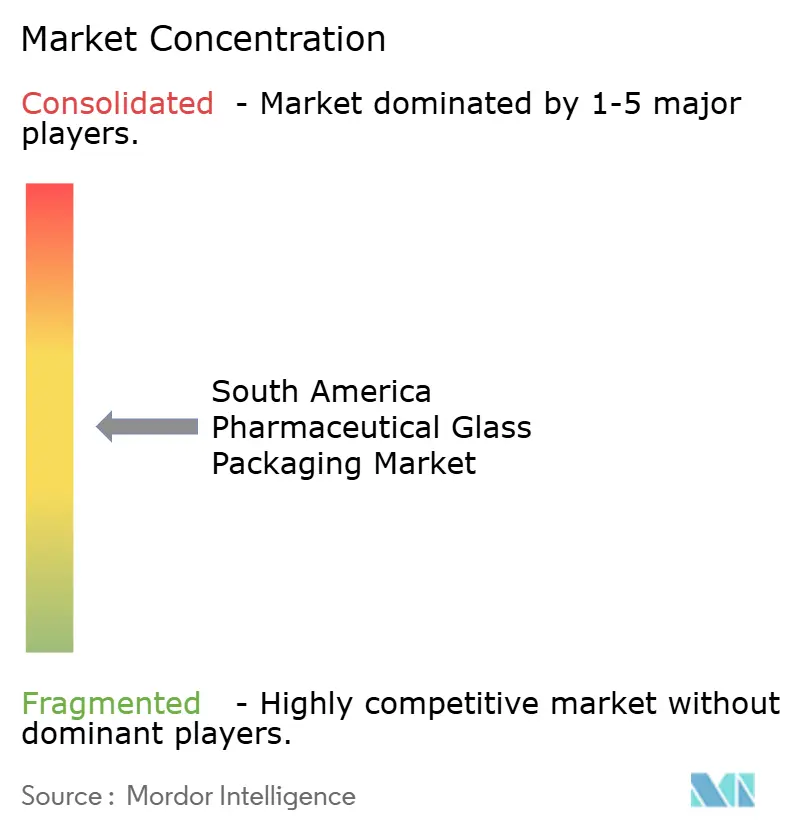
| Market Concentration | Medium |
Major Players *Disclaimer: Major Players sorted in no particular order Image © Mordor Intelligence. Reuse requires attribution under CC BY 4.0. | |
South America Pharmaceutical Glass Packaging Market Analysis by Mordor Intelligence
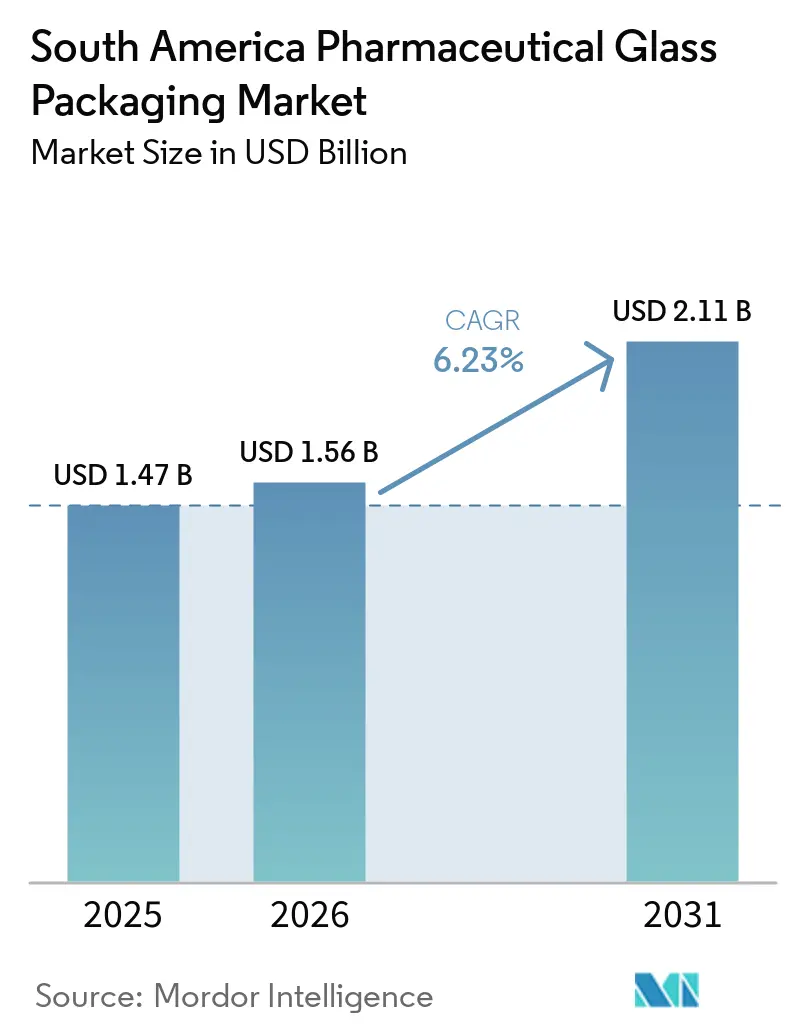
The South America pharmaceutical glass packaging market size was valued at USD 1.47 billion in 2025 and estimated to expand from USD 1.56 billion in 2026 to reach USD 2.11 billion by 2031, at a CAGR of 6.23% during the forecast period (2026-2031). Demand is moving toward packaging for complex injectables, biosimilars, and vaccines, which require high-integrity primary containers. Public efforts to expand biopharmaceutical production in Brazil and sterile fill-finish activity in Argentina are changing regional sourcing toward Type I borosilicate glass. Suppliers with established qualification processes, sterile processing capability, and documented compliance are better placed to serve these programs. The South America pharmaceutical glass packaging market also faces imported input costs and a developing substitution risk from COP and COC formats in selected biologic applications.
Key Report Takeaways
- By product, vials held 19.82% of the South America pharmaceutical glass packaging market share in 2025, while cartridges and prefillable syringes are projected to expand at a CAGR of 7.49% through 2031.
- By glass type, Type I borosilicate held 27.46% of the South America pharmaceutical glass packaging market share in 2025 and is projected to expand at a CAGR of 7.23% through 2031.
- By drug formulation, injectables accounted for 52.31% of the South America pharmaceutical glass packaging market share in 2025 and are projected to expand at a CAGR of 7.11% through 2031.
- By end-user, innovator pharma and biotech firms held 27.56% of the South America pharmaceutical glass packaging market share in 2025 and are projected to expand at a CAGR of 7.34% through 2031.
- By geography, Brazil held 38.32% share in 2025, while Argentina is projected to expand at a 7.87% CAGR through 2031 in the South America pharmaceutical glass packaging market.
Note: Market size and forecast figures in this report are generated using Mordor Intelligence’s proprietary estimation framework, updated with the latest available data and insights as of January 2026.
Market Trends and Insights
Drivers Impact Analysis of South America Pharmaceutical Glass Packaging Market*
| Driver | (~) % Impact on CAGR Forecast | Geographic Relevance | Impact Timeline |
|---|---|---|---|
| Expansion of Injectable and Biologic Drug Manufacturing | +2.1% | Brazil, with spillover to Argentina and Colombia | Long term (≥ 4 years) |
| Brazil Biosimilar Localization and Public Procurement | +1.4% | Brazil, especially São Paulo and Rio de Janeiro | Medium term (2-4 years) |
| Growth of Ready-to-Use Sterile Packaging Platforms | +1.0% | Strongest in Brazil and Argentina | Medium term (2-4 years) |
| Vaccine and Fill-Finish Capacity Expansion | +0.9% | Brazil, with secondary effects in Colombia | Long term (≥ 4 years) |
| Veterinary Vaccination Across Livestock Supply Chains | +0.5% | Brazil, Argentina, and Uruguay | Medium term (2-4 years) |
| Regional Qualification Hubs for Imported High-Purity Glass | +0.3% | Brazil and Argentina | Short term (≤ 2 years) |
| Source: Mordor Intelligence | |||
Expansion of Injectable and Biologic Drug Manufacturing
Brazil’s injectable manufacturing base is moving toward more complex biologics and higher-value parenteral medicines. In January 2026, Blau Farmacêutica announced fully integrated domestic development of a pembrolizumab monoclonal antibody biosimilar and reported ANVISA GMP certification for its API facility. This development supports demand for Type I borosilicate vials and prefillable syringes because biologic products require qualified primary containers. Aurobindo Pharma’s CuraTeQ Biologics received ANVISA GMP certification in July 2026 for its Hyderabad facility, including vial filling and prefillable syringe lines for biosimilar products.[1]Each new biologic program requires container qualification before commercial supply, creating a recurring workstream for packaging suppliers. These qualification requirements also slow the replacement of glass in applications where established container performance remains important. They also tie packaging decisions to clinical and commercial timelines, since a supplier change may require further compatibility work. This gives qualified container suppliers a more durable role in biologic production programs than in lower-specification packaging categories.
Brazil Biosimilar Localization and Public Procurement
Brazil’s public procurement system supports local production through Partnerships for Productive Development, which link technology transfer to expected purchase volumes. This structure can reduce the investment risk for domestic manufacturing and create a steadier requirement for qualified glass containers. In September 2025, ANVISA issued favorable marketing authorization recommendations for biosimilars, including denosumab, trastuzumab, and aflibercept.[2] The Funed, Samsung Bioepis, and Bionovis program for aflibercept included BRL 42 million (USD 7.4 million) in upgrades at Fundação Ezequiel Dias, based on the stated 2025 average exchange rate. Public hospitals often use multi-dose formats to reduce per-dose costs, which favors glass vial consumption. Procurement visibility, therefore, supports demand planning for suppliers capable of meeting the required quality documentation. It also shifts attention from simple unit pricing to service reliability, documentation readiness, and stable availability across tender cycles. Suppliers that can support both local manufacturing and public procurement requirements are positioned to address this demand.
Growth of Ready-to-Use Sterile Packaging Platforms
Ready-to-use, or RTU, packaging is becoming more relevant as fill-finish operators seek to reduce handling during sterile production. Gerresheimer, Stevanato Group, and SCHOTT Pharma formed the Alliance for RTU in September 2024 to support the move from bulk glass to ready-to-use vials and cartridges.[3] Brazil’s model combines limited domestic high-purity tubing output with a growing base of sterile assemblers that can process imported components. This leaves the region dependent on external tubing while supporting local activity in assembly, sterilization, and qualification. SCHOTT Pharma’s Itupeva site has operated in Brazil for 25 years and provides a regional point of access for high-value packaging formats. ANVISA’s risk-based certification framework increased the importance of traceability and documented systems, which can make RTU formats more attractive to contract manufacturers. The format can reduce steps within the customer’s own sterile process while retaining a documented path for components. This makes RTU systems relevant to facilities that are adding capacity without building full glass conversion operations.
Vaccine and Fill-Finish Capacity Expansion
Vaccine and fill-finish investment is strengthening the South America pharmaceutical glass packaging market because vaccines are commonly supplied in glass containers. Brazil announced BRL 1.4 billion (USD 246 million) in February 2026 for two new vaccine factories and the modernization of two existing Instituto Butantan units, using the stated 2026 average exchange rate. The program targets 20 million additional HPV vaccine doses each year. Larger vaccine operations require extensive supplies of 2- to 10-mL Type I borosilicate vials. The existing draft also identifies a proposed Health Biotechnology Industrial Complex in Rio de Janeiro that would increase Bio-Manguinhos and Fiocruz's fill-finish capability. These programs raise the importance of import supply continuity because pharmaceutical-grade tubing is not produced commercially at the necessary scale within Brazil. They also require suppliers to plan for a mix of vaccine presentations, vial sizes, and sterile filling requirements. The need for consistent container quality becomes more important as public programs move from project planning into routine production.
Restraints Impact Analysis of South America Pharmaceutical Glass Packaging Market*
| Restraint | (~) % Impact on CAGR Forecast | Geographic Relevance | Impact Timeline |
|---|---|---|---|
| Imported Raw Materials and Currency Exposure | -1.8% | South America, especially Brazil and Argentina | Short term (≤ 2 years) |
| Polymer Substitution in Standard Injectable Applications | -0.8% | Brazil and Argentina | Medium term (2-4 years) |
| Energy-Intensive Melting and Furnace Utilization Risk | -0.5% | Brazil | Long term (≥ 4 years) |
| Breakage, Delamination, and Extractables Qualification Risk | -0.3% | Brazil and Argentina | Short term (≤ 2 years) |
| Source: Mordor Intelligence | |||
Imported Raw Materials and Currency Exposure
The South America pharmaceutical glass packaging market relies on imported high-purity borosilicate tubing. This reliance leaves buyers exposed to currency movements and higher landed costs in Brazil and Argentina. Domestic production does not currently provide pharmaceutical-grade borosilicate tubing at commercial scale. Developing a furnace and tube-drawing operation requires significant capital, specialized process control, and sustained demand. Regulatory changes can also raise documentation costs when they require additional extractables and leachables evidence. Smaller generic manufacturers and compounding pharmacies may find it hardest to manage both foreign-currency exposure and specification-related costs. Procurement delays can result when buyers wait for more favorable exchange conditions or switch to lower-specification options. The issue is most immediate where contracts are priced in foreign currency and local reimbursement conditions do not change at the same pace.
Polymer Substitution in Standard Injectable Applications
COP and COC vials are gaining use in selected cryogenic and sensitive biologic applications. These materials can reduce breakage concerns and address performance issues linked to low temperatures or ion leaching. SCHOTT Pharma launched a ready-to-use COC polymer cartridge in 2025 with an extractables and leachables profile intended for biologic applications. The substitution risk is concentrated in premium biologics, where users may accept higher unit costs for specialized performance. Type I borosilicate remains the standard choice for many regional vaccine and biosimilar presentations. Glass also retains an established position in multi-dose vials, where polymer does not offer the same cost advantage. This limits substitution to applications where the performance benefit is clear enough to outweigh higher material costs and new qualification work. Suppliers of glass can therefore retain considerable demand in routine vaccine and biosimilar programs.
*Our forecasts treat driver/restraint impacts as directional, not additive. The impact forecasts reflect baseline growth, mix effects, and variable interactions.
South America Pharmaceutical Glass Packaging Market Segment Analysis
By Product:
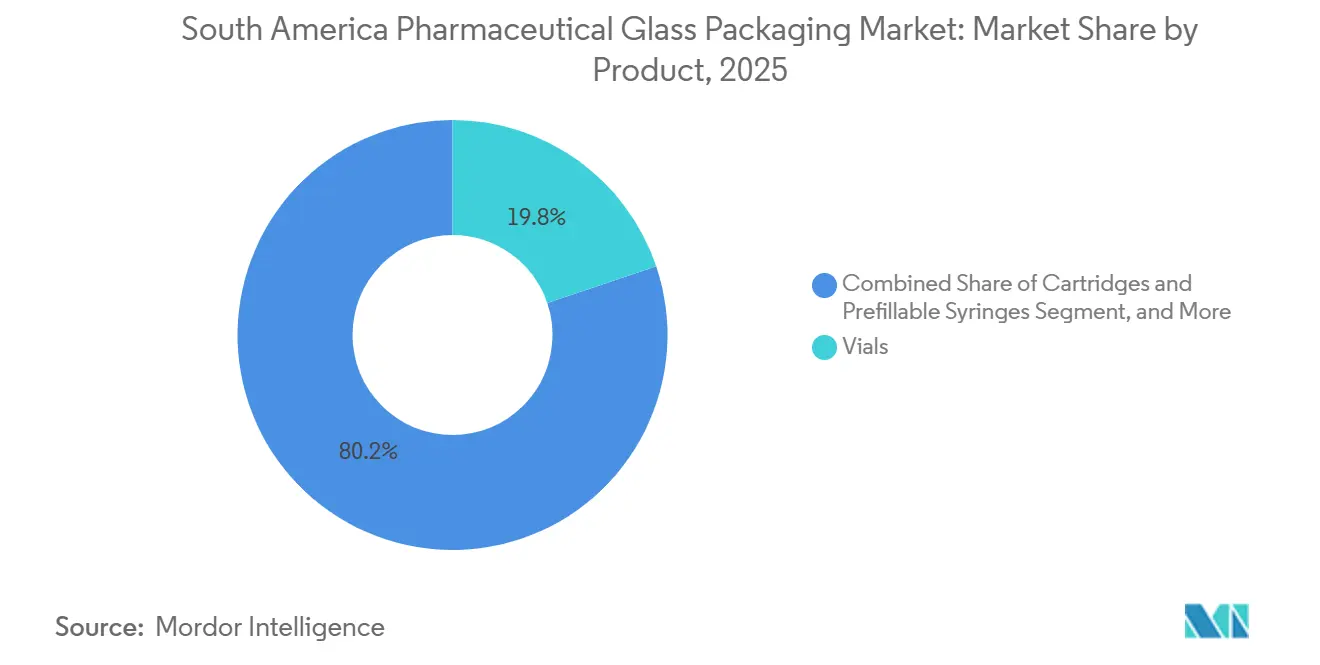
Cartridges and Prefillable Syringes Gain Ground on the Established Vial BaseVials held 19.82% of the South America pharmaceutical glass packaging market share in 2025, supported by their broad use in vaccines, injectable biologics, and standard parenteral medicines. Their established role reflects the requirements of public and private formularies across the region. Multi-dose Type I borosilicate vials are relevant to public health programs because they support economical dosing formats. Generic manufacturers and contract manufacturing organizations also rely on familiar vial configurations with established quality records. Ampoules continued to serve injectable analgesics, anti-inflammatory medicines, and lower-value parenteral products. Bottles remained relevant to oral liquids and topical medicines, although these applications carry less glass intensity than injectables.
Cartridges and prefillable syringes are projected to expand at a CAGR of 7.49% through 2031, making them the fastest-growing product format in the South America pharmaceutical glass packaging market. Auto-injector adoption and GLP-1 receptor agonist pipelines support the shift toward patient-ready delivery formats. Biologic developers also value closed containers that can limit handling during filling operations. The Alliance for RTU was designed to help manufacturers and contract manufacturers shift toward ready-to-use vial and cartridge systems. Brazil’s use of imported components and domestic sterile assembly may enable faster adoption of these formats than a model requiring new domestic glass-forming assets. ABNT NBR 11280 for ampoules and ABNT NBR 11819 for pharmaceutical bottles remain baseline standards for suppliers serving these uses.

By Glass Type:
Type I Borosilicate Supports Premium Parenteral DemandType I borosilicate accounted for 27.46% of the South America pharmaceutical glass packaging market size in 2025. Its position reflects its use in biologics, vaccines, and sensitive injectable products. The material offers the hydrolytic resistance expected for high-value parenteral medicines. Suppliers benefit when customers prefer an established material rather than undertake a new container qualification process. Type II treated soda-lime glass serves aqueous injectables with controlled interaction risk. Type III soda-lime glass remains suitable for oral liquid bottles and selected veterinary uses where high hydrolytic resistance is less critical.
Type I borosilicate is projected to expand at a CAGR of 7.23% through 2031, the highest rate among glass categories in the South America pharmaceutical glass packaging market. Biosimilars, monoclonal antibodies, and GLP-1 medicines are supporting demand for high-specification primary containers. Regulatory documentation requirements can reinforce this preference because Type I glass carries a recognized performance history in parenteral applications. The share gap between Type I and treated or standard soda-lime grades can therefore widen as complex injectables take a larger role in public procurement. The product mix also raises the value placed on low-defect tubing, robust quality records, and regional technical support. This favors suppliers that can pair glass supply with qualification assistance.
By Drug Formulation:
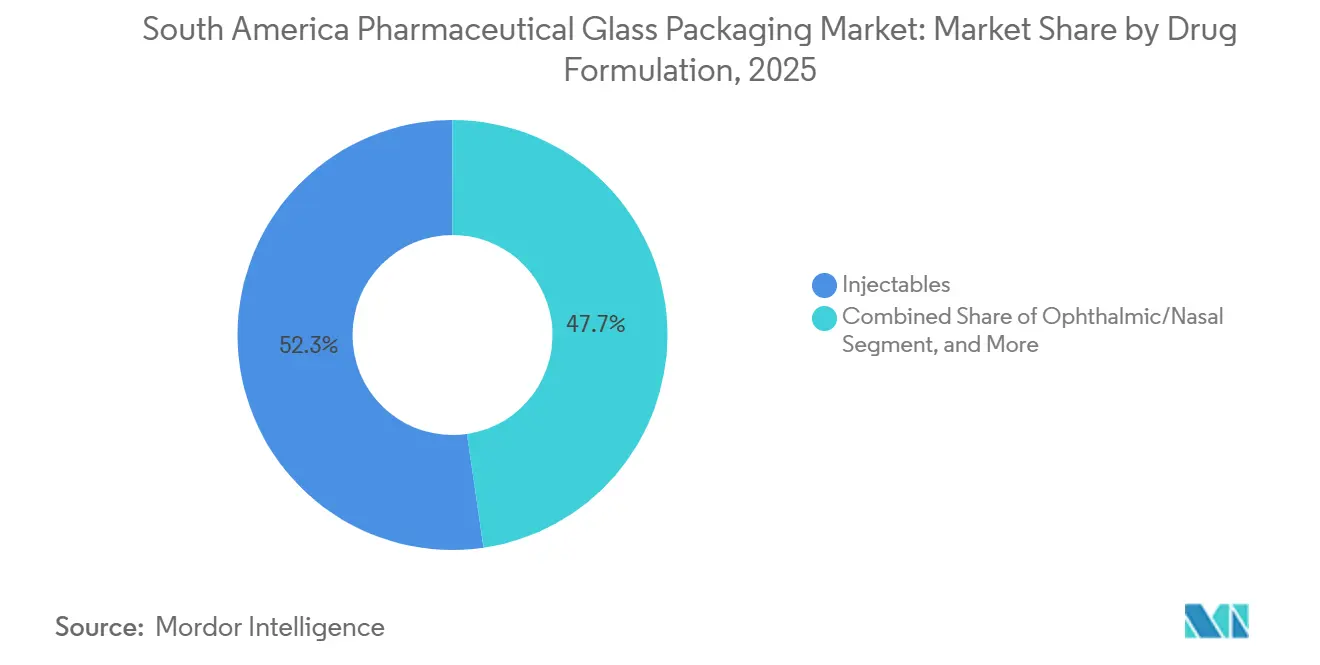
Injectables Retain the Largest Role in Packaging DemandInjectables held 52.31% of the South America pharmaceutical glass packaging market share in 2025. The segment benefits from centralized health procurement for vaccines, biosimilars, and oncology medicines. These products commonly require containers that protect sensitive formulations. ANVISA’s favorable recommendations for biosimilar products in September 2025 illustrated the link between an injectable approval pipeline and glass vial demand. The formulation’s scale makes supply continuity important for health programs and local fill-finish partners. It also supports demand for well-documented Type I formats across several vial sizes.
Injectables are projected to expand at a CAGR of 7.11% through 2031, the fastest rate among drug formulations in the South America pharmaceutical glass packaging market. Oral liquids remain stable for pediatric medicines, cough and cold products, and antifungal syrups. Ophthalmic and nasal medicines can require specialized glass containers for sensitive therapies. The aflibercept production initiative at Funed supports demand for small-volume ophthalmic injectable containers. Topical medicines have lower glass demand because creams and gels often use multilayer plastic tubes. Their unit volumes may remain stable, but their relative contribution to glass packaging is declining.
By End-User:
Innovator Pharma and Biotech Firms Drive High-Specification RequirementsInnovator pharma and biotech firms accounted for 27.56% of the South America pharmaceutical glass packaging market size in 2025. These companies place strong emphasis on documented Type I compliance, container-closure integrity evidence, and established extractables profiles. Such requirements can narrow the qualified supplier base for complex biologics. Roche, Novo Nordisk, and Pfizer are examples of companies associated in the draft with high-specification packaging needs. Their procurement practices favor suppliers with validated regional qualification capability. This pattern can limit the role of lower-tier suppliers in premium applications.
Innovator pharma and biotech firms are projected to expand at a CAGR of 7.34% through 2031. The segment’s growth is linked to the expanding regional footprint of biologics and related delivery formats. GLP-1 receptor agonist demand supports cartridge and prefillable syringe requirements. Generic manufacturers and contract manufacturing organizations continue to generate significant volume for Type I and Type II vial formats. They are more exposed to price competition from lower-cost imports because procurement decisions place greater weight on cost. Domestic biotech development also moves demand toward high-specification packaging from clinical batches through commercial supply.
Geography Analysis
Brazil and Argentina Pharmaceutical Glass Packaging Market
By geography, Brazil held 38.32% share in 2025, while Argentina is projected to expand at a 7.87% CAGR through 2031 in the South America pharmaceutical glass packaging market. Brazil accounted for the majority of the South America pharmaceutical glass packaging market in 2025. It has the region’s largest pharmaceutical manufacturing base and the most active biosimilar regulatory pipeline. ANVISA’s risk-based GMP certification framework, updated through RDC 982 in July 2025, strengthens Brazil’s role as a compliance reference point. Suppliers seeking access to Brazil must provide robust documentation for container performance and traceability. São Paulo concentrates pharmaceutical activity, packaging conversion, and sterile assembly capabilities. SCHOTT Pharma’s Itupeva presence supports access to regional customers seeking advanced packaging solutions.
Colombia Pharmaceutical Glass Packaging Market
Argentina and Colombia formed the next tier of demand in the South America pharmaceutical glass packaging market. Argentina’s ANMAT-supervised producers purchase containers mainly for generic injectables and selected biologic programs. Peso volatility and import restrictions can interrupt purchases of high-specification tubing and finished containers. Colombia is adding injectable capability through incremental investment by contract manufacturers. Bogotá and Medellín are emerging locations for regional fill-finish activity. These countries can benefit from products and technical support routed through Brazilian qualification and distribution networks.
South America Pharmaceutical Glass Packaging Market
Chile, Peru, and Uruguay remain smaller but commercially relevant destinations for pharmaceutical glass containers. Chile’s quality framework aligns closely with FDA and EMA approaches, supporting demand for premium Type I formats used by multinational clinical programs. Peru’s broader health access programs can add demand for multi-dose injectable vaccine vials. Uruguay’s pharmaceutical sector serves smaller export-oriented niches in the region. Veterinary vaccine demand in Brazil and Argentina also supports glass vial use in livestock supply chains. The South America pharmaceutical glass packaging market therefore draws demand from both human health programs and veterinary applications, although no reliable segment size was provided for the latter.
Competitive Landscape
The South America pharmaceutical glass packaging market is moderately concentrated in technically differentiated output. SCHOTT Pharma, Gerresheimer, Stevanato Group, and Nipro are identified as leading suppliers of Type I borosilicate solutions to the region. Their position is supported by technical specifications, validation experience, and established product portfolios. Regional converters and lower-cost importers compete more strongly in standard vials and ampoules. SCHOTT Pharma’s Itupeva site provides a local operational presence and established regional relationships. The company reported revenue of EUR 986 million (USD 1.06 billion) in fiscal year 2025, based on the stated average exchange rate.
Gerresheimer, Stevanato Group, and SCHOTT Pharma created the Alliance for RTU in September 2024 to encourage the adoption of ready-to-use vials and cartridges. The collaboration promotes higher technical requirements at fill-finish sites and favors suppliers with RTU expertise. Gerresheimer also began construction of a 4,000 m² ready-to-fill vial facility at Wertheim in October 2025, with completion targeted for mid-2027. SCHOTT Pharma expanded vial capacity in Lebanon, Pennsylvania, by more than USD 60 million in June 2026. These moves can support global supply availability for customers that source advanced formats for South America.
No South American producer is identified in the draft as a commercial-scale manufacturer of pharmaceutical-grade borosilicate tubing. This leaves a manufacturing gap in melting and tube drawing, while local suppliers focus more on conversion, assembly, and qualification. Stevanato Group’s portfolio includes EZ-fill, Nexa prefillable syringes, and cartridge coating technologies, which support its role in premium delivery formats. Specialty companies can also address smaller clinical or laboratory applications outside standard commercial vial volumes. Competition in amber bottles and oral-liquid packaging is more price sensitive than in biologic primary containers. The South America pharmaceutical glass packaging market remains more protected at the high-specification end because switching suppliers requires documentation, testing, and approval work.
South America Pharmaceutical Glass Packaging Industry Leaders
-
Gerresheimer AG
-
SCHOTT AG
-
Stevanato Group S.p.A.
-
SGD S.A.
-
Nipro Corporation
- *Disclaimer: Major Players sorted in no particular order
South America Pharmaceutical Glass Packaging Market Companies Covered in this Report
- Gerresheimer AG
- SCHOTT AG
- Stevanato Group S.p.A.
- Nipro Corporation
- SGD S.A.
- Corning Incorporated
- West Pharmaceutical Services, Inc.
- Bormioli Pharma S.p.A.
- Ardagh Glass Packaging
- Stoelzle Oberglas GmbH
- Beatson Clark Limited
- Shandong Pharmaceutical Glass Co., Ltd.
- Chongqing Zhengchuan Pharmaceutical Packaging Co., Ltd.
- Cangzhou Four Star Glass Co., Ltd.
- DWK Life Sciences GmbH
- Origin Pharma Packaging Limited
- Vitro, S.A.B. de C.V.
- AptarGroup, Inc.
- Becton, Dickinson and Company
- Owens-Illinois, Inc.
Recent Industry Developments in South America Pharmaceutical Glass Packaging Market
- July 2026: Aurobindo Pharma’s CuraTeQ Biologics received ANVISA GMP certification for its Hyderabad biosimilar facility covering vial filling and prefillable syringe lines for four biosimilar products, validating Brazil-facing supply chain readiness ahead of commercial launch.
- June 2026: SCHOTT Pharma inaugurated more than USD 60 million in expanded vial production capacity in Lebanon, Pennsylvania, tripling its US core and specialty vial output under BARDA funding, a supply chain resilience move that also signals the company’s ambition to satisfy global demand spikes from RTU-qualified facilities.
- March 2026: Fundação Ezequiel Dias, Funed, and Bionovis advanced the PDP for aflibercept with Samsung Bioepis, with Funed committing BRL 42 million (USD 7.4 million) to manufacturing unit upgrades for ophthalmic injectable production, a program with direct glass vial demand implications for small-volume ophthalmic containers.
- January 2026: Blau Farmacêutica announced ANVISA GMP-certified end-to-end domestic development of a pembrolizumab biosimilar, Brazil’s first fully integrated monoclonal antibody manufacturing program, initiating a clinical phase expected to generate recurring Type I borosilicate vial demand across development and eventual commercial supply.
South America Pharmaceutical Glass Packaging Market Report Scope
The South America Pharmaceutical Glass Packaging Market refers to the industry involved in the manufacturing, supply, and use of glass-based packaging solutions for pharmaceutical products across countries such as Brazil, Argentina, Colombia, and the rest of South America.
The South America Pharmaceutical Glass Packaging Market Report is Segmented by Product (Bottles, Vials, Ampoules, Cartridges and Prefillable Syringes, and Other Products), by Glass Type (Type I Borosilicate, Type II Treated Soda-Lime, Type III Soda-Lime, and Other Glass Types), by Drug Formulation (Injectables, Oral Liquids, Ophthalmic and Nasal, and Topical), by End-User (Pharma Innovator Companies, Generic and CMOs, Biotech Firms, Compounding Pharmacies, and Veterinary Pharma), and Geography (Brazil, Argentina, Colombia, and Rest of South America). The Market Forecasts are Provided in Terms of Value (USD).
Segmentation Overview
| Bottles |
| Vials |
| Ampoules |
| Cartridges and Prefillable Syringes |
| Other Products |
| Type I Borosilicate |
| Type II Treated Soda-Lime |
| Type III Soda-Lime |
| Other Glass Types |
| Injectables |
| Oral Liquids |
| Ophthalmic/Nasal |
| Topical |
| Pharma Innovator Companies |
| Generic and CMOs |
| Biotech Firms |
| Compounding Pharmacies |
| Veterinary Pharma |
| Brazil |
| Argentina |
| Colombia |
| Rest of South America |
| By Product | Bottles |
| Vials | |
| Ampoules | |
| Cartridges and Prefillable Syringes | |
| Other Products | |
| By Glass Type | Type I Borosilicate |
| Type II Treated Soda-Lime | |
| Type III Soda-Lime | |
| Other Glass Types | |
| By Drug Formulation | Injectables |
| Oral Liquids | |
| Ophthalmic/Nasal | |
| Topical | |
| By End-User | Pharma Innovator Companies |
| Generic and CMOs | |
| Biotech Firms | |
| Compounding Pharmacies | |
| Veterinary Pharma | |
| By Geography | Brazil |
| Argentina | |
| Colombia | |
| Rest of South America |
Key Questions Answered in the Report
What is the South America pharmaceutical glass packaging market size?
The sector was estimated at USD 1.56 billion in 2026 and is forecast to reach USD 2.11 billion by 2031 at a CAGR of 6.23%.
What is driving pharmaceutical glass packaging demand in South America?
Injectable biologics, biosimilars, vaccines, and greater fill-finish capacity are supporting demand for qualified glass primary containers.
Which product category is expanding fastest in this sector?
Cartridges and prefillable syringes are projected to expand at a CAGR of 7.49% through 2031, supported by auto-injectors and biologic delivery needs.
Why is Type I borosilicate important for pharmaceutical packaging?
Type I borosilicate is used for sensitive injectables, vaccines, and biologics because it provides the performance expected for these formulations.
Which country leads demand for pharmaceutical glass containers in South America?
Brazil led regional demand in 2025 because of its large manufacturing base, biosimilar pipeline, and public investment in vaccine and fill-finish capability.
What risks affect suppliers of pharmaceutical glass containers in South America?
Imported tubing costs, currency exposure, qualification requirements, and selected polymer alternatives can affect purchasing and supplier choices.