
Market Overview
| Study Period | 2020 - 2031 |
|---|---|
| Forecast Data Period | 2026 - 2031 |
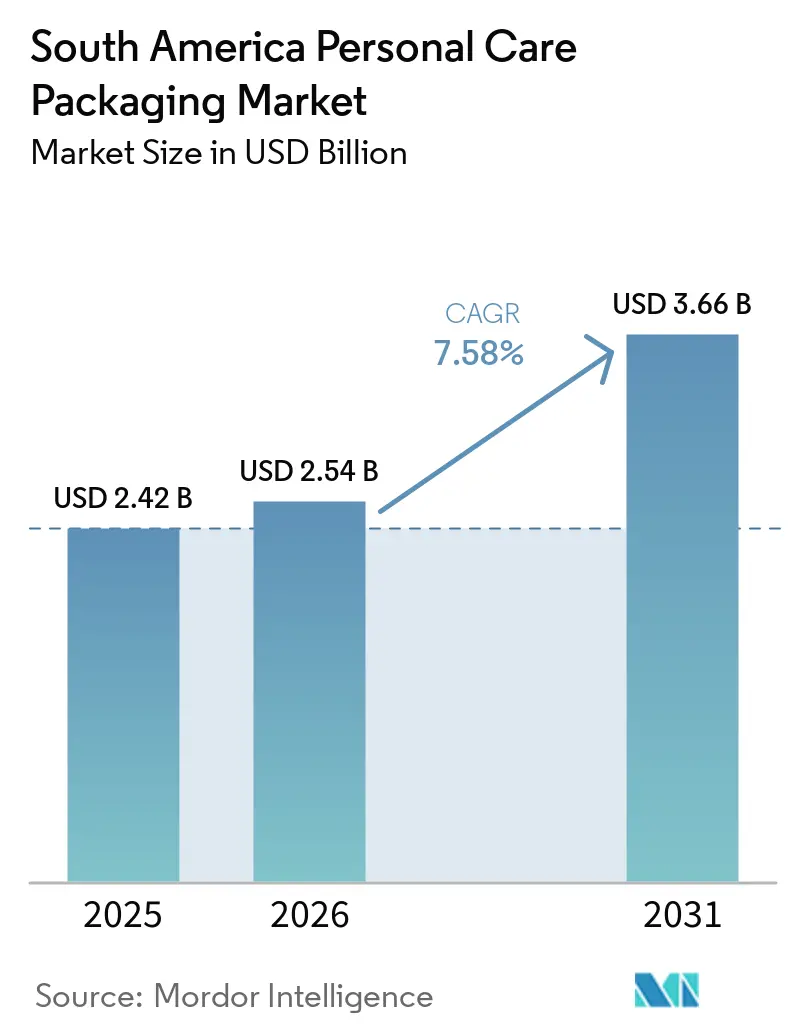
| Base Year Market Size (2025) | USD 2.42 Billion |
| Market Size (2026) | USD 2.54 Billion |
| Market Size (2031) | USD 3.66 Billion |
| Growth Rate (2026 - 2031) | 7.58 % |
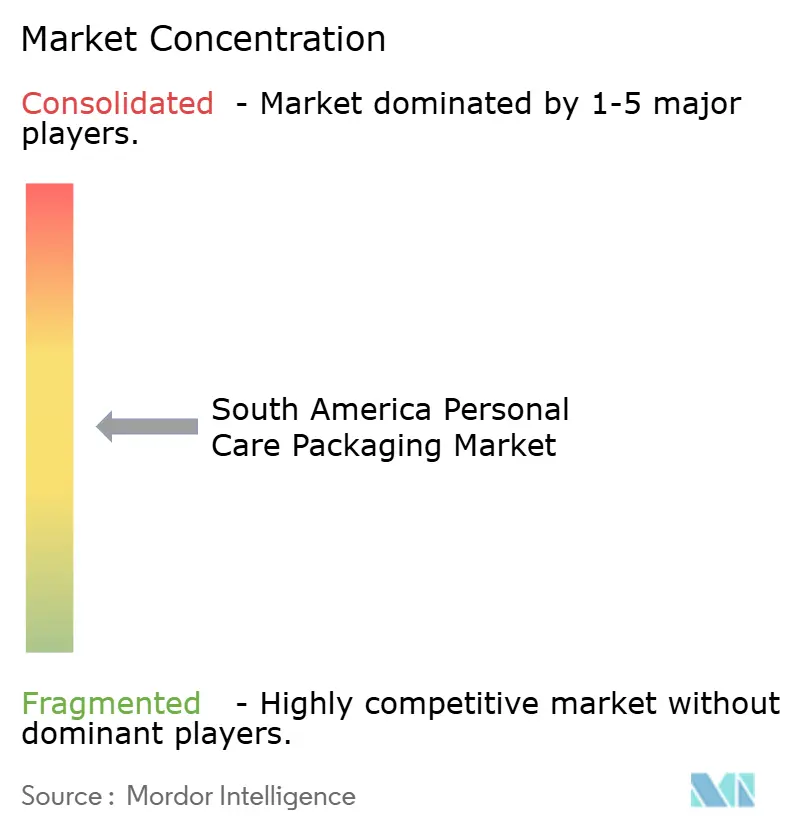
| Market Concentration | Medium |
Major Players *Disclaimer: Major Players sorted in no particular order Image © Mordor Intelligence. Reuse requires attribution under CC BY 4.0. | |
South America Personal Care Packaging Market Analysis by Mordor Intelligence
The South America personal care packaging market size was valued at USD 2.54 billion in 2025 and estimated to grow from USD 2.54 billion in 2026 to reach USD 3.66 billion by 2031, at a CAGR of 7.58% during the forecast period (2026-2031). Rising demand for beauty, hygiene, and premium personal care products is increasing demand for containers, dispensing systems, closures, and refill packs across the region. Brazil remains the main production and consumption base, while Chile and Colombia offer additional opportunities for suppliers with local manufacturing and technical service capabilities. Packaging specifications are moving toward recycled content, recyclable structures, bio-based resins, and reusable formats as brand owners set clearer material requirements for suppliers. This shift favors converters that can document material composition, provide stable quality, and shorten development cycles for new product launches. Cost pressure from polyolefin and recycled-resin inputs may limit margins, particularly for smaller converters that have less purchasing power.
Key Report Takeaways
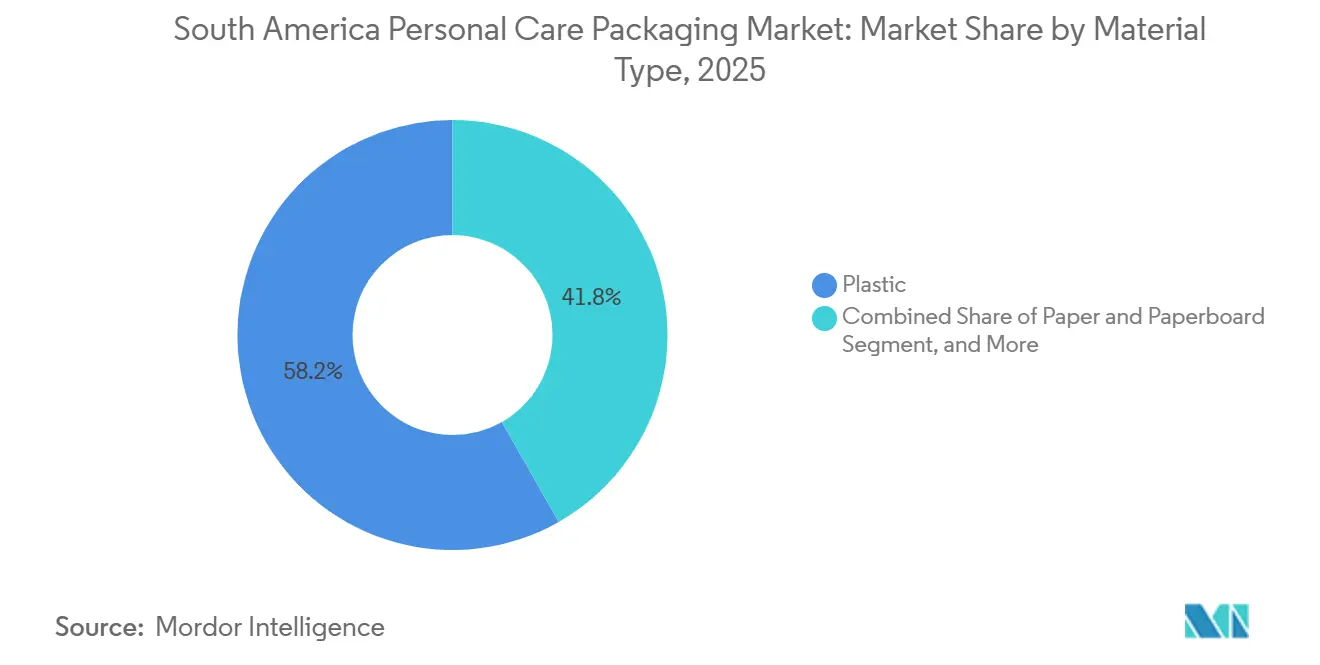
- By material type, plastic held 58.23% of the South America personal care packaging market share in 2025, while plastics are projected to expand at a 8.16% CAGR through 2031.
- By packaging format, rigid packaging accounted for 71.48% of the South America personal care packaging market in 2025, while flexible packaging is projected to expand at a 8.32% CAGR through 2031.
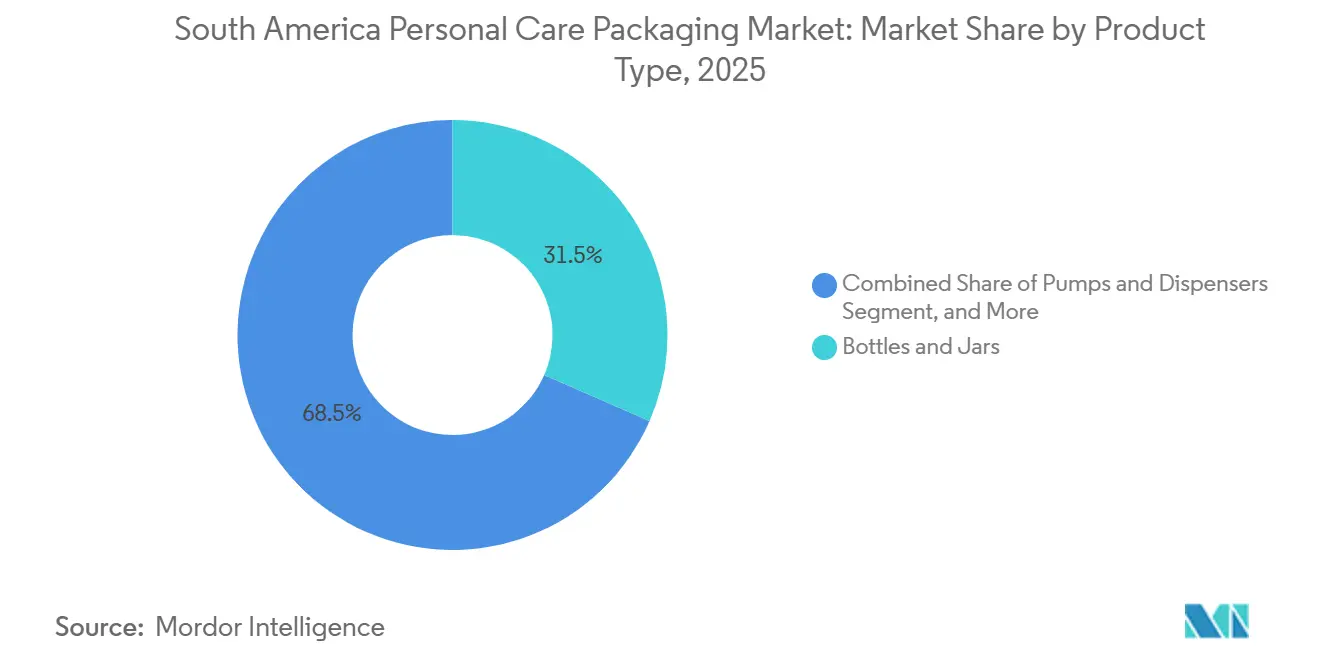
- By product type, bottles and jars accounted for 31.54% of the regional value in 2025, while pouches and sachets are projected to expand at a 8.26% CAGR through 2031.
- By application, skin care accounted for 28.41% of value in 2025, while other applications are projected to expand at a 8.39% CAGR through 2031.
- By geography, Brazil held 58.61% of the value in 2025, while Chile is projected to expand at a 8.56% CAGR through 2031.
Note: Market size and forecast figures in this report are generated using Mordor Intelligence’s proprietary estimation framework, updated with the latest available data and insights as of January 2026.
South America Personal Care Packaging Market Trends and Insights
Drivers Impact Analysis*
| Driver | (~) % Impact on CAGR Forecast | Geographic Relevance | Impact Timeline |
|---|---|---|---|
| Rising Personal Care Consumption and Premium Beauty Products | +1.8% | South America, concentrated in Brazil, Colombia, and Chile | Short term (≤ 2 years) |
| Growth in Skin Care, Hair Care, and Fragrance | +1.4% | Brazil, with spillover to Argentina and Chile | Short term (≤ 2 years) |
| Brand Adoption of Mono-Material and Recycled-Content Packs | +1.0% | Brazil and Colombia, with early adoption in Chile and Argentina | Medium term (2-4 years) |
| Demand for Lightweight Flexible Packaging | +0.9% | Brazil, Colombia, and the rest of South America | Medium term (2-4 years) |
| Expansion of Refillable and Reusable Packaging Models | +0.7% | Brazil, with early expansion in Argentina | Medium term (2-4 years) |
| Nearshore Customization for Shorter Beauty Launch Cycles | +0.5% | Brazil, Colombia, and Argentina hub cities | Medium term (2-4 years) |
| Source: Mordor Intelligence | |||
Rising Consumption of Personal Care Products and Premium Beauty Products
Brazil’s direct-selling networks support repeat purchases and maintain demand for bottles, jars, tubes, and sachets even when retail conditions weaken. More product stock-keeping units require a wider range of container sizes, closures, labels, and dispensing options. Premium products also use airless dispensers, glass flacons, and decorated closures that require more specialized conversion capabilities. Personal consultation and repeat ordering can provide a more stable demand base than channels that depend solely on shelf visibility, giving the South America personal care packaging market a broad demand base not limited to traditional stores.
Growth in Skin Care, Hair Care, and Fragrance
Serums, retinol products, and broad-spectrum sunscreens use airless pumps, UV-protective glass, or sealed tubes to protect their formulas. AptarGroup operates manufacturing sites in Cajamar, Jundiaí, Maringá, and Camaçari, serving regional beauty customers with airless dispensing systems. Fragrance demand supports sales of premium glass flacons and refillable designs, including products supplied by Wheaton Brasil. Greater sunscreen awareness also supports demand for metered tubes and airless pumps, which provide controlled dispensing and protect the product. Local production of these systems can reduce import dependence and help brands respond to shorter launch schedules, raising the technical requirements for the South America personal care packaging market.
Brand Adoption of Mono-Material and Recycled-Content Packs
Natura reported that by 2025, 90% of its packaging would be recyclable, reusable, refillable, or compostable, while recycled plastic accounted for 30.1% of its portfolio. These commitments increase demand for suppliers that can verify post-consumer recycled content and demonstrate compatibility with collection and sorting systems. Grupo Boticário stated that its Nativa SPA refill lines use 78% less plastic per unit than comparable conventional formats, reinforcing the commercial role of refill systems.[1]Grupo Boticário, “Recycled Aluminum Packaging,” Grupo Boticário, grupoboticario.com.br Amcor produced a skin-care stick applicator using 87% recycled polypropylene through its CleanStream technology, demonstrating how material performance and recycled content can be combined. Material certificates, reliable availability of recycled resin, and consistent quality are becoming central supplier requirements rather than optional product features. The South America personal care packaging market, therefore, offers stronger prospects for converters that can qualify recycled and mono-material solutions at a commercial scale.
Demand for Lightweight Flexible Packaging
Sachets allow brands to serve lower-income consumers with smaller purchase sizes, while refill pouches reduce packaging weight for repeat purchases. Amcor’s AmPrima recycle-ready refill pouch received an AmeriStar award after meeting the Association of Plastic Recyclers’ Critical Guidance Testing requirements. ANVISA opened Public Consultations 1380 and 1381 in January 2026 on requirements for repackaging and reuse of cosmetics, personal hygiene products, and perfumes. Clearer requirements can reduce uncertainty for refill and reuse programs in retail and professional channels by setting common expectations for product handling, traceability, manufacturing practices, packaging compatibility, and documented quality controls across regional supply chains. As sachets replace some first-purchase bottles, the South America personal care packaging market can see higher unit volumes even when material use per pack falls, because trial, travel, and low-outlay purchase occasions require more individual packs.
Restraints Impact Analysis*
| Restraint | (~) % Impact on CAGR Forecast | Geographic Relevance | Impact Timeline |
|---|---|---|---|
| Polyolefin and Recycled-Resin Cost Volatility | -1.5% | South America, with high exposure in Brazil and Argentina | Short term (≤ 2 years) |
| High Cost of Sustainable Packaging Development | -1.0% | Brazil, with secondary effects in Colombia and Chile | Medium term (2-4 years) |
| Inconsistent Post-Consumer Packaging Collection and Recovery | -0.7% | South America, especially outside the São Paulo metropolitan area | Long term (≥ 4 years) |
| Product Safety and Retail Constraints for Refill Systems | -0.4% | Brazil and Argentina | Medium term (2-4 years) |
| Source: Mordor Intelligence | |||
Polyolefin and Recycled-Resin Cost Volatility
Polyethylene and polypropylene are widely used in bottles, tubes, caps, and flexible films, making input costs important for regional converters. Higher resin costs can compress margins when packaging suppliers cannot immediately pass price increases to brand owners. Cost uncertainty also complicates pricing for long-term supply contracts and new product development programs. Recycled material may provide an alternative source when virgin material availability tightens, although its quality and supply remain uneven. The South America personal care packaging market remains exposed because resin inputs account for a significant share of the cost of high-volume plastic packs.
High Cost of Sustainable Packaging Development
Mono-material, bio-based, and recycled-content packs require spending on material testing, tooling changes, certification, and consumer validation. These requirements are easier for large suppliers and brand owners with established technical resources. Smaller converters may face longer qualification periods and may not be able to fund multiple material programs simultaneously. The collection and recovery of post-consumer packaging also vary widely across South America, limiting the reliable supply of recycled resin. Product-safety rules and retail execution requirements can further slow refill systems, especially where cleaning, traceability, and handling procedures are not fully established. These pressures make the South America personal care packaging market more difficult for converters to serve without technical and financial scale.
*Our forecasts treat driver/restraint impacts as directional, not additive. The impact forecasts reflect baseline growth, mix effects, and variable interactions.
Segment Analysis
By Material Type: Bio-Based Innovation Changes Plastic Leadership
Plastic accounted for 58.23% of the South America personal care packaging market in 2025 because polyethylene and polypropylene offer a practical cost-performance balance for high-volume products. Plastics are projected to grow at an 8.16% CAGR through 2031, the fastest rate among material subcategories. This change reflects higher demand for renewable and recycled-content options within established plastic conversion systems. Braskem’s I’m Green bio-based polyethylene is produced from Brazilian sugarcane ethanol, giving converters access to a regional renewable feedstock.[2]Braskem, “I’m Green Bio-Based Products,” Braskem, braskem.com Natura and Grupo Boticário have used renewable plastic in packaging, supporting the wider adoption of certified bio-based materials and allowing converters to adapt existing production lines without sacrificing product performance.
Glass remains important for fragrance and prestige skin care because it supports product protection, weight, and premium presentation. Wheaton Brasil supplies glass packaging to domestic and multinational beauty brands and has adopted biometane as a partial replacement for natural gas in production. Metal continues to serve aerosol and deodorant applications, where durability and dispensing requirements are important. Grupo Boticário reported that its recycled aluminum aerosol packaging avoided more than 240 tonnes of carbon dioxide emissions and more than 100 tonnes of aluminum waste by 2024. Paper and paperboard are gaining attention for secondary cartons and selected specialty applications, although material selection remains application-specific because each option provides different barriers, decoration options, and end-of-life pathways.



By Packaging Format: Rigid Formats Retain Scale While Flexible Gains Speed
Rigid packaging accounted for 71.48% of the South America personal care packaging market size in 2025, reflecting the continuing role of bottles and jars in hair care, oral care, fragrance, and skin care. Rigid packs remain important because consumers associate them with product protection, visibility, and a premium experience. Amcor introduced its customizable Mocha bottle in March 2026 in 100 ml, 250 ml, and 500 ml formats, with a minimum order quantity of 10,000 units. The format allows smaller brands to access a standardized bottle platform with a shorter development path. Rigid packs also support decoration and dispensing options that are difficult to reproduce in some flexible structures.
Flexible packaging is projected to grow at an 8.32% CAGR through 2031 as refill pouches and sachets serve different purchasing occasions. Value sachets lower the initial purchase cost, while premium refill pouches retain consumers after a primary pack is purchased. Amcor offers refill pouch structures for personal care products in South America, including designs intended to support recyclability. The formats are increasingly complementary rather than direct substitutes. A rigid primary container can support product presentation, while a refill pouch can reduce material for repeat purchases and create an opportunity in the South America personal care packaging market for suppliers that can meet consistent barrier, sealing, decoration, and color requirements across both formats.
By Product Type: Bottles and Jars Lead While Pouches and Sachets Grow
Bottles and jars accounted for 31.54% of the South America personal care packaging market in 2025 because they are used in applications such as shampoo, conditioner, facial cream, and hand sanitizer. Their established role also reflects regional investment in PET and HDPE blow-molding capacity. Pouches and sachets are projected to grow at an 8.26% CAGR through 2031, supported by smaller purchase sizes and refill programs. Natura’s Ekos Castanha concentrate kit uses 81% less plastic than a conventional refill and uses plastic collected from Amazonian rivers. The product illustrates how flexible formats can support both material reduction and brand messaging.
Tubes and sticks provide an intermediate option for products that require controlled dispensing and product protection. Aptar introduced the Sierra, Moda, and Luna airless packaging lines in April 2025 as part of its local-for-local production strategy in Brazil, Colombia, and Argentina. Pumps and dispensers remain valuable in premium skin care because they enable precise use and protect formulas. Caps and closures are also important technical components, even though they account for a smaller share of pack value.
By Application: Skin Care Supports Value While Specialty Uses Broaden Demand
Skin care accounted for 28.41% of the South America personal care packaging market in 2025 and requires airless dispensers, amber glass, dropper bottles, and precision pumps more often than routine products. These formats generally carry higher specifications than standard rigid packaging. Chile’s mass beauty and personal care category recorded 9% growth in retail value in 2025, with skin care as the leading product segment. Hair care continues to see high demand for shampoo and conditioner bottles, particularly in the 200 ml to 1,000 ml range. Regional converters with local PET blow-molding capacity are well positioned to serve these high-volume applications, while skin care and hair care together create demand for premium systems and standard containers.
Other applications are projected to grow at an 8.39% CAGR through 2031, including body care, sun care, men’s grooming, intimate hygiene, and scalp care. The wider range of uses creates demand for aerosols, roll-on containers, premium glass flacons, tubes, and specialty closures. Brasilata’s aerosol capability and Wheaton Brasil’s glass operations support deodorant and fragrance applications in Brazil and Argentina. Baby care requires material safety, traceability, and label controls that favor suppliers with established quality systems. Oral care remains focused on tube formats and usually changes more slowly than skin care and fragrance, while application diversity broadens demand in the South America personal care packaging industry without removing the importance of high-volume hair care and skin care packs.
Geography Analysis
Brazil held 58.61% of the South America personal care packaging market share in 2025 because it combines the region’s largest consumer base with a dense formulation and packaging manufacturing network. Beauty and personal care sales in Brazil grew 10.3% in 2024 to BRL 173.4 billion (USD 32.1 billion), supporting demand for a broad range of packaging formats. ANVISA opened consultations on repackaging and reuse requirements in January 2026, adding to the compliance focus for refillable cosmetics, hygiene products, and perfumes.[3]Agência Nacional de Vigilância Sanitária, “Public Consultations 1380 and 1381,” ANVISA, gov.br Wheaton Brasil and Natura have also introduced biometane into parts of their Brazilian operations, linking packaging and personal care production to lower-carbon energy use.
Chile is projected to grow at an 8.56% CAGR through 2031, making it the fastest-growing country market in the region. Its mass beauty and personal care category has experienced strong retail value growth, supported by demand for premium products. The Santiago Metropolitan Region remains the main center for beauty retail and higher-value packaging demand. Valparaíso is developing as another area for specialty retail and e-commerce activity. Faster consumer uptake of international beauty trends is increasing local interest in airless dispensing, specialty glass, and decorated flexible formats, providing a focused growth opportunity for the South America personal care packaging market.
Natura’s direct-selling network and Grupo Boticário’s physical and digital channels support product distribution nationwide. Albéa acquired Amfora Packaging in 2025, extending its production access to Colombian and Peruvian beauty customers. Ecuador, Peru, Bolivia, and other South American countries remain more focused on sachets and basic rigid plastic bottles, although formal retail expansion is creating broader opportunities for regional suppliers and extending the addressable base of the South America personal care packaging market.
Competitive Landscape
The South America personal care packaging market has a moderately concentrated top tier that includes Amcor, AptarGroup, Albéa, Silgan, and Gerresheimer. These companies compete through dispensing technology, recycled-content integration, design capabilities, and production close to beauty customers. Domestic suppliers such as Wheaton Brasil, Globalpack, Brasilata, and Tubaplas compete through local relationships, material specialization, and supply reliability. Aptar operates an Americas Hub with production sites in Brazil, Colombia, Argentina, and Mexico, supporting regional delivery and local product development. Brasilata’s work in metal packaging and sustainability programs indicates how domestic companies are responding to higher material and technical requirements.
Airless dispensing is becoming more common outside luxury products as brands seek functional packaging for premium skin care and mass-premium lines. Amcor introduced Magic One in March 2026 as a 100% polyolefin airless dispensing system designed to meet European recyclability requirements. Aptar launched inverted lidless dispensing closures in April 2026 for shampoos, conditioners, body washes, baby soaps, and lotions.[4]AptarGroup, “Aptar Turns Beauty and Personal Care Products Upside Down with Inverted Lidless Dispensing Closures,” AptarGroup, morningstar.com Silgan expanded its airless range for facial serums, creams, liquid makeup, and eye-contour applications in February 2026. These launches show that technical dispensing systems are becoming a larger area of competition in the South America personal care packaging market.
Local production of premium airless and specialty dispensing systems remains an opportunity in Chile and Colombia, where some brands still rely on imported components. Braskem’s sugarcane-derived polyethylene also provides a regional platform for suppliers seeking certified bio-based resin. Wheaton Brasil continues to position glass packaging around premium design and decoration for beauty customers. These local capabilities can differentiate suppliers in the South America personal care packaging market, multiple multinational and domestic converters remain active, and the competitive field spans rigid containers, flexible packs, glass, metal, dispensing systems, and closures.
South America Personal Care Packaging Industry Leaders
Amcor plc
Mondi plc
AptarGroup, Inc.
Sonoco Products Company
Silgan Holdings Inc.
- *Disclaimer: Major Players sorted in no particular order

Recent Industry Developments
- August 2026: Wheaton Brasil showcased its latest glass packaging collections at Emballa Mundi 2026 on August 17-18, presenting the Alegria, Sonho, Surpresa, and Harmonia standard lines alongside decoration techniques for premium personal care.
- July 2026: Gerresheimer signed definitive agreements to sell its global Primary Packaging Plastics business and U.S.-based Centor unit to Apax Funds for a combined enterprise value of EUR 1.5 billion (USD 1.73 billion), a restructuring that exits the company from personal care plastic packaging to focus on pharmaceutical drug delivery and injectable primary packaging.
- May 2026: Natura launched its Aqui Tem Refil Premiado campaign, offering discounts of up to 70% on refillable products during Brazil’s Recycling Day period.
- March 2026: Amcor launched the Mocha personal care bottle in 100 ml, 250 ml, and 500 ml versions with a 10,000-unit minimum order quantity and an 8-week delivery period.


South America Personal Care Packaging Market Report Scope
The South America Personal Care Packaging Market encompasses packaging solutions used for personal care products, including skincare, haircare, cosmetics, fragrances, and toiletries. The report analyzes market size, growth trends, key drivers, challenges, competitive landscape, and demand across packaging materials, product types, and countries in South America.
The South America Personal Care Packaging Market Report is Segmented by Material Type (Plastic [Polyethylene, Polypropylene, PET and PVC, Polystyrene, Bio-Based Plastics, and Other Plastic Types], Glass, Metal, and Paper and Paperboard), Packaging Format (Rigid, and Flexible), Product Type (Bottles and Jars, Tubes and Sticks, Pumps and Dispensers, Pouches and Sachets, Caps and Closures, and Other Product Types), Application (Skin Care, Hair Care, Oral Care, Makeup Products, Deodorants and Fragrances, Baby Care, and Other Applications), and Geography (Brazil, Argentina, Chile, Colombia, and Rest of South America). The Market Forecasts are Provided in Terms of Value (USD).
By Material Type
| Plastic | Polyethylene |
| Polypropylene | |
| PET and PVC | |
| Polystyrene | |
| Bio-Based Plastics | |
| Other Plastic Types | |
| Glass | |
| Metal | |
| Paper and Paperboard |
By Packaging Format
| Rigid |
| Flexible |
By Product Type
| Bottles and Jars |
| Tubes and Sticks |
| Pumps and Dispensers |
| Pouches and Sachets |
| Caps and Closures |
| Other Product Types |
By Application
| Skin Care |
| Hair Care |
| Oral Care |
| Makeup Products |
| Deodorants and Fragrances |
| Baby Care |
| Other Applications |
By Geography
| Brazil |
| Argentina |
| Chile |
| Colombia |
| Rest of South America |
| By Material Type | Plastic | Polyethylene |
| Polypropylene | ||
| PET and PVC | ||
| Polystyrene | ||
| Bio-Based Plastics | ||
| Other Plastic Types | ||
| Glass | ||
| Metal | ||
| Paper and Paperboard | ||
| By Packaging Format | Rigid | |
| Flexible | ||
| By Product Type | Bottles and Jars | |
| Tubes and Sticks | ||
| Pumps and Dispensers | ||
| Pouches and Sachets | ||
| Caps and Closures | ||
| Other Product Types | ||
| By Application | Skin Care | |
| Hair Care | ||
| Oral Care | ||
| Makeup Products | ||
| Deodorants and Fragrances | ||
| Baby Care | ||
| Other Applications | ||
| By Geography | Brazil | |
| Argentina | ||
| Chile | ||
| Colombia | ||
| Rest of South America |


Key Questions Answered in the Report
What is the South America personal care packaging market size?
The South America personal care packaging market was valued at USD 2.54 billion in 2025 and is estimated at USD 2.54 billion in 2026. It is forecast to reach USD 3.66 billion by 2031.
What growth rate is expected for personal care packaging in South America?
The South America personal care packaging market is forecast to grow at a 7.58% CAGR from 2026 to 2031. Demand is supported by beauty consumption, premium formats, and refill packaging.
Which material leads personal care packaging demand in South America?
Plastic led with a 58.23% share in 2025 because it serves high-volume bottles, tubes, closures, and flexible films. Plastics are expected to be the fastest-growing material subcategory at a 8.16% CAGR through 2031.
Why are refill pouches becoming more important for beauty brands?
Refill pouches can reduce packaging weight and support repeat purchases after consumers buy a primary pack. Flexible packaging is forecast to grow at an 8.32% CAGR through 2031.
Which country has the largest demand for personal care packaging in South America?
Brazil led the region with a 58.61% share in 2025, supported by its large beauty sector, direct-selling networks, and established manufacturing base.
Page last updated on:





