
South America Oral Anti-Diabetic Drugs Market Size and Share
Market Overview
| Study Period | 2020 - 2031 |
|---|---|
| Forecast Data Period | 2026 - 2031 |
| Base Year Market Size (2025) | USD 3.17 Billion |
| Market Size (2026) | USD 3.28 Billion |
| Market Size (2031) | USD 3.89 Billion |
| Growth Rate (2026 - 2031) | 3.48 % |
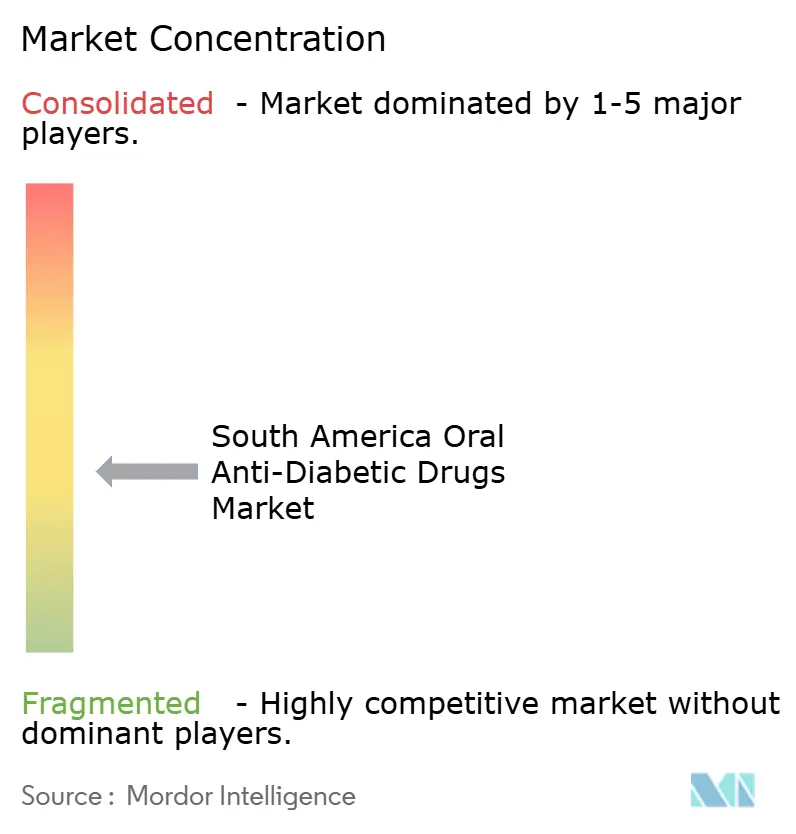
| Market Concentration | Medium |
Major Players *Disclaimer: Major Players sorted in no particular order Image © Mordor Intelligence. Reuse requires attribution under CC BY 4.0. | |
South America Oral Anti-Diabetic Drugs Market Analysis by Mordor Intelligence
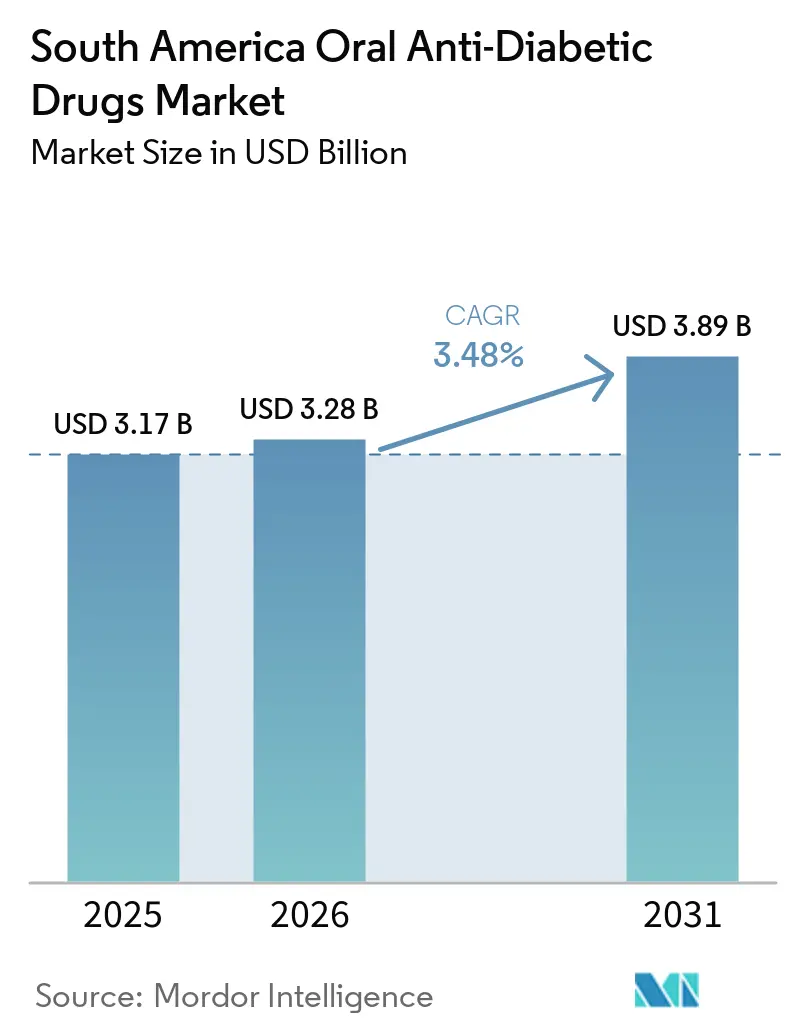
The South America Oral Anti-Diabetic Drugs Market size is expected to grow from USD 3.17 billion in 2025 to USD 3.28 billion in 2026 and is forecast to reach USD 3.89 billion by 2031 at 3.48% CAGR over 2026-2031.
Diabetes prevalence continues to support prescription demand because 35 million adults in South and Central America had diabetes in 2024, while 30.4% remained undiagnosed. The number of people with diabetes is projected to reach 52 million by 2050, which keeps diagnosis and treatment access central to commercial planning. Public medicine programs, generic medicines, and digital refill services are improving access to established oral therapies in several countries. At the same time, cardiorenal prescribing supports newer oral medicines, while lower-priced injectable therapies may redirect some new Type 2 Diabetes prescriptions in higher-income urban areas.
Key Report Takeaways
- By drug class, Biguanides led with 43.31% revenue share in 2025, while SGLT2 inhibitors are forecast to expand at a 6.58% CAGR through 2031.
- By diabetes type, Type 2 Diabetes held 89.24% of the South America oral anti-diabetic drugs market share in 2025 and is expected to have a CAGR at 4.22% through 2031.
- By formulation, Immediate-Release Tablets accounted for 58.14% of the South America oral anti-diabetic drugs market size in 2025, while Extended-Release Tablets are expected to advance at a 6.82% CAGR through 2031.
- By distribution channel, Retail Pharmacies held 48.65% revenue share in 2025, while Online Pharmacies are forecast to grow at a 7.65% CAGR through 2031.
- By country, Brazil accounted for 62.61% revenue share in 2025, while Argentina is forecast to expand at a 5.75% CAGR through 2031.
Note: Market size and forecast figures in this report are generated using Mordor Intelligence’s proprietary estimation framework, updated with the latest available data and insights as of January 2026.
Market Trends and Insights
Drivers Impact Analysis of South America Oral Anti-Diabetic Drugs Market*
| Driver | (~) % Impact on CAGR Forecast | Geographic Relevance | Impact Timeline |
|---|---|---|---|
| Expanding Type 2 Diabetes Treatment Pool | +0.8% | All South American markets | Long term (≥ 4 years) |
| Metformin-Led Public-Sector Treatment Access | +0.6% | Brazil, Argentina, Colombia | Short term (≤ 2 years) |
| Cardiovascular and Renal Benefits of SGLT2 Inhibitors | +0.5% | Brazil, Argentina, Colombia urban specialty care | Medium term (2-4 years) |
| Shift Toward Fixed-Dose Combination Tablets | +0.4% | Brazil, Argentina, Chile | Medium term (2-4 years) |
| Growth of Digital Refills and Online Pharmacy Access | +0.3% | Brazil, urban Argentina, Colombia | Short term (≤ 2 years) |
| Local Generic and Technology-Transfer Capacity | +0.2% | Brazil, Argentina | Long term (≥ 4 years) |
| Source: Mordor Intelligence | |||
Expanding Type 2 Diabetes Treatment Pool
The diagnosed Type 2 Diabetes population is expanding across South America, supporting demand for routine oral treatment in public and private care settings. The International Diabetes Federation estimated that 35.4 million adults in South and Central America had diabetes in 2024, and 30.4%, or 10.7 million people, were undiagnosed. Brazil, Peru, Panama, and Bolivia have conducted national diabetes studies during the past 5 years, strengthening the evidence base for screening programs, local patient registries, and earlier treatment referrals. The IDF projects that the regional diabetes population will increase by 46% to 52 million by 2050, confirming that the prospective treatment population extends beyond a short-term diagnosis initiative. Better identification of people already living with diabetes can translate unmet clinical need into prescriptions within the South America oral anti-diabetic drugs market, even before changes in the underlying rate of disease occurrence.
Cardiovascular and Renal Benefits of SGLT2 Inhibitors
SGLT2 inhibitors are being used beyond glycemic control because their cardiovascular and renal roles have expanded across clinical guidelines and specialist practice. A Brazilian study of 203 million people found that public dapagliflozin access, introduced in 2021, was associated with a 19.1% reduction in cardiovascular mortality rates by 2024 relative to the 2017 baseline. The KDIGO 2024 guideline recommended SGLT2 inhibitors as part of chronic kidney disease management, which broadens their relevance in renal care and reinforces their role in patients with comorbid conditions[1]. Cardiology and nephrology providers manage many patients with coexisting Type 2 Diabetes, so this guidance expands the potential prescriber base beyond endocrinology and general diabetes clinics. This wider clinical role supports demand for these therapies in the South America oral anti-diabetic drugs market, particularly in urban specialty care settings in Brazil, Argentina, and Colombia.
Shift Toward Fixed-Dose Combination Tablets
Fixed-dose oral combinations reduce the number of tablets used in multi-drug treatment regimens. Sitagliptin-metformin, vildagliptin-metformin, and linagliptin-metformin combinations are used in public formularies and private plans as alternatives to separate dispensing. The single-tablet format can support adherence for patients who require more than metformin alone. Combination products also give manufacturers a way to address treatment escalation with familiar active ingredients. This role supports the South America oral anti-diabetic drugs market because urban prescribers are seeking formats that combine treatment convenience with broad access.
Growth of Digital Refills and Online Pharmacy Access
Digital prescription services are changing how many patients obtain chronic medicines in major South American cities. Licensed online pharmacies can support repeat dispensing, prescription processing, and home delivery for people who need continued treatment. Brazil regulates online medicine sales through licensed pharmacy entities under Anvisa RDC 44, which provides a formal structure for digital dispensing GOV.BR. These services are particularly relevant for oral treatments that patients use repeatedly rather than only during hospital visits. Digital refill access can therefore reinforce continuity of treatment in the South America oral anti-diabetic drugs market.
Restraints Impact Analysis of South America Oral Anti-Diabetic Drugs Market*
| Restraint | (~) % Impact on CAGR Forecast | Geographic Relevance | Impact Timeline |
|---|---|---|---|
| High Out-of-Pocket Medication Burden | -0.7% | Peru, Bolivia, Ecuador, rural Argentina | Long term (≥ 4 years) |
| Unequal Rural Diagnosis and Treatment Access | -0.5% | Peru, Colombia interior, Bolivia, rural Brazil | Long term (≥ 4 years) |
| Regulatory and Reimbursement Fragmentation | -0.4% | All markets, highest friction in smaller markets | Medium term (2-4 years) |
| Substitution by Injectable and Weight-Management Therapies | -0.4% | Brazil, Argentina, and urban Chile high-income segments | Medium term (2-4 years) |
| Source: Mordor Intelligence | |||
High Out-of-Pocket Medication Burden
Affordability remains a constraint for second-line and third-line oral treatments that cost more than metformin, particularly where insurance coverage is incomplete. A Colombian study found that 23% of people with Type 2 Diabetes incurred significant out-of-pocket medicine costs within a disease management program. The same source reported that out-of-pocket payments represented 39.5% of total health expenditure across the region, placing medicine affordability within a wider household healthcare burden. In Argentina, medicines accounted for 80-81% of direct Type 2 Diabetes treatment costs per patient, leaving patients sensitive to price differences when coverage does not meet the full cost[2]. Generic medicines can narrow price gaps, but affordability will continue to affect the adoption of SGLT2 inhibitors and DPP-4 inhibitors in lower-income parts of the South America oral anti-diabetic drugs market.
Substitution by Injectable and Weight-Management Therapies
Injectable GLP-1 receptor agonists can displace selected oral therapies among higher-income patients with Type 2 Diabetes who are able to access premium treatment options. Semaglutide patent expiry in Brazil in March 2026 has enabled generic registrations from EMS, Hypera, Sandoz, Sun Pharma, Biolab, and Germed, which could lower injectable therapy prices and extend availability beyond the prior private-pay base. Greater access to these products could affect new prescriptions in urban private-pay settings, where treatment decisions may increasingly consider diabetes control alongside weight management. The CONITEC review process for possible inclusion of GLP-1 therapies in SUS could increase this pressure if the therapies enter public coverage, although the timing and outcome of that process remain relevant. Metformin remains a first-line oral option, and oral treatment remains relevant for people who prefer not to use injections or cannot self-administer them.
*Our forecasts treat driver/restraint impacts as directional, not additive. The impact forecasts reflect baseline growth, mix effects, and variable interactions.
South America Oral Anti-Diabetic Drugs Market Segment Analysis
By Drug Class:
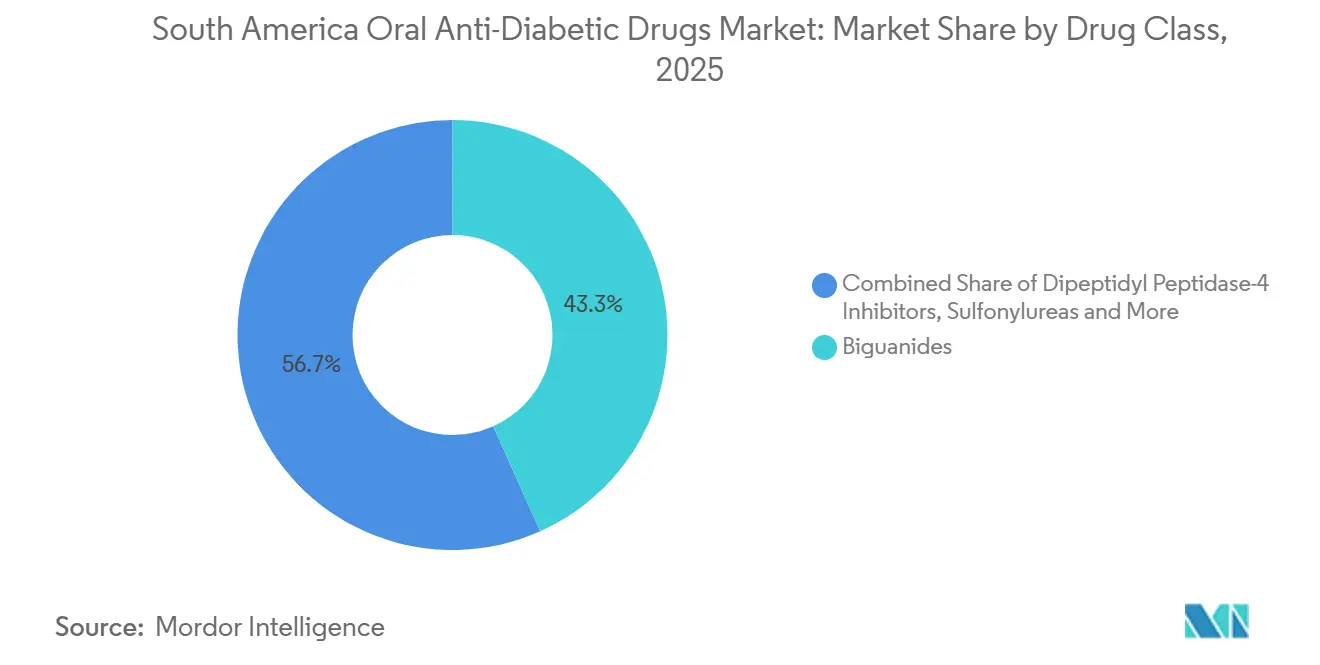
SGLT2 Inhibitors Challenge Metformin’s Structural CeilingBiguanides held 43.31% of the South America oral anti-diabetic drugs market share in 2025, supported by metformin’s presence in public formularies and generic availability. Metformin is provided through SUS, Farmácia Popular, and comparable public subsidy programs in the main country markets. Sulfonylureas and DPP-4 inhibitors serve patients whose treatment progresses beyond metformin monotherapy. Sitagliptin, vildagliptin, and linagliptin have a growing generic presence after patent expirations. Fixed-dose combinations also support treatment escalation when prescribers move beyond monotherapy. The format reduces separate dispensing while retaining the established medicine classes used in a patient’s regimen.
SGLT2 inhibitors are forecast to grow at a 6.58% CAGR from 2026 to 2031, compared with the overall 3.48% CAGR for the South America oral anti-diabetic drugs market size. Dapagliflozin and empagliflozin have relevance in cardiology and nephrology because their use extends beyond diabetes specialty care. Alpha-glucosidase inhibitors, dopamine D2 receptor agonists, and meglitinides retain smaller specialist-led roles. Oral GLP-1 receptor agonists, primarily Rybelsus, remain concentrated in premium private channels because public reimbursement is limited.

By Diabetes Type:
Type 2 Diabetes Leads Across Both Scale and GrowthType 2 Diabetes represented 89.24% of revenue in 2025 and is forecast to expand at a 4.22% CAGR through 2031. The size of this patient group reflects a regional diabetes burden of 35 million adults in 2024. Treatment initiation rates can rise as screening and patient registration improve. Later treatment stages can also add SGLT2 inhibitors and combination tablets to initial metformin therapy.
Prediabetes and insulin resistance remain areas of unmet need, with 32.2 million people in South and Central America estimated to have impaired fasting glucose in 2024. The Brazilian SBD 2026 dispensing guideline identifies prediabetes management as a priority for public investment[3]. Free metformin access through Farmácia Popular lowers the cost barrier for early intervention. Reimbursement for oral treatment specifically indicated for prediabetes remains limited in most countries. Type 1 Diabetes adjunctive oral therapy remains a small segment within the regional treatment mix. SGLT2 inhibitors are used cautiously as off-label additions to insulin in academic medical centers.
By Formulation:
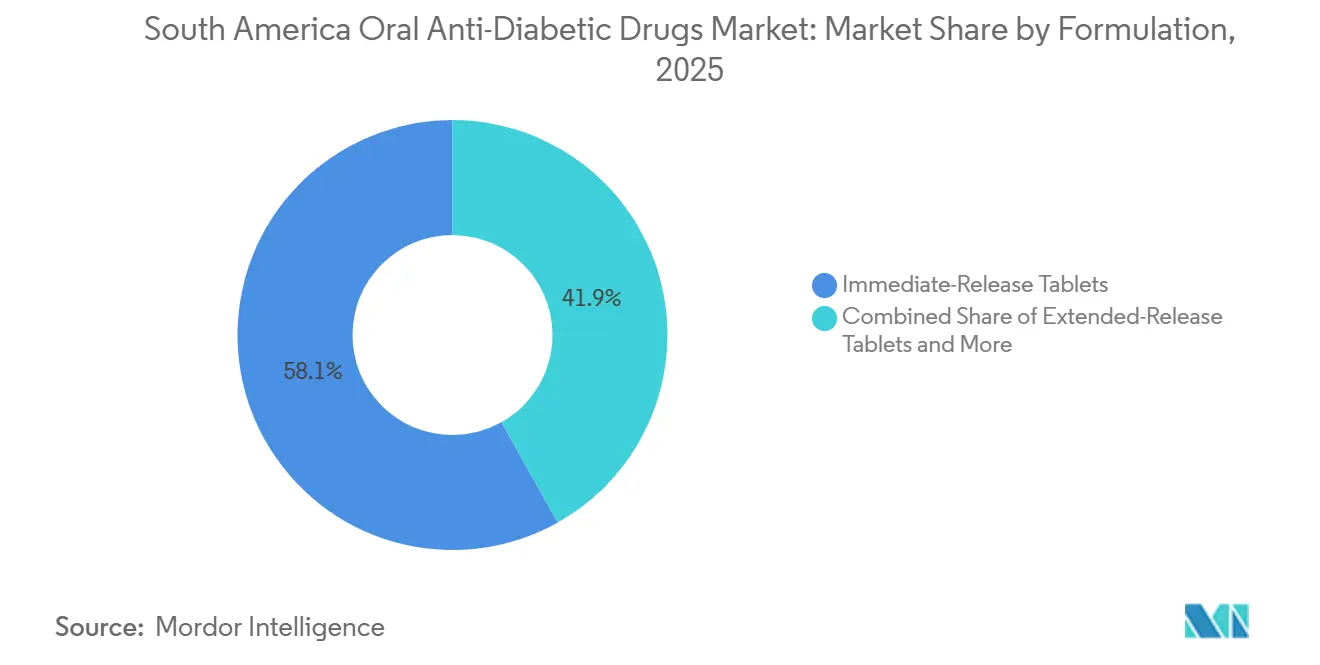
Extended-Release Growth Reflects Adherence EconomicsImmediate-Release Tablets held 58.14% of the South America oral anti-diabetic drugs market share in 2025. Metformin volume is largely dispensed as immediate-release 500 mg and 850 mg presentations through SUS and Farmácia Popular. Regional generic manufacturers have the broad capability to produce this formulation. This availability keeps unit costs low and supports stable prescription volumes.
Extended-Release Tablets are forecast to grow at a 6.82% CAGR from 2026 to 2031. Once-daily extended-release metformin can reduce gastrointestinal side effects that lead some patients to discontinue immediate-release treatment. Film-Coated Tablets hold a mid-tier role because DPP-4 inhibitor and SGLT2 inhibitor products commonly use this form. Oral solutions and dispersible forms remain relevant for pediatric and older patients with swallowing difficulties. Extended-release generic products face more rigorous bioequivalence requirements from Anvisa. Those requirements can temporarily preserve innovator pricing after an originator patent expires.
By Distribution Channel:
Digital Channels Accelerate Prescription Refill ConvenienceRetail Pharmacies held 48.65% of revenue in 2025, reflecting the pharmacy-centered care model across South America. Pharmacists counsel people managing chronic disease and may substitute generic products under Brazil’s pharmacy rules. Hospital Pharmacies handle institutional procurement, especially when specialists initiate SGLT2 inhibitor or DPP-4 inhibitor treatment. Government health centers and social security dispensaries distribute major metformin and sulfonylurea volumes at subsidized or no cost.
Online Pharmacies are forecast to grow at a 7.65% CAGR through 2031 within the South America oral anti-diabetic drugs market. Digital channels can combine automatic refills with electronic prescription services and home delivery. These functions can help patients maintain recurring oral treatment. Licensed pharmacy requirements create a regulated route for scaling such prescription fulfillment. Digital dispensing can be particularly useful for generic and lower-cost products that require routine refills. It also gives chronic-disease patients an alternative to repeated visits to a physical pharmacy.
Geography Analysis
Brazil Oral Anti-Diabetic Drugs Market
Brazil held 62.61% of the South America oral anti-diabetic drugs market share in 2025, supported by population scale and established medicine access programs. The February 2025 Farmácia Popular expansion made all 41 formulary items free for Brazilian citizens, including dapagliflozin 10 mg. This policy broadened access to an SGLT2 inhibitor beyond people with private insurance. A national study also linked publicly funded dapagliflozin access with a 19.1% reduction in cardiovascular mortality rates by 2024. EMS, Eurofarma, and Hypera are increasing generic manufacturing activity and reducing costs across oral drug classes.
Argentina and Colombia Oral Anti-Diabetic Drugs Market
Argentina is forecast to expand at a 5.75% CAGR from 2026 to 2031, the highest country rate in the South America oral anti-diabetic drugs market. Generic SGLT2 inhibitor and DPP-4 inhibitor combinations can improve access in private pharmacy channels. Medicines represented 80-81% of direct Type 2 Diabetes treatment costs per patient in Argentina, making lower generic prices material for patients. Colombia is the third-largest country market and covers antidiabetic medicines through ADRES under the Plan de Beneficios en Salud. However, 23% of Colombian Type 2 Diabetes patients still incurred high out-of-pocket costs in the cited disease management program.
South America Oral Anti-Diabetic Drugs Market
Chile and Peru are mid-tier markets with different access conditions. Chile’s FONASA and ISAPRE systems support wider branded SGLT2 inhibitor and DPP-4 inhibitor use than in several Andean markets. Peru has lower screening rates in rural and Highland areas, while treatment prevalence fell from 74% in 2019 to 63% in 2024. Rural facilities in Puno also had readiness gaps for hypertension and Type 2 Diabetes care. Bolivia, Ecuador, Paraguay, Uruguay, and Venezuela are less mature settings where metformin and sulfonylureas remain dominant, and newer classes are concentrated among private-pay urban patients.
Competitive Landscape
The South America oral anti-diabetic drugs market is moderately fragmented, with global branded suppliers and domestic generic manufacturers competing across different price tiers. AstraZeneca and Boehringer Ingelheim hold branded SGLT2 inhibitor positions through dapagliflozin and empagliflozin. Their cardiorenal evidence supports use in private channels, while generic medicines reduce public procurement values. Merck & Co.’s sitagliptin and Janumet remain relevant DPP-4 inhibitor products, though generic versions are placing pressure on segment value. Novo Nordisk’s Rybelsus occupies a premium oral GLP-1 position, with access largely limited to private-pay patients because SUS does not include the therapy.
Local companies such as Laboratorios Bagó and Laboratorios Roemmers compete on price in Argentine social security procurement with biguanide and sulfonylurea products. The practical opportunity for domestic manufacturers is in affordable fixed-dose combinations for public formulary entry. Boehringer Ingelheim and Fiocruz signed an agreement in March 2024 for technology transfer related to an empagliflozin product, linking access objectives with local manufacturing capability. Anvisa’s rules allow pharmacists to substitute a generic product unless a prescriber prohibits it, which favors volume movement toward domestic generic suppliers. The South America oral anti-diabetic drugs market therefore combines premium branded prescribing with high-volume generic competition.
EMS, Biomm, Hypera, and Eurofarma are building GLP-1 manufacturing capabilities that could affect future competition in oral GLP-1 medicines after relevant patents expire. New lower-priced injectable semaglutide products may also narrow the premium pricing room available to oral GLP-1 therapy. Companies must balance product differentiation, public-sector access, and generic price competition across country systems. Brazil remains the primary regulatory and manufacturing reference point for the region. Colombia and Argentina can draw lessons from Brazilian approvals and compliance practices as their own generic supply systems develop.
South America Oral Anti-Diabetic Drugs Industry Leaders
-
Novo Nordisk A/S
-
AstraZeneca PLC
-
Sanofi S.A.
-
Eli Lilly and Company
-
Boehringer Ingelheim International GmbH
- *Disclaimer: Major Players sorted in no particular order
South America Oral Anti-Diabetic Drugs Market Companies Covered in this Report
- AstraZeneca
- Biomm S.A.
- Boehringer Ingelheim
- Eli Lilly and Company
- EMS S.A.
- Eurofarma Laboratórios S.A.
- Grupo Farmacéutico Somar
- Hypera S.A.
- Johnson & Johnson
- Laboratorios Bagó S.A.
- Laboratorios Roemmers S.A.
- Merck
- Novartis
- Novo Nordisk
- Pfizer
- Sanofi
- Takeda Pharmaceuticals
Recent Industry Developments in South America Oral Anti-Diabetic Drugs Market
- May 2026: Eurofarma received Anvisa’s first generic registration for a fixed-dose dapagliflozin-metformin combination. The approval requires the product to be priced at least 35% lower than AstraZeneca’s Xigduo XR. This development introduces the first generic competition in Brazil’s fixed-dose SGLT2 inhibitor segment and sets a precedent for generic versions of complex combination therapies.
- April 2026: Anvisa approved Novo Nordisk’s Rybelsus (oral semaglutide) to help reduce the risk of heart disease and major cardiovascular events, including heart attack, stroke, and cardiovascular death, in adults with type 2 diabetes.
South America Oral Anti-Diabetic Drugs Market Report Scope
As per the scope of the report, oral anti-diabetic drugs are medications taken by mouth to help control blood sugar levels in people with diabetes mellitus, primarily type 2 diabetes. They work through various mechanisms to improve insulin sensitivity, increase insulin secretion, or reduce glucose production, thereby assisting in managing hyperglycemia.
The South America oral anti-diabetic drugs market is segmented by drug class into biguanides, sulfonylureas, dipeptidyl peptidase-4 inhibitors, sodium-glucose cotransporter-2 inhibitors, alpha-glucosidase inhibitors, dopamine D2 receptor agonists, meglitinides, oral GLP-1 receptor agonists, and fixed-dose combination oral therapies. By diabetes type, the market is segmented into type 2 diabetes, adjunctive oral therapy for type 1 diabetes, and prediabetes and insulin resistance. By formulation, the market is segmented into immediate-release tablets, extended-release tablets, film-coated tablets, and other formulations. By distribution channel, the market is segmented into retail pharmacies, hospital pharmacies, online pharmacies, and other distribution channels. By country, the market is segmented into Brazil, Argentina, Colombia, Chile, Peru, and the rest of South America. For each segment, the market size and forecast are provided in terms of value (USD).
Segmentation Overview
| Biguanides |
| Sulfonylureas |
| Dipeptidyl Peptidase-4 Inhibitors |
| Sodium-Glucose Cotransport-2 Inhibitors |
| Alpha-Glucosidase Inhibitors |
| Dopamine D2 Receptor Agonists |
| Meglitinides |
| Oral GLP-1 Receptor Agonists |
| Fixed-Dose Combination Oral Therapies |
| Type 2 Diabetes |
| Type 1 Diabetes Adjunctive Oral Therapy |
| Prediabetes and Insulin Resistance |
| Immediate-Release Tablets |
| Extended-Release Tablets |
| Film-Coated Tablets |
| Other Formulations |
| Retail Pharmacies |
| Hospital Pharmacies |
| Online Pharmacies |
| Other Distribution Channels |
| Brazil |
| Argentina |
| Colombia |
| Chile |
| Peru |
| Rest of South America |
| By Drug Class | Biguanides |
| Sulfonylureas | |
| Dipeptidyl Peptidase-4 Inhibitors | |
| Sodium-Glucose Cotransport-2 Inhibitors | |
| Alpha-Glucosidase Inhibitors | |
| Dopamine D2 Receptor Agonists | |
| Meglitinides | |
| Oral GLP-1 Receptor Agonists | |
| Fixed-Dose Combination Oral Therapies | |
| By Diabetes Type | Type 2 Diabetes |
| Type 1 Diabetes Adjunctive Oral Therapy | |
| Prediabetes and Insulin Resistance | |
| By Formulation | Immediate-Release Tablets |
| Extended-Release Tablets | |
| Film-Coated Tablets | |
| Other Formulations | |
| By Distribution Channel | Retail Pharmacies |
| Hospital Pharmacies | |
| Online Pharmacies | |
| Other Distribution Channels | |
| By Country | Brazil |
| Argentina | |
| Colombia | |
| Chile | |
| Peru | |
| Rest of South America |
Key Questions Answered in the Report
What is the forecast for South America oral anti-diabetic drugs through 2031?
The value is projected to rise from USD 3.28 billion in 2026 to USD 3.89 billion by 2031, at a 3.48% CAGR.
Which oral drug class is growing fastest in South America?
SGLT2 inhibitors have the fastest projected growth among drug classes, at a 6.58% CAGR from 2026 to 2031.
Why do SGLT2 inhibitors matter to regional treatment demand?
Their cardiovascular and renal use expands prescribing beyond endocrinology to cardiology and nephrology.
Which country leads regional oral antidiabetic sales?
Brazil held 62.61% revenue share in 2025, supported by population scale and public medicine access.
What is the main access barrier for newer oral diabetes medicines?
Out-of-pocket costs limit access to SGLT2 inhibitors and DPP-4 inhibitors, particularly in lower-income settings.
How are digital pharmacies affecting diabetes prescriptions?
Licensed online pharmacies support refill processing and home delivery, which can improve continuity for chronic oral treatment.