
South America Modern Methods Of Construction (MMC) Market Size and Share
Market Overview
| Study Period | 2021 - 2032 |
|---|---|
| Forecast Data Period | 2027 - 2032 |
| Base Year Market Size (2026) | USD 4.94 Billion |
| Market Size (2027) | USD 5.22 Billion |
| Market Size (2032) | USD 7.83 Billion |
| Growth Rate (2027 - 2032) | 8.45 % |
| Market Concentration | Medium |
Major Players *Disclaimer: Major Players sorted in no particular order Image © Mordor Intelligence. Reuse requires attribution under CC BY 4.0. | |
South America Modern Methods Of Construction (MMC) Market Analysis by Mordor Intelligence
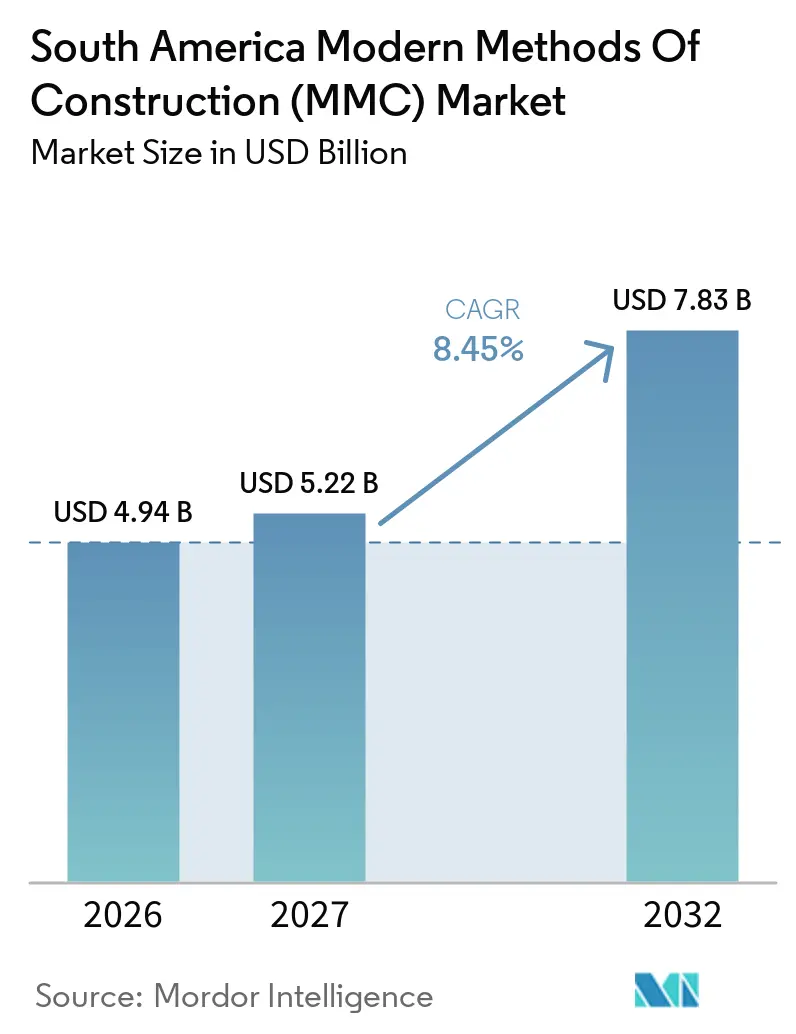
The South America Modern Methods Of Construction Market size was valued at USD 4.94 billion in 2026 and is estimated to grow from USD 5.22 billion in 2027 to reach USD 7.83 billion by 2032, at a CAGR of 8.45% during the forecast period (2027-2032).
Housing shortages in Brazil, Chile, and Argentina continue to drive demand for construction systems that deliver homes on more predictable schedules. Brazil’s housing shortage totaled 5.97 million homes, equivalent to 7.6% of occupied residences, while inadequate urban housing affected 27.6 million units. Public housing programs, remote industrial projects, and the growing adoption of standardized components support the South America modern methods of construction (MMC) market. The opportunity extends beyond new housing construction, as panelized and modular systems can also support the rehabilitation of inadequate housing. Suppliers are responding by expanding local manufacturing, forming material partnerships, and broadening product portfolios. However, high financing costs and exposure to imported components continue to constrain privately funded development.
Key Report Takeaways
- By construction type, prefabricated and modular construction held 99.2% of the South America modern methods of construction (MMC) market share in 2026, while 3D construction is forecast to expand at a 26.1% CAGR through 2032.
- By material type, concrete held 47.2% of the South America modern methods of construction (MMC) market share in 2026, while timber is forecast to expand at a 10.22% CAGR through 2032.
- By application, residential construction held 55.6% of the South America modern methods of construction (MMC) market share in 2026, while commercial construction is forecast to expand at a 10.39% CAGR through 2032.
- By geography, Brazil held 33.22% of the South America modern methods of construction (MMC) market share in 2026, while the Rest of South America is forecast to expand at a 10.48% CAGR through 2032.
Note: Market numbers in this report are based on Mordor Intelligence's proprietary estimation framework, which combines nine months of actuals with Q4 projections for base year 2026.
South America Modern Methods Of Construction (MMC) Market Trends and Insights
Drivers Impact Analysis*
| Drivers | (~) % Impact on CAGR Forecast | Geographic Relevance | Impact Timeline |
|---|---|---|---|
| Urban Housing Deficits in Major Metropolitan Corridors | +2.0% | Brazil, Chile, Argentina | Long term (≥ 4 years) |
| Public Housing and Infrastructure Programs | +1.5% | Brazil, Chile, Argentina | Medium term (2-4 years) |
| Construction Productivity From Standardized Components | +1.0% | Brazil, Chile, Argentina, Peru, Uruguay | Medium term (2-4 years) |
| Demand for Fast-Deployable Buildings in Remote Areas | +0.8% | Argentina, Peru, Chile, Brazil | Short term (≤ 2 years) |
| Building Information Modeling and Industrialized Methods | +0.5% | Chile, Brazil, Colombia | Medium term (2-4 years) |
| Climate-Resilient and Resource-Efficient Construction | +0.4% | Brazil, Chile, Ecuador, Peru | Long term (≥ 4 years) |
| Source: Mordor Intelligence | |||
Urban Housing Deficits in Major Metropolitan Corridors
Brazil’s housing deficit of 5.97 million homes is driving sustained demand for faster construction delivery models in major cities. The deficit is concentrated in urban areas, with 76.6% located in the Southeast, where demand is strongest in São Paulo, Belo Horizonte, and Rio de Janeiro. The large number of inadequate urban homes also supports demand for systems used in both new construction and renovations. Chile’s national housing policy targets the delivery of 100,000 to 120,000 homes annually, while the country’s housing shortage exceeds 1 million homes. Argentina’s housing deficit of 1.15 million units in 2024 represents another source of regional demand, although this figure is used only to illustrate the continuing scale of need. Modular and panelized construction suppliers can compete for projects requiring repeatable designs, short construction timelines, and controlled quality.
Public Housing and Infrastructure Programs
Brazil’s Minha Casa, Minha Vida program supports a substantial share of the regional residential construction pipeline. In the first half of 2026, the program is projected to contract 349,000 units, representing a 21% increase from the same period in the previous year[1]. Financing rules that recognize factory production stages improve working-capital conditions for offsite manufacturers. This change is significant because it aligns funding more closely with the production processes used in the South American modern methods of construction (MMC) market. Chile’s Emergency Housing Plan targets the delivery of 260,000 homes by 2026 and has supported industrialized social housing projects. Brazil’s PBQP-H certification framework and Chile’s DS49 subsidy rules influence the systems that qualify for large public procurement projects.
Construction Productivity From Standardized Components
Standardized components reduce the volume of work required at project sites. Direcional Engenharia states that its industrialized approach can complete two five-story buildings, from foundation to finishing, within 45 days[2]. This production model is particularly relevant in regions where builders face labor shortages and inconsistent access to skilled trades. Tecverde reports that its systems can deliver projects up to three times faster than conventional construction methods. Performance requirements under ABNT NBR 15575 also benefit companies that can document building quality and implement repeatable processes. These factors support the broader adoption of standardized panels, frames, and modules across Brazil and neighboring markets.
Demand for Fast-Deployable Buildings in Remote Areas
Energy and mining projects require accommodation and support buildings well before permanent local construction capacity becomes available. Argentina’s Vaca Muerta corridor has generated demand for the rapid deployment of worker camps near oil and gas operations. ECOSAN reports that its factories supported the design, fabrication, and installation of a large residential camp within six months[3]. In the Andes, mining sites face high transportation costs, limited labor availability, and challenging climatic conditions. Chile’s mining investment pipeline continues to support demand for buildings that can be assembled rapidly near remote sites. Manufacturers can transport factory-built components to these locations through planned deliveries, reducing reliance on extensive on-site construction campaigns.
Restraints Impact Analysis*
| Restraints | (~) % Impact on CAGR Forecast | Geographic Relevance | Impact Timeline |
|---|---|---|---|
| Macroeconomic and Interest-Rate Volatility | -0.8% | Brazil, Argentina, Chile | Short term (≤ 2 years) |
| Import Dependence for Specialized Modular Components | -0.5% | Brazil, Chile, Argentina | Medium term (2-4 years) |
| Uneven Building-Code and Permitting Enforcement | -0.3% | Peru, Bolivia, Ecuador, Paraguay, Brazil | Medium term (2-4 years) |
| Transport Constraints Across Long Distances and Difficult Terrain | -0.2% | Argentina, Brazil, Peru | Long term (≥ 4 years) |
| Source: Mordor Intelligence | |||
Macroeconomic and Interest-Rate Volatility
Brazil’s policy rate is expected to remain at 15% through mid-2026, increasing the cost of private construction financing. High interest rates constrain development outside subsidized housing programs, as developers must bear the full financing costs. The Organization for Economic Co-operation and Development projects Brazil’s real gross domestic product growth at 1.6% in 2026 and 2.1% in 2027. Subsidized financing under the Minha Casa, Minha Vida program could partly shield social housing project pipelines from these pressures. Argentina presents a separate challenge, as inflation and exchange-rate uncertainty complicate the pricing of construction inputs. These conditions have the greatest impact on private mid-income, commercial, and discretionary projects.
Import Dependence for Specialized Modular Components
Specialized mechanical, electrical, and precision modular components are often sourced from outside the region, exposing developers to exchange-rate fluctuations and changes in freight availability. Brazil is particularly vulnerable because it imports many advanced components used in modular systems. Chile’s mining projects may also require high-specification accommodation and healthcare modules that local suppliers do not yet manufacture to the required standards. Shipping delays can disrupt project schedules, particularly when modular accommodation must be installed before industrial work begins. Expanding local manufacturing capabilities and qualifying more suppliers would help reduce this restraint over time.
*Our forecasts treat driver/restraint impacts as directional, not additive. The impact forecasts reflect baseline growth, mix effects, and variable interactions.
Segment Analysis
By Construction Type: Prefabricated And Modular Construction Leads Current Demand
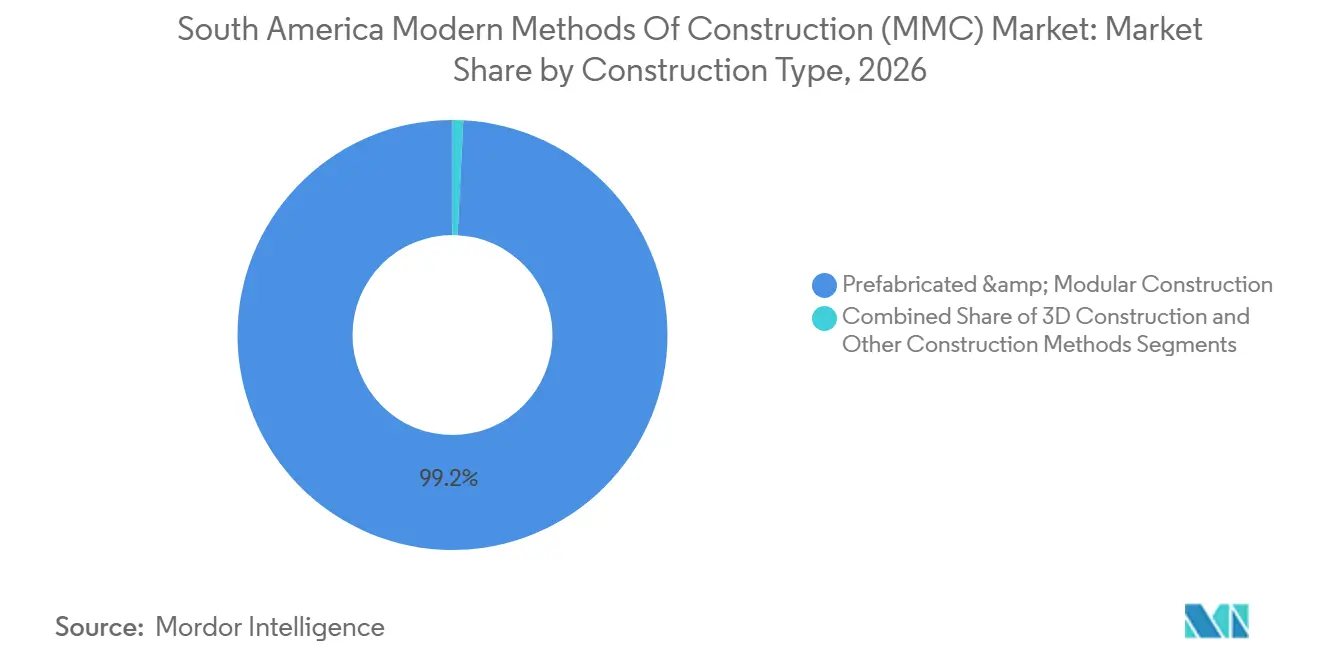
Prefabricated and modular construction is projected to account for 99.2% of the South America modern methods of construction (MMC) market in 2026. This position reflects the established use of precast concrete, panelized steel, and volumetric modules in Brazil, Argentina, Chile, and Peru. Developers are increasingly adopting volumetric systems for mid-rise social housing because they can complete rooms or core sections before transporting them to the construction site. Brasil ao Cubo’s BR3 system exemplifies this trend through its multistory steel-modular construction approach. Gerdau and Dexco are strategic shareholders in the company, supporting its access to steel and related materials. Panelized systems, including structural insulated panels, light-gauge steel panels, and wood-frame panels, remain central to lower-rise and single-family construction.
3D construction is projected to be the fastest-growing construction type, recording a forecast CAGR of 26.1% through 2032. This growth reflects a small base and increasing regulatory acceptance rather than the widespread replacement of established modular methods. In July 2025, Brazil is expected to issue its first technical evaluation document for a 3D construction system through the National System for Technical Evaluation of Innovative Products. The document is expected to support compliance with ABNT NBR 15575 and make qualifying systems eligible for Caixa Econômica Federal mortgage financing. According to the company, Sika Brasil is expected to complete an 80-square-meter 3D-printed concrete house in Caxias do Sul in 60 hours. These projects are expected to provide developers with practical reference points; however, 3D construction will remain an early-stage segment of the South America MMC market.

By Material Type: Concrete Holds The Largest Position While Timber Advances
Concrete is projected to hold a 47.2% share of the South America modern methods of construction (MMC) market in 2026. Precast panels, insulated precast systems, autoclaved aerated concrete blocks, and concrete modules are already familiar to many residential builders. The Ecoparque Cascavel project in Paraná includes a robotized precast panel factory designed to supply components for up to 3,900 apartments annually. This factory-based production model supports consistent quality and high-volume housing delivery. Light-gauge steel also serves applications where structural weight and transportation requirements are critical, particularly in Chile’s seismic environment. Concrete’s established supply chain, material availability, and contractor familiarity sustain its importance in major social housing programs.
Timber is forecast to be the fastest-growing material segment, registering a 10.22% CAGR through 2032. Cross-laminated timber (CLT) is transitioning from specialized applications to broader use in multifamily and commercial construction. Urbem’s Open Mall Praça Pitiguari project, scheduled for 2025, spans 7,000 square meters and uses mass-timber components. Uruguay is also developing its mass-timber base through Arboreal’s facility in Tacuarembó. Chile permits the use of CLT in multistory buildings and public projects, while Brazilian organizations are advancing timber construction standards. These developments expand timber’s role in applications where low weight, renewable inputs, and factory precision are critical.
By Application: Residential Construction Anchors Volume and Commercial Construction Grows Faster
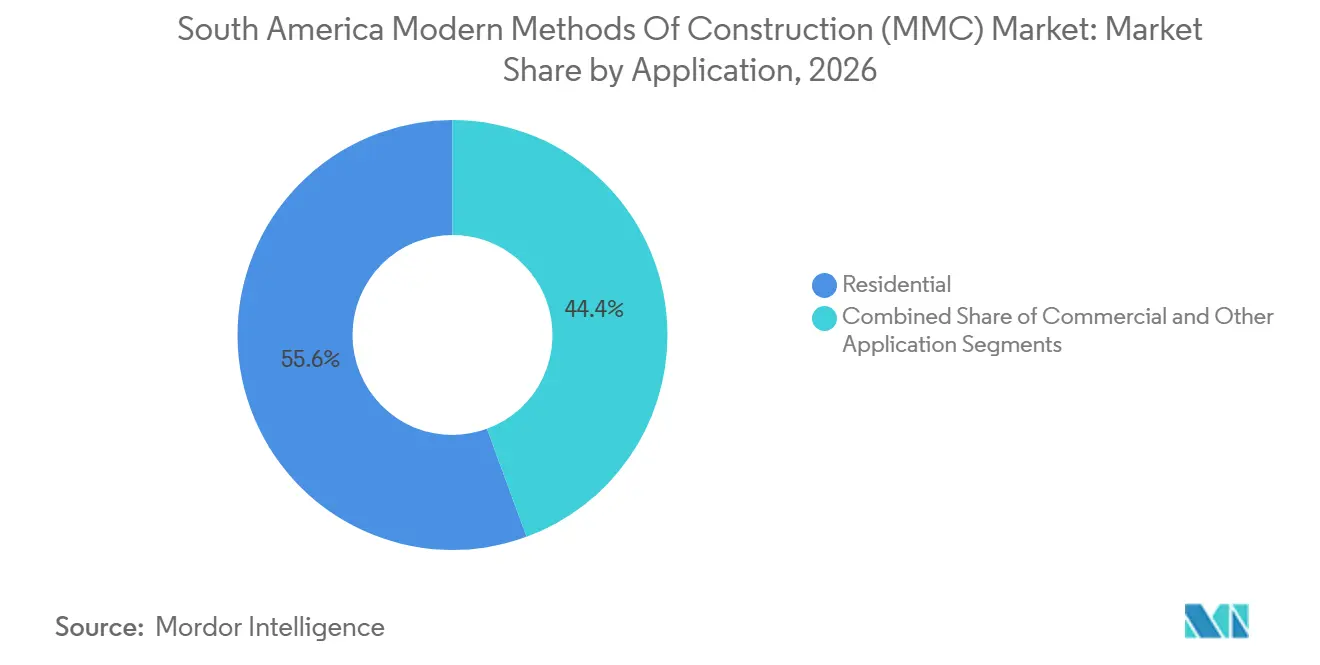
Residential construction is projected to account for 55.6% of the South American modern methods of construction (MMC) market in 2026. Public housing programs provide repeatable designs and high order volumes for panel and module manufacturers. Minha Casa, Minha Vida remains Brazil’s most significant demand base, and its financing treatment for offsite production supports factory-led construction. Direcional’s ability to complete two five-story towers in 45 days demonstrates how industrialized delivery can support large-scale housing programs. Chile’s DS49 program and other social housing initiatives further expand demand beyond Brazil. Consequently, residential construction provides the scale required for suppliers to sustain production capacity and improve unit economics.
Commercial construction is forecast to register the fastest CAGR by application, at 10.39% through 2032. Demand spans logistics facilities, retail sites, offices, data centers, institutional buildings, and worker accommodation. Brazil’s National Development Bank is expected to approve USD 46 million for modular data center facilities in March 2026. Mining, energy, and pulp-and-paper projects also require accommodation and service buildings that can be commissioned rapidly. Opus Construtech is expected to report modular city revenue in 2025; however, this non-USD financial figure is not reproduced under the currency presentation rule. Commercial buyers often prioritize schedule certainty, supporting the adoption of factory-built systems in this application.
Geography Analysis
Brazil is projected to hold a 33.22% share of the South America modern methods of construction (MMC) market in 2026. Its leading position is supported by a broad social housing pipeline, a well-developed precast and panelized supply base, and strong demand from public and private infrastructure projects. In January 2025, the federal government is expected to authorize 4,063 Minha Casa, Minha Vida housing units across 12 states. São Paulo state has also tendered 15,000 offsite modular housing units through its CDHU program, with 3D printing included among the eligible construction methods. Brazil’s MMC ecosystem encompasses modular, prefabricated, industrialized, robotic, BIM-enabled, and 3D construction methods. Given the country’s large geographic footprint, suppliers that combine localized production with efficient logistics are likely to gain a competitive advantage.
Chile and Argentina contribute distinct demand patterns to the regional market. Chile has advanced BIM policy development, industrialized construction training, and active social housing delivery. In February 2025, Tecnofast is expected to assemble 60 modular timber homes for 60 families in Lo Espejo within 42 days. The ProZero building is also expected to establish a five-story social housing reference project using 3D volumetric industrial modules in 2025. In Argentina, demand is linked to Vaca Muerta and mining projects, which require large-scale worker accommodation. In April 2025, ECOSAN is expected to open an 8,000-square-meter modular construction plant in Loma Verde, expanding domestic capacity for industrial and energy-sector projects.
The Rest of South America segment is forecast to grow at a CAGR of 10.48% through 2032, representing the highest growth rate among geographies in the South America modern methods of construction (MMC) market. Peru’s mining and infrastructure activities support demand for modular construction at high-altitude sites that require seismic resilience and climate performance. Uruguay is emerging as a mass-timber production hub, with factories serving both domestic and regional projects. MOOD is expected to begin operating a 5,000-square-meter CLT facility in El Pinar in 2026. In the same year, Idero is expected to begin exporting industrialized steel homes from Argentina to Uruguay and announce plans to establish a local factory. Although these markets are smaller than Brazil, their resource projects, housing requirements, and developing timber supply chains are expanding the region’s sources of demand.
Competitive Landscape
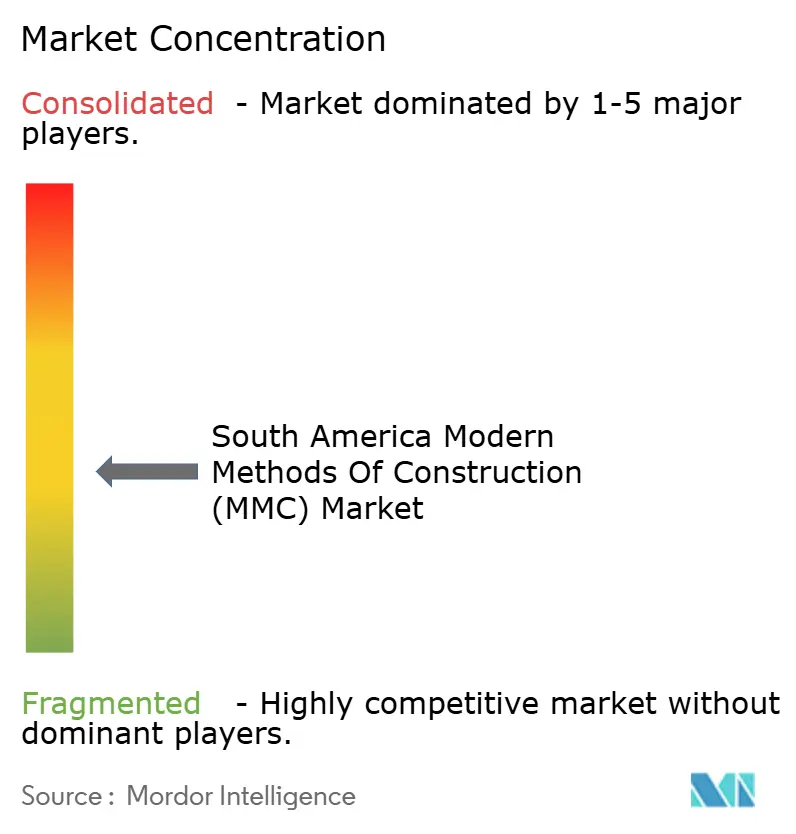
The South America modern methods of construction (MMC) market is moderately fragmented, with regional construction companies competing alongside large materials suppliers. Tecverde, Brasil ao Cubo, and Opus Construtech have established positions through industrialized construction systems and project delivery capabilities. Etex and Saint-Gobain play important roles in the materials segment by supplying products used in lightweight and dry construction systems. Competition centers on system performance, local production capacity, access to materials, regulatory approvals, and the ability to deliver large-scale programs. Companies serving the social housing segment compete on repeatable volumes and cost control, while those serving remote industrial and infrastructure projects place greater emphasis on logistics, technical specifications, and schedule certainty.
Materials investments are expected to shape the competitive environment. In July 2025, Etex is expected to announce investments in plasterboard plants in Peru, Chile, and Argentina to expand capacity for lightweight construction materials. In July 2026, Saint-Gobain is expected to announce a new drywall production line in Feira de Santana, Bahia, which is projected to begin operations in early 2028. These investments are expected to expand regional supply capacity for systems used in industrialized construction. Brasil ao Cubo also relies on strategic relationships with Gerdau and Dexco, linking its volumetric construction approach with material supply. Etex’s connection with Tecverde through the E2E joint venture with Arauco is expected to strengthen the link between timber supply and wood-frame construction in Brazil.
Competitive opportunities remain in mid-rise commercial projects, BIM-integrated prefabrication, hospitals, schools, and data centers. Companies that document system performance in accordance with ABNT NBR 15575 and Chilean seismic requirements are better positioned to meet formal procurement requirements. In August 2025, Tecverde is expected to relocate its manufacturing operations to Ipeúna, São Paulo, and expand its portfolio beyond wood-frame construction. In September 2025, Direcional is expected to sign a cooperation agreement with Moura Dubeux to evaluate residential projects targeting middle- and low-income segments in northeastern Brazil.
South America Modern Methods Of Construction (MMC) Industry Leaders
-
MRV Engenharia e Participações S.A.
-
Tecverde Engenharia S.A.
-
Brasil ao Cubo
-
EZTEC Empreendimentos e Participações S.A.
-
Direcional Engenharia S.A.
- *Disclaimer: Major Players sorted in no particular order
Recent Industry Developments
- August 2026: Saint-Gobain S.A. completed the acquisition of QSI Productos para la Construcción in Peru, further consolidating its construction chemicals platform in Latin America. The deal complements the 2025 acquisition of Soquimic and strengthens Saint-Gobain's presence alongside Weber and Z Aditivos brands, reinforcing the regional value chain for light and sustainable modern methods of construction (MMC) materials.
- July 2026: Saint-Gobain S.A. announced an investment in a new drywall production line at its Feira de Santana, Bahia, Brazil facility. The expansion is expected to increase site capacity by 75%, create 200 direct and indirect jobs, and begin operations in early 2028.
- March 2026: Brazil's National Development Bank (Banco Nacional de Desenvolvimento Econômico e Social, BNDES) approved USD 46 million in financing for modular data center facilities in Brazil, marking a significant shift in institutional capital allocation toward modular construction beyond housing. This approval validates modular delivery as a mainstream technology for technology infrastructure and opens a new commercial segment pipeline for MMC players with industrial module capabilities, according to BNamericas.
South America Modern Methods Of Construction (MMC) Market Report Scope
| Prefabricated & Modular Construction | Panelized Systems | Structural Insulated Panels (SIPs) |
| Timber / Wood Frame Panels | ||
| Light Gauge Steel (LGS) Panels | ||
| Others | ||
| Volumetric Modules | Steel-Framed Volumetric Modules | |
| Timber-Framed Volumetric Modules | ||
| Concrete (Precast/Monolithic) Volumetric Modules | ||
| Others | ||
| Hybrid Modular Construction | ||
| 3D Construction | Extrusion Method | |
| Power Bonding Method | ||
| Others | ||
| Other Construction Methods | ||
| Concrete |
| Glass |
| Metal |
| Timber |
| Other Material Type |
| Residential |
| Commercial |
| Other Application (Industrial, Institutional, Energy and Utilities, Infrastructure) |
| Brazil |
| Argentina |
| Chile |
| Peru |
| Rest of South America |
| By Construction Type | Prefabricated & Modular Construction | Panelized Systems | Structural Insulated Panels (SIPs) |
| Timber / Wood Frame Panels | |||
| Light Gauge Steel (LGS) Panels | |||
| Others | |||
| Volumetric Modules | Steel-Framed Volumetric Modules | ||
| Timber-Framed Volumetric Modules | |||
| Concrete (Precast/Monolithic) Volumetric Modules | |||
| Others | |||
| Hybrid Modular Construction | |||
| 3D Construction | Extrusion Method | ||
| Power Bonding Method | |||
| Others | |||
| Other Construction Methods | |||
| By Material Type | Concrete | ||
| Glass | |||
| Metal | |||
| Timber | |||
| Other Material Type | |||
| By Application | Residential | ||
| Commercial | |||
| Other Application (Industrial, Institutional, Energy and Utilities, Infrastructure) | |||
| By Geography | Brazil | ||
| Argentina | |||
| Chile | |||
| Peru | |||
| Rest of South America | |||
Key Questions Answered in the Report
What is the projected value of South America modern methods of construction through 2032?
The South America Modern Methods Of Construction Market size was valued at USD 4.94 billion in 2026 and is estimated to grow from USD 5.22 billion in 2027 to reach USD 7.83 billion by 2032, at a CAGR of 8.45% during the forecast period (2027-2032).
Which construction method holds the largest share in South America?
Prefabricated and modular construction leads with 99.2% share in 2026, supported by established panel, precast, and volumetric systems.
Which material is growing fastest for industrialized construction in South America?
Timber is forecast to grow at a 10.22% CAGR through 2032, supported by wider CLT production and multistory timber applications.
Why is residential construction important for MMC suppliers?
Residential construction holds 55.6% share in 2026 because public housing programs create repeatable, high-volume requirements for industrialized systems.
Which country leads regional demand for modern construction methods?
Brazil leads with 33.22% share in 2026, supported by social housing programs and an established construction materials base.
What factors limit adoption of offsite construction in South America?
High financing costs, imported-component exposure, uneven permitting, and difficult transport routes can delay or raise the cost of modular delivery.