
Market Overview
| Study Period | 2021 - 2031 |
|---|---|
| Forecast Data Period | 2026 - 2031 |
| Base Year Market Size (2025) | USD 6.03 Billion |
| Market Size (2026) | USD 6.34 Billion |
| Market Size (2031) | USD 8.15 Billion |
| Growth Rate (2026 - 2031) | 5.15 % |
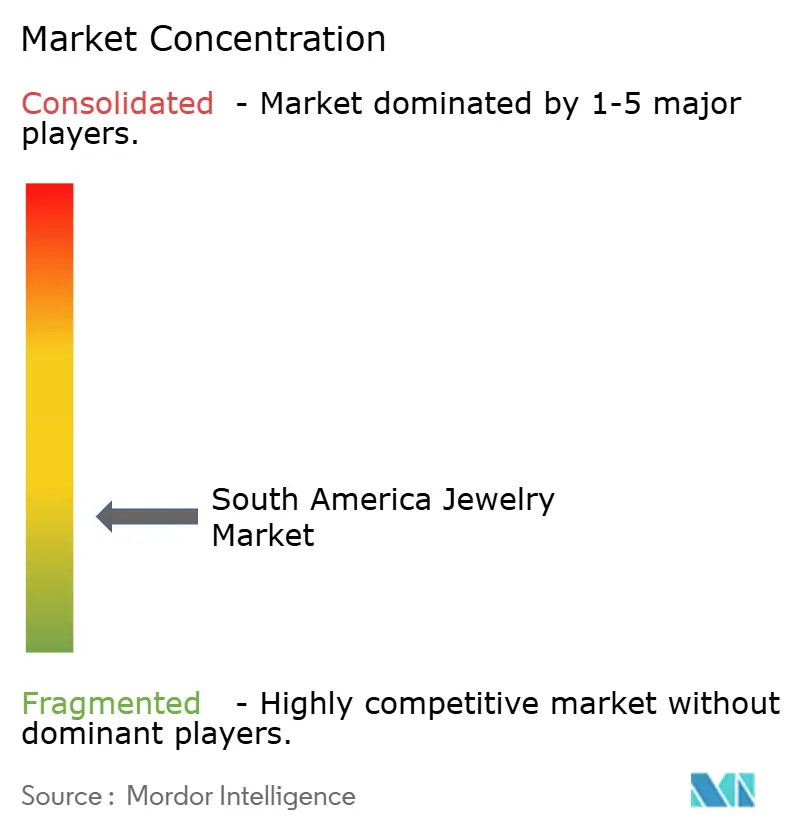
| Market Concentration | Low |
Major Players *Disclaimer: Major Players sorted in no particular order Image © Mordor Intelligence. Reuse requires attribution under CC BY 4.0. | |
South America Jewelry Market Analysis by Mordor Intelligence
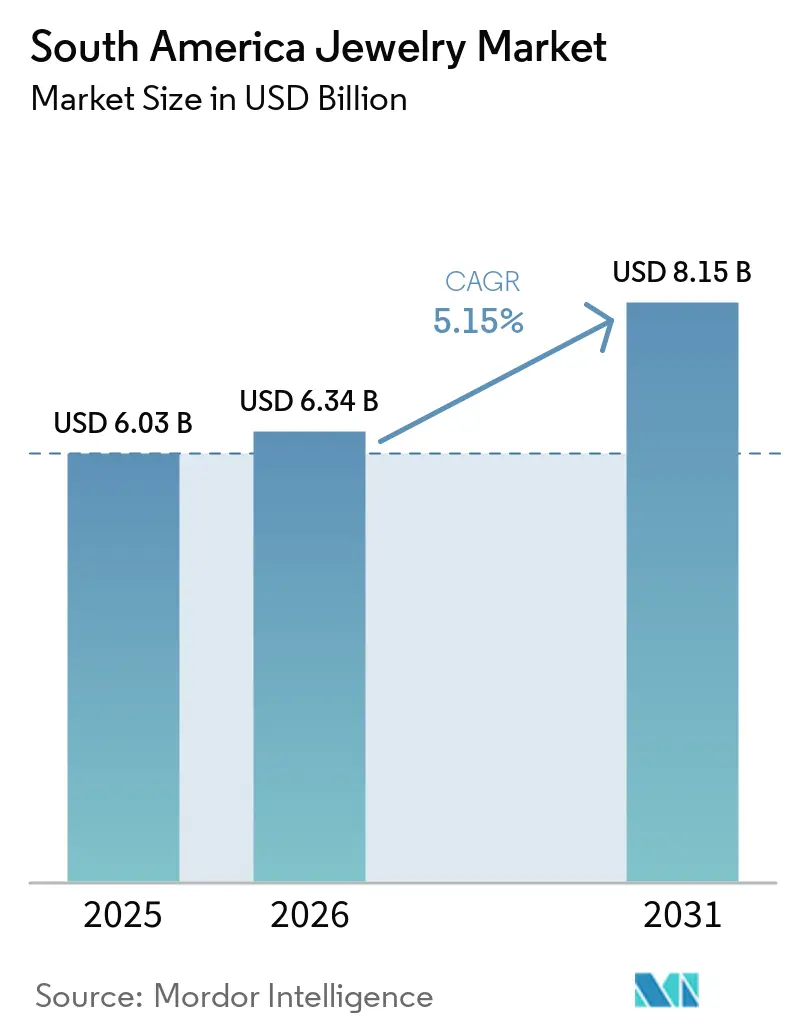
The South America jewelry market was valued at USD 6.03 billion in 2025 and is estimated to increase from USD 6.34 billion in 2026 to USD 8.15 billion by 2031, registering a CAGR of 5.15% during the forecast period (2026-2031). Demand for jewelry remains supported by its role in personal adornment, cultural and ceremonial occasions, gifting, and wealth preservation, enabling the market to cater to consumers across different income groups. Brazil continues to serve as the region’s primary commercial hub, supported by its large consumer base and established retail infrastructure, while Argentina is witnessing a gradual recovery in jewelry demand as financial conditions stabilize. Rising gold and silver prices are increasing the value of fine jewelry; however, elevated prices are also constraining purchase volumes among price-sensitive consumers. Consequently, consumers are increasingly seeking lighter-weight designs, alternative materials, and more affordable jewelry formats, whereas affluent buyers continue to favor premium, high-value, customized, and personalized products.
Key Report Takeaways
- By product type, rings held 27.08% of the South America jewelry market share in 2025, while necklaces are forecast to grow at a 6.43% CAGR through 2031.
- By material, precious metals accounted for 67.43% of the South America jewelry market share in 2025, while base metals are projected to expand at a 6.01% CAGR through 2031.
- By category, fine jewelry accounted for 57.48% of revenue in 2025, while costume jewelry is forecast to grow at a 6.53% CAGR through 2031.
- By end user, adults accounted for 93.11% of revenue in 2025, while the kids segment is projected to grow at a 6.45% CAGR through 2031.
- By distribution channel, offline retail stores held 73.07% of revenue in 2025, while online retail stores are forecast to grow at a 6.11% CAGR through 2031.
- By country, Brazil held 45.29% of revenue in 2025, while Argentina is forecast to expand at a 6.58% CAGR through 2031.
Note: Market size and forecast figures in this report are generated using Mordor Intelligence’s proprietary estimation framework, updated with the latest available data and insights as of January 2026.
Market Trends and Insights
Drivers Impact Analysis of South America Jewelry Market*
| Driver | (~) % Impact on CAGR Forecast | Geographic Relevance | Impact Timeline |
|---|---|---|---|
| Tourism-driven jewelry purchases | +0.6% | Concentrated gains in Brazil, Colombia, Chile, and Argentina | Short term (≤ 2 years) |
| Rising adoption of lab-grown diamonds and alternative materials | +0.5% | Early adoption concentrated in Brazil and Argentina | Medium term (2–4 years) |
| Strong cultural and ceremonial significance of jewelry | +0.8% | Brazil | Long term (≥ 4 years) |
| Expansion of affordable luxury and fashion jewelry | +0.7% | Brazil, Colombia, Chile; spill-over to Peru and Argentina | Medium term (2–4 years) |
| Growing interest in sustainable and ethically sourced jewelry | +0.4% | Stronger in urban Brazil and Colombia | Long term (≥ 4 years) |
| Expansion of branded retail and modern shopping centers | +0.9% | Brazil, Colombia, Chile, Argentina | Medium term (2–4 years) |
| Source: Mordor Intelligence | |||
Tourism-Driven Jewelry Purchases
International tourism is increasingly driving jewelry demand across South America, as visitors allocate their spending toward premium, artisanal, and locally distinctive jewelry that reflects the region’s cultural heritage and craftsmanship. According to the Organization for Economic Co-operation and Development (OECD), Argentina received 5.7 million international tourists in 2025, creating a sizable consumer base for jewelry purchases among travelers[1]. Tourist destinations, airports, hotels, shopping districts, and duty-free retail outlets enable jewelry brands and local artisans to reach international consumers seeking souvenirs, gemstones, handcrafted pieces, and high-value jewelry. As travel activity expands and destination-based retail channels develop, the region’s jewelry market is likely to benefit from incremental sales opportunities that extend beyond domestic consumer demand.
Rising Adoption of Lab-Grown Diamonds and Alternative Materials
South America’s GDP per capita is projected to reach approximately USD 11.73 thousand in 2025, according to the International Monetary Fund (IMF), reflecting a sizable and evolving consumer base for accessible luxury products[2]. This economic environment is creating opportunities for jewelry brands to cater to consumers who seek aspirational products yet remain price-sensitive. Lab-grown diamonds and jewelry made from alternative materials offer an attractive value proposition by providing the visual appeal of traditional precious-stone jewelry at relatively lower price points. Their affordability, contemporary designs, and perceived sustainability are particularly supporting demand among younger consumers, first-time jewelry buyers, and price-conscious shoppers. As disposable income and consumer spending capacity vary significantly across countries in the region, these alternatives enable jewelry brands to expand their addressable customer base, offer products across a broader range of price segments, and maintain a premium yet fashion-oriented appeal.
Strong Cultural and Ceremonial Significance of Jewelry
Weddings, engagements, quinceañeras, first communions, confirmations, and other religious or cultural celebrations create recurring jewelry-purchase occasions across South America, supporting a relatively stable base of demand for both traditional and contemporary jewelry. In Brazil, the number of civil marriages increased by 0.9% between 2023 and 2024, while marriages involving same-sex couples rose by 8.8%, according to the Brazilian Institute of Geography and Statistics (IBGE), as reported by Agência Gov[3]. This continued growth in marriage ceremonies, combined with the region’s strong emphasis on milestone celebrations and family gifting traditions, supports demand for wedding bands, engagement rings, necklaces, earrings, and other occasion-based jewelry. Gold jewelry also remains attractive as a store of value during periods of currency volatility and economic uncertainty, while cultural festivals, religious events, and tourism-related purchases generate additional demand for gifting and commemorative jewelry across the region.
Expansion of Affordable Luxury and Fashion Jewelry
Rising gold prices, coupled with uneven consumer purchasing power across South America, are prompting shoppers to seek more affordable jewelry options that preserve the visual appeal and aspirational value of fine jewelry. This shift is increasing demand for demi-fine jewelry, sterling silver pieces, gold-plated products, mixed-material designs, and fashion jewelry, enabling consumers to maintain their style preferences while managing discretionary spending. The trend is particularly pronounced among middle-income and younger consumers, who increasingly prioritize contemporary designs, personalization, versatility, and brand identity over the intrinsic value of precious metals. Online retail channels and fast-fashion platforms are further improving access to lower-priced jewelry through extensive product assortments, competitive pricing, and convenient purchasing options. Consequently, jewelry brands are expanding their mid-priced and affordable collections, while competition continues to intensify within the value-oriented segment.
Restraints Impact Analysis of South America Jewelry Market*
| Restraint | (~) % Impact on CAGR Forecast | Geographic Relevance | Impact Timeline |
|---|---|---|---|
| High and volatile precious metal prices | -1.2% | South America | Short term (≤ 2 years) |
| Complex import duties and taxation | -0.7% | South America; particularly Brazil and Argentina | Medium term (2–4 years) |
| Counterfeit and imitation jewelry | -0.5% | South America | Medium term (2–4 years) |
| Supply-chain and gemstone provenance challenges | -0.3% | South America | Long term (≥ 4 years) |
| Source: Mordor Intelligence | |||
High and Volatile Precious Metal Prices
High and volatile prices of gold, silver, and other precious metals are raising production costs and reducing the affordability of jewelry for consumers across South America. As raw material expenses increase, manufacturers and retailers may need to raise product prices to protect margins, which can discourage discretionary purchases and lead consumers to postpone buying decisions. These price pressures are also encouraging shoppers to opt for lighter-weight pieces, lower-karat gold jewelry, silver products, and mixed-material designs that offer a similar aesthetic at a more accessible price point. In addition, frequent fluctuations in precious metal prices create challenges for jewelry manufacturers and retailers in managing inventory, forecasting demand, setting prices, and maintaining stable profit margins. Consequently, the growing preference for affordable alternatives may constrain demand for traditional precious-metal jewelry, particularly among price-sensitive consumer segments.
Counterfeit and Imitation Jewelry
Counterfeit and imitation jewelry pose a significant challenge to the South America jewelry market by offering low-priced alternatives that directly compete with legitimate products and erode the perceived value of authentic jewelry. These products are often sold through informal retail outlets and online channels, making them readily accessible to price-sensitive consumers and diverting sales from authorized retailers and established brands. Counterfeit items that replicate recognized brand names, logos, or designs can further weaken consumer confidence, particularly when buyers cannot easily verify a product’s authenticity or quality. In Chile, authorities seized 2,478 counterfeit jewelry items valued at approximately USD 523,000 during Operation Crete II, underscoring the scale of counterfeit jewelry activity in the region. In addition to lost sales, legitimate manufacturers and retailers incur higher costs for product authentication, intellectual property protection, legal enforcement, and consumer awareness initiatives, which can affect profitability and market growth.
*Our forecasts treat driver/restraint impacts as directional, not additive. The impact forecasts reflect baseline growth, mix effects, and variable interactions.
South America Jewelry Market Segment Analysis
By Product Type:
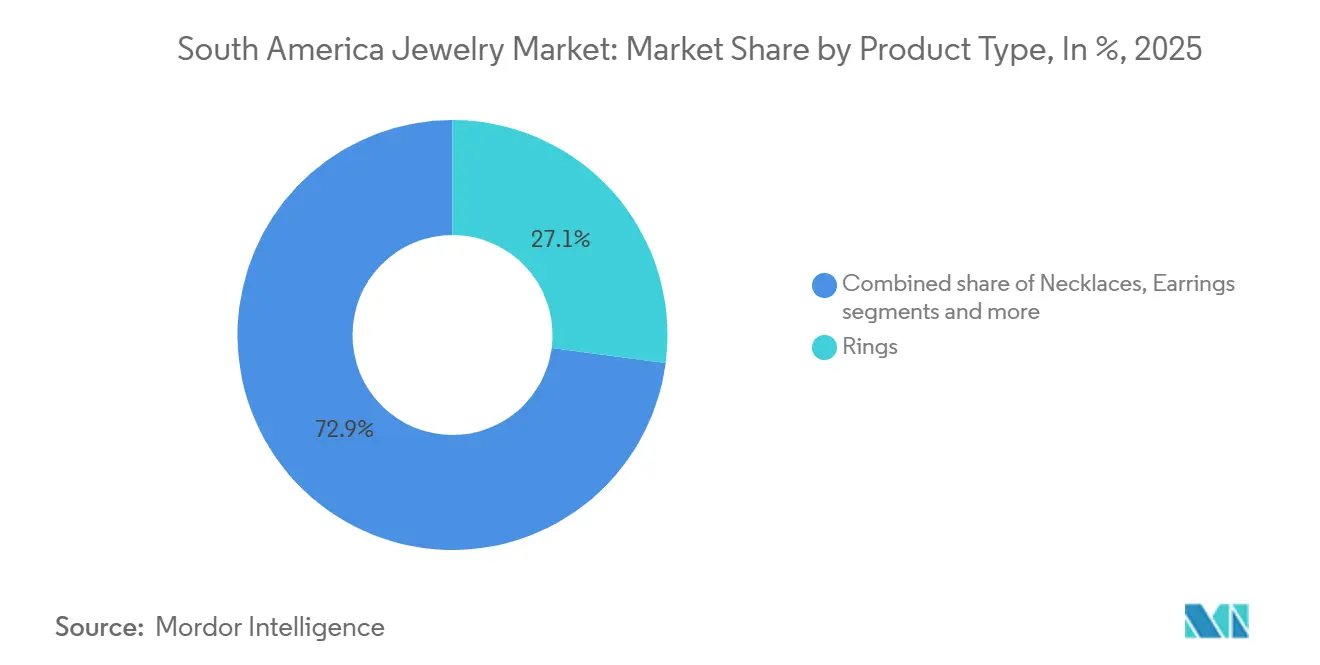
Rings Lead While Necklaces Gain MomentumRings accounted for 27.08% of the South America jewelry market by product type in 2025, making them the largest product category. Strong demand across everyday wear, gifting, and ceremonial occasions continues to support the category’s market leadership. Wedding and engagement jewelry remains a key driver of demand, particularly in countries with strong traditions surrounding marriage-related purchases. The popularity of gold, gemstone, and personalized ring designs further broadens the category’s appeal across different consumer segments. Manufacturers and retailers are also introducing lightweight, affordable designs to meet the needs of price-conscious consumers.
Necklaces are projected to be the fastest-growing product category, recording a CAGR of 6.43% during the forecast period from 2026 to 2031. Rising consumer interest in statement, fashion, and versatile jewelry is expected to drive demand for necklaces across the region. Younger consumers increasingly prefer contemporary, personalized, and layered designs that align with their individual style preferences. The expansion of e-commerce platforms is also improving access to a broader range of domestic and international jewelry brands. These factors are expected to support sustained growth in necklace sales across the South America jewelry market.

By Material:
Precious Metals Lead, While Base Metals Gain DemandPrecious metals accounted for 67.43% of the South America jewelry market by material in 2025, retaining their position as the largest material category. Gold, silver, and other precious metals remain popular choices for everyday jewelry, ceremonial pieces, and gifting occasions across the region. Consumers prefer these materials because of their durability, refined appearance, and ability to retain value over time. Their cultural significance, particularly for weddings, religious events, and traditional celebrations, further supports sustained demand. The investment appeal of precious metals also continues to influence purchasing decisions among South American consumers.
Base metals are projected to be the fastest-growing material segment, registering a CAGR of 6.01% during 2026-2031. Growing demand for affordable and fashion-oriented jewelry is driving the adoption of products made from base metals across the region. These materials allow manufacturers to offer contemporary, lightweight, and versatile designs at accessible price points. The segment is particularly appealing to younger consumers and price-sensitive buyers who seek frequently changing styles. Expanding availability through specialty stores, mass retailers, and online platforms is expected to further support growth during the forecast period.
By Category:
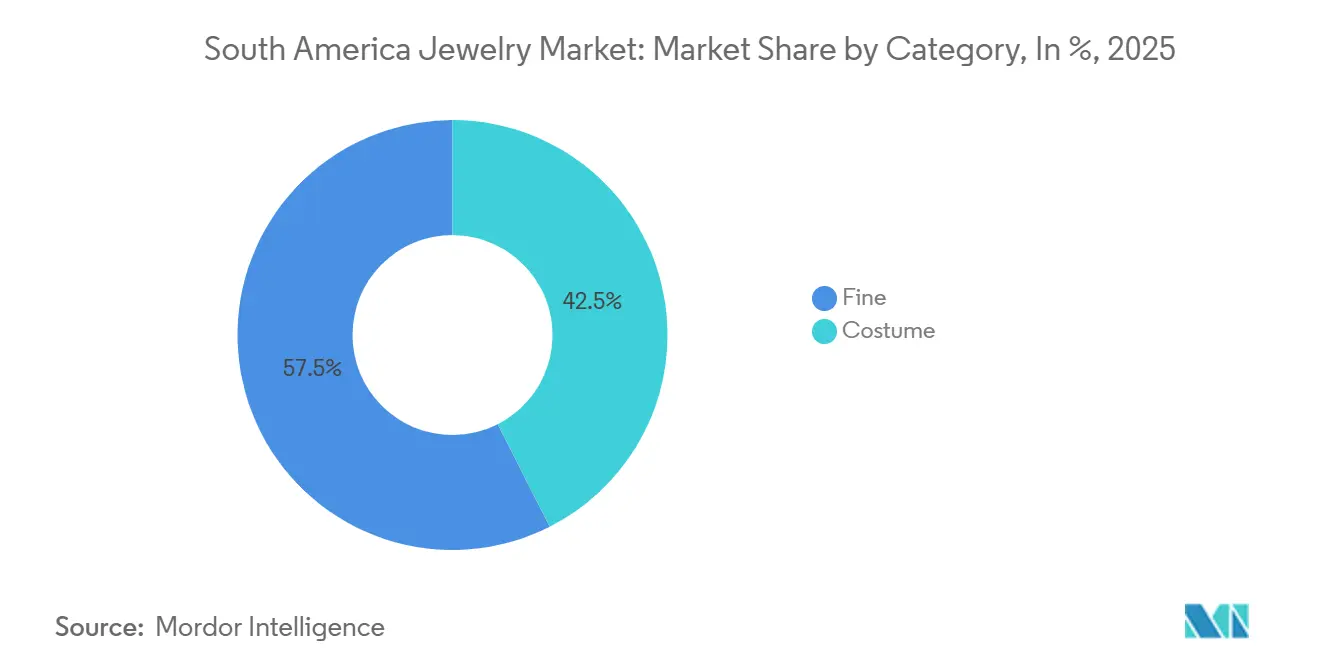
Fine Jewelry Holds Value, While Costume Jewelry Expands OnlineFine jewelry and costume jewelry accounted for 57.48% of the South America jewelry market by value in 2025, establishing it as the largest jewelry type in the region. Demand remains strong for premium pieces crafted from precious metals, diamonds, and other gemstones. Consumers commonly purchase fine jewelry for weddings, anniversaries, religious ceremonies, gifting, and other milestone occasions. Its enduring design appeal, superior craftsmanship, and perceived long-term value continue to support consumer preference. Additionally, fine jewelry’s role as both a personal accessory and a store of value reinforces its market leadership.
Costume jewelry is projected to be the fastest-growing jewelry type, registering a CAGR of 6.53% through 2031. The segment is benefiting from increasing consumer interest in affordable, fashionable, and frequently changing accessory options. Younger consumers, in particular, are purchasing costume jewelry to complement diverse outfits and follow evolving fashion trends. Lower price points enable consumers to buy multiple designs, colors, and styles for different occasions without significant expenditure. The continued expansion of e-commerce, social-media-led fashion influences, and wider product availability is expected to further support segment growth.
By End User:
Adults Anchor Revenue While Kids Create Growth OpportunitiesAdults accounted for 93.11% of the South America jewelry market revenue by end user in 2025, making them the largest consumer group. Demand within this segment is driven by jewelry purchases for everyday wear, gifting, weddings, anniversaries, and other special occasions. Adults generally have higher purchasing power, enabling greater expenditure on fine, premium, and branded jewelry products. Rising interest in personalized designs, contemporary styles, and statement pieces is also driving demand in the segment. Ongoing fashion trends and increasing consumer preference for self-expression through jewelry are expected to sustain growth in this segment.
The kids segment is projected to be the fastest-growing end-user category, registering a CAGR of 6.45% through 2031. Increasing demand for children’s jewelry for birthdays, festivals, celebrations, and gifting occasions is driving segment expansion. Parents are increasingly seeking fashionable, personalized, and age-appropriate accessories that cater to children’s preferences. The availability of affordable designs across online platforms and modern retail channels is improving product accessibility. Manufacturers are also introducing lightweight and child-friendly jewelry designs, which are expected to further support growth in the segment.
By Distribution Channel:
Offline Stores Lead While Online Retail ExpandsOffline retail stores accounted for 73.07% of the South America jewelry market revenue by distribution channel in 2025, reinforcing their position as the leading sales channel. Consumers value physical stores because they can assess the quality, craftsmanship, materials, and fit of jewelry before making a purchase. In-store consultations also enable retailers to offer personalized recommendations, particularly for high-value and occasion-based purchases. Specialty jewelry stores, department stores, and branded outlets in shopping centers continue to strengthen the accessibility and visibility of jewelry products. Established retailer relationships and immediate product availability further support consumer preference for offline purchases.
Online retail stores are projected to be the fastest-growing distribution channel, registering a CAGR of 6.11% from 2026 to 2031. Rising internet penetration, increasing smartphone adoption, and greater consumer confidence in digital transactions are supporting the expansion of online jewelry sales. E-commerce platforms provide consumers with access to a wider range of designs, brands, and price points than many physical stores. Competitive discounts, convenient home delivery, and flexible payment options are also encouraging online purchases. In addition, social commerce, influencer marketing, and targeted digital campaigns are expected to increase consumer engagement and accelerate channel growth.
Geography Analysis
Brazil Jewelry Market
Brazil held the largest share of the South America jewelry market in 2025, accounting for 45.29% of regional market revenue. The country’s leadership is supported by its large consumer base, rising demand for premium products, and extensive network of branded jewelry retailers. Brazil also benefits from the availability of gemstones and well-established jewelry manufacturing and artisan clusters, particularly in Minas Gerais and Bahia. Continued investment by domestic and international brands, along with growing consumer preference for branded and premium jewelry, is expected to reinforce its leading market position.
Argentina Jewelry Market
Argentina is projected to be the fastest-growing country in the South America jewelry market, registering a CAGR of 6.58% from 2026 to 2031. Improving economic conditions and increased availability of imported products are expected to support the recovery of discretionary consumer spending. Demand for fine jewelry is gaining momentum among consumers seeking premium and durable products, while costume jewelry continues to maintain a strong domestic presence. The expansion of e-commerce platforms, improved product accessibility, and renewed interest from jewelry brands are likely to create further growth opportunities during the forecast period.
South America Jewelry Market
Other countries, including Colombia, Chile, Peru, Venezuela, Paraguay, and Uruguay, contribute to the South America jewelry market through diverse consumer preferences and trade conditions. Colombia benefits from its established emerald industry and the increasing popularity of sustainable and artisan jewelry, while Chile records relatively strong demand for higher-end products. Peru remains important for artisan jewelry production and exports, supported by its skilled craftsmanship and local materials. Venezuela faces greater macroeconomic constraints, whereas Paraguay and Uruguay benefit from cross-border trade and tourism-related jewelry purchases.
Competitive Landscape
The South America jewelry market remains highly fragmented, with global luxury groups, regional retail chains, direct-selling companies, independent jewelers, and artisan producers competing across multiple price segments. Key participants include Vivara Participações S.A., HStern Indústria e Comércio S.A., Manoel Bernardes S.A., Pandora A/S, and LVMH Moët Hennessy Louis Vuitton SE. These companies compete through brand positioning, product innovation, store networks, and customer service capabilities. The presence of numerous local and specialized players limits market concentration across the region. Consequently, no single company holds a dominant position across all jewelry categories and consumer price points.
Regional and international companies are strengthening their market presence through store expansion, multi-brand strategies, digital retail investments, and diversified product offerings. Vivara serves premium and accessible jewelry consumers through its Vivara and Life brands, enabling it to address different customer preferences. Pandora continues to broaden its portfolio beyond its core charm-based jewelry range, while expanding its retail and online presence. LVMH competes in the luxury segment through brands such as Tiffany & Co. and Bulgari. Meanwhile, established Brazilian companies, including HStern and Manoel Bernardes, leverage strong brand recognition and heritage to retain their regional customer bases.
The fragmented market structure provides opportunities for emerging brands, online-first companies, and niche jewelry producers to serve underserved consumer segments. Low-cost international e-commerce platforms and counterfeit products are intensifying price competition, particularly within the affordable and fashion jewelry categories. However, growth opportunities persist in men’s jewelry, children’s jewelry, personalized products, and brands promoted through social commerce channels. Consumers increasingly value authenticity, distinctive designs, ethical sourcing, and convenient purchasing experiences. Therefore, established players are expected to prioritize experiential retail, omnichannel strategies, product differentiation, and brand trust to reinforce their competitive positions.
South America Jewelry Industry Leaders
-
Vivara Participações S.A.
-
HStern Indústria e Comércio SA
-
Manoel Bernardes S.A.
-
Pandora A/S
-
LVMH Moët Hennessy Louis Vuitton SE
- *Disclaimer: Major Players sorted in no particular order
South America Jewelry Market Companies Covered in this Report
- Vivara Participações S.A.
- HStern Indústria e Comércio SA
- Manoel Bernardes S.A.
- Monte Carlo Joias
- Rommanel
- Sauer
- Pandora A/S
- LVMH Moët Hennessy Louis Vuitton SE
- Compagnie Financière Richemont SA
- Swarovski Group
- Kering S.A.
- Morana
- Bulgari S.p.A.
- Tiffany & Co.
- TOUS
- Buccellati Holding Italia S.p.A.
- Belatriz Joias
- Ouro Fino Joias
- Vivacy Joias
- HS Semi-Joias
Recent Industry Developments in South America Jewelry Market
- May 2026: Vivara Participacoes S.A. executed a Third Amendment to its Shareholders Agreement on May 28, 2026. The update reinforces governance and shareholder alignment while the company continues to balance profitability, inventory discipline, and the expansion of its Life brand footprint in Brazil.
- April 2026: Spanish jewelry brand Aristocrazy expanded its international presence by opening its first Puerto Rico store at Plaza Las Américas in San Juan. Spanning approximately 100 square meters, the store showcased the brand’s latest collections and signature jewelry pieces.
- January 2026: Pandora rolled out a new go-to-market pricing model across Latin America, as communicated in its 2026 investor materials. The shift standardizes regional pricing execution and supports store network performance, strengthening competitiveness versus local players and cross-border online sellers.
- December 2024: Tiffany and Co. opened a flagship at Iguatemi Sao Paulo, bringing a high jewelry salon and brand-led experiential zones into one of Brazil's most important luxury retail destinations. The investment deepened local engagement for high-ticket categories and raised the bar for experiential offline jewelry retail in the region.
South America Jewelry Market Report Scope
Jewelry includes decorative items used for personal adornment, gifting, and fashion, made from precious metals, base metals, and mixed materials. The South America Jewelry Market is segmented by product type into rings, necklaces, earrings, bracelets, chains and pendants, and other products; by material into precious metals, base metals, and mixed materials; by category into fine and costume jewelry; by end user into children and adults; and by distribution channel into online and offline retail stores. The market covers Brazil, Argentina, Colombia, Chile, Peru, Venezuela, and the Rest of South America. Market forecasts are presented in terms of value (USD).
By Product Type
| Rings |
| Necklaces |
| Earrings |
| Bracelets |
| Chains and Pendants |
| Others |
By Material
| Precious Metals |
| Base Metals |
| Mixed Materials |
By Category
| Fine |
| Costume |
By End User
| Kids |
| Adults |
By Distribution Channel
| Online Retail Stores |
| Offline Retail Stores |
By Country
| Brazil |
| Argentina |
| Colombia |
| Chile |
| Peru |
| Venezuela |
| Rest of South America |
| By Product Type | Rings |
| Necklaces | |
| Earrings | |
| Bracelets | |
| Chains and Pendants | |
| Others | |
| By Material | Precious Metals |
| Base Metals | |
| Mixed Materials | |
| By Category | Fine |
| Costume | |
| By End User | Kids |
| Adults | |
| By Distribution Channel | Online Retail Stores |
| Offline Retail Stores | |
| By Country | Brazil |
| Argentina | |
| Colombia | |
| Chile | |
| Peru | |
| Venezuela | |
| Rest of South America |
Key Questions Answered in the Report
What is the projected value of the South America jewelry market by 2031?
The South America jewelry market is forecast to reach USD 8.15 billion by 2031, rising from USD 6.34 billion in 2026 at a 5.15% CAGR.
Which South American country leads jewelry sales?
Brazil led regional revenue with a 45.29% share in 2025, supported by its branded retail network, high-income consumer base, and domestic gemstone supply.
Which jewelry product type has the largest share in South America?
Rings led product revenue with a 27.08% share in 2025, supported by bridal, engagement, and gifting traditions.
What material is gaining the most demand in South American jewelry?
Base metals are forecast to grow at a 6.01% CAGR through 2031 as higher gold prices increase demand for plated and mixed-material pieces.