
South America Hydroponics Market Size and Share
Market Overview
| Study Period | 2021 - 2031 |
|---|---|
| Forecast Data Period | 2026 - 2031 |
| Base Year Market Size (2025) | USD 159.40 Million |
| Market Size (2026) | USD 176 Million |
| Market Size (2031) | USD 302.80 Million |
| Growth Rate (2026 - 2031) | 11.46 % |
| Market Concentration | Medium |
Major Players
*Disclaimer: Major Players sorted in no particular order Image © Mordor Intelligence. Reuse requires attribution under CC BY 4.0. |
|
South America Hydroponics Market Analysis by Mordor Intelligence
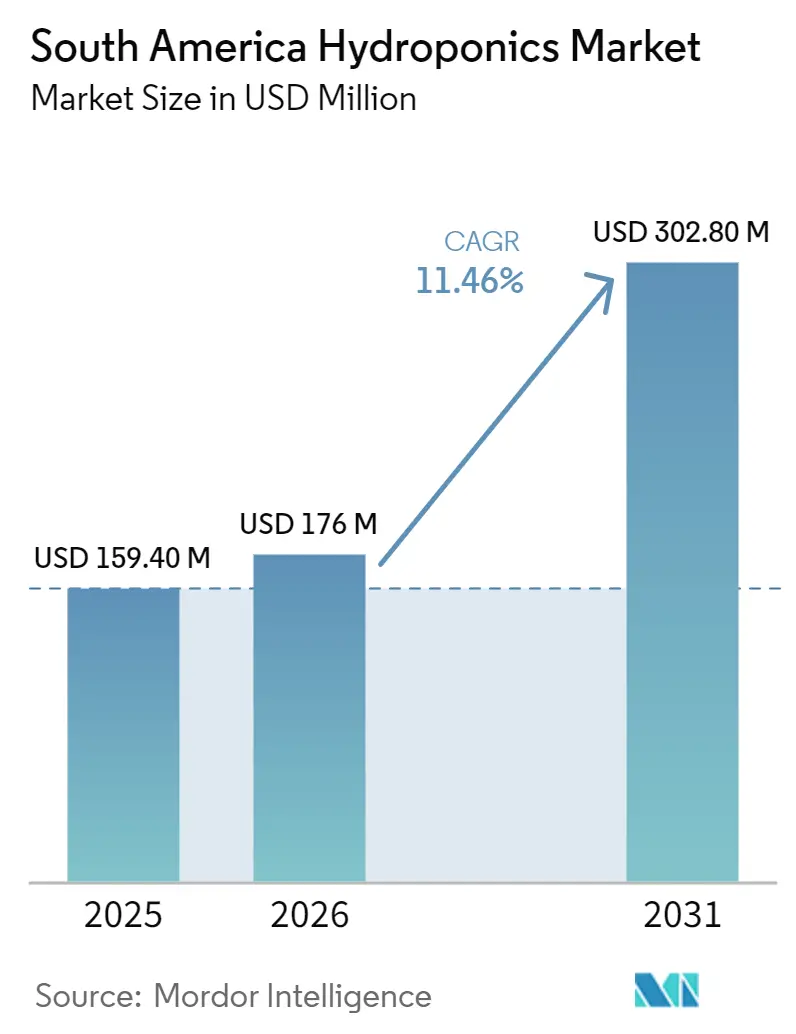
The South America hydroponics market was valued at USD 159.40 million in 2025 and is projected to grow from USD 176.0 million in 2026 to USD 302.80 million by 2031, at a CAGR of 11.46% during the forecast period from 2026 to 2031. Water constraints, urban food distribution challenges, and demand for reliable year-round produce are supporting adoption across the region. Controlled growing environments help producers manage crop quality, water use, and supply consistency in locations where open-field production faces weather variability. Commercial greenhouse operators play an important role, as they can introduce soilless growing methods without replacing all existing infrastructure. Vertical farming is also attracting investment in major cities, where proximity to retail and reduced transport distances can support premium produce models. High capital requirements, electricity costs, limited technical skills, and dependence on imported equipment continue to restrict wider adoption.
Key Report Takeaways
- By system type, aggregate systems accounted for the largest 48.2% of the South America Hydroponics Market Share in 2025, while drip systems are projected to grow at the fastest CAGR of 15.1% from 2026 to 2031.
- By farming type, commercial greenhouses held the largest 47.5% share in 2025, whereas vertical farms are projected to grow at the fastest CAGR of 15.5% from 2026 to 2031.
- By crop type, leafy vegetables accounted for the largest 42.5% share in 2025, while the South America Hydroponics Market size for herbs is projected to grow at the fastest CAGR of 14.5% from 2026 to 2031.
- By geography, Brazil accounted for the largest 42.0% share in 2025, while Chile is projected to grow at the fastest CAGR of 13.8% from 2026 to 2031.
Note: Market size and forecast figures in this report are generated using Mordor Intelligence’s proprietary estimation framework, updated with the latest available data and insights as of January 2026.
South America Hydroponics Market Trends and Insights
Drivers Impact Analysis*
| Driver | (~) % Impact on CAGR Forecast | Geographic Relevance | Impact Timeline |
|---|---|---|---|
| Rising demand for pesticide-free fresh produce | +3.2% | Brazil, Chile, and Argentina, particularly urban retail corridors | Medium term (2-4 years) |
| Water scarcity and efficient water use requirements | +2.5% | Northern Chile, northeastern Brazil, and water-stressed locations across South America | Long term (≥ 4 years) |
| Urban agriculture and short supply chain expansion | +1.8% | São Paulo, Santiago, Buenos Aires, and other major metropolitan areas | Medium term (2-4 years) |
| Climate volatility driving protected cultivation | +1.5% | Drought-prone and temperature-sensitive agricultural areas across South America | Long term (≥ 4 years) |
| Commercial greenhouse adoption in Brazil and Chile | +2.1% | Brazil and Chile, especially established greenhouse regions | Medium term (2-4 years) |
| Declining technology costs improving the accessibility of controlled-environment agriculture | +1.4% | Regional import markets and local equipment distribution channels | Short term (≤ 2 years) |
| Source: Mordor Intelligence | |||
Rising Demand for Pesticide-Free Fresh Produce
Growing consumer preference for pesticide-free fresh vegetables is accelerating hydroponic adoption across South America, particularly among retailers and food service operators seeking consistent, traceable produce. Hydroponic cultivation minimizes exposure to soil-borne pests while enabling year-round production in controlled environments. According to the Brazilian Health Regulatory Agency (ANVISA) Pesticide Residue Analysis Program (PARA), 20.6% of the 3,084 food samples analyzed showed non-compliance with pesticide regulations, highlighting consumer and retailer focus on food safety and residue-free produce[1]Source: Brazilian Health Regulatory Agency (ANVISA), "Resíduos de Agrotóxicos em Alimentos Registram 20% de Não Conformidade," Gov.br.. This trend is driving demand for hydroponically grown leafy vegetables and herbs across the region. Source: Brazilian Health Regulatory Agency (ANVISA), Pesticide Residue Analysis Program (PARA), 2025.
Water Scarcity and Efficient Water Use Requirements
Water scarcity is strengthening the business case for hydroponic farming across South America as growers seek production systems that maximize water efficiency. Hydroponic cultivation recirculates nutrient solutions, significantly reducing water losses compared to conventional soil-based agriculture while ensuring consistent crop growth under controlled conditions. According to the Food and Agriculture Organization of the United Nations (FAO) AQUASTAT Water Data Snapshot 2025, pressure on freshwater resources continues to increase, with updated 2024 AQUASTAT data showing high or very high water stress in countries where water withdrawals regularly exceed renewable freshwater supplies. This trend is driving investment in water-efficient hydroponic production systems across the region.
Urban Agriculture and Short Supply Chain Expansion
Urban agriculture is gaining momentum across South America as demand for fresh, locally produced vegetables increases in major metropolitan areas. Hydroponic farms enable year-round cultivation close to retailers, restaurants, and distribution centers, reducing transportation time and post-harvest losses for highly perishable crops. According to the United Nations Department of Economic and Social Affairs (UN DESA) – World Urbanization Prospects 2025, 65.3% of Chile's population lived in cities in 2025[2]Source: United Nations Department of Economic and Social Affairs (UN DESA), "World Urbanization Prospects 2025," un.org., creating a substantial urban consumer base that supports localized food production systems. This increasing urban concentration is driving demand for hydroponic farms capable of delivering consistent, high-quality fresh produce through shorter supply chains.
Commercial Greenhouse Adoption in Brazil and Chile
Commercial greenhouse adoption is creating favorable conditions for hydroponic expansion across South America by providing growers with controlled environments for year-round cultivation of high-value vegetables and fruits. Greenhouse infrastructure enables efficient implementation of hydroponic systems, including nutrient film technique and aggregate media, while improving water and nutrient management. According to the Ministry of Agriculture of Chile (2025), the government delivered 205 greenhouses to strengthen climate-resilient agricultural production. This expansion of protected cultivation infrastructure increases the potential adoption of hydroponic technologies in Chile, where growers seek higher productivity, improved crop quality, and more efficient resource utilization.
Restraints Impact Analysis*
| Restraint | (~) % Impact on CAGR Forecast | Geographic Relevance | Impact Timeline |
|---|---|---|---|
| High initial capital requirement | -2.8% | South America, with greater pressure in high-cost financing markets | Short term (≤ 2 years) |
| Energy intensity of climate-controlled systems | -1.9% | Brazil, Argentina, Chile, and enclosed farm locations | Medium term (2-4 years) |
| Limited controlled environment agronomy expertise | -1.2% | South America outside established production clusters | Medium term (2-4 years) |
| Currency volatility and imported equipment dependence | -1.5% | Argentina, Brazil, Chile, and regional import markets | Short term (≤ 2 years) |
| Source: Mordor Intelligence | |||
Limited Controlled Environment Agronomy Expertise
Limited technical expertise in controlled-environment agriculture continues to constrain hydroponic adoption across South America. Hydroponic production requires specialized skills in nutrient management, pH regulation, water quality, climate control, and disease prevention, which differ substantially from conventional farming practices. According to the National Institute of Agricultural Technology (INTA), Argentina (2025), the organization conducted a dedicated Operator Training Course for the Antarctic Hydroponic Production Module (MAPHI) to train personnel in hydroponic system operation, nutrient solution preparation, and equipment management[3]Source: National Institute of Agricultural Technology (INTA), "Rumbo a la Antártida: Se Capacitan en Producción Hidropónica en el INTA San Pedro," Argentina.gob.ar.. The need for such specialized training reflects a shortage of skilled operators, which increases implementation risks and slows commercial hydroponic expansion across the region.
Currency Volatility and Imported Equipment Dependence
The hydroponic market relies heavily on imported automation systems, LED grow lights, climate-control equipment, fertigation units, and precision sensors, increasing exposure to currency fluctuations and higher procurement costs. While Brazil manufactures greenhouse structures and basic irrigation systems domestically, advanced hydroponic technologies continue to depend on international suppliers. According to the Ministry of Development, Industry, Trade, and Services (MDIC), machinery and equipment remained among Brazil's principal manufactured import categories in 2025. This reliance on imported technologies raises investment costs, increases supply chain risks, and may delay commercial hydroponic projects, limiting market expansion across South America.
*Our forecasts treat driver/restraint impacts as directional, not additive. The impact forecasts reflect baseline growth, mix effects, and variable interactions.
Segment Analysis
By System Type: Aggregate Systems Lead While Drip Systems Advances Water Efficiency
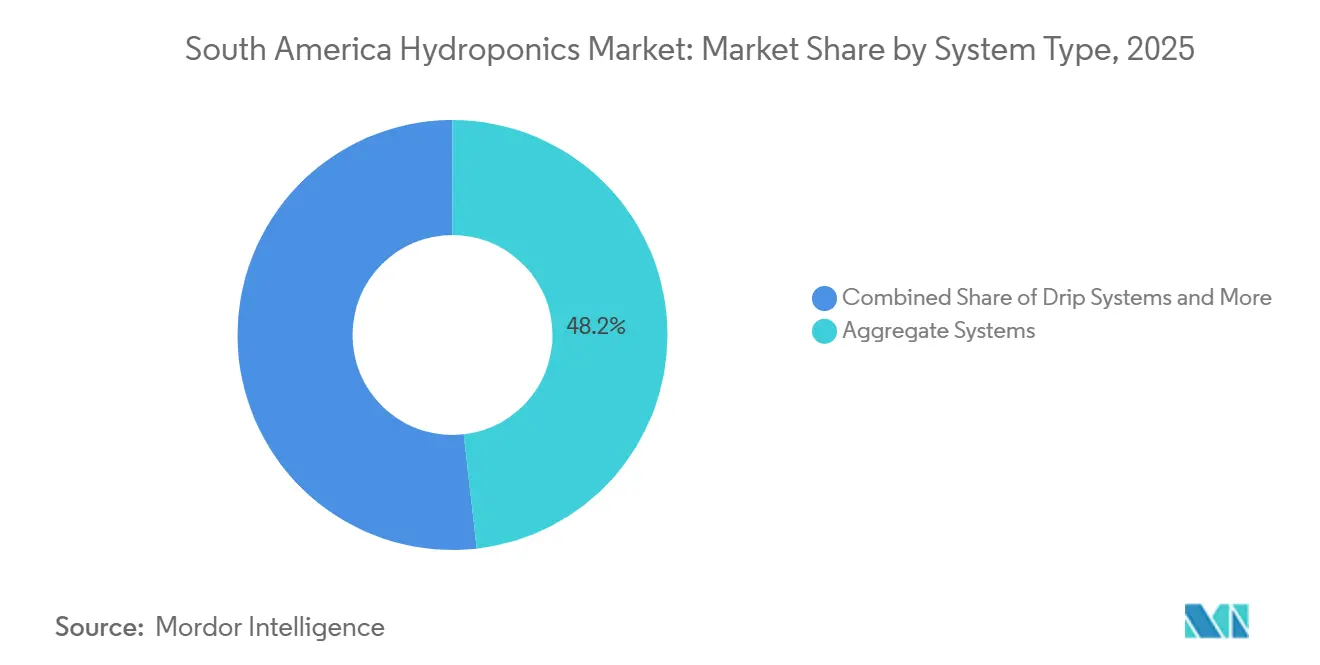
Aggregate systems accounted for the largest 48.2% of the South America Hydroponics Market Share in 2025. These systems remain the preferred production method because they provide stable root support and are compatible with established greenhouse operations across the region. Growing media such as rockwool, coconut coir, and perlite allow producers to cultivate vegetables and fruits under controlled conditions while reducing production risks. Their flexibility enables gradual expansion without major infrastructure changes, making aggregate systems suitable for commercial growers seeking dependable crop performance, efficient nutrient management, and consistent year-round production.
Drip systems are projected to register the fastest CAGR of 15.1% during 2026–2031. These systems deliver nutrient solutions directly to the root zone through controlled drip emitters, minimizing water and fertilizer losses while improving crop productivity. Their compatibility with automated fertigation systems, precise nutrient management, and adaptability to high-value crops such as tomatoes, cucumbers, peppers, strawberries, and herbs are driving adoption among commercial growers. Increasing investments in greenhouse infrastructure, water-efficient cultivation technologies, and precision agriculture are expected to support the continued expansion of drip systems across South America.



By Farming Type: Commercial Greenhouses Provide Scale While Vertical Farms Grow Faster
Commercial greenhouses held the largest share at 47.5% in 2025. Commercial greenhouses remain the dominant cultivation model because they provide controlled growing conditions while utilizing natural sunlight for much of the year. These facilities support multiple hydroponic production systems and the cultivation of vegetables, herbs, and fruit crops under stable environmental conditions. Their scalable design allows producers to expand production in line with market demand without transitioning entirely to enclosed farming systems. Continued investment in greenhouse technologies and climate management supports productivity, operational efficiency, and consistent crop quality across regional horticultural operations.
Vertical farms are projected to grow at the fastest CAGR 15.5% from 2026 to 2031. Vertical farming is attracting investment due to its ability to enable intensive crop production in compact spaces near urban consumers. Multi-layer cultivation, artificial lighting, and automated environmental controls help maximize output while reducing dependence on external weather conditions. This model is particularly suitable for leafy vegetables, herbs, and specialty crops that benefit from shorter production cycles and premium market positioning. Growing interest in urban agriculture and resource-efficient food production continues to support the expansion of vertical cultivation facilities.
By Crop Type: Leafy Vegetables Remain Core While Herbs Gain Premium Demand
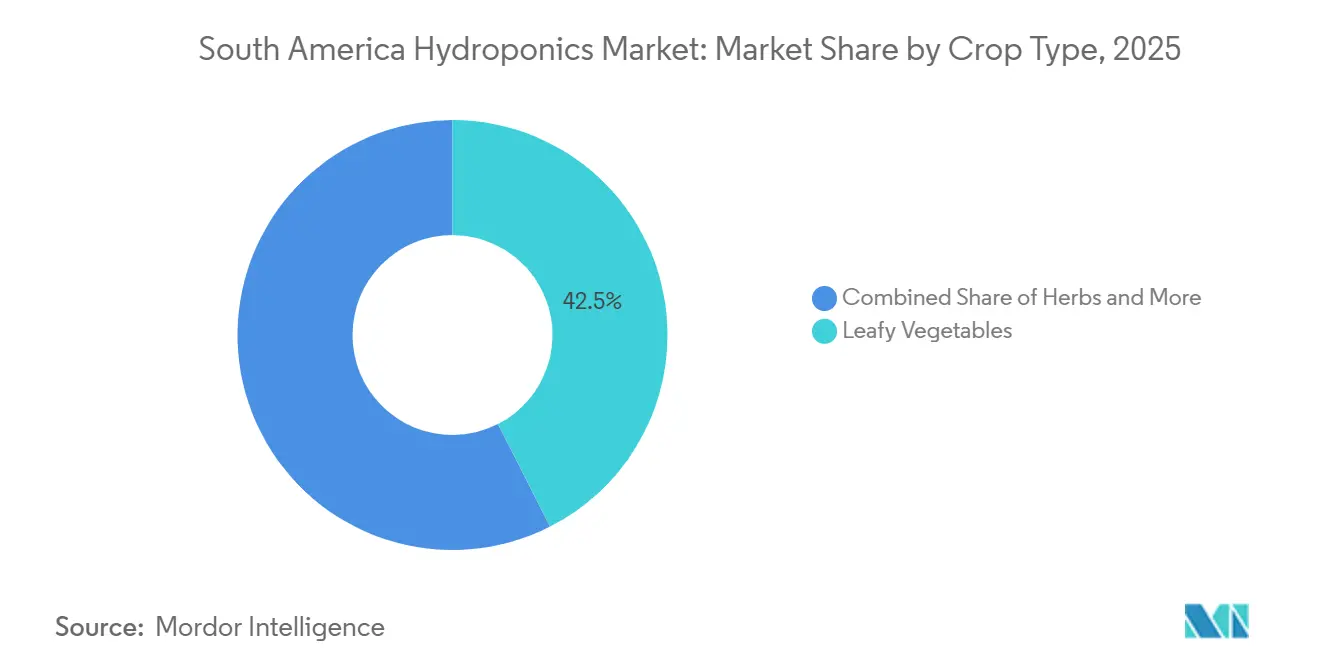
Leafy vegetables accounted for the largest share at 42.5% in 2025. Leafy vegetables dominate hydroponic cultivation due to their rapid production cycles, consistent quality, and reliable year-round consumer demand. Crops such as lettuce, kale, arugula, and watercress adapt well to controlled-environment agriculture, enabling frequent harvesting and efficient nutrient management. Their predictable growth characteristics make them an attractive choice for both established commercial producers and new hydroponic operators. Strong retail and food service demand continues to reinforce their importance in regionally controlled-environment vegetable production.
The South America Hydroponics Market size for herbs is projected to grow at the fastest CAGR of 14.5% from 2026 to 2031. Herb cultivation is expanding as premium varieties benefit from controlled growing environments that deliver consistent quality, freshness, and year-round availability. Basil, mint, cilantro, and similar crops are widely supplied to supermarkets, restaurants, beverage manufacturers, and specialty food retailers seeking dependable local production. Hydroponic cultivation allows producers to improve product uniformity while supporting frequent harvest schedules. Continued diversification into high-value crops is strengthening the commercial attractiveness of hydroponic herb production.
Geography Analysis
Brazil accounted for the largest share of 42.0% in 2025. The country maintains its leading position due to its established protected horticulture sector, strong agricultural research ecosystem, and large urban consumer markets that support year-round demand for fresh vegetables. Commercial growers continue expanding controlled-environment cultivation to improve production consistency and resource efficiency. Research organizations actively support hydroponic production through technology development, crop management, and knowledge transfer. The presence of greenhouse suppliers, irrigation specialists, and climate-control solution providers further strengthens commercial adoption and encourages continued investment in controlled-environment agriculture.
Chile is projected to grow at the fastest CAGR of 13.8% from 2026 to 2031. Water scarcity and increasing emphasis on resource-efficient agriculture continue to drive investment in hydroponic cultivation across the country. Public institutions, universities, and agricultural innovation agencies are supporting demonstration projects that integrate hydroponics, vertical cultivation, greenhouse technologies, and efficient irrigation practices. These initiatives help producers evaluate advanced production systems while improving knowledge transfer and technical capabilities. Continued collaboration between research organizations and commercial growers positions Chile as an important center for controlled-environment agriculture and sustainable food production.
Argentina, Uruguay, Paraguay, and other South American countries continue expanding hydroponic production through research initiatives and commercial projects adapted to local conditions. Argentina is strengthening its hydroponic capabilities through the National Institute of Agricultural Technology (Instituto Nacional de Tecnología Agropecuaria, INTA), where three Módulos Antárticos de Producción Hidropónica (MAPHI) are currently operating in Argentine Antarctic bases to advance controlled-environment vegetable production and technology transfer in 2025. This progress supports broader adoption of hydroponic systems, strengthens regional technical expertise, and encourages sustainable protected agriculture across neighboring South American countries.
Competitive Landscape
The South America hydroponics market is moderately fragmented in 2025, and AmHydro, LLC, Urban Crop Solutions N.V., Certhon Build B.V. (DENSO Corporation), Priva Holding B.V., and Universal Growing are among the prominent players supporting controlled-environment agriculture across the region. These companies compete through greenhouse engineering, hydroponic system design, automation technologies, irrigation solutions, and technical consulting. Collaboration with local distributors and commercial growers strengthens market penetration while supporting the adoption of advanced hydroponic production systems.
International suppliers continue strengthening their competitive position by expanding digital greenhouse technologies, automation platforms, and precision cultivation solutions. Companies increasingly focus on integrating climate control, irrigation management, crop monitoring, and data analytics into unified operating platforms to improve production efficiency and sustainability. Technical support, system customization, installation services, and grower training remain important competitive differentiators, as hydroponic projects require specialized operational expertise. Providers capable of delivering complete solutions rather than standalone equipment are better positioned to establish long-term relationships with commercial growers across South America.
Innovation and strategic partnerships remain central to competition as technology providers develop integrated cultivation platforms for commercial greenhouse operators. In 2026, Priva Holding B.V. partnered with Grodan to integrate GroSens root-zone sensor data into the Priva One platform, enabling growers to access real-time substrate information for improved irrigation and climate management. This collaboration strengthens digital decision-making capabilities while supporting efficient resource utilization and crop consistency. Companies that continue investing in integrated technologies, local technical support, and grower education are projected to strengthen their competitive presence across the region.
South America Hydroponics Industry Leaders
-
AmHydro, LLC
-
Urban Crop Solutions N.V.
-
Certhon Build B.V. (DENSO Corporation)
-
Priva Holding B.V.
-
Universal Growing
- *Disclaimer: Major Players sorted in no particular order


Recent Industry Developments
- June 2026: HidroBio S.A. advanced Phase 1 of its AgroPark project in Nueva Italia, Paraguay, toward a planned 20-hectare hydroponic greenhouse development that integrates Priva Holding B.V. climate control and automated fertigation systems.
- May 2026: Priva Holding B.V. partnered with Grodan to integrate GroSens root-zone sensor data into the Priva One platform, enabling real-time crop steering by leveraging root-zone water content and electrical conductivity to optimize hydroponic greenhouse irrigation and crop management.
- April 2026: Priva Holding B.V. launched Priva Connext 916, an LED lighting control module that provides more precise lighting management for indoor and hydroponic growing facilities, improving lighting automation and supporting optimized crop production in controlled environments.


South America Hydroponics Market Report Scope
Hydroponics is a soilless cultivation method that grows plants using nutrient-rich water solutions, often supported by inert growing media. It enables efficient use of water and nutrients, supports year-round production, increases crop yields, and is widely used to cultivate vegetables, herbs, and fruits in controlled environments.
The South America hydroponics market report is segmented by system type (aggregate systems, liquid systems, and drip systems), by farming type (commercial greenhouses, vertical farms, indoor farms, and container farms), by crop type (leafy vegetables, herbs, tomatoes, cucumbers, strawberries, and other crop types), and by geography (Brazil, Argentina, Chile, and the Rest of South America). The market forecasts are provided in terms of value (USD).
| Aggregate Systems |
| Liquid Systems |
| Drip Systems |
| Commercial Greenhouses |
| Vertical Farms |
| Indoor Farms |
| Container Farms |
| Leafy Vegetables |
| Herbs |
| Tomatoes |
| Cucumbers |
| Strawberries |
| Other Crop Types |
| Brazil |
| Argentina |
| Chile |
| Rest of South America |
| By System Type | Aggregate Systems |
| Liquid Systems | |
| Drip Systems | |
| By Farming Type | Commercial Greenhouses |
| Vertical Farms | |
| Indoor Farms | |
| Container Farms | |
| By Crop Type | Leafy Vegetables |
| Herbs | |
| Tomatoes | |
| Cucumbers | |
| Strawberries | |
| Other Crop Types | |
| By Geography | Brazil |
| Argentina | |
| Chile | |
| Rest of South America |


Key Questions Answered in the Report
What is the market size and projected growth rate for hydroponics in South America?
The South America hydroponics market is projected to grow at an 11.46% CAGR from 2026 to 2031, reaching USD 302.80 million by 2031.
Which country leads hydroponic adoption in South America?
Brazil led the regional sector with the largest 42.0% share in 2025, supported by greenhouse infrastructure, major urban demand centers, and local research capabilities.
Which hydroponic system has the largest share in South America?
Aggregate systems led with the largest 48.2% share in 2025 because they are compatible with established commercial greenhouse operations.
What is the fastest-growing hydroponic farming format?
Vertical farms are the fastest-growing farming type, with a projected CAGR of 15.5% from 2026 to 2031.
Page last updated on:





