
Market Overview
| Study Period | 2021 - 2031 |
|---|---|
| Forecast Data Period | 2026 - 2031 |
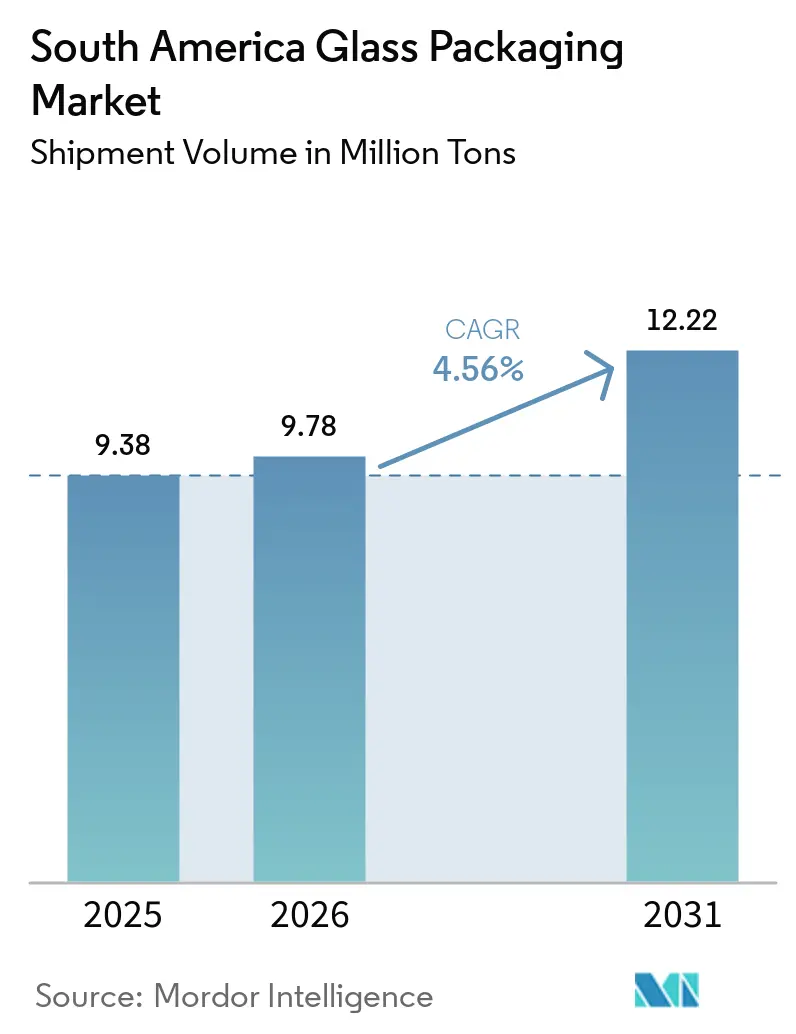
| Base Year Market Size (2025) | 9.38 Million tons |
| Market Volume (2026) | 9.78 Million tons |
| Market Volume (2031) | 12.22 Million tons |
| Growth Rate (2026 - 2031) | 4.56 % |
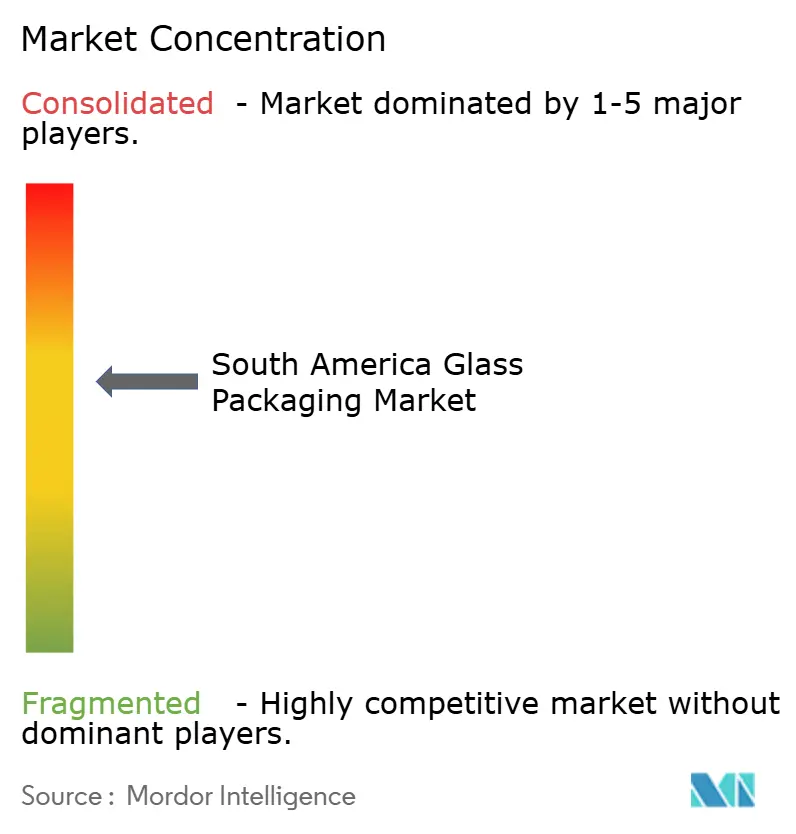
| Market Concentration | Medium |
Major Players *Disclaimer: Major Players sorted in no particular order Image © Mordor Intelligence. Reuse requires attribution under CC BY 4.0. | |
South America Glass Packaging Market Analysis by Mordor Intelligence
The South America glass packaging market size was valued at 9.4 million tons in 2025 and estimated to grow from 9.8 million tons in 2026 to reach 12.2 million tons by 2031, at a CAGR of 4.6% during the forecast period (2026-2031). Premium beer, wine, spirits, and cachaça are supporting demand for differentiated bottles, while pharmaceutical production is increasing the need for specialized containers. Recycled-content rules also strengthen the role of glass in procurement decisions because producers must improve collection and use more cullet. The South America glass packaging market is becoming less dependent on mainstream beverage formats as premium beverages, cosmetics, and pharmaceutical uses gain importance. New furnace capacity in Brazil and a Chilean acquisition by Vidrala show that major producers are investing for long-term regional demand. Energy costs and substitution by plastic and aluminum still limit growth in high-volume, price-sensitive beverage categories.
Key Report Takeaways
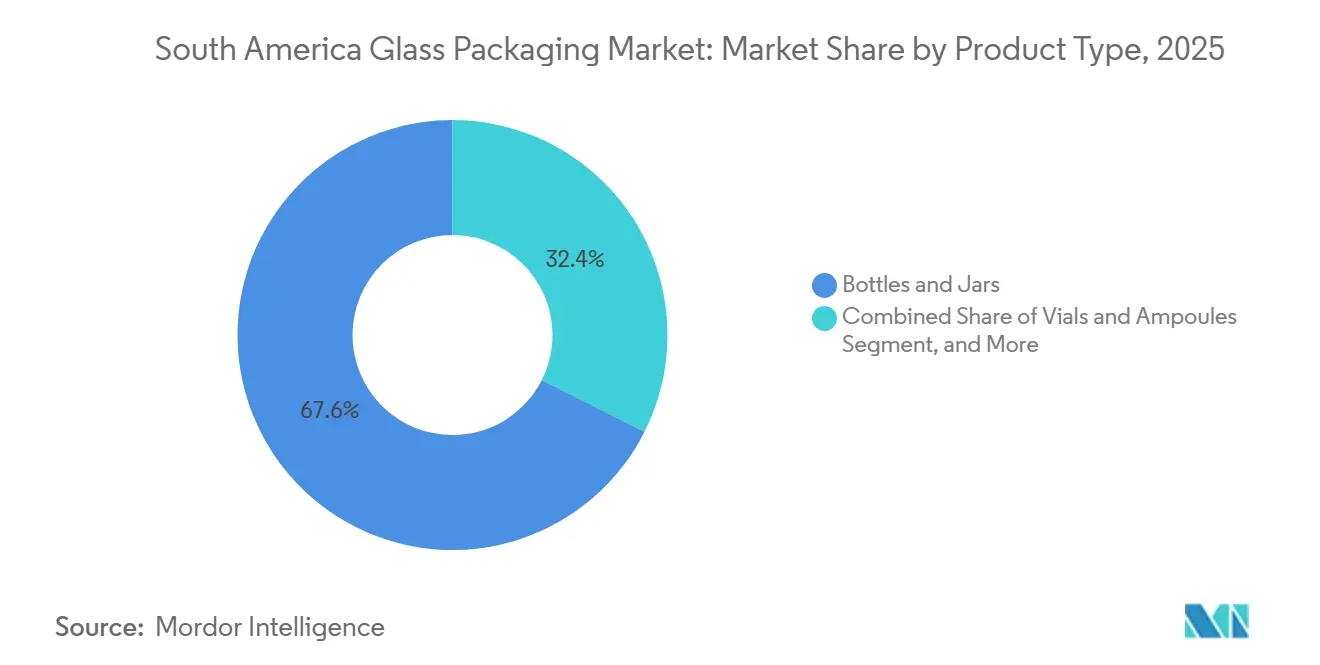
- By product type, bottles and jars held 67.6% of the South America glass packaging market share in 2025, while vials and ampoules are forecast to grow at a 6.1% CAGR through 2031.
- By color, flint glass held 62.6% of the South America glass packaging market share in 2025, while amber glass is forecast to expand at a 5.8% CAGR through 2031.
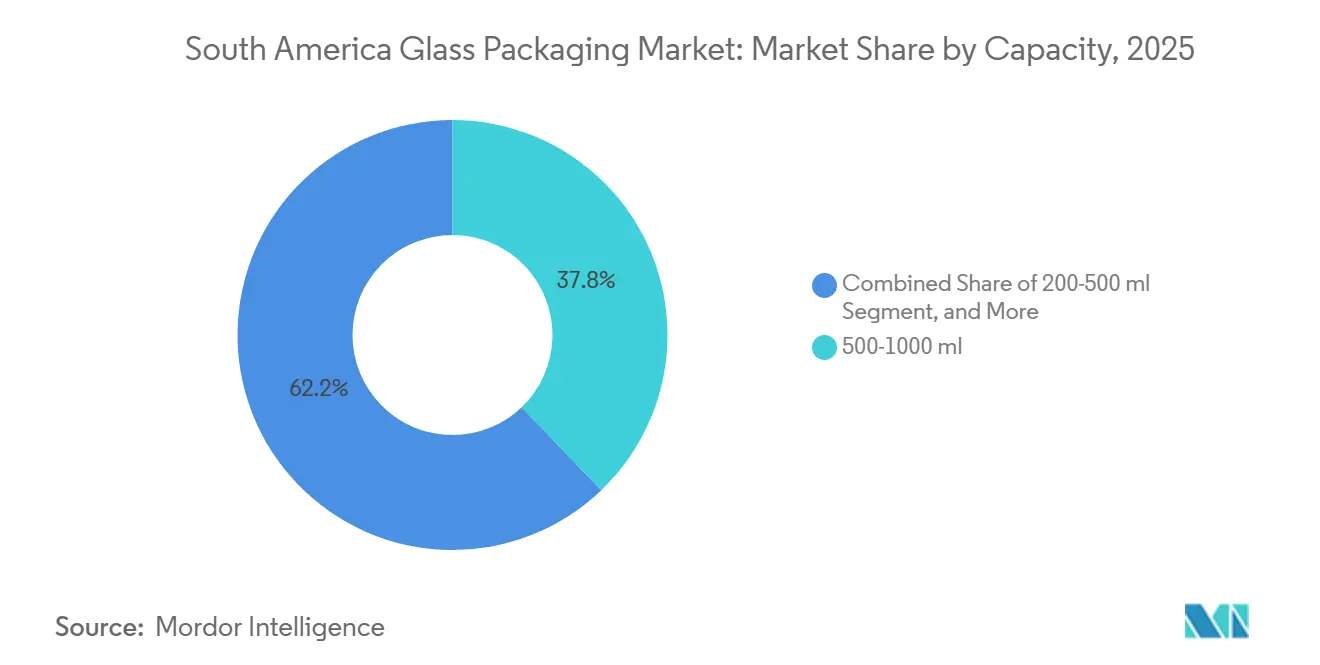
- By capacity, the 500-1,000 ml range held 37.8% of the South America glass packaging market share in 2025 and is forecast to grow at a 5.7% CAGR through 2031.
- By end-use industry, beverages held 64.6% of the South America glass packaging market share in 2025, while cosmetics and personal care is forecast to grow at a 6.0% CAGR through 2031.
- By country, Brazil held 57.8% of the South America glass packaging market share in 2025, while Argentina is forecast to grow at a 6.0% CAGR through 2031.
Note: Market size and forecast figures in this report are generated using Mordor Intelligence’s proprietary estimation framework, updated with the latest available data and insights as of January 2026.
Market Trends and Insights
Drivers Impact Analysis of South America Glass Packaging Market*
| Driver | (~) % Impact on CAGR Forecast | Geographic Relevance | Impact Timeline |
|---|---|---|---|
| Premiumization of Beer, Wine, Spirits, and Cachaça Packaging | +1.4% | Brazil, Argentina, Chile | Short term (≤ 2 years) |
| Expansion of Pharmaceutical and Cosmetic Glass Packaging | +0.9% | Brazil, Colombia | Medium term (2-4 years) |
| Rising Recycled-Content Requirements and Circular-Economy Procurement | +0.6% | Brazil, Chile, Colombia | Medium term (2-4 years) |
| Regional Furnace Investments Improving Supply Reliability | +0.5% | Brazil, Argentina | Short term (≤ 2 years) |
| Growth of Refillable and Returnable Beverage Systems | +0.3% | Argentina, Brazil, Uruguay | Medium term (2-4 years) |
| Short-Run and Customized Packaging Demand from Local Brands | +0.2% | Brazil, Chile | Long term (≥ 4 years) |
| Source: Mordor Intelligence | |||
Premiumization of Beer, Wine, Spirits, and Cachaça Packaging
Premium beverage producers in the South America glass packaging market increasingly use glass to support product quality, heritage, and sustainability claims, especially when a package must distinguish a higher-priced product from mainstream beverages. Export-focused cachaça brands use custom bottle shapes and embossed labels to position their products in international channels, where presentation can influence buyer perceptions before a product is sampled. Cachaça 51 introduced a new export glass packaging edition for distribution in Europe and South America in 2025. Wine producers in Chile and Argentina continue to use heavier flint and antique green bottles for export products, despite softer domestic wine consumption during 2024 and 2025, because export buyers often expect established bottle formats. O-I Glass opened a distribution hub in Caxias do Sul in December 2025 with a minimum order of 1,000 units, making smaller orders more accessible to wineries and juice producers that could not meet larger factory minimums. This model supports growth through a premium product mix and access to services rather than through commodity beverage volumes, and it provides local brands with a more practical route to glass packaging.
Expansion of Pharmaceutical and Cosmetic Glass Packaging
Brazilian pharmaceutical production is driving recurring demand for glass containers with chemical resistance suitable for injectable products, including applications in which material performance is central to product safety. ANVISA primary packaging requirements and pharmacopoeial standards establish a compliance baseline for pharmaceutical glass applications, making substitution more difficult than in ordinary food and beverage uses. Wheaton Brasil Vidros opened a logistics center in 2026 and set a target to increase international sales by 20% and improve service for cosmetics and pharmaceutical customers. Brazil’s prestige beauty categories favor glass for fragrance bottles and high-end skincare packaging because they rely on visual presentation and a premium retail position. Colombia’s personal care exporters also need accurately molded containers for specialized products, creating demand that regional suppliers have only partly addressed. Pharmaceutical and cosmetics demand can improve furnace utilization by enabling precision glass capabilities to serve both applications and reduce reliance on a single end-use category.
Rising Recycled-Content Requirements and Circular-Economy Procurement
Recycled-content requirements are shifting glass recyclability from a brand message to a procurement and compliance requirement in the South America glass packaging market, particularly where brand owners must document their packaging recovery performance. Brazil’s reverse-logistics framework recorded a recycled-content rate of 36.9% in new glass bottles by November 2025, exceeding the 27% target.[1] This result supports higher cullet use and can reduce the raw-material burden of furnace operations, while also demonstrating that collection systems can supply meaningful volumes of recycled material. Chile’s Law 20,920 assigns producers responsibility for the collection of post-consumer packaging.[2] Colombia and Argentina are also raising recovery obligations for packaging producers and importers, so collection and sorting capabilities matter more across the regional supply chain. Greater cullet use reduces furnace fuel needs, linking compliance performance to operating costs and giving producers a reason to improve recycling economics.
Regional Furnace Investments Improving Supply Reliability
New capacity is easing the earlier mismatch between centralized production and the procurement needs of premium producers in southern Brazil, where smaller brands need shorter lead times and lower order thresholds. Verallia opened a EUR 111 million oxy-combustion furnace at Campo Bom in September 2025, doubling the site’s capacity to 1.3 million units per day.[3] The HeatOx system uses recovered heat from furnace exhaust and can reduce carbon dioxide emissions by up to 20% compared with conventional furnaces. Ambev also commissioned a new bottle factory in Carambeí in December 2025, adding 600 million green bottles with an annual capacity and increasing the availability of bottles designed for premium beer. O-I Glass expanded local access for wine and juice producers through its Caxias do Sul distribution center, which stocks multiple formats for smaller commercial orders. The southern Brazil corridor now has more supply options for premium beverage producers in the South America glass packaging market, including options that combine local availability with lower-emission production technology.
Restraints Impact Analysis of South America Glass Packaging Market*
| Restraint | (~) % Impact on CAGR Forecast | Geographic Relevance | Impact Timeline |
|---|---|---|---|
| Furnace Energy and Fuel-Cost Exposure | -1.1% | Argentina, Brazil, Chile | Short term (≤ 2 years) |
| Plastic and Aluminum Substitution in Mainstream Beverages | -1.3% | Brazil, Colombia | Medium term (2-4 years) |
| Long-Distance Freight and Breakage Risk Across the Region | -0.5% | Peru, Ecuador, Bolivia, Rest of South America | Long term (≥ 4 years) |
| Uneven Collection Infrastructure Outside Major Urban Corridors | -0.3% | Brazil’s North, Northeast, and Central-West regions, Rest of South America | Medium term (2-4 years) |
| Source: Mordor Intelligence | |||
Furnace Energy and Fuel-Cost Exposure
Glass melting requires temperatures above 1,500°C, which makes energy a major production-cost variable and leaves operating margins sensitive to changes in fuel costs. Fuel price volatility creates uncertainty for furnace planning in Argentina, Brazil, and Chile because furnaces require continuous heat and cannot easily adjust to short-term price movements. Smaller producers face greater challenges because lower-energy furnace systems require substantial capital investment and extensive planning before installation. Oxy-combustion and hybrid-electric installations can cost EUR 50 million to EUR 120 million per furnace, placing the most efficient technology beyond the immediate reach of many domestic operators. This investment burden can widen the efficiency gap between domestic producers and multinational operators with larger capital resources and broader procurement networks. Energy exposure, therefore, remains a central constraint on the South America glass packaging market, especially where local demand does not support the investment required for new technology.
Plastic and Aluminum Substitution in Mainstream Beverages
Plastic and aluminum competition is concentrated in mainstream beverages where cost, weight, and distribution efficiency matter most, rather than in premium formats where glass has a clearer packaging role. PET remains dominant in Brazilian soft drinks, while glass held a niche in premium juice and craft soda in 2025, showing how material choice changes with product positioning. Aluminum cans accounted for a notable share of South American beverage packaging volume, supported by their convenience and recyclability in ready-to-drink spirits and energy drinks designed for on-the-go use. Glass continues to gain relevance in premium categories, but high-volume mainstream formats are becoming less reliable for furnace utilization and fixed-cost recovery. Producers are therefore more dependent on demand for premium alcohol, pharmaceuticals, and cosmetics, which is smaller in volume but more supportive of differentiated glass formats. This dependence raises portfolio risk when those higher-value categories slow, making the South America glass packaging market more exposed to shifts in premium consumer demand.
*Our forecasts treat driver/restraint impacts as directional, not additive. The impact forecasts reflect baseline growth, mix effects, and variable interactions.
South America Glass Packaging Market Segment Analysis
By Product Type:
Pharmaceutical Demand Reshapes the Growth HierarchyBottles and jars held 67.6% of regional volume in 2025, supported by demand from beverages, food, and condiments. Glass maintains its position in these categories because premium brands value shelf appeal and chemical inertness. Craft beer and premium spirits producers increasingly opt for heavier, custom-molded bottles rather than standard formats. Specialty food packs and cosmetic jars add a smaller but growing demand as prestige lines move from plastic to glass. Vials and ampoules are forecast to grow at a 6.1% CAGR through 2031, the fastest rate among product formats.
Pharmaceutical manufacturing is the main driver of the stronger outlook for vials and ampoules, as regional producers expand their capacity to produce injectables rather than relying entirely on imported finished drugs. Policies supporting domestic drug production are shifting some pharmaceutical glass procurement toward regional suppliers and increasing the importance of dependable specifications, available capacity, and supply continuity. SCHOTT Pharma offers type I borosilicate ampoules in ISO 9187-compliant formats from 1 ml to 30 ml. Gerresheimer supplies pharmaceutical primary packaging that meets Ph. Eur., USP, and JP requirements. The South America glass packaging industry is therefore moving toward a mix in which pharmaceutical formats grow faster than mass-market containers, and the South America glass packaging market depends more on technical capability than on simple volume expansion.

By Color:
Flint Leads Volume, Amber Captures Pharmaceutical DemandFlint glass held 62.6% of 2025 volume because wine, premium spirits, cosmetics, fragrance, and food jars often require colorless containers. The material allows products and brand design to remain visible on retail shelves. Premium producers can accept the higher cost of clear glass when it supports their positioning. Green glass continues to serve mainstream and premium beer across antique green, emerald green, and standard green formats. Specialty tints, blue glass, and artisanal finishes remain limited to smaller luxury and craft applications.
Amber glass is projected to expand at a 5.8% CAGR through 2031, driven mainly by pharmaceutical applications that require protection from light exposure during storage and distribution. Amber glass blocks ultraviolet wavelengths below 450 nm and protects light-sensitive injectable formulations, which gives it a clear functional role beyond color selection. This performance supports use in biologics, vaccines, and contrast media, where package quality is closely linked to formulation stability. Pharmaceutical amber containers must meet exact requirements for dimensions, hydrolytic resistance, and color consistency, so quality assurance requirements are higher than in ordinary beverage production. These requirements make it harder to add pharmaceutical-grade capacity and support stronger pricing than commodity flint production in the South America glass packaging market.
By Capacity:
Mid-Range Formats Anchor Volume and GrowthThe 500-1,000 ml range accounted for 37.8% of volume in 2025 and is expected to grow at a 5.7% CAGR through 2031. This range includes 750 ml wine bottles, 600 ml to 650 ml premium beer bottles, 700 ml to 750 ml spirits bottles, and mid-size fragrance packs. Its use across multiple end markets reduces exposure to any single category. The 200-500 ml range is suitable for smaller spirit bottles, craft beverages, and food condiments. Less-than-200 ml formats support unit-dose pharmaceutical vials, ampoules, and luxury spirit miniatures.
Containers above 1,000 ml mainly serve sauces, olive oils, preserves, and large-format cooking wines, which are important but less attractive uses for glass where transport distances are long. These formats face stronger substitution from rigid and flexible plastic because freight costs rise with container weight, and breakage can create additional distribution losses. The disadvantage is more pronounced in Bolivia, Peru, and Ecuador, where inland road transport often crosses mountainous areas and regional supply is less concentrated. MERCOSUR food-contact rules recognize glass for its chemical inertness across capacity ranges, preserving a compliance benefit for glass where product protection is important. The South America glass packaging market size for mid-range and small pharmaceutical formats benefits from firmer pricing and lower substitution pressure than large commodity containers, which improves the investment case for those formats.
By End-Use Industry:
Beverages Lead as Cosmetics and Personal Care AcceleratesBeverages held 64.6% of 2025 volume, making them the largest end-use segment in the South America glass packaging market. Beer, wine, and spirits account for the largest absolute requirement for glass containers. Brazil is among the world’s top 5 beer producers by output, while Argentina and Chile contribute to wine export demand. Premium juices, craft soft drinks, and functional beverages use glass in on-trade and specialty retail channels. Food packaging adds stable demand from sauces, condiments, olive oils, and preserved foods.
Cosmetics and personal care is forecast to grow at a 6.0% CAGR through 2031, the highest end-use rate, as prestige brands use glass to support differentiation in retail and export channels. Prestige beauty uses glass as an important enclosure for fragrance, luxury skincare, and color cosmetics, where packaging often forms part of the product experience. Wheaton’s 2026 goal of 20% growth in international sales reflects the company’s expectation of export-driven demand for cosmetics. Pharmaceutical demand also has a durable base because regulatory requirements support pharmaceutical-grade containers and limit material substitution in sensitive applications. Agrochemicals, industrial fluids, and specialty chemicals provide stable but slower-growing demand, giving the South America glass packaging market a broader end-use base outside beverages.
Geography Analysis
Brazil Glass Packaging Market
Brazil held 57.8% of the South America glass packaging market share in 2025, supported by the region’s deepest manufacturing base and strong beverage consumption. O-I Glass, Verallia, Vidrala, Wheaton Brasil Vidros, and Nadir Figueiredo operate domestic furnace capacity. The country recorded 36.9% recycled content in new bottles by November 2025, exceeding the national target. Verallia’s Campo Bom furnace doubled the site’s capacity to 1.3 million units per day.
Argentina and Chile Glass Packaging Market
Argentina is forecast to record the highest country growth rate at a 6.0% CAGR through 2031 from a 2025 base of 567 kilotons. Premium wine bottlers in Mendoza need a reliable supply for export markets in North America, Europe, and Asia. Returnable bottles in domestic beer distribution also support volumes by reducing packaging costs for brewers. Chile’s growth is linked to demand for wine, beer, and food packaging. Vidrala completed the acquisition of Cristalerías Toro in March 2026 for an enterprise value of EUR 75 million, creating Vidrala Chile and expanding its regional production base.
South America Glass Packaging Market
Colombia and the Rest of South America are experiencing an expanding demand in premium beverages and cosmetics. O-I Glass completed a USD 120 million transformation of its Zipaquirá plant in April 2024 O-I. The project installed oxy-fuel combustion and waste-heat recovery and reduced carbon dioxide emissions by up to 15% per ton of production. Uruguay formalized a national deposit-return system in February 2025, strengthening collection for glass and other packaging materials. Peru and Ecuador remain net importers, and local manufacturing mainly serves standard bottle formats.
Competitive Landscape
The South America glass packaging market is concentrated among multinational furnace operators and domestic producers serving national or niche demand. O-I Glass, Verallia, and Vidrala control a majority of installed furnace capacity in Brazil. Competition increasingly centers on lower-carbon furnace technology and geographic diversification. These investments help producers lower costs and meet customer requirements for more sustainable packaging.
Vidrala has expanded its position in South America through Vidroporto in Brazil and the acquisition of Cristalerías Toro in Chile. The March 2026 transaction established Vidrala Chile with an enterprise value of EUR 75 million. The company can use this platform to support longer-term relationships with global beverage customers. Verallia’s Campo Bom furnace was the first commercial use of its HeatOx™ system in the company’s global network. Ambev also expanded into bottle manufacturing in Carambeí during 2025 to improve supply security for premium beer bottles.
Pharmaceutical precision glass and premium cosmetics containers remain areas where demand can exceed regional supply. Gerresheimer and SCHOTT Pharma hold differentiated positions through certified processes and pharmaceutical-grade product portfolios. Smaller domestic producers have less access to costly furnace upgrades and face greater energy-cost exposure. Verallia’s technology position can strengthen its appeal to beverage customers that prioritize lower emissions. The competitive gap is widening between international operators with technology and regional scale and domestic firms that must restructure or specialize.
South America Glass Packaging Industry Leaders
-
O-I Glass, Inc.
-
Verallia Brasil S.A.
-
Vidrala, S.A.
-
Wheaton Brasil Vidros Ltda.
-
Rigolleau S.A.
- *Disclaimer: Major Players sorted in no particular order
South America Glass Packaging Market Companies Covered in this Report
- O-I Glass, Inc.
- Verallia Brasil S.A.
- Vidrala, S.A.
- Wheaton Brasil Vidros Ltda.
- Rigolleau S.A.
- Cattorini Hnos. S.A.I.C.F. e I.
- Cristalerías de Chile S.A.
- Cristalería Toro SpA
- Fabrica Paraguaya de Vidrios S.A.
- Saverglass SAS
- Gerresheimer AG
- SCHOTT Pharma AG & Co. KGaA
- Stevanato Group S.p.A.
- Corning Incorporated
- Rayen Curá S.A.I.C.
- Nueva Cristalería Avellaneda S.A.I.C.
- Vitrofar S.A.
- Cristalería La Estrella S.A.
- Oeste Glass S.R.L.
Recent Industry Developments in South America Glass Packaging Market
- March 2026: Vidrala completed the acquisition of 100% of Cristalerías Toro, a glass container producer in the metropolitan area of Santiago, Chile, at a total enterprise value of EUR 75 million (approximately USD 82.5 million at 2026 average exchange rates, including assumed debt), establishing the entity as Vidrala Chile. In 2025, Cristalerías Toro generated revenues of 79,915 million Chilean pesos (approximately EUR 75 million) and an adjusted EBITDA of 13,216 million Chilean pesos (approximately EUR 12 million). The acquisition positions Vidrala Chile to serve global food and beverage multinational customers from a locally integrated manufacturing base, extending Vidrala's South American industrial platform beyond Brazil.
- September 2025: Verallia inaugurated its EUR 111 million (approximately USD 121 million at 2025 average exchange rates) oxy-combustion furnace at Campo Bom, Rio Grande do Sul, Brazil, doubling site capacity to 1.3 million packaging units per day across 3 new production lines, with 820 tonnes of glass processed per day. The HeatOx™ furnace, developed with Air Liquide and Air Industrie Transition, reduced CO₂ emissions by up to 20% versus conventional furnaces and represented the first commercial global deployment of this specific technology within Verallia's network. The State Government of Rio Grande do Sul provided support through the Fundopem program.
South America Glass Packaging Market Report Scope
The South America Glass Packaging Market Report is Segmented by Product Type (Bottles and Jars, Vials and Ampoules, and Other Product Types), Color (Flint, Amber, Green, and Other Colors), Capacity (Less than 200 ml, 200-500 ml, 500-1000 ml, and More than 1000 ml), End-Use Industry (Food, Beverage, Pharmaceuticals, Cosmetics and Personal Care, and Other End-Use Industries), and Country (Brazil, Argentina, Chile, Colombia, and Rest of South America). The Market Forecasts are Provided in Terms of Volume (Million Tons).
Segmentation Overview
By Product Type
| Bottles and Jars |
| Vials and Ampoules |
| Other Product Types |
By Color
| Flint |
| Amber |
| Green |
| Other Colors |
By Capacity
| Less than 200 ml |
| 200-500 ml |
| 500-1000 ml |
| More than 1000 ml |
By End-Use Industry
| Food | ||
| Beverage | Alcoholic Beverage | Beer |
| Wine | ||
| Spirits | ||
| Other Alcoholic Beverages | ||
| Non-Alcoholic Beverage | Carbonated Soft Drinks | |
| Juices | ||
| Dairy Product-Based Drinks | ||
| Other Non-Alcoholic Beverages | ||
| Pharmaceuticals | ||
| Cosmetics and Personal Care | ||
| Other End-Use Industries | ||
By Country
| Brazil |
| Argentina |
| Chile |
| Colombia |
| Rest of South America |
| By Product Type | Bottles and Jars | ||
| Vials and Ampoules | |||
| Other Product Types | |||
| By Color | Flint | ||
| Amber | |||
| Green | |||
| Other Colors | |||
| By Capacity | Less than 200 ml | ||
| 200-500 ml | |||
| 500-1000 ml | |||
| More than 1000 ml | |||
| By End-Use Industry | Food | ||
| Beverage | Alcoholic Beverage | Beer | |
| Wine | |||
| Spirits | |||
| Other Alcoholic Beverages | |||
| Non-Alcoholic Beverage | Carbonated Soft Drinks | ||
| Juices | |||
| Dairy Product-Based Drinks | |||
| Other Non-Alcoholic Beverages | |||
| Pharmaceuticals | |||
| Cosmetics and Personal Care | |||
| Other End-Use Industries | |||
| By Country | Brazil | ||
| Argentina | |||
| Chile | |||
| Colombia | |||
| Rest of South America | |||
Key Questions Answered in the Report
What is driving demand for glass packaging in South America?
The South America glass packaging market is supported by premium alcoholic beverages, pharmaceutical production, cosmetics, and recycled-content requirements that increase the value of recyclable and high-performance containers, rather than by mainstream soft-drink volumes alone. These uses require differentiated bottles, jars, vials, and ampoules, and they favor suppliers with reliable local service, flexible minimum orders, and technical capacity for specialized packaging, including pharmaceutical-grade products and customized premium formats for smaller regional brands.
How large is South America’s glass packaging demand?
Demand is estimated at 9.8 million tons in 2026 and is projected to reach 12.2 million tons by 2031 at a 4.6% CAGR, with premium and specialized uses accounting for much of the momentum across the forecast period. Supply additions in Brazil also support this outlook for regional availability.
Which product format is growing fastest?
Vials and ampoules are forecast to grow at a 6.1% CAGR through 2031 as injectable drug production expands and manufacturers require pharmaceutical-grade containers with consistent technical performance, light protection, and chemical resistance. This format benefits from pharmaceutical compliance requirements and tighter supplier qualification standards.
Which end-use application is expanding fastest?
Cosmetics and personal care is projected to expand at a 6.0% CAGR through 2031, led by prestige beauty packaging, fragrance bottles, and skincare products that use glass to support product positioning in higher-value retail channels. Export-oriented brands are a key source of demand in Brazil and Colombia.
Which country has the largest glass packaging base?
Brazil held 57.8% of regional volume in 2025, supported by its furnace capacity, beverage demand, recycling framework, and investment in new production and distribution infrastructure that serves premium beverage producers. It also recorded recycled content above its national target in new bottles.